U.S. Government Shutdown Difficult, as Both Parties Have Already Calculated the Costs

Odaily星球日报Pubblicato 2026-01-29Pubblicato ultima volta 2026-01-29

Introduzione

The U.S. government faces a shutdown risk by January 30 if a funding bill isn't passed, but prediction markets show the probability dropping to 42%, down from 80%. The deadlock stems from partisan disputes over funding for the Department of Homeland Security (DHS), particularly ICE enforcement actions. Democrats seek restrictions after a fatal incident in Minnesota, while Republicans defend ICE's role. Both parties are maneuvering ahead of midterm elections, where control of Congress is at stake. A shutdown could harm the ruling party’s image, making compromise likely. A temporary funding extension is expected to avoid a full shutdown, with negotiations focusing on separating DHS funding from other bills. Reports indicate ongoing talks between Trump and Democratic leaders to prevent a disruption.

Original | Odaily Planet Daily (@OdailyChina)

Author | Golem (@web 3_golem)

A major macroeconomic event this month is whether the U.S. government will shut down by the end of January. Last October, the U.S. government shut down for 43 days, and it only resumed operations after the passage of a temporary funding bill. January 30 is the expiration date of the temporary funding bill. If Congress fails to pass a formal funding bill or if there is no new temporary bill to extend it, the U.S. government will shut down again.

This time, the dispute between the two U.S. parties mainly revolves around the funding for the Department of Homeland Security (DHS). Democrats believe that ICE (Immigration and Customs Enforcement) has issues with its enforcement actions in Minnesota, resulting in two deaths, and they want to strictly restrict funding and related operations. However, Republicans disagree, arguing that ICE is a key force in combating illegal immigration and welfare fraud. As a result, the two sides are at a stalemate. (For details on the dispute between the U.S. parties, please read: Will the U.S. Government Shutdown Storm Strike Again, and Will the Crypto Circle Repeat the Crash Script?)

It is this confrontational state and the approaching expiration date of the temporary funding bill that have sharply increased the probability of a U.S. government shutdown at the end of January in prediction markets. However, this morning, Polymarket data showed that the probability of the U.S. government shutting down at the end of January has continued to decline and currently stands at 42%, down from a previous high of 80%.
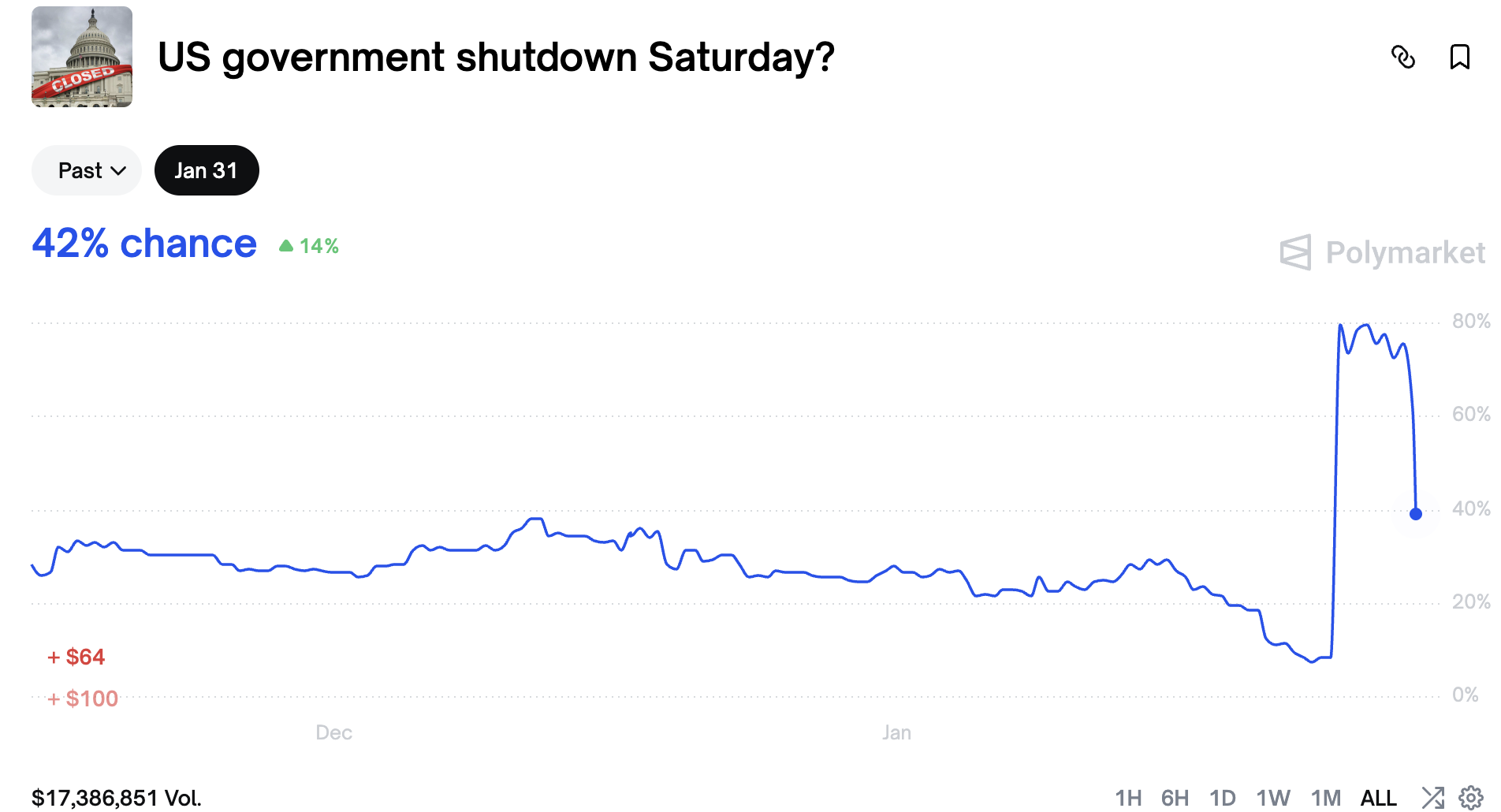
Price changes in prediction markets reflect the results of collective wisdom and博弈. The rising probability that the U.S. government will not shut down at the end of January indicates that people believe the high certainty of a government shutdown, as suggested by the prediction market probabilities, no longer exists under the current U.S. political situation.

Midterm Elections Are the Key Focus of Both U.S. Parties

On January 28, regarding the risk of another possible U.S. government shutdown, U.S. Treasury Secretary Besant stated that the situation is still unclear but emphasized that President Trump has urged the Democratic side to avoid this outcome.

This government shutdown crisis is essentially because the Democrats have caught the Republicans in a political counterattack. The shooting death of a U.S. citizen by ICE officers in Minnesota on January 24 was essentially a result of the Trump administration's increased immigration enforcement efforts, which also led to large-scale public protests expressing dissatisfaction with the Trump administration. The Democrats seized this opportunity and used it as an excuse to block the passage of the funding bill in the Senate. Since it reflects the demands of voters, the Democrats have taken the political initiative in this counterattack.

The Republicans have thus been put in a passive position. If the U.S. government does shut down as a result, the Democrats could blame the Republican government for any subsequent economic and民生 issues (such as delayed economic data releases and large-scale flight delays at airports).

This series of potential chain reactions will also affect the issue that both U.S. parties truly care about this year: the midterm elections.

The U.S. "midterm elections" are held in the second year of a presidential term. All 435 seats in the House of Representatives will be up for election, and approximately one-third of the seats in the Senate are typically up for election. Currently, the Republicans hold a majority in both the House (218 seats) and the Senate (53 seats). For the Republicans to maintain their seat advantage after the midterm elections at the end of the year and reduce governance difficulties, they cannot accumulate too many "stains" politically this year.

Additionally, although the midterm elections do not involve the presidential election, they are also seen as a "midterm referendum" on the incumbent president, affecting the president's policy orientation in the latter two years and reshaping the党内权力结构 and the candidate landscape for the next presidential election. Therefore, it is extremely important for Trump as well.

From the above analysis, it can be seen that this government shutdown is no longer simply a funding issue but a political battlefield set up in advance by both U.S. parties for the midterm elections at the end of the year. The Republicans, in a passive position, are highly likely to compromise to resolve the crisis and矛盾.

For the Democrats, if the Republicans compromise, it would also be a political victory.

Compromise Is Already Underway

This U.S. government shutdown crisis will not be a "full shutdown" like last October (when all 12 funding bills expired). The scale of the shutdown may be much smaller. Funding for the Commerce Department (responsible for releasing GDP data) and the Agriculture Department (responsible for food benefits) has already been secured, but about 78% of federal government functions—involving the remaining six funding bills—may face funding cuts.

The Democrats have already given the Republicans a way out. Senate Minority Leader Chuck Schumer (D-N.Y.) said on January 28 that Senate Democrats are "prepared to quickly advance five funding bills by the January 30 deadline, separate from the Department of Homeland Security funding bill," which could be a way to avoid a large-scale government shutdown. However, Senate Republicans have not yet agreed to separate the DHS bill from the overall funding package.

On the other hand, it is unrealistic to demand changes to the DHS funding before January 30, as any changes to the remaining six funding bills must be approved by the House of Representatives, which will not reconvene until February 2.

For the Democrats, forcing the U.S. government into a shutdown state by being too rigid about amending the funding bill would not be of much benefit, and the "offensive and defensive positions" with the Republicans could even reverse. Therefore, the current consensus between the two U.S. parties may be to pass a temporary funding bill to first address the potential government shutdown and postpone the矛盾 between the two parties.

Just as Odaily was writing this article speculating that the two parties might compromise to avoid a government shutdown, The New York Times also reported that Trump is reaching a possible agreement with Chuck Schumer to avoid a U.S. government shutdown.

According to two informed officials, under the plan being developed, the Senate would separate one of the six spending bills, which aims to fund the Department of Homeland Security, to maintain funding for the military, medical programs, and other federal agencies for the remainder of the fiscal year. The Senate will pass these bills by the Friday midnight deadline, and Congress will also consider a short-term extension of homeland security operations to prevent service disruptions at the TSA, Coast Guard, and FEMA.

It is still unclear how this potential agreement will affect this week's funding bill vote, but it at least shows that the White House and the Senate are working toward resolving the crisis.


Domande pertinenti

QWhat is the main reason for the potential U.S. government shutdown at the end of January?

AThe main reason is the dispute between Democrats and Republicans over funding for the Department of Homeland Security (DHS), particularly related to the enforcement actions of ICE (Immigration and Customs Enforcement) in Minnesota.

QAccording to the article, why did the probability of a government shutdown drop from 80% to 42% on Polymarket?

AThe probability dropped because the prediction market reflected a shift in collective opinion, indicating that people believe the high certainty of a shutdown has diminished due to ongoing political negotiations and potential compromises between the two parties.

QHow does the potential government shutdown relate to the U.S. midterm elections?

AThe shutdown is seen as a political battleground for the midterm elections, where both parties are positioning themselves to avoid blame for economic and民生 issues that could affect their electoral prospects and the balance of power in Congress.

QWhat compromise did Democrats propose to avoid a large-scale government shutdown?

ADemocrats proposed separating the Homeland Security funding bill from the other five remaining appropriations bills, allowing the non-DHS bills to pass quickly while delaying the contentious DHS funding debate.

QWhat temporary solution is being considered to prevent a shutdown before the January 30 deadline?

AA short-term extension for Homeland Security operations is being considered to prevent disruptions to agencies like TSA, Coast Guard, and FEMA, while passing the other appropriations bills to keep most government functions funded.

Letture associate

Anthropic's IPO Launch: Commercial Miracle or Valuation Bubble?

Anthropic has confidentially filed for an IPO, led by Morgan Stanley and Goldman Sachs, potentially going public by October. Following its latest $650 billion funding round, its pre-IPO valuation stands at $965 billion, with projections reaching up to $2 trillion at listing, which would make it the highest-valued private company ever. The article, written by Fu Sheng, addresses skepticism that this represents an AI bubble akin to the 2000 dot-com crash. It argues the current situation differs fundamentally. Unlike the internet bubble era, which relied on speculative narratives with little revenue, Anthropic's valuation is backed by unprecedented, measurable financial performance. Key data points include: * **Revenue Growth:** ARR skyrocketed from $10 billion in early 2025 to $470 billion by May 2026, targeting $100 billion by year-end—a growth curve unmatched in business history. * **Profitability:** It achieved operating profitability in Q2 2026 with an estimated $5.6 billion profit. * **Efficiency:** With ~3,000 employees and ~$470 billion ARR, its revenue per employee exceeds $10 million. Products like Claude Code, launched less than a year ago, already generate $25 billion in annualized revenue. * **Enterprise Adoption:** It boasts a strong enterprise client base, with 8 of the Fortune 10 and over 1,000 large firms spending over $1 million annually on Claude. The valuation is framed using a traditional SaaS model (e.g., a 10x Price-to-Sales multiple on $100 billion revenue). The author contends the core question for analysts has shifted from "How big could this be?" to "How much is it earning and will earn next quarter?" The discussion extends beyond Anthropic to a broader paradigm shift: the transition from a "carbon-based" to a "silicon-based" economy. Companies are increasingly prioritizing investment in compute and AI capabilities over human resources, as these directly scale productivity and competitive advantage. Anthropic's IPO is thus positioned not just as a corporate milestone, but as a price anchor for this new economic era.

链捕手6 min fa

Anthropic's IPO Launch: Commercial Miracle or Valuation Bubble?

链捕手6 min fa

Near Returns to the AI Stage: Transformation into a Public Chain Due to 'Payroll Difficulties,' Agent and Privacy Emerge as New Growth Narratives

NEAR Returns to AI Origins: From Payroll Struggles to Blockchain, Now Focusing on AI Agents and Privacy NEAR Protocol's journey began not with grand blockchain ambitions, but from a practical hurdle: its AI startup founders, including Transformer paper co-author Illia Polosukhin, couldn't efficiently pay international developers in 2017. This led them to pivot and build a high-performance, scalable blockchain. After years navigating various crypto narratives like sharding and cross-chain interoperability, NEAR is now leveraging its AI roots to re-enter the AI arena. A key driver is its "NEAR Intents" layer, which abstracts complex cross-chain transactions. Users simply state their goal (e.g., swap BTC for ETH), and a solver network finds the optimal route. This system has processed over $20B in cross-chain volume, generating significant fee revenue. A major growth area is private transactions via "Confidential Intents/Swaps," which hide trade details until settlement to protect against MEV and front-running. Remarkably, private swaps recently accounted for over 40% of NEAR's transaction volume, highlighting strong demand but also potential regulatory scrutiny. With its AI-founder pedigree, NEAR is positioning itself at the intersection of blockchain, AI agents, and privacy, aiming to become infrastructure for the emerging agent economy while navigating the challenges of its rapid adoption.

marsbit2 h fa

Near Returns to the AI Stage: Transformation into a Public Chain Due to 'Payroll Difficulties,' Agent and Privacy Emerge as New Growth Narratives

marsbit2 h fa

From Ethereum to AI's 'CROPS': What Exactly is This Set of 'Slow Variables' That Vitalik Repeatedly Emphasizes?

In recent discussions, Vitalik Buterin has frequently emphasized the concept of "CROPS," a framework defining core values for Ethereum's development. CROPS stands for Censorship Resistance, Capture Resistance, Open Source, Privacy, and Security. Initially outlined in the Ethereum Foundation's "EF Mandate," it represents a commitment to user sovereignty, ensuring that the network resists external control, remains open, protects privacy, and prioritizes security. The relevance of CROPS extends beyond Ethereum's foundational principles, becoming crucial in the context of AI integration. As AI agents begin handling wallet operations and automated transactions, the risk increases that users may cede control over their digital assets, privacy, and intentions to centralized AI service providers. A "CROPS AI" would therefore emphasize local execution where possible, privacy-preserving remote model calls (e.g., using zero-knowledge proofs), and transparent, verifiable processes to maintain user agency. Vitalik highlights a significant convergence between "CROPS Ethereum access layer" and "CROPS AI." Both address the same fundamental challenge: how users can access powerful services—be it blockchain data via RPCs or AI models—without exposing sensitive information or relinquishing ultimate control. This intersection points toward a future digital entry point that is more private, secure, and user-controlled. Ultimately, CROPS is not merely an abstract ideal but a practical guidepost. It steers development—from protocol resilience and wallet design to AI agent safety—towards a future where users retain self-sovereignty even as digital systems grow more complex and powerful. In an era of accelerating AI adoption, these "slow variables" of censorship resistance, openness, privacy, and security may define Ethereum's enduring value.

marsbit2 h fa

From Ethereum to AI's 'CROPS': What Exactly is This Set of 'Slow Variables' That Vitalik Repeatedly Emphasizes?

marsbit2 h fa

Trading

Spot
Futures
活动图片