U.S. Government Shutdown Difficult, as Both Parties Have Already Calculated the Costs

Odaily星球日报Pubblicato 2026-01-29Pubblicato ultima volta 2026-01-29

Introduzione

The U.S. government faces a shutdown risk by January 30 if a funding bill isn't passed, but prediction markets show the probability dropping to 42%, down from 80%. The deadlock stems from partisan disputes over funding for the Department of Homeland Security (DHS), particularly ICE enforcement actions. Democrats seek restrictions after a fatal incident in Minnesota, while Republicans defend ICE's role. Both parties are maneuvering ahead of midterm elections, where control of Congress is at stake. A shutdown could harm the ruling party’s image, making compromise likely. A temporary funding extension is expected to avoid a full shutdown, with negotiations focusing on separating DHS funding from other bills. Reports indicate ongoing talks between Trump and Democratic leaders to prevent a disruption.

Original | Odaily Planet Daily (@OdailyChina)

Author | Golem (@web 3_golem)
A major macroeconomic event this month is whether the U.S. government will shut down by the end of January. Last October, the U.S. government shut down for 43 days, and it only resumed operations after the passage of a temporary funding bill. January 30 is the expiration date of the temporary funding bill. If Congress fails to pass a formal funding bill or if there is no new temporary bill to extend it, the U.S. government will shut down again.

This time, the dispute between the two U.S. parties mainly revolves around the funding for the Department of Homeland Security (DHS). Democrats believe that ICE (Immigration and Customs Enforcement) has issues with its enforcement actions in Minnesota, resulting in two deaths, and they want to strictly restrict funding and related operations. However, Republicans disagree, arguing that ICE is a key force in combating illegal immigration and welfare fraud. As a result, the two sides are at a stalemate. (For details on the dispute between the U.S. parties, please read: Will the U.S. Government Shutdown Storm Strike Again, and Will the Crypto Circle Repeat the Crash Script?)

It is this confrontational state and the approaching expiration date of the temporary funding bill that have sharply increased the probability of a U.S. government shutdown at the end of January in prediction markets. However, this morning, Polymarket data showed that the probability of the U.S. government shutting down at the end of January has continued to decline and currently stands at 42%, down from a previous high of 80%.
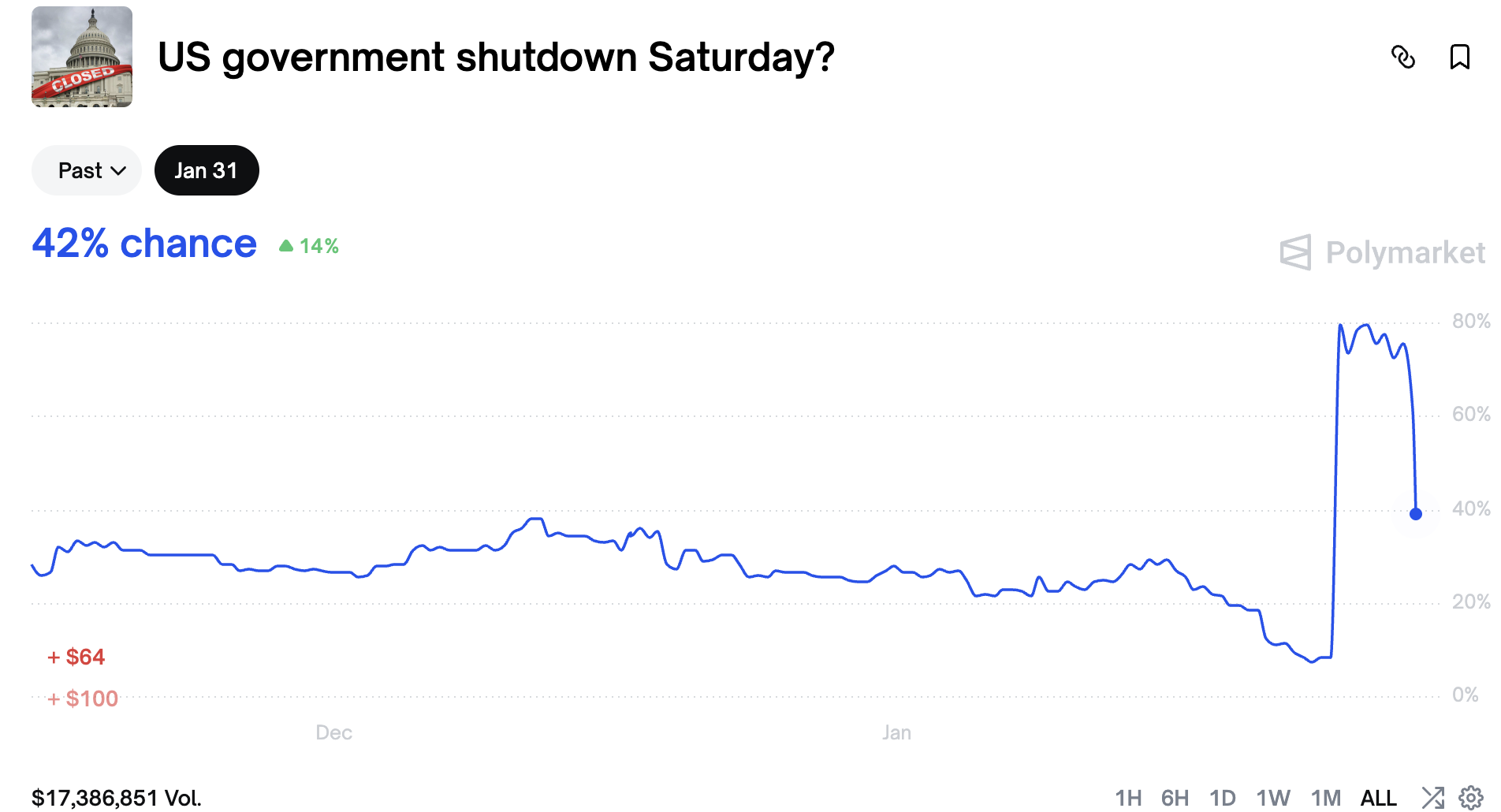
Price changes in prediction markets reflect the results of collective wisdom and博弈. The rising probability that the U.S. government will not shut down at the end of January indicates that people believe the high certainty of a government shutdown, as suggested by the prediction market probabilities, no longer exists under the current U.S. political situation.

Midterm Elections Are the Key Focus of Both U.S. Parties

On January 28, regarding the risk of another possible U.S. government shutdown, U.S. Treasury Secretary Besant stated that the situation is still unclear but emphasized that President Trump has urged the Democratic side to avoid this outcome.

This government shutdown crisis is essentially because the Democrats have caught the Republicans in a political counterattack. The shooting death of a U.S. citizen by ICE officers in Minnesota on January 24 was essentially a result of the Trump administration's increased immigration enforcement efforts, which also led to large-scale public protests expressing dissatisfaction with the Trump administration. The Democrats seized this opportunity and used it as an excuse to block the passage of the funding bill in the Senate. Since it reflects the demands of voters, the Democrats have taken the political initiative in this counterattack.

The Republicans have thus been put in a passive position. If the U.S. government does shut down as a result, the Democrats could blame the Republican government for any subsequent economic and民生 issues (such as delayed economic data releases and large-scale flight delays at airports).

This series of potential chain reactions will also affect the issue that both U.S. parties truly care about this year: the midterm elections.

The U.S. "midterm elections" are held in the second year of a presidential term. All 435 seats in the House of Representatives will be up for election, and approximately one-third of the seats in the Senate are typically up for election. Currently, the Republicans hold a majority in both the House (218 seats) and the Senate (53 seats). For the Republicans to maintain their seat advantage after the midterm elections at the end of the year and reduce governance difficulties, they cannot accumulate too many "stains" politically this year.

Additionally, although the midterm elections do not involve the presidential election, they are also seen as a "midterm referendum" on the incumbent president, affecting the president's policy orientation in the latter two years and reshaping the党内权力结构 and the candidate landscape for the next presidential election. Therefore, it is extremely important for Trump as well.

From the above analysis, it can be seen that this government shutdown is no longer simply a funding issue but a political battlefield set up in advance by both U.S. parties for the midterm elections at the end of the year. The Republicans, in a passive position, are highly likely to compromise to resolve the crisis and矛盾.

For the Democrats, if the Republicans compromise, it would also be a political victory.

Compromise Is Already Underway

This U.S. government shutdown crisis will not be a "full shutdown" like last October (when all 12 funding bills expired). The scale of the shutdown may be much smaller. Funding for the Commerce Department (responsible for releasing GDP data) and the Agriculture Department (responsible for food benefits) has already been secured, but about 78% of federal government functions—involving the remaining six funding bills—may face funding cuts.

The Democrats have already given the Republicans a way out. Senate Minority Leader Chuck Schumer (D-N.Y.) said on January 28 that Senate Democrats are "prepared to quickly advance five funding bills by the January 30 deadline, separate from the Department of Homeland Security funding bill," which could be a way to avoid a large-scale government shutdown. However, Senate Republicans have not yet agreed to separate the DHS bill from the overall funding package.

On the other hand, it is unrealistic to demand changes to the DHS funding before January 30, as any changes to the remaining six funding bills must be approved by the House of Representatives, which will not reconvene until February 2.

For the Democrats, forcing the U.S. government into a shutdown state by being too rigid about amending the funding bill would not be of much benefit, and the "offensive and defensive positions" with the Republicans could even reverse. Therefore, the current consensus between the two U.S. parties may be to pass a temporary funding bill to first address the potential government shutdown and postpone the矛盾 between the two parties.

Just as Odaily was writing this article speculating that the two parties might compromise to avoid a government shutdown, The New York Times also reported that Trump is reaching a possible agreement with Chuck Schumer to avoid a U.S. government shutdown.

According to two informed officials, under the plan being developed, the Senate would separate one of the six spending bills, which aims to fund the Department of Homeland Security, to maintain funding for the military, medical programs, and other federal agencies for the remainder of the fiscal year. The Senate will pass these bills by the Friday midnight deadline, and Congress will also consider a short-term extension of homeland security operations to prevent service disruptions at the TSA, Coast Guard, and FEMA.

It is still unclear how this potential agreement will affect this week's funding bill vote, but it at least shows that the White House and the Senate are working toward resolving the crisis.


Domande pertinenti

QWhat is the main reason for the potential U.S. government shutdown at the end of January?

AThe main reason is the dispute between Democrats and Republicans over funding for the Department of Homeland Security (DHS), particularly related to the enforcement actions of ICE (Immigration and Customs Enforcement) in Minnesota.

QAccording to the article, why did the probability of a government shutdown drop from 80% to 42% on Polymarket?

AThe probability dropped because the prediction market reflected a shift in collective opinion, indicating that people believe the high certainty of a shutdown has diminished due to ongoing political negotiations and potential compromises between the two parties.

QHow does the potential government shutdown relate to the U.S. midterm elections?

AThe shutdown is seen as a political battleground for the midterm elections, where both parties are positioning themselves to avoid blame for economic and民生 issues that could affect their electoral prospects and the balance of power in Congress.

QWhat compromise did Democrats propose to avoid a large-scale government shutdown?

ADemocrats proposed separating the Homeland Security funding bill from the other five remaining appropriations bills, allowing the non-DHS bills to pass quickly while delaying the contentious DHS funding debate.

QWhat temporary solution is being considered to prevent a shutdown before the January 30 deadline?

AA short-term extension for Homeland Security operations is being considered to prevent disruptions to agencies like TSA, Coast Guard, and FEMA, while passing the other appropriations bills to keep most government functions funded.

Letture associate

AI is Killing 'Poor People's Entertainment'

AI Is Eliminating 'Entertainment for the Poor' This article discusses the rising cost of video gaming, arguing that AI is making digital entertainment increasingly expensive. It follows the example of a frugal gamer who, accustomed to waiting for discounts and buying second-hand games, now faces a new reality. Video game consoles like the PS5 Pro and Switch 2 are increasing in price post-launch, breaking the traditional pattern of降价 over time. Game prices are also rising, with major titles like GTA 6 launching at $80. Furthermore, the industry is moving towards eliminating physical media, exemplified by Sony's plan to stop PS disc production by 2028. This shift blocks the二手 market, a key cost-saving avenue for players. Even Valve's anticipated affordable Steam Machine launched with a high price and disappointing specs. Manufacturers cite inflation, supply chain issues, and rising development costs, but a core driver is the AI boom. AI data centers now consume semiconductor and memory resources once prioritized for consumer electronics like game consoles. This competition from a more profitable sector drives up hardware costs. Additionally, developing modern AAA games with massive teams over many years is astronomically expensive, pushing publishers towards digital-only distribution and subscription models to secure recurring revenue. The article suggests this trend extends beyond gaming. Video streaming, music platforms, cloud storage, and AI tools are increasingly locked behind complex subscription tiers. While AI promises future benefits, it is currently making digital entertainment and services more costly. The era of progressively cheaper, accessible online entertainment is ending, forcing consumers to pay more upfront for future technological promises.

marsbit37 min fa

AI is Killing 'Poor People's Entertainment'

marsbit37 min fa

The Demise of the Trillion-HKD ETF Myth: SK Hynix Plummets, Hong Kong Switches from 'Double Leverage' to 'Flexible Leverage', South Korea Restricts Leveraged ETF Investments

South Korea's AI-driven bull market has taken a sharp downturn, severely impacting SK Hynix's stock and prompting regulatory tightening in both Hong Kong and South Korea on single-stock leveraged products. The CSOP SK Hynix Daily Leveraged (2x) ETF, once the world's largest single-stock leveraged ETF with over HKD 130 billion in assets, saw its value plummet by over 80% as SK Hynix shares fell nearly 46% from their June peak, erasing more than HKD 100 billion. In response, Hong Kong's Securities and Futures Commission (SFC) revised its regulatory framework. Starting August 3rd, fixed 2x leverage for single-stock leveraged and inverse products will shift to a dynamic "flexible leverage" mechanism, where daily leverage can vary up to a maximum of 2x. This aims to balance market development with investor protection but has sparked debate about changes to the products' core features and potential reduced appeal for risk-seeking investors. Simultaneously, South Korean authorities announced plans to further restrict single-stock leveraged ETFs following two consecutive days of market circuit breakers. Proposed measures include capping individual investors' allocations to such products at 20% of their total financial investment assets, increasing trading costs, and enhancing suitability requirements. The Finance Minister publicly apologized, acknowledging insufficient initial risk assessment. Analysts note that while the long-term fundamentals for South Korean semiconductor firms like SK Hynix remain solid, short-term market volatility is heightened due to concentrated leveraged bets and shifting global risk sentiment. The regulatory moves in both markets signal a clear shift from encouraging innovation towards prioritizing risk control, reminding investors of the amplified risks inherent in leveraged products.

marsbit42 min fa

The Demise of the Trillion-HKD ETF Myth: SK Hynix Plummets, Hong Kong Switches from 'Double Leverage' to 'Flexible Leverage', South Korea Restricts Leveraged ETF Investments

marsbit42 min fa

After the Privatization of the Internet, Silicon Valley Begins Privatizing Human Civilization

"The Privatization of Human Civilization" The article critiques how AI companies like Anthropic are systematically acquiring and digitizing millions of books—sometimes by destroying physical copies—to build proprietary training datasets for models like Claude. While a lawsuit resulted in a settlement, the author argues the deeper issue transcends copyright: it is about the privatization and centralized control of human knowledge and civilization. This process coincides with a powerful Silicon Valley ideology, exemplified by Marc Andreessen's "Techno-Optimist Manifesto" and movements like e/acc (Effective Accelerationism). This worldview frames technological growth and speed as inherently moral, portraying caution, regulation, and public dissent as obstacles to progress. It often envisions intelligence itself, rather than human well-being, as the ultimate goal, potentially sidelining present human concerns. Figures like Peter Thiel and Curtis Yarvin express skepticism towards democratic processes as too slow, suggesting more centralized, founder-led governance is efficient. This logic extends to AI, where a small team within a company defines the model's "constitution"—its rules, values, and definitions of truth and safety—effectively governing how millions understand the world. Thus, the scanned books symbolize a new form of control. Knowledge isn't erased but is ingested into private, opaque systems. The original, decentralized, and contestable nature of books and public knowledge is replaced by a curated, company-controlled output. The public's access to their own cultural heritage becomes mediated by corporate AI, which remembers civilization only in the form its creators dictate. This is not book-burning but a subtler, potentially more complete privatization of human memory and understanding.

marsbit52 min fa

After the Privatization of the Internet, Silicon Valley Begins Privatizing Human Civilization

marsbit52 min fa

Trading

Spot
活动图片