US Fed pulls guidance blocking its banks from engaging with crypto

cointelegraphPubblicato 2025-12-18Pubblicato ultima volta 2025-12-18

Introduzione

The US Federal Reserve has withdrawn its 2023 guidance that restricted how Fed-supervised banks, including uninsured institutions, could engage with crypto. The policy had required uninsured banks to follow the same rules as federally insured ones, effectively blocking them from offering crypto services. The Fed stated the guidance was outdated and that the financial system and its understanding of innovative products have evolved. The move was praised by crypto industry figures, including Custodia Bank CEO Caitlin Long, whose application for a Fed master account was previously denied under the old policy. Simultaneously, the Fed issued new guidance creating a formal pathway for both insured and uninsured state member banks to pursue innovative activities like cryptocurrencies, provided they meet risk-management standards. Fed Vice Chair Michelle Bowman supported the decision as a way to modernize banking, while Governor Michael Barr dissented, arguing it encourages regulatory arbitrage and undermines a level playing field.

The US Federal Reserve has withdrawn a 2023 guidance that limited how Fed-supervised banks, including uninsured ones, engaged with crypto, as US regulators continue to pivot positively toward digital assets.

The 2023 guidance required uninsured banks to follow the same rules as federally insured institutions, based on the principle that similar activities pose similar risks and should be subject to identical regulation.

This prevented uninsured banks from engaging in activities that weren’t permitted for national banks, like crypto services, which automatically disqualified Fed membership because the institution’s primary activities weren’t allowed.

Fed says financial system has evolved since 2023

The Fed said a key reason for withdrawing the guidance was that it was outdated and “the financial system and the Board’s understanding of innovative products and services have evolved.”

“As a result, the 2023 policy statement is no longer appropriate and has been withdrawn,” it said.

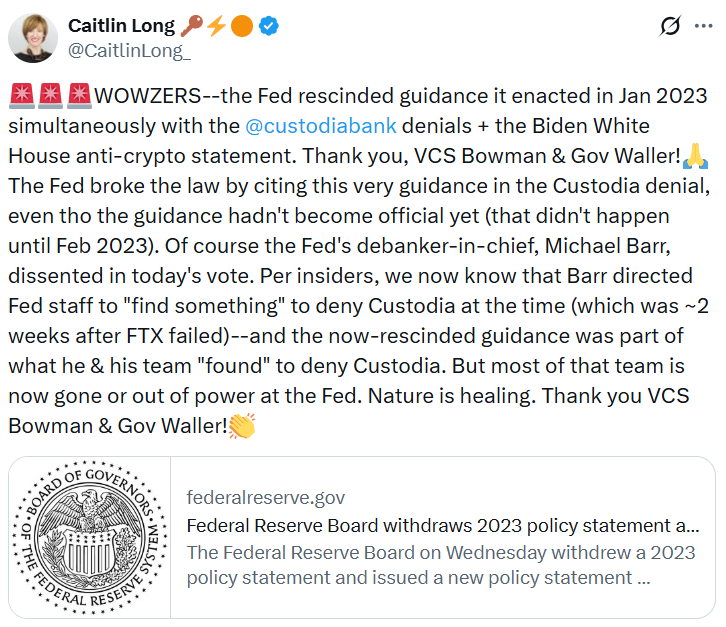
Caitlin Long, the CEO of the crypto‐focused Custodia Bank, applauded the move in an X post on Wednesday, explaining the 2023 guidance was why her institution’s application for a master account was previously denied.
Source: Cailtin Long

A master account with the Fed enables a financial institution to hold balances directly with the US central bank and access its core payment systems, allowing for payment settlement in central bank money rather than relying on another bank as an intermediary.

Related: Trump’s views on interest rates will hold ‘no weight’ at Fed: Hassett

“The Fed broke the law by citing this very guidance in the Custodia denial, even tho the guidance hadn’t become official yet, that didn’t happen until Feb 2023,” Long said.

“But most of that team is now gone or out of power at the Fed. Nature is healing. Thank you VCS Bowman & Gov Waller!” she added.

New guidance to boost bank innovation

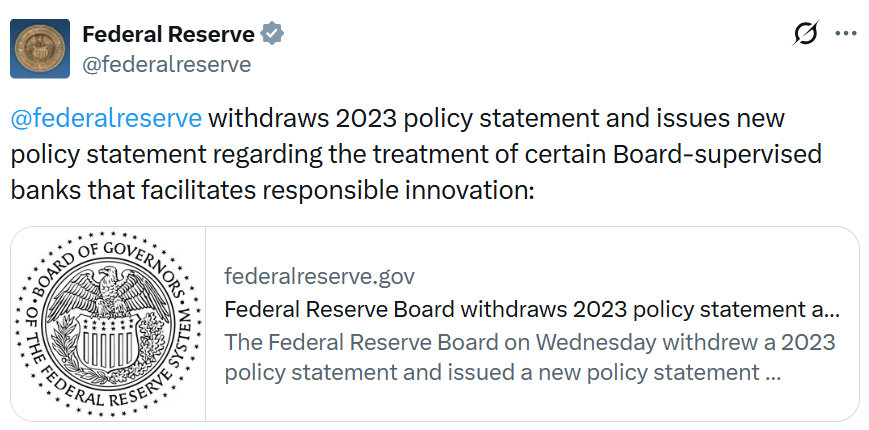
The move on Wednesday came as the Federal Reserve issued new guidance to establish a formal pathway for both insured and uninsured Federal Reserve-supervised state member banks to pursue “innovative activities,” such as cryptocurrencies, provided risk-management expectations are met, according to a statement on Wednesday by the Fed.
Source: Federal Reserve

Fed Vice Chair for Supervision Michelle Bowman said by “creating a pathway for responsible, innovative products and services, the Board is helping ensure that the banking sector remains safe and sound while also modern, efficient, and effective.”

Fed decision wasn’t unanimous

Fed Governor Michael Barr dissented to the decision, arguing that the principle of equal treatment among banks helps maintain a level playing field and prevents regulatory arbitrage.

“This principle continues to hold true today. Therefore, I cannot agree to rescind the current policy statement and adopt a new one that would, in effect, encourage regulatory arbitrage, undermine a level playing field, and promote incentives misaligned with maintaining financial stability. I dissent,” he said.

Barr has been accused of being linked to Operation Chokepoint 2.0, a federal effort to debank crypto companies. However, he was also previously an adviser at Ripple and has pushed for responsible stablecoin regulation.

Magazine: Unstablecoins: Depegging, bank runs and other risks loom

Crypto di tendenza

Letture associate

RIP: Atlas, Which Lived Only 292 Days

On August 9, 2026, OpenAI discontinued its standalone AI browser, Atlas, just 292 days after its launch on October 21, 2025. Initially positioned as a challenger to Chrome and the broader AI browser ecosystem, Atlas aimed to fundamentally redesign how users interact with browsers by deeply integrating ChatGPT. Its features included an AI-powered address bar, a sidebar for webpage analysis, Browser Memories for context retention, and an Agent Mode to automate multi-step tasks like shopping and research. Despite building on Chromium with a custom OWL (OpenAI Web Layer) framework, OpenAI struggled with the immense complexity of maintaining a full-fledged browser. The team spent significant time addressing basic functionalities—password managers, extensions, input methods—that mainstream browsers already handled seamlessly. Atlas's core AI agent capabilities also faced issues with reliability, speed, and security vulnerabilities like prompt injection. Furthermore, Atlas was limited to Apple Silicon Macs, failing to release promised Windows, iOS, and Android versions. This, coupled with the high switching cost for users entrenched in Chrome or Edge's ecosystems, hindered its adoption. By mid-2026, updates slowed, and OpenAI announced its shutdown, opting to integrate Atlas's AI explorations into the ChatGPT desktop app and browser extensions instead. The article contrasts two AI browser development paths: standalone products like Atlas, Perplexity's Comet, and Dia, which redesign the browser around AI but face user migration barriers; and the approach of incumbents like Chrome and Edge, which add AI features atop existing, widely-used platforms. The key question remains whether users need a completely new "AI browser" or simply AI capabilities within their current browser. While Atlas's experiment ended, the broader trend of AI integration into browsing continues.

marsbit24 min fa

RIP: Atlas, Which Lived Only 292 Days

marsbit24 min fa

Bitcoin's "Anti-Spam" Update Failed, Lasting Less Than a Day

A Bitcoin update proposal aimed at curbing spam by temporarily banning non-financial data from being stored on the network, BIP-110, has failed decisively. After months of debate, developers attempted to launch a separate blockchain, which collapsed within a day. The failure stemmed from a critical lack of miner support, with less than 1% signaling approval for the update. The vast majority of miners chose to continue mining the main Bitcoin blockchain without providing explanations. Despite this, the initiative's developers proceeded to launch an alternative blockchain—a hard fork of Bitcoin—on August 8. This meant a small subset of miners stopped mining Bitcoin to support the new chain with BIP-110 changes. However, the new network inherited Bitcoin's mining difficulty. With only a tiny fraction of the total computational power, block times stretched to roughly 7 hours instead of the standard 10 minutes, rendering the network practically non-functional. Michael Saylor, founder of major corporate Bitcoin holder MicroStrategy and a vocal opponent of BIP-110, commented: "Bitcoin worked exactly as designed. The BIP-110 fork occurred, and network participants were free to choose which chain to follow. As a result, about 99.85% of the network's hash power remained with Bitcoin." The event had no significant impact on Bitcoin's price, which traded in a narrow range between approximately $64.5k and $65.5k from August 7 through August 10.

cryptonews.ru30 min fa

Bitcoin's "Anti-Spam" Update Failed, Lasting Less Than a Day

cryptonews.ru30 min fa

Trading

Spot

Articoli Popolari

Come comprare US

Benvenuto in HTX.com! Abbiamo reso l'acquisto di Talus Network (US) semplice e conveniente. Segui la nostra guida passo passo per intraprendere il tuo viaggio nel mondo delle criptovalute.Step 1: Crea il tuo Account HTXUsa la tua email o numero di telefono per registrarti il tuo account gratuito su HTX. Vivi un'esperienza facile e sblocca tutte le funzionalità,Crea il mio accountStep 2: Vai in Acquista crypto e seleziona il tuo metodo di pagamentoCarta di credito/debito: utilizza la tua Visa o Mastercard per acquistare immediatamente Talus NetworkUS.Bilancio: Usa i fondi dal bilancio del tuo account HTX per fare trading senza problemi.Terze parti: abbiamo aggiunto metodi di pagamento molto utilizzati come Google Pay e Apple Pay per maggiore comodità.P2P: Fai trading direttamente con altri utenti HTX.Over-the-Counter (OTC): Offriamo servizi su misura e tassi di cambio competitivi per i trader.Step 3: Conserva Talus Network (US)Dopo aver acquistato Talus Network (US), conserva nel tuo account HTX. In alternativa, puoi inviare tramite trasferimento blockchain o scambiare per altre criptovalute.Step 4: Scambia Talus Network (US)Scambia facilmente Talus Network (US) nel mercato spot di HTX. Accedi al tuo account, seleziona la tua coppia di trading, esegui le tue operazioni e monitora in tempo reale. Offriamo un'esperienza user-friendly sia per chi ha appena iniziato che per i trader più esperti.

467 Totale visualizzazioniPubblicato il 2025.12.11Aggiornato il 2026.06.02

Come comprare US

Discussioni

Benvenuto nella Community HTX. Qui puoi rimanere informato sugli ultimi sviluppi della piattaforma e accedere ad approfondimenti esperti sul mercato. Le opinioni degli utenti sul prezzo di US US sono presentate come di seguito.

活动图片