US Crypto Firms Face Prolonged Compliance Limbo as Market Structure Bill Slips

bitcoinistPubblicato 2026-01-07Pubblicato ultima volta 2026-01-07

Introduzione

A key U.S. legislative effort to regulate cryptocurrencies, the market structure bill (CLARITY Act), faces significant delays and may not pass until 2027, with full implementation potentially extending to 2029. According to TD Cowen analysts, political dynamics—including Democratic concerns over conflicts of interest—are stalling progress. A major point of contention is a provision restricting government officials and their families from crypto ownership, which directly impacts former President Trump’s family. A proposed three-year delay in enforcement would push the rule beyond the next presidential term. The uncertainty prolongs regulatory limbo for crypto firms, potentially hindering institutional adoption and innovation in the U.S. Meanwhile, Bitcoin trades near $94,000 as of early 2026, and international regulatory frameworks continue to advance.

A key U.S. legislative effort to regulate the cryptocurrency market is facing delays that could push the passage of the crypto market structure bill to 2027, with full implementation possibly extending to 2029.

Analysts at TD Cowen warn that political dynamics in Congress, including concerns about conflicts of interest, are slowing progress, leaving crypto firms in regulatory uncertainty.
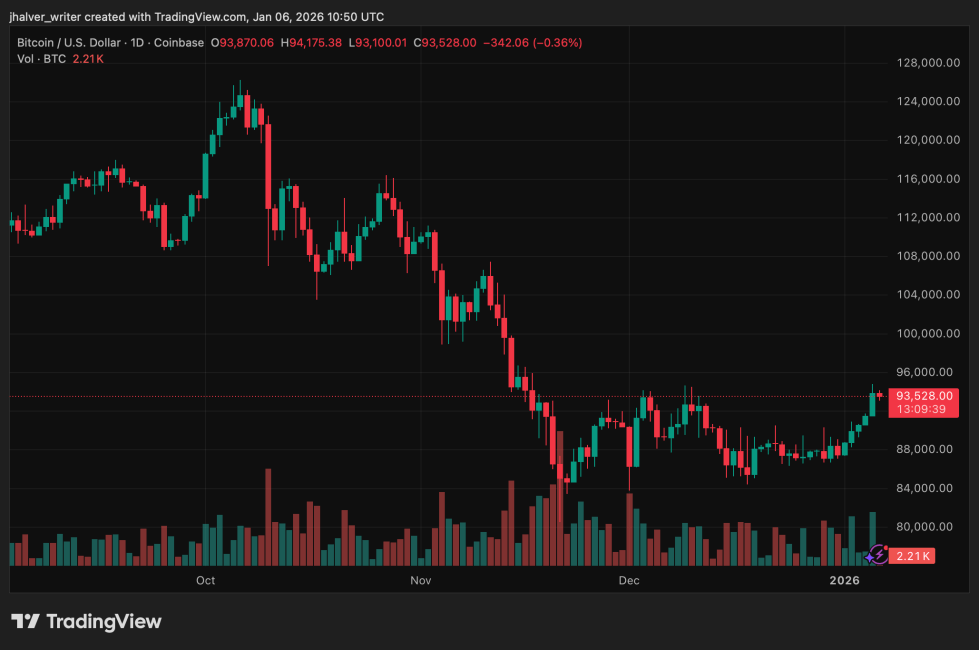
BTC's price climbs back above $90,000 on the daily chart. Source: BTCUSD on Tradingview

Political Roadblocks Delay Crypto Regulation

The crypto market structure bill, which aims to provide a clear regulatory framework for digital assets in the U.S., had been expected to advance this year. However, TD Cowen’s Washington Research Group, led by managing director Jaret Seiberg, says the bill’s approval timeline is now uncertain.

Political calculations tied to the 2026 midterm elections have reduced the urgency among Democrats to push the bill quickly, especially if they anticipate regaining control of the House of Representatives.

Seiberg notes that the Democratic Party’s insistence on strict conflict-of-interest rules, particularly those that would prevent senior government officials and their families from operating or owning cryptocurrency businesses, is a major sticking point.

This provision directly affects President Donald Trump and his family, who have reported significant crypto-related investments, including ventures in decentralized finance (DeFi) projects and bitcoin mining firms.

The proposed solution is to delay enforcement of these conflict-of-interest rules for three years after the bill’s enactment. This compromise would push the effective date beyond the next presidential term, potentially avoiding immediate impact on the Trump family’s crypto interests.

Impact on the Crypto Industry and Market Oversight

The delayed timeline means crypto firms will face ongoing regulatory uncertainty during a critical period of market growth. The bill, known as the CLARITY Act, aims to divide oversight responsibilities between the SEC and the Commodity Futures Trading Commission (CFTC), clarifying the regulation of different digital assets.

The legislation also includes provisions that could exempt certain cryptocurrencies from specific registration requirements, aiming to strike a balance between investor protection and innovation.

However, the path forward remains complicated. Senate committees are scheduled to revisit the bill later this year, but overcoming procedural hurdles, such as filibusters, will require bipartisan support, which remains uncertain.

Investors are advised to prepare for a protracted period of unclear regulatory conditions, which could influence where companies choose to invest and innovate.

Preparing for a Shifting Regulatory Landscape

Despite the delays, the crypto market remains active, with Bitcoin’s price hovering near $94,000 as of early January 2026. Still, the absence of clear rules risks slowing institutional adoption and long-term infrastructure development in the U.S.

Meanwhile, the international regulatory environment continues to evolve, with regions such as the European Union and Singapore advancing their own frameworks.

Industry groups like the Blockchain Association and Coin Center continue to engage with lawmakers, advocating for practical regulations that support growth and protect consumers.

The upcoming January 15 congressional hearing is seen as a critical moment for clarifying legislative intent, but the overall trajectory suggests that U.S. crypto firms will face extended uncertainty before comprehensive rules take effect.

Cover image from ChatGPT, BTCUSD chart from Tradingview

Domande pertinenti

QWhat is the main reason for the delay in the crypto market structure bill according to TD Cowen analysts?

APolitical dynamics in Congress, including concerns about conflicts of interest and the Democratic Party's insistence on strict rules that would prevent senior government officials and their families from operating or owning crypto businesses, are slowing progress.

QHow does the proposed conflict-of-interest provision specifically relate to former President Donald Trump?

AThe provision directly affects President Donald Trump and his family, who have reported significant crypto-related investments, including ventures in decentralized finance (DeFi) projects and bitcoin mining firms.

QWhat is the proposed compromise to address the conflict-of-interest issue and when would it take effect?

AThe proposed solution is to delay enforcement of these conflict-of-interest rules for three years after the bill’s enactment, pushing the effective date beyond the next presidential term.

QWhich two agencies would the CLARITY Act assign oversight responsibilities to for the crypto market?

AThe CLARITY Act aims to divide oversight responsibilities between the SEC (Securities and Exchange Commission) and the CFTC (Commodity Futures Trading Commission).

QWhat is the potential impact of the regulatory delay on the U.S. crypto industry according to the article?

AThe delayed timeline means crypto firms will face ongoing regulatory uncertainty, which could slow institutional adoption, influence where companies choose to invest and innovate, and risk slowing long-term infrastructure development in the U.S.

Letture associate

From Gas Limit to 'Keyed Nonces', How to Understand the Next Step in Ethereum Scalability?

Ethereum’s scalability efforts are shifting toward a user-centric approach—focusing not only on higher TPS, but on translating technical upgrades into lower costs, smoother operations, and better wallet experiences. Two recent developments highlight this direction: - **Raising the Gas Limit to 200 million**: Following the Fusaka upgrade that increased it to 60 million, a consensus has formed around a potential future increase to 200 million. This would boost Ethereum’s execution capacity, but it is planned alongside other upgrades—such as ePBS, Block-Level Access Lists (BAL), and EIP-8037—to manage state growth and keep node operation viable for average participants. - **Keyed Nonces (EIP-8250)**: This proposal aims to improve how transactions are queued. Instead of a single linear nonce per account, it introduces multiple independent nonce domains. This prevents different types of transactions—such as private payments, session keys, or batch operations—from blocking each other. Vitalik Buterin views this as a foundational step toward better privacy support and more flexible state scalability. Together, these upgrades are part of a broader move to push complexity from wallets, DApps, and relays back into the protocol layer. For everyday users, this means future Ethereum interactions could become less congested, more intuitive, and safer—especially as core improvements in account abstraction, cross-L2 interoperability, and node decentralization continue to progress. Ultimately, Ethereum is evolving to handle not just more transactions, but more varied and complex on-chain use cases while preserving its decentralized foundation.

marsbit13 min fa

From Gas Limit to 'Keyed Nonces', How to Understand the Next Step in Ethereum Scalability?

marsbit13 min fa

Leaving OpenAI, How Much Has Their Net Worth Increased?

Former OpenAI employees have collectively accrued near-trillion dollar valuations through ventures and investments, charting AI's future. The article highlights two main paths: founding high-value companies like Anthropic and Perplexity, or applying insider insights as investors. Leopold Aschenbrenner exemplifies the investor path. After being fired from OpenAI, he leveraged firsthand knowledge of AI's massive energy demands to make hugely successful public market bets on nuclear and fuel cell companies, practicing "cross-industry cognitive arbitrage." Other alumni, like the Zero Shot VC fund founders, use their technical foresight for early-stage investing. Their key advantage lies not just in picking winners, but in knowing which technical approaches are likely dead ends—a "veto list" derived from internal OpenAI experience. Angel investing within the network, as seen with Mira Murati and Sam Altman, operates on deep, pre-existing understanding of a founder's capabilities, reducing due diligence to near zero. This creates an ecosystem bound by a shared belief in AGI's imminent arrival, differing from networks like the "PayPal Mafia" which were built on shared past struggles. The shift of these builders to investors signals a profound conviction: their situational awareness of the AI landscape is now so clear that deploying capital based on that judgment is more efficient than building themselves. They are allocating bets on the future they helped shape from the inside.

marsbit24 min fa

Leaving OpenAI, How Much Has Their Net Worth Increased?

marsbit24 min fa

Countdown to the AI Bull Market? Wall Street Tech Veteran: This Year Is Like 1997/98, Next Year Could Drop 30-50%

"AI Bull Market Countdown? Wall Street Veteran: This Year Feels Like 1997/98, Next Year Could Drop 30-50%" In an interview, veteran tech analyst Dan Niles draws parallels between the current AI boom and the 1997-98 period of the internet boom, suggesting the bull run isn't over yet. The core new driver is identified as "Agentic AI," which performs multi-step tasks and consumes vastly more computing power than conversational AI. This shift is expected to boost demand for cloud infrastructure and benefit CPU makers like Intel and AMD, potentially pressuring GPU leader Nvidia. However, Niles warns of significant short-term overbought conditions in semiconductors. His central warning is for a potential major market correction of 30-50% starting in early 2027. Drivers include a slowdown from high growth comparables, the outsized capital demands of companies like OpenAI, and a wave of massive tech IPOs sucking liquidity from the market. A J.P. Morgan survey of 56 global investors aligns with this view, finding that 54% expect a >30% U.S. stock correction by 2027. Among mega-cap tech, Niles favors Google due to its full-stack AI capabilities and cash flow, expresses concern about Meta's user growth, and sees potential for Apple's AI Siri and foldable iPhone. Niles advises investors to be nimble, hold significant cash, and closely monitor the conflicting signals from equities, oil prices, and bond yields, which he believes cannot all be correct simultaneously.

marsbit57 min fa

Countdown to the AI Bull Market? Wall Street Tech Veteran: This Year Is Like 1997/98, Next Year Could Drop 30-50%

marsbit57 min fa

Trading

Spot
Futures
活动图片