US CPI Preview: Overall Inflation May Break Through 4% to Hit a Three-Year High, While Core Inflation Could Be Significantly Below Expectations

marsbitPubblicato 2026-06-10Pubblicato ultima volta 2026-06-10

Introduzione

US CPI Preview: Headline Inflation May Top 4%, Hitting Three-Year High, Core Could Fall Short of Expectations. Wall Street's major institutions (Goldman Sachs, UBS, Deutsche Bank, Morgan Stanley) anticipate May's headline CPI year-over-year to rise sharply to the 4.17%-4.3% range from April's 3.81%, largely driven by a significant jump in energy prices due to recent geopolitical tensions. This could mark the highest level since April 2023. In contrast, core CPI (excluding food and energy) is forecast to increase only 0.17%-0.22% month-over-month, notably below the market consensus of 0.27%-0.30%. Key moderating factors include cooling shelter inflation (OER and rent) and weaker auto insurance prices, while used car prices are expected to be flat. However, upward pressures persist within core components. Airfare, IT goods, and some non-shelter services are expected to show strength, partially offsetting the cooling trends. This divergence makes the report complex for markets: high headline inflation from transient energy shocks versus a potentially softer underlying core trend. Market pricing via inflation swaps suggests a slightly higher-than-expected headline print, historically associated with a modest dollar rally post-release. Looking ahead, the trajectory for inflation remains highly dependent on future oil price movements.

Original Author: Long Yue

Original Source: Wall Street News

At 20:30 Beijing time tonight, the US Bureau of Labor Statistics will release the May CPI data. This is also the most watched heavyweight inflation data by the market before the Federal Reserve's new Chairman Wash's policy rate meeting next week.

According to reports from the Chase the Trade desk, Wall Street's four major institutions—Goldman Sachs, UBS, Deutsche Bank, and Morgan Stanley—have released a flurry of preview reports on the eve of the data release. The forecasts from the four institutions vary, but the direction is similar: Overall inflation may be high, but core inflation may not be that hot. Energy prices are pushing up overall CPI, while factors such as rent and auto insurance are suppressing core CPI.

Overall CPI May Rise Above 4% to Hit a Three-Year High, Core CPI Possibly Below Consensus

Looking at the forecasts, the four institutions' predictions for the May year-on-year overall CPI are concentrated in the range of 4.17% to 4.3%, all higher than April's 3.81%. However, the forecasts for the month-on-month core CPI are generally lower than the market consensus.
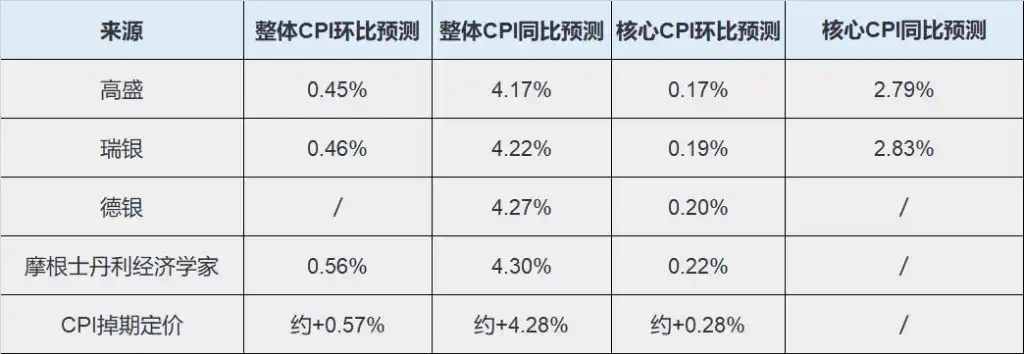
The trends of overall and core inflation show a clear divergence.

The "worrying" part is overall inflation. The year-on-year predictions from Goldman Sachs, UBS, Deutsche Bank, and Morgan Stanley are all above 4%. Deutsche Bank's estimate of 4.27% and Morgan Stanley's estimate of 4.3% are 46-49 basis points higher than April's figure and would be the highest since April 2023.

The "positive" part is core inflation. Excluding food and energy, the month-on-month core CPI may only be 0.17%-0.22%, significantly lower than the market's mainstream expectation of 0.27%-0.30%.

Overall Inflation May Break 4%: Energy Is the "Culprit"

Energy will be the core driver of the potential jump in this inflation reading.

Following the outbreak of the Iran war, US retail gasoline prices have risen sharply, driving a projected month-on-month increase in energy commodity prices of about 6%~7% for May, with the entire energy category seeing a month-on-month increase of nearly 4%. This effect directly pushes the year-on-year overall CPI from 3.81% in April to 4.17%~4.3% in May.

Deutsche Bank's calculations show that energy inflation year-on-year may approach 24%; back in February, this number was only 0.5%.
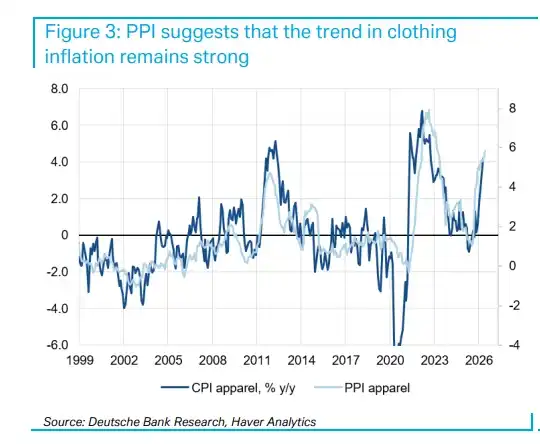
Airfare increases are one of the most direct transmission channels. Rising fuel costs directly increase airline operating costs. Airfare prices in May are expected to rise month-on-month by 1.3%~2%.

The good news is that gasoline prices peaked on May 20th and have since fallen by about 40 cents per gallon. UBS expects this to lead to a month-on-month decline of about 0.13% in the overall CPI for June, with the year-on-year rate falling back to around 3.81%. In other words, May is likely the peak of this round of overall inflation.

Why Core Inflation May Be Lower Than Expected: The Key Lies in Housing Cooling Down Again

Core CPI excludes food and energy. Precisely because these two hottest components are excluded, the May core data will look much more moderate.

Housing carries a very high weight in the US CPI, about 35%.

Both Goldman Sachs and UBS predict that Owner's Equivalent Rent (OER) and primary residence rent in May will increase month-on-month by about 0.22%~0.23%, continuing a slowing trend. In April, these two components rose by 0.53% and 0.55% month-on-month, respectively. Deutsche Bank also lists "housing inflation trends remaining moderate" as one of the reasons for the softness in core inflation.

Because OER itself has a large weight, even a decrease from around 0.5% to just over 0.2% will significantly lower the core CPI reading.

Auto insurance is another cooling point.

Goldman Sachs expects auto insurance prices to fall 0.1% month-on-month in May. Its online data model shows that changes in premiums are giving a downward signal for auto insurance CPI. Deutsche Bank also mentions that auto insurance is expected to be weak again.

There is also no significant upward pressure in used cars. Goldman Sachs expects used car prices to remain flat and new car prices to rise 0.1%; UBS expects used car prices to fall 0.26% and new car prices to fall 0.10%.

This means that several items that have frequently disturbed US core inflation in recent years—housing, auto insurance, used cars—are not giving strong inflation signals this time. In other words, the low May core CPI is not due to a single component "suddenly cooling down."
Core Inflation Is Not Cooling Across the Board: Airfare, IT Goods, and Some Services Still Have Pressure

A core CPI reading below consensus does not mean all core items are cooling.

Airfare is an upward item.

Goldman Sachs expects airfares to rise 2% in May. UBS expects a 1.34% increase. The reason is that jet fuel prices remained high for most of May, which may be passed through to ticket prices.

There is significant divergence in judgments on hotel prices. Goldman Sachs expects hotel prices to rise 0.2%; UBS lowered its lodging forecast based on Smith Travel Research data, expecting the price of lodging away from home to fall 0.77%. However, UBS also notes that CPI measures prices at the time of booking, while STR data is closer to check-in time. This timing difference may bring upside risks, especially potentially reflecting early demand related to the World Cup.

There is also stickiness in goods.

UBS expects core goods prices to rise 0.08% month-on-month, between the 0.11% in March and 0.03% in April. Its assessment is that the impact of tariffs on the 12-month core goods inflation may have slightly passed its peak, but residual pass-through will still keep monthly core goods prices growing slightly positively for the rest of this year.

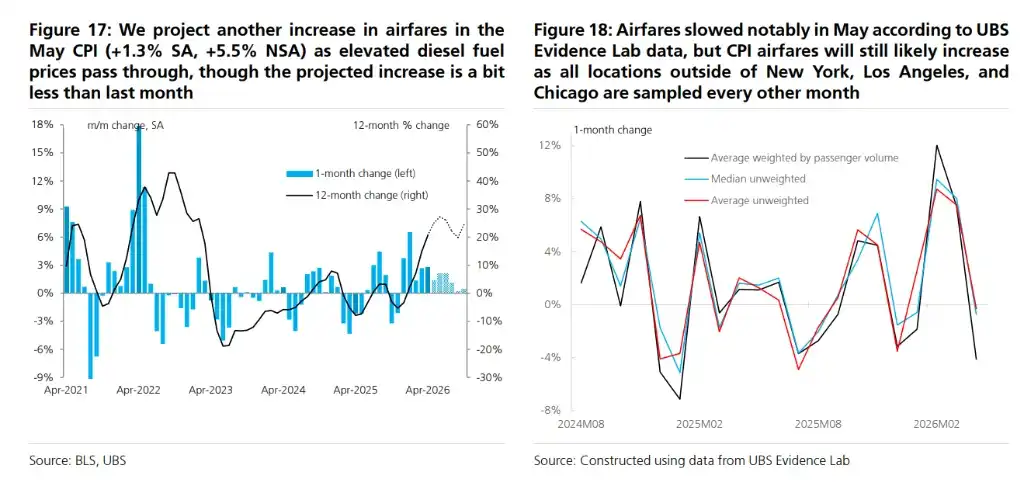
Deutsche Bank also mentions that import prices indicate that IT goods prices still have strong momentum, partly due to global memory chip prices remaining high. Meanwhile, apparel PPI shows that apparel inflation trends remain strong, although import prices are weak, and the momentum in CPI may have slowed compared to previous months.

Services are more complex.

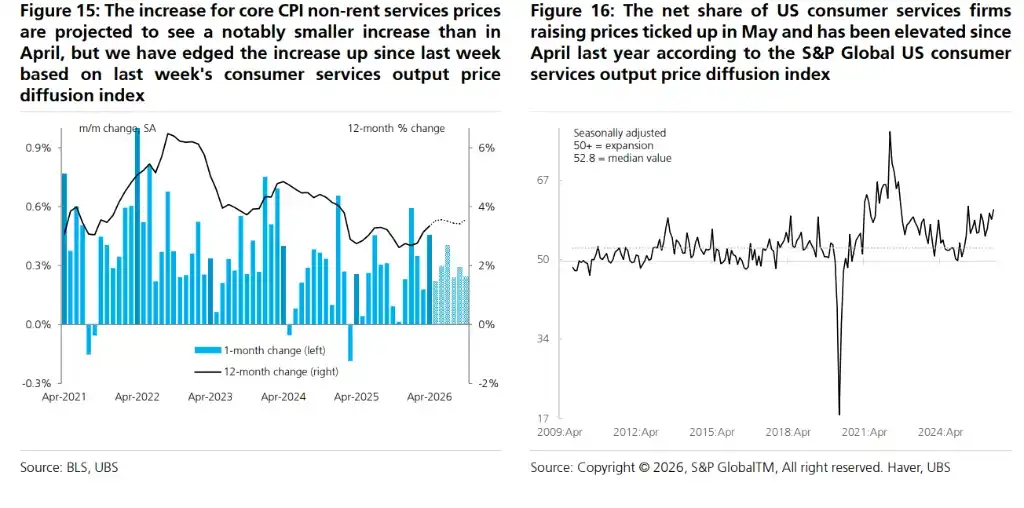
UBS has raised its forecast for non-rent core services prices from 0.17% to 0.21%, citing the S&P Global US Consumer Services Output Price Diffusion Index showing an increase in the proportion of consumer service firms raising prices in May, reaching the second-highest level since 2009, excluding the abnormal pandemic period.
What to Really Watch Tonight Is Not Just an Overall Inflation Above 4%

The surface numbers for May CPI may be high, but breaking them down is more crucial.

If overall CPI is high, primarily driven by gasoline and energy, the market will likely combine that with the decline in gasoline prices in June to judge its sustainability.

If core CPI is significantly lower than expected, the market will continue to examine where the low inflation is coming from: a trend slowdown in housing or a one-off seasonal drag.

If airfare, IT goods, and non-rent services continue to be strong, the significance of the core cooling will be discounted.

Therefore, this CPI might give the market two messages simultaneously:

On one hand, overall inflation has broken through 4% again, potentially even hitting a new high since April 2023.

On the other hand, core inflation might only be around 0.2%, clearly below market consensus.

This is what makes tonight's CPI so difficult to trade: overall inflation looks hot, but core inflation may not be that hot; oil prices push up the overall figure, while housing and auto insurance push down the core.

Inflation Swap Pricing: The Market Is Betting on a Dollar-Rising Surprise

The inflation swap market is currently pricing May overall CPI at 4.27%~4.28%, slightly above the Bloomberg survey median of 4.2%.

The analytical framework of Morgan Stanley strategist Molly Nickolin shows that in the past 12 CPI releases, inflation swap pricing correctly predicted the direction of the year-on-year inflation 9 times before the release. The current pricing implies an upside deviation of about 0.48 standard deviations relative to economists' expectations.

Based on historical backtesting, a 0.48 standard deviation upside surprise typically corresponds to a DXY US Dollar Index increase of about 0.14% within one hour of the release. Among all G10 currencies, the Swedish Krona (SEK) has historically performed the weakest in a "USD-bullish" CPI release day, with the largest average decline.

Looking Ahead: Oil Prices Are the Biggest Variable for the Inflation Path

The path of core CPI in the coming months depends on how long oil prices can be maintained.

The current baseline forecast is: Month-on-month core CPI remains around 0.2%. However, if the Middle East situation persists and the decline in oil prices falls short of expectations, upside risks will become more prominent—high oil prices not only directly push up energy prices but also continue to seep into core inflation through intermediate channels like airfare and transportation.

Deutsche Bank's long-term forecast is more pessimistic: Even if oil prices start to decline in June, overall energy inflation year-on-year will remain above 10% until early 2027 before turning negative. Core services inflation (excluding rent/OER) is also expected to remain above 3% for a long time.


Domande pertinenti

QWhat is the main reason why the overall CPI might exceed 4% in May according to the article?

AThe primary reason is a significant surge in energy prices. Following the outbreak of the Iran war, U.S. retail gasoline prices climbed sharply, driving energy commodity prices up by approximately 6-7% month-over-month in May. This pushed the overall CPI year-over-year rate from 3.81% in April to the predicted range of 4.17% - 4.3% in May.

QWhy is the core CPI for May expected to be significantly lower than market consensus?

AThe core CPI is expected to be lower mainly due to cooling in key categories with high weights, particularly housing. Components like Owners' Equivalent Rent (OER) and primary residence rent are predicted to show slower month-over-month growth around 0.22-0.23%, down from around 0.5% in April. Additionally, factors like auto insurance and used car prices are also providing a cooling effect.

QWhich specific core components are identified as still presenting upward pressure on inflation?

AWithin the core CPI, airfares are an upward component, with forecasts of a 1.34% to 2% month-over-month increase due to high aviation fuel costs. IT goods prices are also cited as having strong momentum, partly due to high global memory chip prices. Furthermore, some non-rent core services show resilience, with a notable share of consumer service firms reporting price increases.

QBased on inflation swap pricing, what market reaction does the article suggest for a potential upside surprise in the CPI data?

ABased on historical analysis by Morgan Stanley, the current inflation swap pricing implies an upside surprise of about 0.48 standard deviations. Historically, such a surprise has been associated with the DXY U.S. Dollar Index rising approximately 0.14% within one hour after the data release. Among G10 currencies, the Swedish Krona (SEK) typically shows the weakest performance on such 'dollar-bullish' CPI days.

QWhat is considered the biggest variable for the future path of inflation according to the article's conclusion?

AThe future path of inflation, particularly core CPI, is highly dependent on oil price movements. Oil prices are identified as the biggest variable. If Middle East tensions persist and oil prices do not decline as expected, there will be significant upside risks, as high oil prices not only directly impact energy costs but also continue to feed into core inflation through channels like airfares and transportation.

Letture associate

Dalio's Latest Warning: Don't Get Carried Away by AI, Real Returns on US Stocks in the Next 5-10 Years Could Be -5% to -10%

Ray Dalio, founder of Bridgewater Associates, warns investors against excessive concentration in AI stocks. He argues the current market, dominated by a few AI giants, mirrors historical patterns where revolutionary new technologies lead to high risk, volatility, and uncertainty. While acknowledging AI's transformative potential, Dalio emphasizes that most investors fail at this stage of the cycle by over-concentrating in a handful of leading companies. He cites inherent risks: companies cannot accurately forecast investment needs or external shocks (e.g., monetary policy, geopolitics, taxes), face potential disruption from future technologies and international competition (notably from China), and experience significant price swings. Dalio's core advice is diversification, calling it his "Holy Grail of Investing." He presents a mathematical case that a well-diversified portfolio of 15-20 uncorrelated, good bets offers a superior risk-adjusted return compared to a concentrated position. Dalio also offers a cautious outlook, suggesting U.S. stocks may deliver real returns of -5% to -10% over the next 5-10 years based on valuation and bubble indicators. He concludes that in the face of high uncertainty, the prudent strategy is not to avoid betting entirely, but to avoid large, concentrated bets where one lacks sufficient informational edge. Instead, investors should build a strategically balanced, diversified portfolio.

marsbit25 min fa

Dalio's Latest Warning: Don't Get Carried Away by AI, Real Returns on US Stocks in the Next 5-10 Years Could Be -5% to -10%

marsbit25 min fa

Rain Valuation Approaches $20 Billion: The Battle for U-Cards Extends to Rewards Systems

Rain, a stablecoin payments infrastructure company, is shifting the competitive focus for U Cards from simple issuance to user retention and repeated usage. On June 15, Rain launched "Rain Rewards," an embedded loyalty program capability within its card-issuing infrastructure. This allows partner businesses—like fintech platforms and neobanks—to configure branded loyalty points, earning rules, redemptions, and merchant promotions directly within their card products. The system, built from the 2025 acquisition of Uptop, ensures points are only issued upon final transaction settlement, preventing liabilities from refunds. Trials, such as with Avalanche Card, reportedly boosted spending by 25% among enrolled users. Founded by Farooq Malik and Charles Yoo-Naut, Rain evolved from a tool for managing Web3 company expenses into a full-stack enterprise platform. It is a Principal Member of Visa and Mastercard, enabling partners to issue stablecoin-backed cards and wallets while leveraging traditional payment networks. Notably, the popular U Card Plasma One is issued by Rain under Visa's authority. Rain also integrates with Visa's stablecoin settlement pilot, using USDC for network settlement. Rain's rapid funding reflects growing institutional interest in stablecoin payment infrastructure. It raised a $245 million Series A in March 2025, a $58 million Series B in August 2025, and a $250 million Series C in January of this year, reaching a $19.5 billion valuation. Annualized transaction volume exceeds $3 billion, serving over 200 partners including Western Union and Nuvei. Beyond cards, Rain is expanding into programmable payments. Its June 2026 "Agent Control Layer" allows businesses to set spending rules—like merchant categories, amounts, and frequency—for AI agents before transactions occur. This positions Rain not as a single product but as an operating system for stablecoin payments, handling everything from card issuance and wallet management to rewards, on/off-ramps, and automated compliance. The goal is to enable seamless, often invisible, real-world spending of on-chain assets.

Foresight News28 min fa

Rain Valuation Approaches $20 Billion: The Battle for U-Cards Extends to Rewards Systems

Foresight News28 min fa

Google TPU Shipments Revised Up by 50%

Recent industry research indicates a significant upward revision in the shipments of Google's TPU (Tensor Processing Unit) chips. Previous expectations for 2027 were set at around 10 million units, but new estimates now point to 15 million units, a 50% increase. This substantial boost directly translates to higher demand across the entire supporting supply chain. Google's TPU clusters utilize a standardized all-optical interconnect architecture. Consequently, key hardware components are deeply integrated and scaled in fixed ratios with the chips. The 15 million TPU target will drive corresponding demand increases for NPO optical engines (roughly a 1:1 match), 1.6T optical modules, OCS optical switches, high-end server power supplies, fiber optics & MPO connectors, and liquid cooling solutions. Among these, liquid cooling is highlighted as the sector experiencing the most significant transformation and offering the most stable potential for excess returns. As next-generation TPU chips reach power levels where traditional air cooling is insufficient, liquid cooling becomes essential. 2026 is forecasted as the first year of substantial adoption for Google's liquid cooling solutions. This shift, coupled with delivery and capacity bottlenecks faced by incumbent overseas manufacturers, is creating a prime window for domestic Chinese suppliers to enter and secure Google's core supply chain. The market size for Google-specific liquid cooling is projected to potentially triple from a baseline of hundreds of billions to around 300 billion units by 2028. The logic for the fiber optic sector is also being rewritten. Once considered a cyclical commodity tied to telecom operator procurement, fiber is now a strategic and scarce resource for AI Data Centers (AIDC). A severe supply-demand imbalance, driven by the long lead time for preform production (18-24 months) and surging demand from cloud giants, is supporting strong performance. Chinese fiber manufacturers are well-positioned to capture a significant share of global AIDC demand, with exports potentially reaching 200-300 million core kilometers in 2026. Overall, the investment focus within the AI computing industry is shifting from pure "chip performance speculation" towards the more certain incremental growth in computing infrastructure and its supporting ecosystem. The upward revision in Google TPU shipments, along with the potential for further doubling by 2028, is seen as solidifying performance visibility for the entire supporting supply chain over the next two years.

marsbit2 h fa

Google TPU Shipments Revised Up by 50%

marsbit2 h fa

What Wall Street Really Wants After the Crypto Story Recedes

The tide of speculative crypto narratives has receded, revealing Wall Street's true objective: building a controlled, yield-generating, and compliant financial pipeline on distributed ledgers. They are migrating core functions onto blockchains, not for decentralization, but for efficiency and new revenue streams. Key developments include BlackRock's BUIDL fund, a tokenized treasury fund acting as a foundational reserve asset, and the rise of Securitize, which is going public and partnering with the NYSE to build a 24/7 digital securities trading and settlement system. This signals a major shift of securities clearing to blockchain technology. To make volatile assets like Bitcoin palatable for institutional investors, firms like BlackRock and Goldman Sachs are creating "covered call" ETFs (e.g., BITA). These products systematically sell options on Bitcoin holdings, transforming price volatility into stable monthly income, effectively repackaging crypto as a yield-bearing asset. Stablecoins are being positioned not as speculative tools but as efficient payment rails. Companies like Stripe and Mastercard are integrating them for instant, low-cost merchant settlements and cross-border card payments, respectively. Critically, new legislation like the GENIUS Act shapes them as non-interest-bearing, heavily regulated extensions of the US dollar system. In summary, Wall Street is quietly constructing a parallel, blockchain-based financial infrastructure featuring tokenized traditional assets, structured crypto yields, and programmable dollar pipelines—all under its control and fully integrated with existing regulatory and credit frameworks.

marsbit2 h fa

What Wall Street Really Wants After the Crypto Story Recedes

marsbit2 h fa

Trading

Spot
Futures

Articoli Popolari

Come comprare 4

Benvenuto in HTX.com! Abbiamo reso l'acquisto di 4 (4) semplice e conveniente. Segui la nostra guida passo passo per intraprendere il tuo viaggio nel mondo delle criptovalute.Step 1: Crea il tuo Account HTXUsa la tua email o numero di telefono per registrarti il tuo account gratuito su HTX. Vivi un'esperienza facile e sblocca tutte le funzionalità,Crea il mio accountStep 2: Vai in Acquista crypto e seleziona il tuo metodo di pagamentoCarta di credito/debito: utilizza la tua Visa o Mastercard per acquistare immediatamente 44.Bilancio: Usa i fondi dal bilancio del tuo account HTX per fare trading senza problemi.Terze parti: abbiamo aggiunto metodi di pagamento molto utilizzati come Google Pay e Apple Pay per maggiore comodità.P2P: Fai trading direttamente con altri utenti HTX.Over-the-Counter (OTC): Offriamo servizi su misura e tassi di cambio competitivi per i trader.Step 3: Conserva 4 (4)Dopo aver acquistato 4 (4), conserva nel tuo account HTX. In alternativa, puoi inviare tramite trasferimento blockchain o scambiare per altre criptovalute.Step 4: Scambia 4 (4)Scambia facilmente 4 (4) nel mercato spot di HTX. Accedi al tuo account, seleziona la tua coppia di trading, esegui le tue operazioni e monitora in tempo reale. Offriamo un'esperienza user-friendly sia per chi ha appena iniziato che per i trader più esperti.

356 Totale visualizzazioniPubblicato il 2025.10.20Aggiornato il 2026.06.02

Come comprare 4

Discussioni

Benvenuto nella Community HTX. Qui puoi rimanere informato sugli ultimi sviluppi della piattaforma e accedere ad approfondimenti esperti sul mercato. Le opinioni degli utenti sul prezzo di 4 4 sono presentate come di seguito.

活动图片