Unveiling the 'White-haired Stock God' Serenity: A Spiritual Remedy for Anxious Retail Investors

Odaily星球日报Pubblicato 2026-06-11Pubblicato ultima volta 2026-06-11

Introduzione

The article details the rise of Serenity, dubbed the "White-Haired Stock God," whose social media posts have recently caused significant volatility in China's A-share market. Previously gaining fame in international retail investor communities, Serenity is known for his "Chokepoint Investment" strategy targeting small monopolies in the AI supply chain, reportedly achieving returns over 3612% this year. His influence stems from his background as a former AI research scientist, detailed analysis, and a massive following on X, where his subscriber count has surpassed Elon Musk's. In early June, Serenity's Chinese-language posts mentioning A-shares like LeaderDrive (Lide Xiebo), Easun, and Innolight triggered immediate 20% surges in their stock prices. He later clarified that some recommendations were crowdsourced from followers and claimed he did not hold positions in these stocks, stating his actions were "just for fun" to offer a foreign perspective on Chinese markets. This activity drew scrutiny from Chinese financial media, which warned of potential "pump-and-dump" schemes and legal risks. While anonymous, clues suggest Serenity is likely a Chinese-speaking individual living in Japan. He maintains his anonymity due to past harassment but enjoys substantial monthly income from his paid subscriptions. The article posits that Serenity embodies the market's current appetite for a charismatic, successful figure during the AI bull run, serving as an "outward projection" of bulli...

Original | Odaily Planet Daily(@OdailyChina)

Author|Golem(@web 3_golem)

In the A-share market, the 'White-haired Stock God' Serenity has completely exploded in popularity.

From June 5th to June 9th, Serenity successively "called" three A-shares on the X platform: LeaderDrive, a concept stock for embodied intelligent robots, Easy Sight, a concept stock for digital intelligence new energy, and Innolight, a leading stock in the optical module sector. The stock prices of the first two were straight-line pulled to a 20cm limit-up on the same day, and LeaderDrive's June gain has already exceeded 30%.

The reason Serenity has such strong "call-signaling ability" is that before entering the sight of domestic A-share investors, he had already gained extremely high recognition in international retail investor communities.

Serenity's investment characteristic is to screen out small monopolistic enterprises on the AI industry chain that are not fully priced according to the "Chokepoint Investment Method." Because the over 16 stocks he called this year have all achieved investment returns exceeding 100%, with his personal year-to-date investment return exceeding 3612%, combined with his professional background as a former AI research scientist and his rigorous analysis of the AI industry and favored companies each time, Serenity has amassed a large number of loyal retail fans in Europe, America, Japan, and South Korea. His X account subscriber count surpasses that of Elon Musk, ranking first on the platform. Therefore, his influence on a stock's price fluctuations also exceeds that of ordinary stock analysts.

For example, on May 27th, Serenity posted on the X platform announcing that he had completed building a position in XFAB on the European stock market at a market cap of $1.28 billion. XFAB's stock price was subsequently pushed higher, with an intraday peak increase of 77%, reaching a high of 13.13 euros. After that, XFAB's stock price began a continuous decline, currently reporting around 8.8 euros, having returned to the level before Serenity's call.

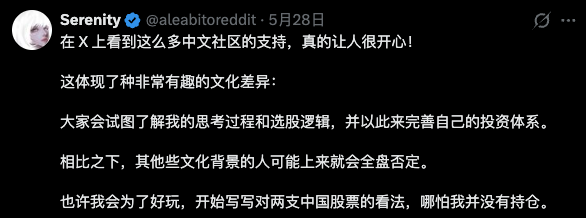
The day after causing significant volatility in XFAB's stock price, Serenity posted on the X platform in Chinese, saying, "Because I see so much support from the Chinese community... maybe for fun, I'll start writing about my views on two Chinese stocks."

A storm sweeping through the A-share market thus began.
Disrupting the A-Share Market Without Holding Positions, Just for Fun?

In hindsight, the two stocks Serenity mentioned were LeaderDrive and Easy Sight.

On June 5th, Serenity posted in Chinese, specifically emphasizing "written especially for my Chinese readers," stating that LeaderDrive (688017, 57.73 billion RMB) was his most favored listed Chinese target while deploying in the humanoid robot sector. The main reason is its absolute dominance in certain robot component supply chains, with over 60% domestic market share and more than 1,800 global customers.
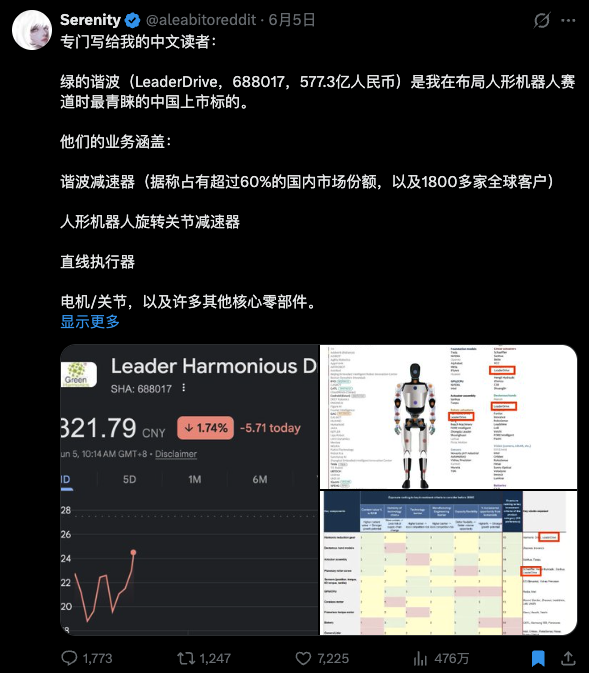
As of now, this post has been viewed over 4 million times and has been disseminated secondarily to multiple domestic social media platforms. LeaderDrive's stock price triggered a 20% limit-up on June 5th. By June 10th, in just 4 trading days, the stock price had risen over 30%.

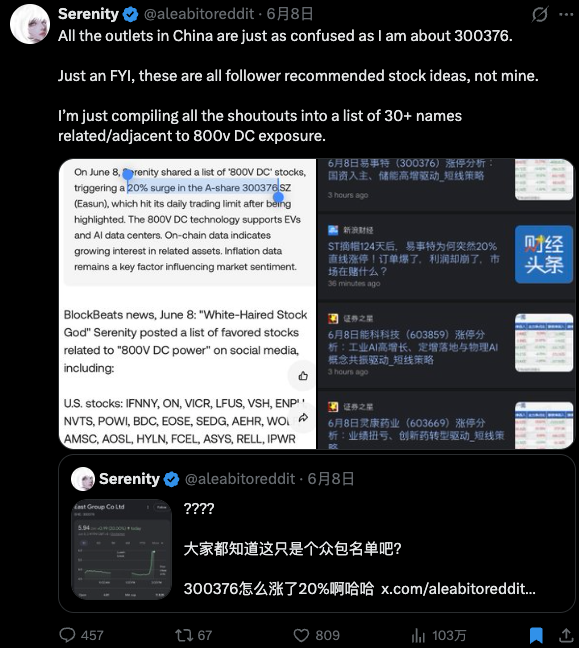
On June 8th, the same market script played out again. Serenity posted a crowdsourced list of over 30 companies related to the "800V DC" concept on the X platform, which included the A-share company Easy Sight. The news quickly fermented domestically, and Easy Sight's stock price happily received a 20CM limit-up within an hour. By June 10th, its gain also exceeded 30%.

Even Serenity himself was surprised, posting in wonder, "Does everyone know this is just a crowdsourced list, right? How did 300376 (Easy Sight) rise 20%?"

He immediately followed up with another post stating, "These are stocks recommended by fans, not my personal recommendations," attempting to distance himself from it.
Besides these two stocks, Serenity also mentioned a third A-share, Innolight, on June 9th, stating that Innolight was the only Chinese listed company he invested in last year. However, because some AI mistranslated "Innolight" as another A-share listed company, Inno Laser, Inno Laser was violently pulled up nearly 10% in 10 minutes. This "mistaken identity" incident also reveals retail investors' FOMO (Fear Of Missing Out) towards Serenity himself, "blindly asking what to buy, afraid of missing out on the hot stuff."

Serenity's actions quickly drew the attention of domestic financial media and securities analysts, who began speculating about his purpose for "cross-border stock promotion." On June 9th, Cailian Press published a long article reminding domestic investors to be vigilant about overseas information backflow. If Serenity's sharing involves profit-sharing, then the behavior is classic "export-for-domestic-sale-style cross-border stock promotion," which carries legal liabilities. Some domestic securities analysts even angrily posted on their social media circles, "These bastards will get their comeuppance sooner or later, thinking they can act lawlessly just by running abroad."

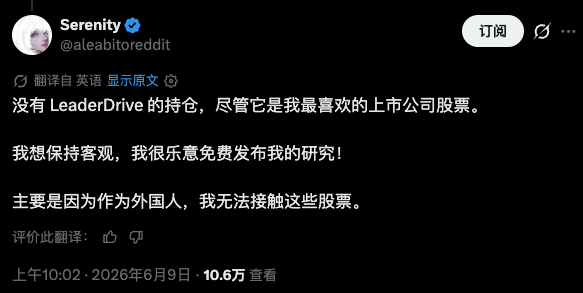
Facing domestic media's questioning about him "harvesting retail investors," Serenity responded that calling A-shares was just because he believed "foreigners could bring a different perspective to A-shares." He further stated, "Although I really like LeaderDrive, I don't hold its stock." Perhaps, as he initially said, the original intention for doing all this was just for fun.
Serenity appears like a "philanthropist." He emphasizes that he does not do any paid promotions or marketing. The only paid thing is a $1 monthly subscription service. He is not a member of any institution or the Illuminati. The reason for his continuous free sharing is his belief that the stock market is a positive-sum game process. He hopes retail investors can buy quality stocks without joining any expensive paid communities, even before institutions enter. He claims he is promoting information democratization.

In the investment field, don't overly deify anyone. Serenity may not seek profit, but he certainly seeks fame. Since starting to call A-shares on June 5th, Serenity's follower count has surged by over 200,000 again. As of June 11th, his X platform follower count exceeds 810,000, and account subscribers have grown to 54,000, leaving Musk (46,000) behind. With such a large subscriber base, even at a price of $1, Serenity's monthly fixed income reaches $54,000, easily earning millions of RMB annually.

Serenity's pinned posts are all celebrating his account subscriber count surpassing Musk, calling it his goal. An anonymous account having such high influence and attention makes investors even more curious about his real identity. Behind this account, is it an individual, a team, or even just an AI?

Very Likely a Chinese Person Residing in Japan?

Serenity explains that the reason for maintaining anonymity is to be able to freely express ideas online. He stated that when he first published negative views about IREN (a NASDAQ-listed stock), he received threats and harassment from dozens of accounts in real life, which is why he chose to remain anonymous.

Nevertheless, the community has slowly pieced together an image of Serenity from various collected fragments of information. It is highly likely he is a Chinese person living in Japan.

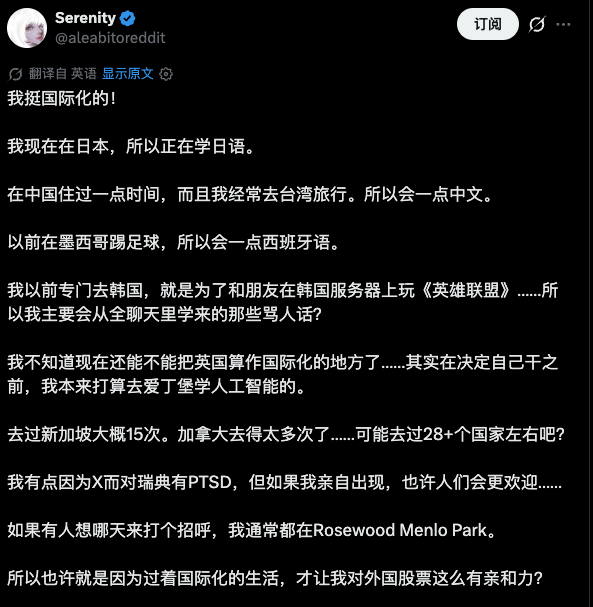
Serenity revealed some personal information in late May. He said he is quite international, currently studying Japanese in Japan. Because he once lived in mainland China for a while and frequently traveled to Taiwan, he knows a bit of Chinese. Additionally, he played soccer in Mexico for two or three years and went to South Korea specifically to play League of Legends... His life seems quite comfortable.
Serenity has lived in Japan for at least half a year. At the end of 2025, he often posted photos of his life in Japan on the X platform, but since becoming popular, he rarely mentions his personal life.

Serenity in Japan

Serenity is a high-frequency poster, averaging 9-10 posts per day, peaking at over 20 posts. Analyzing his daily posting frequency with AI shows he has an absolute silence period of about 5 hours each day. This silence period is likely when Serenity is resting or sleeping. This timeframe conveniently corresponds to the early morning hours (3:00 to 8:00) in some Asian time zones (UTC+8, UTC+9). Combined with the previous information, this basically locks Serenity's location to Japan.

The community leans towards believing Serenity is a Chinese person, but Serenity emphasizes that English is his native language. Most of his posts are still in English. Occasionally posting in Chinese seems to be just to cater to Chinese fans. Moreover, if counting posts in different languages, his Japanese post count is even higher than his Chinese post count.

Combining this with Serenity's early experiences—being active on Reddit WSB (Odaily Note: WallStreetBets is the largest retail trading community in the US) before moving to X, rejecting an offer from Nvidia's AI team in 2018, and being reported by overseas renowned media like Bloomberg and Reuters—it's basically possible to rule out Serenity being a Chinese national.

Serenity's anonymous identity, non-transparent investment returns, and excessive desire for influence are all increasing market controversy about him. But interestingly, everyone who questions him is also constantly refreshing his homepage.

Stock investment has always had its own icons for each era: Warren Buffett, Cathie Wood, Roaring Kitty. Every era has its own spiritual totem. A bull market amplifies returns and also amplifies beliefs. When more and more people start making money, we always want to find someone who can "scientifically explain the bubble." Serenity might just be the outward projection of this round of AI bull market sentiment—mysterious, professional, successful, fitting all the public's imagination of a "stock god."

But next to the altar is the chopping block. Because when the market turns, people will again want to find someone to blame for the losses, and Serenity might then be the most suitable candidate. History repeats itself, the market always moves forward. People enjoy creating gods and are also skilled at "destroying gods." As for who Serenity really is, it probably isn't that important anymore.


Domande pertinenti

QWhat is Serenity's claimed investment methodology for selecting stocks in the AI industry?

ASerenity's claimed investment methodology is the 'Chokepoint Investment Method.' He uses this to filter for small monopoly companies within the AI industrial chain that he believes are underpriced or not fully valued by the market.

QWhat immediate market impact did Serenity's 'callouts' of specific A-share stocks have, according to the article?

AAccording to the article, Serenity's 'callouts' of specific A-share stocks (Lide Hexie, Yishite, and Zhongji Innolight) immediately led to significant price surges. The first two stocks saw their prices pulled straight up to a 20% daily limit up on the days he mentioned them.

QWhat primary reason does Serenity give for maintaining anonymity online?

ASerenity explains that he maintains anonymity to freely express his ideas online. He cites an incident where he faced threats and harassment from numerous accounts after posting negative views about a stock (IREN) as the reason for choosing to remain anonymous.

QBased on community analysis in the article, what is the most likely identity and location of Serenity?

ABased on community analysis of his posting patterns, personal disclosures, and shared photos, the article suggests Serenity is most likely a Chinese person residing in Japan. His posts show activity patterns aligning with Asian time zones, and he has shared details about living in Japan and learning Japanese.

QAccording to the article's analysis, what are Serenity's potential motivations, beyond just 'for fun'?

AThe article suggests that while Serenity may claim his actions are 'for fun' and not for profit, he likely seeks fame and influence. His subscriber count surged significantly after his A-share callouts, generating substantial monthly income from his paid subscription service. His public celebration of surpassing Elon Musk in subscriber numbers also indicates a desire for recognition.

Letture associate

7 Months After the Collapse of Huiwang, Southeast Asia's Escrow Platforms Undergo a Major Reshuffle

Following the collapse of Huione Pay—dubbed the "Alipay of Southeast Asia"—seven months ago, the region's underground financial guarantee platform sector is undergoing a significant reshuffle. This power vacuum has been swiftly filled by emerging platforms such as XinBi, Tiger/Navigator, JinBei (renamed JinBo), Dali/Tiancheng, and FullyLight. These platforms, operating largely via Telegram and offering services like escrow for illicit transactions, have absorbed the vast user base and markets left behind by Huione. While positioning themselves as "trust intermediaries," their primary clientele consists of networks involved in online scams, money laundering, illegal gambling, and even human trafficking. For instance, the Tiger/Navigator platform explicitly provides "escrow" services for kidnapping-for-ransom operations ("强押车交易"). Data underscores the immense scale: Huione alone processed over $103 billion in cryptocurrency payments and facilitated over $31 billion through its escrow market before its downfall, linking it to Cambodia's notorious Prince Group. Since its collapse, competitors have seen explosive growth. For example, the XinBi platform has accumulated over $1.6 billion in total USDT revenue, while platforms like NewPay, OkPay (under Dali), and FullyLight Wallet collectively processed over $4.8 billion in USDT in a single year. This ecosystem thrives in regions like Cambodia and Myanmar, where regulatory gaps allow these platforms to act as critical financial infrastructure for sprawling cybercrime industries, from scam compounds to online casinos. The article concludes that the moniker "Southeast Asian Alipay" is a misnomer, obscuring the platforms' fundamental role in enabling serious criminal enterprises rather than representing legitimate financial innovation.

Odaily星球日报19 min fa

7 Months After the Collapse of Huiwang, Southeast Asia's Escrow Platforms Undergo a Major Reshuffle

Odaily星球日报19 min fa

The Changing Landscape: What Are Crypto VCs Experiencing?

Title: The Shifting Landscape of Crypto Venture Capital The era of dedicated crypto venture capital funds is undergoing a significant transformation. Once essential for navigating the sector's complexity and high risk, these specialized funds are now facing an identity crisis as the market matures. This shift mirrors historical patterns in other specialized investment classes like cleantech and SPACs, where initial information advantages dissipate as technologies become mainstream and integrated into existing industry frameworks. The article argues that crypto is reaching a critical inflection point, transitioning from a "building phase" to an "integration phase." Major players like Stripe, BlackRock, and Visa now engage with crypto not for its novel mechanics but as a foundational financial infrastructure. Their needs—regulatory compliance, banking partnerships, distribution channels—align with traditional fintech, a domain easily understood by large, generalist funds like Sequoia and Founders Fund. This evolution creates a "barbell effect" within the VC landscape. On one end are massive, diversified platforms that can incorporate crypto as one vertical among many. On the other are small, nimble funds focused on niche, experimental projects. The middle ground—medium-sized dedicated crypto funds—is being squeezed out. Their typical fund size makes it impossible to generate sufficient returns solely from early-stage crypto bets, yet they cannot compete with giants for later-stage deals. Consequently, leading crypto-native firms like Paradigm and Framework Ventures are expanding into AI, robotics, and other sectors, driven partly by LP pressure for better returns amid a broader VC DPI crisis. Others, like Dragonfly and a16z, have narrowed their crypto focus predominantly to financial infrastructure like stablecoins, reframing the sector's core narrative. For crypto entrepreneurs, this consolidation presents challenges. While generalist funds offer larger checks and broader resources, crypto projects now compete fiercely with AI for attention and capital within these firms. Furthermore, the long-term, non-commercial foundational work that built the ecosystem—funded by dedicated crypto VCs—is less likely to attract generalist capital focused on direct returns. The conclusion is that "crypto investor" as a standalone category is becoming obsolete, akin to "internet investor." Crypto is becoming a baseline infrastructure layer. The future will see a barbell structure: large-scale growth financing handled by generalist funds, while pioneering, speculative projects are funded by small, specialized vehicles. The dedicated crypto funds of the 2017-2021 boom, which incubated core infrastructure, are giving way to this new, bifurcated reality.

Foresight News37 min fa

The Changing Landscape: What Are Crypto VCs Experiencing?

Foresight News37 min fa

As Consensus Accelerates, What Are Young Investors Betting On?

Title: As Consensus Forms Faster, What Are Young Investors Betting On? In the rapid evolution of tech investment, a new generation of young investors is navigating a landscape where AI, robotics, commercial aerospace, and quantum computing are advancing simultaneously. Traditional investment logic based on financial models is giving way to a need for deep technical understanding and the ability to act before industry consensus forms. An analysis of trends from the "WAIC FUTURE TECH" list of young investment leaders reveals key shifts in focus. The first major trend is the movement of AI from the digital screen into the physical world. Investment is shifting from large language models and chatbots towards embodied AI, robotics, AI hardware, and edge computing. While demonstrations generate excitement, the real challenge lies in achieving scalable, reliable, and cost-effective delivery in complex real-world environments like factories and logistics. Success depends not just on algorithms but on the integration of sensors, actuators, and control systems. Second, the competitive focus for large models is moving beyond raw capability toward building an "intelligence flywheel." The goal is to create self-reinforcing systems where user interaction generates data, improving the model, which in turn enhances the user experience and attracts more engagement. Companies that successfully embed AI into workflows to create these closed-loop systems can build lasting value that isn't easily erased by the next model upgrade. Third, facing a potential bottleneck in high-quality human-generated data, investors are looking at new underlying technologies. Reinforcement learning and self-play, as demonstrated by AlphaGo Zero, offer paths for AI to generate its own experience. Scientific foundation models, which aim to build general AI capabilities for fields like life sciences and materials discovery, represent a non-consensus direction that could unlock new frontiers of knowledge and data. Finally, in deep-tech areas like quantum computing, commercial aerospace, and space-based infrastructure, patient capital is essential. These fields have long, uncertain development and validation cycles involving complex engineering, supply chains, and regulations. Investment here requires a long-term view, focusing on foundational team capabilities and the eventual emergence of market demand, even if commercial returns are distant. Collectively, these trends illustrate how young investors are adapting to a new era. They are learning to make earlier, technically-informed judgments, balance hype with real-world viability, and provide the patient capital needed to build the deep-tech foundations of the future.

marsbit1 h fa

As Consensus Accelerates, What Are Young Investors Betting On?

marsbit1 h fa

Trading

Spot
活动图片




