Uniswap fee switch to go live as community vote set to pass

cointelegraphPubblicato 2025-12-22Pubblicato ultima volta 2025-12-22

Introduzione

The highly-anticipated Uniswap "UNIfication" governance proposal is set to pass, having received over 62 million favorable votes, far exceeding the required 40 million threshold. The proposal will activate the protocol fee switch, leading to the burning of 100 million UNI tokens from the Uniswap Foundation’s treasury. It also introduces a Protocol Fee Discount Auctions system to boost liquidity provider returns. These changes aim to improve UNI’s supply-demand dynamics and long-term value. Since voting began, UNI’s price has risen around 25%, trading at $6.08. The proposal received strong support from major crypto figures, with minimal opposition. The Uniswap Foundation assured that protocol development remains a priority and will create a Growth Budget using 20 million UNI tokens.

The highly-anticipated Uniswap protocol fee switch, dubbed “UNIfication,” is set to pass and go live later this week, having reached the 40 million vote threshold needed to trigger one of the biggest upgrades in the decentralized exchange protocol’s seven-year history.

As of early Monday, nearly 62 million votes have already been cast in favor of the UNIfication governance proposal since voting opened on Dec. 20, with voting set to close on Thursday, Christmas Day.

Uniswap Labs CEO Hayden Adams said on Thursday that a successful vote would follow a two-day timelock period in which Uniswap v2 and v3 fee switches would flip on the Unichain mainnet, triggering the burning of more Uniswap (UNI) tokens.

The proposal will see 100 million UNI tokens burned from the Uniswap Foundation’s treasury, while a Protocol Fee Discount Auctions system to increase liquidity provider returns would also be implemented.

The changes are expected to significantly improve the supply-demand dynamics of the UNI token and make it a more appealing token to hold over the long-term.

UNI has gained around 25% since the UNIfication voting opened, and is currently trading at $6.08, helping to pull it out of a month-long slump amid a broader market pullback that saw it fall to a seventh month low of $4.88.
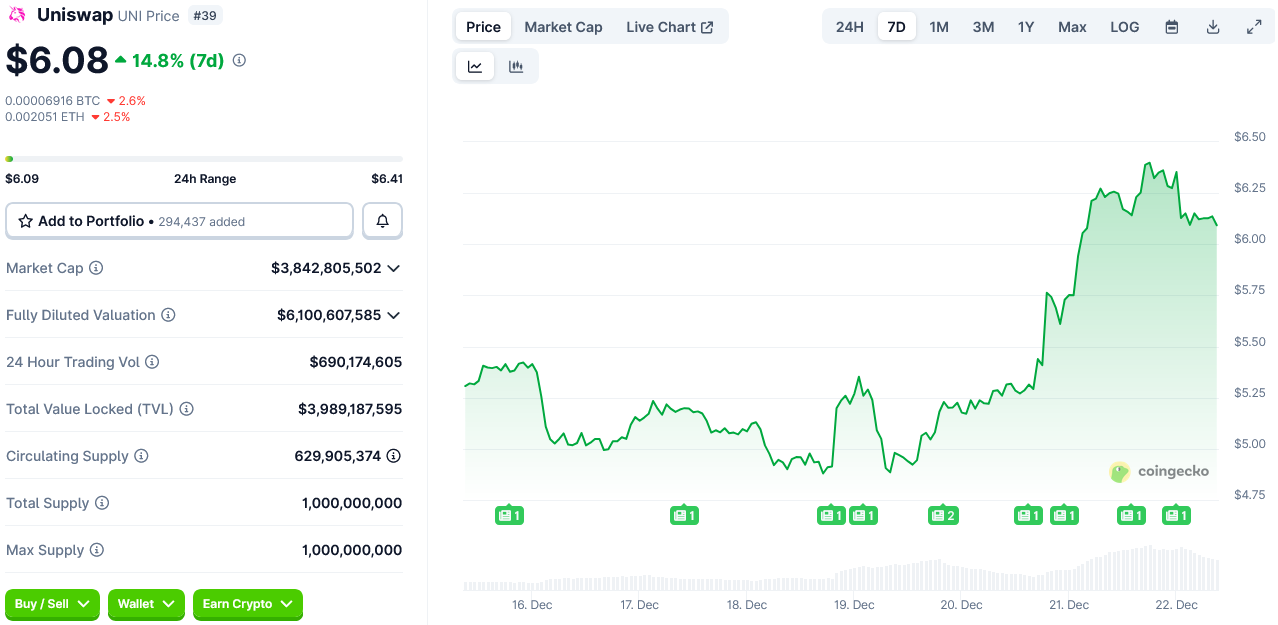
Change in UNI’s price over the last week. Source: CoinGecko

News of the UNIfication proposal in early November spurred a near 40% rally in the UNI token, taking it from about $7 to $9.70 on Nov. 11.

Uniswap is the largest decentralized exchange and has processed more than $4 trillion in trading volume since launching in November 2018. CoinGecko data shows that UNI is the 39th largest token by market cap, at $3.8 billion.

Big names back UNIfication proposal

Several crypto heavyweights with significant voting power backed the UNIfication proposal, including Jesse Waldren, founder and managing partner at crypto-focused venture capital firm Variant, Kain Warwick, the founder of decentralized finance protocols Infinex and Synthetix, and Ian Lapham, who previously worked as an engineer at Uniswap Labs.

Related: Altcoin season never ended, traders just missed the winners: Hayes

Only 741 votes, about 0.001% of those cast, have opposed the proposal so far, while a little over 1.5 million votes have abstained.
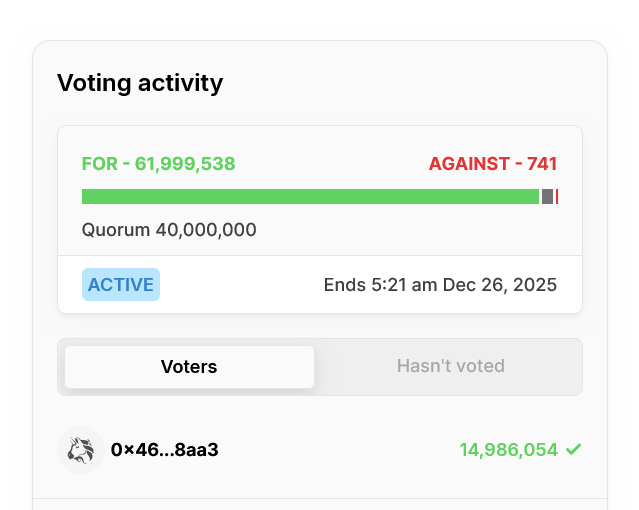
Vote distribution for the UNIfication proposal as of late Sunday. Source: Uniswap


Uniswap will still prioritize protocol development

At the time the proposal was made, the Uniswap Foundation assured builders that it wouldn’t scrap issuing grants to improve protocol development and growth, stating that supporting builders would remain a priority.

The Uniswap Foundation plans to create a Growth Budget to meet these goals, which would involve distributing 20 million UNI tokens.

Magazine: 11 critical moments in Ethereum’s history that made it the No.2 blockchain

Domande pertinenti

QWhat is the name of the Uniswap governance proposal that is set to pass, and what is its primary purpose?

AThe proposal is called 'UNIfication.' Its primary purpose is to activate the protocol fee switch, which will burn UNI tokens and implement a Protocol Fee Discount Auctions system to increase liquidity provider returns.

QHow many votes were required for the UNIfication proposal to pass, and how many have been cast in favor so far?

AThe proposal required 40 million votes to pass. As of early Monday, nearly 62 million votes have been cast in favor of it.

QWhat are the two main changes that will occur if the UNIfication proposal is successfully implemented?

AFirst, 100 million UNI tokens will be burned from the Uniswap Foundation's treasury. Second, a Protocol Fee Discount Auctions system will be implemented to increase returns for liquidity providers.

QHow has the price of the UNI token reacted to the news of the UNIfication proposal?

AThe UNI token gained around 25% since the voting opened, rising from a seven-month low of $4.88 to trade at $6.08, helping it recover from a prolonged slump.

QWhich prominent figures in the crypto industry have publicly backed the UNIfication proposal?

AProminent backers include Jesse Waldren (founder of Variant), Kain Warwick (founder of Infinex and Synthetix), and Ian Lapham (a former Uniswap Labs engineer).

Letture associate

a16z: AI's 'Amnesia', Can Continuous Learning Cure It?

The article "a16z: AI's 'Amnesia' – Can Continual Learning Cure It?" explores the limitations of current large language models (LLMs), which, like the protagonist in the film *Memento*, are trapped in a perpetual present—unable to form new memories after training. While methods like in-context learning (ICL), retrieval-augmented generation (RAG), and external scaffolding (e.g., chat history, prompts) provide temporary solutions, they fail to enable true internalization of new knowledge. The authors argue that compression—the core of learning during training—is halted at deployment, preventing models from generalizing, discovering novel solutions (e.g., mathematical proofs), or handling adversarial scenarios. The piece introduces *continual learning* as a critical research direction to address this, categorizing approaches into three paths: 1. **Context**: Scaling external memory via longer context windows, multi-agent systems, and smarter retrieval. 2. **Modules**: Using pluggable adapters or external memory layers for specialization without full retraining. 3. **Weights**: Enabling parameter updates through sparse training, test-time training, meta-learning, distillation, and reinforcement learning from feedback. Challenges include catastrophic forgetting, safety risks, and auditability, but overcoming these could unlock models that learn iteratively from experience. The conclusion emphasizes that while context-based methods are effective, true breakthroughs require models to compress new information into weights post-deployment, moving from mere retrieval to genuine learning.

marsbit21 min fa

a16z: AI's 'Amnesia', Can Continuous Learning Cure It?

marsbit21 min fa

Can a Hair Dryer Earn $34,000? Deciphering the Reflexivity Paradox in Prediction Markets

An individual manipulated a weather sensor at Paris Charles de Gaulle Airport with a portable heat source, causing a Polymarket weather market to settle at 22°C and earning $34,000. This incident highlights a fundamental issue in prediction markets: when a market aims to reflect reality, it also incentivizes participants to influence that reality. Prediction markets operate on two layers: platform rules (what outcome counts as a win) and data sources (what actually happened). While most focus on rules, the real vulnerability lies in the data source. If reality is recorded through a specific source, influencing that source directly affects market settlement. The article categorizes markets by their vulnerability: 1. **Single-point physical data sources** (e.g., weather stations): Easily manipulated through physical interference. 2. **Insider information markets** (e.g., MrBeast video details): Insiders like team members use non-public information to trade. Kalshi fined a剪辑师 $20,000 for insider trading. 3. **Actor-manipulated markets** (e.g., Andrew Tate’s tweet counts): The subject of the market can control the outcome. Evidence suggests Tate’sociated accounts coordinated to profit. 4. **Individual-action markets** (e.g., WNBA disruptions): A single person can execute an event to profit from their pre-placed bets. Kalshi and Polymarket handle these issues differently. Kalshi enforces strict KYC, publicly penalizes insider trading, and reports to regulators. Polymarket, with its anonymous wallet-based system, has historically been more permissive, arguing that insider information improves market accuracy. However, it cooperated with authorities in the "Van Dyke case," where a user traded on classified government information. The core paradox is reflexivity: prediction markets are designed to discover truth, but their financial incentives can distort reality. The more valuable a prediction becomes, the more likely participants are to influence the event itself. The market ceases to be a mirror of reality and instead shapes it.

marsbit1 h fa

Can a Hair Dryer Earn $34,000? Deciphering the Reflexivity Paradox in Prediction Markets

marsbit1 h fa

Trading

Spot
Futures
活动图片





