Understanding Bound in One Article: The "Multi-signature + Timelock" Escape Mechanism and the Off-Chain Matching Black Box

marsbitPubblicato 2026-05-25Pubblicato ultima volta 2026-05-25

Introduzione

**Title**: Understanding Bound: The Escape Mechanism of "Multi-Sig + Time Lock" and the Off-Chain Matching Black Box **Summary**: Bound Exchange, evolved from the earlier radFi platform, introduces a novel approach to Bitcoin trading by combining self-custody security with exchange-like speed. Its core mechanism relies on a 2-of-2 multi-signature (multi-sig) address for user deposits. One private key is held by the user via a passkey, and the other is held by Bound. This setup requires both keys to sign any transaction, preventing Bound from unilaterally accessing user funds (non-custodial). To address the risk of Bound becoming unavailable, a 3-month timelock is integrated into the Bitcoin script. After this period, users can withdraw their assets with just their single signature, ensuring an escape hatch. For trading, Bound operates a concentrated liquidity AMM. However, as Bitcoin L1 lacks smart contracts, the AMM curve, liquidity management, and trade price calculations occur off-chain in Bound's backend database. On-chain Bitcoin transactions serve only as final settlement receipts for pre-determined amounts. This creates a centralization point: the critical sequence of trade execution—which determines the exact price along the curve for each order—is managed off-chain by Bound in a non-transparent "black box." While the 2-of-2 setup protects user本金 (principal), the pricing and ordering of trades introduce potential operational MEV risks, as the order processing is inv...

Author: 798.eth

The Bound platform, currently popular in the Bitcoin ecosystem, was formerly known as Radfi. It started as a platform I began using at the end of 2025, associated with the NodeStrategy monkey strategy token, and has now upgraded and rebranded as Bound Exchange. This platform features a unique asset, essentially the monkey strategy—a flywheel for Node Monkeys with underlying asset support. The key is whether the underlying assets can sustain it.

Today, I'll mainly discuss its asset deposit/withdrawal and trading logic. But before diving into the mechanisms, let me first explain the differences between the upgraded Bound and the original Radfi.

1. Past and Present: From Radfi to Bound

Bound didn't emerge out of thin air; it's a complete rewrite and evolution of Radfi. The Radfi website now displays a line stating, "Radfi has evolved into bound.exchange." It's the same team, with the tech stack migrated from Create-React-App to Next.js—a full rewrite.

Bound's key additions are a passkey-built-in multi-chain wallet, fixed-term loans collateralized by Bitcoin for bUSD, and SODAX cross-chain. The trading engine remains Radfi's concentrated liquidity AMM; the Runes swap functionality is unchanged.

This product line features two sets of 2-of-2 plus timelock. The account layer set protects you, allowing you to bypass Bound after three months; the lending set protects lenders, allowing them to directly take your collateral after the grace period expires. (See chart for a side-by-side comparison of Radfi → Bound)
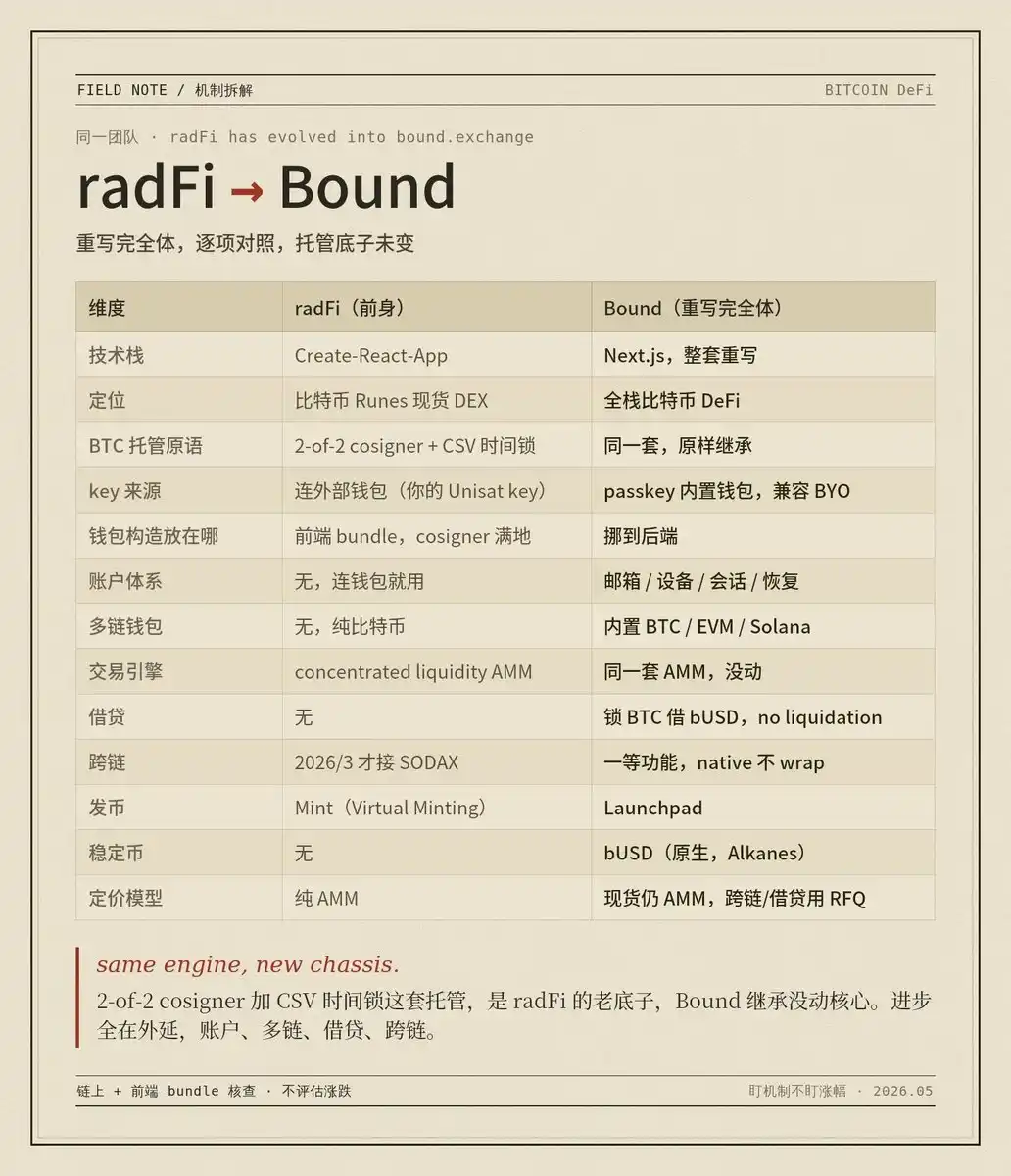
2. Core Mechanism: Asset Deposit/Withdrawal and 2-of-2 Multi-Signature Custody

Understanding its positioning, let's examine its asset management logic. There are two main points: 2-of-2 multi-signature custody, and timelock countdown protection in the event of platform abandonment or downtime.

First, set up the scenario. You have BTC and want to trade on a platform. The traditional method is to send coins to the platform's wallet, where they are held for you. The problem is the coins are no longer in your possession; if the platform runs away or is hacked, your coins are gone—FTX and Celsius failed this way. Bound aims to solve this contradiction: achieving CEX-like transaction speed without relinquishing control of your coins.

Step 1: What is a deposit?

After registering, Bound provides you with a Bitcoin address, starting with "bc1p." To trade, you first transfer BTC from your wallet to this address. This is a standard Bitcoin transfer, taking about half an hour with 3 confirmations. Up to this point, it's no different from using a regular wallet. The real design lies in the next question.

Step 2: Who holds the private key for this address?

This is the core of the entire system. There are only two naive approaches: if the private key is solely with the platform, it's custodial, reverting to the FTX problem; if it's solely with you, the platform cannot facilitate fast trades, requiring manual signing for every transaction—slow.

Bound's solution is that this address doesn't have just one key; it has two. To move coins from it, both keys must sign. This is 2-of-2 multi-signature.

Step 3: Whose keys are these?

One is yours, stored on your device, invoked via passkey, with the private key never leaving the device. The other is in Bound's backend. During daily trading, you sign with your passkey, Bound's backend automatically adds the other signature, and with both combined, settlement is near-instantaneous.

Pause here to consider this. Bound holds only one key; it cannot move your coins unilaterally, so it's not custodial and cannot lend out or misappropriate your coins. But together, you can achieve instant settlement, recovering the speed. This is the intended effect of 2-of-2—achieving both security and speed.

Step 4: What problem does the timelock solve?

2-of-2 introduces a new issue. Since two keys are required, what if Bound runs away, goes down, or is shut down? The backend key might be lost forever, leaving you with only one key. Would your coins be locked in the address forever?

Timelock plugs this hole. The rule is simple: Bound's co-signing key has a 3-month validity period. Within 3 months, moving coins requires both keys. After 3 months, you can withdraw all coins with just your single key, no longer needing Bound.

Crucially, this isn't just a promise from Bound; it's encoded into the Bitcoin script and enforced by the Bitcoin network. Bound's consent is irrelevant; when the time comes, you can single-sign and leave. This is the foundation of its claim to be self-custodial.

Step 5: Withdrawals now make sense.

For normal withdrawals, your passkey signs plus Bound's backend co-signs—both keys ready, instant arrival. For emergency withdrawals, if Bound disappears, you wait out the 3-month timelock, then use your single key to sweep the coins to any address.

Linking these five steps together, the initial four terms form a chain: you deposit coins into a 2-of-2 address (deposit); daily, you and Bound spend together (fast-path withdrawal); Bound's key expires in 3 months (timelock); after expiry, you can leave with just one key (escape-hatch withdrawal).

3. Underlying Logic: Bound Exchange's Transaction Sequencing

Having understood how assets are deposited, let's discuss Bound Exchange's transaction sequencing.

There are no smart contracts on Bitcoin. So, for a native Bitcoin DEX's AMM, where is matching done, and who decides the order of your trades? Essentially, it's a CEX-like matching backend, with the Bitcoin blockchain serving as the settlement layer. Let's break it down:

  • First, the AMM curve is not on-chain. BTC L1 lacks contracts; states like reserves, ticks, and liquidity ranges have nowhere to be stored and must reside in Bound's backend database. The UTXOs on-chain only represent the settlement outcome of LPs' funds under custody.

  • Second, on-chain transactions are merely settlement receipts. I pulled the trade history of that pool; each inflow/outflow is a fixed, predetermined amount, containing no curve calculation itself. The multiplication along the curve is completed off-chain in the backend before anything goes on-chain. The dozens of trades in a block, each spending separate UTXOs, unconnected to each other, precisely because the price was fixed off-chain; going on-chain is just about recording a set of pre-calculated numbers.

  • Third, how is a single trade priced? When you want to buy/sell on the frontend, the frontend requests a quote from the backend. The backend calculates using its maintained concentrated liquidity curve, your order consumes liquidity along the tick, fees are deducted, and it gives you a number. You sign a PSBT locking in this number, the backend verifies and co-signs/broadcasts it, simultaneously advancing its off-chain curve by one step. The curve lives only in the backend.

  • Fourth, sequencing is mathematically forced by this curve and unavoidable. The curve has state; at any moment, there's only one current position. Each incoming order consumes a segment of liquidity, pushing the curve to a new position; the next order can only execute at the new position. This means all orders inherently cannot settle simultaneously; they must be arranged in a strict sequential order. The first trade executes at the original position, pushing the curve one step; the second executes at the new position, pushing it again, and so on.

  • Fifth, but who decides this order and based on what is another matter. Distinguish between two sequences: one is the real-time timestamp when you click confirm, the other is the processing order the backend actually uses to advance the curve. Nothing on-chain or in the protocol guarantees these two match. Your order enters Bound's backend queue. Whether it declares the order, processes by arrival time, or bumps someone ahead/behind, is entirely its internal affair—you cannot see it.

  • Sixth, this is the entry point for operator MEV, even sharper than typical on-chain MEV. In general DEXes, the transaction order is at least visible in the block; front-running, sandwiching can be analyzed afterward. Bound's sequencing occurs off-chain; after results are settled in a block, even sequential traces are absent—dozens of unrelated transactions show no order on-chain. However, at the moment you click confirm, the price is already calculated based on a point on the curve. You just don't know its position within the block's sequence.

Therefore, Bound does have order; order is mathematically mandatory. It simply centralizes the power to define this order entirely within a black box. At the principal level, it is indeed self-custodial—2-of-2 plus timelock, the platform cannot move your coins. But the price and sequence at which your trade executes are accounted for off-chain by it alone. Ultimately, this is a CEX-like matching backend, interfacing with the world's largest blockchain for settlement, finalizing roughly every ten minutes with an immutable block.

4. Practical Tips and Experience Feedback

Finally, two practical details to avoid pitfalls. This 2-of-2 address only accepts BTC and Runes. Sending BRC-20, Alkanes, or coins from other chains will result in permanent loss. Alternatively, you can bypass Bound's system and directly connect your own Unisat or Xverse wallet. That means no 2-of-2 or timelock; coins remain in your single-signature wallet, but the trade-off is requiring manual signing for every transaction.

Based on current experience, there are still minor issues. I tested; a previous transaction already had two block confirmations, but the Bound frontend still showed "pending," preventing me from placing the next order. Hopefully, @Bound_Exchange official can look into this problem.


Crypto di tendenza

Domande pertinenti

QWhat is the core security mechanism of Bound exchange for user assets, and how does it work?

ABound's core security mechanism for user assets is a combination of a 2-of-2 multisignature scheme and a timelock. Users deposit assets into a bitcoin address (starting with bc1p). This address requires two private keys to sign any transaction moving funds: one is held by the user (secured by passkey on their device), and the other is held by Bound's backend. For everyday transactions, both keys sign, enabling fast execution. Crucially, Bound's key has a 3-month timelock. After this period, the user's key alone is sufficient to withdraw all funds, providing a self-custody escape hatch even if Bound becomes non-operational.

QHow does Bound's trading and price determination work, given that Bitcoin lacks smart contracts?

ABound operates as a centralized exchange (CEX) backend with Bitcoin as a settlement layer. The AMM's concentrated liquidity curve, tick states, and LP reserves are not stored on-chain but are maintained in Bound's private database. When a user initiates a trade, the frontend requests a quote from this backend. The backend calculates the execution price based on its internal liquidity curve, deducts fees, and provides a fixed amount. The user signs a Partially Signed Bitcoin Transaction (PSBT) with this amount, which Bound co-signs and broadcasts. The on-chain transaction is merely a settlement receipt of the pre-calculated result.

QWhat is a key difference between using Bound's built-in passkey wallet versus connecting an external wallet like Unisat or Xverse?

AThe key difference lies in security, convenience, and custody. Using Bound's built-in passkey wallet enables the 2-of-2 multisig and timelock mechanism, providing a balance of fast transaction execution and a self-custody safety net. If you connect an external wallet (like Unisat or Xverse), your assets remain in your single-signature (single-sig) wallet at all times. This means you have full and immediate control (no timelock), but the trade-off is that you must manually sign every single transaction yourself, which is slower.

QAccording to the article, what is the main source of potential Miner Extractable Value (MEV) in Bound's system?

AThe primary source of potential MEV (or more precisely, operator extractable value) in Bound's system is the opaque, off-chain transaction sequencing. While the mathematical AMM curve necessitates a strict sequential order for processing trades, this ordering is entirely managed within Bound's private backend. Unlike on-chain DEXs where transaction order is publicly visible in a block, Bound's internal queue is a black box. The operator could potentially reorder trades, front-run, or sandwich user transactions for profit without leaving a discernible trace on the blockchain, as the final on-chain settlements appear as unrelated, fixed-amount transactions.

QWhat is the evolution of Bound exchange, and what key features were added in the upgrade from Radfi?

ABound exchange is a complete rewrite and evolution of the previous platform Radfi. The core technology stack was switched from Create-React-App to Next.js. Key features added in the Bound upgrade include: 1) A built-in, passkey-secured multi-chain wallet. 2) A time-locked loan product allowing Bitcoin抵押 to borrow bUSD. 3) SODAX for cross-chain functionality. The original Radfi concentrated liquidity AMM engine for Runes swapping remained unchanged. The system also implements two separate 2-of-2 + timelock setups: one at the account layer to protect users and another for the lending product to protect lenders.

Letture associate

In Jinjiang, Fujian, a Storage Super Unicorn Lies Quiet

In Fujian's Jinjiang, a city known for sportswear, lies a quiet semiconductor giant: Fujian Jinhua Integrated Circuit Co. (JHICC). Once a promising domestic DRAM manufacturer alongside Yangtze Memory and ChangXin Memory Technologies (CXMT), its journey was derailed in 2018 when the U.S. placed it on an Entity List and filed criminal charges for alleged trade secret theft. This halted production for years. A turning point came in February 2024 when a U.S. federal court found JHICC not guilty. However, it had lost crucial time. While CXMT soared to become a top-valued A-share company in 2024, JHICC, with an estimated valuation of 80 billion RMB, was just restarting. Its current output is primarily customized DDR4 chips, not the advanced DDR5/HBM demanded for AI, but it still benefits from the broader memory chip upcycle. JHICC's story is tied to Chen Zhengkun, a veteran engineer who left Micron to lead the venture. Founded in 2016 with state-backed funding, JHICC partnered with Taiwan's UMC to develop DRAM technology. Rapid progress was cut short by the U.S. actions, which Micron initiated, partly due to its heavy reliance on the Chinese market. Post-sanctions, Chen's team worked to rebuild the production line with reduced reliance on U.S. technology. According to its records, JHICC achieved small-scale production and revenue growth under immense pressure. It now focuses on the stable "niche" DRAM market (e.g., TVs, routers) with a monthly capacity of ~40,000 wafers, aiming for 60,000 by 2026. It holds over 1,000 patents but remains on the Entity List. For Jinjiang, investing in JHICC was a bold industrial leap. The local government provided unwavering financial and logistical support during the crisis, helping the company survive. JHICC has become the anchor for a growing local semiconductor cluster. Though its scale lags behind domestic peers, JHICC's persistence symbolizes a hard-won foothold in a global market long dominated by Samsung, SK Hynix, and Micron. Having missed one boom, it seeks a place in the new AI-driven memory supercycle.

marsbit14 min fa

In Jinjiang, Fujian, a Storage Super Unicorn Lies Quiet

marsbit14 min fa

Must-Watch Events Next Week|CLARITY Act Could Face Senate Vote; SpaceX, Circle to Report Earnings (8.3-8.9)

**Summary: Key Events and Developments to Watch (August 3-9)** The upcoming week is marked by significant financial disclosures, key legislative deadlines, and notable product updates. **Major Financial Events:** Several companies are scheduled to release their Q2 2026 earnings. American Bitcoin (ABTC) will report on August 3, followed by SpaceX and Hut 8 Mining Corp. on August 4, and Circle on August 5. Notably, a significant portion of SpaceX shares (up to 12% of total shares) will be unlocked on August 6 following their earnings release. **Key Legislative Deadline:** The U.S. Senate faces an August 7 deadline to secure 60 votes for the CLARITY Act, a bipartisan bill aiming to establish a federal regulatory framework for cryptocurrencies. The Senate may hold a full vote on the bill during the week. **Economic Data:** The U.S. July Non-Farm Payrolls report will be released on August 7, providing crucial labor market data. **Technology & Product Updates:** * **Shutdowns:** DeFi portfolio tracker Zapper and wallet app Ctrl Wallet will cease operations on August 3. * **Upgrades:** LayerZero will deprecate its v1 relayers on August 3. XRP Ledger's new version 3.3.0, featuring five new functions, is expected next week. * **AI:** Elon Musk announced that the advanced Grok 4.6 AI model is set for release around August 7. * **Bitcoin:** The BIP-110 forced signaling for a potential Bitcoin network change is scheduled to begin around August 8. **Other Notable Events:** Chinese robotics firm Unitree Tech has set its preliminary price inquiry for its IPO for August 5. South Korean exchange Upbit will delist AQT and AERGO tokens on August 3.

marsbit2 h fa

Must-Watch Events Next Week|CLARITY Act Could Face Senate Vote; SpaceX, Circle to Report Earnings (8.3-8.9)

marsbit2 h fa

Trading

Spot

Articoli Popolari

Come comprare ONE

Benvenuto in HTX.com! Abbiamo reso l'acquisto di Harmony (ONE) semplice e conveniente. Segui la nostra guida passo passo per intraprendere il tuo viaggio nel mondo delle criptovalute.Step 1: Crea il tuo Account HTXUsa la tua email o numero di telefono per registrarti il tuo account gratuito su HTX. Vivi un'esperienza facile e sblocca tutte le funzionalità,Crea il mio accountStep 2: Vai in Acquista crypto e seleziona il tuo metodo di pagamentoCarta di credito/debito: utilizza la tua Visa o Mastercard per acquistare immediatamente HarmonyONE.Bilancio: Usa i fondi dal bilancio del tuo account HTX per fare trading senza problemi.Terze parti: abbiamo aggiunto metodi di pagamento molto utilizzati come Google Pay e Apple Pay per maggiore comodità.P2P: Fai trading direttamente con altri utenti HTX.Over-the-Counter (OTC): Offriamo servizi su misura e tassi di cambio competitivi per i trader.Step 3: Conserva Harmony (ONE)Dopo aver acquistato Harmony (ONE), conserva nel tuo account HTX. In alternativa, puoi inviare tramite trasferimento blockchain o scambiare per altre criptovalute.Step 4: Scambia Harmony (ONE)Scambia facilmente Harmony (ONE) nel mercato spot di HTX. Accedi al tuo account, seleziona la tua coppia di trading, esegui le tue operazioni e monitora in tempo reale. Offriamo un'esperienza user-friendly sia per chi ha appena iniziato che per i trader più esperti.

401 Totale visualizzazioniPubblicato il 2024.12.12Aggiornato il 2026.06.02

Come comprare ONE

Discussioni

Benvenuto nella Community HTX. Qui puoi rimanere informato sugli ultimi sviluppi della piattaforma e accedere ad approfondimenti esperti sul mercato. Le opinioni degli utenti sul prezzo di ONE ONE sono presentate come di seguito.

活动图片












