Undercurrents of Capital in the Midst of Middle East Turmoil: Option Data Reveals BTC's Safe-Haven Logic

比推Pubblicato 2026-03-02Pubblicato ultima volta 2026-03-02

Introduzione

Amidst the unprecedented geopolitical shock triggered by the U.S.-Israel military strike on Iran on March 1, 2026, global markets witnessed a classic flight to safety, with oil and gold surging while risk assets faced initial sell-offs. Bitcoin, positioned between its “digital gold” narrative and high-risk asset attributes, showed resilience by holding the key support level of $67,000. Deribit期权数据揭示BTC期权隐含波动率 surged to 51.3%, reflecting heightened expectations of near-term volatility. The significant divergence between the spot price (~$67,400) and the options max pain point at $76,000 indicates persistent institutional bullish sentiment before the crisis. The put/call open interest ratio of 0.75 shows dominant call holdings, while the 24-hour volume put/call ratio of 1.37 reveals tactical hedging via puts amid the crisis. A break below $65,000 could trigger a sell-off due to market maker hedging, potentially testing $60,000. Conversely, if tensions ease, a gamma squeeze above $70,000 could rapidly push BTC toward the $76,000 max pain level. The event underscores Bitcoin’s growing role as a non-sovereign, uncorrelated asset in institutional portfolios amid escalating geopolitical risks.

On March 1, 2026, the global macro markets encountered an epic "black swan" event: direct military strikes by the United States and Israel against Iran resulted in the death of Iran's Supreme Leader, Ayatollah Khamenei.

This extreme tail-risk event instantly reshaped the risk premium models for global asset classes. The complete ignition of the Middle East powder keg not only caused violent fluctuations in traditional crude oil and safe-haven assets but also pushed the cryptocurrency market, at a critical juncture of博弈, to a crossroads of liquidity and pricing power.

Combining Binance spot market data with Deribit option data, this analysis delves into the immediate impact of this geopolitical crisis on the cryptocurrency market from a quantitative and derivatives博弈 perspective, offering a forward-looking projection of future volatility paths and market trends.

The essence of geopolitical conflict is the reshaping of global supply chains, energy prices, and the ensuing inflation expectations. The financial market transmission of this surprise US-Israel attack on Iran manifested as a textbook risk-aversion pattern: commodities like crude oil and gold became the preferred safe havens, while high-risk assets faced indiscriminate selling in the first instance.
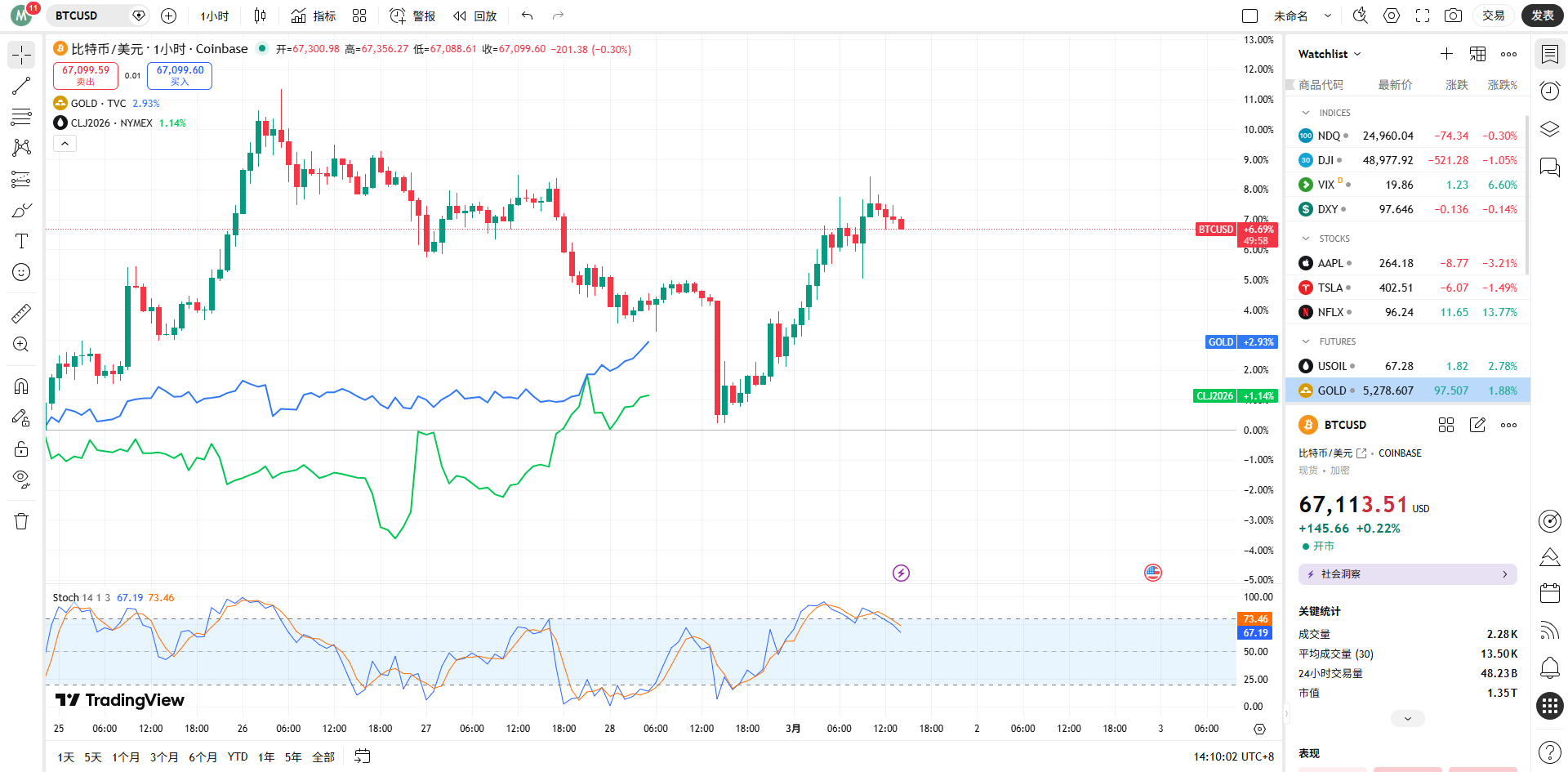
With the outbreak of high-intensity conflict in the Middle East, the primary concerns are the global energy supply chain and the safe-haven sentiment towards the fiat currency credit system. In traditional financial markets, Brent crude oil is highly likely to gap up on open due to panic over potential supply disruptions, and traditional safe-haven assets like gold will also see intensive accumulation by institutional funds. However, in the crypto asset space, BTC's "digital gold" narrative and its "high-beta risk asset"属性 are experiencing intense internal conflict.

From a macro liquidity perspective, panic induced by geopolitics (a soaring VIX index) typically triggers cross-asset indiscriminate selling in the first instance to secure US dollar liquidity. But after a brief liquidity squeeze, Bitcoin, which is不受特定主权国家控制 and possesses抗审查与便携属性, often attracts capital fleeing from high-risk emerging market fiat currencies.

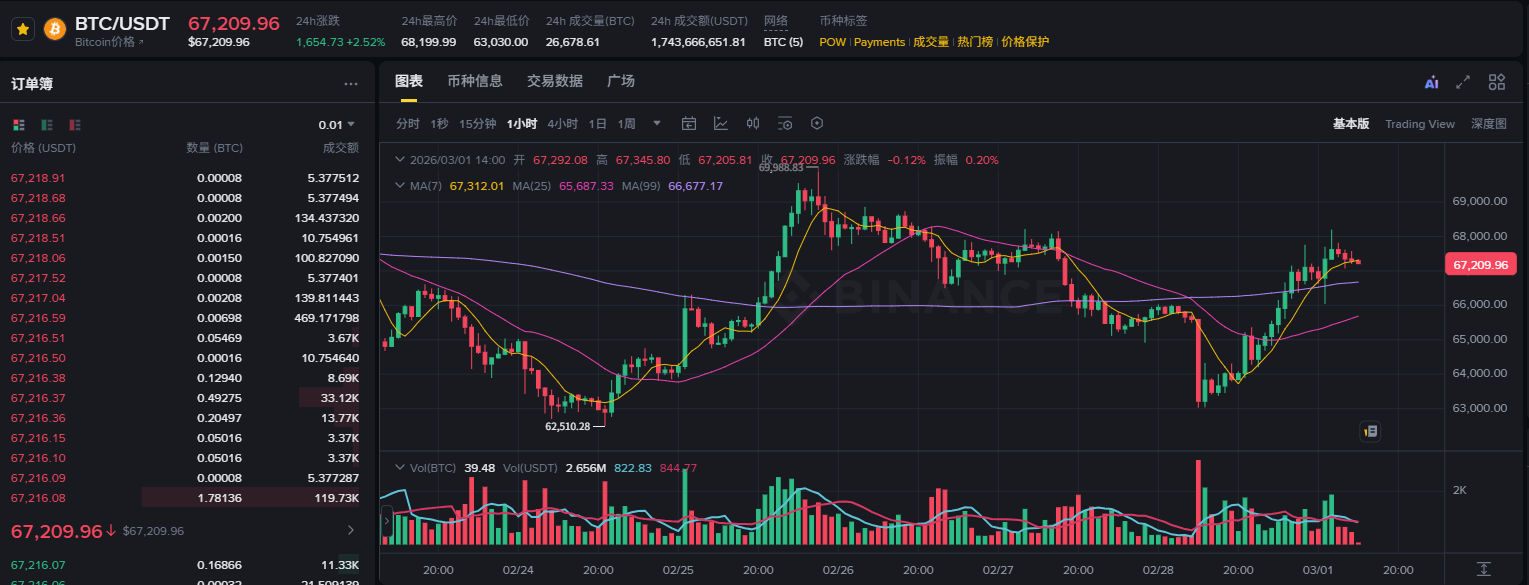
Combining Binance's spot and contract market data (as of 14:00 on March 1, 2026), the BTC/USDT spot price is oscillating around $67,392. In the initial phase of such a major geopolitical crisis, BTC did not experience a crash similar to the "312" event of 2020 but tenaciously held the key support level of $67,000.

The 24-hour trading volume reached a high of $1.74 billion, indicating significant disagreement and turnover between bulls and bears at this level. The moving average system in the price chart shows a pattern of high volatility after a多头排列, suggesting that, under the impact of sudden news, the承接盘力量 in the spot market is exceptionally robust, and the long-term配置底仓 of institutional funds has not fundamentally shifted.
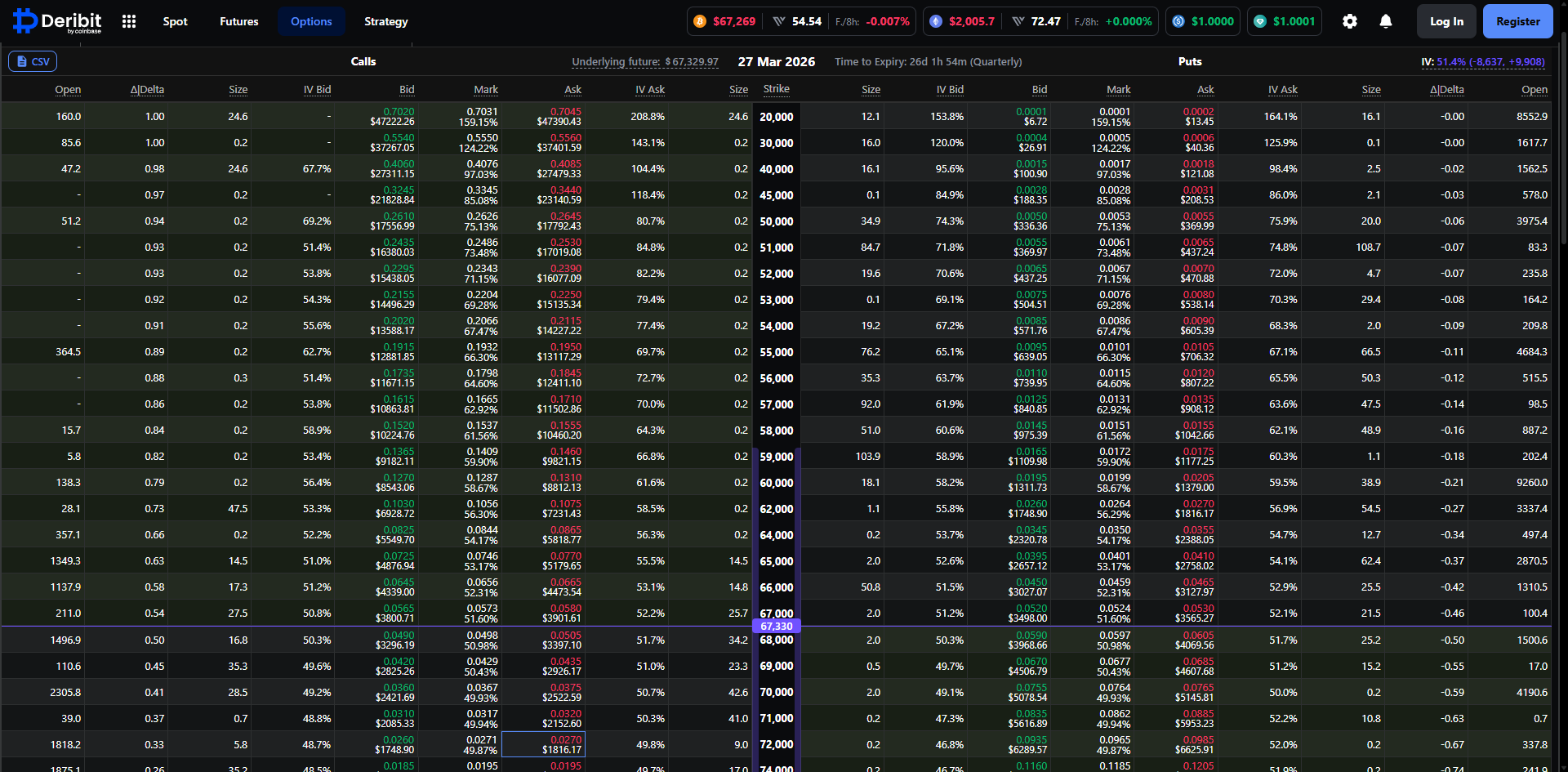
To透视聪明资金的真实意图, the derivatives market, especially option data, provides the most直观的量化截面. By analyzing the current BTC option data expiring on March 27, 2026, on the Deribit platform, we can clearly outline the path projection of major institutions for the next month.

The current implied volatility (IV) for BTC options expiring on March 27 has reached a relatively high level of 51.3%. Against the backdrop of the geopolitical crisis, option sellers quickly raised the volatility surface to hedge against the Gamma exposure risks posed by extreme market movements. An IV above 51% indicates the market is hedging against potential wide fluctuations in the next two to three weeks. For quantitative traders, the risk-reward ratio for selling volatility at this time is extremely poor, and the market is overall in a frenzy of "buying straddles" or constructing tail-risk protection.
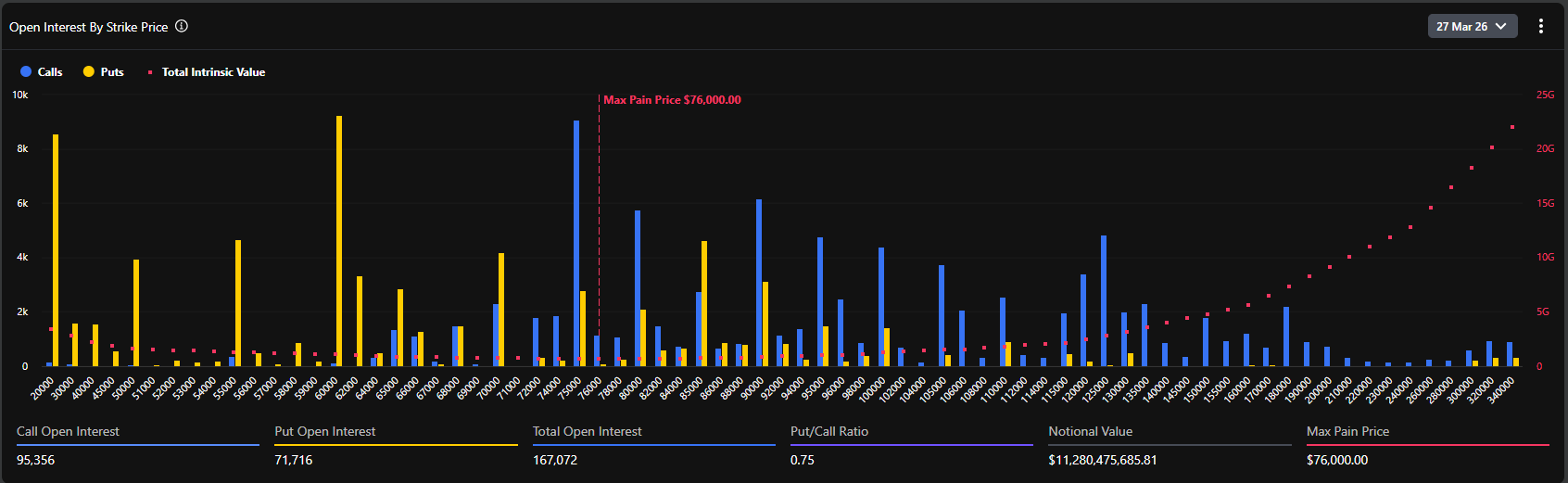
According to the open interest (OI) distribution chart for options, the current global maximum pain point is as high as $76,000. This is a highly forward-looking and controversial data point.

Typically, as expiration approaches, the underlying asset price tends to gravitate towards the maximum pain point to minimize the overall value for option buyers. However, the current spot price (around $67,400) is at a discount of nearly 12% to the maximum pain point ($76,000). This significant deviation reveals two core logics:

First, before the crisis erupted, the market was in an extremely optimistic bullish sentiment, with substantial funds betting on breaking through the all-time high (the $75,000–$80,000 range) by the end of March, which directly pushed the maximum pain point higher.

Second, the outbreak of the geopolitical crisis constituted a strong external shock, suppressing the upward momentum of the spot price. But judging from the total open interest of 167,072 BTC (notional value exceeding $11.2 billion), long positions did not experience large-scale unwinding and stampede due to the war news.

Data shows that the current put/call ratio (based on OI) is 0.75. This value, being below 1, indicates that from a global存量 perspective, call option (Call) open interest still dominates absolutely. Particularly at strike prices of $75,000, $80,000, and even $100,000, there are massive call open interest piles (with single strike open interest reaching nearly 10k BTC).

However, it is worth noting that the 24-hour volume PCR (Put/Call Volume Ratio) reached 1.37. The divergence between存量偏多 (0.75) and增量偏空 (1.37) perfectly captures the current market psychology: long-term institutions maintain their original long exposure (not selling spot, not closing long Calls), but in the short term following the outbreak of the Middle East war, substantial funds rushed in to buy out-of-the-money put options (OTM Puts) for tactical hedging, leading to a surge in short-term Put trading volume.

Combining detailed option data from Deribit, we observe that the distribution of Delta values is extremely dense in the $67,000 to $70,000 range. The current spot price of $67,495 is right in the "meat grinder" zone of the bull-bear struggle.

If the geopolitical situation further deteriorates, causing macro funds to withdraw en masse, and the spot price breaks below $65,000 (a strong support level), market makers, to hedge their short Put exposure, will be forced to sell in the spot or futures market, potentially triggering a wave of localized negative liquidity feedback, testing the psychological关口 of $60,000 downwards.

Conversely, if the Middle East situation enters a stalemate stage mediated by major powers after a brief violent conflict, and once the panic sentiment peaks and recedes, the rebound in the crypto market will be extremely fierce. Due to the massive accumulation of Call options in the $70,000 to $76,000 range above, once the spot price stabilizes and breaks through the $70,000 resistance level, market makers will be forced to buy spot to hedge their negative Gamma exposure. This classic "Gamma Squeeze" effect will propel the BTC price towards the maximum pain point of $76,000 at an unprecedented speed.

The aftershocks of the Middle East geopolitical tremor will continue to ferment. The subsequent actions of the US and Iran will determine the final destination of global safe-haven funds. In the foreseeable short term, BTC spot will experience violent whipsaws within a wide range of $62,000~$70,000. Leverage in the contract market will be反复清洗 during this process. Quantitative strategies should focus on "reducing leverage and capitalizing on volatility," suitable for constructing calendar spreads or grid market making at key support and resistance levels, avoiding unilateral trend exposure.

Judging from the option持仓结构, the massive expiration on March 27 is a gravitational center the market cannot bypass. Unless a global, uncontrollable World War III-level liquidity drought erupts, as panic sentiment marginally decreases, BTC's "safe-haven属性" and "anti-inflation属性" will be repriced. In mid-to-late March, the market is highly likely to initiate a restorative rebound, and the spot price has a strong incentive to move towards the $75,000–$76,000 range (the maximum pain point and dense Call strike zone).
This event marks the entry of geopolitics into a higher-risk phase. Whether it's the rekindling of inflation expectations brought by war (soaring crude oil) or the crisis of confidence in fiat currencies triggered by financial sanctions against specific countries, the strategic value of Bitcoin as a "borderless, non-sovereign hard asset" is being reinforced at the underlying logic level. For large institutions such as family offices and macro hedge funds, the单一的美元债+美股的60/40 portfolio can no longer cope with current tail risks. The allocation proportion of BTC as an "uncorrelated asset" in investment portfolios will undergo a systematic leap following this crisis.

The US and Israeli strike on Iran is the first thunderclap reshaping the global financial landscape in early 2026. Beneath the surface of panic, crypto option data冷静地揭示了机构资金's底牌 of "short-term defensive hedging, long-term依然看涨".

For professional financial practitioners, stripping away emotional noise and closely monitoring the trend of implied volatility changes and the transfer of market makers' Gamma exposure are the core codes to穿透战争迷雾 and grasp the next round of asset pricing power. With the $76,000 option maximum pain point standing like a lighthouse, every deep pullback caused by panic is accumulating potential energy for the future breakthrough.


Twitter:https://twitter.com/BitpushNewsCN

Bitpush TG Discussion Group:https://t.me/BitPushCommunity

Bitpush TG Subscription: https://t.me/bitpush

Original article link:https://www.bitpush.news/articles/7615676

Domande pertinenti

QWhat was the immediate impact of the US-Israel military strike on Iran on global financial markets, according to the article?

AThe strike triggered a classic risk-aversion pattern: crude oil and gold surged as safe-haven assets, while high-risk assets experienced indiscriminate selling. It also caused a significant repricing of global risk premiums.

QHow did the BTC price react initially to the geopolitical crisis, and what does its resilience at the $67,000 support level indicate?

ABTC did not crash but held firm at the $67,000 key support level with high trading volume ($1.74 billion in 24 hours), indicating strong buying interest and that long-term institutional holdings remained largely unchanged.

QWhat does the high Implied Volatility (IV) of 51.3% for BTC options expiring on March 27, 2026, suggest about market expectations?

AThe elevated IV indicates that the market is pricing in and hedging against the potential for wide price swings (high volatility) over the next few weeks due to the geopolitical crisis, making shorting volatility an unattractive strategy.

QWhat is the significance of the large discrepancy between the current BTC spot price (~$67,400) and the options market 'Max Pain' point at $76,000?

AThe 12%+ gap shows that the market was extremely bullish before the crisis, with heavy call option bets above $75k. The crisis temporarily suppressed the price, but the massive open interest suggests core bullish positions were not liquidated.

QHow does the Put/Call Ratio (PCR) analysis, showing a volume PCR of 1.37 against an open interest PCR of 0.75, reflect trader positioning?

AThis divergence shows that while the overall market structure is still net long (more calls held), there was a tactical, short-term surge in buying put options for downside protection immediately after the news broke, reflecting a 'long-term bullish, short-term cautious' stance.

Letture associate

Anthropic and OpenAI Have Single-Handedly Severed the Logic of Pre-IPO Stock Tokenization

The pre-IPO stock token market is experiencing significant turmoil following strong statements from AI giants Anthropic and OpenAI. Both companies have updated their official policies, declaring that any transfer of their company shares—including sales, transfers, or assignments of share interests—without prior board approval is "invalid" and will not be recognized in their corporate records. This means buyers in such unauthorized transactions would not be recognized as shareholders and would have no shareholder rights. A major point of contention is the use of Special Purpose Vehicles (SPVs), which are legal entities commonly used by pre-IPO token platforms to pool investor funds and indirectly acquire shares from employees or early investors. The companies explicitly state they do not permit SPVs to acquire their shares, and any such transfer violates their restrictions. They warn that third parties selling shares through SPVs, direct sales, forward contracts, or stock tokens are likely engaged in fraud or are offering worthless investments due to these transfer limits. This stance directly threatens the core model of many pre-IPO token platforms, which rely on SPV structures. The announcement revealed additional risks within this model, such as complex "SPV-within-SPV" layering that obscures legal transparency, increases management fees, and creates a chain reaction risk of invalidation. Following the news, tokens like ANTHROPIC and OPENAI on platforms like PreStocks fell sharply (over 20%). The market reaction highlights a divergence: while asset-backed pre-IPO tokens plummeted, purely speculative pre-IPO futures contracts, which are bilateral bets on future IPO prices with no claim to actual shares, remained relatively stable as they are unaffected by the transfer restrictions. The industry is split on the implications. Some believe the fundamental logic of pre-IPO token trading is broken if leading companies reject SPV-held shares, potentially causing a domino effect. Others, like Rivet founder Nick Abouzeid, argue that buyers of such unofficial tokens always knowingly accepted the risk of non-recognition by the company. The statements serve as a stark risk warning and a corrective measure for a market where valuations for some AI-related pre-IPO tokens had soared to irrational levels, far exceeding recent funding round valuations.

marsbit7 min fa

Anthropic and OpenAI Have Single-Handedly Severed the Logic of Pre-IPO Stock Tokenization

marsbit7 min fa

Anthropic and OpenAI Personally Sever the Logic of Pre-IPO Crypto-Stocks

The pre-IPO token market has been rocked by strong statements from Anthropic and OpenAI. Both AI giants have updated official warnings, declaring that any sale or transfer of their company shares without explicit board approval is "invalid" and will not be recognized on their corporate records. This directly targets Special Purpose Vehicles (SPVs), the common legal structure used by pre-IPO token platforms. These platforms typically use an SPV to acquire shares from employees or early investors, then issue blockchain-based tokens representing a claim on the SPV's economic benefits. Anthropic and OpenAI's position means that if an SPV's share purchase lacked authorization, the underlying asset could be deemed worthless, nullifying the token's value. Anthropic explicitly warned that any third party selling its shares—via direct sales, forwards, or tokens—is likely fraudulent or offering a valueless investment. The crackdown highlights risks in the popular SPV model, including complex multi-layered "Russian doll" SPV structures that obscure legal ownership, add fees, and concentrate risk. If one layer is invalidated, the entire chain could collapse. Following the announcements, tokens like ANTHROPIC and OPENAI on platforms like PreStocks fell sharply (over 20%). In contrast, purely speculative pre-IPO prediction contracts remained stable, as they involve no actual share ownership. The move is seen as a corrective measure amid a market frenzy where some pre-IPO token valuations (e.g., Anthropic's token hitting a $1.4 trillion implied valuation) far exceeded recent official funding rounds. Opinions are split: some believe this undermines the core logic of pre-IPO token trading if top companies reject SPVs, while others argue buyers always assumed this legal risk when accessing unofficial channels. The statements serve as a stark warning and a potential catalyst for market de-leveraging and clearer boundaries.

Odaily星球日报11 min fa

Anthropic and OpenAI Personally Sever the Logic of Pre-IPO Crypto-Stocks

Odaily星球日报11 min fa

The Waged Worker Driven to Poverty by AI Subscriptions

"AI Membership: The Hidden Cost Pushing Workers Toward 'Poverty'" The widespread corporate push for AI adoption is creating a hidden financial burden for employees. Companies, from giants like Alibaba to small firms, are mandating AI use, often tying token consumption to KPIs, but frequently refuse to cover the costs. Workers are forced to pay for subscriptions out of pocket to stay competitive and avoid being replaced. Front-end developer Long Shen spends up to 2000 RMB monthly on tools like Cursor and ChatGPT Plus, seeing it as a necessary 3% salary investment to handle 90% of his coding tasks. While it boosted his performance and led to promotions, he now faces idle time at work, pretending to be busy. Designer Peng Peng navigates strict company firewalls by using personal devices and accounts for AI image generation tools like Midjourney, spending hundreds monthly without reimbursement, while her boss demands faster, more numerous revisions. The pressure creates workplace anxiety and suspicion. Programmer Li Huahua, after a friend's experience of raised KPIs following AI success, fears being branded a "traitor" for using it yet worries about falling behind if she doesn't. The dynamic allows management to demand results without understanding the tools or covering expenses, treating employees like AI "agents." While some, like entrepreneur Jin Tu, find high value in paid AI, building entire systems and winning competitions, for most, it's a trap. Free tools like Kimi and Doubao are introducing fees, closing off alternatives. The initial efficiency gains individual advantage, but as AI becomes ubiquitous, the personal edge disappears, workloads increase, and a cycle of dependency begins. Workers like Long Shen realize they cannot maintain AI-generated code without AI, making stopping harder than continuing to pay. The tool promising liberation is instead becoming a compulsory, costly chain in the modern workplace.

marsbit1 h fa

The Waged Worker Driven to Poverty by AI Subscriptions

marsbit1 h fa

SK Hynix's Trillion-Won Empire: The Successors

"SK Hynix's Trillion-Won Empire and Its Heirs" explores the unconventional succession narrative within SK Group, South Korea's second-largest conglomerate, following SK Hynix's dramatic market rise. Unlike traditional chaebol scripts prioritizing the eldest son, ownership, and political marriages, Chairman Choi Tae-won's three children from his first marriage are charting distinct paths. The eldest daughter, Choi Yun-jeong, is considered the most visible candidate. With a background in biology, consulting, and a PhD, she holds executive roles at SK Bioscience and SK Inc.'s growth strategy unit, focusing on biopharma and new businesses. Her marriage is to an AI infrastructure entrepreneur, not a traditional chaebol heir. The second daughter, Choi Min-jeong, took a unique route by voluntarily serving as a South Korean naval officer, including a tour in the Gulf of Aden. She later worked on policy and strategy for SK Hynix in Washington D.C. before co-founding an AI-driven healthcare startup in San Francisco. She married a former U.S. Marine Corps officer, connecting the family to U.S. defense and policy networks. The son, Choi In-geun, who has Type 1 diabetes, followed a more classic preparatory path with a physics degree and a stint at SK E&S but left to join McKinsey's Seoul office. He remains publicly silent and holds no SK shares, defying the traditional "crown prince" archetype. Their paths unfold against the backdrop of their parents' high-profile, contentious divorce and a record-setting asset division lawsuit. The article argues that as SK Hynix becomes a geopolitical asset in the AI era, the conventional rules of chaebol inheritance are changing. The heirs are being groomed not simply to take over, but to navigate a complex global landscape defined by AI, biotech, geopolitics, and policy, forging legitimacy through their own expertise and networks rather than birth order alone.

marsbit1 h fa

SK Hynix's Trillion-Won Empire: The Successors

marsbit1 h fa

Trading

Spot
Futures

Articoli Popolari

Come comprare EPIC

Benvenuto in HTX.com! Abbiamo reso l'acquisto di Epic Chain (EPIC) semplice e conveniente. Segui la nostra guida passo passo per intraprendere il tuo viaggio nel mondo delle criptovalute.Step 1: Crea il tuo Account HTXUsa la tua email o numero di telefono per registrarti il tuo account gratuito su HTX. Vivi un'esperienza facile e sblocca tutte le funzionalità,Crea il mio accountStep 2: Vai in Acquista crypto e seleziona il tuo metodo di pagamentoCarta di credito/debito: utilizza la tua Visa o Mastercard per acquistare immediatamente Epic ChainEPIC.Bilancio: Usa i fondi dal bilancio del tuo account HTX per fare trading senza problemi.Terze parti: abbiamo aggiunto metodi di pagamento molto utilizzati come Google Pay e Apple Pay per maggiore comodità.P2P: Fai trading direttamente con altri utenti HTX.Over-the-Counter (OTC): Offriamo servizi su misura e tassi di cambio competitivi per i trader.Step 3: Conserva Epic Chain (EPIC)Dopo aver acquistato Epic Chain (EPIC), conserva nel tuo account HTX. In alternativa, puoi inviare tramite trasferimento blockchain o scambiare per altre criptovalute.Step 4: Scambia Epic Chain (EPIC)Scambia facilmente Epic Chain (EPIC) nel mercato spot di HTX. Accedi al tuo account, seleziona la tua coppia di trading, esegui le tue operazioni e monitora in tempo reale. Offriamo un'esperienza user-friendly sia per chi ha appena iniziato che per i trader più esperti.

184 Totale visualizzazioniPubblicato il 2025.03.17Aggiornato il 2025.03.21

Come comprare EPIC

Discussioni

Benvenuto nella Community HTX. Qui puoi rimanere informato sugli ultimi sviluppi della piattaforma e accedere ad approfondimenti esperti sul mercato. Le opinioni degli utenti sul prezzo di EPIC EPIC sono presentate come di seguito.

活动图片













