TVL on Robinhood Chain Approaches $100 Billion Amid Uniswap Liquidity: Standard Chartered

cryptonews.ruPubblicato 2026-08-13Pubblicato ultima volta 2026-08-13

Introduzione

TVL on the Robinhood Chain is approaching $1 billion, driven by a key partnership with Uniswap that provides liquidity, according to Standard Chartered. This collaboration is helping Robinhood scale its new blockchain rapidly by leveraging Uniswap's existing DeFi infrastructure (V2, V3, and V4 versions), instead of building liquidity from scratch. The partnership has also significantly impacted Uniswap's tokenomics. Since activating a fee-redirection mechanism related to Robinhood on July 27, the burn rate for UNI tokens has roughly doubled. At an annualized rate of about $90 million, this equates to burning over 4% of the circulating supply per year at current prices. Launched on July 1 with a focus on tokenizing real-world assets, Robinhood Chain saw nearly 194,000 daily active users in its first week. This blockchain initiative is part of Robinhood's broader strategy to expand beyond traditional stock trading into areas like crypto, prediction markets, and tokenization, which has drawn positive attention from Wall Street analysts.

The partnership between Robinhood and Uniswap is helping the brokerage rapidly build liquidity in its new blockchain. Standard Chartered believes this could remove the main obstacle to attracting users and assets.

In a recent note, Standard Chartered analyst Geoffrey Kendrick reported that the Total Value Locked (TVL) on Robinhood Chain has reached nearly $1 billion. He stated this is the fastest growth rate among all blockchains. Kendrick noted that Uniswap, through its V2, V3, and V4 versions, is providing virtually all of Robinhood Chain's liquidity.

This structure gives Robinhood access to developed DeFi infrastructure as the blockchain scales and strengthens the company's ability to attract users without the need to build liquidity from scratch.

The partnership is also significantly impacting Uniswap's tokenomics. According to Standard Chartered, the protocol's fees from operations on Robinhood have now become the largest source of $UNI token burning.

After the activation on July 27 of the fee redirection mechanism related to Robinhood, the $UNI burn rate approximately doubled, reaching an annualized rate of about $90 million. With $UNI's current price around $3.50, this translates to an annual burn of 25 million $UNI tokens—slightly over 4% of the circulating supply.
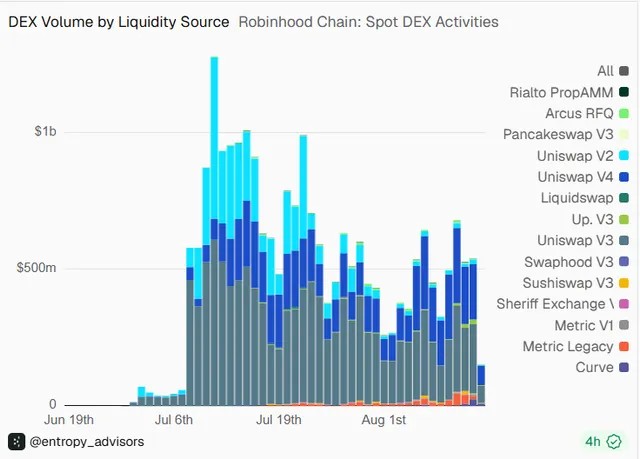
Sources of Robinhood Chain liquidity. Source: Standard Chartered

Robinhood Chain launched on July 1 with a focus on bringing real-world assets on-chain. Adoption accelerated quickly after launch: the number of daily active users reached 194,000 in the first week.

Related: Robinhood Chain Attracted Over $70 Million in ETH via Bridge in First Week

Robinhood's Crypto Business Expands Through Tokenization and Prediction Markets

Robinhood Chain is part of the brokerage's broader strategy to move beyond traditional stock trading: Robinhood is expanding its activities in crypto, prediction markets, and tokenization. The strategy has caught Wall Street's attention: analysts at Bernstein raised their price target for Robinhood (HOOD) stock to $160 per share and named tokenization and prediction markets as key growth factors.
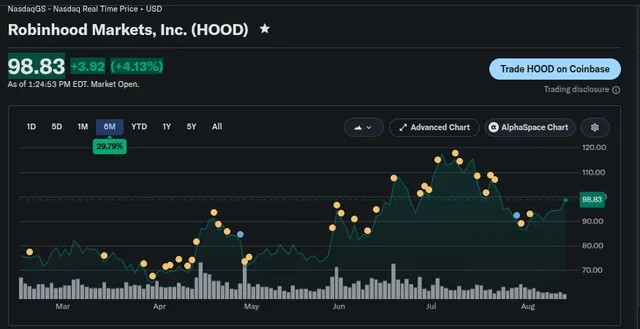
On Thursday, HOOD stock rose more than 4%, extending its six-month gain to nearly 30%. Source: Yahoo Finance.

The business expansion coincides with mixed performance in Robinhood's crypto business. The company reported record revenue and profit in the second quarter, despite a decline in crypto trading volumes and revenue.

Related: Robinhood in Talks with Crypto.com About Prediction Markets: WSJ

end-content
Domande pertinenti

QAccording to Standard Chartered, what is the main reason for the rapid growth of TVL on Robinhood Chain?

AStandard Chartered attributes the rapid growth of TVL on Robinhood Chain primarily to its partnership with Uniswap, which provides the majority of the chain's liquidity through its V2, V3, and V4 versions. This gives Robinhood access to a mature DeFi infrastructure.

QHow did the partnership with Robinhood Chain affect Uniswap's token ($UNI) burn rate?

AFollowing the activation of a fee switch related to Robinhood on July 27th, the burn rate of Uniswap's $UNI token approximately doubled. It reached an annualized rate of about $90 million, which at a price of $3.50 per $UNI, translates to the burning of around 25 million tokens annually.

QWhat is Robinhood Chain's primary focus, as mentioned in the article?

AAccording to the article, Robinhood Chain launched with a focus on bringing real-world assets (RWAs) on-chain.

QWhy did Bernstein analysts raise their price target for Robinhood's stock (HOOD)?

ABernstein analysts raised their price target for Robinhood's stock (HOOD) to $160 per share, citing tokenization and prediction markets as key growth factors for the company's broader strategy beyond traditional stock trading.

QDespite a strong Q2 financial report, what specific segment of Robinhood's business showed declining revenue?

ADespite reporting record revenue and profit in the second quarter, Robinhood's crypto trading segment experienced a decline in both trading volumes and revenue.

Letture associate

Token Buyback Volumes Continue to Rise, But Price Lows Keep Falling

The volume of token buybacks continues to grow, but the minimum price level is constantly declining, according to an internal memo by Bitwise CIO Matt Hogan. He argues that most crypto tokens, except Bitcoin, are undervalued as investors are unaware of the revenue now being returned to holders. He highlights the example of Hyperliquid, which has bought back and burned $1.3 billion worth of its $HYPE token. Hogan posits that tokens are beginning to trade based on revenue, similar to stocks and bonds, marking the end of an era where scaling networks provided little token utility. He links token valuation to strengthening protocol revenue, noting that Hyperliquid has earned over $800 million in the past year and spends nearly all fees on $HYPE buybacks. Following this model, protocols like Uniswap and Aave have implemented fee mechanisms to buy back and burn their own tokens. The trend has also affected base chains like Solana and Aptos, which have proposed or enacted higher fee burns. However, the memo acknowledges that reducing token supply has not reliably boosted prices. A Cryptopolitan report found many tokens with regular buybacks still underperformed the market. Even Hyperliquid's upward trend broke, and Pump.fun conducted significant buybacks near token lows. Hogan cautions that token buybacks differ from stock buybacks due to the lack of contractual claims on profits or assets, as governance rules can always be rewritten.

cryptonews.ru14 min fa

Token Buyback Volumes Continue to Rise, But Price Lows Keep Falling

cryptonews.ru14 min fa

NullReceiver abandons the recording address that made EtherHiding easy to detect

**Sonatype Research Labs has uncovered six malicious npm packages that retrieve command-and-control server addresses from an attacker's Ethereum wallet.** Three of the packages are legitimate, popular libraries that were compromised: `@kolbo/mcp`, `agentgui`, and `godot-kit`. The other three are purely malicious packages: `envpack-conf`, `postcss-initial-provider`, and `tailwindcss-motion-advanced`. All six deploy the same payload. The malware loader queries the Ethereum blockchain for the latest outgoing transaction from a specific wallet. It extracts bytes from the recipient field of that transaction, converts them into two IPv4 addresses, and uses these as primary and backup command-and-control servers. After connecting, it fetches, decodes, and executes a second-stage payload using `eval()` or by spawning a child process. This method, dubbed **"NullReceiver,"** is an evolution of the earlier "EtherHiding" technique. While EtherHiding hid data in transaction fields and sent funds to a fixed "burner" address (creating a monitoring point), NullReceiver sends no funds and generates unique, dynamic receiver addresses, making detection harder. OpenSourceMalware has linked this activity to the North Korean Lazarus group's "Contagious Interview" campaign. Sonatype advises developers to remove the affected package versions immediately and check their systems for signs of secondary payload execution.

cryptonews.ru16 min fa

NullReceiver abandons the recording address that made EtherHiding easy to detect

cryptonews.ru16 min fa

Cryptomarket Loses $14 Billion Due to Hacks. What Was Special About 2026?

The cryptocurrency market lost over $14 billion due to hacks and code exploits from 2016 to 2026, according to a CoinGecko report. The year 2026 has seen a significant spike, with 164 separate incidents recorded as of August—a 70% increase from all of 2025. Although the total financial loss for 2026 currently stands at about $1.2 billion, still below the peak of $2.77 billion in 2022, the number of attacks is unprecedented. Analysts attribute this rise to improved tracking methods and increased malicious activity, possibly fueled by advancements in artificial intelligence. Notable 2026 breaches include the April hacks of Drift and Kelp protocols, resulting in losses of $295 million and $293 million, respectively. The Kelp exploit, linked to North Korean hackers, involved minting unbacked tokens via a LayerZero bridge vulnerability, which were then used as collateral on Aave. This triggered a massive withdrawal of liquidity from Aave and the broader DeFi sector, leading to over $20 billion in sector-wide outflows by August, despite the eventual recovery of the stolen Kelp funds. The report also highlights that market reactions to hacks often inflict greater financial damage than the exploits themselves. For instance, following the BonkDAO hack, the token's market cap fell by nearly $140 million, far exceeding the $21 million direct loss. Other examples include the DRIFT token dropping 80% and Step Finance's token losing over 99% of its value, leading to the protocol's bankruptcy. The analysis notes that the real total damage is likely higher, as it excludes individual wallet breaches and broader ecosystem losses.

cryptonews.ru18 min fa

Cryptomarket Loses $14 Billion Due to Hacks. What Was Special About 2026?

cryptonews.ru18 min fa

Trading

Spot
活动图片