Turning $50 into a Million at 18 by Tracking Wallets

marsbitPubblicato 2025-12-30Pubblicato ultima volta 2025-12-30

Introduzione

In February 2024, the author lost $80 twice trading meme coins before realizing their flawed approach. They restarted with $50 using wallet tracking strategies and grew it to over $1 million by February 2025. Initially, the author bought meme coins based on narratives and social hype, which was unreliable. They shifted to tracking "smart money" movements—wallets of insiders, KOLs, market makers, and project teams—to identify opportunities before pumps. Key methods included: - Tracking influential KOLs' wallets, turning $50 into $5,000 in a month. - Monitoring groups of coordinated traders (e.g., turning $4,000 into $600,000 on $ROCKY). - Following new wallets, project wallets, and large holders (e.g., earning $110,000 in minutes on $BARRON). - Observing market maker wallets for entry and exit signals (e.g., 50x gains on $HOOD). The author emphasizes strict risk management: no more than 5% per trade, avoiding large positions to prevent detection, and adhering to a disciplined plan. They credit their success to data-driven decisions, not emotions or hype. This journey highlights the importance of adapting strategies, learning from losses, and respecting the market. The author shares this as a personal milestone and inspiration for others.

Written by: Ugo

Compiled by: Luffy, Foresight News

In February 2024, I entered the world of Meme coin trading with $80 and lost everything—a devastating experience I went through twice.

It was then that I realized I hadn't figured out how this market works and had been using the wrong approach all along.

Later, I re-entered the market with $50, but this time I employed a wallet tracking strategy. In less than a year, by February 2025, that $50 had grown to over $1 million.

Early Pitfalls

My previous logic for buying Meme coins was simple: "This coin has a fun meme, great promotional content, and a clean website—let's buy it."

Admittedly, this method occasionally made some money, but most of the time, it was pure gambling. You had no solid basis or objective reason to determine how high the price could go.

To achieve consistent profits, you need a way to access key information before the trend starts, rather than following the crowd after the price has already surged.

I used to obsess over rumors on X (formerly Twitter) and Telegram groups: "This coin will definitely hit a $100 million market cap this week, just wait and see." Later, I learned that most of these messages were from paid shills or people who had already accumulated 15% of the token supply at low prices. You rush in excitedly, only to end up as the bag holder.

If your profit-taking targets aren't based on real information, your actions are merely responding to others' interests rather than truly following market trends.

Turning the Tide with Wallet Tracking

I quickly realized that my previous approach was missing a critical element. I would watch top traders and wonder, "How do they predict the market so well, while I can't?" So I had to find a solution.

Wallet tracking completely changed my perspective on trading. I stopped guessing market tops and bottoms, stopped chasing narratives, and stopped being led by hype on X. Instead, I focused on one thing: where the smart money was flowing.

Every major market move originates not on social media but in a small number of wallets. These wallets could belong to project teams, large holders, early institutional investors, insiders, KOLs, industry experts, market makers, or newly created anonymous addresses.

My success wasn't due to luck in a single trade but to repeatedly capturing replicable market patterns.

At that moment, it all clicked: I didn't need to be smarter than the entire market, nor did I need to rely on subjective judgments or market hype. I just needed to focus on data, analyze fund movements, and execute my trading strategy decisively.

From then on, my goal became crystal clear: build a trading system that reacts solely to the movements of smart money, not to rumors.

My Practical Wallet Tracking Methods

Tracking KOL Wallets

When I started in February 2024, wallet tracking was straightforward. Back then, people rarely changed wallet addresses frequently.

All you had to do was find the hidden wallet addresses of influential KOLs and follow their moves. That was it.

They accumulated at low prices → hyped it up → the price surged 10x instantly.

Using this method, I turned $50 into $5,000 in the first month. The next month, $5,000 became $30,000.

For example, on February 24: A project team launched a token specifically for a KOL. This industry heavyweight quietly accumulated the token using multiple hidden wallets when its market cap was only $20,000. I followed his lead and bought in at a $30,000 market cap. He then aggressively promoted it on Telegram and X, and the token's market cap instantly soared to $400,000. I took partial profits at this level.

Later that day, the market cap climbed to $1 million, and I cashed out again. In just a few hours, my initial investment had multiplied about 30 times.

At that time, my capital was small, so I had no concerns about liquidity and could exit cleanly.

Tracking Conspiracy Group Wallets

A few months later, I shifted from tracking individual KOLs to monitoring the wallets of conspiracy groups (small manipulation teams). As people started changing wallet addresses more frequently, tracking a group of people with aligned actions became far more reliable than following a single wallet. For instance, 10 different wallets, all part of the same circle, executing identical moves simultaneously.

This kind of signal gave me much more confidence than a single wallet ever could.

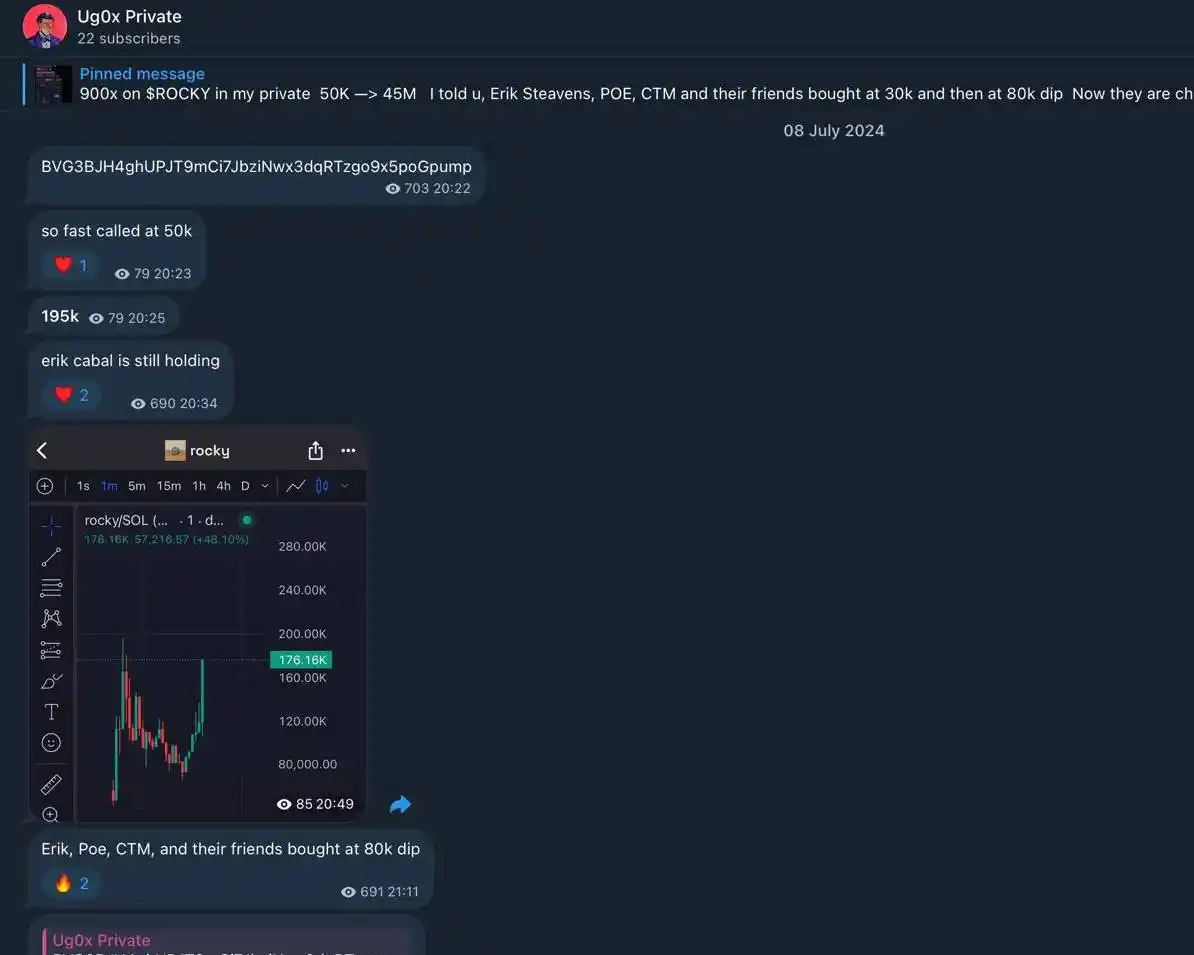
July 8, 2024, was a perfect example with the $ROCKY token. At that time, Erik Steavens, POE, DOGEN, and CTM were all quietly buying between a $10,000 and $80,000 market cap.

Seeing this signal, I knew it wasn't a coincidence—they were planning a pump.

I bought 2.8% of the circulating supply at a $40,000 market cap.

Over the next few days, these大佬联合发力拉盘 (big players jointly drove up the price), and the token's market cap skyrocketed to $45 million.

I took profits between $2 million and $10 million market cap, exiting on average around $6 million.

This trade multiplied my initial investment by 150 times. Although holding until the peak would have yielded 1100x, I strictly followed my exit plan and was more than satisfied with my first six-figure profit.
Tracking New Wallets, Project Team Wallets, and Large Holder Wallets

By January 2025, the crypto market was buzzing with activity, but wallet tracking had become more challenging. To stay ahead of insider information, I had to constantly refine my methods and adapt.

The key to tracking these insiders' wallets was finding their new wallets that had just withdrawn funds from centralized exchanges like Binance. This required precisely tracing fund transfers between multiple Binance addresses and their timestamps. Though time-consuming, it was absolutely worth it.

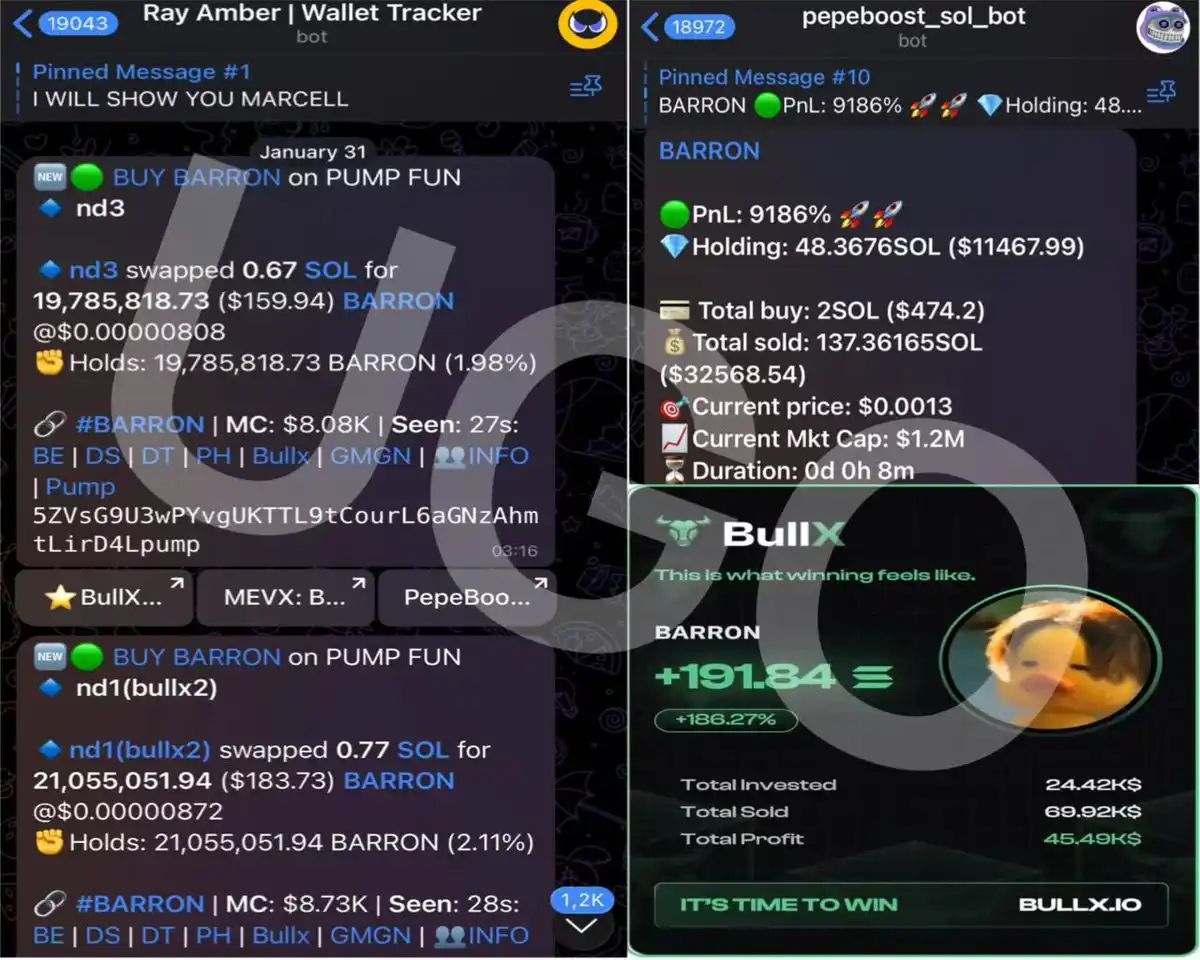
For example, I was closely monitoring Marcell's wallet movements, so I saw his newly funded wallets daily. On January 31, he personally launched and accumulated a large position in the $BARRON token.

I built my position across three wallets between a $15,000 and $25,000 market cap. About three minutes later, Marcell started posting to hype and pump the token. I quickly took profits between a $1 million and $2.5 million market cap.

This was one of my fastest trades ever: an initial investment of $1,300 turned into over $110,000. (The trading platform BullX showed my buy amount as $24,000 because I later added to my position during dips in this wallet, maximizing the profit.)
Tracking Market Maker Wallets

Market maker wallets are addresses controlled directly by the token project team, primarily used to manipulate prices for the benefit of the team or the token itself.

Common manipulation tactics include: placing large buy/sell orders to trigger stop-loss orders and scalp retail traders, or dumping the price by 30% in minutes to cause panic selling, allowing new investors to buy in low.

However, market makers often transfer tokens between wallets shortly after launch. If these wallets aren't newly created or are easily identifiable, we can directly track the project team's movements and precisely catch their every new token launch opportunity.

I did exactly this with the $HOOD token on January 31, 2025.

This project team launched a new token roughly every month. They completed their large accumulation around a $2 million market cap, and I bought in decisively at this level, getting in before top KOLs started hyping. Hours later, I took profits between an $80 million and $120 million market cap, netting about a 50x return on this trade.

Simultaneously, during breaks from managing my initial position's exit, I also leveraged the market maker's large sell-offs to re-enter heavily, making 40% to 70% gains in just minutes.

My total profit for the day was a staggering $152,000. Until the ASTER token trade in September of the same year, January 31st remained my most profitable trading day.

My Ironclad Trading Rules

I always strictly adhere to capital management rules. For example, the capital allocated to any single trade never exceeds 5% of my total portfolio. I also adjust my risk exposure flexibly based on the quality of the opportunity and my confidence level.

When trading with a wallet tracking strategy, you must never use large positions. If the target you're tracking detects your presence, they can easily turn around and rug pull you.

You also need to learn to think from their perspective—understand their interests, operational habits, and timing—to minimize the risk of being rug pulled and achieve consistent profitability.

Of course, I strictly follow my trading plan and never let emotions dictate decisions. I rarely struggle with this aspect because I started learning forex trading at 14, so discipline is deeply ingrained.

That said, I've also experienced several painful lessons of profit drawdowns. But these setbacks didn't break me; instead, they fueled my determination. Driven by this不甘 (reluctance to accept defeat), I studied even harder, continuously honing my trading edge.

Finally

I'm writing this article not to boast. On one hand, I want it to serve as a diary to look back on in five years and see how far I've come. On the other hand, I hope to inspire and help more people understand: as long as you are willing to actively seek change and put in the effort, there is always a way to achieve your goals.

I must clarify one point: I never use these tracking techniques against friends or people close to me. Everything I do is purely to understand the underlying logic of the market and then go with the flow.

I am also very grateful to those I track, and to the project teams who genuinely work hard. I always approach trading with reverence and without hostility. I am also sincerely thankful for all the friends I've met on this journey who have helped me tremendously. Thank you all, and thank heaven for its blessings.


Domande pertinenti

QWhat was the key strategy the author used to turn $50 into over $1 million in less than a year?

AThe author used a wallet tracking strategy, focusing on following the money flow of 'smart money' such as KOLs, insider groups, project teams, and market maker wallets to make trades.

QWhat common mistake did the author make initially when trading meme coins?

AThe author initially bought meme coins based on subjective factors like whether the meme was funny, the promotional content was good, or the website looked clean, which was akin to gambling without solid data.

QHow did tracking 'conspiracy groups' (coordinated insider wallets) improve the author's trading success?

ATracking multiple wallets from a coordinated group provided stronger and more reliable signals than following a single wallet, as it indicated a planned pump operation, leading to higher confidence and larger gains.

QWhat is one of the author's strict money management rules when using the wallet tracking strategy?

AThe author never risks more than 5% of their total portfolio on a single trade and adjusts risk exposure based on the quality of the opportunity and their confidence level to avoid being targeted and exploited.

QWhy does the author emphasize the importance of tracking new wallets or wallets that have just withdrawn from exchanges like Binance?

ATracking new wallets or recent withdrawals from centralized exchanges helps identify fresh capital movements from insiders, providing early signals for new token launches or pump operations before public promotion.

Letture associate

The First Case on AI Agents: What Was Adjudicated?

"The First 'Agent' Ruling: What Was Decided?" On April 30, the Guangzhou Internet Court issued a ruling—China's first behavior preservation order in the intelligent agent (AI agent) field. The defendant, an open-source AI agent software, was ordered to stop downloads, cease actions that bypassed a platform's technical protection measures, and delete related tutorials and data. The core issue: the software used the operating system's "accessibility service" permissions to automate user interactions within other apps without those platforms' authorization. This mirrors a recent US case where Amazon sued Perplexity for similar reasons—bypassing Amazon's API to directly scrape and interact with its pages—and won a preliminary injunction. Both rulings establish a crucial legal boundary for the AI agent era: agents cannot operate unchecked. The article argues the fundamental legal principle emerging is one of **dual authorization**. An AI agent requires both **user consent** AND **platform consent** to operate legitimately within that platform's ecosystem. Bypassing platform rules through system-level permissions, even with user permission, undermines platform responsibilities for content moderation, data security, and user privacy, creating liability issues. The piece uses the evolution of "Doubao Phone" (an AI-integrated smartphone) as a case study. Its initial, aggressive version that bypassed platform controls faced roadblocks. Its upcoming 2.0 version is reportedly pivoting to negotiate API access and authorization deals with major platforms (like Alibaba's ecosystem), seen as a strategic adaptation to the new regulatory reality. A global trend is identified: the era of unregulated, "wild west" growth for AI agents is ending, replaced by a **compliance race**. This raises barriers to entry, as securing platform authorizations becomes a new cost. Open-source status is also not a legal shield if the code facilitates bypassing technical protections. In conclusion, these first rulings target not the largest, but the most **aggressive and representative** cases. By setting precedent with them, regulators are efficiently steering the entire industry towards a new, more regulated operating paradigm defined by dual authorization and platform cooperation.

marsbit7 min fa

The First Case on AI Agents: What Was Adjudicated?

marsbit7 min fa

Fired by Google Over a 14-Page Paper, Over 4,000 Rallied for Her. 6 Years Later: She Almost Predicted the Entire AI Era Back Then.

In late 2020, Google AI researcher Timnit Gebru was effectively dismissed following a conflict over a 14-page, unpublished research paper she co-authored titled "On the Dangers of Stochastic Parrots." The paper, which has since been cited over 14,000 times, raised critical early warnings about the risks of large language models (LLMs). It argued that these models, trained on vast, biased internet data, are essentially "stochastic parrots" that mimic language without true understanding, potentially amplifying societal biases, generating plausible but false information (later termed "AI hallucination"), consuming massive energy, and obscuring their training data contents. Gebru's stance led to a clash with Google management, who requested the paper's withdrawal. Her subsequent internal criticism of the company's diversity efforts and handling of the matter culminated in her termination, which sparked protests from over 4,000 Google employees and researchers. Six years later, the paper's predictions have proven remarkably prescient. Issues like AI hallucination, embedded bias (evident in resume screening and healthcare algorithms), soaring energy consumption from AI data centers, unvetted training data containing harmful content, and the risk of "model collapse" from AI-generated internet content have become central industry challenges. The incident also highlighted concerns about AI development being driven primarily by commercial competition within a handful of powerful tech companies, often at the expense of ethical considerations. After leaving Google, Gebru founded the Distributed AI Research Institute (DAIR) to explore these issues independently. The controversy underscores how her early, critical insights into the fundamental limitations and societal impacts of LLMs anticipated many of the most pressing dilemmas in today's AI era.

marsbit8 min fa

Fired by Google Over a 14-Page Paper, Over 4,000 Rallied for Her. 6 Years Later: She Almost Predicted the Entire AI Era Back Then.

marsbit8 min fa

Elderly Borrow Money to Trade Stocks, Entire Nation Adds Leverage: 'Ant Army' Panics as South Korean Stock Market Plunges

Titled "Panic Among 'Ant Army' as South Korean Stocks Plunge After Elders Borrow to Invest, Everyone Leverages Up," this article details a dramatic reversal in South Korea's red-hot stock market. After a sustained rally toward 9,000 points driven by AI semiconductor hype, the KOSPI index recently crashed, triggering circuit breakers. The sell-off was led by major chipmakers Samsung Electronics and SK Hynix, whose combined weight in the index is over 50%. The plunge exposed the extreme leverage and speculative behavior that fueled the boom. Individual investors, dubbed the "ant army," had borrowed heavily or used leverage ETFs to chase gains, with trading accounts outnumbering the population. A significant portion of this leveraged money came from older citizens, some of whom reportedly cashed out insurance policies to invest. ETF trading became dominated (over 90%) by high-risk leveraged and inverse products. The correction was triggered by a pullback in U.S. tech stocks, leading to a foreign capital exodus and a weakening Korean won, creating a vicious cycle. While President Lee Jae-myung attempted to reassure markets and NVIDIA's CEO signaled support during a visit, officials like Finance Minister Ju Yeong-geun expressed concern over the dangerous "herd mentality." The article highlights a pervasive, high-risk investment culture where everyone from office workers to retirees and even parents opening accounts for newborns sought quick profits, largely concentrated in a few tech stocks, setting the stage for a sharp and painful correction.

marsbit14 min fa

Elderly Borrow Money to Trade Stocks, Entire Nation Adds Leverage: 'Ant Army' Panics as South Korean Stock Market Plunges

marsbit14 min fa

From Hunyuan to WeChat AI: Tencent's Slow Paced Journey Reaches the Delivery Juncture

On June 8, 2026, WeChat's developer platform announced the internal testing of "WeChat AI," an AI assistant integrated into the WeChat ecosystem. It allows users to invoke, access, and operate Mini Programs through natural language conversation. The platform offers two access modes: an "Automatic Mode" where developers authorize platform access to their source code for zero-configuration AI operation, and a "Developer Mode" for building custom skills. While the name "WeChat AI" is provisional, this marks WeChat's first step in opening its vast Mini Program ecosystem—comprising over 400,000 developers and hundreds of millions of daily active users—to AI-driven conversational interaction. This move represents the latest step in Tencent's deliberate AI strategy, moving from technical R&D and standalone product validation to integration within its super-app. The underlying foundation is Tencent's self-developed Hunyuan large language model. Ranked first domestically in application-oriented capabilities like Agent task execution in 2025, Hunyuan's focus on stability and precision over raw parameter count aligns with WeChat AI's need for reliable, low-latency operations involving sensitive tasks like payments and bookings. Prior C-side validation came from "Yuanbao," a standalone AI app whose Monthly Active Users (MAU) surpassed 114 million during the 2026 Chinese New Year红包 campaign, though daily activity later subsided. This "pulse growth" highlighted the challenge of user retention for standalone apps, informing the decision to integrate AI natively into WeChat's high-frequency scenarios. However, WeChat AI's "Automatic Mode," which requires source code access, raises developer concerns about code security, data visibility, and liability for AI errors. A deeper, ecosystem-level tension exists between the efficiency of centralized AI task调度 and the potential "short-circuiting" of merchant pages, which could erode their branding, advertising revenue, and user engagement. As Tencent Chairman Pony Ma noted, balancing centralized AI调度 with the protection of decentralized merchant traffic is a core challenge. In summary, Tencent's AI path—comprising the stable Hunyuan base model, the user-validated Yuanbao app, and the newly testing WeChat AI integration—is logically coherent. The success of WeChat AI now hinges on resolving developer trust, establishing fair ecosystem rules for merchants, and ensuring operational reliability to gain user confidence for deep, transactional use.

marsbit14 min fa

From Hunyuan to WeChat AI: Tencent's Slow Paced Journey Reaches the Delivery Juncture

marsbit14 min fa

STRC Briefly Fell Below $91: Will Strategy Be Hunted by 'Market Fear'?

The article draws a parallel between FTX's 2022 collapse and the current situation facing MicroStrategy (Strategy), a major corporate holder of Bitcoin. The author argues that MicroStrategy's financial model, heavily reliant on issuing equity and convertible debt at a premium to its Bitcoin holdings, is under stress. The core issue is the compression of MSTR's stock premium over its Bitcoin holdings (NAV). This erodes the viability of its "flywheel" – using equity sales to buy more Bitcoin. The company has shifted towards preferred shares (like STRC) and debt to raise capital, incurring significant dividend and interest obligations (approximately $1.7 billion annually). With cash reserves dwindling and debt maturities looming, MicroStrategy faces mounting pressure to generate cash. The article outlines three problematic options: 1) cutting preferred dividends, damaging investor confidence; 2) issuing more MSTR stock at low premiums, diluting existing shareholders; or 3) selling Bitcoin, which founder Michael Saylor had vowed against but recently did in a small symbolic transaction. The author suggests that, like FTX, a crisis of confidence could trigger a rapid downward spiral as investors flee. While noting Saylor's actions are legal—unlike SBF's fraud at FTX—the article warns the structural risk born from financial engineering and over-leverage is significant. The preferred path out is a sharp rise in Bitcoin's price to restart the premium flywheel, but this would only create a larger, more complex system vulnerable to future failure. The author concludes by advocating for direct Bitcoin ownership over exposure through MicroStrategy's increasingly risky financial structure.

Foresight News29 min fa

STRC Briefly Fell Below $91: Will Strategy Be Hunted by 'Market Fear'?

Foresight News29 min fa

Trading

Spot
Futures

Articoli Popolari

Come comprare BILL

Benvenuto in HTX.com! Abbiamo reso l'acquisto di Billions Network (BILL) semplice e conveniente. Segui la nostra guida passo passo per intraprendere il tuo viaggio nel mondo delle criptovalute.Step 1: Crea il tuo Account HTXUsa la tua email o numero di telefono per registrarti il tuo account gratuito su HTX. Vivi un'esperienza facile e sblocca tutte le funzionalità,Crea il mio accountStep 2: Vai in Acquista crypto e seleziona il tuo metodo di pagamentoCarta di credito/debito: utilizza la tua Visa o Mastercard per acquistare immediatamente Billions NetworkBILL.Bilancio: Usa i fondi dal bilancio del tuo account HTX per fare trading senza problemi.Terze parti: abbiamo aggiunto metodi di pagamento molto utilizzati come Google Pay e Apple Pay per maggiore comodità.P2P: Fai trading direttamente con altri utenti HTX.Over-the-Counter (OTC): Offriamo servizi su misura e tassi di cambio competitivi per i trader.Step 3: Conserva Billions Network (BILL)Dopo aver acquistato Billions Network (BILL), conserva nel tuo account HTX. In alternativa, puoi inviare tramite trasferimento blockchain o scambiare per altre criptovalute.Step 4: Scambia Billions Network (BILL)Scambia facilmente Billions Network (BILL) nel mercato spot di HTX. Accedi al tuo account, seleziona la tua coppia di trading, esegui le tue operazioni e monitora in tempo reale. Offriamo un'esperienza user-friendly sia per chi ha appena iniziato che per i trader più esperti.

205 Totale visualizzazioniPubblicato il 2026.05.07Aggiornato il 2026.06.02

Come comprare BILL

Cosa è ATWO

I. Introduzione al ProgettoArena Two è una piattaforma interattiva decentralizzata che consente ai fan di svolgere un ruolo attivo e tokenizzato nei risultati degli eventi in tempo reale. A differenza dei modelli di trasmissione tradizionali che riducono i fan a spettatori passivi, Arena Two sfrutta la tecnologia blockchain per consentire ai fan di votare direttamente in tempo reale e influenzare i risultati sul campo.II. Informazioni sul TokenNome del token: ATWO(Arena Two)III. Link CorrelatiSito web:https://arenatwo.com/Esploratori:https://basescan.org/token/0x499D35eBE6cEe9B2Ac35Fd003fcBbeeB9CFc7B32Twitter:https://x.com/arenatwoXNota: L'introduzione al progetto proviene dai materiali pubblicati o forniti dal team ufficiale del progetto, che è solo a scopo di riferimento e non costituisce consulenza sugli investimenti. HTX non si assume responsabilità per eventuali perdite dirette o indirette derivanti.

146 Totale visualizzazioniPubblicato il 2026.05.18Aggiornato il 2026.06.02

Cosa è ATWO

Come comprare ATWO

Benvenuto in HTX.com! Abbiamo reso l'acquisto di Arena Two (ATWO) semplice e conveniente. Segui la nostra guida passo passo per intraprendere il tuo viaggio nel mondo delle criptovalute.Step 1: Crea il tuo Account HTXUsa la tua email o numero di telefono per registrarti il tuo account gratuito su HTX. Vivi un'esperienza facile e sblocca tutte le funzionalità,Crea il mio accountStep 2: Vai in Acquista crypto e seleziona il tuo metodo di pagamentoCarta di credito/debito: utilizza la tua Visa o Mastercard per acquistare immediatamente Arena TwoATWO.Bilancio: Usa i fondi dal bilancio del tuo account HTX per fare trading senza problemi.Terze parti: abbiamo aggiunto metodi di pagamento molto utilizzati come Google Pay e Apple Pay per maggiore comodità.P2P: Fai trading direttamente con altri utenti HTX.Over-the-Counter (OTC): Offriamo servizi su misura e tassi di cambio competitivi per i trader.Step 3: Conserva Arena Two (ATWO)Dopo aver acquistato Arena Two (ATWO), conserva nel tuo account HTX. In alternativa, puoi inviare tramite trasferimento blockchain o scambiare per altre criptovalute.Step 4: Scambia Arena Two (ATWO)Scambia facilmente Arena Two (ATWO) nel mercato spot di HTX. Accedi al tuo account, seleziona la tua coppia di trading, esegui le tue operazioni e monitora in tempo reale. Offriamo un'esperienza user-friendly sia per chi ha appena iniziato che per i trader più esperti.

85 Totale visualizzazioniPubblicato il 2026.05.18Aggiornato il 2026.06.02

Come comprare ATWO

Discussioni

Benvenuto nella Community HTX. Qui puoi rimanere informato sugli ultimi sviluppi della piattaforma e accedere ad approfondimenti esperti sul mercato. Le opinioni degli utenti sul prezzo di A A sono presentate come di seguito.

活动图片