Tsinghua's Prediction 2 Years Ago Is Becoming Global Consensus: Meta and Two Other Major AI Institutions Have Reached the Same Conclusion

marsbitPubblicato 2026-04-13Pubblicato ultima volta 2026-04-13

Introduzione

Summary: In a remarkable validation of Chinese AI research, Meta and METR have independently reached conclusions that align perfectly with the "Density Law" proposed by a Tsinghua University and FaceWall Intelligent team two years ago. Published in Nature Machine Intelligence in late 2025, the law states that the computational power required to achieve a specific level of AI performance halves every 3.5 months. This convergence was starkly evident in April 2026. METR reported that AI capabilities are doubling every 88.6 days, while Meta's new model, Muse Spark, demonstrated it could match the performance of a model from the previous year using less than one-tenth of the training compute. When plotted, the growth curves from all three sources—using different metrics (parameters, compute, task length)—show an almost identical exponential slope. The findings have profound implications: AI inference costs are collapsing faster than anticipated, powerful edge-computing AI is becoming rapidly feasible, and the industry's strategy of simply scaling model size is becoming economically inefficient. The Chinese team, which has been building its "MiniCPM" model series based on this law since 2024, is seen as having a significant two-year lead in practical engineering experience, marking a rare instance where Chinese researchers pioneered a fundamental predictive trend in AI.

【Insight】Too crazy! The AI evolution data recently measured by Meta and METR perfectly aligns with the "Density Law" proposed by a Chinese team two years ago. Silicon Valley suddenly realized that Chinese researchers have been leading this path for two years!

Three of the world's most serious AI research institutions collectively collided in the past week!

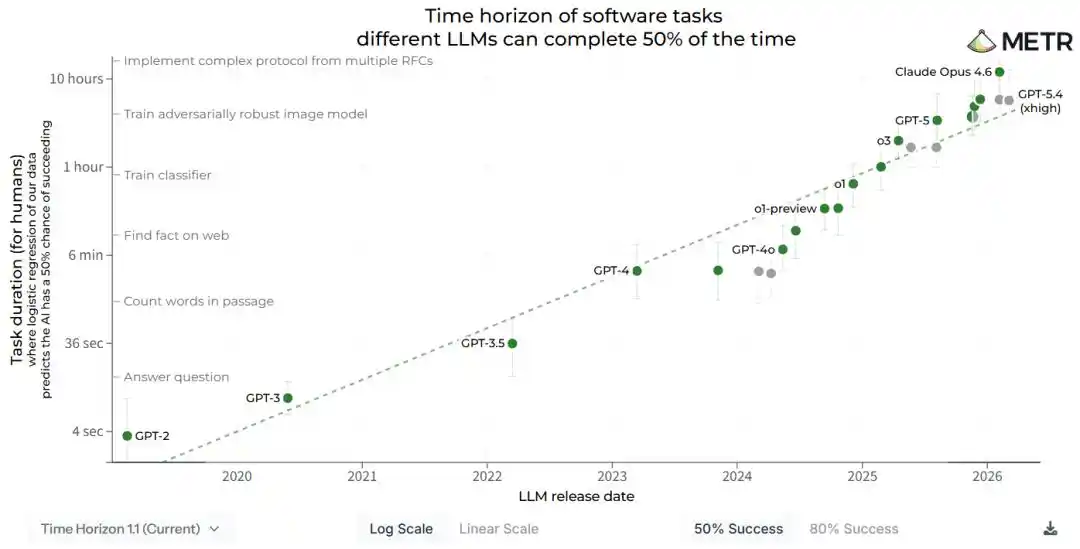
On April 3, the American research institution METR quietly updated a technical report, with the core conclusion compressed into one sentence.

AI capabilities double every 88.6 days.
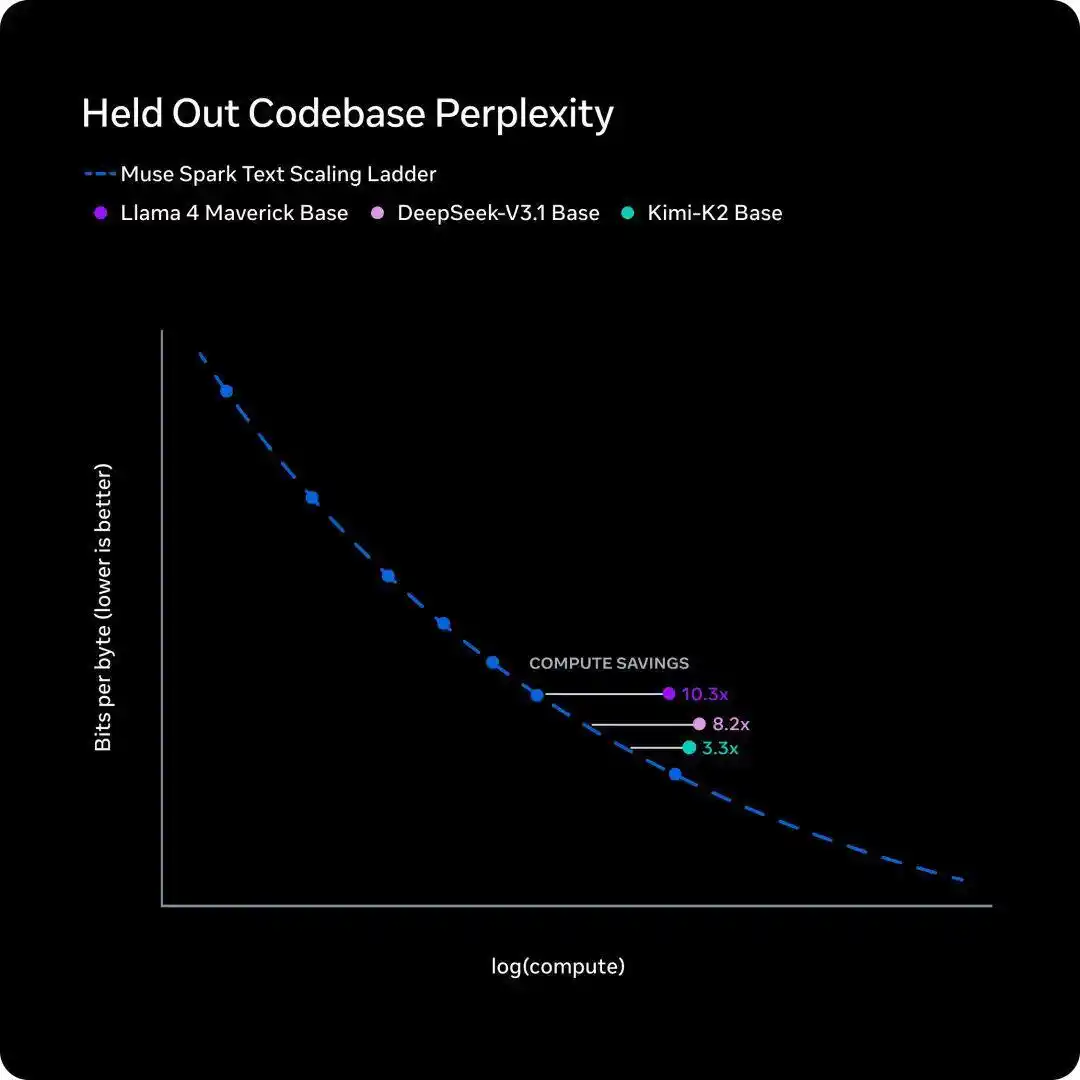
Five days later, on April 8, Meta's Super Intelligence Lab released a new model, Muse Spark, and disclosed an internal training efficiency curve called the scaling ladder, with the conclusion also being one sentence.

To catch up with the performance of Llama 4 Maverick from a year ago, the new model requires less than one-tenth of the training compute.
One measured task duration, the other measured training compute. The two institutions had no interaction, and their research methods had no overlap.

But when the two curves were converted to the same coordinate system, their slopes were almost identical.

At this point, things were already bizarre enough.

Even more bizarre is that this curve was completely drawn by a Chinese team two years ago and even published in a Nature sub-journal.

It's called the Density Law.

Two Years Ago, Someone Drew This Line in Advance

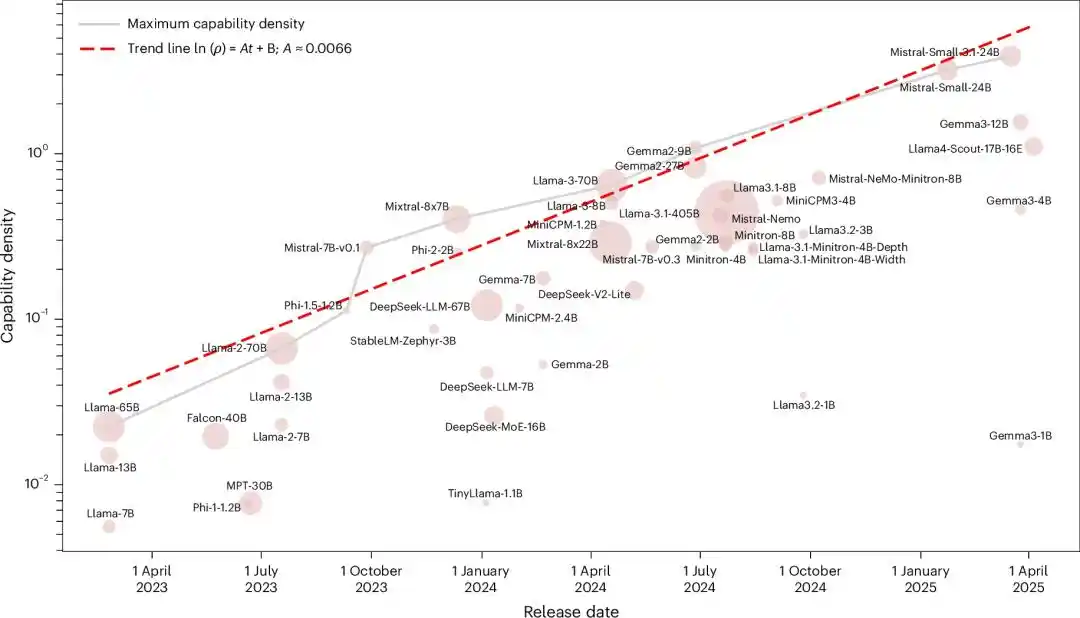
This concept first appeared in a paper called "Densing Law of LLMs".

The authors were a joint team from ModelBest and Tsinghua University, led by Professors Sun Maosong and Liu Zhiyuan, with doctoral student Xiao Chaojun as the first author.

The paper was posted on arXiv in December 2024 and accepted by Nature Machine Intelligence in November 2025.
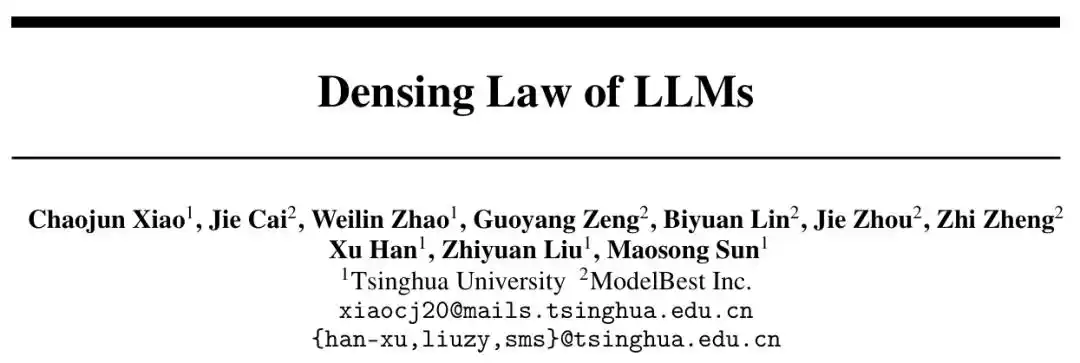
Paper address: https://arxiv.org/abs/2412.04315
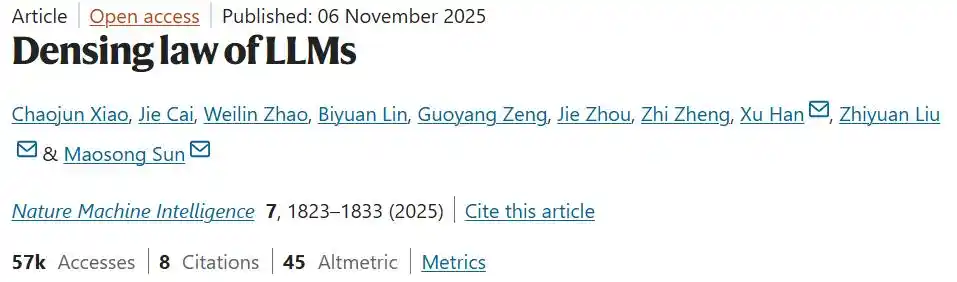
Paper address: https://www.nature.com/articles/s42256-025-01137-0

The core assertion of the paper is just one sentence.

Model intelligence density increases exponentially over time, and the number of parameters required to reach a specific intelligence level halves every 3.5 months.

Back in late 2024, this sounded a bit radical.

At that time, the entire industry was worshipping the scaling law. OpenAI was scaling models, Anthropic was scaling models, Meta was scaling models.

Everyone thought that bigger parameters meant stronger intelligence, and burning GPUs to the extreme was the right way.
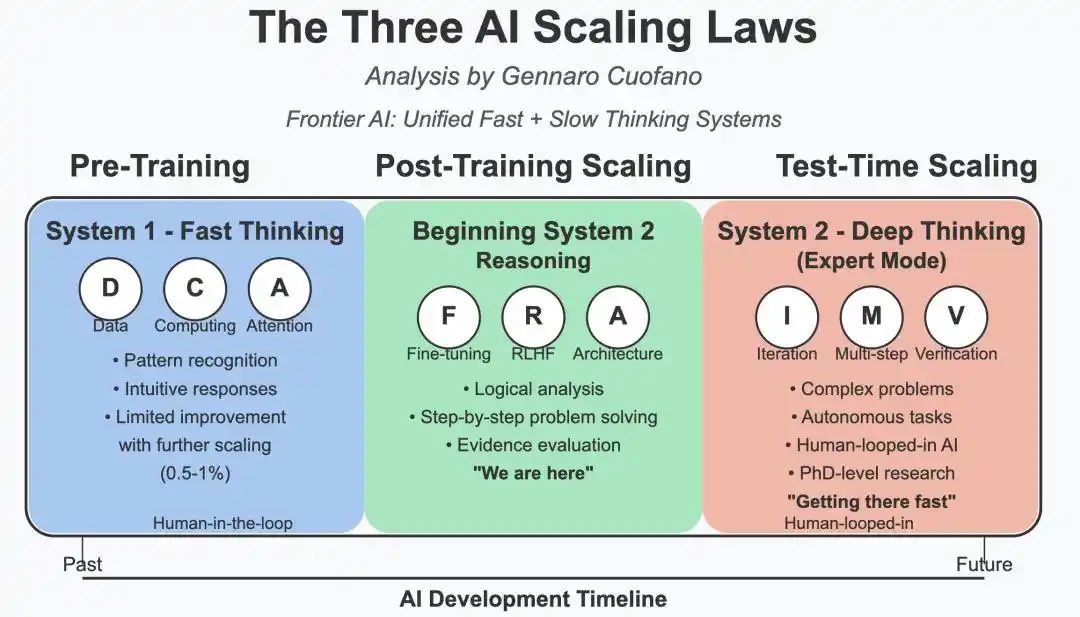
But the research team didn't see it that way.

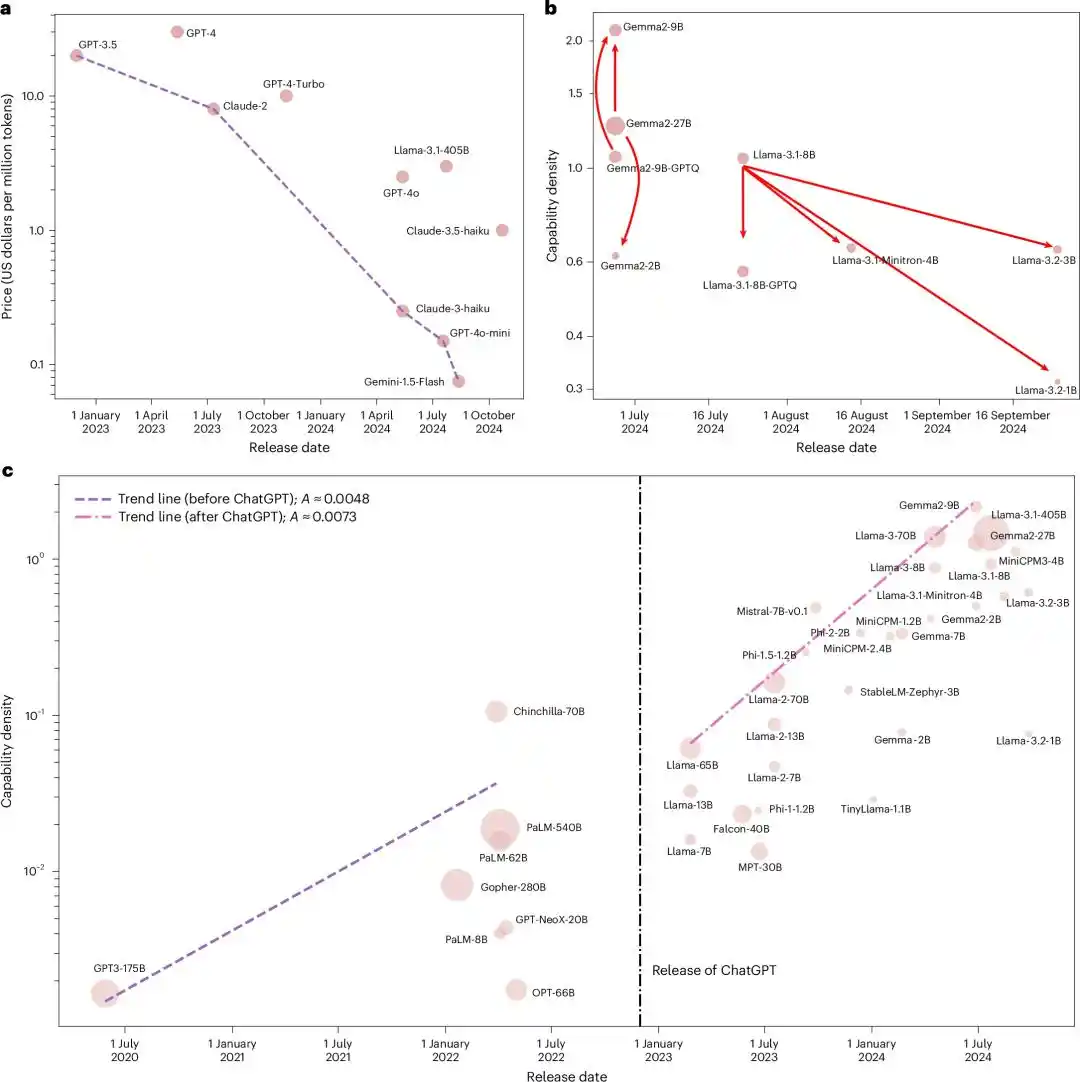
They put all influential open-source foundation models at the time, from Llama-1 all the way to Gemma-2 and MiniCPM-3, a total of 51 models, into the same ruler to measure.

After running five major benchmarks, the result was an almost perfect exponential relationship, with an R² of 0.934.

Considering that LLM evaluation is easily contaminated by data pollution, they retested using a newly constructed contamination-filtered dataset, MMLU-CF. R²=0.953.

Both fits achieved an R² close to 1. Statistically, this is almost impossible to be a coincidence.

In other words, every mainstream open-source model released in these two years, regardless of which team it came from or what architecture it used, fell on the same exponential line of "doubling every 3.5 months".
Up to this point, the story was just "a Chinese team proposed a seemingly radical empirical rule".

What truly made this a "moment" was what happened in the next half year.

Three Institutions, Three Methods, One Slope

Laying out the conclusions from ModelBest, Meta, and METR:

  • ModelBest's Density Law measures "how many parameters are needed for the same intelligence level". The conclusion is that the parameter requirement halves every 3.5 months.
  • Meta's scaling ladder measures "how much training compute is needed for the same intelligence level". The conclusion is that Muse Spark saves an order of magnitude compared to Llama 4 Maverick from a year ago.
  • METR's time horizon report measures "how long a task a model can handle". The conclusion is that the task length doubles every 88.6 days.

Three rulers. Three academic institutions. Three research paths with no overlap whatsoever.

But when all the numbers are converted and viewed in the same coordinate system, the slopes of their curves are almost identical.

The most easily overlooked point about this is that the Density Law was the first proposed among these three. It was nearly two years earlier than Meta's scaling ladder and more than a year earlier than METR's complete modeling.

And when Meta drew that scaling ladder in their early April blog post, they probably didn't realize it themselves. The shape of this graph was almost the same line as the curve on a PPT from an academic conference in Beijing in 2024.

What Kind of Observation Deserves to Be Called a "Law"

In the scientific community, there is an unwritten standard to judge whether an empirical observation qualifies as a "law".

It's not about how beautiful the data is, but whether it holds true across multiple independent measurement systems.

The reason Moore's Law is a law is because the semiconductor industry has verified it over decades from three completely different dimensions: lithography precision, transistor density, and cost per unit of computing power.
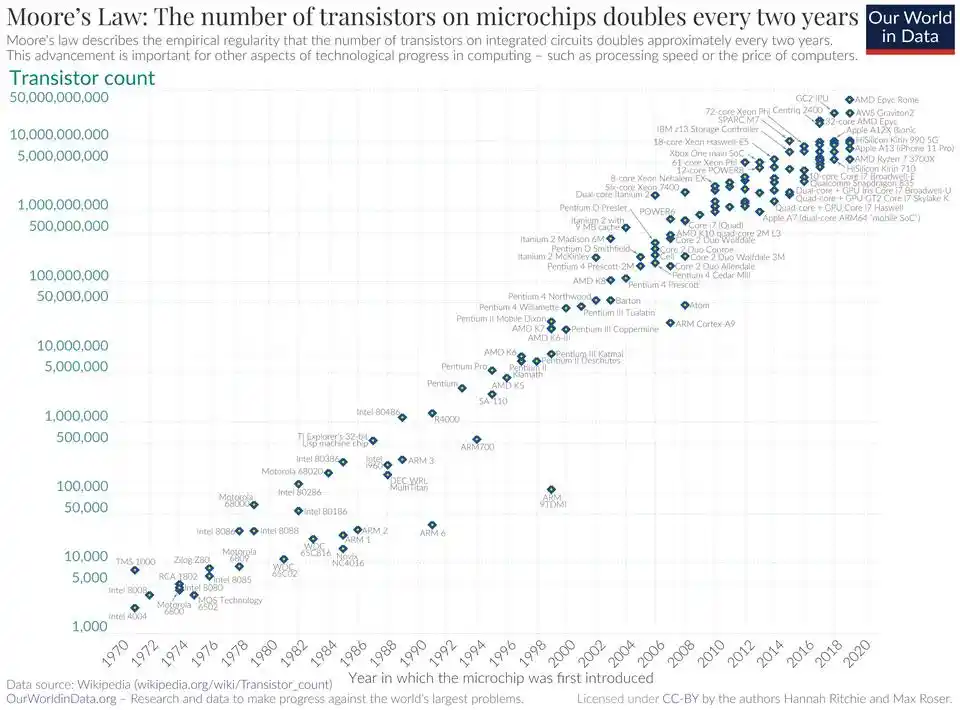
The Density Law follows the same path.

It was initially just a fitting curve from a single team. By the time it was accepted by the Nature sub-journal, it could already be reproduced on contamination-filtered datasets. And this month, it was independently verified twice more in Meta's training data and METR's task evaluations.

Viewed in a larger coordinate system, this moment is very much like when electricity first entered New York in the 1880s.

Back then, it was also different inventors, different engineers, different cities, each working on their own power grids. It wasn't until someone plotted the development curves of all the projects on one sheet of paper that people realized. This wasn't a few scattered engineering advances; this was a new era quietly unfolding.

Only this time, it took less than a year from the paper's publication to its verification by global peers.

Three Inferences, Each Rewriting Industry Assumptions

If the Density Law holds, it will rewrite many things simultaneously.

First, inference costs will crash faster than anyone expected.

One inference of the Density Law is that the inference cost for LLMs achieving the same performance roughly halves every 2.6 months.

Today, this rate of decline has already been exceeded by reality.

The latest tracking data from Epoch AI shows that the token price for LLMs achieving Claude 3.5 Sonnet performance level has dropped 400 times in the past year. The fastest decline for the same performance tier reached 900x/year.

The level that GPT-3.5 priced at $20 per million tokens in late 2022, today Mistral Nemo charges only $0.02, 1000 times cheaper, and the model is even stronger.

In retrospect, the prediction in the paper was conservative.

Second, the explosion point for on-device AI is closer than anyone thought.

Multiplying the Density Law by Moore's Law yields an even more exciting number.

According to current estimates, the maximum effective model size that can run on chips at the same price roughly doubles every 88 days.

This number is almost identical to the 88.6 days calculated by METR. Two completely different calculation paths collided after the decimal point.

In the next three to five years, running a current top-tier GPT-level model on an ordinary laptop or even a mobile phone may no longer be science fiction.

Third, the optimal strategy for the large model industry is quietly reversing.

For the past three years, the industry's understanding of the scaling law has remained at "stack parameters, stack data."

But the Density Law offers a counterintuitive judgment. Given the continuous exponential growth in density, any state's strongest model only has an optimal window of a few months.

Throwing all resources into training a larger model, only to be surpassed by a new model half the size three months later, is economically unwise.

The truly sustainable path is to invest resources in improving the density itself. Better architectures, higher quality data, smarter training algorithms.

ModelBest, Has Been Walking Along the Ruler They Drew

It's worth mentioning that the Density Law is not a paper that ended after publication.

ModelBest, which proposed this theory, has been verifying it with their own "Small Cannon" MiniCPM series models for the past two years.

When MiniCPM-1-2.4B was released in February 2024, its benchmark scores could match or exceed Mistral-7B from September 2023. That is, in four months, with 35% of the parameters, it achieved equivalent performance.

This number was directly written into the Nature sub-journal paper as the first empirical case of the Density Law.

Since then, the Small Cannon series has been open-sourced all the way, covering four major directions for parameters below 10B: text, multimodal, speech, and full-modality. This level of open-source completeness domestically, besides Alibaba, only ModelBest has achieved.

So far, the global open-source downloads of the Small Cannon series have exceeded 24 million.

It is not the largest model in the industry. But it is the first team in the industry to implement "density first" as a company methodology.

And when Meta and METR verified the Density Law in their respective ways in April 2026, this Chinese company that started training models using this methodology back in 2024 actually had a two-year lead in engineering experience.

This Time, Chinese Researchers Are at the Starting Point of the Curve

A theoretical framework proposed by a Chinese research team two years ago is being rediscovered, in their own ways, by overseas institutions like Meta and METR, the most serious players.

The weight of this matter may take some time to fully understand.

It is not a "we can do it too" story. It is a "we saw it a bit earlier" story.

There aren't many such moments in the history of science. A judgment doubted in 2024 became the same curve pointed to by multiple independent pieces of evidence in 2026.

This kind of "coincidence" across regions, methods, and institutions has happened a few times in physics, each time marking the end of an old paradigm and the beginning of a new one.

This time, Chinese AI researchers are standing at that starting point.

And that curve is still rising, doubling every 88 days.

References:

The "Density Law"首创 (first proposed) by ModelBest gains recognition from top overseas institutions like Meta

https://arxiv.org/abs/2412.04315

https://www.nature.com/articles/s42256-025-01137-0

https://metr.org/blog/2026-1-29-time-horizon-1-1/

https://ai.meta.com/blog/introducing-muse-spark-msl/

This article is from the WeChat public account "新智元" (New Zhiyuan), edited: 好困 (Hao Kun) 桃子 (Tao Zi)


Domande pertinenti

QWhat is the 'Density Law' proposed by the Chinese research team from Tsinghua University and ModelBest, and what is its core finding?

AThe 'Density Law' is a theory proposed by a joint team from Tsinghua University and ModelBest (面壁智能). Its core finding is that the intelligence density of AI models increases exponentially over time, with the number of parameters required to achieve a specific level of intelligence halving approximately every 3.5 months.

QWhich three independent research institutions recently reached conclusions that align with the Density Law, and what did each one measure?

AThe three institutions are ModelBest (the original proposer), Meta's Super Intelligence Lab, and METR. ModelBest measured the parameter efficiency (parameters needed for a given intelligence level). Meta measured training compute efficiency (compute needed for a given intelligence level). METR measured the expansion of AI capabilities over time (task horizon length doubling every 88.6 days).

QAccording to the article, what are three major implications of the Density Law for the AI industry?

A1. Inference costs are collapsing faster than expected, potentially halving every ~2.6 months. 2. The arrival of powerful on-device AI is much closer than previously thought, as smaller models can achieve performance previously requiring large data centers. 3. The optimal strategy for AI companies is shifting from simply scaling up model size (scaling law) to focusing on improving intelligence density through better architectures, data, and algorithms.

QHow did the MiniCPM model series from ModelBest serve as an early validation of the Density Law?

AThe MiniCPM-1-2.4B model, released in February 2024, achieved performance comparable to the Mistral-7B model from September 2023. This demonstrated that in just four months, a model with only 35% of the parameters could achieve the same level of performance, providing an early empirical case for the Density Law's prediction of rapidly increasing parameter efficiency.

QWhat is the significance of multiple independent institutions arriving at the same conclusion as the Density Law using different methods?

AThis convergence of evidence from independent paths (parameter efficiency, training compute, and capability growth) significantly strengthens the validity of the Density Law. In science, a principle gains the status of a 'law' when it holds across multiple, independent measurement systems, similar to how Moore's Law was validated across different aspects of semiconductor progress. It suggests a fundamental shift in the AI development paradigm is underway.

Letture associate

First Day Review of "Musk's WeChat" XChat: Even Worse Than Expected

Elon Musk's much-anticipated "WeChat-like" app, XChat, has officially launched after multiple delays. The initial review reveals a product that falls short of expectations, offering an experience largely similar to X Platform's (formerly Twitter) direct messages, despite being marketed as an encrypted communication tool. Key observations from the first-day test include: 1. The app's promoted "end-to-end encryption" and its claimed relation to Bitcoin's architecture were criticized by experts as a superficial attempt to capitalize on crypto buzz, with no real technical connection. 2. Musk's vision of an ad-free "secure communication system" is technically met, but only because the app is currently extremely basic, featuring only a single chat interface. 3. A promised anti-screenshot feature appears inconsistent; it works in X Platform group chats but fails within the XChat app itself, where screenshots still capture avatars. 4. The app supports 45 languages and has a 16+ age rating, indicating a broader tolerance for content compared to WeChat's 13+ rating. 5. A puzzling login process requires users to verify the email associated with their X account. 6. The touted encryption" feels minimal in practice, with its presence only indicated by a simple "Encrypted - Yes" label on messages. 7. Disappearing message timers for groups can be set from 5 minutes to 4 weeks, with the timer starting upon being read by a user. 8. Group invite links are shared with X Platform groups. 9. Group size limits are planned to be increased, aiming for 1000 members, a move that has drawn user criticism. 10. The app offers 8 different colored icons, and its chat bubbles are notably similar to WeChat's. Message deletion options mimic Telegram's. Crucially, many pre-announced features like importing X contacts, integrating Grok AI, X Money payments, and Cashtags are not yet available. The initial release is seen as a bare-bones and underwhelming first step.

Odaily星球日报53 min fa

First Day Review of "Musk's WeChat" XChat: Even Worse Than Expected

Odaily星球日报53 min fa

Trading

Spot
Futures

Articoli Popolari

Cosa è $S$

Comprendere SPERO: Una Panoramica Completa Introduzione a SPERO Mentre il panorama dell'innovazione continua a evolversi, l'emergere delle tecnologie web3 e dei progetti di criptovaluta gioca un ruolo fondamentale nel plasmare il futuro digitale. Un progetto che ha attirato l'attenzione in questo campo dinamico è SPERO, denotato come SPERO,$$s$. Questo articolo mira a raccogliere e presentare informazioni dettagliate su SPERO, per aiutare gli appassionati e gli investitori a comprendere le sue basi, obiettivi e innovazioni nei domini web3 e crypto. Che cos'è SPERO,$$s$? SPERO,$$s$ è un progetto unico all'interno dello spazio crypto che cerca di sfruttare i principi della decentralizzazione e della tecnologia blockchain per creare un ecosistema che promuove l'impegno, l'utilità e l'inclusione finanziaria. Il progetto è progettato per facilitare interazioni peer-to-peer in modi nuovi, fornendo agli utenti soluzioni e servizi finanziari innovativi. Al suo interno, SPERO,$$s$ mira a responsabilizzare gli individui fornendo strumenti e piattaforme che migliorano l'esperienza dell'utente nello spazio delle criptovalute. Questo include la possibilità di metodi di transazione più flessibili, la promozione di iniziative guidate dalla comunità e la creazione di percorsi per opportunità finanziarie attraverso applicazioni decentralizzate (dApps). La visione sottostante di SPERO,$$s$ ruota attorno all'inclusività, cercando di colmare le lacune all'interno della finanza tradizionale mentre sfrutta i vantaggi della tecnologia blockchain. Chi è il Creatore di SPERO,$$s$? L'identità del creatore di SPERO,$$s$ rimane piuttosto oscura, poiché ci sono risorse pubblicamente disponibili limitate che forniscono informazioni dettagliate sul suo fondatore o fondatori. Questa mancanza di trasparenza può derivare dall'impegno del progetto per la decentralizzazione—un ethos che molti progetti web3 condividono, dando priorità ai contributi collettivi rispetto al riconoscimento individuale. Centrando le discussioni attorno alla comunità e ai suoi obiettivi collettivi, SPERO,$$s$ incarna l'essenza dell'empowerment senza mettere in evidenza individui specifici. Pertanto, comprendere l'etica e la missione di SPERO rimane più importante che identificare un creatore singolo. Chi sono gli Investitori di SPERO,$$s$? SPERO,$$s$ è supportato da una varietà di investitori che vanno dai capitalisti di rischio agli investitori angelici dedicati a promuovere l'innovazione nel settore crypto. Il focus di questi investitori generalmente si allinea con la missione di SPERO—dando priorità a progetti che promettono avanzamenti tecnologici sociali, inclusività finanziaria e governance decentralizzata. Queste fondazioni di investitori sono tipicamente interessate a progetti che non solo offrono prodotti innovativi, ma contribuiscono anche positivamente alla comunità blockchain e ai suoi ecosistemi. Il supporto di questi investitori rafforza SPERO,$$s$ come un concorrente degno di nota nel dominio in rapida evoluzione dei progetti crypto. Come Funziona SPERO,$$s$? SPERO,$$s$ impiega un framework multifunzionale che lo distingue dai progetti di criptovaluta convenzionali. Ecco alcune delle caratteristiche chiave che sottolineano la sua unicità e innovazione: Governance Decentralizzata: SPERO,$$s$ integra modelli di governance decentralizzati, responsabilizzando gli utenti a partecipare attivamente ai processi decisionali riguardanti il futuro del progetto. Questo approccio favorisce un senso di proprietà e responsabilità tra i membri della comunità. Utilità del Token: SPERO,$$s$ utilizza il proprio token di criptovaluta, progettato per servire varie funzioni all'interno dell'ecosistema. Questi token abilitano transazioni, premi e la facilitazione dei servizi offerti sulla piattaforma, migliorando l'impegno e l'utilità complessivi. Architettura Stratificata: L'architettura tecnica di SPERO,$$s$ supporta la modularità e la scalabilità, consentendo un'integrazione fluida di funzionalità e applicazioni aggiuntive man mano che il progetto evolve. Questa adattabilità è fondamentale per mantenere la rilevanza nel panorama crypto in continua evoluzione. Coinvolgimento della Comunità: Il progetto enfatizza iniziative guidate dalla comunità, impiegando meccanismi che incentivano la collaborazione e il feedback. Nutrendo una comunità forte, SPERO,$$s$ può affrontare meglio le esigenze degli utenti e adattarsi alle tendenze di mercato. Focus sull'Inclusione: Offrendo basse commissioni di transazione e interfacce user-friendly, SPERO,$$s$ mira ad attrarre una base utenti diversificata, inclusi individui che potrebbero non aver precedentemente interagito nello spazio crypto. Questo impegno per l'inclusione si allinea con la sua missione generale di empowerment attraverso l'accessibilità. Cronologia di SPERO,$$s$ Comprendere la storia di un progetto fornisce preziose intuizioni sulla sua traiettoria di sviluppo e sui traguardi. Di seguito è riportata una cronologia suggerita che mappa eventi significativi nell'evoluzione di SPERO,$$s$: Fase di Concettualizzazione e Ideazione: Le idee iniziali che formano la base di SPERO,$$s$ sono state concepite, allineandosi strettamente con i principi di decentralizzazione e focus sulla comunità all'interno dell'industria blockchain. Lancio del Whitepaper del Progetto: Dopo la fase concettuale, è stato rilasciato un whitepaper completo che dettaglia la visione, gli obiettivi e l'infrastruttura tecnologica di SPERO,$$s$ per suscitare interesse e feedback dalla comunità. Costruzione della Comunità e Prime Interazioni: Sono stati effettuati sforzi attivi di outreach per costruire una comunità di early adopters e potenziali investitori, facilitando discussioni attorno agli obiettivi del progetto e ottenendo supporto. Evento di Generazione del Token: SPERO,$$s$ ha condotto un evento di generazione del token (TGE) per distribuire i propri token nativi ai primi sostenitori e stabilire una liquidità iniziale all'interno dell'ecosistema. Lancio della Prima dApp: La prima applicazione decentralizzata (dApp) associata a SPERO,$$s$ è stata attivata, consentendo agli utenti di interagire con le funzionalità principali della piattaforma. Sviluppo Continuo e Partnership: Aggiornamenti e miglioramenti continui alle offerte del progetto, inclusi partnership strategiche con altri attori nello spazio blockchain, hanno plasmato SPERO,$$s$ in un concorrente competitivo e in evoluzione nel mercato crypto. Conclusione SPERO,$$s$ rappresenta una testimonianza del potenziale del web3 e delle criptovalute di rivoluzionare i sistemi finanziari e responsabilizzare gli individui. Con un impegno per la governance decentralizzata, il coinvolgimento della comunità e funzionalità progettate in modo innovativo, apre la strada verso un panorama finanziario più inclusivo. Come per qualsiasi investimento nello spazio crypto in rapida evoluzione, si incoraggiano potenziali investitori e utenti a ricercare approfonditamente e a impegnarsi in modo riflessivo con gli sviluppi in corso all'interno di SPERO,$$s$. Il progetto mostra lo spirito innovativo dell'industria crypto, invitando a ulteriori esplorazioni delle sue innumerevoli possibilità. Mentre il percorso di SPERO,$$s$ è ancora in fase di sviluppo, i suoi principi fondamentali potrebbero effettivamente influenzare il futuro di come interagiamo con la tecnologia, la finanza e tra di noi in ecosistemi digitali interconnessi.

75 Totale visualizzazioniPubblicato il 2024.12.17Aggiornato il 2024.12.17

Cosa è $S$

Cosa è AGENT S

Agent S: Il Futuro dell'Interazione Autonoma in Web3 Introduzione Nel panorama in continua evoluzione di Web3 e criptovalute, le innovazioni stanno costantemente ridefinendo il modo in cui gli individui interagiscono con le piattaforme digitali. Uno di questi progetti pionieristici, Agent S, promette di rivoluzionare l'interazione uomo-computer attraverso il suo framework agentico aperto. Aprendo la strada a interazioni autonome, Agent S mira a semplificare compiti complessi, offrendo applicazioni trasformative nell'intelligenza artificiale (AI). Questa esplorazione dettagliata approfondirà le complessità del progetto, le sue caratteristiche uniche e le implicazioni per il dominio delle criptovalute. Cos'è Agent S? Agent S si presenta come un innovativo framework agentico aperto, progettato specificamente per affrontare tre sfide fondamentali nell'automazione dei compiti informatici: Acquisizione di Conoscenze Specifiche del Dominio: Il framework apprende in modo intelligente da varie fonti di conoscenza esterne ed esperienze interne. Questo approccio duale gli consente di costruire un ricco repository di conoscenze specifiche del dominio, migliorando le sue prestazioni nell'esecuzione dei compiti. Pianificazione su Lungo Orizzonte di Compiti: Agent S impiega una pianificazione gerarchica potenziata dall'esperienza, un approccio strategico che facilita la suddivisione e l'esecuzione efficiente di compiti complessi. Questa caratteristica migliora significativamente la sua capacità di gestire più sottocompiti in modo efficiente ed efficace. Gestione di Interfacce Dinamiche e Non Uniformi: Il progetto introduce l'Interfaccia Agente-Computer (ACI), una soluzione innovativa che migliora l'interazione tra agenti e utenti. Utilizzando Modelli Linguistici Multimodali di Grandi Dimensioni (MLLM), Agent S può navigare e manipolare senza sforzo diverse interfacce grafiche utente. Attraverso queste caratteristiche pionieristiche, Agent S fornisce un framework robusto che affronta le complessità coinvolte nell'automazione dell'interazione umana con le macchine, preparando il terreno per innumerevoli applicazioni nell'AI e oltre. Chi è il Creatore di Agent S? Sebbene il concetto di Agent S sia fondamentalmente innovativo, informazioni specifiche sul suo creatore rimangono elusive. Il creatore è attualmente sconosciuto, il che evidenzia sia la fase embrionale del progetto sia la scelta strategica di mantenere i membri fondatori sotto anonimato. Indipendentemente dall'anonimato, l'attenzione rimane sulle capacità e sul potenziale del framework. Chi sono gli Investitori di Agent S? Poiché Agent S è relativamente nuovo nell'ecosistema crittografico, informazioni dettagliate riguardanti i suoi investitori e sostenitori finanziari non sono documentate esplicitamente. La mancanza di approfondimenti pubblicamente disponibili sulle fondazioni di investimento o sulle organizzazioni che supportano il progetto solleva interrogativi sulla sua struttura di finanziamento e sulla roadmap di sviluppo. Comprendere il supporto è cruciale per valutare la sostenibilità del progetto e il suo potenziale impatto sul mercato. Come Funziona Agent S? Al centro di Agent S si trova una tecnologia all'avanguardia che gli consente di funzionare efficacemente in contesti diversi. Il suo modello operativo è costruito attorno a diverse caratteristiche chiave: Interazione Uomo-Computer Simile a Quella Umana: Il framework offre una pianificazione AI avanzata, cercando di rendere le interazioni con i computer più intuitive. Mimando il comportamento umano nell'esecuzione dei compiti, promette di elevare le esperienze degli utenti. Memoria Narrativa: Utilizzata per sfruttare esperienze di alto livello, Agent S utilizza la memoria narrativa per tenere traccia delle storie dei compiti, migliorando così i suoi processi decisionali. Memoria Episodica: Questa caratteristica fornisce agli utenti una guida passo-passo, consentendo al framework di offrire supporto contestuale mentre i compiti si sviluppano. Supporto per OpenACI: Con la capacità di funzionare localmente, Agent S consente agli utenti di mantenere il controllo sulle proprie interazioni e flussi di lavoro, allineandosi con l'etica decentralizzata di Web3. Facile Integrazione con API Esterne: La sua versatilità e compatibilità con varie piattaforme AI garantiscono che Agent S possa adattarsi senza problemi agli ecosistemi tecnologici esistenti, rendendolo una scelta attraente per sviluppatori e organizzazioni. Queste funzionalità contribuiscono collettivamente alla posizione unica di Agent S all'interno dello spazio crittografico, poiché automatizza compiti complessi e multi-fase con un intervento umano minimo. Man mano che il progetto evolve, le sue potenziali applicazioni in Web3 potrebbero ridefinire il modo in cui si svolgono le interazioni digitali. Cronologia di Agent S Lo sviluppo e le tappe di Agent S possono essere riassunti in una cronologia che evidenzia i suoi eventi significativi: 27 Settembre 2024: Il concetto di Agent S è stato lanciato in un documento di ricerca completo intitolato “Un Framework Agentico Aperto che Usa i Computer Come un Umano”, mostrando le basi per il progetto. 10 Ottobre 2024: Il documento di ricerca è stato reso pubblicamente disponibile su arXiv, offrendo un'esplorazione approfondita del framework e della sua valutazione delle prestazioni basata sul benchmark OSWorld. 12 Ottobre 2024: È stata rilasciata una presentazione video, fornendo un'idea visiva delle capacità e delle caratteristiche di Agent S, coinvolgendo ulteriormente potenziali utenti e investitori. Questi indicatori nella cronologia non solo illustrano i progressi di Agent S, ma indicano anche il suo impegno per la trasparenza e il coinvolgimento della comunità. Punti Chiave su Agent S Man mano che il framework Agent S continua a evolversi, diversi attributi chiave si distinguono, sottolineando la sua natura innovativa e il potenziale: Framework Innovativo: Progettato per fornire un uso intuitivo dei computer simile all'interazione umana, Agent S porta un approccio nuovo all'automazione dei compiti. Interazione Autonoma: La capacità di interagire autonomamente con i computer attraverso GUI segna un passo avanti verso soluzioni informatiche più intelligenti ed efficienti. Automazione di Compiti Complessi: Con la sua metodologia robusta, può automatizzare compiti complessi e multi-fase, rendendo i processi più veloci e meno soggetti a errori. Miglioramento Continuo: I meccanismi di apprendimento consentono ad Agent S di migliorare dalle esperienze passate, migliorando continuamente le sue prestazioni e la sua efficacia. Versatilità: La sua adattabilità attraverso diversi ambienti operativi come OSWorld e WindowsAgentArena garantisce che possa servire un'ampia gamma di applicazioni. Man mano che Agent S si posiziona nel panorama di Web3 e delle criptovalute, il suo potenziale per migliorare le capacità di interazione e automatizzare i processi segna un significativo avanzamento nelle tecnologie AI. Attraverso il suo framework innovativo, Agent S esemplifica il futuro delle interazioni digitali, promettendo un'esperienza più fluida ed efficiente per gli utenti in vari settori. Conclusione Agent S rappresenta un audace passo avanti nell'unione tra AI e Web3, con la capacità di ridefinire il modo in cui interagiamo con la tecnologia. Sebbene sia ancora nelle sue fasi iniziali, le possibilità per la sua applicazione sono vaste e coinvolgenti. Attraverso il suo framework completo che affronta sfide critiche, Agent S mira a portare le interazioni autonome al centro dell'esperienza digitale. Man mano che ci addentriamo nei regni delle criptovalute e della decentralizzazione, progetti come Agent S giocheranno senza dubbio un ruolo cruciale nel plasmare il futuro della tecnologia e della collaborazione uomo-computer.

420 Totale visualizzazioniPubblicato il 2025.01.14Aggiornato il 2025.01.14

Cosa è AGENT S

Come comprare S

Benvenuto in HTX.com! Abbiamo reso l'acquisto di Sonic (S) semplice e conveniente. Segui la nostra guida passo passo per intraprendere il tuo viaggio nel mondo delle criptovalute.Step 1: Crea il tuo Account HTXUsa la tua email o numero di telefono per registrarti il tuo account gratuito su HTX. Vivi un'esperienza facile e sblocca tutte le funzionalità,Crea il mio accountStep 2: Vai in Acquista crypto e seleziona il tuo metodo di pagamentoCarta di credito/debito: utilizza la tua Visa o Mastercard per acquistare immediatamente SonicS.Bilancio: Usa i fondi dal bilancio del tuo account HTX per fare trading senza problemi.Terze parti: abbiamo aggiunto metodi di pagamento molto utilizzati come Google Pay e Apple Pay per maggiore comodità.P2P: Fai trading direttamente con altri utenti HTX.Over-the-Counter (OTC): Offriamo servizi su misura e tassi di cambio competitivi per i trader.Step 3: Conserva Sonic (S)Dopo aver acquistato Sonic (S), conserva nel tuo account HTX. In alternativa, puoi inviare tramite trasferimento blockchain o scambiare per altre criptovalute.Step 4: Scambia Sonic (S)Scambia facilmente Sonic (S) nel mercato spot di HTX. Accedi al tuo account, seleziona la tua coppia di trading, esegui le tue operazioni e monitora in tempo reale. Offriamo un'esperienza user-friendly sia per chi ha appena iniziato che per i trader più esperti.

835 Totale visualizzazioniPubblicato il 2025.01.15Aggiornato il 2025.03.21

Come comprare S

Discussioni

Benvenuto nella Community HTX. Qui puoi rimanere informato sugli ultimi sviluppi della piattaforma e accedere ad approfondimenti esperti sul mercato. Le opinioni degli utenti sul prezzo di S S sono presentate come di seguito.

活动图片