Trust Wallet Hacked: What Crypto Users Should Do Now

bitcoinistPubblicato 2025-12-26Pubblicato ultima volta 2025-12-26

Introduzione

Trust Wallet has confirmed a security incident specifically affecting its Chrome browser extension version 2.68, advising users to immediately disable and upgrade to version 2.69. Mobile-only users and those on other extension versions are not impacted. The breach was first flagged by on-chain investigator ZachXBT, who reported multiple users had funds drained. Cybersecurity firm PeckShield estimates losses exceeded $6 million, with a portion sent to centralized exchanges. Trust Wallet is directing affected users to contact support, and Binance founder Changpeng Zhao has stated that Trust Wallet will cover the estimated $7 million in losses. Users are urged to update their extensions and avoid using version 2.68 until upgraded.

Trust Wallet says a “security incident” hit only one slice of its product stack: the Chrome browser extension on version 2.68. If you are a mobile-only user, the company says you’re not affected. If you are on any other extension version, the company says you’re not affected either. The problem, per Trust Wallet’s own wording, is tightly scoped, even if the fallout doesn’t feel that way when you’re staring at an emptied address.

The first public flare went up on Dec. 25 via on-chain investigator ZachXBT, who posted a Telegram warning that “a number of Trust Wallet users have reported that funds were drained from wallet addresses within the past couple of hours.”

He stressed that “the exact root cause has not been determined,” then pointed out an uncomfortable coincidence: “the Trust Wallet Chrome extension pushed a new update yesterday.” In the same message, he asked victims to DM him on X so he could “update the list of theft addresses below as I verify more,” and he began publishing alleged theft destinations across multiple chains. His list included multiple EVM addresses and a Solana address.

Trust Wallet Confirms The Hack

The wallet firm later confirmed the incident on X. “We’ve identified a security incident affecting Trust Wallet Browser Extension version 2.68 only. Users with Browser Extension 2.68 should disable and upgrade to 2.69,” the company wrote, linking users to the official Chrome Web Store listing.

It added: “Please note: Mobile-only users and all other browser extension versions are not impacted.” The post closed with the kind of line every security team ends up typing sooner or later: “We understand how concerning this is and our team is actively working on the issue. We’ll keep sharing updates as soon as possible.”

Then the guidance got more urgent, and more specific. Trust Wallet warned users who hadn’t updated to 2.69: “please do not open the Browser Extension until you have updated. This may help to ensure the security of your wallet and prevent further issues.”

In a follow-up, it spelled out a step-by-step that boils down to: don’t open the extension, go to Chrome’s extensions page for Trust Wallet, toggle it off if it’s still on, enable Developer mode, hit “Update,” and confirm you’re on version 2.69 before doing anything else. It’s not glamorous, but it’s actionable, which is what matters when you’re in incident mode.

As the claims and counterclaims swirled, cybersecurity firm PeckShield put an early dollar figure on the damage. “The Trust Wallet exploit has drained >$6M worth of cryptos from victims,” PeckShield wrote, adding that while about “~$2.8M of the stolen funds remain in the hacker’s wallets (Bitcoin/EVM/Solana), the bulk – >$4M in cryptos – has been sent to CEXs,” with a breakdown of “~$3.3M to ChangeNOW, ~$340K to Fixed Float, & ~$447K to Kucoin.”

One more pressure point surfaced quickly: compensation. ZachXBT said, “I currently have many concerned victims contacting me via DM so can your team please clarify if you will be offering any compensation for Trust Wallet Browser Extension users.” Trust Wallet did not answer that directly in public. Instead, it replied that its customer support team was already in touch with impacted users regarding next steps and directed people to reach out via its support channel.

So what should users do now, in plain terms? If you are on extension version 2.68, Trust Wallet’s instruction is to stop using it as-is: disable it and upgrade to 2.69 before you open it again. If you think you were affected, the company is routing users to support, while independent investigator ZachXBT is asking for reports to help map theft flows.

UPDATE: Binance founder Changpeng Zhao confirmed via X that user will be compensated for the hack. “So far, $7m affected by this hack. Trust Wallet will cover. User funds are SAFU. Appreciate your understanding for any inconveniences caused. The team is still investigating how hackers were able to submit a new version,” Zhao wrote today.

At press time, the total crypto market cap stood at $2.95 trillion.
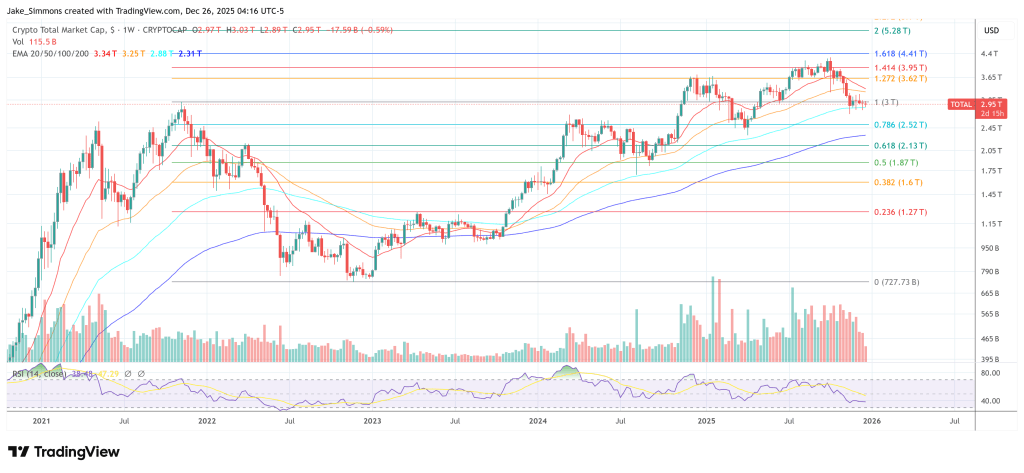
Total crypto market cap sits below the 2021 high, 1-week chart | Source: TOTAL on TradingView.com

Domande pertinenti

QWhich specific version of the Trust Wallet extension was affected by the security incident?

AThe security incident affected Trust Wallet Browser Extension version 2.68 only.

QWhat is the primary action users of the affected extension version should take immediately?

AUsers on version 2.68 should disable the extension and upgrade to version 2.69 before opening it again.

QAccording to cybersecurity firm PeckShield, what was the estimated value of crypto drained in the exploit?

APeckShield reported that the exploit drained over $6 million worth of cryptocurrencies from victims.

QWho first publicly reported the potential issue with Trust Wallet on December 25th?

AOn-chain investigator ZachXBT first reported the issue via a Telegram warning.

QDid Trust Wallet or its parent company commit to compensating affected victims?

AYes, Binance founder Changpeng Zhao confirmed via X that Trust Wallet would cover the losses, stating that user funds are SAFU.

Letture associate

What's the Connection Between Pinduoduo's Huang Zheng and Blockchain?

This text explores the unexpected connection between Pinduoduo founder Colin Huang and blockchain, as suggested in his article *Turning Capitalism Upside Down*. Huang argues Pinduoduo's core business is about managing "uncertainty." He posits that wealth flows to the rich because they absorb life's uncertainties (e.g., illness, job loss) that devastate the poor, who pay a premium for certainty through insurance or stable prices. Pinduoduo's model attempts a "reverse insurance": by aggregating consumer demand via group-buying and flash sales, it creates a large, predictable order for manufacturers. This certainty allows factories to remove risk premiums, passing savings back as lower prices, thus partially reversing the wealth flow. The key obstacle, Huang notes, is that an individual's buying intent is an unreliable promise. He then asks if blockchain is the natural solution for this "reverse insurance." The text elaborates that blockchain, through smart contracts with binding deposits, could transform casual intent into a costly-to-break, enforceable commitment. This replaces interpersonal trust with coded rules, making promises credible, pricable, and resistant to fraud. Finally, the author draws a parallel to Bitcoin, framing two paths to creating certainty: the "Pinduoduo path" of aggregating decentralized will into scale, and the "Bitcoin path" of locking rules into immutable code. Both sacrifice something—personal freedom or system flexibility—to manufacture trust and predictability.

链捕手5 min fa

What's the Connection Between Pinduoduo's Huang Zheng and Blockchain?

链捕手5 min fa

The Storage Magnate Who Conquered a Trillion-Dollar Kingdom, Yet Ultimately Could Not Become the Richest

**Summary:** "The Memory Magnate Who Built a Trillion-Dollar Empire, Yet Never Became the Richest" explores the journey of Zhu Yiming, founder of GigaDevice (603986) and co-founder of the soon-to-IPO ChangXin Memory Technologies (CXMT). The article positions GigaDevice, a fabless chip designer now valued at ~¥340 billion, as a prequel to the massive IDM (Integrated Device Manufacturer) venture, CXMT. Starting in 2005 with minimal capital, Zhu strategically "picked up the pieces" by focusing on niche markets like NOR Flash and microcontrollers (MCUs), areas major players were exiting. This allowed GigaDevice to grow into a diversified semiconductor company, maintaining robust profitability even during industry downturns by controlling costs. However, the piece argues that in the highly cyclical and capital-intensive memory chip industry, the fabless model has limits. True resilience and scale require the ability for "counter-cyclical expansion" – investing heavily during downturns – a tactic only possible for IDMs like Samsung or SK Hynix. This insight led Zhu to partner with the Hefei city government in 2016 to establish CXMT, an IDM focused on DRAM. Zhu's symbolic moves, like forfeiting salary and diluting his equity, were crucial in securing the massive state and bank funding needed. CXMT's equipment base is now valued even higher than that of BYD's vast auto manufacturing empire. Despite the potential for CXMT to reach a market cap of ¥1-2 trillion upon its IPO, Zhu's indirect stake in both companies is estimated below 3%, placing his personal wealth far below that of China's top billionaires. The article concludes that his strategic vision built a trillion-yuan memory landscape, but the capital structure necessary to achieve it precluded a personal fortune of similar scale.

marsbit12 min fa

The Storage Magnate Who Conquered a Trillion-Dollar Kingdom, Yet Ultimately Could Not Become the Richest

marsbit12 min fa

XRP Ledger Daily Fees Drop Below $400 As Network Activity Question Returns

The XRP Ledger is drawing attention as daily network fees have fallen below $400. While low fees align with XRPL's design for affordable transactions and are often seen as a strength, the metric can also serve as an indicator of network demand and paid transaction volume. This data point of around $3,100 in weekly fee burn highlights the stark contrast with higher-fee chains like Ethereum and Bitcoin. The development fuels an ongoing debate. Proponents view low fees as a sign of efficiency and accessibility, while critics may question if the network is generating sufficient high-value activity relative to its market cap and payments-focused narrative. The article cautions against overstating the finding, noting a single low-fee day does not signify network failure. It instead adds context to discussions about XRPL's usage, especially alongside Ripple's broader initiatives in stablecoins (RLUSD), AI payments, and enterprise infrastructure. The report recommends monitoring for a fee rebound, checking transaction counts for a fuller picture, and confirming the trend via native explorers like Bithomp. It frames the story within a larger market shift where on-chain data, protocol updates, and infrastructure developments are becoming crucial alongside price action. The editorial stance is to present the verified data, explain its significance for assessing network activity, and avoid hype, positioning it as part of the daily crypto conversation.

bitcoinist4 h fa

XRP Ledger Daily Fees Drop Below $400 As Network Activity Question Returns

bitcoinist4 h fa

Trading

Spot
Futures
活动图片





