Trump's Post Leaked in Advance? Polymarket Abnormal Betting Points to US-Iran Ceasefire Before Next Week

marsbitPubblicato 2026-03-24Pubblicato ultima volta 2026-03-24

Introduzione

Former US President Donald Trump announced on Truth Social that "very good and productive discussions" were taking place to resolve the Middle East conflict. Prior to this public statement, several accounts on the prediction market platform Polymarket placed large bets, totaling approximately $160,000, that a ceasefire between the US would occur by March 31 or April 15. These bets, which would yield over $1 million if successful, were made by 10 newly created accounts and had already generated over $300,000 in floating profits after Trump's post. The timing and success of these wagers, particularly from an account with a history of profitable bets on geopolitical events, have raised suspicions of insider trading. In response, Polymarket announced new rules explicitly prohibiting trading on stolen confidential information, illegal insider knowledge, or by users who can influence event outcomes. Concurrently, unusual trading activity was detected in S&P 500 e-mini futures and WTI crude oil futures just minutes before Trump's post. A significant, isolated spike in volume occurred in these typically illiquid pre-market sessions. Shortly after the post, S&P futures surged over 2.5% while oil prices fell nearly 6%, suggesting that some entities may have traded on advance knowledge of the announcement. The SEC and CME Group declined to comment.

Author: Jinshi Data

On Monday morning local time, US President Trump posted on Truth Social, stating that the US and Iran had "very good and productive discussions" regarding resolving the Middle East war.

However, before Trump publicly disclosed this news, several accounts on the prediction market platform Polymarket had already placed large bets that the war would end within this week.

Ten recently opened accounts invested thousands of dollars in Polymarket's "US-Iran Ceasefire" market, betting on a ceasefire being reached by March 31 or April 15; these accounts collectively wagered approximately $160,000, and if a ceasefire is achieved before the end of the month, they stand to profit over $1 million.

These accounts were identified by X platform user Lirrato on Sunday and were subsequently shared and spread by the PolymarketHistory account. After Trump's post on Monday, the unrealized gains of these 10 accounts have already exceeded $300,000.
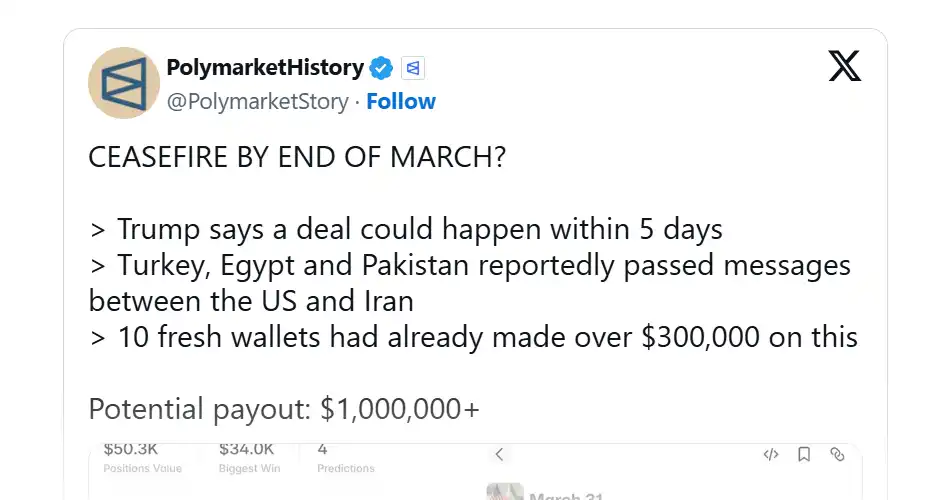
One account named "NOTHINGEVERFRICKINGHAPPENS" was particularly noteworthy. This account was registered in late February. Its first two trades were betting $7,600 on a US strike against Iran before February 28 and betting $11,283 on a strike before March 1; these two bets yielded profits totaling over $85,000. Now, the account has bet $8,005 on a US-Iran ceasefire before March 31 and another $15,614 on a ceasefire before April 15; these two bets have already generated unrealized gains of over $30,000.

The scale, timing, and past performance of these bets have led to external speculation about whether these Polymarket accounts belong to insiders—individuals connected to US or Iranian political circles who possess non-public information about diplomatic progress.

Prediction markets have previously been mired in insider trading scandals. A recent example involves a Polymarket trader who bet on the US taking military action against Venezuela, profiting over $400,000; a few days later, the US announced the capture of Venezuelan strongman Nicolás Maduro. Its competitor, Kalshi, recently also banned two users for insider trading, marking the platform's first public investigation into such activities.

On Monday, Polymarket announced an upgrade to its insider trading rules, explicitly prohibiting three types of behavior: trading using stolen confidential information, trading using illegal insider information, and trading when a user has the ability to influence the outcome of an event.

Polymarket's Chief Legal Officer, Neal Kumar, stated in a declaration: "Market prosperity relies on clear rules. The new regulations provide clarity for all participants and also demonstrate the compliance system we have built."

This rule adjustment may indicate that Polymarket will follow Kalshi's lead and initiate insider trading investigations. Although it is not yet certain whether the accounts betting on a US-Iran ceasefire are insiders, a platform investigation is expected to uncover the truth.

Abnormal Volume Spikes in S&P and Crude Futures Before Trump's Post

Furthermore, several minutes before Trump posted his market-moving social media update, abnormal trading volume spikes were also observed in S&P 500 futures and crude oil futures.

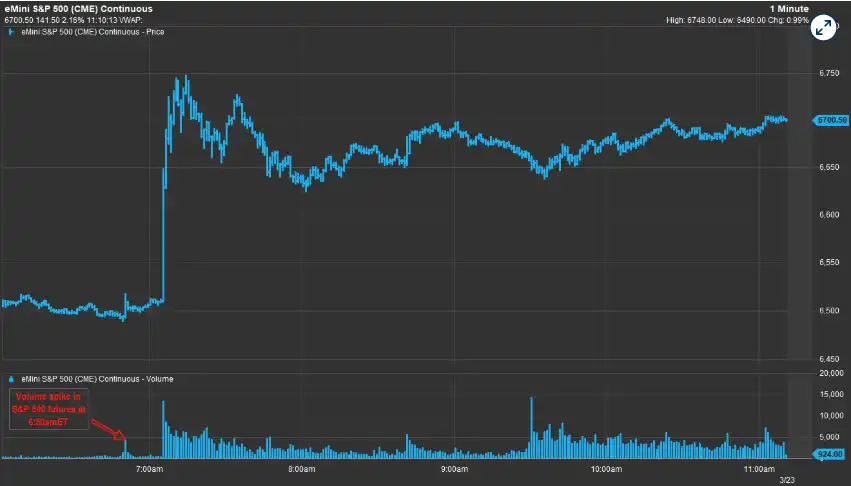
Around 6:50 AM New York time on Monday, the trading volume of S&P 500 e-mini futures traded on the Chicago Mercantile Exchange (CME) experienced a sharp and isolated surge, breaking the typically quiet pre-market backdrop. The early session is usually characterized by thin liquidity, making this sudden volume spike one of the largest moments of on-screen volume for that session up to that point.
A similar pattern emerged in the crude oil market. WTI crude oil futures also showed a noticeable uptick in trading activity around the same time, with a significant volume spike disrupting the previously calm market conditions.
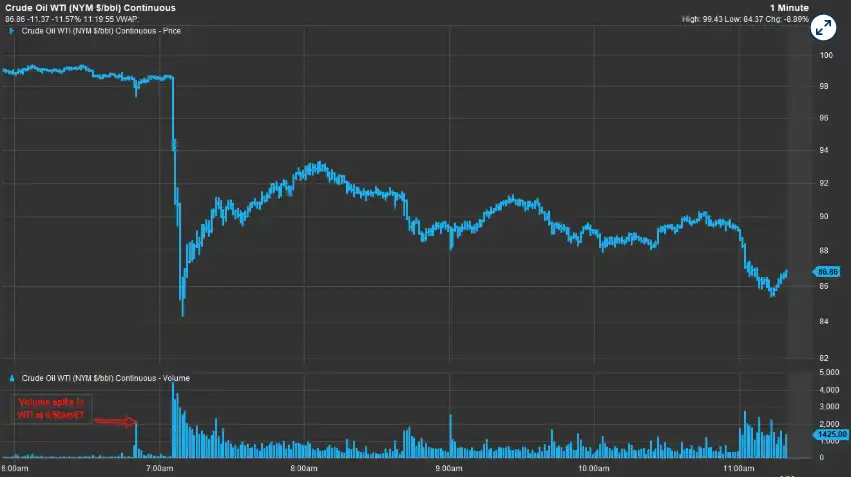
Approximately 15 minutes later, at 7:05 AM, Trump's statement about delaying strikes on Iranian power plants immediately triggered a rally in risk assets. S&P 500 futures surged over 2.5% before the open, while West Texas Intermediate (WTI) crude futures fell nearly 6% following the announcement.

The timing of the synchronized volume spikes in the stock and oil markets during the early session caught traders' attention—especially since there was no apparent catalyst driving the movement at the time of the spikes.

Pre-market futures trading typically has lower liquidity, making brief bursts of buying and selling more conspicuous than during regular trading hours. Nonetheless, these trades were still notable because anyone who bought stock futures in large quantities while simultaneously selling or shorting crude oil futures at that moment would have made huge profits just minutes later.

The US Securities and Exchange Commission (SEC) and the CME Group both declined to comment.

Algorithmic trading strategies and macro-driven strategies could also trigger rapid cross-asset capital flows during pre-market trading, even in the absence of a single identifiable catalyst.


Domande pertinenti

QWhat did President Trump post on Truth Social regarding US-Iran relations?

APresident Trump posted on Truth Social that there had been 'very good and productive conversations' regarding resolving the Middle East war.

QWhat suspicious activity was observed on the Polymarket prediction platform before Trump's announcement?

ATen recently created accounts placed large bets, totaling approximately $160,000, predicting a ceasefire between the US and Iran would be reached by March 31st or April 15th.

QWhat is the name of one notable account that made profitable bets on these events, and what were its wagers?

AOne notable account was named 'NOTHINGEVERFRICKINGHAPPENS'. It previously profited over $85,000 from bets on US strikes on Iran and had new bets on a ceasefire that were already up over $30,000 in profit.

QWhat other financial markets showed unusual activity just before Trump's post?

AS&P 500 e-mini futures and WTI crude oil futures showed isolated, sharp spikes in trading volume approximately 15 minutes before Trump's post, in an otherwise quiet pre-market session.

QHow did Polymarket respond to concerns about potential insider trading on its platform?

APolymarket announced upgraded insider trading rules, explicitly prohibiting trading on stolen confidential information, illegal insider information, and trading by users with the ability to influence event outcomes.

Letture associate

Within Strategy's Framework, STRC's Dividend Yield Remains at 12% as Share Price Stays Below Par Value

Michael Saylor, Executive Chairman of Strategy (MSTR), confirmed that the dividend rate for its STRC perpetual preferred shares will remain at 12.00% through August 2026. The rate has increased from 9% at its July 2025 launch to the current high via a "ratchet" mechanism, which permanently raises the rate by 0.5% whenever the share price falls below $95. This mechanism is intended to push the price back toward its $100 par value and support Strategy's "at-the-market" (ATM) program for issuing new shares to fund Bitcoin purchases. However, the mechanism has not worked as intended. STRC shares closed at $89.46 on July 31, remaining about 10-11% below par value despite the record-high dividend. Competition from rival Strive's higher-yielding SATA securities has pressured demand. The persistent discount has forced Strategy to suspend new STRC issuances via its ATM program, limiting this funding channel for Bitcoin acquisitions. STRC's struggles reflect Bitcoin's own volatility, as the preferred shares historically move in tandem. Analysts have warned the ratchet structure carries long-term, one-way risk. A law firm is investigating Strategy's ability to maintain dividend payments if Bitcoin's price stays low. Retail investors own roughly 83% of outstanding STRC shares, a group seen as prone to panic selling during downturns. In response, Strategy has established financial reserves, including a liquidity cushion covering about 26 months of dividend/interest obligations, and a $2 billion share buyback program alongside a Bitcoin monetization framework, though the company emphasized it is not obligated to sell any Bitcoin.

cryptonews.ru41 min fa

Within Strategy's Framework, STRC's Dividend Yield Remains at 12% as Share Price Stays Below Par Value

cryptonews.ru41 min fa

Analyst: Bitcoin's Price Will Drop to $60k in August, Then Rebound to $70k

Financial analyst Andrey Poroshin has provided a new forecast for Bitcoin's price dynamics in August. Poroshin, an analyst at the Bitbanker exchange, expects the cryptocurrency market to experience a downturn this month, with prices retesting the $60,000 level due to a lack of supportive macroeconomic catalysts. He noted that the recent US Federal Reserve decision to hold interest rates did not significantly impact the market, while inflation remains above the 2% target. Poroshin stated that Bitcoin is ending July under pressure from moderate volatility and a lack of new macroeconomic stimuli, leading to continued market caution. According to his base scenario, Bitcoin will drop to a range of $60,000 to $62,000 before recovering to $70,000. He pointed out that even $70,000 remains below the cost of mining in the US, which has prompted some miners to shift towards AI data center operations. Poroshin cited the winding down of BitMEX's operations as a potential catalyst for a price rebound, suggesting the exit of weaker players often coincides with market reversals and reduced short-term selling pressure. He believes Bitcoin is currently less susceptible to geopolitical shocks, such as the Iran-US conflict, and does not expect significant market changes in August related to the pending CLARITY Act. Looking ahead, Poroshin forecasts that September will bring more active price fluctuations driven by potential Fed rate decisions and possible discussions or approval of the CLARITY Act.

cryptonews.ru41 min fa

Analyst: Bitcoin's Price Will Drop to $60k in August, Then Rebound to $70k

cryptonews.ru41 min fa

Trading

Spot
活动图片




