Trump's Bank Arrives: 49% Goes to Middle East Royalty, 38% Belongs to President's Family

marsbitPubblicato 2026-08-28Pubblicato ultima volta 2026-08-28

Introduzione

The U.S. Office of the Comptroller of the Currency (OCC) has granted preliminary conditional approval to World Liberty Financial to establish a national trust bank for its USD1 stablecoin. Major ownership of the bank's holding company reveals Sheikh Tahnoon bin Zayed al Nahyan, a senior UAE official and national security advisor, holds 49% through an investment vehicle, while entities linked to the Trump family hold 38%. This mirrors a prior $500 million investment by the sheikh into World Liberty, which reportedly channeled $263 million to Trump-linked entities. The bank would allow World Liberty to directly custody USD1's dollar reserves (currently $4 billion) and keep all interest income, estimated at $150 million annually, rather than sharing it with a third-party custodian. This move was enabled by the 2025 "Genius Act," signed by the president, which permits approved stablecoin issuers to self-custody reserves. The approval process, overseen by a Trump-appointed OCC head, has drawn scrutiny due to the unprecedented foreign and presidential family stakes in a federally chartered bank poised to manage significant U.S. Treasury investments.

Earlier this month, the U.S. Office of the Comptroller of the Currency (OCC) granted World Liberty Financial preliminary conditional approval to establish a federally chartered national trust bank to issue, redeem, and custody USD1, the dollar-backed stablecoin it launched last year.

The Wall Street Journal disclosed the ownership structure behind this bank on Thursday.
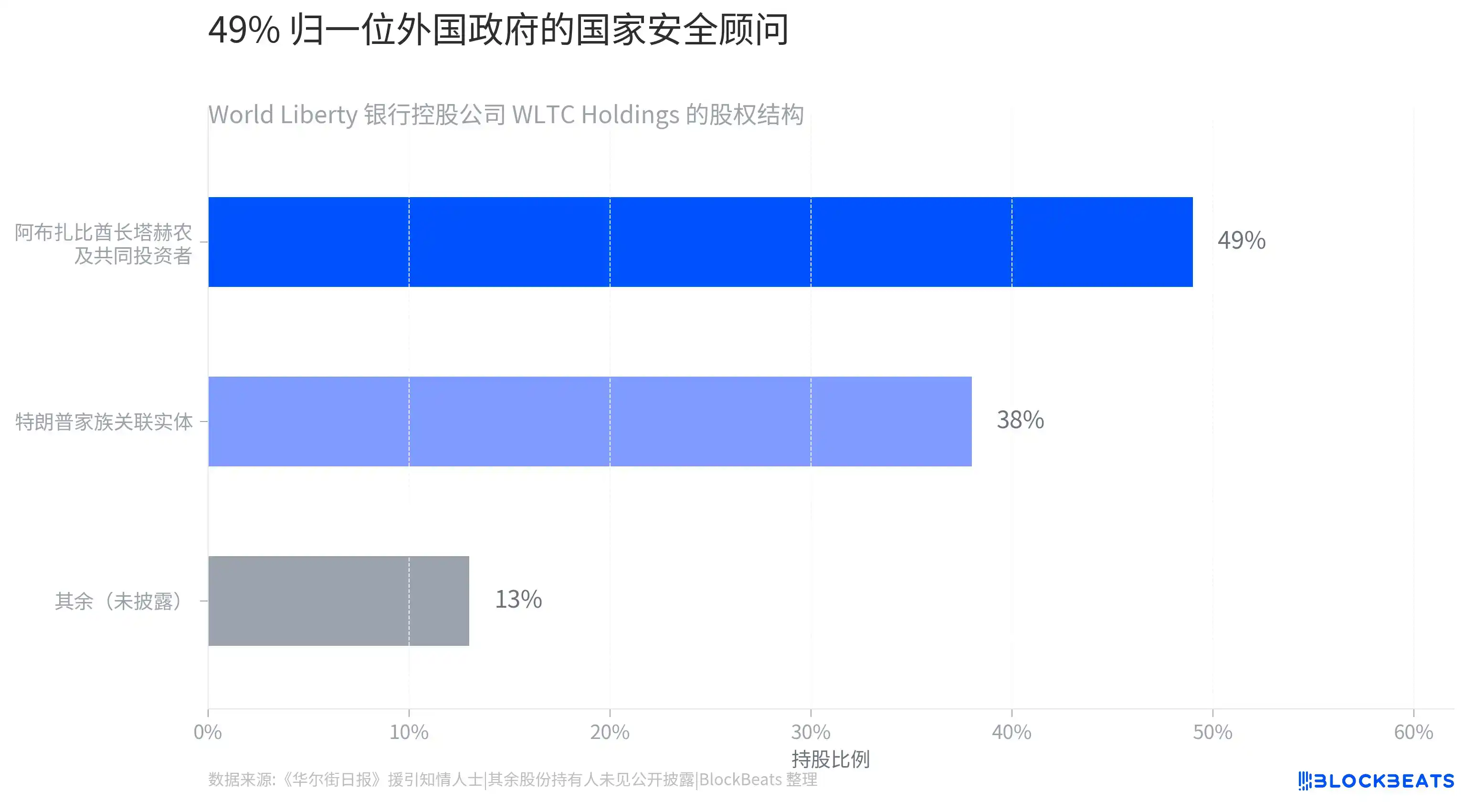
The largest shareholder is Sheikh Tahnoon bin Zayed al Nahyan, a member of the Abu Dhabi royal family, and his co-investors. Through an entity called StringZ Holding RSC, they hold 49% of the bank's holding company, WLTC Holdings.

Entities linked to the Trump family hold 38%.

Who is Tahnoon? He is the National Security Advisor of the United Arab Emirates and a brother of the country's President. He oversees a financial empire exceeding $1.3 trillion, with funds coming from both his personal wealth and state coffers. In Western media reports, he is sometimes referred to as the "Spy Sheikh."

This Isn't His First Appearance on This Chain

In January 2025, four days before Trump's inauguration, Tahnoon and co-investors invested $500 million into World Liberty Financial through an entity called Aryam Investment 1, acquiring a 49% stake in the company. That deal was not disclosed at the time and was only exposed by The Wall Street Journal this January.

According to the President's latest financial disclosure, $263 million of that money flowed to Trump family entities.

Democratic lawmakers and legal experts criticized it directly at the time: a senior foreign government official holding significant ownership in a company belonging to a U.S. President-elect was unprecedented.

Now, the same 49% appears in an institution about to receive a U.S. federal bank charter. The shareholder structure of the bank holding company is the same as that of World Liberty itself, except Tahnoon's side uses a different entity to hold the shares.

What Exactly Will This Bank Do?

It is not a traditional bank; a trust charter generally does not allow taking deposits or making loans. What it can do is: hold assets for clients nationwide and facilitate faster payment settlements.

Specifically for World Liberty, this charter allows it to issue USD1 directly and custody the dollar assets backing the stablecoin itself. These two tasks are currently handled by partner BitGo, an independent trust bank that holds USD1's reserves and keeps a portion of the interest.

This is the core of the business.

USD1 currently has a market capitalization of $4 billion. World Liberty states that the dollars backing it are invested in U.S. Treasury bonds and other cash equivalents, generating an estimated $150 million in interest annually.

Previously, this interest had to be shared with BitGo. With its own bank, it won't.

And the logic is self-reinforcing: the more USD1 in circulation, the larger the reserves, the greater the interest income. Therefore, World Liberty says the mission of this trust bank is to drive the "mainstream adoption" of USD1 while offering new services to customers, such as charging fees to custody their cryptocurrency.

After the OCC approval, World Liberty CEO Zach Witkoff said the company's ambition is "to build the most trusted and widely used digital dollar in the world." He is the son of Steve Witkoff, the U.S. Middle East envoy.

The Legal Gateway for This Charter Was Signed by the President Himself

World Liberty only began the process of setting up the bank after July 2025, the month the President signed the Genius Act.

This law did one key thing: it allowed approved stablecoin companies to directly hold the reserve assets backing their tokens.

Before this, World Liberty had to rely on a third party like BitGo. After this, it can do it itself, as long as it obtains a federal charter. It applied in January of this year and received preliminary conditional approval on August 14.

The Genius Act also stipulates that U.S.-issued dollar-pegged stablecoins must be backed by specific assets, including U.S. Treasury securities maturing in 93 days or less. Treasury Secretary Besant previously cited a prediction that stablecoins could grow into a market approaching $4 trillion and has written that "this could lower the government's borrowing costs."

In other words, the stablecoin track has clear fiscal significance for this administration; it creates new buyers for U.S. Treasury debt. And one of the companies running furthest ahead on this track belongs to the President's family.

The Same Regulator, Several Other Decisions This Summer

The OCC has approved a series of national bank charters for crypto companies in recent months, with Ripple and Circle both receiving preliminary approvals. The current Comptroller, Jonathan Gould, was appointed by Trump last year.

But there were also rejections.

In early August, the OCC rejected Dutch fintech company Bunq's application for a national bank charter, citing significant regulatory and compliance concerns. In mid-August, Zerohash, which provides crypto infrastructure for Morgan Stanley's E*Trade, had its trust bank application returned, citing material deficiencies; it subsequently resubmitted with a narrower business scope, with a public comment period ending September 17.

Regarding World Liberty's application, the OCC's letter stated: "This preliminary conditional approval is based on a comprehensive evaluation of all information available to the OCC, including statements and commitments made in the application and by representatives of the bank." Final approval is contingent on meeting a series of "pre-opening requirements" and passing a final examination.

A World Liberty spokesperson said OCC career staff reviewed the application "for compliance with statutory, regulatory, and policy requirements and factors governing bank approvals." The company did not comment on the shareholder structure behind its bank.

An OCC official said application reviews are handled by career staff and that the agency "consulted with multiple experienced career government ethics officials" to ensure the process "complies with all government ethics standards and policies."

There's Another Sum of Money

Tahnoon's $500 million is not the only controversial funding entering this company.

Earlier this month, The New York Times reported that a businessman named Guren "Bobby" Zhou invested a total of $100 million into World Liberty through a new company called Aqua 1, becoming one of the largest buyers of the company's tokens.

Two years ago, he was a failed hardwood flooring retailer in the UK, under investigation for money laundering there, and presided over the collapse of a small crypto startup.

Under World Liberty's policy, up to $75 million of that money was allocated to a company controlled by the President and his three sons, while also benefiting the Witkoff family.

On July 19, the day of the World Cup final, Zhou and Zach Witkoff sat together in a luxury box at the stadium in New Jersey.

What Remains to Be Seen

The bank has not yet opened. It must first meet the conditions set by the OCC and pass a final examination.

What is already certain is: if it opens, an institution 49% owned by a senior foreign government official and 38% owned by the President's family will hold the full reserves of a dollar stablecoin, invest them into U.S. Treasury bonds, and take all the interest.

Crypto di tendenza

Domande pertinenti

QWhat is the primary function of the federal trust bank charter granted to World Liberty Financial, and what key business advantage does it provide?

AThe primary function is to allow World Liberty Financial to directly issue, redeem, and custody its USD1 stablecoin. The key business advantage is that it allows the company to hold the reserve assets backing the stablecoin itself, eliminating the need to share the interest income from those reserves with a third-party custodian like BitGo.

QWho are the major owners of the bank holding company (WLTC Holdings) behind World Liberty Financial, and what percentage does each control?

ASheikh Tahnoon bin Zayed al Nahyan of Abu Dhabi and his co-investors, through StringZ Holding RSC, own 49% of WLTC Holdings. Entities linked to the Trump family own 38%.

QHow did the 'Genius Act,' signed by President Trump, create a legal pathway for World Liberty Financial to establish its own trust bank?

AThe Genius Act, signed in July 2025, allowed approved stablecoin companies to directly hold the reserve assets backing their tokens. This removed the legal requirement for a third-party custodian, enabling World Liberty to seek its own federal trust bank charter to perform this function in-house.

QWhat controversy surrounded the initial $500 million investment in World Liberty Financial by Sheikh Tahnoon bin Zayed al Nahyan in January 2025?

AThe controversy centered on the unprecedented nature of a senior foreign government official holding significant ownership in a company controlled by an incoming U.S. President (then President-elect Trump). Critics argued it created a major conflict of interest, with $263 million of that investment flowing to Trump-family entities.

QWhat is one additional source of controversial funding mentioned in the article that flowed into World Liberty Financial, and who benefited from it?

ABusinessman Guren 'Bobby' Zhou invested $100 million through Aqua 1. Up to $75 million of that was allocated to a company controlled by the then President and his three sons, and also benefited the Witkoff family (the CEO's family).

Letture associate

Podcast Notes | After Watching 141 YouTube Investment Guru Videos, I Found Everyone's Bullish on These 5 Stocks

Podcast Summary: After analyzing 141 YouTube investment videos from 21 creators, five stocks were consistently highlighted: Alphabet (Google), Nvidia, Micron, CoreWeave, and Uber. However, the analysis reveals a key concentration: four of these (Google, Nvidia, Micron, CoreWeave) represent essentially the same AI-focused bet, with only Uber standing as an independent pick. The podcaster, Brian, provides his specific views and entry strategies for each. **Key Stocks & Brian's Stance:** - **Alphabet (Google):** Viewed as cheap based on profits but expensive based on sales. Brian is only buying a half-position via monthly investments at ~$362. - **Nvidia:** Models suggest it is undervalued (~$221 vs. a ~$290-330 fair value range), but significant client debt ($500B) raises risk. Brian holds a 12% position (his cap) and would not buy below $148. - **Micron:** Brian's model fair value is ~$1450, but it's a cyclical stock. He is buying only on schedule after it broke below its 50-day moving average (~$961), with a "story broken" line at $434. - **CoreWeave:** Has large contracts but faces scrutiny over demand sustainability, with Nvidia backing unsold capacity. Brian holds zero position due to limited history and structural concerns. - **Uber:** The only non-AI pick, valued cheaply on strong cash flow (~$100B annually). Brian's fair value is ~$109 (current price ~$67), and he is buying a full position. **Core Insight:** Most discussed topics (76/141 videos) were chips, cloud, and AI models. A portfolio built from such consensus may appear diversified but often constitutes a single, concentrated bet on AI. Brian concludes with a disciplined framework for any investment: compare to its own history, understand what the current price assumes, separate a good company from a good price, and pre-define your exit conditions.

marsbit6 min fa

Podcast Notes | After Watching 141 YouTube Investment Guru Videos, I Found Everyone's Bullish on These 5 Stocks

marsbit6 min fa

From 'Interest Rate Trading' to 'Dollar Debasement Trade', the Logic Behind Gold's Rise Has Changed

From "Rate Trade" to "Debasement Trade": The Logic Behind Gold's Rally Has Shifted Gold surged by 17% in August. According to UBS, the key development was a fundamental shift in the driving narrative mid-rally—from the traditional "rate trade" to a "debasement trade" focused on fiscal and dollar concerns. The bank breaks the summer rebound into two acts. The first was a technically-driven bounce from a solid base, supported by light positioning, resilient physical demand (especially from central banks like China's), and softening US economic data. The second act, triggered by the US Treasury's announcement to double long-term bond buybacks, marked a shift in gold's pricing logic. The market began viewing higher long-term yields as a sign of fiscal sustainability risks rather than economic strength, weakening gold's traditional inverse correlation with real rates. Gold's role evolved from an "opportunity cost" asset to a hedge against "fiscal credibility" and currency debasement, further aided by a weakening US dollar. UBS maintains a bullish outlook, noting rising upside risks to its long-term forecasts. While it lowered its 2026 year-end target to $4,675/oz, its 2027+ forecasts are unchanged, with an upside scenario target as high as $6,500/oz. The primary near-term risk is a hawkish Fed pivot, which could trigger a correction. However, UBS views any such dip as a buying opportunity, not a trend reversal, unless AI-driven growth allows for significantly higher rates. The report concludes that as gold is increasingly seen as a hedge against fiscal and currency risks, its strategic role in portfolios is changing. With overall gold allocations still low, there is significant room for further price appreciation if debt sustainability concerns drive sustained strategic buying.

marsbit7 min fa

From 'Interest Rate Trading' to 'Dollar Debasement Trade', the Logic Behind Gold's Rise Has Changed

marsbit7 min fa

Not Just Trading and Meme: These 5 Projects on Base Are Exploring New On-Chain Use Cases

Beyond Trading and Memes: 5 Projects Exploring New On-Chain Use Cases on Base While much of the crypto space is dominated by speculation, Base—Coinbase's Ethereum Layer 2 with over $5B TVL—is fostering innovative projects beyond the usual categories. Here are five notable examples: 1. **Hydrex**: A MetaDEX/AMM aggregator that pools native and external liquidity (e.g., from Uniswap, Morpho) to offer optimal swap rates. It features a ve(3,3)-style incentive model and single-signature transactions. 2. **SwapRoyale**: A fantasy trading competition app where users pay a fixed entry fee to trade with a virtual $100k portfolio in real-time contests. It gamifies trading with various tournament formats and has already distributed over $100k in prizes. 3. **BlockRun**: A permissionless AI gateway and payment layer for the on-chain agent economy. It allows autonomous systems to discover, pay for, and execute services using USDC on Base via the x402 micropayment standard, enabling pay-per-use AI. 4. **PixieChess**: A play-to-earn digital chess game where each piece is a collectible NFT with unique abilities that alter classic rules. Value is kept within the ecosystem, with a treasury funding real ETH prizes for winners. 5. **Tokensto**: A platform that lets users sell their unused AI API credits (e.g., from OpenRouter) for cash. It automatically prices credits and facilitates direct payouts to crypto wallets. These projects demonstrate that builders on Base are actively experimenting with consumer experiences, the agent economy, and novel gaming mechanics, suggesting the surface area for meaningful on-chain activity is broader than current narratives imply.

marsbit51 min fa

Not Just Trading and Meme: These 5 Projects on Base Are Exploring New On-Chain Use Cases

marsbit51 min fa

Trading

Spot

Articoli Popolari

Cosa è $BANK

Banca AI: Un Passo Rivoluzionario nel Futuro della Banca Introduzione In un'era caratterizzata da rapidi progressi tecnologici, Banca AI si trova all'incrocio tra intelligenza artificiale (AI) e servizi bancari. Questo progetto innovativo mira a ridefinire il panorama finanziario, migliorando l'efficienza operativa, le misure di sicurezza e le esperienze dei clienti attraverso il potere dell'AI. Mentre ci impegniamo in questa esplorazione di Banca AI, esamineremo cosa comporta il progetto, le sue dinamiche operative, il suo contesto storico e i traguardi significativi. Cos'è Banca AI? Alla sua essenza, Banca AI rappresenta un'iniziativa trasformativa volta a integrare l'intelligenza artificiale in varie operazioni bancarie. Questo progetto sfrutta le capacità dell'AI per automatizzare processi, migliorare i protocolli di gestione del rischio e potenziare l'interazione con i clienti attraverso servizi personalizzati. Gli obiettivi principali di Banca AI includono: Automazione delle Funzioni Bancarie: Sfruttando le tecnologie AI, Banca AI mira ad automatizzare compiti di routine, riducendo il carico sulle risorse umane e aumentando l'efficienza. Miglioramento della Gestione del Rischio: Il progetto utilizza algoritmi AI per prevedere e identificare i rischi, rafforzando così le misure di sicurezza contro le frodi e altre minacce. Personalizzazione dei Servizi Bancari: Banca AI si concentra sull'offrire prodotti e servizi finanziari su misura analizzando i dati e i comportamenti dei clienti. Miglioramento dell'Esperienza del Cliente: L'implementazione di soluzioni guidate dall'AI, come chatbot e assistenti virtuali, mira a fornire agli utenti interazioni più umane, rivoluzionando il modo in cui i clienti si relazionano con le banche. Con questi obiettivi, Banca AI si posiziona come un attore cruciale nel rendere la banca più efficiente, sicura e centrata sull'utente. Chi è il Creatore di Banca AI? I dettagli riguardanti il creatore di Banca AI rimangono sconosciuti. Pertanto, non è stata identificata alcuna persona o organizzazione specifica nelle informazioni disponibili. L'anonimato che circonda la nascita del progetto solleva domande, ma non sminuisce la sua ambiziosa visione e obiettivi. Chi sono gli Investitori di Banca AI? Simile al creatore del progetto, informazioni specifiche riguardo gli investitori o le organizzazioni di supporto di Banca AI non sono state divulgate. Senza queste informazioni, è difficile delineare il sostegno finanziario e istituzionale che potrebbe spingere il progetto in avanti. Tuttavia, l'importanza di avere una solida base di investimento è fondamentale per sostenere lo sviluppo in un campo così innovativo. Come Funziona Banca AI? Banca AI opera su più fronti innovativi, concentrandosi su fattori unici che la differenziano dai framework bancari tradizionali. Di seguito sono riportate le caratteristiche operative chiave: Automazione: Applicando algoritmi di machine learning, Banca AI automatizza vari processi manuali all'interno delle banche. Ciò si traduce in una riduzione dei costi operativi e consente ai lavoratori umani di reindirizzare i propri sforzi verso attività più strategiche. Gestione Avanzata del Rischio: L'integrazione dell'AI nelle pratiche di gestione del rischio fornisce alle banche strumenti per prevedere con precisione potenziali minacce come le frodi, garantendo che le informazioni e i beni dei clienti rimangano al sicuro. Raccomandazioni Finanziarie Personalizzate: Attraverso l'apprendimento continuo dalle interazioni con i clienti, i sistemi AI sviluppano una comprensione sfumata delle esigenze degli utenti, consentendo loro di offrire consigli su misura per le decisioni finanziarie. Interazioni Migliorate con i Clienti: Utilizzando chatbot e assistenti virtuali alimentati dall'AI, Banca AI consente un'esperienza cliente più coinvolgente, permettendo agli utenti di risolvere rapidamente le loro richieste, riducendo così i tempi di attesa e migliorando i livelli di soddisfazione. Tutte queste caratteristiche operative posizionano Banca AI come un pioniere nel settore bancario, stabilendo nuovi standard per la fornitura di servizi e l'eccellenza operativa. Timeline di Banca AI Comprendere la traiettoria di Banca AI richiede uno sguardo al suo contesto storico. Di seguito è riportata una timeline che evidenzia traguardi e sviluppi importanti: Inizio 2010: La concettualizzazione dell'integrazione dell'AI nei servizi bancari ha cominciato a guadagnare attenzione mentre le istituzioni bancarie riconoscevano i potenziali benefici. 2018: Si è verificato un aumento significativo nell'implementazione delle tecnologie AI quando le banche hanno iniziato a utilizzare strumenti AI come i chatbot per servizi clienti di base e sistemi di gestione del rischio per migliorare la sicurezza. 2023: La sofisticazione dell'AI ha continuato ad avanzare, con l'introduzione dell'AI generativa per compiti più complessi come l'elaborazione di documenti e l'analisi degli investimenti in tempo reale. Quest'anno ha segnato un significativo salto nelle capacità offerte alle banche dalla tecnologia AI. 2024-Stato Attuale: A partire da quest'anno, Banca AI è su una traiettoria ascendente, con ricerche e sviluppi in corso pronti a migliorare ulteriormente le capacità nelle operazioni bancarie. L'esplorazione continua delle applicazioni AI suggerisce sviluppi entusiasmanti in arrivo. Punti Chiave su Banca AI Integrazione dell'AI nella Banca: Banca AI si concentra sull'adozione dell'intelligenza artificiale per snellire i processi bancari e migliorare le esperienze degli utenti. Focus su Automazione e Gestione del Rischio: Il progetto enfatizza fortemente queste aree, mirando a spostare il carico di compiti di routine mentre migliora le strutture di sicurezza attraverso analisi predittive. Soluzioni Bancarie Personalizzate: Sfruttando i dati dei clienti, Banca AI consente servizi bancari su misura che si adattano alle esigenze individuali degli utenti. Impegno per lo Sviluppo: Banca AI rimane impegnata in sforzi di ricerca e sviluppo continuativi, garantendo la sua adattabilità e rilevanza continua man mano che la tecnologia continua a evolversi. Conclusione In sintesi, Banca AI rappresenta un passo cruciale in avanti nell'industria bancaria, sfruttando l'intelligenza artificiale per rimodellare i paradigmi operativi, migliorare la sicurezza e promuovere la soddisfazione del cliente. Nonostante le lacune nelle informazioni riguardo il creatore e gli investitori, gli obiettivi chiari e i meccanismi funzionali di Banca AI forniscono una solida base per la sua continua evoluzione. Mentre la tecnologia AI continua ad avanzare e fondersi con il settore bancario, Banca AI è ben posizionata per avere un impatto significativo sul futuro dei servizi finanziari, migliorando il modo in cui comprendiamo e interagiamo con la banca.

326 Totale visualizzazioniPubblicato il 2024.04.06Aggiornato il 2024.12.03

Cosa è $BANK

Come comprare BANK

Benvenuto in HTX.com! Abbiamo reso l'acquisto di Lorenzo Protocol (BANK) semplice e conveniente. Segui la nostra guida passo passo per intraprendere il tuo viaggio nel mondo delle criptovalute.Step 1: Crea il tuo Account HTXUsa la tua email o numero di telefono per registrarti il tuo account gratuito su HTX. Vivi un'esperienza facile e sblocca tutte le funzionalità,Crea il mio accountStep 2: Vai in Acquista crypto e seleziona il tuo metodo di pagamentoCarta di credito/debito: utilizza la tua Visa o Mastercard per acquistare immediatamente Lorenzo ProtocolBANK.Bilancio: Usa i fondi dal bilancio del tuo account HTX per fare trading senza problemi.Terze parti: abbiamo aggiunto metodi di pagamento molto utilizzati come Google Pay e Apple Pay per maggiore comodità.P2P: Fai trading direttamente con altri utenti HTX.Over-the-Counter (OTC): Offriamo servizi su misura e tassi di cambio competitivi per i trader.Step 3: Conserva Lorenzo Protocol (BANK)Dopo aver acquistato Lorenzo Protocol (BANK), conserva nel tuo account HTX. In alternativa, puoi inviare tramite trasferimento blockchain o scambiare per altre criptovalute.Step 4: Scambia Lorenzo Protocol (BANK)Scambia facilmente Lorenzo Protocol (BANK) nel mercato spot di HTX. Accedi al tuo account, seleziona la tua coppia di trading, esegui le tue operazioni e monitora in tempo reale. Offriamo un'esperienza user-friendly sia per chi ha appena iniziato che per i trader più esperti.

979 Totale visualizzazioniPubblicato il 2025.05.09Aggiornato il 2026.06.02

Come comprare BANK

Discussioni

Benvenuto nella Community HTX. Qui puoi rimanere informato sugli ultimi sviluppi della piattaforma e accedere ad approfondimenti esperti sul mercato. Le opinioni degli utenti sul prezzo di BANK BANK sono presentate come di seguito.

活动图片