Trump opens door for Bitcoin as U.S. national debt surpasses $40 trillion

cryptonews.ruPubblicato 2026-08-20Pubblicato ultima volta 2026-08-20

Introduzione

US national debt has surpassed $40 trillion, more than doubling from $19.95 trillion when Trump took office in 2017. The last trillion was added in just over five months. Pandemic spending under Trump and Biden accelerated borrowing, while entitlement programs, defense spending, and chronic deficits sustain it. Rising interest rates, now costing roughly $1 trillion annually, are making the debt more expensive to service and refinance. Bitcoin advocates see the $40 trillion debt milestone as an advertisement for the cryptocurrency's fixed 21 million supply, contrasting with unlimited government debt issuance. Bitcoin's price surged past $69,000 following a US Treasury announcement to buy back long-term securities. In related news, Donald Trump acknowledged discussions about the US potentially acquiring significant Bitcoin holdings, stating it could reduce pressure on the dollar. He emphasized the US would remain a leader in crypto. This is not a firm policy commitment, but Congress is already considering bills to explore a national Bitcoin reserve. The key test will be whether this rhetoric translates into actual policy as debt, deficits, and bond yields continue to rise.

The debt has more than doubled from approximately $19.95 trillion when U.S. President Donald Trump took office in January 2017. Even more tellingly, Washington accumulated the last $1 trillion in just over five months after the federal debt exceeded the $39 trillion mark in March.

The blame for this can be shared among many. Pandemic-era spending under Trump and former President Joe Biden sharply accelerated borrowing, while the Social Security system, Medicare, tax policies, huge defense spending, and chronic federal deficits have kept this machine running. Rising interest rates have now made the cost of hiding this bill significantly more difficult.

Interest Expense Turns Debt into a Vicious Cycle

Net federal interest expense is hovering around or exceeding $1 trillion per year. The Congressional Budget Office forecasts roughly $1 trillion in fiscal year 2026, with interest costs potentially rising to $2.1 trillion by 2036 under current law.
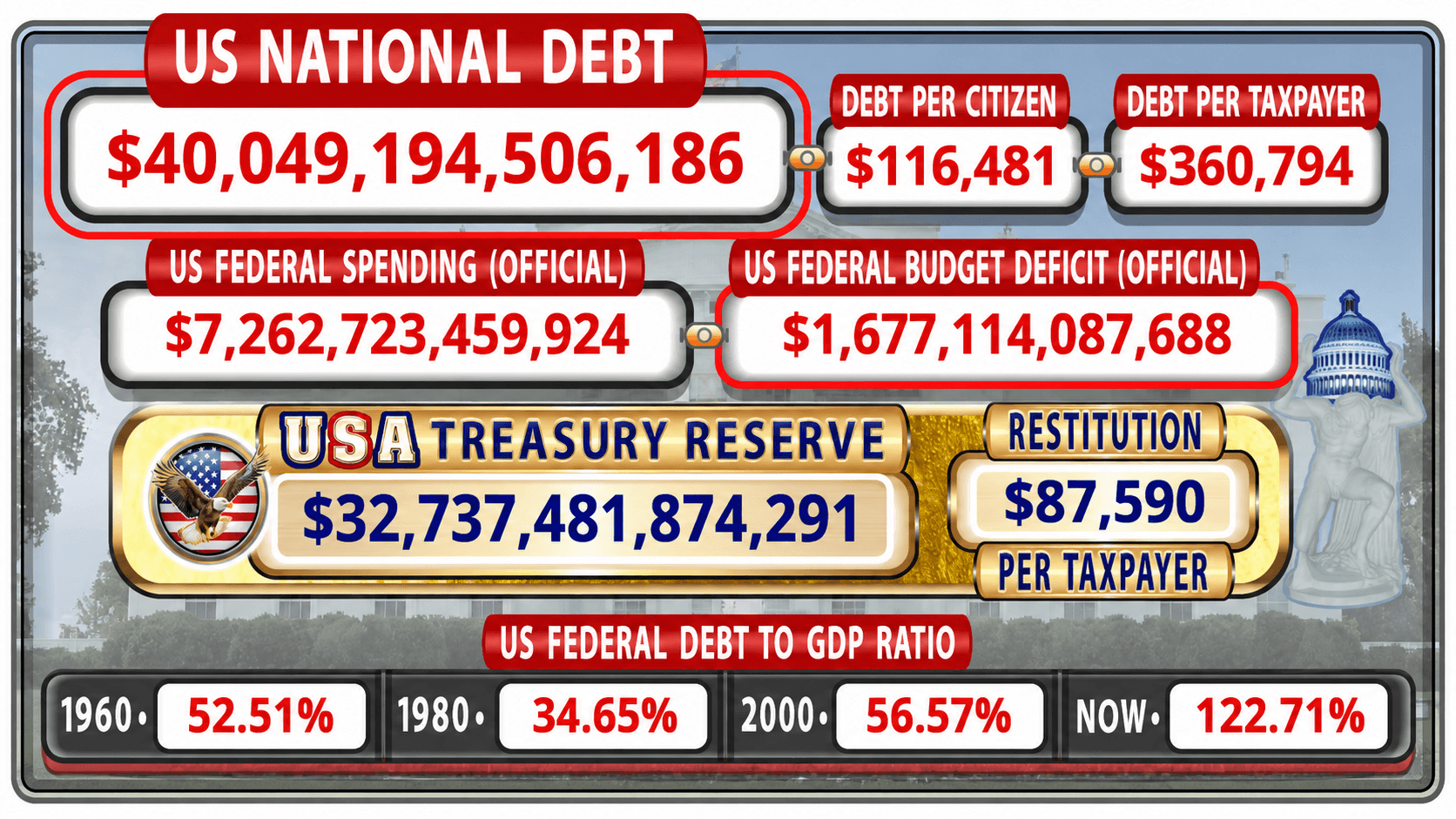
U.S. national debt clock from usdebtclock.org.

And here's where the numbers become truly terrifying. Washington must refinance maturing debt while also issuing more debt to finance new deficits. Higher rates make rolling over old obligations more expensive, which increases interest expense, worsens the deficit, and forces the Treasury Department to go back to the market for yet more borrowing.

The problems are not confined to Washington. Treasury yields set the baseline cost of borrowing across the entire economy, so the rising cost of government funding impacts mortgages, auto loans, and business lending. The ratio of public debt to gross domestic product is already hovering around 100%.

Bitcoin Advocates See a $40 Trillion Advertisement

For Bitcoin advocates, the $40 trillion figure is practically an advertisement in itself. Bitcoin's maximum supply is fixed at 21 million coins, while governments have no comparable limit on issuing debt or expanding the volume of dollars ultimately needed to finance that debt.
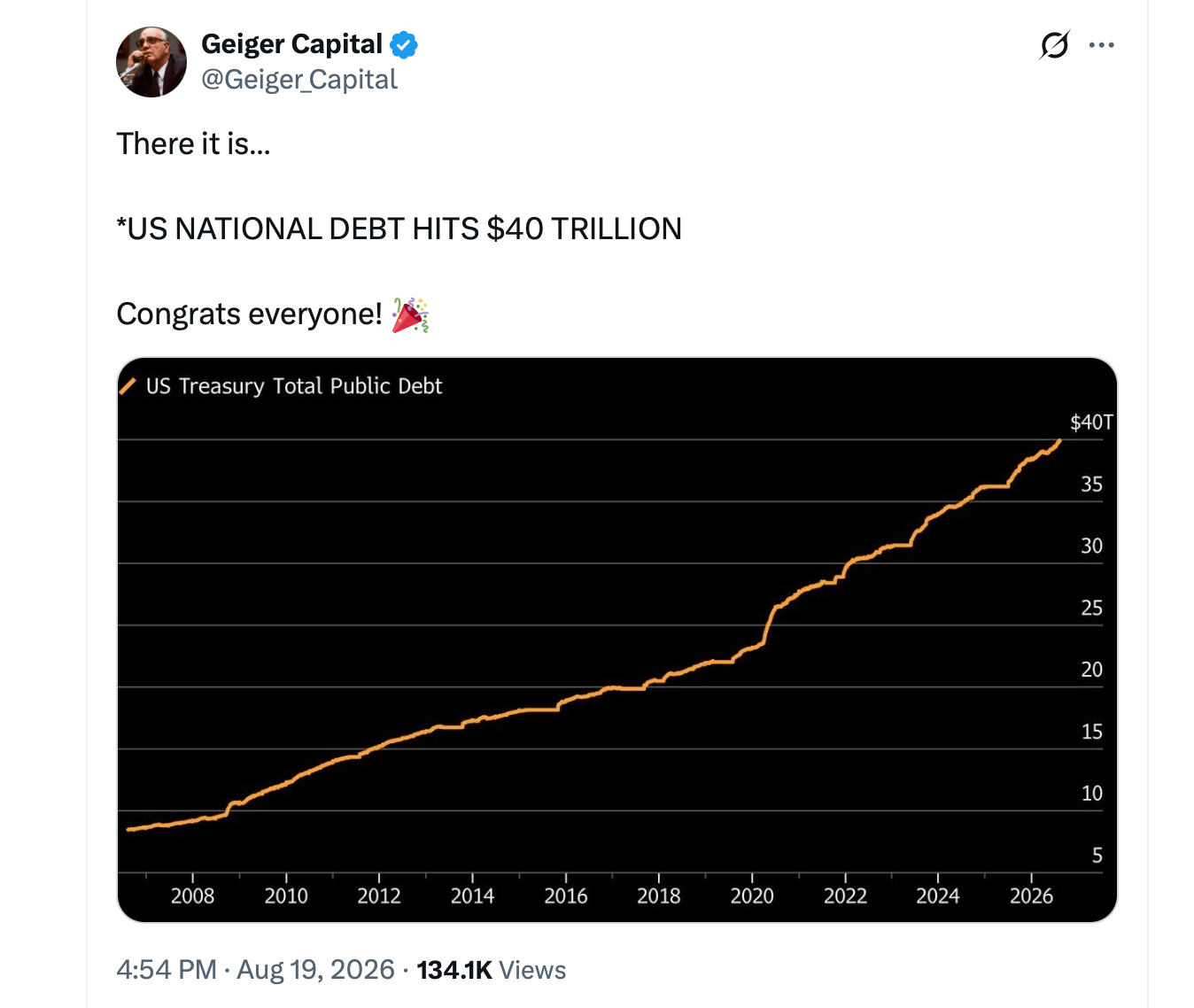
Image source: X

It is this distinction that explains why each new debt milestone reaffirms the arguments for Bitcoin as a scarce, non-sovereign currency. The deeper bet is that chronic deficits, rising interest payments, and shrinking fiscal flexibility are gradually making currency debasement a more visible phenomenon that investors find increasingly difficult to ignore.

On Wednesday, Bitcoin provided the perfect backdrop, surging from the mid-$64,000 range to the $69,000-$70,000 level. The immediate trigger was the U.S. Treasury Department's decision to expand its buyback of long-term securities to at least $4 billion per operation, easing pressure on long-term bond yields and helping flush out overextended cryptocurrency short sellers.

Trump Leaves Door Open for Bitcoin

Then Trump gave Bitcoin advocates another headline opportunity. Responding to a question about accumulating significant Bitcoin holdings, he acknowledged the idea had been discussed and stated he would listen to recommendations from advisors, including former Securities and Exchange Commission (SEC) Chairman Paul Atkins and his team.

"Of course, it's been discussed," Trump noted. "It takes a lot of pressure off the dollar. It's very, very good for the dollar." On Wednesday, Trump also remarked that the U.S. would remain the leader in cryptocurrency, prediction markets, and artificial intelligence (AI).

This was not a promise to begin buying Bitcoin on the open market. The existing Bitcoin Strategic Reserve is primarily filled with government-confiscated Bitcoin seized in criminal cases, while officials have already been tasked with exploring ways to replenish the reserve without impacting the budget. Members of Congress have also introduced bills aimed at advancing this BTC reserve idea.

The real test will be whether Trump's rhetoric translates into real policy. Market watchers will look for concrete Bitcoin reserve proposals, while Treasury yields, monthly deficits, and looming debt ceiling negotiations will reveal whether the $40 trillion milestone was just another blinking number for America or the beginning of a harsher financial reckoning.


Domande pertinenti

QHow much did the U.S. national debt increase during Trump's presidency, according to the article?

AThe U.S. national debt more than doubled, rising from approximately $19.95 trillion at the start of Trump's presidency in January 2017 to over $40 trillion mentioned in the article.

QWhat does the article identify as the 'vicious cycle' related to the national debt?

AThe article identifies the cycle where higher interest rates make refinancing maturing debt more expensive. This increases interest payments, worsens the deficit, and forces the Treasury to borrow more, which is a vicious cycle.

QAccording to the article, why is the $40 trillion debt figure seen as an advertisement for Bitcoin proponents?

AIt's seen as an advertisement because Bitcoin has a fixed maximum supply of 21 million coins, while governments have no comparable limit on issuing debt or creating the currency (like dollars) needed to service that debt, highlighting Bitcoin's scarcity.

QWhat did former President Donald Trump say about the idea of the U.S. accumulating Bitcoin?

ATrump acknowledged that the idea had been discussed and said he would listen to recommendations from advisors, including former SEC Chairman Paul Atkins. He stated it 'significantly reduces pressure on the dollar' and is 'very, very good for the dollar.'

QWhat is the main difference between the existing U.S. Bitcoin reserve and potential future market purchases mentioned in the article?

AThe existing U.S. Strategic Bitcoin Reserve is primarily filled with Bitcoin confiscated by the government in criminal cases. The article mentions officials are studying ways to add to the reserve without affecting the budget, which would be different from direct market purchases.

Letture associate

EIP-8363 Quantitative Review: Cutting Staking 'Subsidies' – What Does Ethereum Hope to Gain?

**EIP-8363 Quantitative Review: Reducing Staking "Subsidies" – What Does Ethereum Want in Return?** EIP-8363 proposes burning an increasing portion of validator rewards as the staking rate rises, reaching 100% burn when 50% of ETH is staked. This analysis models its impact on issuance, yield, and staking equilibrium, examines whether ETH's yield explains its price, quantifies the chain economy's reliance on this yield, and presents conclusions. Key findings: 1. **EIP-1559 Burns Are Ineffective:** Post-merge, burning (via base fees) has collapsed by 98% and now offsets only 2.4% of new ETH issuance, making issuance policy Ethereum's sole remaining supply lever. 2. **EIP-8363's Real Impact:** At the current ~42.2M ETH staked, the proposal would cut issuance by ~58.6% and staking APR by ~56.4%, removing ~633k ETH ($1.55B) in annual dilution (0.53% of market cap). It's not zero issuance; that would require 43% more ETH staked. 3. **Self-Limiting Mechanism:** The design has a built-in equilibrium. At reasonable required returns (e.g., 2%), the system stabilizes at ~26% staking rate and ~0.48% annual inflation. 4. **Yield vs. Price:** No detectable statistical relationship exists between changes in staking yield and ETH price returns over 43 months. The natural 37% yield decline since 2023 did not drive price action. 5. **Chain Economy Dependence:** While LSTs like wstETH form ~34% of collateral in major lending markets, their utility as collateral remains if yield is positive. The direct revenue hit to protocols like Lido is significant (~50% of fee income) but not systemic. Staking-focused ETFs represent only 0.19% of ETH supply. 6. **Core Conflict:** The debate masks a zero-sum redistribution: cutting ~$1.55B in annual issuance transfers value from concentrated staking intermediaries (LST/LRT protocols, leverage players) to the dispersed majority of non-staking ETH holders. 7. **Outlook:** The proposal is economically sound for ETH's scarcity but politically difficult due to concentrated opposition. It is unlikely to pass in its current form.

marsbit46 min fa

EIP-8363 Quantitative Review: Cutting Staking 'Subsidies' – What Does Ethereum Hope to Gain?

marsbit46 min fa

Trading

Spot
活动图片