Trump Media’s Crypto Bet Implodes With Massive $406M Quarterly Loss

bitcoinistPubblicato 2026-05-11Pubblicato ultima volta 2026-05-11

Introduzione

Trump Media & Technology Group, parent company of Truth Social, reported a massive $406 million net loss in Q1 2026, sharply up from $31.7 million a year earlier. The collapse was driven primarily by $370 million in unrealized losses from digital asset investments. These include a $61 million loss on 756 million Cronos tokens and a nearly $500 million gap on 9,542 Bitcoin purchased near the 2025 market peak, though Bitcoin's recent recovery has reduced that paper loss. Adding to turmoil, CEO Devin Nunes resigned in late April. Meanwhile, the company's core media revenue was only $871,200, a minimal increase. Despite the financial losses, the company generated $18 million in operating cash flow by selling options on its pledged Bitcoin holdings. Its stock, once valued at over $97, now trades around $9, reflecting a more than 90% decline from its 2022 peak.

Trump Media & Technology Group’s stock now trades around $8.93. That number tells a story on its own. The parent company of Truth Social once peaked at $97.50 a share back in early 2022, and it has shed more than 90% of its value since then.

CEO Devin Nunes stepped down on April 22, adding leadership uncertainty to a company already under financial pressure.

A Bad Deal Gets Worse

756 million Cronos tokens sit on Trump Media’s books, purchased for close to $114 million as part of a deal with Crypto.com. By March 31, those tokens were valued at just $53 million — less than half what the company paid.

That loss compounded an already bruising quarter driven largely by Bitcoin purchases made near last summer’s market peak. The company bought roughly 9,500 Bitcoin at an average cost of around $108,519 per coin.

At quarter-end, the 9,542 Bitcoin it held carried a cost basis of $1.13 billion but a fair value of only $647 million — a gap of nearly $500 million. Bitcoin has since climbed back above $80,000, pushing the position’s value closer to $770 million.

WLFIUSD trading at $0.06 on the 24-hour chart: TradingView

The total damage for the first quarter of 2026 came to $406 million in net losses, up sharply from $31.7 million during the same period a year earlier.

According to a filing with the Securities and Exchange Commission, nearly $370 million of that figure came from unrealized losses on digital assets and equity holdings — meaning the company has not sold its positions at a loss, but the decline in market value still hit the books hard. An additional $108 million in investment losses was tied mostly to equity securities.
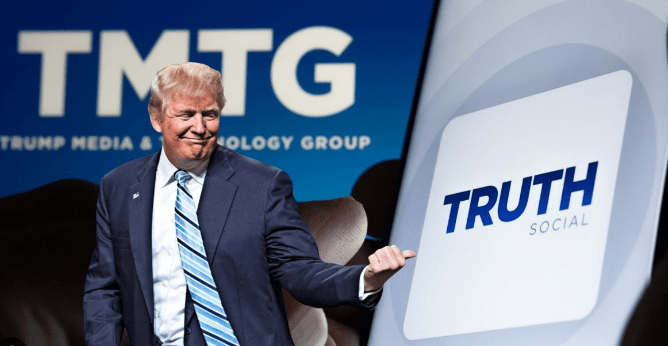
Image: Technext

Revenue Barely Moves

While crypto losses dominated the quarter, Trump Media’s core media business generated just $871,200 in revenue — a 6% increase from $821,200 in the first quarter of 2025.

That figure includes $810,100 in media revenue and $61,100 in management fees tied to Truth.Fi ETF offerings. For a publicly traded company sitting on over $2 billion in total financial assets, the revenue line is thin.

The company did manage to generate nearly $18 million in operating cash flow during the quarter, helped by selling options on its pledged Bitcoin holdings.

Of its total Bitcoin position, 4,260 BTC has been pledged as collateral for convertible notes, and another 2,000 BTC is held against covered call options as a hedge.

Featured image from Thomas Fuller/SOPA Images/LightRocket via Getty Images, chart from TradingView


Domande pertinenti

QWhat is the main reason for Trump Media's massive quarterly loss of $406 million?

AThe main reason is a combination of large unrealized losses on its cryptocurrency holdings. Specifically, its Cronos tokens lost over half their value, and its significant Bitcoin position, purchased near the 2025 market peak, was worth far less than its cost basis at the end of the quarter.

QHow much did Trump Media pay for its Cronos tokens and what was their value at the quarter's end?

ATrump Media purchased 756 million Cronos tokens for approximately $114 million. By March 31, 2026, those tokens were valued at just $53 million.

QWhat was the value of Trump Media's Bitcoin position at quarter-end and how does it compare to its purchase cost?

AAt quarter-end, Trump Media's 9,542 Bitcoin had a cost basis of $1.13 billion but a fair market value of only $647 million, resulting in an unrealized loss of nearly $500 million.

QHow much revenue did Trump Media's core business generate in the first quarter of 2026?

ATrump Media's core media business generated $871,200 in revenue in the first quarter of 2026, a slight increase from the same period in 2025.

QWhat recent leadership change was announced at Trump Media & Technology Group?

ACEO Devin Nunes stepped down from his position on April 22, 2026.

Letture associate

The Verdict in Choi Tae-won's Divorce Case: Revealing the Inheritance Undercurrent Behind SK Hynix's Trillion-Won Empire

SK Group Chairman Chey Tae-won's high-profile divorce case, involving a record 1.38 trillion won settlement, has drawn attention to the succession plans for Korea's second-largest conglomerate, especially its crown jewel, SK hynix. Unlike traditional chaebol scripts centered on the eldest son, Chey's three children from his marriage to former President Roh Tae-woo's daughter, Roh Soh-yeong, are carving distinct, non-traditional paths. Eldest daughter Chey Yun-jung (b. 1989) is seen as the most evident successor. With a scientific and consulting background, she holds executive roles at SK bioscience and SK Inc.'s growth support department, focusing on future strategy and biopharma. Her marriage is to an AI infrastructure entrepreneur, not a traditional business alliance. Second daughter Chey Min-jung (b. 1991) took a unique route, voluntarily serving as a South Korean naval officer, including an anti-piracy deployment. She later worked on policy and strategy for SK hynix in Washington D.C. before co-founding an AI-driven healthcare startup. She married a former U.S. Marine Corps officer, connecting her to U.S. defense and policy circles—networks crucial for a global semiconductor giant. The only son, Chey In-geun (b. 1995), who studied physics like his father, worked briefly at SK E&S before joining McKinsey. Despite fitting the traditional "heir" profile as the eldest son, he remains silent and holds no public position or shares in SK, suggesting the old succession playbook is obsolete. As SK hynix's valuation soars, becoming a geopolitical asset in the AI era, the heirs' legitimacy is no longer automatic. They must prove themselves in fields like AI biotech, global policy, and strategic consulting. Their marriages also reflect new elite networks in tech and defense, not old political alliances. Their inheritance is the complex challenge of navigating a globalized, tech-driven world, not just a corporate throne.

marsbit11 h fa

The Verdict in Choi Tae-won's Divorce Case: Revealing the Inheritance Undercurrent Behind SK Hynix's Trillion-Won Empire

marsbit11 h fa

From OpenSea to OpenRouter: Is Alex Atallah Repeating His 'Exit at the Peak' Playbook?

From OpenSea to OpenRouter: Is Alex Atallah Repeating His "Exit at the Peak" Playbook? According to the Wall Street Journal, payments giant Stripe is in talks to acquire the AI model aggregation platform OpenRouter in a potential deal valuing the company near $100 billion. This would mark founder Alex Atallah's second creation of a company reaching a $100 billion valuation, following his co-founding of NFT marketplace OpenSea. OpenRouter, founded just over three years ago, has grown rapidly by acting as a unified gateway for developers to access over 400 AI models. It currently has about 10 million users and processes over 200 trillion tokens monthly. While the platform's annualized revenue is around $50 million, its valuation has skyrocketed from $1.3 billion in March 2026. The potential acquisition by Stripe, a company OpenRouter's founder once likened it to, represents a major expansion into AI infrastructure for the payments leader. This move echoes Atallah's previous timing with OpenSea, where he departed before the NFT market's significant downturn. For OpenRouter, selling now may be strategic. Despite its scale, its business model—charging a 5-5.5% fee on AI inference calls—faces pressure from competition, open-source models, and potential price wars among model providers, limiting its profitability narrative for an IPO. A key asset for potential acquirers like Stripe is OpenRouter's vast repository of real-world AI usage data, which offers unique insights into model performance and developer preferences that are difficult to replicate. Whether this potential deal signifies a new valuation benchmark for AI infrastructure or another market peak signal remains to be seen.

链捕手11 h fa

From OpenSea to OpenRouter: Is Alex Atallah Repeating His 'Exit at the Peak' Playbook?

链捕手11 h fa

Trading

Spot
活动图片




