Trump lauds Chris Waller as ‘great’ after Fed chair interview, will pick within weeks

cointelegraphPubblicato 2025-12-19Pubblicato ultima volta 2025-12-19

Introduzione

President Donald Trump praised Federal Reserve chair nominee Chris Waller as "great" and "fantastic," confirming he will announce his selection for the role within weeks. Waller, who has expressed crypto-friendly views, is among three or four candidates on the shortlist. According to prediction platform Polymarket, Waller currently has a 14% chance of selection, trailing crypto-supportive White House adviser Kevin Hassett (53%) and former Fed governor Kevin Warsh (28%). The crypto industry is closely monitoring the appointment due to the Fed's influence on interest rates, which significantly impact digital asset markets. Lower rates often drive investors toward higher-risk investments like cryptocurrencies.

United States President Donald Trump offered positive remarks about pro-crypto Fed chair nominee Chris Waller at a recent press conference, as speculation continues over his final choice.

“I think he’s great. I mean, he’s been a man who’s been there a long time. Somebody that I was very involved with and sense of his career, and he’s a fantastic man,” Trump said during a press conference on Thursday.

Waller has recently been perceived as relatively supportive of crypto, saying in an August speech at the Wyoming Blockchain Symposium 2025 that there is “nothing to be afraid of” about crypto payments operating outside the traditional banking system.

Trump says everyone on the shortlist “would be a good choice”

Waller currently has a 14% chance of being selected, according to crypto prediction platform Polymarket, making him the third most likely pick. Crypto-friendly White House economic adviser Kevin Hassett leads at 53%, followed by former Fed governor Kevin Warsh with 28% odds.
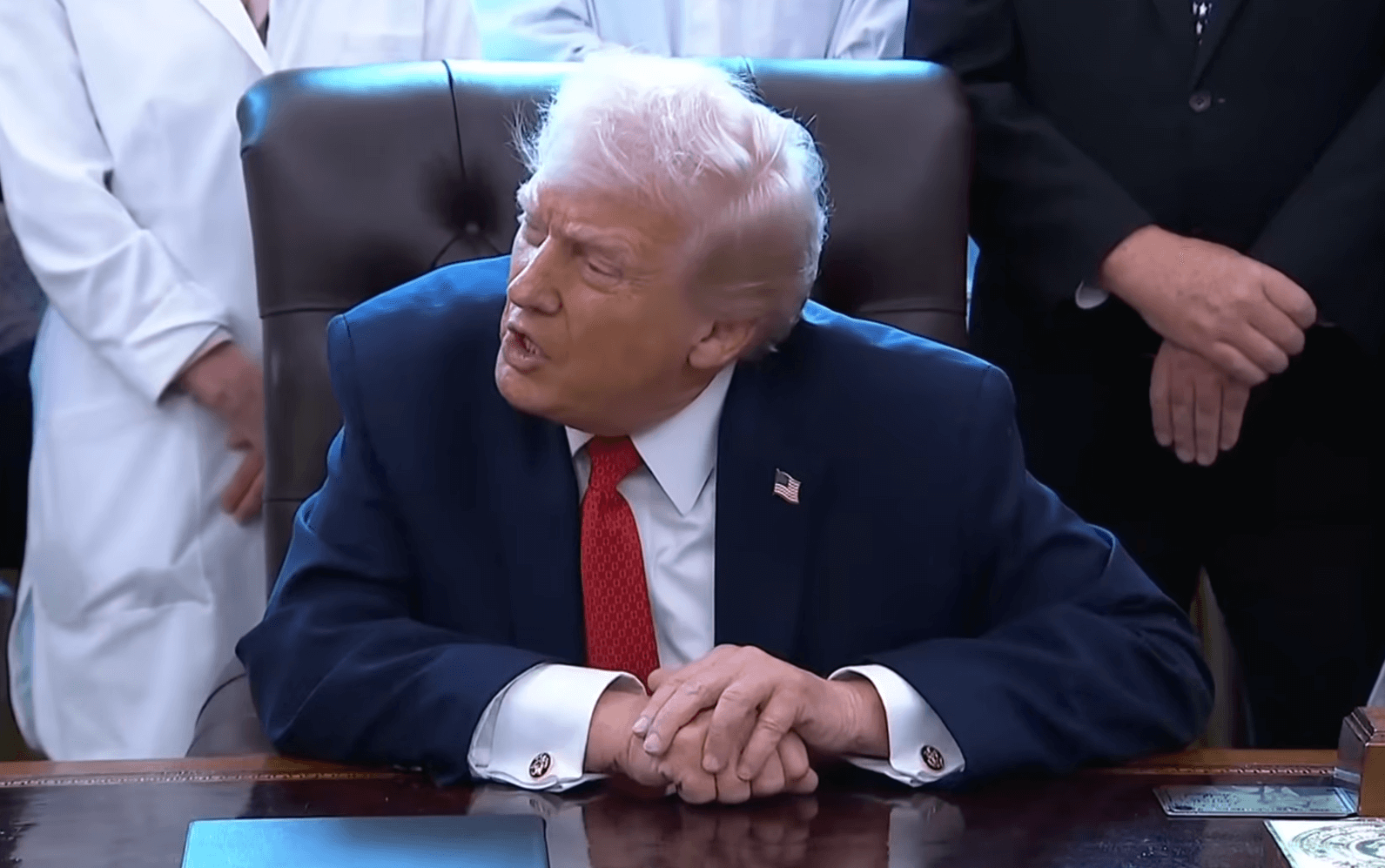
US President Donald Trump expects to make the Fed chair announcement in the next few weeks. Source: YouTube

Trump said that the list has been narrowed to three or four candidates. “I think every one of them would be a good choice, honestly,” he said.

When asked whether Fed governor Michelle Bowman was also on the shortlist, Trump did not directly answer the question, but described her as a “fantastic person.” Polymarket currently puts Bowman’s odds at 2%.

Trump said that he expects to make the announcement over the “next couple of weeks.” “I don’t know before the end of the year, but pretty soon,” Trump said.

Crypto industry has been keeping a close eye on Fed chair developments

The crypto industry has been paying close attention to developments surrounding Trump’s Fed chair nominee, with the discussion ramping up in recent months as the Fed’s role in monetary policy is often seen as affecting broader crypto market conditions.

Related: Global debt markets show dollar dominance moves in cycles, US Fed says

Interest rates, which are set by the Federal Reserve, are widely viewed as having a significant impact on the crypto market.

When rates are lowered, investors tend to seek higher-risk assets such as cryptocurrencies, as traditional investments like bonds and term deposits become less attractive.

Magazine: Big questions: Would Bitcoin survive a 10-year power outage?

Domande pertinenti

QWhat did President Trump say about Chris Waller at the press conference?

APresident Trump said, 'I think he’s great. I mean, he’s been a man who’s been there a long time. Somebody that I was very involved with and sense of his career, and he’s a fantastic man.'

QAccording to the crypto prediction platform Polymarket, what are the odds for the top three Fed chair candidates?

AAccording to Polymarket, crypto-friendly White House economic adviser Kevin Hassett leads at 53%, followed by former Fed governor Kevin Warsh with 28% odds, and Chris Waller is third with a 14% chance.

QWhat is Chris Waller's stance on cryptocurrency, as mentioned in the article?

AChris Waller is perceived as relatively supportive of crypto. In a speech, he stated there is 'nothing to be afraid of' about crypto payments operating outside the traditional banking system.

QWhen does President Trump expect to announce his choice for Fed chair?

APresident Trump said he expects to make the announcement in the 'next couple of weeks' and that it would be 'pretty soon,' though he was unsure if it would be before the end of the year.

QWhy is the crypto industry paying close attention to the Fed chair nomination?

AThe crypto industry is paying attention because the Fed’s role in monetary policy, particularly in setting interest rates, is widely viewed as having a significant impact on broader crypto market conditions.

Letture associate

147 Trillion vs 70 Billion: The Rise of On-Chain 'Risk Managers' and the Potential Dawn of a New Era in DeFi Asset Management

"147 Trillion vs 70 Billion: The Rise of On-Chain 'Risk Managers' and the Potential Dawn of a New Era in DeFi Asset Management" Key Points: The role of professional asset managers is emerging in DeFi, ending the era where protocols and governance dictated everything. While early DeFi protocols like Aave and Compound bundled risk management within their code, innovations like Morpho have separated infrastructure from risk judgment. This allows specialized "Risk Managers" to operate independent lending vaults, acting as on-chain asset managers. The market, though early with ~$7B in assets under management (AUM), is rapidly consolidating around top performers like SteakhouseFi (RWA focus), SentoraHQ (AI-driven models), and Gauntlet (crisis management). This modular structure mirrors TradFi's division of labor: distributors (e.g., exchanges) source capital, Risk Managers design strategies and set standards, and underlying protocols handle custody and execution. For traditional asset managers, this familiar structure presents clear entry paths: 1) **Distribution**: Partnering with Risk Managers as a backend service. 2) **Supply**: Bringing real-world assets (RWA) on-chain as collateral. 3) **Operation**: Becoming a Risk Manager themselves (e.g., Bitwise). The core competency required is shifting from coding to traditional risk underwriting and financial expertise—areas where established institutions hold a natural advantage. While the current DeFi market (~$80B) is minuscule compared to global asset management (~$147T), it represents a significant growth runway. The teams that build the trusted standards and rails for risk-managed capital now are poised to define the market's future as institutional capital seeks secure on-ramps.

marsbit6 min fa

147 Trillion vs 70 Billion: The Rise of On-Chain 'Risk Managers' and the Potential Dawn of a New Era in DeFi Asset Management

marsbit6 min fa

Sui Launches Gasless Stablecoin Transfers, Supported by Fireblocks

Sui has officially launched "Gasless Stablecoin Transfers," a new protocol-level feature enabling users and enterprises to send supported stablecoins on Sui without paying gas fees or needing a separate SUI token balance. As the feature rolls out, stablecoin transfer fees on Sui are now effectively $0. Major stablecoins like USDsui, suiUSDe, AUSD, FDUSD, USDB, USDC, and USDY are already supported. This aims to simplify payments and remove a key barrier to mass adoption: requiring users to hold another token for gas. The enterprise platform Fireblocks, securing over $14 trillion in digital asset transactions, has integrated the feature in advance, enhancing institutional accessibility. Other wallets and custodians are also set to support zero-gas transactions. Sui co-founder Adeniyi Abiodun stated this brings Sui closer to being a global payment rail. Fireblocks' Ran Goldi noted it removes a major friction point for businesses building on-chain payments. This is a permanent structural change to Sui's mainnet, not a subsidy. It positions Sui as low-cost infrastructure for enterprises, traders, and AI agents. Sui's stablecoin transfer volume has surpassed $1 trillion since August 2025, with its architecture supporting high-frequency payments. Recent growth includes three SUI Exchange-Traded Products (ETPs) launching in 2026 and the expansion of major stablecoin projects like USDsui and SuiUSDe on the network. Zero-gas stablecoin transfers are now being gradually deployed on the Sui mainnet.

marsbit7 min fa

Sui Launches Gasless Stablecoin Transfers, Supported by Fireblocks

marsbit7 min fa

Major AI Collaboration Breakthrough! Stanford and NVIDIA Jointly Eliminate AI Communication Overhead, Boosting Reasoning Speed by 2.4x

Title: AI Collaboration Breakthrough: Stanford & NVIDIA Eliminate Communication Overhead, Boost Reasoning Speed by 2.4x A new approach called RecursiveMAS, developed by UIUC, Stanford, NVIDIA, and MIT, tackles the major bottleneck in multi-agent AI systems: the "language tax." Currently, AI agents collaborate by generating and reading natural language text, a slow, costly, and information-lossy process akin to inefficient radio communication. RecursiveMAS bypasses this by enabling agents to communicate directly through their "thoughts"—latent space vector representations—instead of text. Inspired by recursive language models, it treats each agent like a reusable layer in a recursive loop. A special lightweight module called RecursiveLink passes these high-dimensional, semantic-rich internal states between agents. Only the final agent decodes the last latent representation into human-readable text. This process, described as "telepathic" communication, dramatically cuts the overhead of encoding and decoding text at each step. The system is highly efficient; the core AI model weights remain frozen, and only the small RecursiveLink modules are trained, requiring updates to just 0.31% of total parameters. This reduces training costs by over 50% compared to full fine-tuning. Comprehensive evaluations across math, science, coding, and QA benchmarks show significant improvements: - **Accuracy:** Average increase of 8.3%, with gains up to 18.1% on complex math problems (AIME2025). - **Speed:** End-to-end reasoning is 1.2x to 2.4x faster, with greater speedups as recursive depth increases. - **Cost:** Token usage is reduced by 34.6% to 75.6%. The research suggests a new scaling paradigm for multi-agent systems: deepening recursive collaboration depth rather than merely adding more agents. This could address key production barriers like compute cost, latency, and memory limits. However, challenges remain, including the need for independent verification, compatibility between different AI models (heterogeneous agents), reduced interpretability of the "black-box" latent communication, and adaptation to complex real-world workflows involving tools and human interaction. If validated, RecursiveMAS could fundamentally change how AI agents work together, moving beyond inefficient "textual handoffs" to more seamless and powerful collaborative reasoning.

marsbit1 h fa

Major AI Collaboration Breakthrough! Stanford and NVIDIA Jointly Eliminate AI Communication Overhead, Boosting Reasoning Speed by 2.4x

marsbit1 h fa

Trading

Spot
Futures
活动图片