Trump in Web3 Games: Temporary Hype or Trend?

bitcoinistPubblicato 2025-12-12Pubblicato ultima volta 2025-12-12

Introduzione

The article "Trump in Web3 Games: Temporary Hype or Trend?" discusses the growing integration of political brands, particularly Donald Trump’s, into the crypto industry—especially within Web3 gaming. It highlights the recent launch of the 3D game *Trump Billionaires Club*, which features an in-game economy tied to the $TRUMP memecoin and user engagement mechanics. The piece argues that while political and media-driven narratives can generate initial user interest, they often fail to retain players without clear, sustainable incentives. Many gaming tokenomics rely on short-term emotional appeal rather than long-term engagement. In response, projects like PEPENODE are emerging with simplified, routine-based reward systems—such as virtual "mining" nodes—that require no technical knowledge or hardware. PEPENODE, promoted as the "first memecoin mine-to-earn" platform, allows users to buy and upgrade virtual mining nodes to earn rewards, including memecoins like PEPE and Fartcoin. Early data shows significant pre-sale interest, with $2.3 million raised and a token price of $0.001192. The project aims to combine meme-driven engagement with predictable, recurring action—a trend gaining traction as Web3 games seek broader, more consistent user bases beyond one-time hype. The article concludes that while politically themed games attract attention, their long-term success depends on transitioning from viral momentum to habitual use through clear mechanics and recurring value.

Trusted Editorial content, reviewed by leading industry experts and seasoned editors. Ad Disclosure

Political brands are increasingly penetrating the crypto industry—and today this is most noticeable in games. This week, the Spanish business publication Cinco Días described the launch of the 3D game Trump Billionaires Club, where the in-game economy is tied to the $TRUMP memecoin and user engagement mechanics.

For the market, this is a signal not so much about a specific politician, but about a direction: Web3 gaming is once again seeking a mass audience through recognizable themes and simple progression steps. When a product is understood without training, it's easier for the user to take the first step—buy a token, enter the game, complete tasks, and return tomorrow.

But this approach has a weak spot: the majority of gaming tokenomics live only on emotions and quickly burn out if the user has no clear reason to stay in the system. That is why 2025 looks like a race for mechanics that retain attention not with promises, but with regular action and predictable rewards.

Against this backdrop, memecoins are getting another chance to break out of the "buy and forget" mode into a format where the token becomes a participation tool. And here, the new project PEPENODE is trying to fill the niche: to combine meme energy with a clear gaming routine of mining, without requiring iron, electricity, or technical skills.

BUY PEPENODE

Why Gaming Memecoins Are Returning Attention to Simple Mechanics

Web3 games in 2025 need one thing: to convert the noise around a brand into a daily habit. Political and media themes provide traffic, but do not guarantee retention—users quickly leave if progress seems random or too complex.

Parallelly, the infrastructure side has become less painful for retail. According to Cointelegraph, average commissions on the Ethereum network after the Dencun update have noticeably decreased: in March 2025, the average swap was valued at approximately $0.39 versus around $86 a year earlier.

Hence the trend: projects are competing not only with memes, but also with "grounded" reward cycles—from simplified game quests to mining simulations. Against this backdrop, many investors are becoming interested in other market directions, including the list of the best altcoins for 2025.

PEPENODE currently looks like one of the variants in this logic, because it bets on regular activity and a clear interface, not on complex economics.

How PEPENODE Turns "Mining" into a Game Without Iron

The key idea of PEPENODE is positioning as the "world's first memecoin mine-to-earn": instead of classical mining with equipment, the project offers a virtual "mining" system. The entry is built around nodes and reward levels. This addresses three market pains at once: boring mining models, weak early incentives, and technical complexity for newcomers.
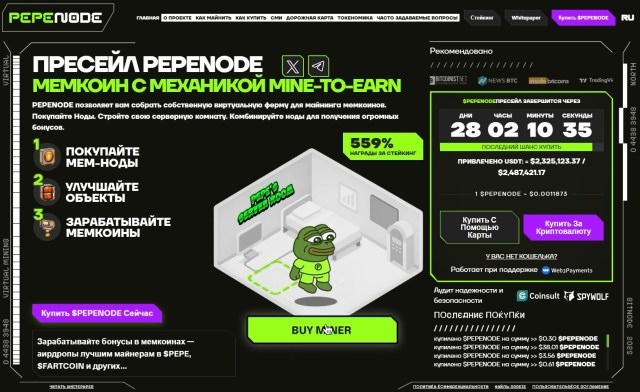
In product terms, this looks like a gamified panel. You buy and configure "node-miners," improve nodes to increase efficiency, and receive rewards, including memecoins like PEPE and Fartcoin. Importantly, the scenario of "enter — improve — collect reward" is simpler than dealing with iron and expenses.

Interest is also heating up the early demand dynamics. According to the presale team's data, PEPENODE has already attracted $2.3 million, and the token price is $0.001192. This is the level at which the base of early participants usually forms, if the product really promises activity after launch.

Large wallet tracking data indicates 2 purchases for a total of $215K; the largest deal—$51K—took place on February 8, 2025.

This bet has a clear logic: if the game finds an audience after launch, then "mining as a habit" may turn out to be stronger than the one-time hype around a loud name.

Editorial Process for bitcoinist is centered on delivering thoroughly researched, accurate, and unbiased content. We uphold strict sourcing standards, and each page undergoes diligent review by our team of top technology experts and seasoned editors. This process ensures the integrity, relevance, and value of our content for our readers.

Daria Vlasova

Follow

Crypto journalist, specializes in the digital asset market, DeFi platforms, and Web3 projects. Graduate of the Economics Faculty of Moscow State University. Since 2019, she has been writing about the crypto industry, tokenomics, and the development of new digital economy models.

Full Profile

Related Posts

Even 0.1 $BTC is financial independence for decades. But that's not enough

MEXC KYC Reward December 2025: First Trade Loss Coverage (100% Loss Coverage Up to 50 USDT)

Best crypto presale: MAXI stands out among meme-presale projects

Best crypto to buy now: MAXI attracts global attention after a surge in trading volume

Best crypto to buy now: Bitcoin Hyper (HYPER) shows the strongest growth signals

New crypto that could explode today: Pepenode (PEPENODE) predicted to surge strongly in the next few hours

Domande pertinenti

QWhat is the main focus of the article regarding Web3 gaming trends in 2025?

AThe article focuses on the trend of Web3 gaming shifting towards simple, engaging mechanics and meme-driven economies to attract and retain a mass audience, moving away from complex models that rely solely on hype.

QWhat specific project is highlighted as an example of combining meme energy with a playable mining routine?

AThe project highlighted is PEPENODE, which positions itself as the 'first meme coin mine-to-earn' project, offering a virtual mining system with nodes and reward levels instead of traditional hardware-based mining.

QAccording to the article, what is the key weakness of many gaming tokenomics models that rely on emotions and hype?

ATheir key weakness is that they quickly lose value and user interest if there is no clear reason for the user to stay in the system, as they lack predictable, regular rewards and sustainable engagement mechanics.

QWhat infrastructure development is mentioned as making the market less painful for retail participants?

AThe article mentions that average commissions on the Ethereum network have noticeably decreased after the Dencun update, with the average swap fee estimated at around $0.39 in March 2025 compared to about $86 a year earlier.

QWhat early traction data is provided for the PEPENODE project in its pre-sale phase?

AThe pre-sale for PEPENODE had attracted $2.3 million, with a token price of $0.001192. Data also indicated two large purchases totaling $215K, with the largest single transaction being $51K on February 8, 2025.

Letture associate

From South Korea to the United States: Blue-Collar Jobs Are Becoming Increasingly Popular, Thanks to AI

AI is reshaping the labor market's value proposition. The traditional four-year college degree is losing its appeal as a guaranteed career path, while skilled blue-collar trades like electricians, welders, and plumbers are experiencing historic demand and wage premiums. This shift is driven by dual pressures: AI's displacement of certain white-collar roles and a booming need for physical infrastructure and data center construction. Data confirms the trend. In the U.S., vocational school revenue surged, and a significant portion of recent layoffs are AI-related. Surveys show a majority of Gen Z adults plan to pursue blue-collar work, citing better job security against AI automation. Vocational education interest has exploded recently. Experts cite a psychological shift as younger generations seek tangible, AI-resistant careers and avoid high student debt. In many cases, salaries for skilled trades now match or exceed those requiring a bachelor's degree. In South Korea, semiconductor vocational high schools boast near-total employment, with graduates securing high-paying roles at companies like Samsung. The shortage is structural, exacerbated by a retiring baby boomer workforce and massive infrastructure projects. Companies like JPMorgan Chase, Meta, and Lowe's are investing heavily in training programs. However, overcoming historical stigma and a "perception gap" around trade careers remains a key challenge to closing the talent gap.

marsbit27 min fa

From South Korea to the United States: Blue-Collar Jobs Are Becoming Increasingly Popular, Thanks to AI

marsbit27 min fa

Qualcomm: AI Hype Subsides, When Will Smartphones Emerge from the Gloom?

Qualcomm reported its Q3 FY2026 results (ending June 2026), with revenue of $9.95B, down 4% YoY but above expectations. Gross margin declined to 53.1%, pressured by rising costs across manufacturing and memory. Key business segments showed mixed performance: Handset revenue fell 19.6% YoY to $5.09B, dragged by an 11% decline in non-Apple Android shipments and weaker high-end mix. Conversely, Automotive revenue surged 61% to $1.59B, and IoT grew 9% to $1.83B. Core operating profit dropped 41% YoY due to margin compression and higher expenses. Management's Q4 FY2026 guidance projects revenue of $9.7B-$10.5B, in line with consensus, but Non-GAAP EPS guidance of $2.05-$2.25 fell short of expectations. Amidst persistent weakness in its core handset market, Qualcomm is pursuing growth in AI, focusing on Edge AI (smartphones, PCs, automotive) and Data Center AI. Its data center strategy includes four pillars: AI accelerators (e.g., AI200), commercial CPUs (Dragonfly C1000), custom silicon, and connectivity solutions. While these initiatives initially boosted its stock, concerns over AI capital expenditure sustainability have since erased those gains. The company targets $5B in data center revenue for FY2027 and $15B for FY2029. The report concludes that with the traditional handset business still under pressure, the data center opportunity is currently viewed as a longer-term option, and a more conservative valuation based on core operations may be warranted until AI contributions materialize.

marsbit31 min fa

Qualcomm: AI Hype Subsides, When Will Smartphones Emerge from the Gloom?

marsbit31 min fa

From TPU to Self-Evolving Agents: How Jeff Dean Predicts the Next Step in AI

At the 2026 YC Startup School, Jeff Dean outlined his vision for AI's next phase, shifting focus from simply scaling models to building intelligent, autonomous systems. He believes AI's progress is no longer just about creating smarter models, but about integrating them into systems capable of long-term, iterative work, automated experimentation, and continuous learning. This evolution moves the competition from "who has the bigger model" to "who can best organize intelligence." Dean suggests AI capabilities are now comparable to a junior engineer, enabling the automation of complex workflows. However, the true challenge and opportunity lie in managing these AI "workers" at scale. He emphasizes the importance of **context engineering**—structuring tools, memory, and feedback loops—over raw model power. For startups, this means building deep expertise in niche domains where general models currently fail (near 0-1% success rates), leveraging proprietary data, specialized tools, and domain-specific evaluators. A recurring theme is re-examining fundamental constraints. Dean's past work, like moving Google's search index to memory or creating the TPU, stemmed from questioning outdated assumptions about hardware and cost. He sees similar inflection points today, particularly in **specialized inference hardware** to drastically reduce latency and energy consumption for real-time Agent operation. Notably, he points out that in modern AI systems, the dominant cost is often not computation but **data movement**. Reliable, long-running Agents require robust system design, borrowing concepts from distributed computing like checkpointing, state management, and parallel exploration to handle failures and maintain progress over days or weeks. As AI automates execution, the scarcest human skills will shift to **defining clear specifications**, **judging what problems are worth solving** (taste), and designing effective feedback loops. Ultimately, Dean's framework prioritizes understanding the problem deeply, identifying the true bottlenecks, and systematically building closed-loop systems where AI can not only perform tasks but also improve AI itself.

marsbit31 min fa

From TPU to Self-Evolving Agents: How Jeff Dean Predicts the Next Step in AI

marsbit31 min fa

Trading

Spot
活动图片





