Trump Has Cost Investors $4.7 Billion Through Crypto 'Schemes': Public Citizen

cryptonews.ruPubblicato 2026-08-27Pubblicato ultima volta 2026-08-27

Introduzione

A report by consumer advocacy group Public Citizen claims former U.S. President Donald Trump and his family have caused investors losses estimated at at least $4.7 billion since 2022 through their digital asset ventures. These include the Trump family's World Liberty Financial governance token, Trump's NFT collections, his "Official Trump" meme coin ($TRUMP), and the Trump Media digital asset treasury. According to the report, $3.2 billion of the alleged losses stemmed from investors in the $TRUMP meme coin, described as a transfer of wealth to a small group of early buyers. In contrast, Trump reportedly earned substantial income from these projects: over $7 million in NFT royalties, more than $600 million from World Liberty token sales and equity, $635 million in meme coin licensing fees, and $197 million from World Liberty capital contributions. These figures exclude his ongoing holdings. A White House spokesperson has previously stated there are "no conflicts of interest" regarding Trump's crypto investments. Public Citizen is urging for the inclusion of ethics provisions in the pending CLARITY Act crypto market bill, arguing a president's policy decisions and personal investments cannot be separated and should require divestment from industry projects. A Senate cloture vote on the bill is scheduled for September 15.

The consumer advocacy non-profit Public Citizen reported that since 2022, US President Donald Trump "has cost investors losses estimated at least at $4.7 billion" through his and his family's digital assets.

According to Public Citizen, investors lost billions of dollars due to the Trump family's World Liberty Financial governance token, the 2022-released presidential collectible $NFTs, his Official Trump ($TRUMP) memecoin, and the Trump Media digital asset treasury.

The organization states that the bulk of the alleged losses fell on investors in the $TRUMP memecoin: they lost $3.2 billion, while buyers of World Liberty Financial's USD1 stablecoin "did not suffer significant losses." Public Citizen said that in the case of the memecoin, these losses represented "a transfer of wealth to a small group of early buyers, not money that simply disappeared."
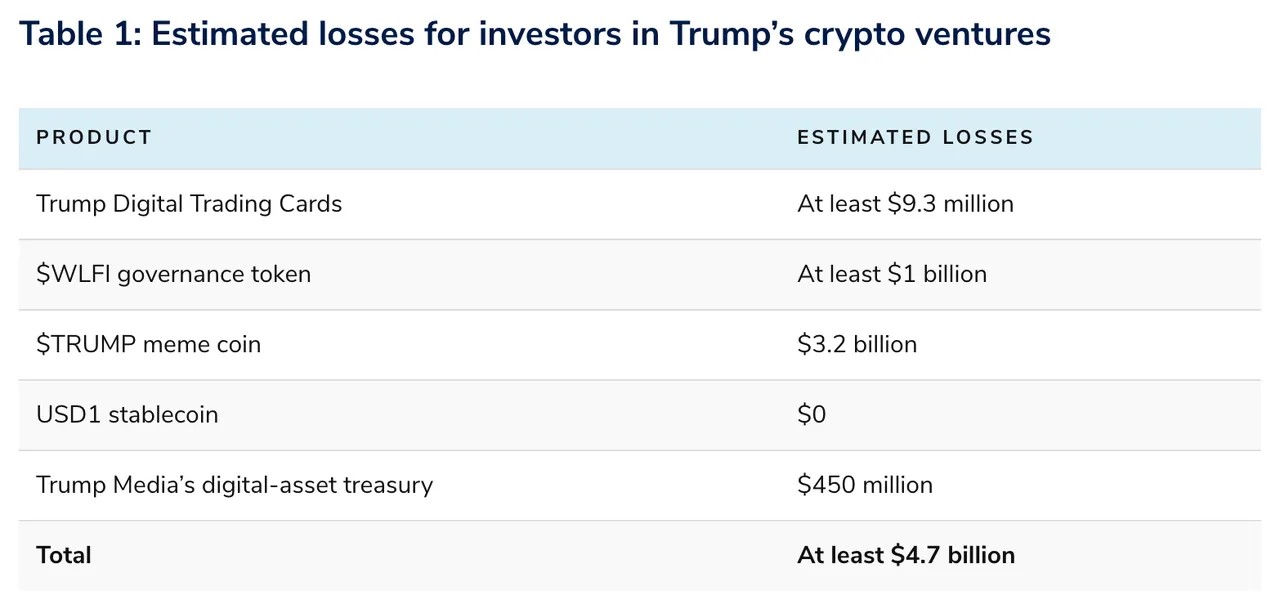
Alleged investor losses from Donald Trump's cryptocurrency projects. Source: Public Citizen

According to Public Citizen, against the backdrop of $4.7 billion in investor losses, Trump received $7.2 million in licensing fees and royalties for $NFTs, over $600 million from the sale of World Liberty tokens and the realization of equity stakes, $635 million in licensing fees for his memecoin, and $197 million in capital contribution income from World Liberty. This amount did not include stakes in companies and projects he still owns. Some of these figures were included in the President's 2025 disclosure, which reported $1.4 billion in cryptocurrency-related income.

Related: Majority of Americans Find Trump Family's Crypto Investments 'Inappropriate': Poll

Cointelegraph reached out to the White House for comment but did not receive an immediate response. Spokesperson Anna Kelly has repeatedly stated in response to questions about Trump's cryptocurrency investments that "there is no conflict of interest."

Vote on Crypto Bill Still Weeks Away

Against the backdrop of Trump's crypto projects and other potential ones, the organization renewed its call to include ethics provisions in the crypto market structure bill—the Clarity for Regulating Digital Assets (CLARITY) Act—arguing that "the President's policy decisions and his personal investment portfolio cannot be separated," and any law should require the US President and his family to divest from projects in this industry.

Last week, Trump met with cryptocurrency company executives and urged them to pass a "fair version" of the CLARITY Act after the Senate returns to work next month. A cloture vote on the bill is scheduled for September 15; at least 60 senators' votes will be required to advance it.

Magazine: Proposed US SEC crypto rules likely won't trigger a new ICO boom

end-content

Domande pertinenti

QAccording to the report by Public Citizen, how much in investor losses is Donald Trump accused of being responsible for through his and his family's crypto assets since 2022?

AAccording to Public Citizen, Donald Trump is accused of bringing investors losses of at least $4.7 billion through his and his family's digital assets since 2022.

QWhich specific Trump-related crypto project is reported to have caused the largest portion of the alleged investor losses ($3.2 billion)?

AThe Trump-related meme coin, $TRUMP, is reported to have caused the largest portion of the alleged investor losses, amounting to $3.2 billion.

QWhat is the name of the digital assets market structure bill that Public Citizen argues should include ethical provisions?

AThe bill is called the Crypto-Asset Regulatory Clarity Act (CLARITY Act).

QWhat key demand does Public Citizen make regarding the U.S. President and their family in relation to the cryptocurrency industry?

APublic Citizen demands that any crypto market structure law should require the U.S. President and their family to divest from projects in the cryptocurrency industry.

QWhen is the cloture vote for the CLARITY Act scheduled in the Senate, and what is the required threshold for it to proceed?

AThe cloture vote for the CLARITY Act is scheduled for September 15. It requires at least 60 votes in the Senate to proceed.

Letture associate

Why Ethereum Staking Will Change in 2026

The article discusses the evolving role of Ethereum (ETH) staking, shifting from a niche crypto enthusiast topic to a mainstream portfolio management tool for financial advisors and institutional investors. It explains how staking works in Ethereum's Proof-of-Stake network, detailing validator requirements and methods like solo staking, pools, exchanges, and liquid staking protocols, each with its own risk-reward profile (e.g., liquidity, control, technical requirements). A key point is staking's growing importance for corporate treasuries, where staking rewards represent a significant income stream, unlike non-yielding Bitcoin holdings. Looking ahead, the article highlights the anticipated 'Glamsterdam' upgrade in late 2026 as a pivotal development expected to enhance scalability, decentralization, and post-quantum resistance, further solidifying Ethereum's institutional appeal. It also emphasizes that while staking offers passive income and network participation, risks include technical failures, slashing penalties, platform/custodial risks, and regulatory uncertainty. For advisors, the conclusion stresses the need to evaluate staking providers beyond just promised yields, focusing on reliability, fees, withdrawal terms, security, and the specifics of reward structures (protocol vs. MEV-based). The regulatory landscape and infrastructure maturity around digital asset custody are noted as critical adjacent topics to monitor.

cryptonews.ru1 h fa

Why Ethereum Staking Will Change in 2026

cryptonews.ru1 h fa

Scott Bessent's Risky Bond Buyback Operation Could Fuel Bitcoin Price Surge

Bitcoin returned to the $80,000 level on Thursday, breaking past a key $79,000 resistance point, on news of an upcoming $92 billion U.S. Treasury bill auction scheduled for August 31st. The price recovery saw Bitcoin reach a daily high of $80,808, though it faced brief selling pressure. The cryptocurrency was trading around $80,400 by late morning EST, marking a roughly 3% daily increase and pushing its market cap back to $1.61 trillion. This surge positions Bitcoin for a monthly gain of over 20%, a sharp reversal from July's flat performance. The volatility led to $105 million in leveraged Bitcoin positions being liquidated in 24 hours, with short positions accounting for the majority of losses. Analysts note the large-scale Treasury auction could drain short-term market liquidity, potentially pushing yields higher and pressuring risk assets like stocks and crypto. Furthermore, a recent article in The Economist warns that U.S. Treasury Secretary Scott Bessent's policies risk undermining confidence in the American financial system. The report criticizes measures to artificially cap long-term bond yields and a shift towards issuing more short-term T-bills, which shortens the overall debt duration and increases vulnerability to future rate hikes. This approach, along with distorting market pricing mechanisms, could jeopardize long-term investor trust in U.S. sovereign debt. Prominent figures like Ray Dalio suggest such policies are reducing the inflation-adjusted yield of traditional fixed-income assets, potentially driving capital seeking a store of value towards alternatives like gold and Bitcoin, whose prices have risen since the Treasury's announcements.

cryptonews.ru1 h fa

Scott Bessent's Risky Bond Buyback Operation Could Fuel Bitcoin Price Surge

cryptonews.ru1 h fa

Trading

Spot
活动图片