Trump Executed 3,600 Stock Trades in Q1, Bought Nvidia, Dell, Then Made a 'Stock Tip,' Sparking Conflict-of-Interest Controversy

marsbitPubblicato 2026-05-15Pubblicato ultima volta 2026-05-15

Introduzione

Former President Donald Trump executed 3,642 individual stock trades in Q1 2026, averaging about 60 trades per day, according to a recent OGE 278-T disclosure. This breaks from the modern presidential tradition of using blind trusts. The filings reveal Trump sold large positions in Amazon, Meta, and Microsoft while making significant new purchases in AI and semiconductor firms like NVIDIA, Broadcom, and Intel. Notably, he bought $1-5 million worth of Dell stock on February 10. Three months later, on May 8, he publicly urged Americans to "buy Dell" at a White House event; the stock has since risen 96%. His Intel purchases began in early March, after which the stock surged 150%. The U.S. government had taken a 9.9% stake in Intel in August 2025. These transactions, occurring close to related policy actions or public endorsements, have ignited significant controversy over potential conflicts of interest. While the White House maintains full compliance with the STOCK Act, critics highlight the unprecedented scale of trading and the timing coinciding with his official duties and donors' interests.

Author: Claude, Deep Chao TechFlow

Deep Chao Introduction: Trump's newly disclosed OGE 278-T form shows he executed 3,642 stock trades in Q1 2026, averaging about 60 trades per day, breaking the precedent of using a "blind trust" set by presidents since Lyndon Johnson.

The disclosure reveals that after buying $1 million to $5 million worth of Dell stock on February 10th, Trump publicly urged people on May 8th at the White House to "go buy Dell," following which the stock surged 96%. Multiple trades, including those in Nvidia and Intel, occurred ahead of related policy moves, rapidly fueling a conflict-of-interest controversy.

Trump's personal stock trading record is becoming one of the most contentious documents in Washington.

According to Benzinga, documents released this week by the Office of Government Ethics (OGE) show Trump executed 3,642 securities transactions in Q1 2026, averaging about 58 per day. The 113-page OGE 278-T form was signed by Trump on May 8th, delivered to the OGE on May 12th, and had "Filer paid late fee" handwritten on the cover page, indicating it exceeded the 30- to 45-day filing window stipulated by federal regulations.

This trading frequency breaks the nearly continuous blind trust arrangement precedent since Lyndon Johnson. Most former U.S. presidents placed personal assets in qualified blind trusts to limit conflicts of interest; Carter even liquidated his peanut farm, Obama held Treasury bonds and index funds, and Biden also employed a blind trust arrangement during his term.

Massively Sold Tech Giants, Heavily Bet on AI Chip Supply Chain

Disclosure documents show Trump significantly reduced holdings in Amazon, Meta, and Microsoft in Q1, all falling within the highest valuation bracket of $5 million to $25 million. However, while selling heavily, Trump maintained exposure to these three companies through smaller purchases.

More notably are the new positions. Trump established new positions in the $1 million to $5 million range in Nvidia (NVDA), Broadcom (AVGO), Synopsys (SNPS), Cadence Design Systems (CDNS), and Texas Instruments (TXN), covering almost every core segment of the U.S. AI chip supply chain. Large buys also appeared in Apple, Oracle, ServiceNow, Adobe, and Workday within the same range.
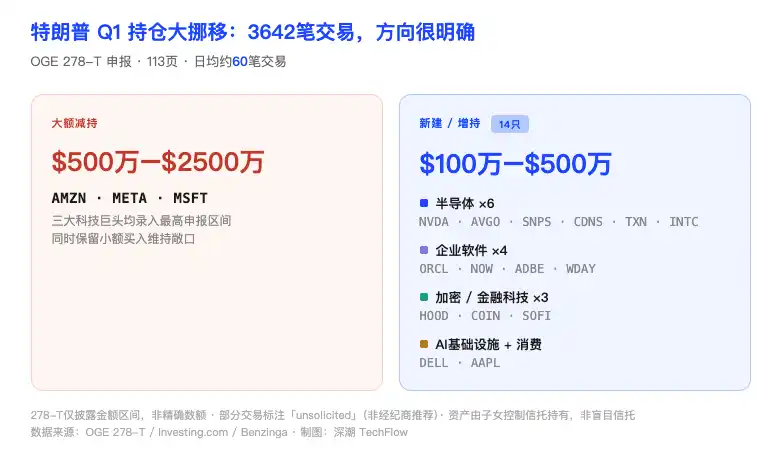
The semiconductor holdings closely align with the White House's policy direction of boosting domestic chip production capacity. According to Quiver Quantitative analysis, the purchase of Nvidia occurred before CEO Jensen Huang accompanied Trump on a visit to China, a trip expected to involve discussions on AI chip exports and semiconductor policy.

White House "Stock Tip" Three Months After Buying Dell, Stock Up 96%

The focus of the conflict-of-interest controversy centers on Dell.

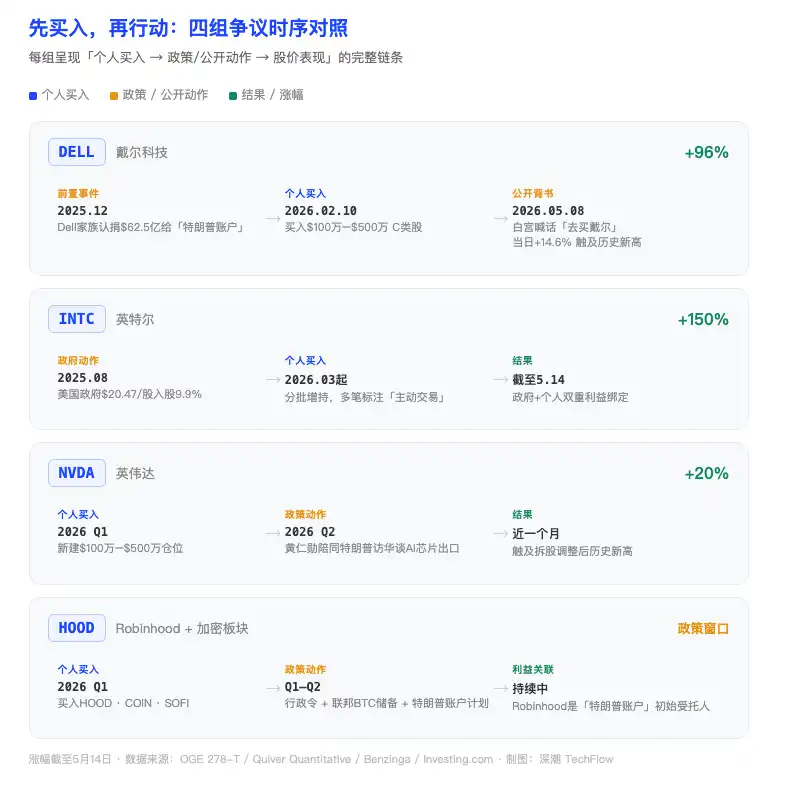
Documents show Trump bought $1 million to $5 million worth of Dell Technologies Class C stock on February 10, 2026. Three months later, at a Mother's Day event on May 8th, Trump thanked Michael Dell and Susan Dell by name at the White House and made the remark that sparked an uproar to those present—telling Americans to "go buy Dell."

That day, Dell's stock price surged as much as 14.6%, hitting a record high of $263.99. From Trump's purchase to the present, Dell's stock price has risen 96% cumulatively.

Another detail in the timeline intensified the controversy. On December 2, 2025, Michael Dell and Susan Dell pledged $6.25 billion to the "Trump Accounts," one of the largest private donations in recent years to a signature project of a sitting president. The White House has not responded to whether there was coordination between the President's public endorsement and the Dell family's donation.

Intel Shares Soar 150% After Purchase, Government Holds 9.9% Stake

Intel's trades are also worth examining.

Trump began buying Intel in batches starting in early March 2026, with several trades marked as "unsolicited," meaning not broker-recommended. Since the initial purchase on March 2nd, Intel's stock price has risen 150%.

Prior to this, the U.S. government purchased 433.3 million shares of Intel in August 2025 at $20.47 per share, giving it a 9.9% stake. In other words, Trump was buying Intel stock in the open market in his personal capacity while, in his presidential role, promoting government investment in Intel.

Additionally, purchases of Coinbase, Robinhood, and SoFi occurred during a period of active government promotion of crypto-friendly policies, including executive orders, a federal bitcoin reserve, and the "Trump Accounts" retirement plan. Robinhood is the initial trustee for that plan.
Non-Blind Trust Sparks Constitutional Debate, White House Claims Compliance

Critics view the alignment of these trading timelines as posing a conflict-of-interest risk. The White House argues that the filings fully comply with the STOCK Act's requirements.

Trump's assets are held in trusts controlled by his children, but the latest documents show numerous trades were executed by brokers acting as agents. The documents do not specify exactly which accounts hold the trading positions nor who gave the trading instructions.

An OGE spokesperson declined to comment on whether the trades reflect Trump's direct trading activity or operations through managed accounts, stating only that "the OGE is committed to transparency and citizen oversight of government."

According to Quiver Quantitative analysis, to their knowledge, this is the first time Trump has actively traded individual stocks while in office. The conservative, bond-heavy portfolio seen in previous 278-T filings has been completely overturned.


Domande pertinenti

QWhat is the primary controversy surrounding Donald Trump's stock trades in Q1 2026 as detailed in the article?

AThe primary controversy is the potential conflict of interest, as Trump conducted numerous personal stock trades (3642 in total) while in office, a break from the tradition of modern presidents using blind trusts. Specific concerns include his purchase of Dell stock followed by a public endorsement to "buy Dell" from the White House, and trades in companies like Nvidia and Intel that coincided with or preceded related government policy actions.

QHow did Donald Trump's investment activity in Dell become a focal point of the conflict-of-interest allegations?

ATrump purchased between $1 million and $5 million worth of Dell stock on February 10, 2026. Three months later, on May 8, he publicly told attendees at a White House event to "go buy Dell." Following this endorsement, Dell's stock price surged, having already risen 96% from his purchase date. This sequence created the appearance of using his presidential platform to influence a stock in which he held a significant personal financial stake.

QWhat significant change does the article note in Trump's investment strategy during his presidency compared to his previous disclosures?

AThe article notes a dramatic shift from a conservative, bond-heavy portfolio in his previous financial disclosures to an active trading strategy focused on individual stocks, particularly within the AI chip and technology sectors. This represents his first known period of active individual stock trading while in office.

QAccording to the article, what action did the US government take regarding Intel before Trump's personal stock purchases?

AIn August 2025, the US government purchased 433.3 million shares of Intel at $20.47 per share, acquiring a 9.9% stake in the company. Trump subsequently began personally buying Intel stock in March 2026.

QHow has the White House responded to criticism about the timing of Trump's stock trades?

AThe White House has defended the transactions, stating that the financial disclosures are fully compliant with the requirements of the STOCK Act. However, it has not commented on whether there was any coordination between the president's public endorsements and related stock trades or political donations.

Letture associate

Goldman Sachs Research Report Analysis: 135% Profit Growth in Q2, APAC Valuations Fall to a Decade Low

Goldman Sachs Asia Pacific Market Report Summary (Aug 21, 2026) Earnings soared 135% YoY in Q2 for the MXAPJ index, with 46% of companies beating expectations, led by the Information Technology sector (+390% YoY). Despite this robust profit growth, the index's forward P/E of 11x sits 2 standard deviations below its 10-year average, indicating deep valuation discount. Market sentiment remains cautious, as seen in hedge fund leverage for Asian long/short funds dropping to a one-year low. While China saw net buying in August, its allocation remains near five-year lows, and foreign investors withdrew $1.5bn from EM Asia ex-China markets. The valuation gap is attributed to market pessimism on future growth, not aligning with consensus EPS growth forecasts of 71% for 2026 and 24% for 2027. The upcoming MSCI index rebalancing is expected to trigger approximately $42bn in total two-way passive fund flows. Leveraged ETF flows in Korea and Taiwan show signs of cooling, suggesting a reduction in crowded long positions. Goldman Sachs' core trades include long positions in stocks with strong earnings revisions and AI infrastructure/semiconductors. Key downside risks are rising long-term US bond yields, heightened geopolitical tensions, and a slower-than-expected Chinese economic recovery. The firm maintains a 12-month target of 1080 for MXAPJ, implying 21% upside.

marsbit31 min fa

Goldman Sachs Research Report Analysis: 135% Profit Growth in Q2, APAC Valuations Fall to a Decade Low

marsbit31 min fa

Phantom Discontinues Support for Sui as Network Struggles to Recover

On September 24, Phantom wallet will discontinue support for the Sui blockchain, giving users a few weeks to migrate their assets. This marks the end of a partnership that began with much fanfare in January 2025, when Sui became the fourth Layer 1 network supported by the then-15-million-user wallet. Phantom is also dropping support for Monad in August, indicating a broader streamlining of its multi-chain offerings rather than a move specific to Sui. The announcement coincides with a significant downturn for the Sui network. Its Total Value Locked (TVL) in DeFi has plummeted from approximately $2 billion in early 2026 to under $1 billion by July. The price of SUI has also fallen sharply from its all-time high of $5.36 in January 2025 to around $0.83 at the time of reporting. Phantom provided users with two main migration paths: converting SUI to a wrapped version on Solana directly within the wallet (with no proprietary Phantom fee until the cutoff date), or exporting their seed phrase to another Sui-compatible wallet like Sui Foundation's preferred wallet, Sui Wallet. The company emphasized that assets remain on the blockchain, not in the wallet, and warned users against potential migration scams. While both parties describe the split as mutual and leave open the possibility of future collaboration, the loss of a major wallet's support highlights the ongoing fragmentation in the blockchain industry. This poses a challenge for Sui's retail accessibility, even as the network maintains other infrastructure support, such as from Circle for its stablecoins. The future will reveal whether other wallets follow Phantom's lead or seek to attract the displaced Sui user base.

cryptonews.ru45 min fa

Phantom Discontinues Support for Sui as Network Struggles to Recover

cryptonews.ru45 min fa

Trading

Spot
活动图片