Trump-Era CFTC Rescinds Biden-Era Crackdown on Sports and Election Wagering: $MAXI Set to Dominate

bitcoinistPubblicato 2026-02-05Pubblicato ultima volta 2026-02-05

Introduzione

The CFTC has rescinded a Biden-era proposal to ban event contracts, including political and sports betting, shifting the regulatory landscape toward free markets. This move is seen as a green light for risk assets and speculative trading, creating a liquidity vacuum that benefits platforms like prediction markets. The decision validates high-stakes crypto trading culture, fueling interest in volatile assets. Maxi Doge ($MAXI) is positioned to capitalize on this shift, offering a gamified trading ecosystem with competitions and staking rewards. The project has raised over $4.5M in presale and attracted significant whale investments, aligning with the new deregulatory environment. It aims to serve as a leverage-focused economy for traders embracing high-risk strategies.

The regulatory pendulum in Washington hasn’t just swung; it snapped back toward free markets.

By officially rescinding the Biden-era proposal to ban contracts involving political contests, gaming, and war, the Commodity Futures Trading Commission (CFTC) has fundamentally altered the landscape for high-risk derivatives. This withdrawal, originally spearheaded by former Chair Rostin Behnam, marks a hard stop to the aggressive ‘nanny state’ oversight that characterized the previous administration’s approach to event contracts.

This creates a massive liquidity vacuum. Previously, platforms like Kalshi and Polymarket faced existential threats just for listing congressional control contracts. Now? The rescission (frankly, a surprise to many legal observers) effectively legalizes the financialization of real-world outcomes.

Markets aren’t just seeing this as a win for election betting; they’re interpreting it as a green light for risk assets across the board. When the regulator steps back, volatility steps up.
The psychological impact on retail traders is immediate.

Removing these barriers validates the ‘high-stakes’ culture that crypto natives have been building for years. Capital previously sidelined by regulatory fear is now hunting for assets that embody this renewed spirit of conviction and leverage.

As the traditional financial guardrails come down, traders are rotating into projects that gamify volatility rather than run from it. That is the exact macro environment fueling the rise of Maxi Doge ($MAXI).

Unleashing The Leverage Economy With Gym-Bro Precision

The CFTC’s retreat creates a specific narrative opening: the normalization of ‘degen’ trading culture. While traditional finance builds products for safety, the current crypto zeitgeist demands products for amplification.

Maxi Doge sits right at that intersection. Unlike typical meme coins that rely solely on passive holding, this project identifies as a ‘trading community’ built for the 1000X mindset. The branding isn’t about cuteness.

With a 240-lb canine juggernaut mascot, it’s about the ‘heavy lifting’ required to survive a volatile bull market.
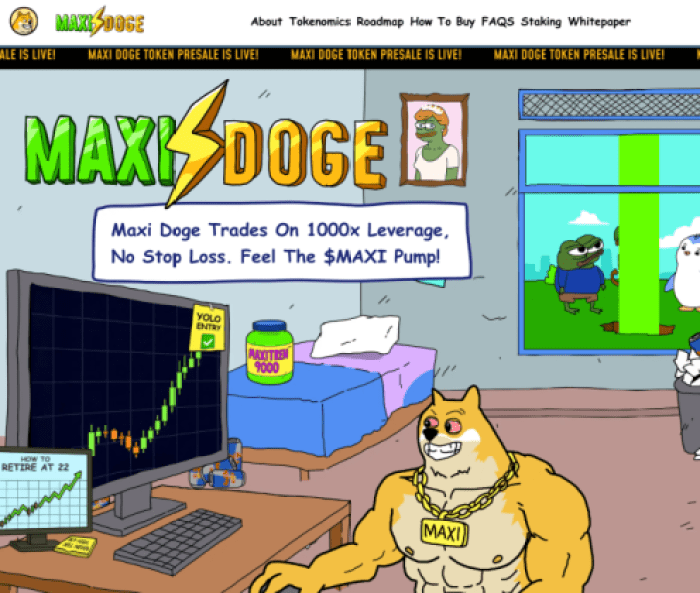

Why does this matter to the post-CFTC news cycle? It comes down to utility. As prediction markets open up, retail traders are looking for arenas to prove their edge. $MAXI plans to integrate ‘Holder-Only Trading Competitions’ directly into its ecosystem, gamifying the very activity regulators tried to suppress.

By offering leaderboard rewards to top ROI hunters, the project creates a synergy with the broader market’s shift toward speculative freedom.

Plus, the ‘Maxi Fund’ treasury introduces a layer of strategic capital management often missing in this sector. (The risk here is usually treasury mismanagement, but the project’s smart contract governance aims to mitigate that).

Rather than just a token, it hopes to function as a localized economy for traders who believe leverage is a feature, not a bug. In an environment where the government has stopped trying to protect traders from themselves, tools empowering aggressive strategies are primed to capture market share.

FIND OUT MORE ABOUT $MAXI

Smart Money Rotates Into High-Octane Assets

While headlines focus on the CFTC’s legal maneuvering, on-chain data suggests institutional capital is already front-running the expected surge in risk appetite. Smart money is moving.

Etherscan data reveals high-net-worth wallets buying $MAXI, up to sums as large as $314K . This specific timing, aligning with the shifting regulatory rumors, suggests sophisticated actors are positioning for a breakout in ‘culture coins’ offering leverage-like returns.

The financial metrics of the Maxi Doge presale back this up. According to the official presale page, the project has already raised over $4.5M, with tokens currently priced at $0.0002802. That level of capital injection during a presale phase indicates a conviction that extends well beyond simple retail FOMO.

Investors are also looking at yield sustainability. The project offers staking rewards with daily automatic distribution, but unlike static yield farms, the dynamic APY is designed to reward long-term conviction. Think of it as the ‘never skip leg day’ philosophy applied to your portfolio.

For traders watching the CFTC clear the runway for speculative markets, the combination of a $4.5M+ raise and significant whale accumulation signals that $MAXI is positioning itself as a primary vehicle for this new, deregulated cycle.

GET YOUR $MAXI BEFORE THE NEXT PRICE INCREASE

This article is for informational purposes only and does not constitute financial advice. Cryptocurrencies are high-risk assets, and presale tokens carry significant volatility. Always conduct your own due diligence before investing.


Crypto di tendenza

Letture associate

Annual Salary of Millions Competing for Electricians, Meta Rushes to Open Its Own Technical School

The AI boom is facing an unexpected bottleneck: a severe shortage of skilled construction workers and electricians. As tech giants like Meta, OpenAI, and Alphabet race to build massive data centers—such as OpenAI's $16 billion "Stargate" project—they are hitting a critical labor wall. The U.S. needs an estimated 130,000 more electricians, 240,000 construction workers, and 150,000 supervisors by 2030 for AI infrastructure alone, but tens of thousands of electrician jobs go unfilled each year. While AI companies offer high premiums, with electricians earning up to $280,000 annually, worker scarcity still causes massive losses—delays on a single project can cost $14.2 million per month. The complexity of building AI data centers, which require immense power (equivalent to powering hundreds of thousands of homes), sophisticated electrical systems, and advanced liquid cooling solutions, demands highly skilled technicians who are in short supply. To combat this, companies are investing heavily in training. Meta has committed $115 million to a free training school offering tuition, housing, and stipends, targeting 5,000 new workers. OpenAI is partnering with unions to secure skilled labor. These efforts are paying off, with a significant rise in Gen Z interest in trade schools over college. However, the power demands are staggering. AI data centers are driving a rapid surge in electricity consumption, projected to account for up to 12% of U.S. power use by 2028 and raising costs for consumers. Furthermore, the construction boom is project-based, leading to a potential future glut of trained workers once building peaks, which could depress wages industry-wide. The race for AI supremacy now depends as much on skilled hands as on advanced chips.

marsbit18 min fa

Annual Salary of Millions Competing for Electricians, Meta Rushes to Open Its Own Technical School

marsbit18 min fa

OpenAI No Longer Sells Its Most Expensive Model for Profit

OpenAI is shifting its business strategy away from promoting its most expensive, flagship models for every task. Recent price cuts—80% for GPT-5.6 Luna and 20% for Terra—signal a deeper change: the company now actively advises users that many tasks don't require the most powerful model. Instead, OpenAI recommends a tiered approach: use the high-end GPT-5.6 Sol for complex planning and analysis, then delegate execution to cheaper models like Luna. This mirrors moves by Anthropic, which recently launched Claude Opus 5 at half the price of its top model, Fable 5. Both companies are de-emphasizing flagship models as primary revenue drivers, using them instead for brand prestige and technological showcases. The industry is entering a "mass-market" phase, similar to automotive, where high-volume, cost-effective models handle daily operations and drive scale. OpenAI's price reductions are partly enabled by AI models themselves optimizing underlying code and infrastructure, creating a self-reinforcing cycle of efficiency gains and cost reduction. Competition is shifting from "who is smartest" to "who offers the best value." The goal is no longer selling individual models but fostering widespread API adoption and ecosystem lock-in. By making AI calls cheap and ubiquitous, companies like OpenAI aim to become the indispensable, utility-like infrastructure powering automated workflows—the "water and electricity" of software, quietly embedded everywhere.

marsbit18 min fa

OpenAI No Longer Sells Its Most Expensive Model for Profit

marsbit18 min fa

Will the Fed Definitely Raise Interest Rates in September? How Will Crypto and U.S. Stocks Withstand the Pressure?

The market's expectation for a September Fed rate hike surged dramatically in early August, jumping from under 50% to over 80% within a week. This shift followed a contentious July FOMC meeting, where a 9-3 vote to hold rates revealed growing dissent from hawkish members advocating for an immediate hike to combat persistent inflation. The primary catalyst for this repricing is rising oil prices, driven by renewed geopolitical tensions around the Strait of Hormuz, which threaten global supply. Energy costs directly influence inflation metrics, making the upcoming July CPI report (due August 12th) a critical data point. If it shows inflation reaccelerating, the probability of a September hike will solidify. For Bitcoin and crypto assets, this is typically bearish news. Bitcoin continues to behave as a high-beta, liquidity-sensitive risk asset. A rate hike raises the opportunity cost of holding non-yielding assets and could drive capital toward money markets, pressuring crypto prices in the short term. However, historical patterns suggest that if a hike is perceived as the end of a tightening cycle rather than the start, any negative price impact may be brief. U.S. stocks, particularly crypto-linked equities like Coinbase and growth-oriented tech stocks, are also vulnerable. Higher rates increase discount rates in valuation models, putting pressure on high-multiple companies. This coincides with a pivotal tech earnings season where investor focus has shifted from massive AI capital expenditure to tangible revenue and cash flow generation. Companies with negative cash flow and weak growth narratives could face heightened volatility if borrowing costs rise in September. In summary, a September Fed hike has evolved into a mainstream market scenario. Key factors to watch are oil prices, the July CPI report, and Fed communications, which will determine the final decision and its impact on volatile crypto and equity markets.

marsbit29 min fa

Will the Fed Definitely Raise Interest Rates in September? How Will Crypto and U.S. Stocks Withstand the Pressure?

marsbit29 min fa

Trading

Spot

Articoli Popolari

Come comprare ERA

Benvenuto in HTX.com! Abbiamo reso l'acquisto di Caldera (ERA) semplice e conveniente. Segui la nostra guida passo passo per intraprendere il tuo viaggio nel mondo delle criptovalute.Step 1: Crea il tuo Account HTXUsa la tua email o numero di telefono per registrarti il tuo account gratuito su HTX. Vivi un'esperienza facile e sblocca tutte le funzionalità,Crea il mio accountStep 2: Vai in Acquista crypto e seleziona il tuo metodo di pagamentoCarta di credito/debito: utilizza la tua Visa o Mastercard per acquistare immediatamente CalderaERA.Bilancio: Usa i fondi dal bilancio del tuo account HTX per fare trading senza problemi.Terze parti: abbiamo aggiunto metodi di pagamento molto utilizzati come Google Pay e Apple Pay per maggiore comodità.P2P: Fai trading direttamente con altri utenti HTX.Over-the-Counter (OTC): Offriamo servizi su misura e tassi di cambio competitivi per i trader.Step 3: Conserva Caldera (ERA)Dopo aver acquistato Caldera (ERA), conserva nel tuo account HTX. In alternativa, puoi inviare tramite trasferimento blockchain o scambiare per altre criptovalute.Step 4: Scambia Caldera (ERA)Scambia facilmente Caldera (ERA) nel mercato spot di HTX. Accedi al tuo account, seleziona la tua coppia di trading, esegui le tue operazioni e monitora in tempo reale. Offriamo un'esperienza user-friendly sia per chi ha appena iniziato che per i trader più esperti.

444 Totale visualizzazioniPubblicato il 2025.07.17Aggiornato il 2026.06.02

Come comprare ERA

Discussioni

Benvenuto nella Community HTX. Qui puoi rimanere informato sugli ultimi sviluppi della piattaforma e accedere ad approfondimenti esperti sul mercato. Le opinioni degli utenti sul prezzo di ERA ERA sono presentate come di seguito.

活动图片












