TRON Integration Pushes Kolo Further Into Real-World Stablecoin Payments – Details

bitcoinistPubblicato 2026-02-05Pubblicato ultima volta 2026-02-05

Introduzione

Kolo's integration with the TRON network enables direct TRC-20 USDT transfers to Kolo cards, allowing near-real-time settlement after on-chain confirmation. This move aims to reduce reliance on traditional exchanges and banking systems, streamlining the use of on-chain liquidity for everyday payments. Amid broader crypto volatility, TRON is defending the $0.30 price level, with its technical structure remaining intact despite market weakness. TRX continues to trade within a key consolidation range, supported by rising long-term moving averages and declining selling pressure. Kolo has processed over $250 million in transactions, with 30% occurring on the TRON network, highlighting TRON’s growing role in real-world payments. Lower transaction costs and faster confirmations make TRON suitable for frequent, smaller transactions. The network has also surpassed Ethereum in USDT circulating supply, reflecting its increasing adoption in practical, real-world stablecoin usage.

Trusted Editorial content, reviewed by leading industry experts and seasoned editors. Ad Disclosure

TRON is attempting to defend the $0.30 level as broader crypto markets remain under sustained selling pressure and risk appetite stays fragile. Price action across major assets has been dominated by deleveraging and reduced spot participation, leaving altcoins particularly exposed to downside volatility. Within this context, TRON’s ability to hold key technical levels is being closely watched, not only as a price signal but also as a reflection of ongoing network activity and real-world usage.

Against this uncertain market backdrop, Kolo announced its integration with the TRON network, enabling direct TRC-20 USDT transfers to Kolo cards with near-real-time settlement following on-chain confirmation. The integration allows funds to move from the TRON network to payment cards without relying on traditional exchange withdrawals or banking rails, reducing settlement delays that have historically limited practical usage of on-chain liquidity.

Rather than signaling speculative expansion, this development highlights an operational use case at a time when markets are contracting. With stablecoin flows increasingly concentrated on the TRC-20 USDT standard, the integration underscores how existing blockchain infrastructure is being used to support everyday transactions even during market stress.

TRON’s Growing Role in Stablecoin Payments

Recent data around Kolo provides useful context for understanding TRON’s role in today’s stablecoin market. Kolo has processed more than $250 million in total transaction volume to date, with roughly 30% of that activity executed directly on the TRON network. This concentration is notable given the broad range of chains available for stablecoin transfers and points to sustained usage rather than short-term experimentation.

The platform has also recorded a high number of individual deposits, reinforcing the idea that TRC-20 USDT is increasingly used as a settlement rail for everyday payments and routine transfers, rather than solely for trading or arbitrage.

Lower transaction costs and faster confirmation times make the TRON network particularly suited for smaller, frequent payments, which tend to dominate real-world spending behavior. Kolo’s design emphasizes speed and operational simplicity, allowing users to open an account, complete verification, and begin spending within minutes, while remaining fully compliant with global KYC and AML requirements.

At the network level, this activity aligns with a broader structural shift. TRON has now surpassed Ethereum in USDT circulating supply, reflecting where stablecoins are actually being held and moved at scale.

TRX Price Holds Key Structure Amid Market Weakness

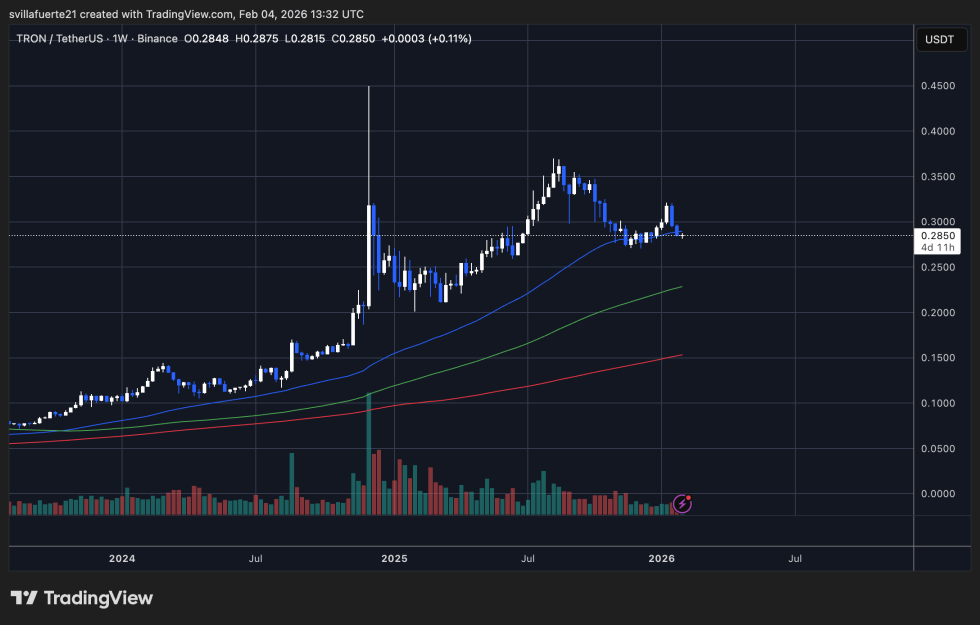
TRON (TRX) continues to trade near the $0.28–$0.30 zone, a level that has become structurally important on the weekly chart. After a strong advance throughout 2024, price entered a consolidation phase following the sharp spike and rejection above the $0.35 area. Since then, TRX has been moving sideways, suggesting the market is digesting prior gains rather than entering a clear distribution phase.

TRX testing critical demand level | Source: TRXUSDT chart on TradingView

From a trend perspective, the broader structure remains constructive. Price is still holding above the rising 100-week moving average (blue), which has acted as dynamic support during pullbacks. The 200-week moving average (green) continues to slope higher well below the current price, reinforcing that the long-term trend remains intact despite recent volatility. The 50-week moving average (red) also continues to rise, indicating that long-term momentum has not yet broken.

Volume behavior supports this interpretation. The largest volume spike occurred during the impulsive rally, while recent weeks show declining activity, consistent with consolidation rather than aggressive selling. This suggests sellers are not pressing the market with urgency.

However, the inability to decisively reclaim and hold above $0.30 highlights near-term caution. A sustained break below the $0.27–$0.28 range would weaken the structure and expose deeper support near the 100-week average. Conversely, a clean weekly close above $0.30 would signal renewed strength and open the door for a retest of prior highs.

Featured image from ChatGPT, chart from TradingView.com 

Editorial Process for bitcoinist is centered on delivering thoroughly researched, accurate, and unbiased content. We uphold strict sourcing standards, and each page undergoes diligent review by our team of top technology experts and seasoned editors. This process ensures the integrity, relevance, and value of our content for our readers.

Sebastian Villafuerte

Follow

Sebastian's journey into the world of crypto began four years ago, driven by a fascination with the potential of blockchain technology to revolutionize financial systems. His initial exploration focused on understanding the intricacies of various crypto projects, particularly those focused on building innovative financial solutions. Through countless hours of research and learning, Sebastian developed a deep understanding of the underlying technologies, market dynamics, and potential applications of cryptocurrencies. As his knowledge grew, Sebastian felt compelled to share his insights with others. He began actively contributing to online discussions on platforms like X and LinkedIn, focusing on fintech and crypto-related content. His goal was to expose valuable trends and insights to a wider audience, fostering a deeper understanding of the rapidly evolving crypto landscape. Sebastian's contributions quickly gained recognition, and he became a trusted voice in the online crypto community. To further enhance his expertise, Sebastian pursued a UC Berkeley Fintech: Frameworks, Applications, and Strategies certification. This rigorous program equipped him with valuable skills and knowledge regarding Financial Technology, bridging the gap between traditional finance (TradFi) and decentralized finance (DeFi). The certification deepened his understanding of the broader financial landscape and its intersection with blockchain technology. Sebastian's passion for finance and writing is evident in his work. He enjoys delving into financial research, analyzing market trends, and exploring the latest developments in the crypto space. In his spare time, Sebastian can often be found immersed in charts, studying 10-K forms, or engaging in thought-provoking discussions about the future of finance. Sebastian's journey as a crypto analyst and investor has been marked by a relentless pursuit of knowledge and a dedication to sharing his insights. His ability to navigate the complex world of crypto, combined with his passion for financial research and communication, makes him a valuable asset to the industry. As the crypto landscape continues to evolve, Sebastian remains at the forefront, providing valuable insights and contributing to the growth of this revolutionary technology.

Full Profile

Related Posts

Les altcoins dans le rouge : l’altseason n’aura plus jamais lieu sur le marché crypto ?

Claude IA évoque une phase haussière sur les cryptomonnaies : trois jetons à surveiller en février 2026

Famous Analyst Says Altcoin Holders Will Be Disappointed, Bitcoin Rotation Not Coming?

Cardano’s Big Rally In Sight? ADA’s Interest Sees Subtle Shift As Smart Money Accumulates

From Boom To Goodbye: NFT Marketplace Nifty Gateway To End Operations

ONDO’s Silent Accumulation: Whales Absorb The 1.94B Unlock While Price Bleeds

Domande pertinenti

QWhat is the significance of Kolo's integration with the TRON network?

AThe integration enables direct TRC-20 USDT transfers to Kolo cards with near-real-time settlement, allowing funds to move from the TRON network to payment cards without relying on traditional exchange withdrawals or banking rails. This reduces settlement delays and supports practical usage of on-chain liquidity for everyday transactions.

QWhat percentage of Kolo's total transaction volume is executed on the TRON network?

AApproximately 30% of Kolo's total transaction volume, which is over $250 million, is executed directly on the TRON network.

QWhy is the TRON network particularly suited for real-world payments according to the article?

AThe TRON network is suited for real-world payments due to its lower transaction costs and faster confirmation times, which are ideal for smaller, frequent payments that dominate real-world spending behavior.

QWhat key technical level is TRON (TRX) attempting to defend amidst market weakness?

ATRON (TRX) is attempting to defend the $0.30 level, which is a structurally important zone on the weekly chart. A break below the $0.27–$0.28 range would weaken its market structure.

QHow does the article characterize the current trend and momentum for TRX based on its moving averages?

AThe broader structure remains constructive as TRX is holding above the rising 100-week moving average, and the 200-week moving average continues to slope higher, indicating the long-term trend is intact. The 50-week moving average is also rising, showing that long-term momentum has not broken.

Letture associate

From Theft to Re-entry: How Was $292 Million "Laundered"?

A sophisticated crypto laundering operation was executed following the $292 million hack of Kelp DAO on April 18. The attack, attributed to the North Korean Lazarus group, began with anonymous infrastructure preparation using Tornado Cash to fund wallets untraceably. The hacker exploited a vulnerability in Kelp’s cross-chain bridge, stealing 116,500 rsETH. To avoid crashing the market, the attacker used Aave and Compound as laundering tools—depositing the stolen rsETH as collateral to borrow $190 million in clean, liquid ETH. This move triggered a bank run on Aave, causing an $8 billion drop in TVL. After consolidating funds, the attacker fragmented them across hundreds of wallets to evade detection. A major breakpoint was THORChain, where over $460 million in volume—30 times its usual activity—was processed in 24 hours, converting ETH into Bitcoin. This shift to Bitcoin’s UTXO model exponentially increased tracing complexity by shattering funds into countless untraceable fragments. The final destination was Tron-based USDT, the primary channel for illicit crypto flows. From there, funds were cashed out via OTC brokers in China and Southeast Asia, using unlicensed underground banks and UnionPay networks outside Western sanctions scope. Ultimately, the laundered money supports North Korea’s weapons programs, which rely heavily on crypto hacking for foreign currency. The incident underscores structural challenges in DeFi: its openness, composability, and lack of central control make such laundering not just possible, but inherently difficult to prevent.

marsbit1 h fa

From Theft to Re-entry: How Was $292 Million "Laundered"?

marsbit1 h fa

Google and Amazon Simultaneously Invest Heavily in a Competitor: The Most Absurd Business Logic of the AI Era Is Becoming Reality

In a span of four days, Amazon announced an additional $25 billion investment, and Google pledged up to $40 billion—both direct competitors pouring over $65 billion into the same AI startup, Anthropic. Rather than a typical venture capital move, this signals the latest escalation in the cloud wars. The core of the deal is not equity but compute pre-orders: Anthropic must spend the majority of these funds on AWS and Google Cloud services and chips, effectively locking in massive future compute consumption. This reflects a shift in cloud market dynamics—enterprises now choose cloud providers based on which hosts the best AI models, not just price or stability. With OpenAI deeply tied to Microsoft, Anthropic’s Claude has become the only viable strategic asset for Google and Amazon to remain competitive. Anthropic’s annualized revenue has surged to $30 billion, and it is expanding into verticals like biotech, positioning itself as a cross-industry AI infrastructure layer. However, this funding comes with constraints: Anthropic’s independence is challenged as it balances two rival investors, its safety-first narrative faces pressure from regulatory scrutiny, and its path to IPO introduces new financial pressures. Globally, this accelerates a "tri-polar" closed-loop structure in AI infrastructure, with Microsoft-OpenAI, Google-Anthropic, and Amazon-Anthropic forming exclusive model-cloud alliances. In contrast, China’s landscape differs—investments like Alibaba and Tencent backing open-source model firm DeepSeek reflect a more decoupled approach, though closed-source models from major cloud providers still dominate. The $65 billion bet is ultimately about securing a seat at the table in an AI-defined future—where missing the model layer means losing the cloud war.

marsbit7 h fa

Google and Amazon Simultaneously Invest Heavily in a Competitor: The Most Absurd Business Logic of the AI Era Is Becoming Reality

marsbit7 h fa

Trading

Spot
Futures

Articoli Popolari

Come comprare TRX

Benvenuto in HTX.com! Abbiamo reso l'acquisto di TRON (TRX) semplice e conveniente. Segui la nostra guida passo passo per intraprendere il tuo viaggio nel mondo delle criptovalute.Step 1: Crea il tuo Account HTXUsa la tua email o numero di telefono per registrarti il tuo account gratuito su HTX. Vivi un'esperienza facile e sblocca tutte le funzionalità,Crea il mio accountStep 2: Vai in Acquista crypto e seleziona il tuo metodo di pagamentoCarta di credito/debito: utilizza la tua Visa o Mastercard per acquistare immediatamente TRONTRX.Bilancio: Usa i fondi dal bilancio del tuo account HTX per fare trading senza problemi.Terze parti: abbiamo aggiunto metodi di pagamento molto utilizzati come Google Pay e Apple Pay per maggiore comodità.P2P: Fai trading direttamente con altri utenti HTX.Over-the-Counter (OTC): Offriamo servizi su misura e tassi di cambio competitivi per i trader.Step 3: Conserva TRON (TRX)Dopo aver acquistato TRON (TRX), conserva nel tuo account HTX. In alternativa, puoi inviare tramite trasferimento blockchain o scambiare per altre criptovalute.Step 4: Scambia TRON (TRX)Scambia facilmente TRON (TRX) nel mercato spot di HTX. Accedi al tuo account, seleziona la tua coppia di trading, esegui le tue operazioni e monitora in tempo reale. Offriamo un'esperienza user-friendly sia per chi ha appena iniziato che per i trader più esperti.

1.4k Totale visualizzazioniPubblicato il 2024.12.10Aggiornato il 2025.03.21

Come comprare TRX

Discussioni

Benvenuto nella Community HTX. Qui puoi rimanere informato sugli ultimi sviluppi della piattaforma e accedere ad approfondimenti esperti sul mercato. Le opinioni degli utenti sul prezzo di TRX TRX sono presentate come di seguito.

活动图片