Treasury’s GENIUS Act Report Backs Mixers, But Wants a New ‘Hold Law’ For Crypto

bitcoinistPubblicato 2026-03-09Pubblicato ultima volta 2026-03-09

Introduzione

The U.S. Treasury's GENIUS Act report acknowledges the legitimate privacy benefits of cryptocurrency mixers for lawful users, such as protecting personal or business transactions. However, it highlights the misuse of these tools by illicit actors like North Korean cyber units and ransomware groups to launder funds. To address this, the report proposes a new "digital-asset-specific hold law" that would allow regulated platforms to temporarily freeze suspicious transactions, giving law enforcement time to act without disrupting legitimate privacy-focused usage. The report is part of a broader effort to balance financial innovation and security under the GENIUS Act framework.

Treasury sent Congress its GENIUS‐Act‐mandated report on “innovative tools” to fight crypto‐enabled illicit finance.

A Crypto’s “Hold Law” And A Privacy Paradox

In a 32-page report submitted to the US Congress this March, the U.S. Treasury Department has endorsed lawful uses of crypto mixers (a service that takes in cryptocurrency from many different users, mixes all those coins together, and then sends each user back an equivalent amount from the pool, but from different addresses than the ones they used to deposit) in favor of privacy.

However, it has also urged lawmakers to create a new “digital‐asset‐specific hold law” so platforms can freeze suspicious funds.

Mixers, Privacy And DPRK

The report notes favorably that mixing and similar tools “can be used by lawful users seeking to enhance financial privacy on public blockchains,” including for “protecting sensitive information about personal wealth, business transactions, or charitable donations from public view. It adds that Treasury “recognizes that privacy‐enhancing technologies, including mixers and other obfuscation tools, may serve legitimate purposes when used by compliant actors in line with applicable AML/CFT requirements.”

On the other side, the same report also stresses that North Korea’s cyber units and major ransomware crews rely on mixers, cross‐chain bridges, and rapid swaps as core infrastructure to launder massive hauls from hacks and fraud. The report cites billions of dollars in stolen digital assets tied to DPRK actors and details how those funds are pushed through mixers and into stablecoins before being bridged and cashed out, using the same tools that ordinary users might pick for privacy.

What The “Hold Law” Would Do

Therefore, to tackle this paradox, the report proposes a “hold law” that would ensure that legitimate, clean, users keep their privacy while unlawful or suspicious activity can be addressed. Under the proposal, crypto exchanges and other regulated platforms would gain a clear and legal “pause button” for suspicious funds. The report recommends that “Congress establish a digital‐asset‐specific statutory ‘hold’ authority” that would allow platforms “to temporarily retain or delay the movement of digital assets associated with suspected illicit activity while appropriate legal process is pursued.” Firms could temporarily hold or delay those assets when strong red flags appear, with statutory cover for doing so.

The idea would be to give law enforcement time to act against ransomware crews, large fraud schemes, or state‐sponsored hackers, while limiting the tool to narrowly defined, high‐risk cases so routine customer flows are not frozen by default.

TradFi and Legacy media have often linked mixers to money laundering, with Tornado Cash as the obvious cautionary tale. Ethereum co‐founder Vitalik Buterin has repeatedly argued that mixers are neutral tools, even saying he used Tornado Cash to make a private donation to Ukraine, and is now backing ‘compliant’ designs like Privacy Pools that aim to protect on‐chain privacy without commingling with known dirty funds.

Another Piece On The GENIUS Act Puzzle

The report is part of the broader GENIUS Act framework, the law Trump signed to create a federal regime for payment stablecoins and push “innovative” tools against illicit finance. It fulfills a mandate for Treasury to spell out how AI, digital identity, and blockchain analytics should be used under a risk‐based AML approach.

The report also proposes a preferred tech stack (AI, digital ID, blockchain analytics, APIs) that regulated platforms should deploy under a risk‐based AML approach.
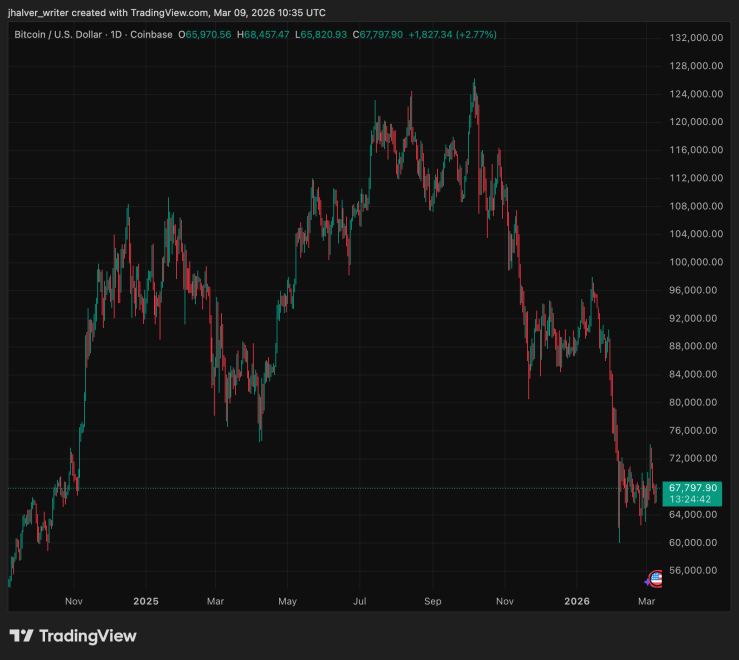
BTC's price trends to the downside on the daily chart. Source: BTCUSD on Tradingview

Cover image from ChatGPT, BTCUSD chart from Tradingview

Domande pertinenti

QWhat is the main purpose of the GENIUS Act report submitted by the U.S. Treasury Department?

AThe GENIUS Act report outlines 'innovative tools' to fight crypto-enabled illicit finance, endorsing lawful uses of crypto mixers for privacy while proposing a new 'hold law' to freeze suspicious funds.

QHow does the report view the use of crypto mixers by lawful users?

AThe report recognizes that mixers and other privacy-enhancing technologies can serve legitimate purposes for lawful users seeking financial privacy, such as protecting sensitive information about personal wealth or business transactions, when used in compliance with AML/CFT requirements.

QWhat specific legislative measure does the Treasury Department recommend to address suspicious crypto transactions?

AThe Treasury Department recommends that Congress establish a digital-asset-specific statutory 'hold' authority, allowing platforms to temporarily retain or delay the movement of digital assets associated with suspected illicit activity while legal process is pursued.

QAccording to the report, how do malicious actors like North Korea's cyber units utilize crypto mixers?

ANorth Korea's cyber units and ransomware crews use mixers, cross-chain bridges, and rapid swaps as core infrastructure to launder massive amounts of stolen digital assets, often pushing funds through mixers into stablecoins before cashing out.

QWhat broader framework is this report a part of, and what additional tools does it propose for regulated platforms?

AThe report is part of the GENIUS Act framework, which aims to create a federal regime for payment stablecoins and combat illicit finance. It proposes a tech stack including AI, digital identity, blockchain analytics, and APIs for regulated platforms under a risk-based AML approach.

Letture associate

CPU Makes a Comeback to the Table, A $170 Billion "Power Seizure" Drama Begins

A new era is dawning for the server CPU (Central Processing Unit), driven by the shift from AI model training to large-scale reasoning and the rise of Agentic AI. This article explores how the CPU is reclaiming a central role in the AI data center. For years, the focus has been on the GPU (Graphics Processing Unit) for AI training. However, as AI moves to the inference and Agent phase—where tasks involve complex, multi-step reasoning, tool calls, and data management—the workload balance is flipping. Studies show CPUs now handle over 70% of the workload in Agentic AI, up from 10-30% in training. This is because Agent tasks generate massive intermediate data (KV Cache) that exceeds GPU memory, forcing it to be offloaded to the CPU's larger, more scalable memory pools. This increased importance is translating into market changes. Major players are taking note: NVIDIA launched its first standalone CPU line, Vera, based on ARM architecture and optimized for Agent performance. AMD doubled its server CPU market forecast to over $1200 billion by 2030. Analyst reports project the total server CPU market could reach $1700 billion by 2030, with AI-driven demand being a primary driver. Furthermore, the classic ratio of CPUs to GPUs in AI servers is rapidly changing, converging from 1:8 toward 1:1 for Agent deployments. This surge in demand has led to a rare industry-wide price increase of 10-15% for server CPUs from Intel and AMD, breaking a decade-long trend of "more performance for the same price." Demand is bifurcating into high-core-count CPUs for in-rack GPU support and moderate-core CPUs for standalone Agent task orchestration. In China, this global trend presents an opportunity for domestic CPU manufacturers like Hygon (海光信息) and Huawei Kunpeng, who are bolstered by both growing AI infrastructure needs and national policies promoting technological self-reliance ("xin chuang"). The maturity of their software ecosystems is also accelerating, evidenced by faster adaptation to new AI models. In conclusion, the narrative is shifting from a GPU-centric view to one where CPU-GPU synergy is critical. The CPU is no longer a peripheral component but a performance-defining bottleneck and a key growth driver in the AI hardware stack, opening a massive new market estimated in the hundreds of billions of dollars.

marsbit3 h fa

CPU Makes a Comeback to the Table, A $170 Billion "Power Seizure" Drama Begins

marsbit3 h fa

TechFlow Intelligence: AMD AI Director Publicly Criticizes Claude Code for "Becoming Dumber and Lazier", Trump Claims Full Ceasefire in Hormuz But Strait Still Has 80 Unexploded Mines

TechFlow Intelligence Report: This daily digest covers key developments in AI, crypto, hardware, and geopolitics. In AI, SK Telecom faces US export control scrutiny over its partnership with Anthropic, while a Gemini user reports being misled in a scam scenario, sparking safety debates. China's Z.AI launches the GLM-5.2 model, rivaling Claude Opus without NVIDIA chips. In crypto, Bithumb lists ReProtocol, and Upbit delists KernelDAO. On the hardware front, MIT researchers build a custom OS to study chips, ASML denies US claims its advanced lithography machines are in China, and Amazon considers selling its in-house AI chips. Apple's future A21 Pro chip may use TSMC's latest N2P process. Major tech issues include 10,000 GitHub repositories distributing malware and Apple patching a critical eavesdropping flaw in Beats earbuds. US stocks rise, led by semiconductors, with Intel surging 10.6%, while SpaceX falls 3.5%. Geopolitically, despite a US-Iran deal, the Strait of Hormuz remains risky with ~80 uncleared mines, stalling 80M barrels of oil on standby tankers. Iran postpones Switzerland talks, and Trump calls the agreement an "unconditional surrender." The report highlights a contrast: temporary geopolitical calm versus the ongoing, fundamental restructuring of tech supply chains and chip independence.

marsbit3 h fa

TechFlow Intelligence: AMD AI Director Publicly Criticizes Claude Code for "Becoming Dumber and Lazier", Trump Claims Full Ceasefire in Hormuz But Strait Still Has 80 Unexploded Mines

marsbit3 h fa

Trading

Spot
Futures
活动图片