Trading Volume Hits New Highs Repeatedly, Why Is Kalshi's Pre-IPO Stock Price Experiencing a Tale of Extremes?

比推Pubblicato 2026-02-11Pubblicato ultima volta 2026-02-11

Introduzione

Amidst a declining broader market, the prediction market sector has shown remarkable resilience, with trading activity hitting record highs. Kalshi, the largest regulated prediction market platform in the U.S., reached over $9.5 billion in trading volume in January, ranking first in the sector and setting a new monthly record. This has sparked renewed discussions about the fair pre-IPO share price of Kalshi, which is poised to become the "first prediction market stock." Currently, significant price discrepancies exist on crypto-based pre-IPO trading platforms: PreStocks lists Kalshi shares between $364 and $369, while Jarsy shows a price of around $504. In traditional markets, Nasdaq Private Market prices shares at approximately $320, and Hiive at $358. Kalshi completed a Series E funding round last year at a $11 billion valuation. Based on this, the reasonable pre-IPO share price range is estimated to be between $320 and $358. However, considering Kalshi's dominant market share and January volume nearing the entire prediction market's size from October last year, its implied valuation could be at least $15 billion. This would adjust the reasonable share price range to approximately $320–$423. Thus, Jarsy's current pricing appears high, while PreStocks may present arbitrage opportunities. With 2026 being a major year for global sporting events, Kalshi's annual revenue potential is significant, likely exceeding earlier estimates for competitor Polymarket, which could furthe...

Author: Wenser

Original Title: Kalshi's Trading Volume Continues to Break New Highs, What Is a Reasonable Pre-IPO Stock Price?


During the market downturn, prediction markets have become the most eye-catching sector in the crypto market. In early February, when the market plummeted, BTC and ETH once fell by over 10%, but prediction market trading remained active, with weekly transactions reaching 26.39 million, setting a historical record. Meanwhile, as the largest compliant prediction market platform in the United States, Kalshi also surged to the top of the sector with over $9.5 billion in trading volume in January this year, setting a new historical high for monthly trading volume. This has led to a new round of pricing for Kalshi's pre-IPO stock.

Today, the question we are discussing is—what should be the reasonable price range for the pre-IPO stock of Kalshi, which is poised to become the "first stock in the prediction market"?

Overview of Current Pricing on Tokenized Stock Trading Platforms: PreStocks, Jarsy

As of the time of writing, there is a significant price difference for Kalshi's pre-IPO stock on two major tokenized stock trading platforms:

On the PreStocks platform, Kalshi's pre-IPO stock pricing includes two prices—

One price is the token price under the implied market capitalization (market liquidity pricing level), with a per-share price of around $369;

The other price is the marked price under the capital market capitalization (existing financing pricing level), with a per-share price of around $364.
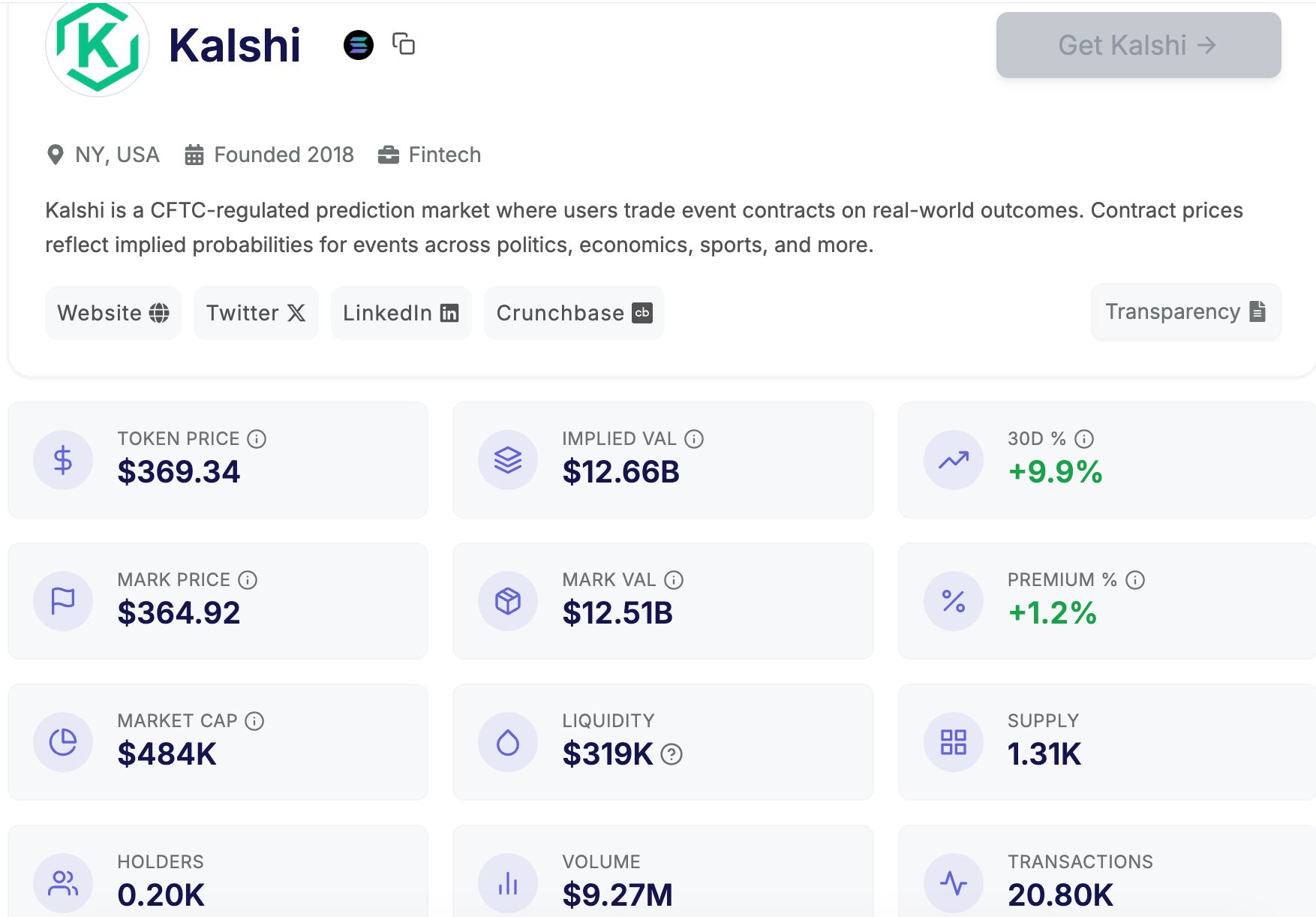
On the Jarsy platform, Kalshi's pre-IPO per-share price has already jumped to around $504.

It is worth mentioning that compared to when we previously wrote the article "Kalshi's Pre-IPO Stock Price Soars, Is It Still Worth Buying Now?", the pre-IPO prices of Kalshi stock on both platforms have experienced varying degrees of increases and decreases. The price situation at that time was as follows:

  • On PreStocks, Kalshi's implied market capitalization was approximately $14 billion, with a per-share price of around $407;

  • On Jarsy, Kalshi's market valuation was $11 billion, with a per-share price of $450.

In other words, the price on PreStocks dropped from $407 to around $369; while the price on Jarsy increased from $450 to around $504.

As a comparison, the pre-market pricing for Kalshi stock in traditional financial markets has also changed—

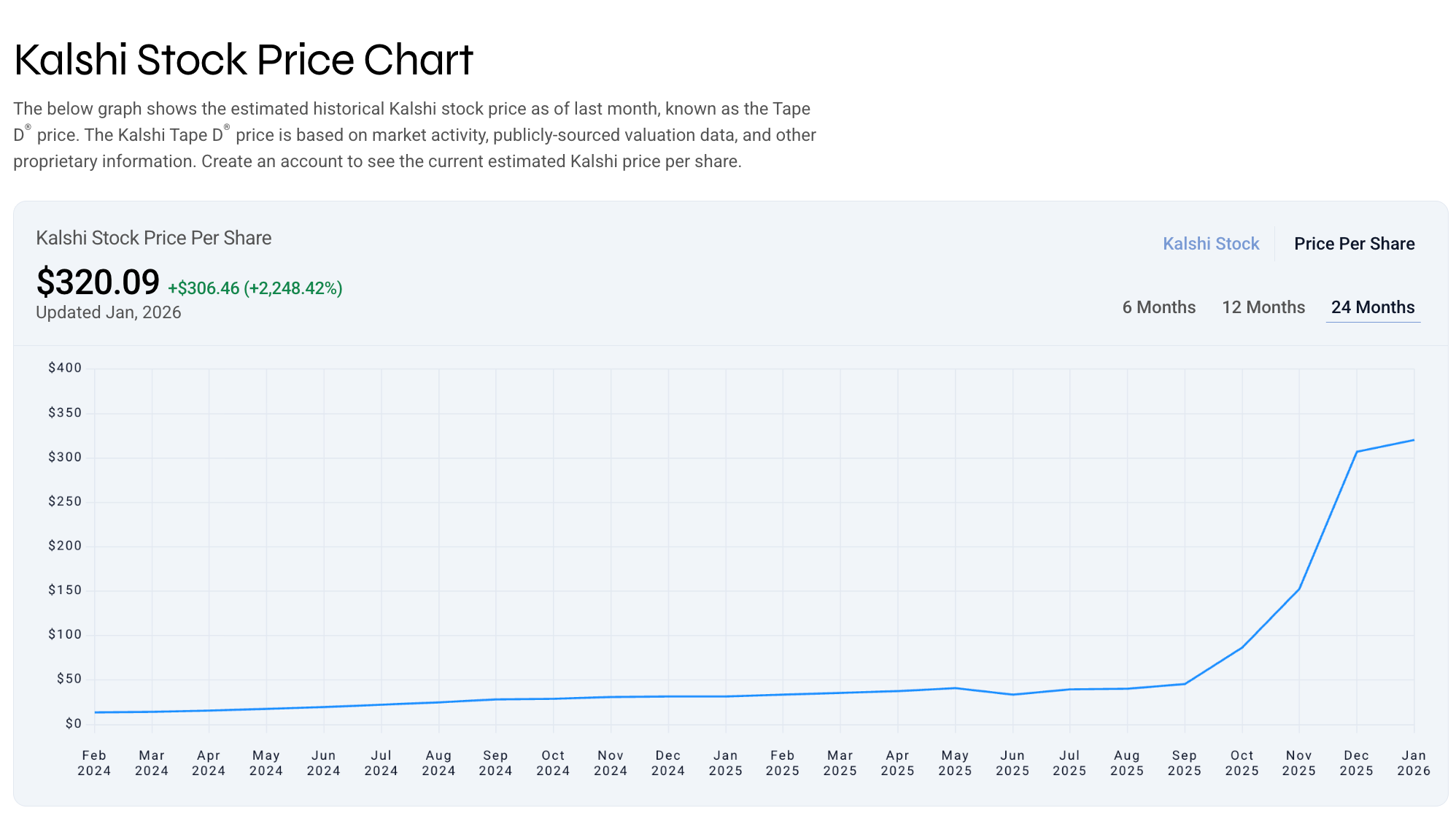
  • On Nasdaq Private Market, Kalshi's per-share price increased from around $307 to around $320;
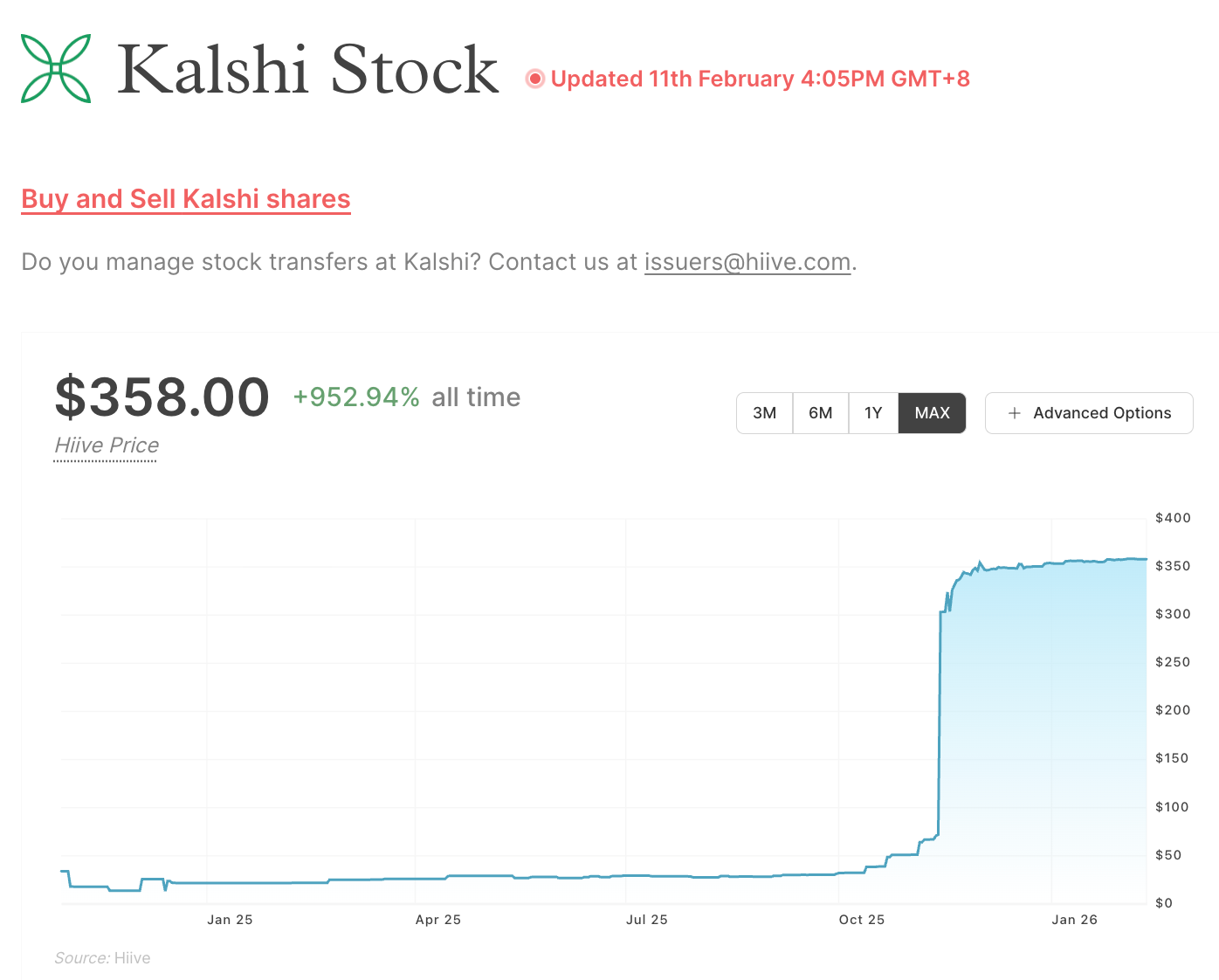
  • On Hiive, Kalshi's per-share price increased by $1 from around $357 to around $358.
Reasonable Pre-IPO Pricing Range for Kalshi Stock: Around $320~$423

Last year, Kalshi completed a $1 billion Series E funding round, valuing the company at $11 billion.

Based on the market capitalization and corresponding stock prices mentioned above, the number of Kalshi shares is approximately between 30.72 million and 34.30 million.

Specifically, the calculation of the number of shares is as follows—

Based on a $11 billion market capitalization corresponding to pre-market prices of $320 and $358 in traditional financial markets, the number of Kalshi shares is approximately 30.72 million to 34.37 million;

Based on the implied market capitalization/token price and capital market capitalization/marked price on PreStocks, the number of Kalshi shares is approximately 34.27 million to 34.30 million;

Based on the pre-IPO purchase price per share on Jarsy, Kalshi's market capitalization caps at $18.665 billion, with a per-share price of $604.84, and the number of shares is around 30.86 million.

Based on the above information, we can make the following deductions:

First, based on the $11 billion valuation, the reasonable pre-IPO pricing range for Kalshi stock is approximately $320-$358. In other words, the current pricing on crypto market tokenized stock trading platforms like PreStocks and Jarsy is relatively high;

Second, Kalshi's trading volume in January reached $9.5 billion, close to the overall prediction market size of about $10 billion in October last year; in October last year, its market share was about 50% of the prediction market. From this perspective, Kalshi's current capital market valuation is at least above $15 billion.

Third, based on a $15 billion valuation and combined with data such as the range of Kalshi's share count, the pre-IPO pricing range for Kalshi stock is approximately $436~$488.

Therefore, if the number of Kalshi shares meets expectations, and under the premise of a $15 billion implied market capitalization, conservatively estimated, the reasonable pre-IPO pricing range for Kalshi stock might be $320~$378 (calculated based on the average of the lowest prices in the pricing range); optimistically estimated, the reasonable pre-IPO pricing range for Kalshi stock might be $358~$423 (calculated based on the average of the highest prices in the pricing range).

Based on the above data conclusions, the pre-IPO pricing for Kalshi stock on the Jarsy platform is偏高 (high), while the PreStocks platform offers some arbitrage opportunities.

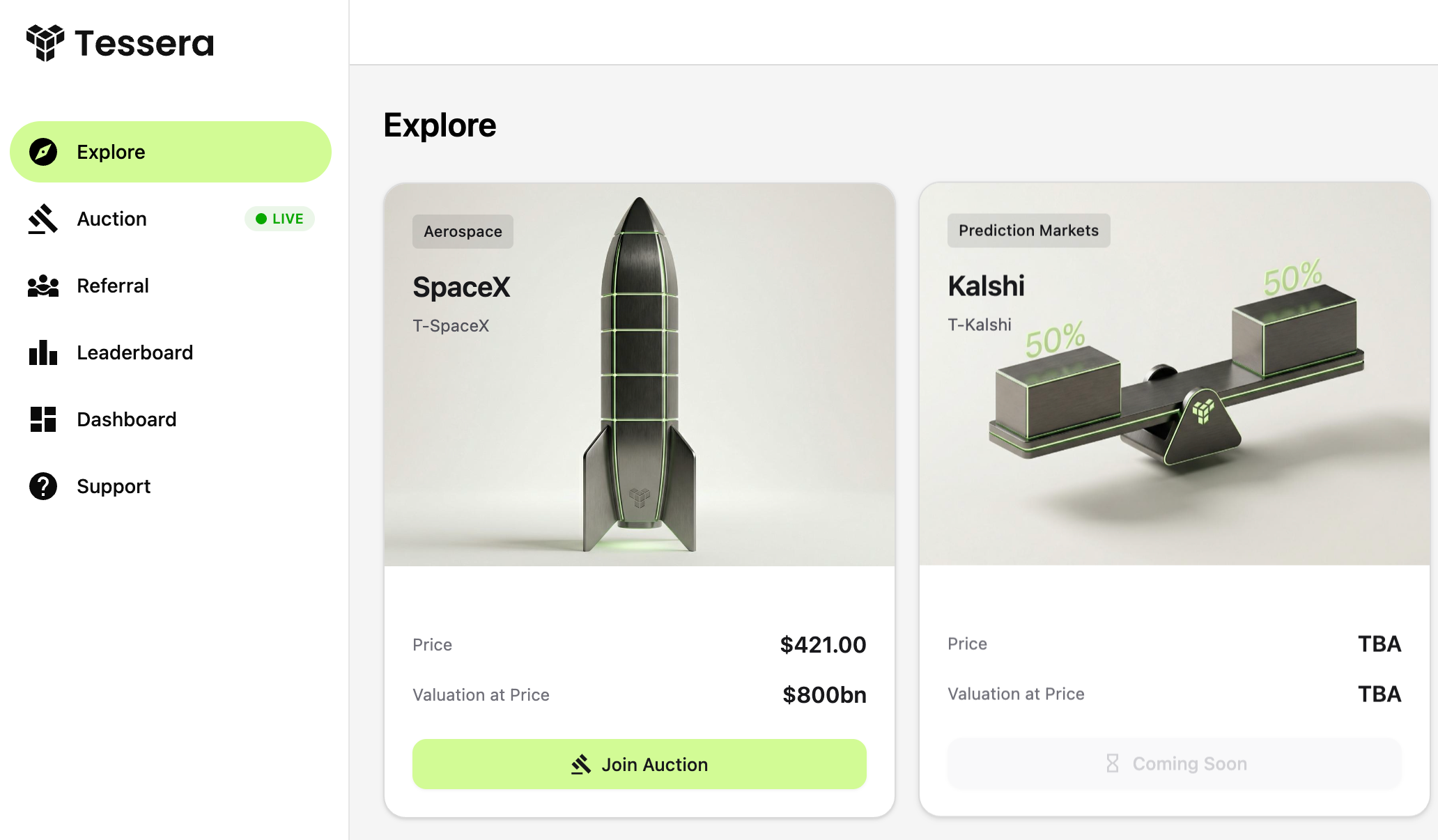
In addition, the latest tokenized stock trading platform, Tessera, plans to open equity public offerings in the future, which readers can also consider as an alternative reference (invitation code can be found here).
Combined with the relevant information mentioned in the previously published Odaily Planet Daily article "Data Calculation Shows Polymarket's Annual Revenue Exceeding $100 Million Is Not Difficult, Provided That...":

Based on a static calculation of the trading volume and fee ratio in the "15-minute cryptocurrency rise and fall" market on Polymarket, under the current trading volume level and structure, if Polymarket introduces a similar fee model in all markets, it is expected to bring in $418 million in annual revenue for the platform.

As a prediction market platform with larger trading volume and higher fees, and taking advantage of the timing of the major sports year in 2026, Kalshi's annual revenue is expected to exceed this estimated revenue of Polymarket. From this perspective, the capital market may further raise the pre-IPO pricing of Kalshi stock in the future.


Twitter:https://twitter.com/BitpushNewsCN

BitPush TG Discussion Group:https://t.me/BitPushCommunity

BitPush TG Subscription: https://t.me/bitpush

Original link:https://www.bitpush.news/articles/7611114

Domande pertinenti

QWhat is the current pre-market stock price range for Kalshi on PreStocks and Jarsy platforms?

AOn PreStocks, the pre-market stock price for Kalshi is around $369 (implied market cap pricing) and $364 (capital market cap pricing). On Jarsy, the price is around $504.

QWhat was the valuation of Kalshi after its Series E funding round last year?

AKalshi completed a $1 billion Series E funding round last year with a valuation of $11 billion.

QWhat is the estimated reasonable pre-market stock price range for Kalshi based on a $11 billion valuation?

ABased on a $11 billion valuation, the reasonable pre-market stock price range for Kalshi is estimated to be between $320 and $358.

QWhat is the estimated pre-market stock price range for Kalshi if assuming a $15 billion implied market cap?

AAssuming a $15 billion implied market cap, the estimated pre-market stock price range for Kalshi is between $436 and $488.

QWhich platform's pre-market pricing for Kalshi stock is considered relatively high, and which platform may present arbitrage opportunities?

AJarsy's pre-market pricing for Kalshi stock is considered relatively high, while PreStocks may present some arbitrage opportunities.

Letture associate

Must-Watch Events Next Week|CLARITY Act Could Face Senate Vote; SpaceX, Circle to Report Earnings (8.3-8.9)

**Summary: Key Events and Developments to Watch (August 3-9)** The upcoming week is marked by significant financial disclosures, key legislative deadlines, and notable product updates. **Major Financial Events:** Several companies are scheduled to release their Q2 2026 earnings. American Bitcoin (ABTC) will report on August 3, followed by SpaceX and Hut 8 Mining Corp. on August 4, and Circle on August 5. Notably, a significant portion of SpaceX shares (up to 12% of total shares) will be unlocked on August 6 following their earnings release. **Key Legislative Deadline:** The U.S. Senate faces an August 7 deadline to secure 60 votes for the CLARITY Act, a bipartisan bill aiming to establish a federal regulatory framework for cryptocurrencies. The Senate may hold a full vote on the bill during the week. **Economic Data:** The U.S. July Non-Farm Payrolls report will be released on August 7, providing crucial labor market data. **Technology & Product Updates:** * **Shutdowns:** DeFi portfolio tracker Zapper and wallet app Ctrl Wallet will cease operations on August 3. * **Upgrades:** LayerZero will deprecate its v1 relayers on August 3. XRP Ledger's new version 3.3.0, featuring five new functions, is expected next week. * **AI:** Elon Musk announced that the advanced Grok 4.6 AI model is set for release around August 7. * **Bitcoin:** The BIP-110 forced signaling for a potential Bitcoin network change is scheduled to begin around August 8. **Other Notable Events:** Chinese robotics firm Unitree Tech has set its preliminary price inquiry for its IPO for August 5. South Korean exchange Upbit will delist AQT and AERGO tokens on August 3.

marsbit1 h fa

Must-Watch Events Next Week|CLARITY Act Could Face Senate Vote; SpaceX, Circle to Report Earnings (8.3-8.9)

marsbit1 h fa

Stocks Are Plummeting More Sharply Than Cryptocurrencies. Where Has the Money Gone?

Stock Markets Plunge Deeper Than Cryptocurrencies: Where Did the Money Go? In late July, Seoul's Kospi index triggered circuit breakers for two consecutive days, plummeting over 40% from its June high. The collapse was led by heavyweight stocks like SK Hynix, whose record profits still disappointed investors, and devastating leveraged ETFs, with one major product losing over 83% of its value. This signaled a global, forced deleveraging targeting the most crowded trades. Interestingly, while stocks exhibited extreme volatility akin to crypto markets, Bitcoin rose nearly 15% in July after a prior steep drop. Analysis shows the money fleeing equities did not flow into Bitcoin. Instead, Bitcoin had already absorbed its sell-off in May-June, when U.S. spot Bitcoin ETFs saw historic outflows. The true safe-haven beneficiary was gold, whose price rose over 20% year-on-year, highlighting a decoupling between Bitcoin and gold as "digital gold." The sell-off was a targeted unwinding of leveraged positions in tech and semiconductors, accelerated by broker-dealer risk management and shifts in the AI narrative, including new competition from Chinese memory chipmakers. The retreat path was clear: from high-valuation tech stocks to cash and U.S. Treasuries, then to gold. For Bitcoin to attract sustained institutional inflows, conditions like eased global liquidity pressure, a "soft-landing" Fed rate cut, and U.S. regulatory clarity via legislation like the stalled CLARITY Act are needed. Currently, Bitcoin is not a safe haven but an already-cleared asset. Its low correlation with tech stocks, however, makes it a potential diversification play for institutional portfolios once the storm passes. The money isn't here yet, but the positioning is underway.

marsbit1 h fa

Stocks Are Plummeting More Sharply Than Cryptocurrencies. Where Has the Money Gone?

marsbit1 h fa

In Conversation with Ray Dalio: We Are Currently in an AI Bubble, with 1% of My Portfolio in Bitcoin

Ray Dalio, founder of Bridgewater Associates, warns in an interview that the current AI boom shows classic bubble characteristics, which could lead to significant economic downturns as seen in past cycles like 1929 or 2000. He explains that speculative enthusiasm, fueled by debt and overvaluation, often precedes a crash when rising rates or taxation force asset sales, causing widespread losses and recession. Dalio also outlines his "Big Cycle" theory, describing an approximate 80-year pattern where widening wealth gaps, massive government deficits, and shifting geopolitical power (like China's rise) create internal conflict and global instability. He emphasizes that we are in a late-cycle, transitional phase where traditional powers like the US and UK face decline. For personal wealth protection, Dalio advises diversification beyond cash into assets like stocks, bonds, real estate, and particularly gold, which he prefers over Bitcoin. While he holds about 1% of his portfolio in Bitcoin as a non-printable hard asset, he views gold as more secure from technological or governmental threats. Regarding AI's impact, Dalio believes it will disproportionately benefit capital owners, worsening inequality by replacing both physical and cognitive labor. He suggests that human intuition and emotional intelligence, combined with AI, will be key for future workers. On taxation, Dalio argues that wealth taxes are impractical and risk triggering asset sell-offs, reducing productive investment. He points to the UK as a cautionary example of debt, low productivity, and political strife. Geopolitically, Dalio foresees a more regionalized world, with the US showing weakness in prolonged conflicts like with Iran, akin to past imperial declines. The ideal outcome, he suggests, is coexisting powerful blocs (e.g., Americas, China-Asia Pacific) without major war.

marsbit5 h fa

In Conversation with Ray Dalio: We Are Currently in an AI Bubble, with 1% of My Portfolio in Bitcoin

marsbit5 h fa

Trading

Spot
活动图片





