
Daily key market data review and trend analysis, produced by PANews.
1. Market Overview
With U.S. markets closed for Martin Luther King Jr. Day, global market focus shifted to geopolitical tensions. U.S. President Trump announced that, to facilitate the acquisition of Greenland, a 10% tariff would be imposed on eight European countries including Denmark and Norway starting February 1, with plans to raise the rate to 25% by June 1. Trump stated the tariffs would remain in effect until a "full acquisition of Greenland" agreement is reached. This move sparked strong condemnation from multiple European nations, calling it "blackmail" and threatening countermeasures, intensifying market fears of a new trade war and rapidly boosting safe-haven demand. As a result, spot gold prices rose over 2% intraday,刷新历史高点至4690美元/盎司;现货白银涨幅更是一度超过4%,同样创下94美元/盎司的历史新高。现货白银涨幅更是一度超过4%,同样创下94美元/盎司的历史新高。现货白银涨幅更是一度超过4%,同样创下94美元/盎司的历史新高。现货白银涨幅更是一度超过4%,同样创下94美元/盎司的历史新高。现货白银涨幅更是一度超过4%,同样创下94美元/盎司的历史新高。现货白银涨幅更是一度超过4%,同样创下94美元/盎司的历史新高。现货白银涨幅更是一度超过4%,同样创下94美元/盎司的历史新高。现货白银涨幅更是一度超过4%,同样创下94美元/盎司的历史新高。现货白银涨幅更是一度超过4%,同样创下94美元/盎司的历史新高。现货白银涨幅更是一度超过4%,同样创下94美元/盎司的历史新高。现货白银涨幅更是一度超过4%,同样创下94美元/盎司的历史新高。现货白银涨幅更是一度超过4%,同样创下94美元/盎司的历史新高。现货白银涨幅更是一度超过4%,同样创下94美元/盎司的历史新高。现货白银涨幅更是一度超过4%,同样创下94美元/盎司的历史新高。现货白银涨幅更是一度超过4%,同样创下94美元/盎司的历史新高。现货白银涨幅更是一度超过4%,同样创下94美元/盎司的历史新高。现货白银涨幅更是一度超过4%,同样创下94美元/盎司的历史新高。现货白银涨幅更是一度超过4%,同样创下94美元/盎司的历史新高。现货白银涨幅更是一度超过4%,同样创下94美元/盎司的历史新高。现货白银涨幅更是一度超过4%,同样创下94美元/盎司的历史新高。现货白银涨幅更是一度超过4%,同样创下94美元/盎司的历史新高。现货白银涨幅更是一度超过4%,同样创下94美元/盎司的历史新高。现货白银涨幅更是一度超过4%,同样创下94美元/盎司的历史新高。现货白银涨幅更是一度超过4%,同样创下94美元/盎司的历史新高。现货白银涨幅更是一度超过4%,同样创下94美元/盎司的历史新高。现货白银涨幅更是一度超过4%,同样创下94美元/盎司的历史新高。现货白银涨幅更是一度超过4%,同样创下94美元/盎司的历史新高。现货白银涨幅更是一度超过4%,同样创下94美元/盎司的历史新高。现货白银涨幅更是一度超过4%,同样创下94美元/盎司的历史新高。现货白银涨幅更是一度超过4%,同样创下94美元/盎司的历史新高。现货白银涨幅更是一度超过4%,同样创下94美元/盎司的历史新高。现货白银涨幅更是一度超过4%,同样创下94美元/盎司的历史新高。现货白银涨幅更是一度超过4%,同样创下94美元/盎司的历史新高。现货白银涨幅更是一度超过4%,同样创下94美元/盎司的历史新高。现货白银涨幅更是一度超过4%,同样创下94美元/盎司的历史新高。现货白银涨幅更是一度超过4%,同样创下94美元/盎司的历史新高。现货白银涨幅更是一度超过4%,同样创下94美元/盎司的历史新高。现货白银涨幅更是一度超过4%,同样创下94美元/盎司的历史新高。现货白银涨幅更是一度超过4%,同样创下94美元/盎司的历史新高。现货白银涨幅更是一度超过4%,同样创下94美元/盎司的历史新高。现货白银涨幅更是一度超过4%,同样创下94美元/盎司的历史新高。现货白银涨幅更是一度超过4%,同样创下94美元/盎司的历史新高。现货白银涨幅更是一度超过4%,同样创下94美元/盎司的历史新高。现货白银涨幅更是一度超过4%,同样创下94美元/盎司的历史新高。现货白银涨幅更是一度超过4%,同样创下94美元/盎司的历史新高。现货白银涨幅更是一度超过4%,同样创下94美元/盎司的历史新高。现货白银涨幅更是一度超过4%,同样创下94美元/盎司的历史新高。现货白银涨幅更是一度超过4%,同样创下94美元/盎司的历史新高。现货白银涨幅更是一度超过4%,同样创下94美元/盎司的历史新高。现货白银涨幅更是一度超过4%,同样创下94美元/盎司的历史新高。现货白银涨幅更是一度超过4%,同样创下94美元/盎司的历史新高。现货白银涨幅更是一度超过4%,同样创下94美元/盎司的历史新高。现货白银涨幅更是一度超过4%,同样创下94美元/盎司的历史新高。现货白银涨幅更是一度超过4%,同样创下94美元/盎司的历史新高。现货白银涨幅更是一度超过4%,同样创下94美元/盎司的历史新高。现货白银涨幅更是一度超过4%,同样创下94美元/盎司的历史新高。现货白银涨幅更是一度超过4%,同样创下94美元/盎司的历史新高。现货白银涨幅更是一度超过4%,同样创下94美元/盎司的历史新高。现货白银涨幅更是一度超过4%,同样创下94美元/盎司的历史新高。现货白银涨幅更是一度超过4%,同样创下94美元/盎司的历史新高。现货白银涨幅更是一度超过4%,同样创极历史新高至94美元/盎司。美国银行首席投资策略师Michael Hartnett认为,特朗普正在推动全球财政扩张,形成“新世界秩序=新世界牛市”,黄金和白银牛市将延续,黄金长期目标有望突破6000美元,但最大风险在于日元、韩元和新台币的快速升值可能触发全球流动性紧缩。展望未来,市场的目光将聚焦于美国参议院即将对加密市场结构法案的投票,以及最高法院对特朗普利用紧急权力征收关税合法性的裁决,这些都将是影响市场走向的关键变量。
Bitcoin recently faced resistance near $98,000 and declined for five consecutive days, falling below the $92,000 level this morning to a low of $91,910. Altcoin Sherpa noted significant negative macroeconomic impacts on the crypto market, suggesting Bitcoin could test the lower range around $85,000, and if a reversal doesn't occur in the coming days, the $80,000 range might be the next target. Doctor Profit maintains that Bitcoin has entered a bear market since the highs of $115,000-$125,000, with the current consolidation being just a pause before further decline, ultimately targeting below $80,000. Mister Crypto warned that a drop to $77,000 could trigger $18 billion in long liquidations.
However, on-chain data and technical analysts remain optimistic. Murphy pointed out that although short-term holder losses are nearing panic levels and long-term holder transfers to exchanges have increased, this might be setting the stage for the next rally. Cryptoquant analyst DarkFrost added that selling pressure from OG holders has significantly weakened, with $101,000 being a key cost resistance for LTHs and $81,700 acting as strong support. Technically, Astronomer believes a higher low is forming near $92,200, maintaining a bullish outlook; Sykodelic went long near $92,300, targeting $100,000; Man of Bitcoin indicated that as long as key support areas (like $92,992) hold, Bitcoin could form another high, while World Of Charts suggested a failure to hold could lead to a drop back to the $88,000-$89,000 range.
Ethereum followed the broader market lower, falling below $3,200, with market sentiment torn between technical bullishness and fundamental weakness. Ali Charts analysis indicated that ETH is at the end of a triangle consolidation on the daily chart and must hold the $3,085 support; a break above $3,400 could target $3,660 or even $4,000. Glassnode data shows recovering on-chain activity, with active addresses doubling and ETFs accumulating approximately $520 million since late December. Etherealize co-founders Vivek Raman and Danny Ryan are bullish long-term, predicting ETH could reach $15,000 by the end of 2026. CyrilXBT also believes the ETH/BTC pair is bottoming, with long-term support holding. However, short-term risks remain, as a Cointelegraph report showed professional traders are neutral to bearish due to declining DApp activity and lower fees, with derivative markets lacking bullish momentum.
Facing the complex market environment,知名交易员Eugene表示已清仓山寨币多头,转为持有核心比特币仓位和大量现金。虽然山寨币市场普跌,但隐私板块仍在坚持,继门罗币(XMR)创下800美元历史新高、DASH创下96美元的2个月新高后,DUSK过去24小时大涨超70%,本月涨幅超360%。DeFi项目中,FXS在1月15日完成1:1兑换为FRAX的品牌更新后获得关注,24小时涨幅超过30%。Meme板块方面,Wagyu创始人推出的个人代币FROG市值经历过山车,从2.2亿美元回落至3500万美元,并扬言Fwog.fun要打造成超越竞品Pump.fun的平台。
2. Key Data (As of January 19, 13:00 HKT)
(Data Source: CoinAnk, Upbit, SoSoValue, CoinMarketCap)
-
Bitcoin: $92,527.2 (Year-to-date +5.5%), daily spot trading volume $37.33 billion
-
Ethereum: $3,280.38 (Year-to-date +7.6%), daily spot trading volume $25.28 billion
-
Fear & Greed Index: 49 (Neutral)
-
Average GAS: BTC: 1.75 sat/vB, ETH: 0.02 Gwei
-
Market Dominance: BTC 59.1%, ETH 12.4%
-
Upbit 24h Trading Volume Leaders: XRP, AXS, BTC, BERA, ME
-
24h BTC Long/Short Ratio: 48.80% / 51.20%
-
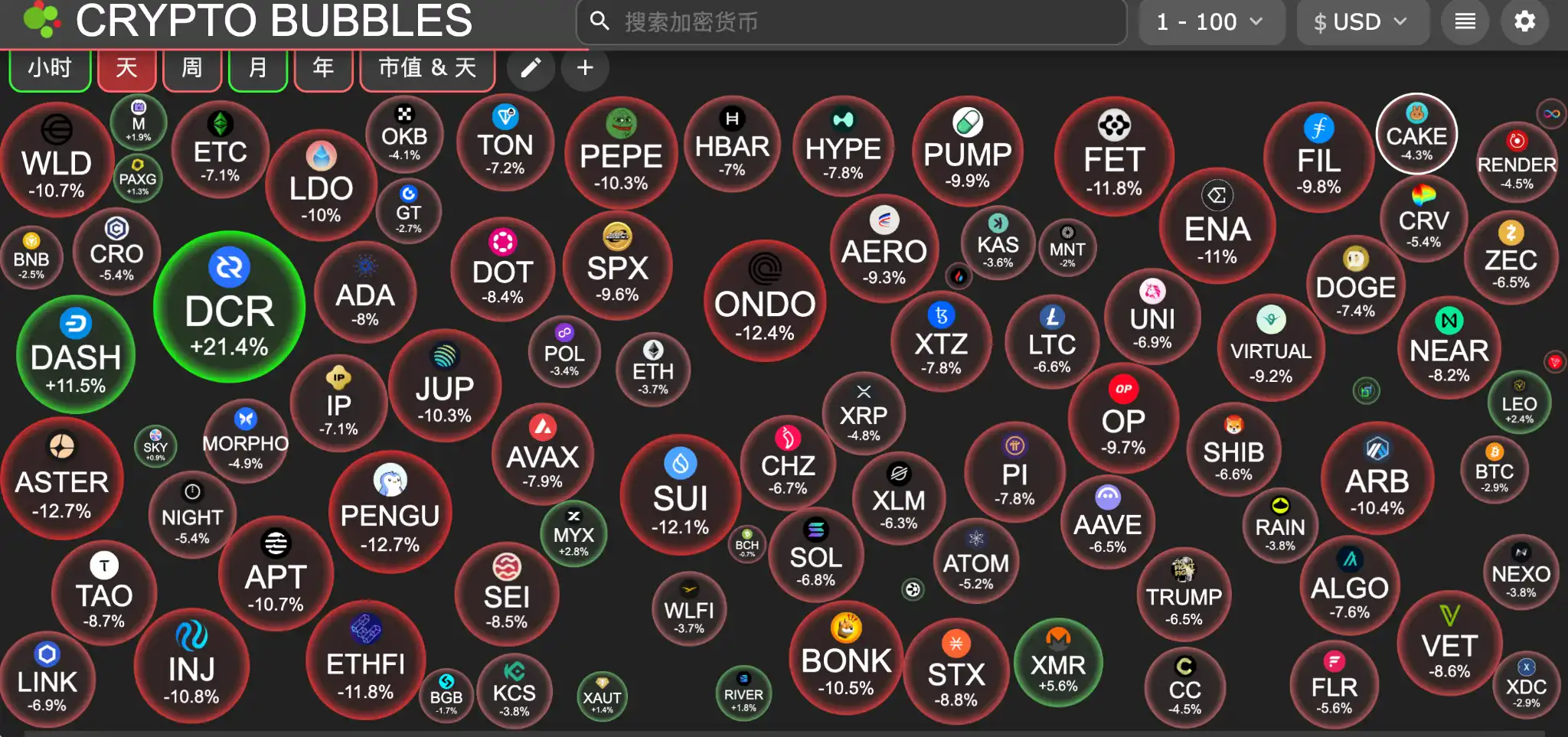
Sector Performance: Crypto market broadly lower, GameFi sector down over 8%
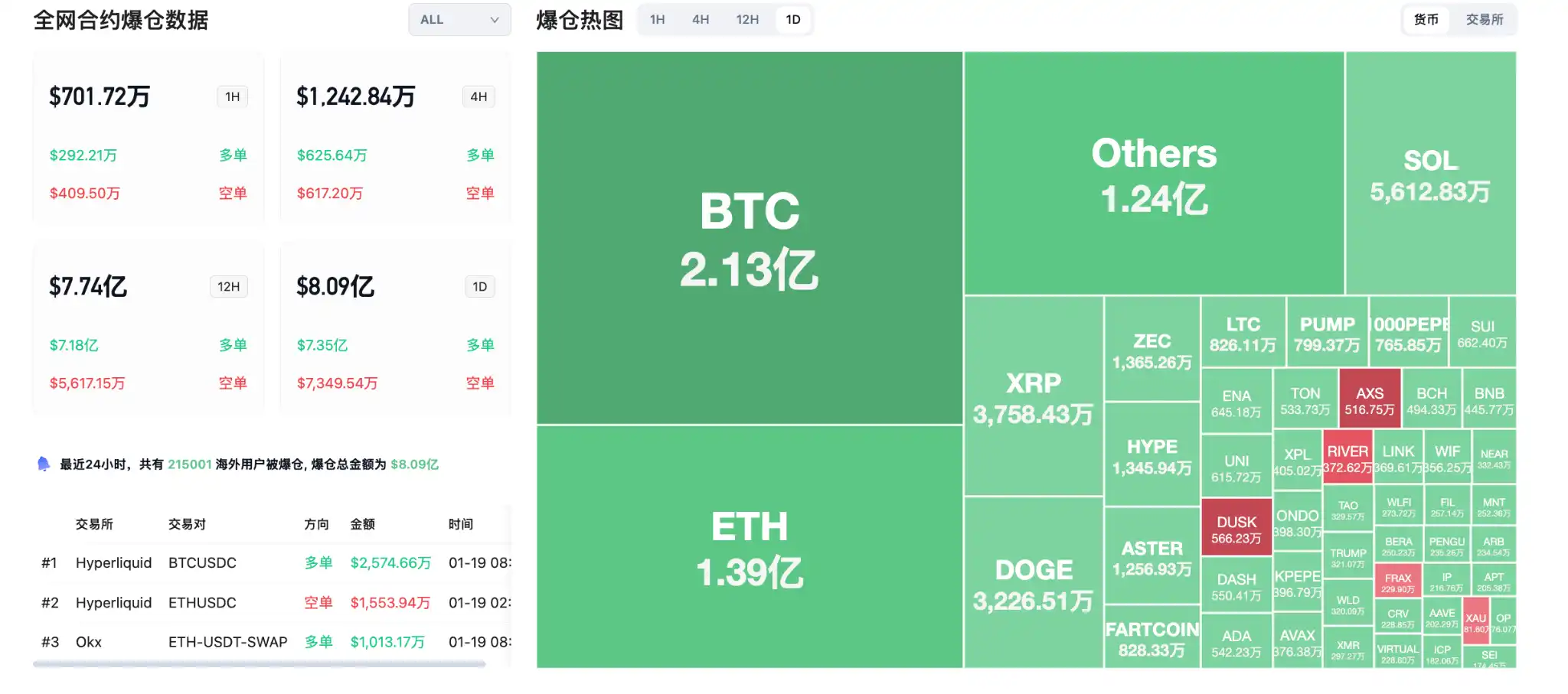
24-hour liquidation data: 215,001 people liquidated globally, total liquidation amount $809 million,其中BTC爆仓2.13亿美元、ETH爆仓1.39亿美元、XRP爆仓3758万美元
3. ETF Flows (As of January 16)
-
Bitcoin ETF: Net inflow of $1.42 billion last week
-
Ethereum ETF: Net inflow of $479 million last week
-
XRP ETF: Net inflow of $56.83 million last week
-
SOL ETF: Net inflow of $46.88 million last week
4. Today's Outlook
-
Binance Alpha to list Acurast (ACU) on January 20
-
Binance Wallet plans to launch the SENT Pre-TGE Prime Sale event on January 19
-
Trove shifts to Solana to rebuild DEX, TROVE token listing postponed to January 19
-
MANTRA: Token symbol change and 1:4 token split scheduled for January 19
-
ETHGas snapshot time set for January 19
- U.S. stock market closed on January 19 (Martin Luther King Jr. Day holiday)
-
LayerZero (ZRO) to unlock approximately 25.71 million tokens on January 20 at 7 PM, representing 6.36% of circulating supply, valued at ~$44.5 million;
-
U.S. Q4 GDP (advance estimate) to be released
-
U.S. President Trump calls for capping credit card interest rates at 10% starting January 20, 2026, for one year
Top gainers among top 100 coins by market cap today: Decred +21.4%, Dash +11.5%, Monero +5.6%, MYX Finance +2.8%, LEO Token +2.4%.
5. Hot News
-
Data: ZRO, RIVER, PLUME, and other tokens face significant unlocks next week, with ZRO unlock valued at ~$44.5 million
-
Weekly Preview | U.S. Senate Agriculture Committee to release its crypto market structure bill; Aster launches Season 2 of its human vs. AI trading competition
-
A whale closed ASTER and other positions at a loss of $4.21 million, reopening a 25x ETH long position
-
Avalanche active addresses hit a new all-time high, daily active addresses surge 986% to 1.71 million
-
Aster initiates automatic buyback mechanism, using 20%-40% of daily revenue to buy back $ASTER
-
Trump Token team deposits 381,000 TRUMP ($2 million) to Binance
-
Ancient whale who accumulated 5,000 BTC 12 years ago sells another 500 BTC, total profit reaches $260 million
-
"Insider big shot who shorted after the 1011 flash crash" increases ETH long position after one month, position grows to $736 million