
Trading Moment: Silver Plunges After Hitting New High, Institutions Warn of Precious Metals Correction Risk, Bitcoin Shows 'Dead Cat Bounce'?

marsbitPubblicato 2025-12-29Pubblicato ultima volta 2025-12-29

Introduzione

Silver prices hit a record high above $84/oz before sharply retreating to around $78 amid profit-taking, dragging gold and other precious metals lower. While factors like Fed rate cut expectations and central bank buying persist, new supply concerns emerged as China plans export controls on silver from 2026. Institutions are divided: Goldman Sachs sees gold potentially surpassing $4,900, but UBS and Capital Economics warn of a correction, with silver possibly falling to $42 by end-2026. Bitcoin briefly reclaimed $90k but faces cautious sentiment, with analysts debating if it’s a "dead cat bounce" or a setup for a rally toward $112k. ETF outflows and low trading volume signal fragility, though some expect rotation from metals to crypto. Ethereum hovered near $3k, with key support at $2,775; a break could trigger a drop toward $1,800. Key data: BTC at $89,989, ETH at $3,033, fear index at 24. Over $151M liquidated in 24h. ETF flows: Bitcoin ETFs saw $782M outflows last week, Ethereum ETFs $102M. Notable events: Lighter TGE expected Dec 29, Flow hacked for $3.9M, and several tokens facing unlocks worth hundreds of millions.

Daily key data review and trend analysis, produced by PANews.

1. Market Observation

At the start of the new week, the precious metals market took center stage. Spot silver broke through $84/oz to hit a new historical high, but then faced selling pressure from profit-taking, quickly plunging and turning negative intraday, eventually fluctuating around $78. This rollercoaster ride directly impacted related financial products, with spot gold retreating from near its historical high of $4550, and platinum and palladium both falling close to or over 7%. Beyond the traditional logic of Fed rate cut expectations and continued central bank gold buying, the market began pricing in a new narrative of "commodity control," where the importance of geopolitics and supply chain security is increasingly highlighted, especially after China announced export licensing for silver effective January 1, 2026, further exacerbating expectations of tight global physical supply. However, market divergence also intensified. The Chicago Mercantile Exchange (CME) raised margins on silver futures for the second time in two weeks, sparking concerns about a historical replay of the 2011 silver crash triggered by similar measures. Institutions like Goldman Sachs remain bullish on gold continuing its strength into 2026, with a target price potentially exceeding $4900, but UBS and Capital Economics warned that precious metal prices have detached from fundamentals, accumulating correction risks, with Capital Economics even predicting silver could fall back to $42 by the end of next year. For silver, despite its strong industrial demand in sectors like solar energy, analysis suggests that prices reaching $134/oz could lead to demand destruction; while copper, as a potential substitute, poses little short-term threat as factory retrofits take at least 4 years. Institutions like Guojin Securities believe the 2026 investment theme is already visible across commodities, supply chains, and foreign exchange markets—under a structure where investment outweighs consumption,大宗商品 trading ranges are lengthening, China's manufacturing advantages are prominent, and industrial resources resonating with AI investment and global manufacturing recovery are worth watching.

Compared to the剧烈 volatility in the precious metals market, the cryptocurrency market overall was permeated with cautious and sluggish sentiment, even as Bitcoin broke through $90,000 again today. Most analysts are cautious about the outlook. For example, analyst Killa believes that although there might be short-term bounces, the broader trend is still downward seeking support below $70,000, judging that this cycle has ended. Ali Charts expressed similar views, suggesting that against a backdrop of net capital outflows reaching $4.5 billion and Bitcoin ETFs seeing nearly $1 billion in net outflows over the past two weeks, any rebound is likely a "dead cat bounce" lacking support from spot demand. A report from 10x Research also pointed out that current crypto market trading volume is 30% lower than normal, with undercurrents beneath the surface calm making the market particularly fragile. However, there are also bullish voices in the market. Analyst Astronomer, through liquidity analysis, indicated that the market has built sufficient short liquidity in the $94,000 to $95,000 region, creating conditions for a price surge towards the $112,000 target. Michaël van de Poppe expects that as funds rotate from the overheated precious metals market to the crypto market, Bitcoin could move towards $100,000 in the coming week. Analyst Plan B, by recalling the history of the 2021 bull market which experienced a correction of over 50% mid-cycle before hitting new highs, suggested the current pullback might just be a normal correction within the cycle. Samson Mow made the bold assertion that "2025 is the bear market," predicting Bitcoin might embark on a decade-long bull run. On the technical front, analysts are closely watching key levels. Ardi pointed out that whether Bitcoin can effectively break through the resistance zone between $90,000 and $94,600, and hold the support band between $80,000 and $86,300, is core to judging the future direction.

Ethereum broke through $3000 again, but market sentiment remains cautious. On-chain analyst Murphy provided a deeper analysis, suggesting the main矛盾 (contradiction) for Ethereum currently is not the overhead selling pressure from trapped positions, but the overly dispersed structure of profitable筹码 (chips/holdings) below. He noted that $2700 is one of the few levels that can form a consensus strong承接区 (support area); if lost, the price could enter a "vacuum zone" lacking effective support, with the nearest gap area below between $1800 and $2600. Nonetheless, he also observed that the whale group holding over 100,000 ETH has been adding positions near $2700, showing a posture of "long-term optimism, short-term caution." For short-term movements, technical analyst CyrilXBT described Ethereum as a "coiled spring," believing it needs to break through $3345 to release upward momentum. Michaël van de Poppe gave specific key levels: $2775 is an unbreakable support level, otherwise it could trigger a chain reaction decline; while a break above the $3000 resistance could lead to a rapid冲击 (assault) on $3650.

The market is currently most concerned about the TGE of the decentralized perpetual exchange Lighter, widely expected to occur on December 29. According to its airdrop details, the team confirmed the airdrop will account for 25% of the total supply, requiring no claim and will be sent directly to user wallets. The team also clarified that recent large token transfers were for safeguarding investor and team allocations. Meanwhile, the public chain project Flow experienced a security incident over the weekend, where an attacker exploited a vulnerability in its execution layer to transfer approximately $3.9 million, leading validators to temporarily halt operations to deploy a fix; the project team stated that user balances were unaffected and the protocol faces no solvency risk. Additionally, the ZEROBASE token ZBT saw its price briefly突破 (break through) $0.2, with a 78% gain in 24 hours.

2. Key Data (As of 13:00 HKT, December 29)

(Data sources: CoinAnk, Upbit, SoSoValue, CoinMarketCap)

  • Bitcoin: $89,989 (Year-to-date -3.25%), daily spot trading volume $31.45 billion

  • Ethereum: $3,033 (Year-to-date -9.2%), daily spot trading volume $28.28 billion

  • Fear & Greed Index: 24 (Fear)

  • Average GAS: BTC: 1.75 sat/vB, ETH: 0.02 Gwei

  • Market Dominance: BTC 59.1%, ETH 12%

  • Upbit 24-hour trading volume ranking: BTC, ZBT, XRP, ETH, 0G

  • 24-hour BTC Long/Short Ratio: 50.99% / 49.01%

  • Sector Performance: Crypto sectors generally rose, SocialFi sector up over 3%, only Layer2 sector slightly down

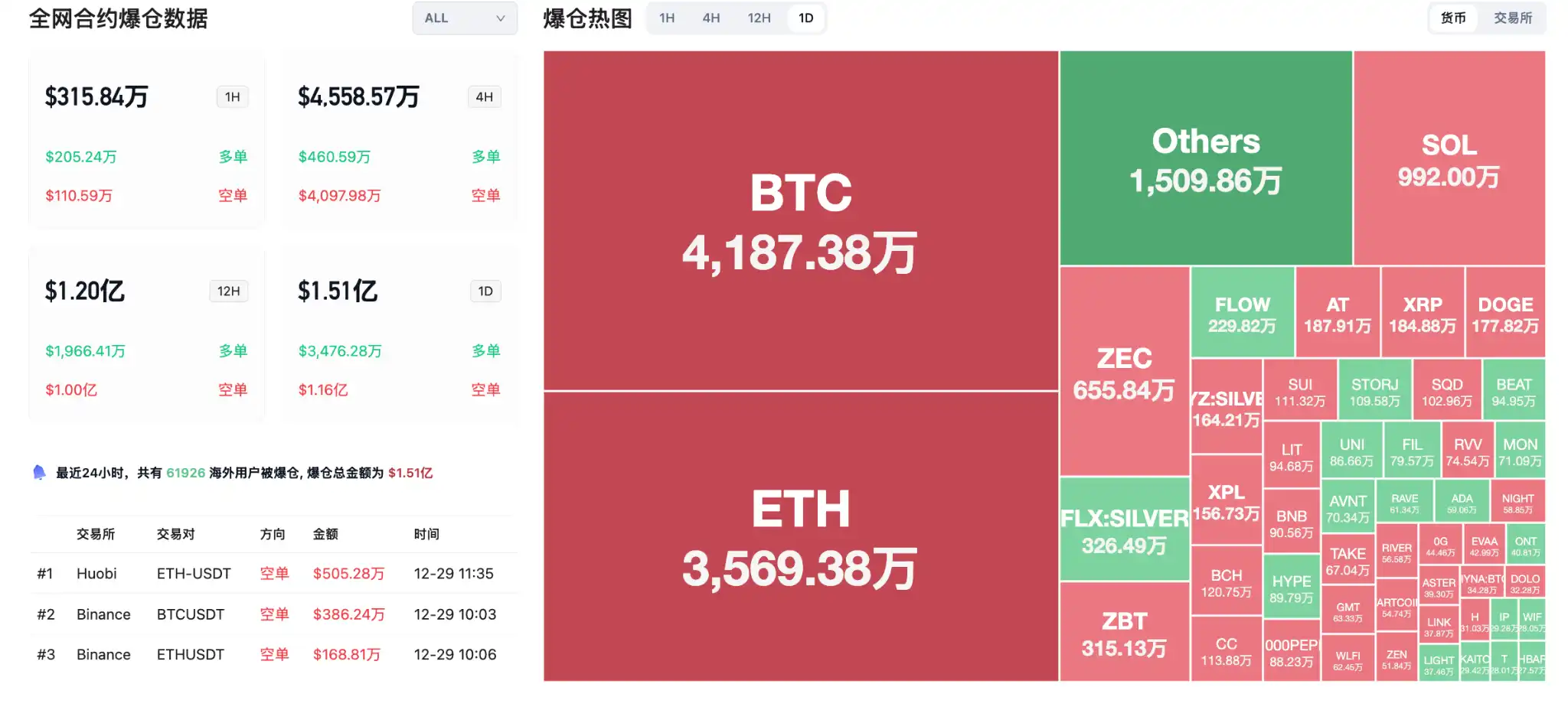
  • 24-hour Liquidation Data: 61,926 people liquidated globally, total liquidation amount $151 million,其中 (including) BTC liquidations $41.87 million, ETH liquidations $35.69 million, ZEC liquidations $6.55 million
3. ETF Flows (As of December 26)

  • Bitcoin ETFs: Net outflow of $782 million last week, BlackRock's IBIT led with net outflow of $435 million

  • Ethereum ETFs: Net outflow of $102 million last week, BlackRock's ETHA led with net outflow of $69.42 million

  • Solana ETF: Net inflow of $13.14 million last week

  • XRP ETF: Net inflow of $64 million last week

4. Today's Preview

  • "Lantian Gerui Case" fund refund registration deadline is December 29, missing it may affect fund return

  • Binance will delist EIGEN/FDUSD, ARB/FDUSD and other FDUSD margin trading pairs on December 30

  • Web3 game studio ChronoForge will shut down on December 30 due to funding shortage

  • Padre: PADRE holders will receive PUMP based on their holdings, need to submit wallet address by December 30

  • SHFE: From close on December 30, price limits for gold and silver futures contracts adjusted to 15%,同时 (simultaneously) adjusting margin ratios

  • SDIC Silver LOF: Class A定投 (fixed investment)上限 (upper limit) reduced back to 100 yuan, Class C shares will begin suspending subscriptions, effective December 29

  • 51VR, Chantecaille (Linshangtang) expected to list on HKEX on December 30

  • Hyperliquid (HYPE) will unlock approximately 9.92 million tokens at 15:30 on December 29, representing about 2.87% of circulating supply, value approx. $256 million;

  • Kamino (KMNO) will unlock approximately 229 million tokens at 20:00 on December 30, representing about 5.35% of circulating supply, value approx. $11.8 million;

  • Slash Vision Labs (SVL) will unlock approximately 234 million tokens at 08:00 on December 30, representing about 2.96% of circulating supply, value approx. $6.8 million;

  • Zora (ZORA) will unlock approximately 166 million tokens at 08:00 on December 30, representing about 4.17% of circulating supply, value approx. $6.7 million.

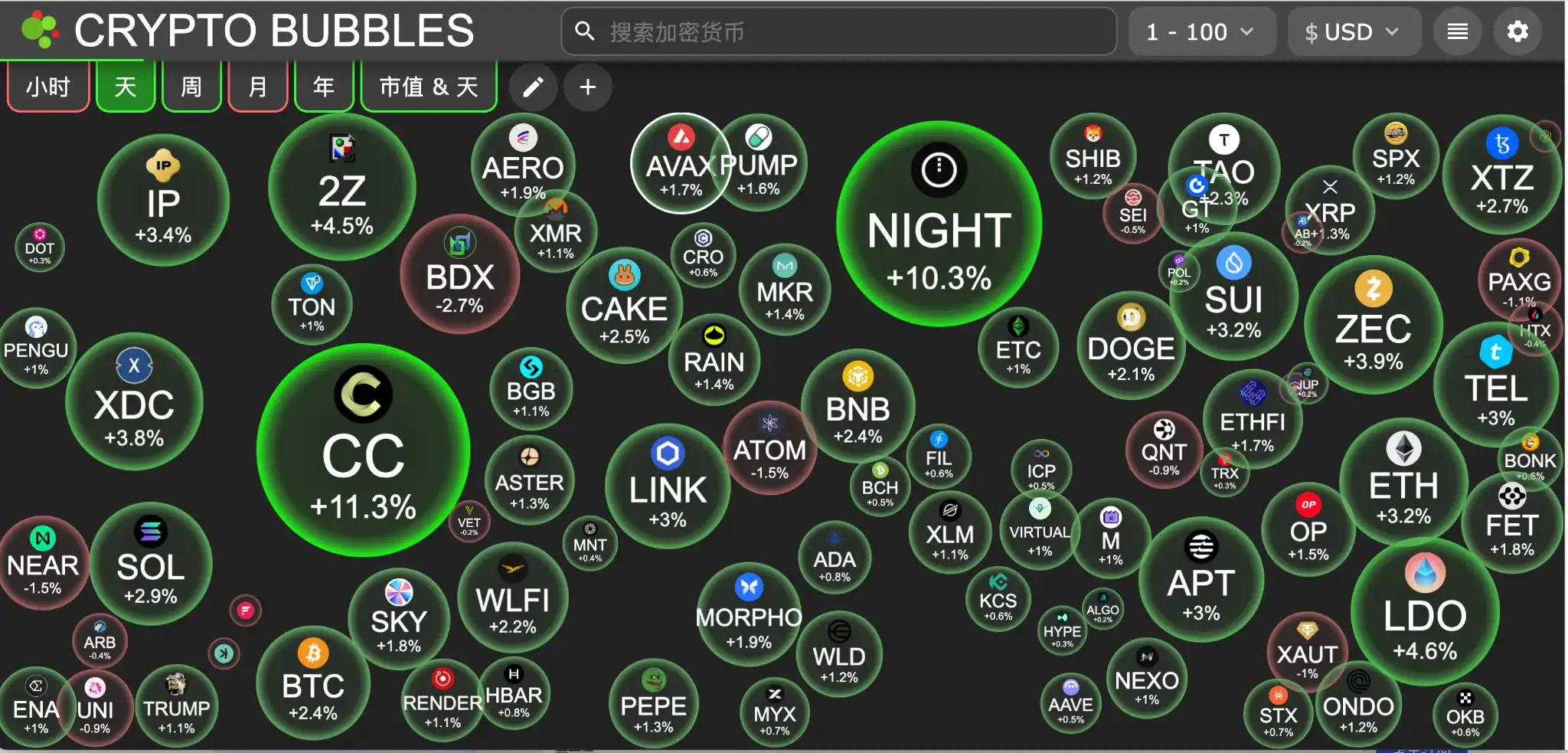
Today's Top 100 Coins by Market Cap - Maximum Gains: Canton Network up 11.3%, Midnight up 10.3%, DoubleZero up 4.7%, Lido DAO up 4.5%, Zcash up 3.9%.
5. Hot News

  • Data: HYPE, SUI, EIGEN and other tokens to see large unlocks next week,其中 (with) HYPE unlock value approx. $256 million

  • Weekly Preview | EU, UK, Hong Kong and other regions implement relevant new regulations for digital assets; Hyperliquid (HYPE) to unlock tokens worth ~$256 million

  • Suspected Trend Research purchased another 11,520 ETH, worth $34.93 million

  • Analysis: Bitcoin spot ETFs累计 (accumulated) net outflows nearly $6 billion over past nine weeks, market funding and sentiment remain under pressure

  • Hyperliquid's weekly revenue仅为 (only) $9.16 million, hitting a new low since early May

  • Solana DEX spot trading volume year-to-date exceeds $1.7 trillion, surpassing Bybit to rank second

  • A whale withdrew 2,218 ETH, 37.1 million SKY, and 4,772 AAVE from Kraken 7 hours ago

  • Spot silver breaks through $80/oz, setting a new record

  • Hyperliquid Co-founder: 1.2 million HYPE tokens will be allocated to team members on January 6 after unlock

  • Bubblemaps: Meme coin project ATLAS疑似 (suspected) insider trading, 68 wallets already hold 47% of token supply

  • Coinbase Bitcoin Premium Index has been in negative premium for two consecutive weeks, currently reported at -0.0784%

  • 100 million UNI burned from Uniswap treasury, worth $596 million

  • Flow hacked for $3.9 million loss, user deposits unaffected

Domande pertinenti

QWhat happened to the price of silver after it hit a new all-time high, and what was a key factor contributing to the subsequent volatility?

AAfter hitting a new all-time high above $84/oz, the price of silver experienced a sharp pullback, falling to around $78/oz. A key factor contributing to this volatility was profit-taking by traders. Additionally, the CME raised margin requirements for silver futures for the second time in two weeks, which historically has triggered sell-offs.

QAccording to analysts cited, what is the prevailing sentiment in the cryptocurrency market despite Bitcoin's price breaking through $90,000?

AThe prevailing sentiment in the cryptocurrency market is one of caution and pessimism. Analysts like Killa and Ali Charts view any price rebounds as potential 'dead cat bounces'—temporary recoveries lacking genuine demand—due to significant capital outflows from Bitcoin ETFs and a general market downturn.

QWhat critical price level for Ethereum did on-chain analyst Murphy identify as a major support zone, and what was the concern if it were broken?

AOn-chain analyst Murphy identified $2,700 as a critical support zone for Ethereum. The concern was that if this level were broken, the price could enter a 'vacuum zone' with little support, potentially falling to a range between $1,800 and $2,600.

QWhat major event is the market anticipating for the decentralized perpetual exchange Lighter, and what is unique about its token airdrop distribution?

AThe market is anticipating the Token Generation Event (TGE) for the decentralized perpetual exchange Lighter, widely expected to occur on December 29th. A unique feature of its airdrop is that it will distribute 25% of the total token supply directly to users' wallets without requiring them to claim it.

QBased on the ETF flow data provided, what was the net flow trend for Bitcoin and Ethereum ETFs for the week ending December 26th?

AFor the week ending December 26th, both Bitcoin and Ethereum ETFs experienced net outflows. Bitcoin ETFs saw a net outflow of $782 million, while Ethereum ETFs had a net outflow of $102 million.

Letture associate

In-Depth Report on the On-Chain Lending Market: When Off-Chain Credit Meets On-Chain Liquidation

The on-chain lending market has evolved from a peripheral DeFi niche into core financial infrastructure. As of early 2026, total value locked (TVL) in on-chain lending protocols has reached $64.3 billion, accounting for 53.54% of total DeFi TVL, making it the largest and most mature vertical within decentralized finance. Aave dominates the sector with approximately $32.9 billion in TVL, commanding nearly half of the market—a leadership position that is unlikely to be challenged in the foreseeable future. However, the path of on-chain lending forward is not without risk. Liquidation cascades, credit defaults, and cross-chain vulnerabilities remain systemic threats hanging over the industry. At the same time, a deeper structural transformation is underway: on-chain lending is shifting from a “leverage tool for crypto-native users” to a “compliant gateway for institutional capital”. The scale of RWA (Real World Asset) lending has surpassed $18.5 billion, with U.S. Treasuries and government securities increasingly serving as core collateral. Institutional capital inflows are reshaping both the user base and risk appetite of the sector. This report systematically analyzes the evolution of on-chain lending definitions, competitive dynamics, core risks, and future trends, providing a comprehensive industry outlook for investors and trade practitioners. Key findings suggest that the “one dominant player with several strong challengers” structure will persist in the short term, while fixed-rate lending, compliant collateral, and institutional credit underwriting will define the next phase of competition. For investors focused on DeFi infrastructure, three key opportunity tracks stand out, namely, the Aave ecosystem (Morpho, Spark), RWA lending protocols (Ondo, Maple) and fixed-rate innovation (Notional, Pendle).

HTX Learn42 min fa

In-Depth Report on the On-Chain Lending Market: When Off-Chain Credit Meets On-Chain Liquidation

HTX Learn42 min fa

Fu Peng's First Public Speech in 2026: What Exactly Are Crypto Assets? Why Did I Join the Crypto Asset Industry?

Fu Peng, a renowned macroeconomist and now Chief Economist at New火 Group, delivered his first public speech of 2026 at the Hong Kong Web3 Festival. He explained his perspective on crypto assets and why he joined the industry, framing it within the context of macroeconomic trends and financial evolution. Fu emphasized that crypto assets are transitioning from an early, belief-driven phase to a mature, institutionally integrated asset class. He drew parallels to the 1970s-80s, when technological advances (like computing) revolutionized traditional finance, leading to the rise of FICC (Fixed Income, Currencies, and Commodities). Similarly, current advancements in AI, data, and blockchain are reshaping finance, with crypto assets becoming part of a new "FICC + C" (C for Crypto) framework. He noted that institutional capital, including traditional hedge funds, avoided early crypto due to its speculative nature but are now engaging as regulatory clarity emerges (e.g., stablecoin laws, CFTC classifying crypto as a commodity). Fu predicted that 2025-2026 marks a turning point where crypto becomes a standardized, financially viable asset for diversified portfolios, akin to commodities or derivatives in traditional finance. Fu defined Bitcoin not as "digital gold" in a simplistic sense but as a value-preserving, financially tradable asset. He highlighted that crypto's future lies in regulated, institutional adoption, moving away from retail-dominated trading. His entry into crypto signals this maturation, where traditional finance integrates crypto into mainstream asset management.

marsbit1 h fa

Fu Peng's First Public Speech in 2026: What Exactly Are Crypto Assets? Why Did I Join the Crypto Asset Industry?

marsbit1 h fa

Justin Sun Sues Trump Family: What $75 Million Bought Was Only a Blacklist

Justin Sun, founder of Tron, has filed a lawsuit in federal court against World Liberty Financial (WLF), alleging he was made the "primary target of a fraudulent scheme" after investing $75 million. Sun claims the investment secured him an advisor title and WLFI tokens, which were later frozen by WLF, causing "hundreds of millions in losses." The dispute began in late 2024 when Sun's investment helped revive WLF's struggling token sale, which ultimately raised $550 million. Shortly after, the SEC dropped its lawsuit against Sun following Donald Trump's inauguration. However, relations soured when Sun refused WLF's demands for additional funding. In August 2025, WLF added a "blacklist" function to its smart contract, allowing it to unilaterally freeze tokens. Sun's holdings, worth approximately $107 million, were frozen, and he was threatened with token destruction. The lawsuit highlights WLF's structure, which directs 75% of token sale profits to the Trump family, who had earned $1 billion by December 2025. WLF's CEO is Zach Witkoff, son of U.S. Middle East envoy Steve Witkoff. The project faces scrutiny for opaque operations, including a controversial loan arrangement on the Dolomite platform, co-founded by a WLF advisor. Despite Sun's history with the SEC, the case underscores centralization risks within DeFi, as WLF controls governance and holds powers to freeze assets arbitrarily. Sun's tokens remain frozen as legal proceedings begin.

marsbit2 h fa

Justin Sun Sues Trump Family: What $75 Million Bought Was Only a Blacklist

marsbit2 h fa

Trading

Spot
Futures

Articoli Popolari

Cosa è BITCOIN

Comprendere HarryPotterObamaSonic10Inu (ERC-20) e la sua posizione nel mondo delle criptovalute Negli ultimi anni, il mercato delle criptovalute ha assistito a un aumento della popolarità delle meme coin, catturando l'interesse non solo dei trader, ma anche di coloro che cercano coinvolgimento comunitario e valore di intrattenimento. Tra questi token unici c'è HarryPotterObamaSonic10Inu (ERC-20), un progetto intrigante che mescola riferimenti culturali nel tessuto delle criptovalute. Questo articolo esplora gli aspetti chiave di HarryPotterObamaSonic10Inu, analizzando i suoi meccanismi, l'etica guidata dalla comunità e il suo coinvolgimento con il panorama crittografico più ampio. Che cos'è HarryPotterObamaSonic10Inu (ERC-20)? Come suggerisce il suo nome, HarryPotterObamaSonic10Inu è una meme coin costruita sulla blockchain di Ethereum, classificata secondo lo standard ERC-20. A differenza delle criptovalute tradizionali che possono enfatizzare l'utilità pratica o il potenziale investimento, questo token prospera grazie al valore di intrattenimento e alla forza della sua comunità. Il progetto mira a creare un ambiente in cui gli utenti coinvolti possono riunirsi, condividere idee e partecipare ad attività ispirate a diversi fenomeni culturali. Una caratteristica notevole di HarryPotterObamaSonic10Inu è la zero tassa sulle transazioni. Questo elemento allettante tende a incoraggiare il trading e il coinvolgimento della comunità, privo di costi aggiuntivi che possono scoraggiare i trader di piccole dimensioni. L'offerta totale della moneta è fissata a un miliardo di token, un numero che segna la sua intenzione di mantenere una circolazione sostanziale all'interno della comunità. Creatore di HarryPotterObamaSonic10Inu (ERC-20) Le origini di HarryPotterObamaSonic10Inu sono avvolte in un certo mistero; i dettagli sul creatore rimangono sconosciuti. Lo sviluppo di questo token non presenta un team identificabile o un piano esplicito, cosa non rara nel settore delle meme coin. Invece, il progetto è emerso organicamente, con il suo progresso fortemente dipendente dall'entusiasmo e dalla partecipazione della sua comunità. Investitori di HarryPotterObamaSonic10Inu (ERC-20) Per quanto riguarda investimenti esterni e finanziamenti, HarryPotterObamaSonic10Inu rimane ambiguo. Il token non elenca alcuna fondazione di investimento conosciuta o un sostegno organizzativo significativo. Invece, la linfa vitale del progetto è la sua comunità di base, che informa la sua crescita e sostenibilità attraverso azioni collettive e coinvolgimento nello spazio crittografico. Come funziona HarryPotterObamaSonic10Inu (ERC-20)? In quanto meme coin, HarryPotterObamaSonic10Inu opera principalmente al di fuori delle strutture tradizionali che governano spesso il valore degli asset. Ci sono diversi aspetti distintivi che definiscono il funzionamento del progetto: Transazioni senza tasse: Senza costi fiscali sulle transazioni, gli utenti possono comprare e vendere liberamente il token senza preoccuparsi di costi nascosti. Coinvolgimento della comunità: Il progetto prospera sull'interazione della comunità, sfruttando le piattaforme social per creare entusiasmo e facilitare il coinvolgimento. Discussioni, condivisione di contenuti e coinvolgimento sono elementi cruciali che aiutano ad espandere la sua portata e a favorire la lealtà tra i sostenitori. Nessuna utilità pratica: Va notato che HarryPotterObamaSonic10Inu non offre un'utilità concreta all'interno dell'ecosistema finanziario. Piuttosto, è classificato come un token principalmente per attività di intrattenimento e comunitarie. Riferimento culturale: Il token incorpora astutamente elementi della cultura pop per attirare interesse, collegandosi a appassionati di meme e seguaci delle criptovalute. HarryPotterObamaSonic10Inu esemplifica come le meme coin operino in modo diverso rispetto ai progetti di criptovalute più tradizionali, entrando nel mercato come costrutti sociali innovativi piuttosto che come asset utilitari. Cronologia di HarryPotterObamaSonic10Inu (ERC-20) La storia di HarryPotterObamaSonic10Inu è segnata da diversi traguardi notevoli: Creazione: Il token è emerso da un meme virale, catturando l'immaginazione di molti appassionati di criptovalute. Le date di creazione specifiche non sono disponibili, sottolineando la sua crescita organica. Inserimento negli scambi: HarryPotterObamaSonic10Inu ha fatto il suo ingresso in vari scambi, consentendo un accesso e un trading più facili da parte della comunità. Iniziative di coinvolgimento della comunità: Attività in corso volte a migliorare l'interazione della comunità, comprese gare, campagne sui social media e generazione di contenuti da parte di fan e sostenitori. Piani di espansione futura: La tabella di marcia del progetto include il lancio di una collezione NFT, merchandising e un sito di eCommerce relativo ai suoi temi culturali, coinvolgendo ulteriormente la comunità e cercando di aggiungere più dimensioni al suo ecosistema. Punti chiave su HarryPotterObamaSonic10Inu (ERC-20) Natura guidata dalla comunità: Il progetto dà priorità al contributo collettivo e alla creatività, garantendo che il coinvolgimento degli utenti sia al centro del suo sviluppo. Classificazione come meme coin: Rappresenta l'epitome delle criptovalute basate sull'intrattenimento, distinguendosi dai veicoli d'investimento tradizionali. Nessuna affiliazione diretta con Bitcoin: Nonostante la somiglianza nel nome del ticker, HarryPotterObamaSonic10Inu è distintivo e non ha alcuna relazione con Bitcoin o altre criptovalute consolidate. Focus sulla collaborazione: HarryPotterObamaSonic10Inu è progettato per creare uno spazio per la collaborazione e la condivisione di storie tra i suoi detentori, fornendo un canale per la creatività e il legame comunitario. Prospettive future: L'ambizione di espandersi oltre il suo presupposto iniziale verso NFT e merchandising delinea un percorso per il progetto per potenzialmente entrare in strade più mainstream all'interno della cultura digitale. Poiché le meme coin continuano a catturare l'immaginazione della comunità crittografica, HarryPotterObamaSonic10Inu (ERC-20) si distingue per i suoi legami culturali e il suo approccio centrato sulla comunità. Anche se potrebbe non adattarsi al modello tipico di un token orientato all'utilità, la sua essenza risiede nella gioia e nella camaraderia coltivate tra i suoi sostenitori, evidenziando la natura in evoluzione delle criptovalute in un'epoca sempre più digitale. Con la continuazione dello sviluppo del progetto, sarà importante osservare come le dinamiche della comunità influenzano la sua traiettoria nel panorama in continuo cambiamento della tecnologia blockchain.

1.2k Totale visualizzazioniPubblicato il 2024.04.01Aggiornato il 2024.12.03

Cosa è BITCOIN

Come comprare BTC

Benvenuto in HTX.com! Abbiamo reso l'acquisto di Bitcoin (BTC) semplice e conveniente. Segui la nostra guida passo passo per intraprendere il tuo viaggio nel mondo delle criptovalute.Step 1: Crea il tuo Account HTXUsa la tua email o numero di telefono per registrarti il tuo account gratuito su HTX. Vivi un'esperienza facile e sblocca tutte le funzionalità,Crea il mio accountStep 2: Vai in Acquista crypto e seleziona il tuo metodo di pagamentoCarta di credito/debito: utilizza la tua Visa o Mastercard per acquistare immediatamente BitcoinBTC.Bilancio: Usa i fondi dal bilancio del tuo account HTX per fare trading senza problemi.Terze parti: abbiamo aggiunto metodi di pagamento molto utilizzati come Google Pay e Apple Pay per maggiore comodità.P2P: Fai trading direttamente con altri utenti HTX.Over-the-Counter (OTC): Offriamo servizi su misura e tassi di cambio competitivi per i trader.Step 3: Conserva Bitcoin (BTC)Dopo aver acquistato Bitcoin (BTC), conserva nel tuo account HTX. In alternativa, puoi inviare tramite trasferimento blockchain o scambiare per altre criptovalute.Step 4: Scambia Bitcoin (BTC)Scambia facilmente Bitcoin (BTC) nel mercato spot di HTX. Accedi al tuo account, seleziona la tua coppia di trading, esegui le tue operazioni e monitora in tempo reale. Offriamo un'esperienza user-friendly sia per chi ha appena iniziato che per i trader più esperti.

3.6k Totale visualizzazioniPubblicato il 2024.12.12Aggiornato il 2025.03.21

Come comprare BTC

Cosa è $BITCOIN

ORO DIGITALE ($BITCOIN): Un'Analisi Completa Introduzione all'ORO DIGITALE ($BITCOIN) L'ORO DIGITALE ($BITCOIN) è un progetto basato su blockchain che opera sulla rete Solana, con l'obiettivo di combinare le caratteristiche dei metalli preziosi tradizionali con l'innovazione delle tecnologie decentralizzate. Sebbene condivida un nome con Bitcoin, spesso definito “oro digitale” a causa della sua percezione come riserva di valore, l'ORO DIGITALE è un token separato progettato per creare un ecosistema unico all'interno del panorama Web3. Il suo obiettivo è posizionarsi come un asset digitale alternativo valido, anche se i dettagli riguardanti le sue applicazioni e funzionalità sono ancora in fase di sviluppo. Cos'è l'ORO DIGITALE ($BITCOIN)? L'ORO DIGITALE ($BITCOIN) è un token di criptovaluta esplicitamente progettato per l'uso sulla blockchain di Solana. A differenza di Bitcoin, che fornisce un ruolo di stoccaggio di valore ampiamente riconosciuto, questo token sembra concentrarsi su applicazioni e caratteristiche più ampie. Aspetti notevoli includono: Infrastruttura Blockchain: Il token è costruito sulla blockchain di Solana, nota per la sua capacità di gestire transazioni ad alta velocità e a basso costo. Dinamiche di Offerta: L'ORO DIGITALE ha un'offerta massima fissata a 100 quadrilioni di token (100P $BITCOIN), sebbene i dettagli riguardanti la sua offerta circolante siano attualmente non divulgati. Utilità: Sebbene le funzionalità precise non siano esplicitamente delineate, ci sono indicazioni che il token potrebbe essere utilizzato per varie applicazioni, potenzialmente coinvolgendo applicazioni decentralizzate (dApp) o strategie di tokenizzazione degli asset. Chi è il Creatore dell'ORO DIGITALE ($BITCOIN)? Attualmente, l'identità dei creatori e del team di sviluppo dietro l'ORO DIGITALE ($BITCOIN) rimane sconosciuta. Questa situazione è tipica tra molti progetti innovativi nel settore blockchain, in particolare quelli allineati con la finanza decentralizzata e i fenomeni delle meme coin. Sebbene tale anonimato possa favorire una cultura guidata dalla comunità, intensifica le preoccupazioni riguardo alla governance e alla responsabilità. Chi sono gli Investitori dell'ORO DIGITALE ($BITCOIN)? Le informazioni disponibili indicano che l'ORO DIGITALE ($BITCOIN) non ha alcun sostenitore istituzionale noto o investimenti di venture capital prominenti. Il progetto sembra operare su un modello peer-to-peer incentrato sul supporto e sull'adozione della comunità piuttosto che su percorsi di finanziamento tradizionali. La sua attività e liquidità si trovano principalmente su exchange decentralizzati (DEX), come PumpSwap, piuttosto che su piattaforme di trading centralizzate consolidate, evidenziando ulteriormente il suo approccio di base. Come Funziona l'ORO DIGITALE ($BITCOIN) Le meccaniche operative dell'ORO DIGITALE ($BITCOIN) possono essere elaborate in base al suo design blockchain e alle caratteristiche della rete: Meccanismo di Consenso: Sfruttando il proof-of-history (PoH) unico di Solana combinato con un modello di proof-of-stake (PoS), il progetto garantisce una validazione efficiente delle transazioni contribuendo all'alta performance della rete. Tokenomics: Sebbene meccanismi deflazionistici specifici non siano stati dettagliati ampiamente, l'ampia offerta massima di token implica che potrebbe soddisfare microtransazioni o casi d'uso di nicchia che devono ancora essere definiti. Interoperabilità: Esiste il potenziale per l'integrazione con l'ecosistema più ampio di Solana, inclusi vari piattaforme di finanza decentralizzata (DeFi). Tuttavia, i dettagli riguardanti integrazioni specifiche rimangono non specificati. Cronologia degli Eventi Chiave Ecco una cronologia che evidenzia traguardi significativi riguardanti l'ORO DIGITALE ($BITCOIN): 2023: Il dispiegamento iniziale del token avviene sulla blockchain di Solana, contrassegnato dal suo indirizzo di contratto. 2024: L'ORO DIGITALE guadagna visibilità poiché diventa disponibile per il trading su exchange decentralizzati come PumpSwap, consentendo agli utenti di scambiarlo contro SOL. 2025: Il progetto assiste a un'attività di trading sporadica e a un potenziale interesse per impegni guidati dalla comunità, sebbene non siano state documentate partnership significative o avanzamenti tecnici fino ad ora. Analisi Critica Punti di Forza Scalabilità: L'infrastruttura sottostante di Solana supporta alti volumi di transazioni, il che potrebbe migliorare l'utilità di $BITCOIN in vari scenari di transazione. Accessibilità: Il potenziale basso prezzo di trading per token potrebbe attrarre investitori al dettaglio, facilitando una partecipazione più ampia grazie a opportunità di proprietà frazionata. Rischi Mancanza di Trasparenza: L'assenza di sostenitori, sviluppatori o di un processo di audit pubblicamente noti potrebbe generare scetticismo riguardo alla sostenibilità e all'affidabilità del progetto. Volatilità del Mercato: L'attività di trading è fortemente dipendente dal comportamento speculativo, il che può comportare una significativa volatilità dei prezzi e incertezze per gli investitori. Conclusione L'ORO DIGITALE ($BITCOIN) emerge come un progetto intrigante ma ambiguo all'interno dell'evolvente ecosistema di Solana. Sebbene tenti di sfruttare la narrativa dell'“oro digitale”, la sua partenza dal ruolo consolidato di Bitcoin come riserva di valore sottolinea la necessità di una chiara differenziazione della sua utilità e struttura di governance. L'accettazione e l'adozione future dipenderanno probabilmente dall'affrontare l'attuale opacità e dalla definizione più esplicita delle sue strategie operative ed economiche. Nota: Questo rapporto comprende informazioni sintetizzate disponibili a ottobre 2023, e potrebbero essersi verificati sviluppi oltre il periodo di ricerca.

99 Totale visualizzazioniPubblicato il 2025.05.13Aggiornato il 2025.05.13

Cosa è $BITCOIN

Discussioni

Benvenuto nella Community HTX. Qui puoi rimanere informato sugli ultimi sviluppi della piattaforma e accedere ad approfondimenti esperti sul mercato. Le opinioni degli utenti sul prezzo di BTC BTC sono presentate come di seguito.

活动图片