
Trading Moment: Gold and Silver Hit New Highs Again, Bitcoin's Next Support Range is $84,000 to $86,000

marsbitPubblicato 2026-01-26Pubblicato ultima volta 2026-01-26

Introduzione

Global markets are gripped by heightened risk-off sentiment and speculative fervor, driven by geopolitical tensions, fiscal risks, and sectoral cycles. Spot gold surged past $5,000, hitting a record $5,106, with Bank of America forecasting a rise to $6,000 by spring 2026. Silver also reached an all-time high above $109, supported by AI and solar industry demand. In forex, the yen strengthened on potential "Plaza Accord 2.0" intervention fears, while Bitcoin faced a weekly decline of over 7%, testing support near $86,000. Technical analysts warn of further downside risks, with key support levels between $84,000 and $86,000. Ethereum fell more than 14%, breaching $2,800 and eroding market confidence. Meme coins on Solana, like PENGUIN, saw volatile pumps. ETF flows showed net outflows for Bitcoin and Ethereum, while SOL ETF saw modest inflows. Key events include the launch of VanEck’s Avalanche ETF and a joint SEC-CFTC crypto regulatory event.

Daily key market data review and trend analysis, produced by PANews.

1. Market Overview

The global macro market is in the midst of a severe storm triggered by geopolitical games, fiscal crises, and the resonance of industry cycles, with both safe-haven sentiment and speculative fervor coexisting. Following the U.S. ICE shooting incident that led to the breakdown of Congressional budget negotiations, Polymarket data shows the probability of a U.S. government shutdown before January 31 has surged to 79%. Coupled with the Trump administration's tariff threats and purchase intentions towards Canada and Greenland, and the deployment of the U.S. aircraft carrier "Lincoln" to the Middle East in response to the Iran situation, global "credit devaluation" trading has reached a climax. Spot gold historically broke through the $5,000 mark, rising over 2.3% intraday to a high of $5,106, with Bank of America aggressively predicting it will reach $6,000 by Spring 2026; Spot silver, driven by rigid demand from the AI and solar industries, also broke through $109 to hit a record high, with institutions bullish up to $120.

In the forex market, expectations for a "Plaza Accord 2.0" with U.S.-Japan joint FX intervention have heated up sharply. A rare "inquiry" action by the New York Fed triggered short covering in the yen, with USD/JPY falling over 1% to a low of 153. Meanwhile, the Korean market moved independently, with the KOSDAQ index surging 6%, mainly due to explosive growth in the semiconductor industry. Driven by AI demand, global memory chip supply is extremely tight. Samsung Electronics raised Q1 NAND flash prices by over 100% and plans further increases in Q2. The spot premium rate for DDR4 is as high as 172%. Consequently, Goldman Sachs maintains a "buy" rating on Samsung Electronics and SK Hynix, noting that server ODM revenue has seen 13 consecutive months of high growth, indicating the establishment of a super cycle in the memory industry. In U.S. stocks, earnings reports from tech giants like Microsoft and Apple are due this week, but market sentiment is divided. Bloomberg strategist Mike McGlone and trader Peter Brandt both recommend shorting U.S. stocks and the dollar, believing U.S. assets have peaked. While Goldman Sachs strategists are optimistic about Asia, they also warn that global stocks have gone too long without a correction, and geopolitical risks could be a trigger for a pullback.

Bitcoin ended last week with a bearish candle, down over 7% weekly, finding support near $86,000. Matrixport pointed out that BTC has lost the key bull-bear dividing line of the 21-week moving average, with no reversal signal appearing in the market; Technical views are generally pessimistic. Peter Brandt confirmed the formation of a bearish channel and issued a sell signal. EliZ believes that if it breaks below $86,000/$85,800, the price will seek liquidity near $84,500 to $85,000. Daan Crypto Trades pointed out that $84,000 to $85,000 will be an important upcoming support level; Tai Bai analyzed that the weekly chart shows a bearish engulfing pattern, and if the trendline is broken, it could fall to $70,000 or even the $60,000s. Roman continues to be bearish towards $76,000. Rekt Capital warned that breaking below the macro triangle bottom at $82,000 would accelerate the decline. Murphy also emphasized that losing the $87,000-$88,000 range would damage long-term holder confidence, with key support below at $82,000. Despite this, bulls are not without hope. A Coinbase survey showed 71% of institutional investors believe BTC is undervalued between $85,000-$95,000. Astronomer insists on a weekly bullish view and has already entered a long position at $86,000. Sykodelic pointed out a CME gap at $89,500 and that liquidity in the $86,000 region has been absorbed. Castillo Trading believes the return of spot buying on Binance is the only signal for a market rebound. Placeholder partner Chris Burniske has formulated a ladder buying plan, focusing on buying opportunities at $80,000, $74,000, and $58,000, stating that he will continue to add positions if there is a major drop.

Ethereum's weekly loss was double that of Bitcoin, falling over 14%, once breaking below $2,800, a retreat of over 40% from its all-time high, severely testing market confidence. Man of Bitcoin issued a warning, noting that ETH has broken below the key level of $2,867, and a further break below $2,773 would宣告 the complete failure of the bullish pattern; BigBullMike believes it can only stabilize by climbing back above $2,900. On-chain data加剧了 the panic. Whale Alert monitored a dormant whale address from 9 years ago suddenly awakening and transferring 50,000 ETH (approx. $145 million) to Gemini exchange. This address still holds 85,000 ETH, and the potential selling pressure weighs on the market. However, Ted pointed out that ETH and the Russell 2000 index have shown a huge divergence not seen in years,暗示 a potential catch-up rally in 2026,保留 a glimmer of hope for long-term investors.

In the altcoin market, Meme coins on Solana finally saw some improvement. Over the weekend, the White House released an AI-generated image of Trump walking towards Greenland with a penguin, captioned "Embrace the penguin." This led to Binance Alpha, after a long absence, listing the Solana Meme coin PENGUIN. The token's market cap surged over 30 times at one point, skyrocketing to a high of $173 million, and has since回落 to around $85 million. Additionally, the automated tool Clawdbot gained attention for its utility. Despite token issuance controversies, its token $clawd recorded a maximum gain of 720x, with its market cap reaching a high of $17 million (currently回落 to around $9 million), and caused a shortage of Mac Minis.

2. Key Data (As of January 26, 13:00 HKT)

(Data sources: CoinAnk, Upbit, SoSoValue, CoinMarketCap, GMGN)

  • Bitcoin: $87,596 (Year-to-date +0.2%), Daily spot trading volume $50.36 billion

  • Ethereum: $2,895 (Year-to-date -2.26%), Daily spot trading volume $30.47 billion

  • Fear & Greed Index: 20 (Extreme Fear)

  • Average GAS: BTC: 1.75 sat/vB, ETH: 0.02 Gwei

  • Market Dominance: BTC 59.2%, ETH 11.8%

  • Upbit 24-hour trading volume leaders: ENSO, NOM, AUCTION, XRP, ZKC

  • 24-hour BTC Long/Short Ratio: 47.72% / 52.28%

  • Sector Performance: Crypto market generally down, GameFi sector led declines, down nearly 5%

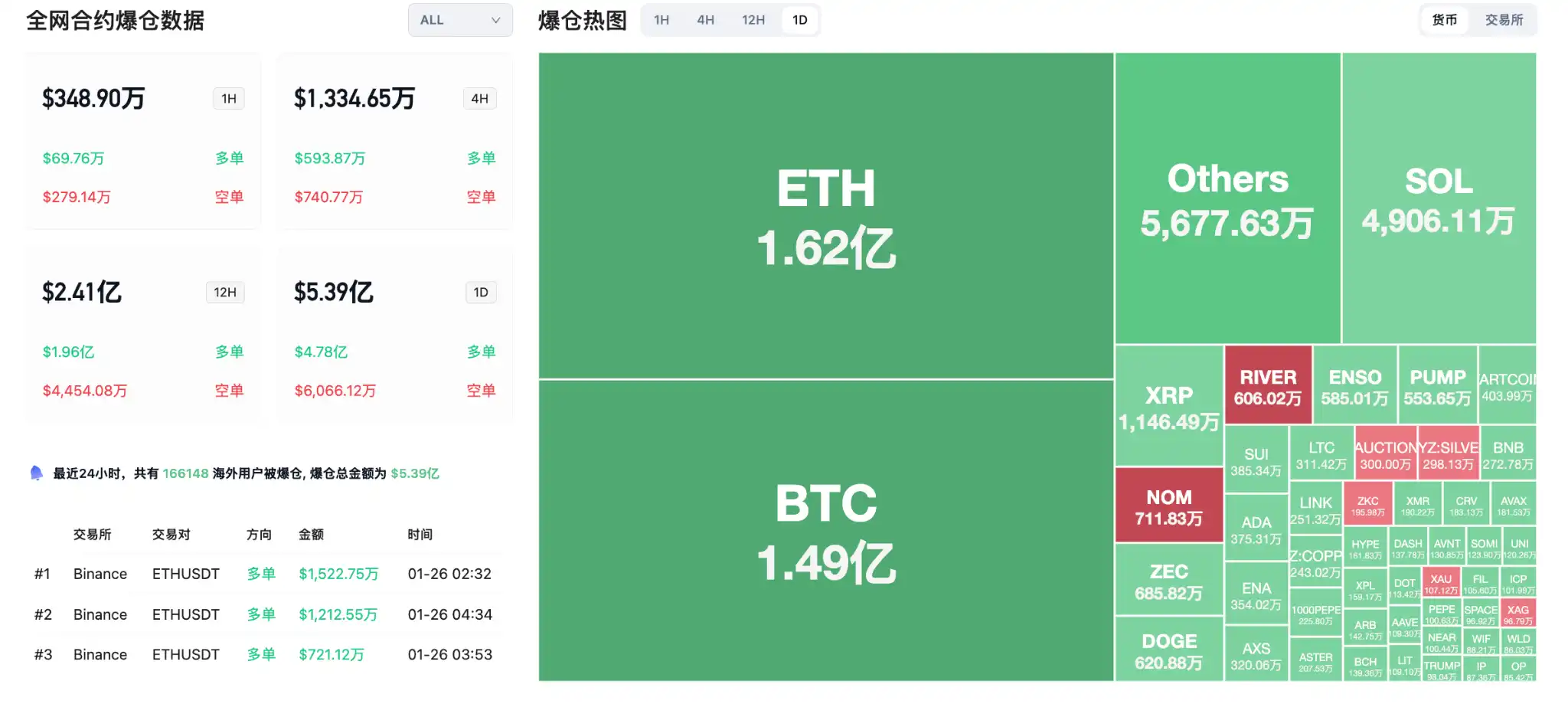
24-hour liquidation data: 166,148 people liquidated globally, total liquidation amount $539 million, including BTC liquidations $162 million, ETH liquidations $149 million, XRP liquidations $11.46 million
3. ETF Flows (As of January 23)

  • Bitcoin ETF: Net outflow this week $1.328 billion

  • Ethereum ETF: Net outflow this week $611 million

  • XRP ETF: Net outflow this week $40.64 million

  • SOL ETF: Net inflow this week $9.5736 million

4. Today's Preview

  • VanEck Avalanche spot ETF will begin trading on Nasdaq on January 26

  • Base network Perp DEX protocol RollX: First batch claim deadline until January 26

  • Fabric plans to launch ROBO token, public sale on Kaito starts January 26

  • Huma Season 2 Airdrop Part 2 opens, claim deadline until January 26

  • SEC and CFTC will host a "Regulatory Coordination" joint crypto-themed event on January 27 at 23:00

  • OKX OKX will delist ULTI, GEAR, VRA and other spot trading pairs

  • Impossible discloses Flying Tulip presale details, public round starts January 27

  • U.S. Treasury Secretary Besant: New Fed Chair appointment to be announced as early as the week of January 26 (Weekly event)

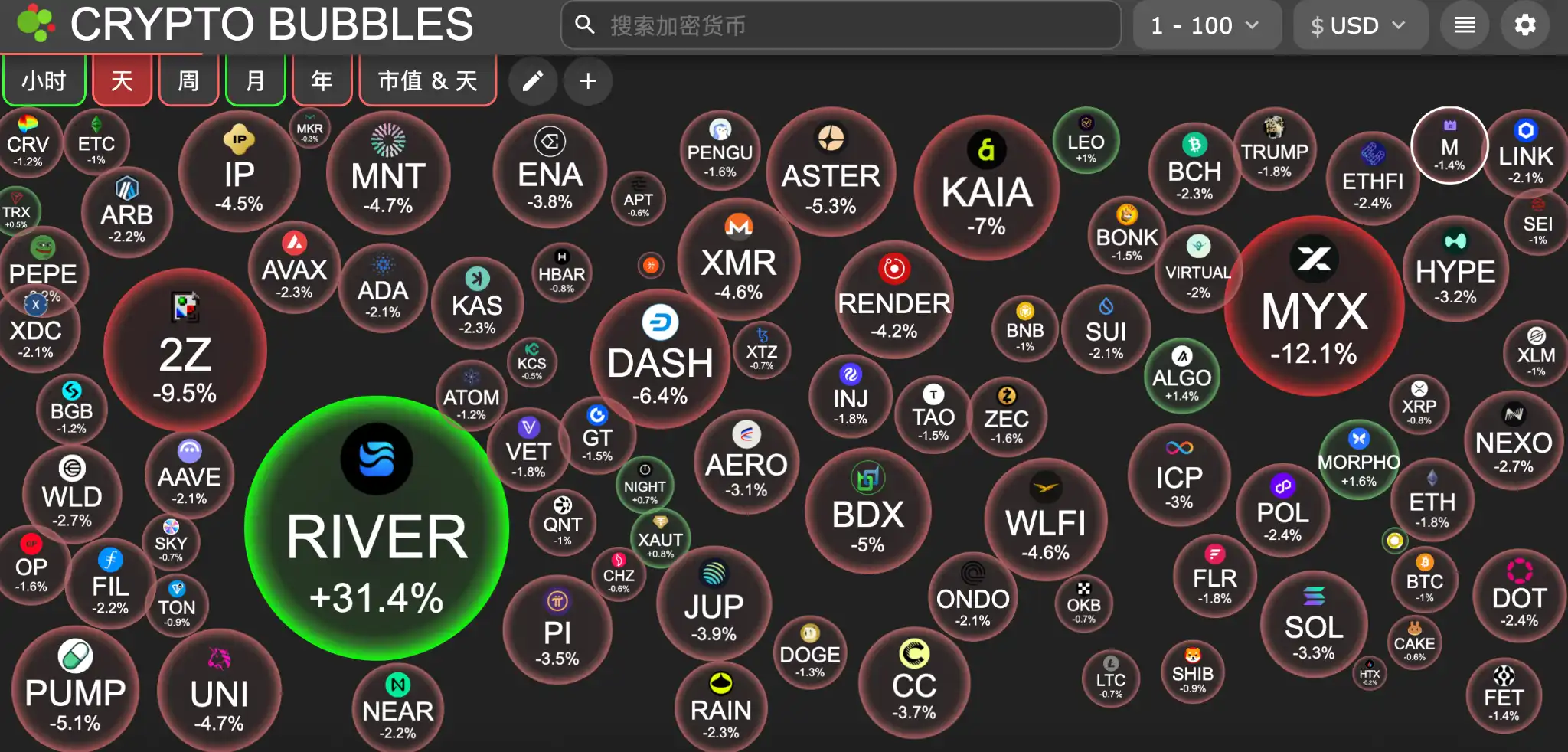
Today's top 100 coins by market cap, biggest gainers: River up 31.4%, Morpho up 1.6%, Algorand up 1.4%, LEO Token up 1%, Tether Gold up 0.8%.
5. Hot News

  • Data: SIGN, JUP and other tokens are about to see large unlocks, with SIGN unlock value approx. $12.2 million

  • Week Preview | SEC and CFTC host "Regulatory Coordination" crypto-themed joint event; Moonbirds to launch BIRB token on Solana blockchain

  • A wallet received 465,000 HYPE from Galaxy Digital OTC, worth $10.32 million

  • Optimism releases Superchain anti-quantum roadmap: ECDSA EOAs to be phased out within 10 years

  • A dormant 9-year ETH whale transferred 50,000 ETH to Gemini, worth approx. $145 million

  • Spot silver breaks through $107 for the first time, up over $35 month-to-date

  • WLFI transferred rewards from the USD1 holding activity treasury to Binance, totaling WLFI tokens worth $40 million

  • Japan may lift ban on crypto ETFs in 2028, SBI and Nomura are advancing related product development

  • Spot gold historically breaks through the $5,000 mark

  • Space public sale refund details: Total $12.3 million, top 5% participants only refunded 11% to 21%

  • Tether Gold market cap breaks $2.5 billion, hitting a new all-time high

  • World Gold Council survey: 95% of central banks will continue buying gold in the future, USD's share of global forex reserves falls below 60%


Domande pertinenti

QAccording to the article, what is the next key support range for Bitcoin?

AThe next key support range for Bitcoin is between $84,000 and $86,000.

QWhat major milestone did spot gold achieve, and what is the bullish price target from one institution?

ASpot gold historically broke through the $5,000 mark, and the Bank of America has a bullish price target of $6,000 for it by the spring of 2026.

QWhat was the primary reason cited for the surge in the price of silver?

AThe surge in silver's price was primarily driven by rigid demand from the AI and solar energy industries.

QWhat significant on-chain event for Ethereum is mentioned that is causing market pressure?

AA whale address that had been dormant for 9 years woke up and transferred 50,000 ETH (worth approximately $145 million) to the Gemini exchange, creating potential selling pressure.

QWhich meme coin on Solana saw a significant price increase after being mentioned in a White House post, and on which exchange was it listed?

AThe meme coin PENGUIN on Solana saw a significant price increase after the White House post, and it was listed on Binance Alpha.

Letture associate

Must-Watch Events Next Week|CLARITY Act Could Face Senate Vote; SpaceX, Circle to Report Earnings (8.3-8.9)

**Summary: Key Events and Developments to Watch (August 3-9)** The upcoming week is marked by significant financial disclosures, key legislative deadlines, and notable product updates. **Major Financial Events:** Several companies are scheduled to release their Q2 2026 earnings. American Bitcoin (ABTC) will report on August 3, followed by SpaceX and Hut 8 Mining Corp. on August 4, and Circle on August 5. Notably, a significant portion of SpaceX shares (up to 12% of total shares) will be unlocked on August 6 following their earnings release. **Key Legislative Deadline:** The U.S. Senate faces an August 7 deadline to secure 60 votes for the CLARITY Act, a bipartisan bill aiming to establish a federal regulatory framework for cryptocurrencies. The Senate may hold a full vote on the bill during the week. **Economic Data:** The U.S. July Non-Farm Payrolls report will be released on August 7, providing crucial labor market data. **Technology & Product Updates:** * **Shutdowns:** DeFi portfolio tracker Zapper and wallet app Ctrl Wallet will cease operations on August 3. * **Upgrades:** LayerZero will deprecate its v1 relayers on August 3. XRP Ledger's new version 3.3.0, featuring five new functions, is expected next week. * **AI:** Elon Musk announced that the advanced Grok 4.6 AI model is set for release around August 7. * **Bitcoin:** The BIP-110 forced signaling for a potential Bitcoin network change is scheduled to begin around August 8. **Other Notable Events:** Chinese robotics firm Unitree Tech has set its preliminary price inquiry for its IPO for August 5. South Korean exchange Upbit will delist AQT and AERGO tokens on August 3.

marsbit10 min fa

Must-Watch Events Next Week|CLARITY Act Could Face Senate Vote; SpaceX, Circle to Report Earnings (8.3-8.9)

marsbit10 min fa

Stocks Are Plummeting More Sharply Than Cryptocurrencies. Where Has the Money Gone?

Stock Markets Plunge Deeper Than Cryptocurrencies: Where Did the Money Go? In late July, Seoul's Kospi index triggered circuit breakers for two consecutive days, plummeting over 40% from its June high. The collapse was led by heavyweight stocks like SK Hynix, whose record profits still disappointed investors, and devastating leveraged ETFs, with one major product losing over 83% of its value. This signaled a global, forced deleveraging targeting the most crowded trades. Interestingly, while stocks exhibited extreme volatility akin to crypto markets, Bitcoin rose nearly 15% in July after a prior steep drop. Analysis shows the money fleeing equities did not flow into Bitcoin. Instead, Bitcoin had already absorbed its sell-off in May-June, when U.S. spot Bitcoin ETFs saw historic outflows. The true safe-haven beneficiary was gold, whose price rose over 20% year-on-year, highlighting a decoupling between Bitcoin and gold as "digital gold." The sell-off was a targeted unwinding of leveraged positions in tech and semiconductors, accelerated by broker-dealer risk management and shifts in the AI narrative, including new competition from Chinese memory chipmakers. The retreat path was clear: from high-valuation tech stocks to cash and U.S. Treasuries, then to gold. For Bitcoin to attract sustained institutional inflows, conditions like eased global liquidity pressure, a "soft-landing" Fed rate cut, and U.S. regulatory clarity via legislation like the stalled CLARITY Act are needed. Currently, Bitcoin is not a safe haven but an already-cleared asset. Its low correlation with tech stocks, however, makes it a potential diversification play for institutional portfolios once the storm passes. The money isn't here yet, but the positioning is underway.

marsbit10 min fa

Stocks Are Plummeting More Sharply Than Cryptocurrencies. Where Has the Money Gone?

marsbit10 min fa

In Conversation with Ray Dalio: We Are Currently in an AI Bubble, with 1% of My Portfolio in Bitcoin

Ray Dalio, founder of Bridgewater Associates, warns in an interview that the current AI boom shows classic bubble characteristics, which could lead to significant economic downturns as seen in past cycles like 1929 or 2000. He explains that speculative enthusiasm, fueled by debt and overvaluation, often precedes a crash when rising rates or taxation force asset sales, causing widespread losses and recession. Dalio also outlines his "Big Cycle" theory, describing an approximate 80-year pattern where widening wealth gaps, massive government deficits, and shifting geopolitical power (like China's rise) create internal conflict and global instability. He emphasizes that we are in a late-cycle, transitional phase where traditional powers like the US and UK face decline. For personal wealth protection, Dalio advises diversification beyond cash into assets like stocks, bonds, real estate, and particularly gold, which he prefers over Bitcoin. While he holds about 1% of his portfolio in Bitcoin as a non-printable hard asset, he views gold as more secure from technological or governmental threats. Regarding AI's impact, Dalio believes it will disproportionately benefit capital owners, worsening inequality by replacing both physical and cognitive labor. He suggests that human intuition and emotional intelligence, combined with AI, will be key for future workers. On taxation, Dalio argues that wealth taxes are impractical and risk triggering asset sell-offs, reducing productive investment. He points to the UK as a cautionary example of debt, low productivity, and political strife. Geopolitically, Dalio foresees a more regionalized world, with the US showing weakness in prolonged conflicts like with Iran, akin to past imperial declines. The ideal outcome, he suggests, is coexisting powerful blocs (e.g., Americas, China-Asia Pacific) without major war.

marsbit4 h fa

In Conversation with Ray Dalio: We Are Currently in an AI Bubble, with 1% of My Portfolio in Bitcoin

marsbit4 h fa

Daily 7.2 Trillion KRW: Foreign Capital's Record Net Buying on Friday! Wall Street Says Headwinds for Korean Stock Fund Flows Have Subsided

South Korean stock market sees a dramatic shift in fund flows. On July 31, foreign investors made a record net purchase of approximately KRW 7.2 trillion in KOSPI stocks, marking a fundamental reversal from the persistent large-scale net outflows seen in previous months. This contributed to a significant narrowing of foreign net selling in July to KRW 9.8 trillion, down sharply from KRW 48.4 trillion in June and KRW 44.5 trillion in May. Simultaneously, domestic institutional pressure eased. South Korean pension funds and asset managers turned to a net buying position in July, purchasing KRW 1.0 trillion worth of KOSPI shares, contrasting with net sales in May and June. Market volatility is expected to be dampened by new financial regulations. Effective July 31, the Financial Services Commission tightened access for retail investors to single-stock leveraged ETFs by raising the minimum cash deposit requirement. Trading volumes for these products subsequently dropped to about 50% of their monthly average. Citigroup Research maintains its year-end KOSPI target of 10,000 points. The firm cites several supportive factors: the substantial easing of headwinds from capital outflows, a robust fundamental outlook for the semiconductor sector, historically low market valuations, strong economic fundamentals, and the potential for policy support from financial authorities if needed.

marsbit4 h fa

Daily 7.2 Trillion KRW: Foreign Capital's Record Net Buying on Friday! Wall Street Says Headwinds for Korean Stock Fund Flows Have Subsided

marsbit4 h fa

Trading

Spot
活动图片




