TPS is Just the Entry Ticket, Ordering Decides Success or Failure: On-Chain Transactions Enter a New Era of 'Application-Awareness'

marsbitPubblicato 2025-12-29Pubblicato ultima volta 2025-12-29

Introduzione

The competition between blockchains has shifted from TPS (transactions per second) to transaction ordering, which critically impacts market maker behavior, liquidity depth, and pricing. Transaction ordering refers to how transactions in the mempool are sequenced and included in blocks. This process affects transaction cost, MEV (Maximal Extractable Value), success rate, and fairness. For market makers, the ability to cancel orders quickly during volatility is essential—failure leads to risks like sniping, where high-Gas transactions exploit pending orders, forcing wider spreads and reduced liquidity. Innovations are moving from generic, Gas-based ordering to "application-aware sequencing," where transaction intent and fairness rules take priority. Examples include: - Hyperliquid, which prioritizes cancellations and post-only orders at the consensus layer. - Solana’s Application Controlled Execution (ACE) and BAM nodes, allowing DEXs to set custom ordering rules (e.g., market-maker priority). - Chainlink’s SVR, which uses MEV auctions to redistribute value from liquidations triggered by oracle updates. These developments suggest that tailored transaction sequencing is becoming essential—not just an improvement—for on-chain trading, potentially enabling DEXs to surpass CEXs in efficiency and fairness.

Competition between chains has escalated to the level of "transaction ordering," which directly impacts market makers' bid-ask spreads and depth🧐🧐

The demand for "general-purpose chains" has been disproven. Current chain-to-chain competition focuses on two levels:

1) Building "application chains" on the foundation of existing mature businesses, allowing blockchain to supplement existing operations in areas like settlement;

2) Competition at the level of "transaction ordering."

This article focuses on the second level.

Ordering directly influences the behavior of market makers. This is the core issue.

What is Transaction Ordering?

On-chain, user transactions are not immediately written to a block; they first enter a "waiting area" (Mempool). There may be thousands of transactions simultaneously, and it must be decided by a sequencer, validator, or miner:

1) Which transactions are included in the next block?

2) In what order are these transactions arranged?

The process of "deciding the order" is transaction ordering, which directly affects the transaction costs for on-chain users, MEV conditions, transaction success rate, and fairness.

For example, during network congestion, ordering determines whether a transaction can be quickly added to the chain or waits indefinitely in the mempool.

For high-frequency traders like market makers, whether a cancellation order takes effect is more critical than a placement order succeeding. The priority given to processing cancellation orders directly impacts whether market makers dare to offer deep liquidity.

In the last cycle, everyone pursued TPS, believing that speed alone could improve on-chain transaction settlement. But it has been proven that, besides speed, the risk pricing of market makers is equally important.

On centralized exchanges, trade matching strictly follows the "price-time priority" principle. In this highly deterministic environment, market makers can provide deep order book liquidity with extremely narrow spreads.

On-chain, after transactions enter the Mempool waiting area, nodes select transactions based on Gas fees, which creates room for sniping existing orders by offering higher Gas.

Suppose TRUMP is priced at $4.5, and a market maker places a buy order at $4.4 and a sell order at $4.6 to provide depth. But the exchange price of TRUMP suddenly crashes to $4.

At this point, the on-chain market maker wants to cancel the $4.4 buy order but gets sniped by a high-frequency trader offering higher Gas—buying at $4 and selling to the market maker at $4.4.

Therefore, market makers can only widen their spreads to reduce risk.

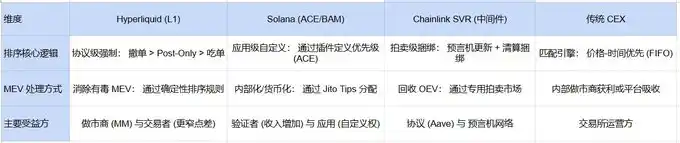
The purpose of the new generation of ordering innovations is to transition from "general ordering" to "Application-Aware Sequencing."

The ordering layer can understand transaction intent and order based on preset fairness rules, not just based on Gas fees.

1) Define the ordering method at the consensus layer

A typical case is Hyperliquid. It stipulates at the consensus layer that cancellation and Post-Only transactions take priority, breaking the Gas priority rule.

For market makers, being able to exit is paramount. During sharp price fluctuations, cancellation requests are always executed before others' takers.

Market makers fear being sniped the most. Hyperliquid precisely guarantees that cancellations are always prioritized—when the price drops, market makers cancel their orders, and the system forcibly prioritizes processing the cancellations, allowing market makers to successfully hedge risks.

On the day of the 10.11 crash, Hyperliquid market makers stayed online continuously, with spreads of 0.01–0.05%. The reason is that market makers knew they could get out.

2) Add new ordering methods at the sequencing layer

For example, Solana's Application Controlled Execution (ACE). Jito Labs developed BAM (Block Assembly Marketplace), introducing specialized BAM nodes responsible for transaction collection, filtering, and ordering.

Nodes run in a Trusted Execution Environment (TEE), ensuring the privacy of transaction data and the fairness of ordering.

Through ACE, DEXs on Solana (like Jupiter, Drift, Phoenix) can register custom ordering rules with BAM nodes. For example, market maker priority (similar to Hyperliquid), conditional liquidity, etc.

Additionally, proprietary AMM market makers like HumidiFi represent innovation at the ordering level, using Nozomi to connect directly with major validators to reduce latency and complete transactions.

During specific transactions, HumidiFi's off-chain servers monitor prices across platforms. The oracle communicates with the on-chain contract to inform it of the situation. Nozomi acts like a VIP channel, allowing effective order cancellation before execution.

3) Utilizing MEV facilities and private channels

Chainlink SVR (Smart Value Recapture) focuses on the归属 (belonging) of the value generated by ordering (MEV).

By deeply integrating with oracle data, it redefines the ordering rights and value distribution of liquidation transactions. After generating a price update, Chainlink nodes send it through two channels:

1) Public channel: Sent to the standard on-chain aggregator (serving as a backup, but in SVR mode, there is a slight delay to leave an auction window).

2) Private channel (Flashbots MEV-Share): Sent to an auction market supporting MEV-Share.

This way, the auction proceeds from liquidations triggered by oracle price changes in lending protocols (i.e., the amount searchers are willing to pay) are no longer solely captured by miners; most are captured by the SVR protocol.
Summary

If TPS is the entry ticket, then having only TPS is completely insufficient now. Custom ordering logic might not just be an innovation but a necessary path for putting transactions on-chain.

It might also be the beginning of DEXs surpassing CEXs.

Domande pertinenti

QWhat is the core argument of the article regarding the evolution of blockchain competition beyond TPS?

AThe article argues that competition between blockchains has moved beyond just transaction speed (TPS) and is now focused on the critical layer of 'transaction ordering' (sequencing). Effective and fair transaction ordering directly impacts market maker behavior, liquidity depth, and the overall user experience, making it a decisive factor for success.

QHow does transaction ordering on a blockchain negatively impact market makers, according to the article?

AIn a default 'gas-first' ordering system, market makers are vulnerable to being sniped. When an asset's price moves, a high-frequency trader can pay a higher gas fee to have their 'take order' (e.g., buying the asset at a low price) processed before the market maker's 'cancel order' (e.g., trying to withdraw their offer). This forces the market maker to buy the asset back at their own, now outdated, higher price, leading to losses and causing them to widen their spreads to mitigate risk.

QWhat is 'Application-Aware Sequencing' and can you name a project that implements it at the consensus layer?

A'Application-Aware Sequencing' is an innovative approach where the sequencing logic understands the intent of transactions (e.g., a cancelation vs. a trade) and orders them based on predefined fairness rules, not just gas fees. Hyperliquid is a prime example that implements this at the consensus layer by mandating that cancel and post-only orders are always prioritized over others, ensuring market makers can escape unfavorable positions.

QBesides consensus-layer changes, what other method does the article mention for improving transaction ordering on Solana?

AThe article mentions Solana's Application Controlled Execution (ACE) and the Block Assembly Marketplace (BAM) developed by Jito Labs. This allows decentralized exchanges (DEXs) like Jupiter and Drift to register custom ordering rules (e.g., market maker priority) with specialized BAM nodes, which operate in a Trusted Execution Environment (TEE) for privacy and fairness.

QHow does Chainlink's Smart Value Recapture (SVR) model change who benefits from MEV generated by oracle price updates?

AChainlink's SVR model changes MEV distribution by creating a two-path system for oracle price updates. After generating a new price, Chainlink nodes send it through a public channel (with a slight delay) and a private channel to a MEV auction market (like Flashbots MEV-Share). This allows the value from auctions for liquidation trades triggered by the price update to be captured mostly by the SVR protocol itself, rather than being kept entirely by miners/validators.

Letture associate

Trading

Spot
Futures

Articoli Popolari

Come comprare OPG

Benvenuto in HTX.com! Abbiamo reso l'acquisto di OpenGradient (OPG) semplice e conveniente. Segui la nostra guida passo passo per intraprendere il tuo viaggio nel mondo delle criptovalute.Step 1: Crea il tuo Account HTXUsa la tua email o numero di telefono per registrarti il tuo account gratuito su HTX. Vivi un'esperienza facile e sblocca tutte le funzionalità,Crea il mio accountStep 2: Vai in Acquista crypto e seleziona il tuo metodo di pagamentoCarta di credito/debito: utilizza la tua Visa o Mastercard per acquistare immediatamente OpenGradientOPG.Bilancio: Usa i fondi dal bilancio del tuo account HTX per fare trading senza problemi.Terze parti: abbiamo aggiunto metodi di pagamento molto utilizzati come Google Pay e Apple Pay per maggiore comodità.P2P: Fai trading direttamente con altri utenti HTX.Over-the-Counter (OTC): Offriamo servizi su misura e tassi di cambio competitivi per i trader.Step 3: Conserva OpenGradient (OPG)Dopo aver acquistato OpenGradient (OPG), conserva nel tuo account HTX. In alternativa, puoi inviare tramite trasferimento blockchain o scambiare per altre criptovalute.Step 4: Scambia OpenGradient (OPG)Scambia facilmente OpenGradient (OPG) nel mercato spot di HTX. Accedi al tuo account, seleziona la tua coppia di trading, esegui le tue operazioni e monitora in tempo reale. Offriamo un'esperienza user-friendly sia per chi ha appena iniziato che per i trader più esperti.

105 Totale visualizzazioniPubblicato il 2026.04.20Aggiornato il 2026.04.20

Come comprare OPG

Come comprare CHIP

Benvenuto in HTX.com! Abbiamo reso l'acquisto di USD.AI (CHIP) semplice e conveniente. Segui la nostra guida passo passo per intraprendere il tuo viaggio nel mondo delle criptovalute.Step 1: Crea il tuo Account HTXUsa la tua email o numero di telefono per registrarti il tuo account gratuito su HTX. Vivi un'esperienza facile e sblocca tutte le funzionalità,Crea il mio accountStep 2: Vai in Acquista crypto e seleziona il tuo metodo di pagamentoCarta di credito/debito: utilizza la tua Visa o Mastercard per acquistare immediatamente USD.AICHIP.Bilancio: Usa i fondi dal bilancio del tuo account HTX per fare trading senza problemi.Terze parti: abbiamo aggiunto metodi di pagamento molto utilizzati come Google Pay e Apple Pay per maggiore comodità.P2P: Fai trading direttamente con altri utenti HTX.Over-the-Counter (OTC): Offriamo servizi su misura e tassi di cambio competitivi per i trader.Step 3: Conserva USD.AI (CHIP)Dopo aver acquistato USD.AI (CHIP), conserva nel tuo account HTX. In alternativa, puoi inviare tramite trasferimento blockchain o scambiare per altre criptovalute.Step 4: Scambia USD.AI (CHIP)Scambia facilmente USD.AI (CHIP) nel mercato spot di HTX. Accedi al tuo account, seleziona la tua coppia di trading, esegui le tue operazioni e monitora in tempo reale. Offriamo un'esperienza user-friendly sia per chi ha appena iniziato che per i trader più esperti.

63 Totale visualizzazioniPubblicato il 2026.04.21Aggiornato il 2026.04.21

Come comprare CHIP

Come comprare CC

Benvenuto in HTX.com! Abbiamo reso l'acquisto di CC(Canton) (CC) semplice e conveniente. Segui la nostra guida passo passo per intraprendere il tuo viaggio nel mondo delle criptovalute.Step 1: Crea il tuo Account HTXUsa la tua email o numero di telefono per registrarti il tuo account gratuito su HTX. Vivi un'esperienza facile e sblocca tutte le funzionalità,Crea il mio accountStep 2: Vai in Acquista crypto e seleziona il tuo metodo di pagamentoCarta di credito/debito: utilizza la tua Visa o Mastercard per acquistare immediatamente CC(Canton)CC.Bilancio: Usa i fondi dal bilancio del tuo account HTX per fare trading senza problemi.Terze parti: abbiamo aggiunto metodi di pagamento molto utilizzati come Google Pay e Apple Pay per maggiore comodità.P2P: Fai trading direttamente con altri utenti HTX.Over-the-Counter (OTC): Offriamo servizi su misura e tassi di cambio competitivi per i trader.Step 3: Conserva CC(Canton) (CC)Dopo aver acquistato CC(Canton) (CC), conserva nel tuo account HTX. In alternativa, puoi inviare tramite trasferimento blockchain o scambiare per altre criptovalute.Step 4: Scambia CC(Canton) (CC)Scambia facilmente CC(Canton) (CC) nel mercato spot di HTX. Accedi al tuo account, seleziona la tua coppia di trading, esegui le tue operazioni e monitora in tempo reale. Offriamo un'esperienza user-friendly sia per chi ha appena iniziato che per i trader più esperti.

108 Totale visualizzazioniPubblicato il 2026.04.21Aggiornato il 2026.04.21

Come comprare CC

Discussioni

Benvenuto nella Community HTX. Qui puoi rimanere informato sugli ultimi sviluppi della piattaforma e accedere ad approfondimenti esperti sul mercato. Le opinioni degli utenti sul prezzo di A A sono presentate come di seguito.

活动图片