Toss Brings 30 Million Users Into the AI Data Economy in Partnership With Poseidon

TheNewsCryptoPubblicato 2026-06-26Pubblicato ultima volta 2026-06-26

Introduzione

Poseidon, a data infrastructure company for AI, has partnered with South Korean mobile financial platform Toss (operated by Viva Republica) to integrate its contributor app, Numo, into the Toss app. This partnership allows Toss's approximately 30 million users to contribute real-world voice, image, and video data for AI training and receive direct payment for their contributions. The initiative addresses the AI industry's growing need for high-quality, first-person data not available on the open web, crucial for developing physical intelligence in robotics and autonomous vehicles. Poseidon's infrastructure tracks each contribution's value, while Toss handles user payments. Contributions are registered on the DATA network, which provides verifiable provenance via its Trace audit layer. The partners aim to prove this user-compensated data model in South Korea—a market with dense real-life data and advanced mobile finance—before expanding globally. Poseidon recently raised a $15 million seed round led by Andreessen Horowitz.

Palo Alto, United States, June 26th, 2026, Chainwire

Toss users can now contribute real-world data to train AI and get paid for it, in a first-of-its-kind model launching in Korea ahead of global expansion.

Poseidon, the data infrastructure built to source and license real-world data for AI, today announced a partnership with Toss, the mobile financial platform operated by Viva Republica, to let everyday users contribute to AI training and be paid for what they provide. It is Toss’s first move into AI data, and it opens that market to its roughly 30 million users.

Frontier AI has run out of internet to scrape. The next generation of models depends on real-world data, the kind that captures how people actually speak, move, and react, which does not exist on the open web and has never had a clean way to be sourced, licensed, or paid for. Poseidon is building the infrastructure to change that, and Toss brings the reach to do it at scale.

Through the partnership, Poseidon’s contributor app, Numo, launches inside the Toss app. Toss users can help build Korean-language training data across voice, image, and video, and receive payment tied directly to what they contribute. Poseidon provides the infrastructure that tracks each contribution and its value, while Toss provides the user base and the financial experience that turns participation into payment. Together they offer a working answer to a question the AI industry has struggled with, which is how to compensate the people whose data makes models better.

Every contribution made through Numo is registered on DATA, the AI data network that Poseidon refines data for. DATA gives each record a verifiable provenance trail through Trace, its public audit layer, so a buyer can see where a piece of training data came from and a contributor can see that their work was counted and paid. DATA Foundation, which launched this week from the rebrand of Story, is building this layer alongside integration partners including the human data marketplace Kled, and Poseidon is one of the largest sources of refined data flowing into it.
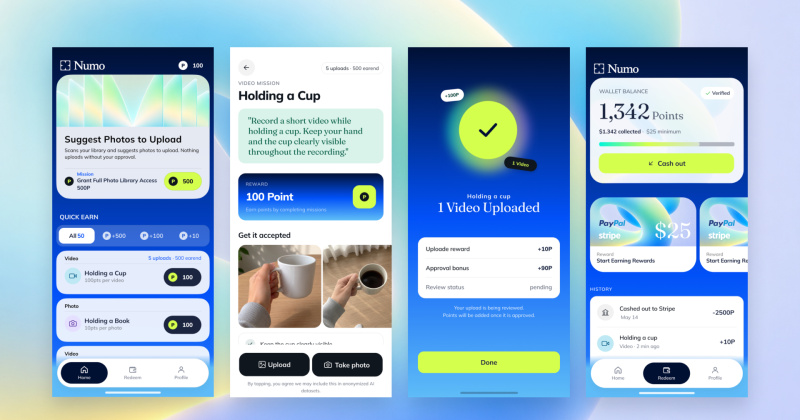
What Numo collects is first-person data, recorded by real people in real environments, which is among the hardest and most valuable categories to obtain. It is the raw material for physical intelligence, the AI that has to operate in the physical world across robotics, autonomous vehicles, and other applications. Demand from global AI labs for this kind of data is climbing, and Korea is positioned to supply it, with its dense real-life data and Toss’s user base. Poseidon and Toss intend to prove the model in Korea, then expand to global markets.

Changhoon Seo, Executive Director of New Business at Toss, said: “As the AI industry grows, demand for high-quality data is rising just as fast. Toss plans to build an environment where users can take part in the data economy more easily and naturally, and to expand a structure in which the value they contribute is rewarded transparently.”

SY Lee, Chief Strategy Officer and Chairman of Poseidon, said: “Korea is one of the few markets where the strategic importance of AI data, a mature financial system, and world-class mobile experience all exist at once. Toss is the right partner to turn user-contributed AI data from an early idea into a standard the rest of the world can adopt.” Lee previously founded the web-novel platform Radish and sold it to Kakao Entertainment, co-founded Story, the IP infrastructure that recently rebranded as DATA Foundation, and was named a Young Global Leader by the World Economic Forum this year.

About Poseidon

Poseidon is the data infrastructure for AI, built to source, refine, and license the real-world data that frontier models need and the open internet cannot supply. Incubated by the team behind The DATA Network, Poseidon bridges the gap between data supply and AI demand by enabling access to high-quality, IP-safe, and composable training datasets. Poseidon raised a $15 million seed round led by Andreessen Horowitz (a16z). Poseidon’s contributor app, Numo, has recorded more than 711,000 data registrations worldwide and is available and is now available on the Toss app.

Contact

HV
henri.vies@piplabs.xyz

Domande pertinenti

QWhat is the key outcome of the partnership between Toss and Poseidon?

AThe partnership allows approximately 30 million Toss users to contribute real-world data for AI training through the Numo app within the Toss platform and receive direct payment for their contributions.

QWhat is the main purpose of the Numo app launched by Poseidon?

ANumo is a contributor app that enables users to help build Korean-language training data across voice, image, and video formats, with each contribution tracked for value and compensation.

QWhy is first-person real-world data considered so valuable for AI development according to the article?

AFirst-person data, recorded by real people in real environments, is among the hardest and most valuable to obtain. It is essential raw material for developing physical intelligence in AI, which operates in the physical world for applications like robotics and autonomous vehicles.

QWhat role does the DATA network play in this data economy model?

AThe DATA network, refined by Poseidon, registers each contribution. It provides a verifiable provenance trail through its public audit layer, Trace, allowing buyers to see a data record's origin and contributors to see their work was counted and paid for.

QWhat are the future plans for the Toss and Poseidon partnership after launching in Korea?

APoseidon and Toss intend to first prove the user-contributed AI data model in the Korean market and then expand it to global markets.

Letture associate

Google's 'Reasoning King' Also Departs for Meta, Originally Recruited by Fei-Fei Li

"Google's 'King of Reasoning' Leaves for Meta, Quietly Departing After Over Eight Years. Denny Zhou, a key figure behind Google's AI reasoning advancements including work showcased by CEO Sundar Pichai, has joined Meta's MSL as a research scientist. His low-profile move, discovered via a LinkedIn update, occurred months before the high-profile departures of Noam Shazeer to OpenAI and Nobel laureate John Jumper to Anthropic. Zhou was originally recruited to Google by Fei-Fei Li's China center initiative after nearly 11 years at Microsoft. This is part of a significant talent drain at Google, with top researchers like Shazeer (co-author of the Transformer paper) and Jumper (AlphaFold lead) recently leaving for rivals. Reports suggest internal friction is a contributing factor, particularly around Google's strategic shift. The company has reportedly formed a high-priority 'AI Coding Strike Team,' involving co-founder Sergey Brin, to urgently bridge the gap in AI coding agents, potentially reallocating resources and focus away from other research directions like DeepMind's 'world model' AGI approach. This pivot towards commercially-proven coding applications may have influenced departures, as hinted by Shazeer's comment about his compute allocation being given to another team. Meanwhile, Meta continues to bolster its team, also recently hiring UC Berkeley professor and 'security godmother' Dawn Song, along with her startup Virtue AI team, as a VP of AI research."

marsbit1 h fa

Google's 'Reasoning King' Also Departs for Meta, Originally Recruited by Fei-Fei Li

marsbit1 h fa

How Did Hundreds of Billions of Dollars Flow into SpaceX After Its Index Inclusion on June 26th? Will SpaceX Experience a Massive Price Surge?

Will SpaceX ($SPCX) stock surge when billions in passive index fund money flows in on the effective date? A common retail investor belief is that a massive wave of buying will hit on July 6th, when SpaceX joins the Nasdaq-100, potentially causing a huge price spike. However, the reality is far more complex and less dramatic. The anticipated billions are not controlled by a single entity but are spread across hundreds of passive fund managers (e.g., BlackRock, Vanguard) whose sole mandate is to minimize "tracking error." They aim to buy shares at prices as close as possible to the index's closing price on the effective date, not to aggressively drive the price up. There are two key index inclusion scripts: 1) For the Russell US Index (effective June 26th at close), buying is compressed into the final minutes via Market-On-Close (MOC) orders. 2) For the Nasdaq-100 (announced June 26th, effective July 6th), a 10-day window creates a layered game. Arbitrage funds buy early, betting on selling to passive funds later. Some index funds "front-run" by accumulating shares gradually before the deadline. The bulk of passive funds execute large MOC orders at the July 6th close, often trading directly with arbitrageurs. A critical wildcard is SpaceX's limited free float due to a standard 180-day post-IPO lockup. To avoid causing a massive price spike by competing for scarce shares on the open market, large funds will likely use off-exchange methods: 1) Negotiating large block trades (over-the-counter) with major holders. 2) Using derivatives like total return swaps with locked-up shareholders to gain economic exposure without physically buying the stock. Most of the index-driven buying will thus happen invisibly, not on public exchanges. For retail investors, trying to front-run these sophisticated flows is risky. More viable strategies include: waiting for post-inclusion volatility to subside before establishing a long-term position, or employing options strategies like selling strangles to profit from elevated, but potentially overstated, implied volatility around the event. In conclusion, while price appreciation may occur in the days following the announcement due to arbitrage and front-running activity, a single-day "explosive pump" on July 6th is highly unlikely. The major index fund buying will be executed efficiently and discreetly, often away from public markets, turning the anticipated climax into a well-orchestrated, anti-climactic settlement.

marsbit1 h fa

How Did Hundreds of Billions of Dollars Flow into SpaceX After Its Index Inclusion on June 26th? Will SpaceX Experience a Massive Price Surge?

marsbit1 h fa

Trading

Spot
活动图片