Tonight's Non-Farm Payrolls Report Is Unconventional! October Data 'Missing', But November Unemployment Rate Set to Soar?

marsbitPubblicato 2025-12-16Pubblicato ultima volta 2025-12-16

Introduzione

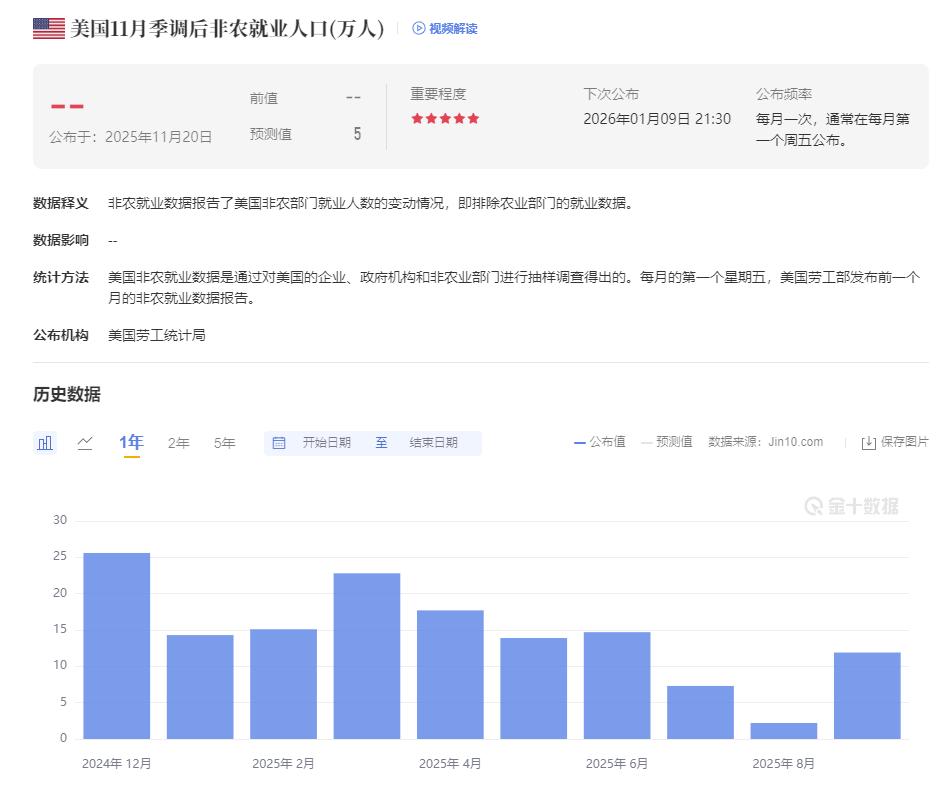
The US November nonfarm payrolls report, unusually delayed to a Tuesday in mid-December due to the government shutdown, is the market's key focus. This release will include both November data and October's job growth figures, though October's unemployment rate is missing due to the shutdown's disruption. Economists expect a modest 50,000 job gain in November, with the rate holding at 4.4% or potentially rising. The report is expected to be volatile and complex due to the shutdown's impact, including federal worker furloughs and extended data collection windows. Beyond the headline numbers, details on sectoral job growth, wage trends, and labor force participation will be crucial for assessing the economy's health. The data will significantly influence the Federal Reserve's future interest rate decisions. Bitcoin may see volatility in reaction, with strong data potentially pressuring prices via a stronger dollar, while weak data could boost expectations for rate cuts.

This week, the US economic calendar welcomes a dense release period, with the November Non-Farm Payrolls (NFP) report, originally scheduled for 9:30 PM Beijing Time on Tuesday, undoubtedly becoming the focal point of market attention.

The release of this data has been unusually postponed to a Tuesday in mid-December due to the impact of the government shutdown, breaking the conventional practice of being released on the first Friday of each month.

Over the past month, the backlog of economic data due to the government shutdown is gradually being released, creating a situation this week where multiple important data sets will be unveiled consecutively: over the next three days, heavyweight reports on retail sales, inflation, and the labor market will be released, providing the market with crucial evidence to assess the state of the US economy.

Technical Background of the Unconventional Data Release

The uniqueness of this NFP report lies in the fact that it will essentially contain "two" sets of data—besides the new employment numbers and unemployment rate for November, the Bureau of Labor Statistics (BLS) will also release the October non-farm payroll data concurrently.

As the statistical agency cannot retrospectively collect unemployment rate information for October, the October unemployment rate data will definitely be absent from this report. This "buy one, get half" release format stems from the previous federal government shutdown that lasted 43 days. This historically long shutdown prevented the BLS from conducting the collection and processing of October data according to the常规流程 (conventional process).

The market普遍预期 (widely expects) that November non-farm payrolls will increase by 50,000, with the unemployment rate预计 (expected) to remain at 4.4%.

However, the importance of this report lies not only in revealing the true state of the US labor market but also in providing key guidance for the Federal Reserve's interest rate policy path next year.


Data Expectations and Potential Volatility

In recent months, US employment data has shown significant volatility, swinging between declines and robust growth.

Economists expect Tuesday's report may continue this trend and appear particularly chaotic due to the后续影响 (knock-on effects) of the government shutdown.

Following stronger-than-expected job growth in September, some analysts predicted October employment could turn negative. This expectation primarily stems from approximately 144,000 federal workers accepting "delayed resignation plans" and leaving government positions after September 30th. Goldman Sachs economists estimate this factor will lead to a decrease of 70,000 in October employment and another 10,000 decrease in November. Despite the uncertainty, most economists still expect positive job growth, but the forecast range is unusually wide, spanning from a decrease of 20,000 to an increase of 127,000.

Nancy Vanden Houten, Chief US Economist at Oxford Economics, pointed out that healthcare and private education services sectors are likely to be the main drivers of job growth for the month.

Daniel Zhao, Chief Economist at Glassdoor, stated: "Government shutdowns don't happen often, so there's always some uncertainty when dealing with a large-scale statistical operation like the BLS. Caution should be exercised when interpreting this report, and one should be prepared for various possible outcomes." He believes the pace of job growth is most likely to remain steady, but同时强调 (simultaneously emphasized) that "there's a big variable on top of this."


Impact of Statistical Technical Factors on the Data

The BLS is known for its transparency and usually adds explanatory notes to its reports to account for major contextual or technical issues. Shruti Mishra, an economist at Bank of America, noted in a recent report that despite over 700,000 federal workers being furloughed during the shutdown, a scenario of sharply negative October data followed by a surge in November employment is not expected.

Mishra explained: "The establishment survey counts workers who were paid or expected to be paid for any part of the reference week.

Historical experience shows that the 2013 and 2019 government shutdowns had minimal impact on employment numbers." Daniel Zhao further pointed out that due to the extended timeframe for data submission and collection, the October and November employment data might actually be more complete, with less room for subsequent revisions. Although the October unemployment rate data is confirmed missing, economists expect the November unemployment rate to either remain at 4.4% or face upward pressure. In the three months leading up to September, the unemployment rate had climbed consecutively each month due to a subdued hiring environment and rising labor force participation. Meanwhile, recent layoff announcements have increased significantly, with the October layoff indicator reaching its highest level since early 2023. Some forecasters believe that the decline in federal government employment could push the November unemployment rate higher, potentially to 4.5% or even 4.6%.

Bloomberg Economics also noted that the absence of October unemployment data and the later-than-usual collection cycle for November data could trigger the "technical issues" mentioned by Fed Chair Jerome Powell, such as distortions in seasonal adjustments.


Report Details and Related Data Indicators

Beyond the two core indicators of overall employment numbers and the unemployment rate, economists believe the internal details of the establishment survey and household survey provide a more important perspective for understanding the performance of key sectors of the US economy. Dean Baker, Senior Economist at the Center for Economic and Policy Research, emphasized that the breakdown of job growth by industry deserves close attention. He expects employment in the goods-producing sector may decline again, while healthcare and the restaurant industry are expected to continue leading job growth. Meanwhile, slowing wage growth is expected to put further pressure on consumer spending. Cory Stahle, an economist at Indeed Hiring Lab, pointed out that the labor force participation rate, the employment-population ratio, and the trajectory of unemployment data are crucial indicators for measuring how Americans perceive the job market. "Ultimately, if 100,000 jobs are created every month, but the unemployment rate is rising, or people are saying 'can't find any work, not planning to search anymore,' that will eventually come back to bite the labor market." At the same time on Tuesday, the US Commerce Department will also release October retail sales data. Excluding auto and gasoline sales, economists expect accelerating支出 (spending) to show robust consumer demand at the start of the fourth quarter. Unadjusted overall retail sales are预计 (expected) to grow by just 0.1%. Later this week, the BLS will also release the November Consumer Price Index (CPI) report. The October CPI report was canceled due to insufficient price data collection during the government shutdown. Due to the lack of a comparable October baseline, the statistical agency cannot release the month-over-month figures for the CPI and core measures; investors will need to focus on the year-over-year indicators for signals on the direction of inflation.


Bitcoin Price Forecast

As an asset highly sensitive to macroeconomic data, Bitcoin's price may react noticeably to this NFP data. If the NFP data is significantly stronger than expected, especially if the unemployment rate remains stable and wage growth is robust, it could strengthen the Fed's stance on maintaining high interest rates, thereby boosting the US Dollar Index and creating short-term pressure on non-yielding assets like Bitcoin.

Conversely, if employment data is weak, showing a significant cooling in the labor market, it could strengthen market expectations for an earlier Fed rate cut, potentially benefiting Bitcoin's price.

Given that the market has already priced in considerable rate cut expectations, any data that deviates significantly from forecasts could trigger剧烈波动 (sharp volatility) in Bitcoin's price. Technically, Bitcoin needs to hold the key support level at $85,000; a break below could lead to a further test of the $83,000-$84,000 region.

However, from a medium-to-long-term perspective, Bitcoin's fundamental factors, including the upcoming halving event and the持续提升 (continually increasing) rate of institutional adoption, still provide a solid foundation. Every pullback caused by macroeconomic data could potentially offer strategic entry opportunities for long-term investors.


Crypto di tendenza

Domande pertinenti

QWhy was the November non-farm payroll report unusually delayed and what is its special format?

AThe report was delayed to a Tuesday in December due to the government shutdown, breaking the usual first-Friday-of-the-month release pattern. It will contain November's new employment numbers and unemployment rate, plus October's new non-farm payroll data, but the October unemployment rate will be missing.

QWhat is the market consensus for the key figures in the November non-farm payroll report?

AThe market generally expects an increase of 50,000 in non-farm payroll employment for November, with the unemployment rate expected to remain at 4.4%.

QHow did the government shutdown specifically impact the collection and reporting of the October employment data?

AThe 43-day federal shutdown prevented the Bureau of Labor Statistics from collecting and processing October data through its常规流程. This is why the October unemployment rate is unavailable, and the data for that month is being released alongside November's figures.

QWhat potential impact could a significantly stronger or weaker than expected non-farm payroll report have on Bitcoin's price?

AA significantly stronger report (e.g., higher job growth, stable unemployment, strong wage growth) could strengthen the case for the Fed maintaining high interest rates, potentially boosting the USD and putting short-term downward pressure on Bitcoin. A weaker report, signaling a labor market cool-down, could increase expectations for earlier Fed rate cuts, potentially benefiting Bitcoin's price.

QBesides the headline unemployment rate and payroll numbers, what other details in the report do economists consider crucial for assessing the economy?

AEconomists emphasize the details within the establishment and household surveys, particularly the breakdown of job growth by sector (e.g., goods-producing vs. healthcare/leisure), the labor force participation rate, the employment-population ratio, and the trajectory of unemployment data to gauge the true health of the labor market.

Letture associate

Major Altcoin Market Players Did This During the Massive Rally!

As the cryptocurrency bull market intensifies, large-scale transactions by crypto 'whales' are drawing significant attention. Blockchain data reveals multi-million dollar positions opened and closed in Bitcoin ($BTC), Ethereum ($ETH), and Hyperliquid ($HYPE). A major investor, likely tied to Matrixport, closed a 40,000 $ETH long position worth ~$100.5M for a $9.9M profit. The investor still holds 80,000 $ETH (~$201M) and 500 $BTC (~$39M), with an unrealized profit of ~$22.9M. This turned their previous $92.5M total loss into an approximate $32.8M overall profit. On Hyperliquid, a trader known as loracle.hl reportedly lost over $70M trading $HYPE in the past three months. The investor currently holds ~$54.88M in $HYPE short positions, at risk of liquidation if $HYPE's price reaches $101.15. Notorious trader Machi Big Brother, who reportedly survived 500 liquidations, capitalized on the recent rally. He grew his portfolio from $152K to $12.72M in just three days, yielding over $12.5M in profit. While $HYPE hits a new all-time high, Multicoin Capital has deposited 427,422 $HYPE (~$31.74M) to Coinbase Prime over three days, raising speculation about a potential sale or portfolio rebalance. In Bitcoin markets, an anonymous whale stands out, selling ~2,700 $BTC (~$211.8M) in a recent transaction. Over three days, this whale sold a total of 7,700 $BTC, valued at approximately $576.6M.

cryptonews.ru25 min fa

Major Altcoin Market Players Did This During the Massive Rally!

cryptonews.ru25 min fa

Goldman Sachs' Summary After Silicon Valley Investigation: Agents Enter the Execution Era, AI Competition Shifts to Workflows, World Models Rise

Based on a recent field research in Silicon Valley, Goldman Sachs highlights a key shift in the AI industry: moving from systems that "answer questions" to autonomous AI agents that "execute tasks." Commercial models are transitioning from per-seat subscriptions to usage- and outcome-based pricing. The competition is shifting from raw model capability to mastery over specific business workflows, with value accruing to proprietary data, domain context, and operational expertise. A major hurdle for enterprise Agent deployment is not technical ability but "controllability"—issues of accountability, auditability, and error correction, especially in regulated fields. Workflows with clear rules, verifiable outcomes, and reversible actions (e.g., invoice processing) are being automated first. The model landscape is evolving toward a division of labor. Frontier models (like GPT-4) are expected to handle high-value, high-reliability core tasks, while improving open-source models will likely capture the majority (~90%) of inference tokens for standardized, high-volume tasks due to cost advantages. Finally, attention is moving from Large Language Models (LLMs) to "World Models," which understand physical environments, causality, and dynamic interactions. This shift elevates the importance of proprietary, real-world data (from industrial, scientific, and robotic systems) and could drive a second wave of compute demand. Goldman Sachs projects compute needs could grow ~24x over five years, benefiting cloud and infrastructure providers.

marsbit1 h fa

Goldman Sachs' Summary After Silicon Valley Investigation: Agents Enter the Execution Era, AI Competition Shifts to Workflows, World Models Rise

marsbit1 h fa

Fidelity Warns: The Boom in AI Agents May Not Be a Feast for Public Blockchains

Fidelity Digital Assets cautions that the anticipated boom in AI agents does not automatically guarantee a corresponding surge in public blockchain adoption or token value. While AI agents that can autonomously perform tasks like payments and data calls could theoretically utilize blockchain for settlement, a significant gap exists between "can use" and "must use." The analysis highlights six key risks. First, many AI agents, especially in corporate settings, may prefer closed, permissioned systems over public blockchains due to needs for speed, cost, compliance, and control. Second, increased on-chain transactions from AI-driven micropayments may not benefit native tokens if fees remain low or if value is captured by stablecoins and payment service providers instead. Third, while AI lowers development costs and increases the number of projects, more code does not equal more economic value and can lead to market oversaturation. Fourth, AI commoditizes coding, making pure technological advantage less of a sustainable moat; competition may shift to brand, liquidity, and user networks. Fifth, AI can also lower the cost of attacks by making vulnerability discovery easier, potentially outpacing security auditing and increasing ecosystem risk. Sixth, institutions may require "controlled blockchain" systems with robust identity, permissioning, and audit trails, conflicting with the permissionless nature of public chains. Ultimately, Fidelity argues against simply equating AI growth with blockchain prosperity. The narrative requires moving from speculation to a concrete analysis of which infrastructures can convert real AI agent needs into sustainable economic value, critically examining each step of the assumed value chain.

marsbit1 h fa

Fidelity Warns: The Boom in AI Agents May Not Be a Feast for Public Blockchains

marsbit1 h fa

Telegram Introduces WEB-Proxy Technology: Masks Traffic as Regular Website Visits

Telegram has introduced a new experimental WEB-Proxy technology designed to circumvent blocking by disguising messenger traffic as regular, secure website visits. Announced on August 21, 2026, the technology routes MTProxy data through an in-app WebView using HTTPS or WebSocket transport, making the data stream indistinguishable from legitimate web surfing. The core innovation is a multiplexed stream sent through a single WebView session. It uses special frame formats to pack multiple logical Telegram connections into one encrypted channel that externally resembles loading a web page. A server-side relay receives this stream, separates it into individual connections for the standard MTProxy, without decrypting content or knowing final destinations, thus preserving privacy. The WEB-Proxy operates on a standard HTTPS domain that also hosts a public website. The proxy bridge page is only activated by a specific URL parameter derived via HMAC-SHA256 from the proxy configuration; all other requests receive the normal site homepage. This provides reliable cover against automated detection systems. Currently a proof-of-concept, the system includes a desktop implementation, an experimental Android client, and plans for iOS support. The technology represents a shift towards more sophisticated integration with legitimate web infrastructure, complicating filtering systems that must choose between blocking HTTPS traffic entirely or allowing service access. Its long-term value will depend on resilience to adaptive traffic analysis and scalability without performance loss.

cryptonews.ru1 h fa

Telegram Introduces WEB-Proxy Technology: Masks Traffic as Regular Website Visits

cryptonews.ru1 h fa

Trading

Spot

Articoli Popolari

Cosa è $S$

Comprendere SPERO: Una Panoramica Completa Introduzione a SPERO Mentre il panorama dell'innovazione continua a evolversi, l'emergere delle tecnologie web3 e dei progetti di criptovaluta gioca un ruolo fondamentale nel plasmare il futuro digitale. Un progetto che ha attirato l'attenzione in questo campo dinamico è SPERO, denotato come SPERO,$$s$. Questo articolo mira a raccogliere e presentare informazioni dettagliate su SPERO, per aiutare gli appassionati e gli investitori a comprendere le sue basi, obiettivi e innovazioni nei domini web3 e crypto. Che cos'è SPERO,$$s$? SPERO,$$s$ è un progetto unico all'interno dello spazio crypto che cerca di sfruttare i principi della decentralizzazione e della tecnologia blockchain per creare un ecosistema che promuove l'impegno, l'utilità e l'inclusione finanziaria. Il progetto è progettato per facilitare interazioni peer-to-peer in modi nuovi, fornendo agli utenti soluzioni e servizi finanziari innovativi. Al suo interno, SPERO,$$s$ mira a responsabilizzare gli individui fornendo strumenti e piattaforme che migliorano l'esperienza dell'utente nello spazio delle criptovalute. Questo include la possibilità di metodi di transazione più flessibili, la promozione di iniziative guidate dalla comunità e la creazione di percorsi per opportunità finanziarie attraverso applicazioni decentralizzate (dApps). La visione sottostante di SPERO,$$s$ ruota attorno all'inclusività, cercando di colmare le lacune all'interno della finanza tradizionale mentre sfrutta i vantaggi della tecnologia blockchain. Chi è il Creatore di SPERO,$$s$? L'identità del creatore di SPERO,$$s$ rimane piuttosto oscura, poiché ci sono risorse pubblicamente disponibili limitate che forniscono informazioni dettagliate sul suo fondatore o fondatori. Questa mancanza di trasparenza può derivare dall'impegno del progetto per la decentralizzazione—un ethos che molti progetti web3 condividono, dando priorità ai contributi collettivi rispetto al riconoscimento individuale. Centrando le discussioni attorno alla comunità e ai suoi obiettivi collettivi, SPERO,$$s$ incarna l'essenza dell'empowerment senza mettere in evidenza individui specifici. Pertanto, comprendere l'etica e la missione di SPERO rimane più importante che identificare un creatore singolo. Chi sono gli Investitori di SPERO,$$s$? SPERO,$$s$ è supportato da una varietà di investitori che vanno dai capitalisti di rischio agli investitori angelici dedicati a promuovere l'innovazione nel settore crypto. Il focus di questi investitori generalmente si allinea con la missione di SPERO—dando priorità a progetti che promettono avanzamenti tecnologici sociali, inclusività finanziaria e governance decentralizzata. Queste fondazioni di investitori sono tipicamente interessate a progetti che non solo offrono prodotti innovativi, ma contribuiscono anche positivamente alla comunità blockchain e ai suoi ecosistemi. Il supporto di questi investitori rafforza SPERO,$$s$ come un concorrente degno di nota nel dominio in rapida evoluzione dei progetti crypto. Come Funziona SPERO,$$s$? SPERO,$$s$ impiega un framework multifunzionale che lo distingue dai progetti di criptovaluta convenzionali. Ecco alcune delle caratteristiche chiave che sottolineano la sua unicità e innovazione: Governance Decentralizzata: SPERO,$$s$ integra modelli di governance decentralizzati, responsabilizzando gli utenti a partecipare attivamente ai processi decisionali riguardanti il futuro del progetto. Questo approccio favorisce un senso di proprietà e responsabilità tra i membri della comunità. Utilità del Token: SPERO,$$s$ utilizza il proprio token di criptovaluta, progettato per servire varie funzioni all'interno dell'ecosistema. Questi token abilitano transazioni, premi e la facilitazione dei servizi offerti sulla piattaforma, migliorando l'impegno e l'utilità complessivi. Architettura Stratificata: L'architettura tecnica di SPERO,$$s$ supporta la modularità e la scalabilità, consentendo un'integrazione fluida di funzionalità e applicazioni aggiuntive man mano che il progetto evolve. Questa adattabilità è fondamentale per mantenere la rilevanza nel panorama crypto in continua evoluzione. Coinvolgimento della Comunità: Il progetto enfatizza iniziative guidate dalla comunità, impiegando meccanismi che incentivano la collaborazione e il feedback. Nutrendo una comunità forte, SPERO,$$s$ può affrontare meglio le esigenze degli utenti e adattarsi alle tendenze di mercato. Focus sull'Inclusione: Offrendo basse commissioni di transazione e interfacce user-friendly, SPERO,$$s$ mira ad attrarre una base utenti diversificata, inclusi individui che potrebbero non aver precedentemente interagito nello spazio crypto. Questo impegno per l'inclusione si allinea con la sua missione generale di empowerment attraverso l'accessibilità. Cronologia di SPERO,$$s$ Comprendere la storia di un progetto fornisce preziose intuizioni sulla sua traiettoria di sviluppo e sui traguardi. Di seguito è riportata una cronologia suggerita che mappa eventi significativi nell'evoluzione di SPERO,$$s$: Fase di Concettualizzazione e Ideazione: Le idee iniziali che formano la base di SPERO,$$s$ sono state concepite, allineandosi strettamente con i principi di decentralizzazione e focus sulla comunità all'interno dell'industria blockchain. Lancio del Whitepaper del Progetto: Dopo la fase concettuale, è stato rilasciato un whitepaper completo che dettaglia la visione, gli obiettivi e l'infrastruttura tecnologica di SPERO,$$s$ per suscitare interesse e feedback dalla comunità. Costruzione della Comunità e Prime Interazioni: Sono stati effettuati sforzi attivi di outreach per costruire una comunità di early adopters e potenziali investitori, facilitando discussioni attorno agli obiettivi del progetto e ottenendo supporto. Evento di Generazione del Token: SPERO,$$s$ ha condotto un evento di generazione del token (TGE) per distribuire i propri token nativi ai primi sostenitori e stabilire una liquidità iniziale all'interno dell'ecosistema. Lancio della Prima dApp: La prima applicazione decentralizzata (dApp) associata a SPERO,$$s$ è stata attivata, consentendo agli utenti di interagire con le funzionalità principali della piattaforma. Sviluppo Continuo e Partnership: Aggiornamenti e miglioramenti continui alle offerte del progetto, inclusi partnership strategiche con altri attori nello spazio blockchain, hanno plasmato SPERO,$$s$ in un concorrente competitivo e in evoluzione nel mercato crypto. Conclusione SPERO,$$s$ rappresenta una testimonianza del potenziale del web3 e delle criptovalute di rivoluzionare i sistemi finanziari e responsabilizzare gli individui. Con un impegno per la governance decentralizzata, il coinvolgimento della comunità e funzionalità progettate in modo innovativo, apre la strada verso un panorama finanziario più inclusivo. Come per qualsiasi investimento nello spazio crypto in rapida evoluzione, si incoraggiano potenziali investitori e utenti a ricercare approfonditamente e a impegnarsi in modo riflessivo con gli sviluppi in corso all'interno di SPERO,$$s$. Il progetto mostra lo spirito innovativo dell'industria crypto, invitando a ulteriori esplorazioni delle sue innumerevoli possibilità. Mentre il percorso di SPERO,$$s$ è ancora in fase di sviluppo, i suoi principi fondamentali potrebbero effettivamente influenzare il futuro di come interagiamo con la tecnologia, la finanza e tra di noi in ecosistemi digitali interconnessi.

423 Totale visualizzazioniPubblicato il 2024.12.17Aggiornato il 2024.12.17

Cosa è $S$

Cosa è AGENT S

Agent S: Il Futuro dell'Interazione Autonoma in Web3 Introduzione Nel panorama in continua evoluzione di Web3 e criptovalute, le innovazioni stanno costantemente ridefinendo il modo in cui gli individui interagiscono con le piattaforme digitali. Uno di questi progetti pionieristici, Agent S, promette di rivoluzionare l'interazione uomo-computer attraverso il suo framework agentico aperto. Aprendo la strada a interazioni autonome, Agent S mira a semplificare compiti complessi, offrendo applicazioni trasformative nell'intelligenza artificiale (AI). Questa esplorazione dettagliata approfondirà le complessità del progetto, le sue caratteristiche uniche e le implicazioni per il dominio delle criptovalute. Cos'è Agent S? Agent S si presenta come un innovativo framework agentico aperto, progettato specificamente per affrontare tre sfide fondamentali nell'automazione dei compiti informatici: Acquisizione di Conoscenze Specifiche del Dominio: Il framework apprende in modo intelligente da varie fonti di conoscenza esterne ed esperienze interne. Questo approccio duale gli consente di costruire un ricco repository di conoscenze specifiche del dominio, migliorando le sue prestazioni nell'esecuzione dei compiti. Pianificazione su Lungo Orizzonte di Compiti: Agent S impiega una pianificazione gerarchica potenziata dall'esperienza, un approccio strategico che facilita la suddivisione e l'esecuzione efficiente di compiti complessi. Questa caratteristica migliora significativamente la sua capacità di gestire più sottocompiti in modo efficiente ed efficace. Gestione di Interfacce Dinamiche e Non Uniformi: Il progetto introduce l'Interfaccia Agente-Computer (ACI), una soluzione innovativa che migliora l'interazione tra agenti e utenti. Utilizzando Modelli Linguistici Multimodali di Grandi Dimensioni (MLLM), Agent S può navigare e manipolare senza sforzo diverse interfacce grafiche utente. Attraverso queste caratteristiche pionieristiche, Agent S fornisce un framework robusto che affronta le complessità coinvolte nell'automazione dell'interazione umana con le macchine, preparando il terreno per innumerevoli applicazioni nell'AI e oltre. Chi è il Creatore di Agent S? Sebbene il concetto di Agent S sia fondamentalmente innovativo, informazioni specifiche sul suo creatore rimangono elusive. Il creatore è attualmente sconosciuto, il che evidenzia sia la fase embrionale del progetto sia la scelta strategica di mantenere i membri fondatori sotto anonimato. Indipendentemente dall'anonimato, l'attenzione rimane sulle capacità e sul potenziale del framework. Chi sono gli Investitori di Agent S? Poiché Agent S è relativamente nuovo nell'ecosistema crittografico, informazioni dettagliate riguardanti i suoi investitori e sostenitori finanziari non sono documentate esplicitamente. La mancanza di approfondimenti pubblicamente disponibili sulle fondazioni di investimento o sulle organizzazioni che supportano il progetto solleva interrogativi sulla sua struttura di finanziamento e sulla roadmap di sviluppo. Comprendere il supporto è cruciale per valutare la sostenibilità del progetto e il suo potenziale impatto sul mercato. Come Funziona Agent S? Al centro di Agent S si trova una tecnologia all'avanguardia che gli consente di funzionare efficacemente in contesti diversi. Il suo modello operativo è costruito attorno a diverse caratteristiche chiave: Interazione Uomo-Computer Simile a Quella Umana: Il framework offre una pianificazione AI avanzata, cercando di rendere le interazioni con i computer più intuitive. Mimando il comportamento umano nell'esecuzione dei compiti, promette di elevare le esperienze degli utenti. Memoria Narrativa: Utilizzata per sfruttare esperienze di alto livello, Agent S utilizza la memoria narrativa per tenere traccia delle storie dei compiti, migliorando così i suoi processi decisionali. Memoria Episodica: Questa caratteristica fornisce agli utenti una guida passo-passo, consentendo al framework di offrire supporto contestuale mentre i compiti si sviluppano. Supporto per OpenACI: Con la capacità di funzionare localmente, Agent S consente agli utenti di mantenere il controllo sulle proprie interazioni e flussi di lavoro, allineandosi con l'etica decentralizzata di Web3. Facile Integrazione con API Esterne: La sua versatilità e compatibilità con varie piattaforme AI garantiscono che Agent S possa adattarsi senza problemi agli ecosistemi tecnologici esistenti, rendendolo una scelta attraente per sviluppatori e organizzazioni. Queste funzionalità contribuiscono collettivamente alla posizione unica di Agent S all'interno dello spazio crittografico, poiché automatizza compiti complessi e multi-fase con un intervento umano minimo. Man mano che il progetto evolve, le sue potenziali applicazioni in Web3 potrebbero ridefinire il modo in cui si svolgono le interazioni digitali. Cronologia di Agent S Lo sviluppo e le tappe di Agent S possono essere riassunti in una cronologia che evidenzia i suoi eventi significativi: 27 Settembre 2024: Il concetto di Agent S è stato lanciato in un documento di ricerca completo intitolato “Un Framework Agentico Aperto che Usa i Computer Come un Umano”, mostrando le basi per il progetto. 10 Ottobre 2024: Il documento di ricerca è stato reso pubblicamente disponibile su arXiv, offrendo un'esplorazione approfondita del framework e della sua valutazione delle prestazioni basata sul benchmark OSWorld. 12 Ottobre 2024: È stata rilasciata una presentazione video, fornendo un'idea visiva delle capacità e delle caratteristiche di Agent S, coinvolgendo ulteriormente potenziali utenti e investitori. Questi indicatori nella cronologia non solo illustrano i progressi di Agent S, ma indicano anche il suo impegno per la trasparenza e il coinvolgimento della comunità. Punti Chiave su Agent S Man mano che il framework Agent S continua a evolversi, diversi attributi chiave si distinguono, sottolineando la sua natura innovativa e il potenziale: Framework Innovativo: Progettato per fornire un uso intuitivo dei computer simile all'interazione umana, Agent S porta un approccio nuovo all'automazione dei compiti. Interazione Autonoma: La capacità di interagire autonomamente con i computer attraverso GUI segna un passo avanti verso soluzioni informatiche più intelligenti ed efficienti. Automazione di Compiti Complessi: Con la sua metodologia robusta, può automatizzare compiti complessi e multi-fase, rendendo i processi più veloci e meno soggetti a errori. Miglioramento Continuo: I meccanismi di apprendimento consentono ad Agent S di migliorare dalle esperienze passate, migliorando continuamente le sue prestazioni e la sua efficacia. Versatilità: La sua adattabilità attraverso diversi ambienti operativi come OSWorld e WindowsAgentArena garantisce che possa servire un'ampia gamma di applicazioni. Man mano che Agent S si posiziona nel panorama di Web3 e delle criptovalute, il suo potenziale per migliorare le capacità di interazione e automatizzare i processi segna un significativo avanzamento nelle tecnologie AI. Attraverso il suo framework innovativo, Agent S esemplifica il futuro delle interazioni digitali, promettendo un'esperienza più fluida ed efficiente per gli utenti in vari settori. Conclusione Agent S rappresenta un audace passo avanti nell'unione tra AI e Web3, con la capacità di ridefinire il modo in cui interagiamo con la tecnologia. Sebbene sia ancora nelle sue fasi iniziali, le possibilità per la sua applicazione sono vaste e coinvolgenti. Attraverso il suo framework completo che affronta sfide critiche, Agent S mira a portare le interazioni autonome al centro dell'esperienza digitale. Man mano che ci addentriamo nei regni delle criptovalute e della decentralizzazione, progetti come Agent S giocheranno senza dubbio un ruolo cruciale nel plasmare il futuro della tecnologia e della collaborazione uomo-computer.

847 Totale visualizzazioniPubblicato il 2025.01.14Aggiornato il 2025.01.14

Cosa è AGENT S

Come comprare S

Benvenuto in HTX.com! Abbiamo reso l'acquisto di Sonic (S) semplice e conveniente. Segui la nostra guida passo passo per intraprendere il tuo viaggio nel mondo delle criptovalute.Step 1: Crea il tuo Account HTXUsa la tua email o numero di telefono per registrarti il tuo account gratuito su HTX. Vivi un'esperienza facile e sblocca tutte le funzionalità,Crea il mio accountStep 2: Vai in Acquista crypto e seleziona il tuo metodo di pagamentoCarta di credito/debito: utilizza la tua Visa o Mastercard per acquistare immediatamente SonicS.Bilancio: Usa i fondi dal bilancio del tuo account HTX per fare trading senza problemi.Terze parti: abbiamo aggiunto metodi di pagamento molto utilizzati come Google Pay e Apple Pay per maggiore comodità.P2P: Fai trading direttamente con altri utenti HTX.Over-the-Counter (OTC): Offriamo servizi su misura e tassi di cambio competitivi per i trader.Step 3: Conserva Sonic (S)Dopo aver acquistato Sonic (S), conserva nel tuo account HTX. In alternativa, puoi inviare tramite trasferimento blockchain o scambiare per altre criptovalute.Step 4: Scambia Sonic (S)Scambia facilmente Sonic (S) nel mercato spot di HTX. Accedi al tuo account, seleziona la tua coppia di trading, esegui le tue operazioni e monitora in tempo reale. Offriamo un'esperienza user-friendly sia per chi ha appena iniziato che per i trader più esperti.

1.7k Totale visualizzazioniPubblicato il 2025.01.15Aggiornato il 2026.06.02

Come comprare S

Discussioni

Benvenuto nella Community HTX. Qui puoi rimanere informato sugli ultimi sviluppi della piattaforma e accedere ad approfondimenti esperti sul mercato. Le opinioni degli utenti sul prezzo di S S sono presentate come di seguito.

活动图片