Tokenized US Treasuries Lose Momentum, Equity Tokenization Becomes New Frontier in RWA

marsbitPubblicato 2026-08-11Pubblicato ultima volta 2026-08-11

Introduzione

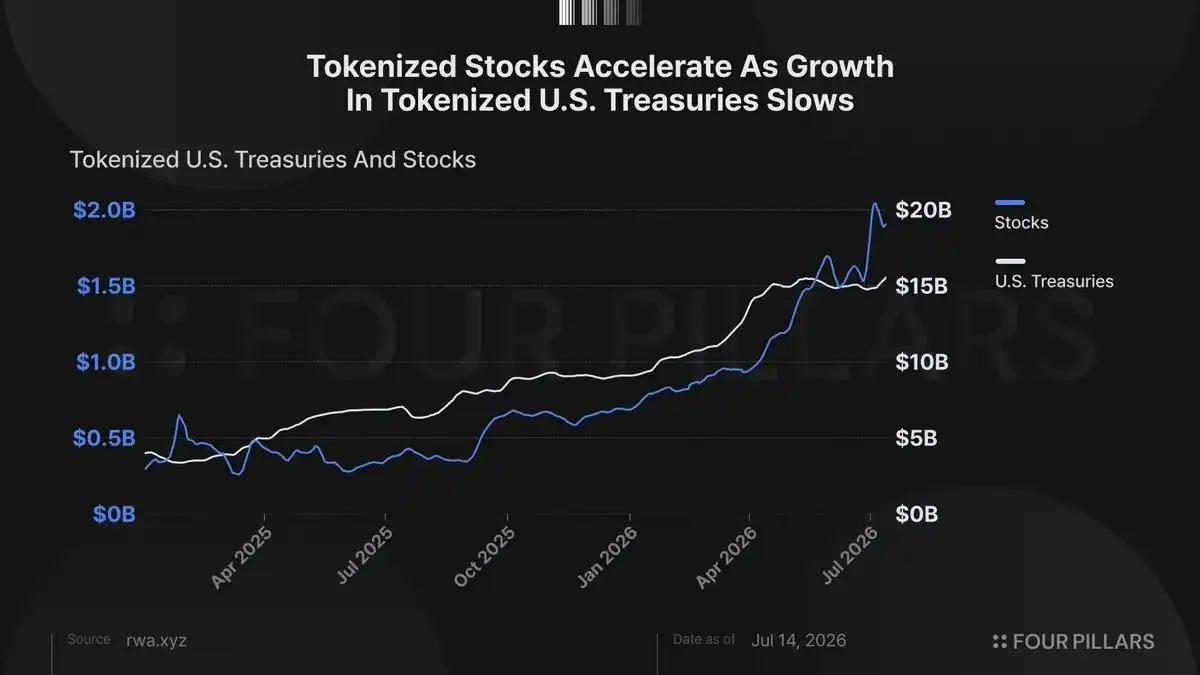
Tokenized U.S. Treasuries, once a major driver in the RWA market, have plateaued around $15 billion. Meanwhile, the tokenized stock market is rapidly expanding, growing 6.5x to approximately $1.9 billion since early 2025, attracting diverse players. The SEC's recent classification framework identifies four key tokenized security structures, applicable to stocks: 1. **Issuer-Sponsored:** Companies tokenize their own shares directly, preserving full shareholder rights but with stricter compliance (e.g., Securitize). 2. **Custodial:** A third party tokenizes securities held by a custodian like DTCC, also inheriting rights but reliant on traditional infrastructure (e.g., DTCC's pilot, Ondo's recent IVV tokenization). 3. **Linked Security:** A third party issues tokenized debt securities backed by the underlying stock, offering high on-chain flexibility but no voting rights (e.g., Ondo, xStocks, Robinhood's new Stock Tokens). 4. **Security-Based Swap:** Tokenized derivatives contracts providing synthetic exposure (e.g., Robinhood's earlier Classic Stock Tokens). Major players are pursuing different strategies. **Securitize** uses the issuer-sponsored model for full compliance. **Ondo** and **xStocks** leverage the linked security structure for wider accessibility and DeFi integration, though it fragments liquidity and excludes U.S. investors. **Robinhood** has shifted to a linked security model, aiming to leverage its user base and new blockchain. Traditional infrastructure ...

Author: 100y_eth

Compiled: AididiaoJP

Key Takeaways

Unlike the recently stagnant tokenized US Treasury market, the tokenized equity market is experiencing rapid expansion in both quantity and quality.

Players ranging from traditional equity infrastructure providers, fintech companies, crypto exchanges to Web3-native platforms all view tokenized equities as the next major opportunity in the RWA industry. In fact, there are multiple distinct paths to equity tokenization, and understanding their respective strengths, weaknesses, and positioning is crucial.

This article analyzes the strategies of players from diverse backgrounds, including Securitize, Ondo, xStocks, Robinhood, DTCC, NYSE, Nasdaq, and Coinbase.

All Eyes Are on Tokenized Equities
Today, regulators, banks, institutions, fintech companies, and nearly all major market participants show strong interest in tokenization. However, the term 'tokenization' truly becoming a focal point is a relatively recent phenomenon. The main driver behind the early growth of the tokenization market was undeniably US Treasuries. Their rapid adoption relied on three factors: the safety of US government debt, the relatively simple tokenization structure, and the high yields available at the time.

The tokenized US Treasury market grew from $701 million on January 1, 2024, to over $15 billion for the first time on April 17, 2026, representing an astonishing compound annual growth rate (CAGR) of approximately 3.81x. However, after surpassing $15 billion, the market has hovered around that level, showing a clear slowdown in growth. Given that a significant portion of the demand for tokenized Treasuries came from DeFi protocols or exchange margin use cases, the recent unfavorable market environment makes the demand stagnation unsurprising.

As the momentum for tokenized US Treasuries wanes, another tokenization segment is rapidly rising in both scale and quality—tokenized equities. The market has grown 6.5x, from $291 million on January 1, 2025, to approximately $1.9 billion currently, within a year and a half. At the industry level, whether it's Web3-native players like Securitize and Ondo Global Markets, financial companies like Robinhood and Coinbase, or financial infrastructure providers like DTCC, NYSE, and Nasdaq, they have either already launched tokenized equities or are actively preparing to do so.

What advantages do tokenized equities offer over the traditional stock market that make nearly all major US players see them as the next significant opportunity? At first glance, tokenizing stocks seems straightforward, but in practice, depending on the regulatory framework adopted, various tokenization structures emerge, each offering different benefits. To understand these differences, one must first clarify the SEC's classification framework for tokenized securities.

SEC's Classification Framework for Tokenized Securities
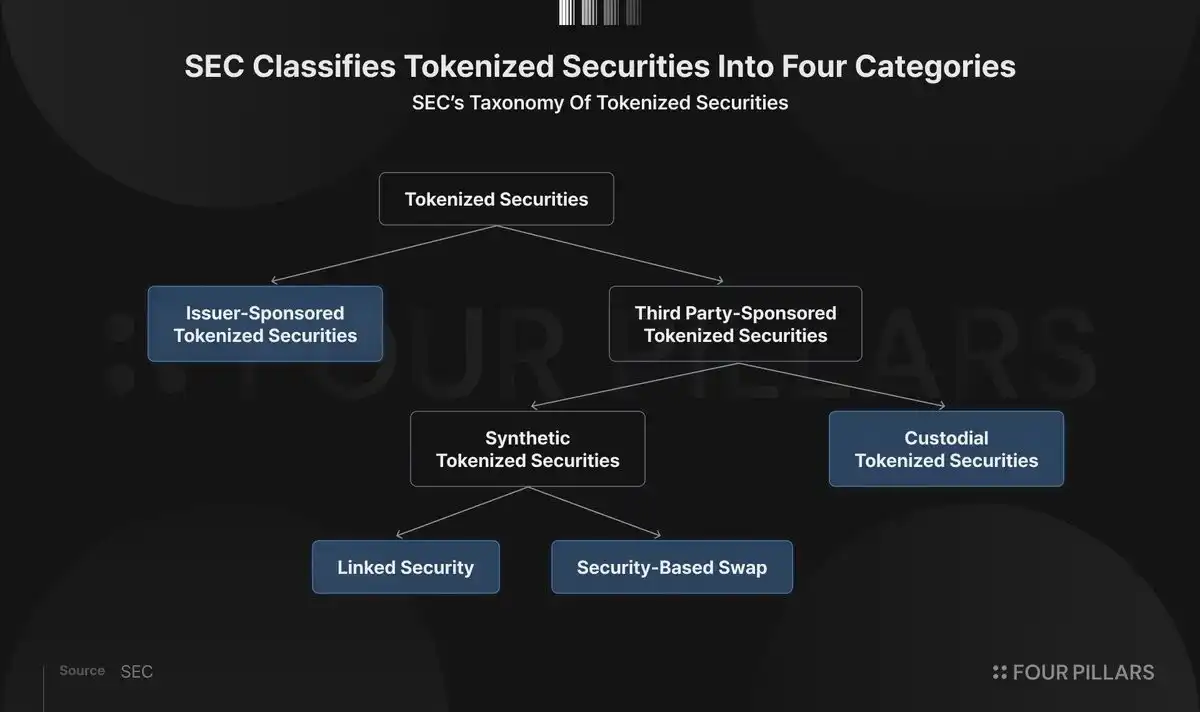
In January of this year, the SEC issued a statement proposing a classification framework for tokenized securities.

First, based on whether the tokenization is conducted by the security issuer itself or a third party, it is categorized into 'Issuer-Sponsored Tokenized Securities' and 'Third Party-Sponsored Tokenized Securities'.

Third Party-Sponsored Tokenized Securities are further subdivided: if the rights related to the underlying security itself are tokenized, it's 'Custodial Tokenized Securities'; if a separate tokenized product is issued that merely references the price, yield, events, or other characteristics of the underlying security, it's 'Synthetic Tokenized Securities'.

Synthetic types are then categorized by product type: if a third party issues an independent security (e.g., a debt security), it's a 'Linked Security'; if it involves entering into a derivative contract, it's a 'Security-Based Swap'.

Ultimately, under this framework, tokenized securities can be classified into the following four categories, which also apply to tokenized equities:

  • Issuer-Sponsored Tokenized Securities: The equity issuer itself, or its designated agent (e.g., a transfer agent), directly tokenizes and operates the security. The issuer (or its agent) connects a blockchain or other DLT system to the official shareholder registry for maintaining shareholder records. This approach does not fundamentally alter the existing legal framework and directly complies with current securities laws. The biggest advantage is that all shareholder rights, including ownership, are inherited by the token. However, strict compliance requirements somewhat limit usability. Primary representatives: Securitize, Superstate, Figure.
  • Custodial Tokenized Securities: A third party tokenizes the interest (indirect rights) in securities held at a depository (like DTCC) or broker-dealer. It similarly inherits all related rights but is highly reliant on existing stock market infrastructure; ownership remains indirect, offering relatively limited improvements over the traditional system. Primary representative: DTCC; Ondo recently used this method to tokenize IVV and MU.
  • Linked Securities: A third party issues and tokenizes an independent security (e.g., a debt security) that provides synthetic exposure to the underlying stock. Token holders only gain exposure to price performance and do not inherit other shareholder rights. The biggest advantage is high flexibility for on-chain use. Primary representatives: Ondo, xStocks, Robinhood Stock Tokens.
  • Security-Based Swaps: A third party issues a derivative contract providing synthetic exposure to the underlying stock and then tokenizes the contract. Like Linked Securities, it only provides exposure related to price, inheriting no other rights. Currently, almost the only major case is Robinhood Classic Stock Tokens.

Analysis of Major Tokenized Equity Platforms

Securitize: Taking the Most Direct Route

Securitize is currently the tokenization platform with the largest market share, with a tokenized RWA scale of $5.1 billion. Its flagship product is BlackRock's money market fund, BUIDL. Securitize holds SEC-registered broker-dealer, transfer agent, and ATS licenses and leverages these regulatory advantages to follow a 'Direct Tokenized Security' model. According to the SEC classification, this falls under 'Issuer-Sponsored Tokenized Securities'.

Recently, Securitize has also extended the same model to tokenized equities. When it listed its own stock SECZ via a SPAC, it used its own service to tokenize and issue $180 million worth of SECZ on-chain.

The advantages of this model are clear: existing stocks can be tokenized as-is while fully complying with current securities laws. Investors first directly register ownership of their shares, previously held through DTCC or brokers, via DRS. Then, Securitize, acting as the transfer agent, tokenizes these shares. The result is that the stock token shares the same CUSIP as the existing stock, inheriting not only economic rights but also all related rights like voting rights and claims on residual assets in bankruptcy.

However, precisely because the tokenized stock is essentially another form of the same security, it comes with corresponding drawbacks. Most importantly, the compliance requirements are stringent, and on-chain usage is relatively restricted. Unlike Ondo's or xStocks' tokenized equities, Securitize's stock tokens can only be transferred between whitelisted wallets that have passed KYC/AML checks, and on-chain interactions are only possible with a limited set of smart contracts pre-approved by the team.
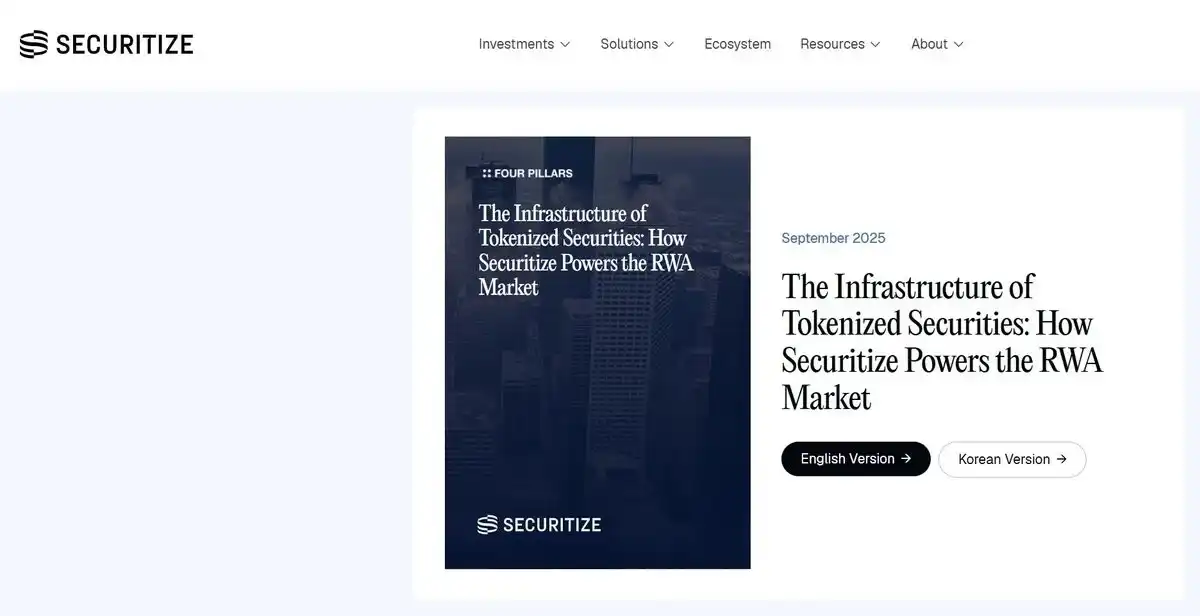
How does Securitize enforce KYC/AML and other compliance requirements on-chain? The answer is the DS Protocol. This is a set of smart contracts developed by Securitize that uses code to enforce compliance throughout the lifecycle of a tokenized security (issuance, transfer, usage, voting, dividends). Four Pillars previously published an in-depth research report on the DS Protocol, which is also featured on Securitize's website. Readers interested in understanding how tokenized securities operate at the smart contract level can refer to that report.

Other platforms tokenizing equities in a similar manner include Superstate and Figure. They all act as transfer agents for tokenization. The key difference lies in the type of stock being tokenized: Securitize and Superstate tokenize shares identical to existing stocks via the DRS system, while Figure issues a separate blockchain-native class of shares and then tokenizes that portion.

Ondo & xStocks: Expanding the Ecosystem with Broad Accessibility

Ondo and xStocks employ a structure where, when a user places an order for a stock token, an offshore SPV acquires the underlying shares and then issues tokenized debt securities backed by those shares.

Taking xStocks as an example. It has a Jersey-regulated SPV—Backed Assets (JE) Limited. When a user requests the issuance of a stock token via the platform, this SPV purchases the underlying shares through US-based Alpaca Securities and holds them in a segregated account at a regulated custodian. Subsequently, the SPV issues independent debt securities backed by these shares, tokenizes them, and delivers them to the user.

This structure falls under the 'Linked Securities' category in the SEC classification.
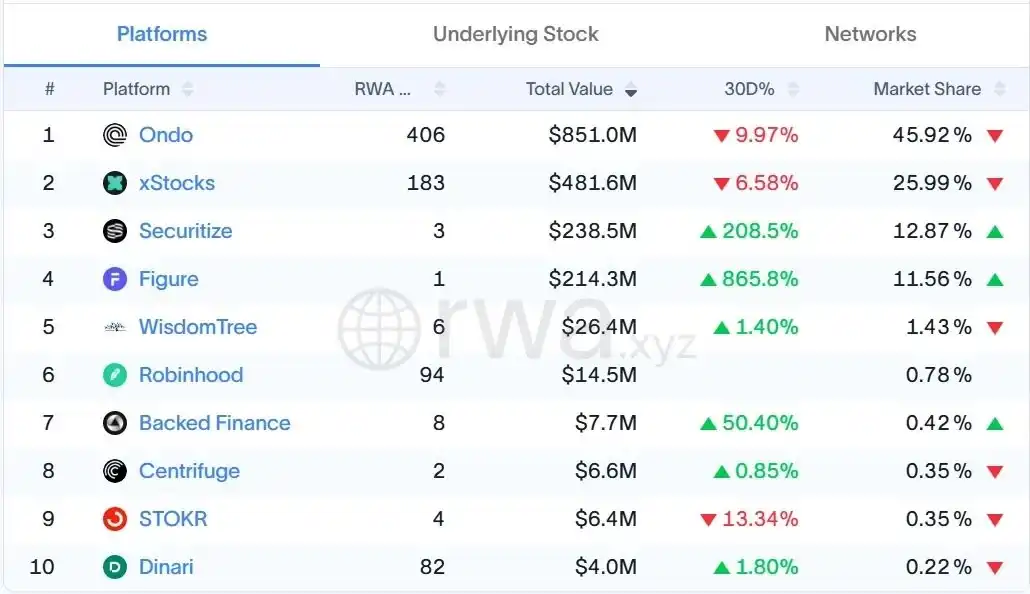
Currently, Ondo has tokenized 406 different stocks with a total value of approximately $851 million; xStocks has tokenized 183 stocks, valued at about $482 million. Their market shares in the tokenized equity segment are 45.9% and 26.0% respectively, firmly holding the top two positions.

The key to their rapid growth lies in the broad accessibility enabled by their tokenization structure. Strictly speaking, they are not tokenizing the stocks themselves but rather tokenizing debt securities issued by a third party and backed by the stocks. Therefore, compared to the issuer-sponsored model that directly tokenizes existing shares, this type of structure faces less stringent compliance requirements for distribution and secondary trading. Users can more freely trade and use the tokenized equities issued by Ondo and xStocks on CEXs and on-chain DeFi protocols. For instance, with xStocks, anyone can trade using a Web3 wallet via the Jupiter DEX or deposit them into lending protocols like Kamino as collateral to borrow stablecoins.

However, this indirect tokenization also creates issues: even if the underlying asset is the same, tokens issued by different platforms are not interoperable, leading to fragmented liquidity. For example, both backed by NVIDIA stock, Ondo issues NVDAon, and xStocks issues NVDAx; the two are not interchangeable. Additionally, due to reliance on Regulation S, US investors and persons are unable to use these services.

To address these limitations, Ondo recently acquired Oasis Pro, gaining broker-dealer, ATS, and transfer agent licenses, moving towards a more compliance-friendly tokenization model. In fact, Ondo has already used these licenses to tokenize shares of the IVV ETF and MU stock held in brokerage accounts via the 'Custodial Tokenized Securities' model, demonstrating the possibility of operating multiple structures in parallel.

Robinhood: Can the Latecomer Gain Traction?

An important new player has entered the tokenized equity ecosystem—Robinhood. It actually already provided tokenized equity services to European investors through Classic Stock Tokens. However, under the SEC classification, that structure is a 'Security-Based Swap': Robinhood enters into a derivative contract with the user referencing a stock and then tokenizes the contract into a receipt token. The entire structure is highly closed, usable only within the Robinhood App.

On July 1, 2026, Robinhood launched a new Stock Tokens service. Its tokenization structure adopts the 'Linked Securities' model, almost identical to Ondo's and xStocks' approaches, with largely similar advantages and disadvantages.

While the structure is the same, the potential Robinhood brings is clear: its product DNA and massive existing user base. Concurrently with launching Stock Tokens, Robinhood also launched the Robinhood Chain mainnet, centered around Stock Tokens. US users can also deposit stablecoins into Morpho on the Robinhood Chain via the Robinhood App to earn 7% interest. Although entering the market later than Ondo and xStocks, with its product iteration capabilities and ecosystem expansion potential, Robinhood still has the opportunity to scale up rapidly.

DTCC, NYSE, Nasdaq: Signals of Financial Infrastructure Transformation

It's not just platforms and companies considering equity tokenization. Key settlement and trading infrastructure providers in the traditional stock market—DTCC, NYSE, Nasdaq—are also moving towards tokenization.

The DTC, a subsidiary of DTCC, has received a no-action letter from the SEC, permitting the tokenization of some securities held at DTC on pre-approved blockchains. DTC expects this to enhance collateral liquidity, extend trading hours, improve operational and settlement efficiency, and enable programmability and real-time auditing. On July 15, DTCC also conducted limited tokenization of securities like QQQ and SPY in a live securities infrastructure environment, successfully completing trades and collateral transfers.

The NYSE submitted a rule change proposal to the SEC in April 2026 to support DTC's tokenization pilot, allowing stocks to settle in tokenized form. Additionally, the NYSE is developing a new regulated exchange—the Digital Trading Platform—aiming to use blockchain infrastructure to enable 7x24 trading of US stocks and ETFs, with support for stablecoin funding. In March 2026, the NYSE also signed a Memorandum of Understanding with Securitize, designating Securitize as the first potential digital transfer agent for this new platform.

Nasdaq received SEC rule change approval in March 2026, allowing stocks in the DTC tokenization pilot to trade and settle in tokenized form on its exchange. Nasdaq is also collaborating with Payward, the parent company of Kraken, to design a gateway service enabling issuers and investors to transfer shares between the regulated Nasdaq market and the permissionless blockchain environment.

Coinbase: Which Path Will It Take?

The final player worth watching is Coinbase. It has not yet launched a tokenized equities service but has stated multiple times since last year its intention to do so. In February of this year, Coinbase launched 5x24 trading for traditional stocks in the US; at an event in June, it announced it would soon offer tokenized equities.
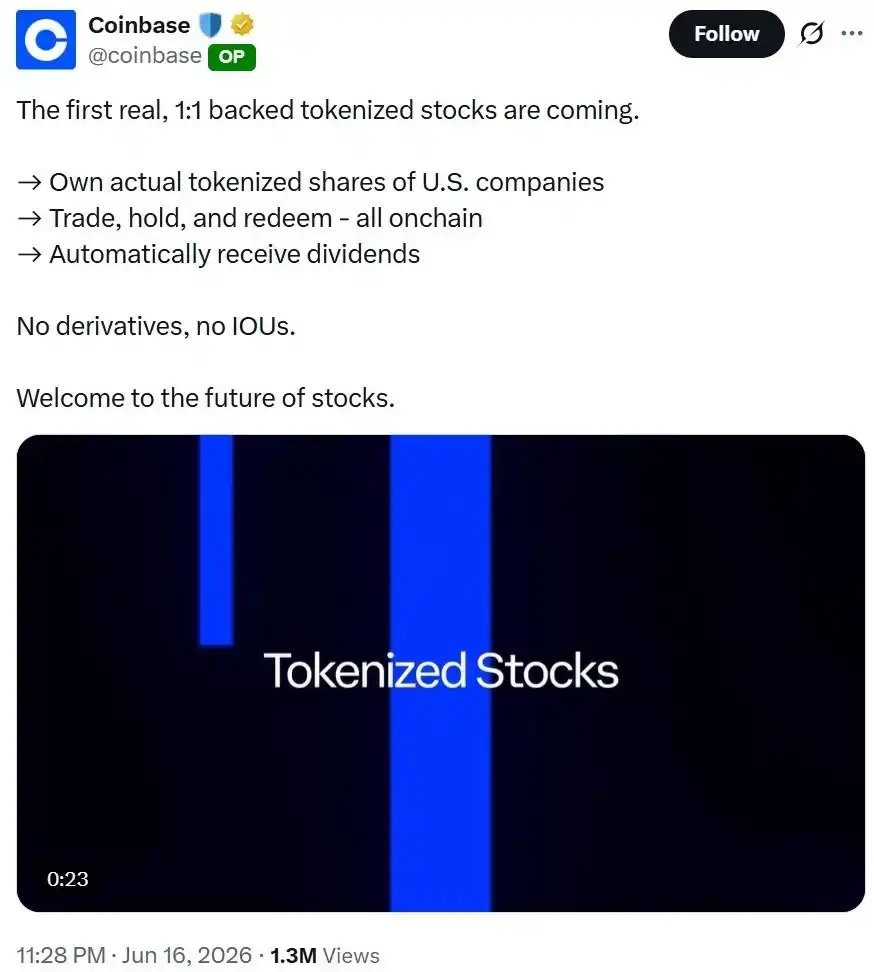
The industry is highly focused on what structure Coinbase will use to tokenize equities. Coinbase has stated that its service will not only ensure the tokens are 1:1 backed by real stocks but will also provide shareholder rights, though the specific structure has not been disclosed in detail. More crucially, it explicitly stated these stock tokens would be usable on-chain while not being available to US customers.

If adopting an issuer-sponsored structure, tokens typically inherit all shareholder rights, are open to US customers, but have relatively restricted on-chain usability. The combination of 'broad on-chain usability + exclusion of US customers' resembles the approach taken by third-party structures (like Linked Securities). It is worth monitoring which structure Coinbase ultimately chooses to tokenize equities and how it will leverage its own exchange infrastructure to expand the tokenized equity ecosystem.

Competing on the Same Battlefield

The goal of financial services is clear: to allow anyone, anywhere, anytime, to trade all types of assets through a single backend and frontend. On the surface, today's financial services seem close to this goal, but in reality, integration mostly happens on the frontend, while the backend remains fragmented.

Stocks, as one of many asset classes, are no exception. Robinhood, which started with stock trading; Coinbase, which started with crypto trading; traditional stock infrastructure providers DTCC/NYSE/Nasdaq; and Web3-native players like Securitize, Ondo, and xStocks—their tokenization structures and strategic directions differ, yet they are all moving towards the same North Star: tokenized equities.

What needs to be closely observed next is how the US and other jurisdictions view tokenized equities, how the regulatory framework evolves, and how these changes will reshape the competitive landscape for all parties. Also, whether tokenized equities can become the next major catalyst driving the expansion of the entire RWA sector after tokenized US Treasuries.

The Korean market is also worth watching: despite high retail trading activity, the development of the RWA industry has been relatively slow. How discussions around tokenized equities will unfold in Korea deserves ongoing tracking.

Crypto di tendenza

Domande pertinenti

QAccording to the article, what is the main reason for the slowdown in the growth of tokenized U.S. Treasury market?

AThe main reason for the slowdown is unfavorable market conditions, as a significant portion of the demand came from DeFi protocols or exchange margin scenarios, and this demand has stagnated.

QHow does the SEC classify tokenized securities based on who sponsors the tokenization?

AThe SEC classifies tokenized securities into two primary categories based on the sponsor: 'Issuer-Sponsored Tokenized Securities' (sponsored by the security issuer itself) and 'Third Party-Sponsored Tokenized Securities' (sponsored by a third party).

QWhat is the key advantage of the 'Issuer-Sponsored Tokenized Securities' model, as exemplified by Securitize, for tokenizing stocks?

AThe key advantage is that the token inherits all shareholder rights, including economic rights, voting rights, and claims to residual assets in bankruptcy, as it represents the same stock under the existing legal framework.

QWhat is a major limitation for U.S.-based investors regarding the tokenized stock products from Ondo and xStocks, and why?

AA major limitation is that U.S. investors and persons cannot use these products because they rely on Regulation S for their issuance, which restricts availability to non-U.S. investors.

QWhat new strategic move did Ondo make to address limitations in its initial tokenized stock model and move towards a more compliance-friendly approach?

AOndo acquired Oasis Pro to obtain broker-dealer, ATS, and transfer agent licenses. This allows Ondo to utilize a 'Custodial Tokenized Securities' model for more compliant tokenization, as demonstrated with the tokenization of IVV ETF and MU stock holdings.

Letture associate

China Monopolizes the Humanoid Market: The U.S. is Forced to Defend Itself

China accounted for over 97% of global humanoid robot shipments in the first half of 2026, according to research firm Smart Analytics Global (SAG). Global shipments reached approximately 19,100 units, a 272% increase year-over-year, with China itself representing over 85% of global demand. Shanghai-based AGIBOT led the market with a 44% share, followed by Hangzhou's Unitree Robotics at 31%. Together, these two Chinese firms controlled about 75% of global supply. Demand is shifting from research to practical applications, with industrial and commercial uses now comprising over 70% of shipments. SAG forecasts full-year 2026 shipments near 60,000 units. In response, the U.S. Federal Communications Commission (FCC) banned federal agencies and subsidy recipients from purchasing foreign "advanced robotic devices," including humanoids, citing national security concerns. Analysts attribute China's dominance to strong state support, abundant funding, expanding manufacturing capacity, IPO waves, and a vast domestic ecosystem for testing and deployment. Over 90% of key components for Chinese humanoid robots are now sourced domestically. The AI analysis notes potential risks beyond export controls, such as reputational issues for Chinese firms linked to the defense sector and parallels to past trade conflicts in sectors like solar panels, where rapid Chinese market capture led to protectionist measures. The low average robot price could fuel adoption but also invite dumping accusations.

cryptonews.ru8 min fa

China Monopolizes the Humanoid Market: The U.S. is Forced to Defend Itself

cryptonews.ru8 min fa

Trading

Spot

Articoli Popolari

Cosa è ETH 3.0

ETH3.0 e $eth 3.0: Un'Analisi Approfondita del Futuro di Ethereum Introduzione Nel panorama in rapida evoluzione delle criptovalute e della tecnologia blockchain, ETH3.0, spesso indicato come $eth 3.0, è emerso come un argomento di considerevole interesse e speculazione. Il termine comprende due concetti principali che warrantono chiarimenti: Ethereum 3.0: Questo rappresenta un potenziale futuro aggiornamento volto ad aumentare le capacità dell'attuale blockchain di Ethereum, concentrandosi principalmente sul miglioramento della scalabilità e delle prestazioni. ETH3.0 Meme Token: Questo progetto di criptovaluta distinto cerca di sfruttare la blockchain di Ethereum per creare un ecosistema incentrato sui meme, promuovendo il coinvolgimento all'interno della comunità delle criptovalute. Comprendere questi aspetti di ETH3.0 è essenziale non solo per gli appassionati di criptovalute, ma anche per coloro che osservano tendenze tecnologiche più ampie nello spazio digitale. Che cos'è ETH3.0? Ethereum 3.0 Ethereum 3.0 è pubblicizzato come un aggiornamento proposto per la rete Ethereum già stabilita, che è stata la spina dorsale di molte applicazioni decentralizzate (dApps) e contratti smart sin dalla sua nascita. I miglioramenti previsti si concentrano principalmente sulla scalabilità, integrando tecnologie avanzate come lo sharding e le prove a conoscenza zero (zk-proofs). Queste innovazioni tecnologiche mirano a facilitare un numero senza precedenti di transazioni al secondo (TPS), potenzialmente raggiungendo milioni, affrontando così una delle limitazioni più significative della tecnologia blockchain attuale. Il miglioramento non è meramente tecnico, ma anche strategico; è volto a preparare la rete Ethereum per un'adozione e un'utilità diffuse in un futuro contrassegnato da un aumento della domanda di soluzioni decentralizzate. ETH3.0 Meme Token Al contrario di Ethereum 3.0, l'ETH3.0 Meme Token si avventura in un dominio più leggero e giocoso, combinando la cultura dei meme di internet con la dinamica delle criptovalute. Questo progetto consente agli utenti di acquistare, vendere e scambiare meme sulla blockchain di Ethereum, fornendo una piattaforma che promuove il coinvolgimento della comunità attraverso la creatività e interessi condivisi. L'ETH3.0 Meme Token mira a dimostrare come la tecnologia blockchain possa intersecarsi con la cultura digitale, creando casi d'uso che siano sia divertenti che finanziariamente praticabili. Chi è il Creatore di ETH3.0? Ethereum 3.0 L'iniziativa verso Ethereum 3.0 è principalmente propulsa da un consorzio di sviluppatori e ricercatori all'interno della comunità di Ethereum, tra cui Justin Drake. Conosciuto per le sue intuizioni e contributi all'evoluzione di Ethereum, Drake è stato una figura di spicco nelle discussioni riguardanti la transizione di Ethereum verso un nuovo livello di consenso, chiamato “Beam Chain.” Questo approccio collaborativo allo sviluppo significa che Ethereum 3.0 non è il prodotto di un creatore singolo, ma piuttosto una manifestazione di ingegno collettivo focalizzato sul progresso della tecnologia blockchain. ETH3.0 Meme Token I dettagli riguardanti il creatore dell'ETH3.0 Meme Token sono attualmente non rintracciabili. La natura dei token meme conduce spesso a una struttura più decentralizzata e guidata dalla comunità, il che potrebbe spiegare la mancanza di attribuzione specifica. Questo si allinea con l'etica della comunità crypto più ampia, dove l'innovazione spesso nasce da sforzi collaborativi piuttosto che individuali. Chi sono gli Investitori di ETH3.0? Ethereum 3.0 Il supporto per Ethereum 3.0 proviene principalmente dalla Ethereum Foundation insieme a una comunità entusiasta di sviluppatori e investitori. Questa associazione fondamentale fornisce un considerevole grado di legittimità e migliora le prospettive di implementazione di successo poiché sfrutta la fiducia e la credibilità costruite nel corso degli anni di operazioni della rete. Nel clima in rapida evoluzione delle criptovalute, il supporto della comunità gioca un ruolo cruciale nello sviluppo e nell'adozione, posizionando Ethereum 3.0 come un serio contenditore per i futuri progressi della blockchain. ETH3.0 Meme Token Sebbene le fonti attualmente disponibili non forniscano informazioni esplicite riguardo ai fondamenti o alle organizzazioni di investimento che sostengono l'ETH3.0 Meme Token, ciò è indicativo del modello di finanziamento tipico per i token meme, che spesso si basa sul supporto di base e sul coinvolgimento della comunità. Gli investitori in tali progetti sono tipicamente individui motivati dal potenziale per innovazioni guidate dalla comunità e dallo spirito di cooperazione trovato all'interno della comunità crypto. Come Funziona ETH3.0? Ethereum 3.0 Le caratteristiche distintive dell'Ethereum 3.0 risiedono nella sua proposta di implementazione della tecnologia di sharding e zk-proof. Lo sharding è un metodo di partizionamento della blockchain in pezzi più piccoli e gestibili o “shard,” che possono elaborare transazioni in modo concorrente piuttosto che sequenziale. Questa decentralizzazione dell'elaborazione aiuta a prevenire la congestione e garantisce che la rete rimanga reattiva anche sotto un carico pesante. La tecnologia delle prove a conoscenza zero (zk-proof) contribuisce con un ulteriore livello di sofisticazione consentendo la validazione delle transazioni senza rivelare i dati sottostanti coinvolti. Questo aspetto non solo migliora la privacy, ma aumenta anche l'efficienza complessiva della rete. Si parla anche di incorporare una macchina virtuale Ethereum a conoscenza zero (zkEVM) in questo aggiornamento, amplificando ulteriormente le capacità e l'utilità della rete. ETH3.0 Meme Token L'ETH3.0 Meme Token si distingue capitalizzando sulla popolarità della cultura dei meme. Stabilisce un mercato per gli utenti che desiderano partecipare al trading di meme, non solo per divertimento, ma anche per potenziale guadagno economico. Integrando funzioni come lo staking, la fornitura di liquidità e meccanismi di governance, il progetto promuove un ambiente che incentiva l'interazione e la partecipazione della comunità. Offrendo una miscela unica di intrattenimento e opportunità economica, l'ETH3.0 Meme Token mira ad attrarre un pubblico variegato, che va dagli appassionati di crypto ai semplici intenditori di meme. Timeline di ETH3.0 Ethereum 3.0 11 Novembre 2024: Justin Drake accenna al prossimo aggiornamento ETH 3.0, incentrato sui miglioramenti della scalabilità. Questo annuncio segna l'inizio delle discussioni formali riguardo l'architettura futura di Ethereum. 12 Novembre 2024: La proposta attesa per Ethereum 3.0 dovrebbe essere svelata a Devcon a Bangkok, preparando il terreno per un feedback più ampio della comunità e potenziali passi successivi nello sviluppo. ETH3.0 Meme Token 21 Marzo 2024: L'ETH3.0 Meme Token viene ufficialmente elencato su CoinMarketCap, segnando il suo ingresso nel dominio pubblico delle criptovalute e aumentando la visibilità per il suo ecosistema basato sui meme. Punti Chiave In conclusione, Ethereum 3.0 rappresenta una significativa evoluzione all'interno della rete Ethereum, concentrandosi sul superamento delle limitazioni riguardanti scalabilità e prestazioni attraverso tecnologie avanzate. I suoi aggiornamenti proposti riflettono un approccio proattivo alle future esigenze e usabilità. D'altra parte, l'ETH3.0 Meme Token incarna l'essenza della cultura guidata dalla comunità nello spazio delle criptovalute, sfruttando la cultura dei meme per creare piattaforme coinvolgenti che incoraggiano la creatività e la partecipazione degli utenti. Comprendere gli scopi e le funzionalità distinte di ETH3.0 e $eth 3.0 è fondamentale per chiunque sia interessato ai continui sviluppi nello spazio crypto. Con entrambe le iniziative che tracciano percorsi unici, esse sottolineano collettivamente la natura dinamica e multifacetica dell'innovazione blockchain.

309 Totale visualizzazioniPubblicato il 2024.04.04Aggiornato il 2024.12.03

Cosa è ETH 3.0

Cosa è ETHEREUM

HarryPotterTrumpHomerSimpson777Inu: Panoramica di un Progetto Crypto Web3 Introduzione Nel mondo in rapida evoluzione delle criptovalute e della finanza decentralizzata, progetti innovativi emergono frequentemente, catturando l'interesse della comunità degli investitori e degli appassionati di crypto. Uno di questi progetti è HarryPotterTrumpHomerSimpson777Inu, una criptovaluta che si trova all'incrocio tra cultura popolare e tecnologia blockchain. Questo token guidato dalla comunità mescola personaggi e figure politiche ben noti, con l'obiettivo di creare una piattaforma coinvolgente e promuovere un'adozione diffusa. Che cos'è HarryPotterTrumpHomerSimpson777Inu? HarryPotterTrumpHomerSimpson777Inu è un token costruito sulla blockchain di Ethereum, progettato per essere accessibile e divertente per un pubblico diversificato. L'unicità di questo progetto deriva dal suo approccio tematico, che intreccia elementi di fantasia, politica e intrattenimento. Sfruttando il fascino nostalgico di personaggi amati, il progetto cerca di creare un'esperienza di criptovaluta coinvolgente, incoraggiando il coinvolgimento e la partecipazione della comunità. L'obiettivo principale di HarryPotterTrumpHomerSimpson777Inu è stabilire un token che risuoni con gli utenti a livello personale, promuovendo sia il divertimento che il coinvolgimento nell'ambito crypto. Questo branding distintivo mira ad attrarre individui che in precedenza potrebbero non essersi interessati alle criptovalute, facilitando un nuovo punto di ingresso per utenti potenziali. Creatore di HarryPotterTrumpHomerSimpson777Inu L'identità del creatore dietro HarryPotterTrumpHomerSimpson777Inu rimane sconosciuta. Questa non è una pratica rara nel dominio delle criptovalute, dove l'anonimato è spesso preferito dai fondatori come mezzo di protezione della privacy e promozione di un ethos decentralizzato. Questa oscurità non diminuisce il valore del progetto; al contrario, riflette una tendenza più ampia all'interno del settore, dove molti progetti di successo sono emersi da origini anonime. Investitori di HarryPotterTrumpHomerSimpson777Inu Le informazioni pubbliche riguardo agli investitori di HarryPotterTrumpHomerSimpson777Inu sono limitate. La natura del progetto, incentrata sul coinvolgimento della comunità, suggerisce una dipendenza da investimenti di piccole dimensioni da parte di singoli appassionati piuttosto che da sostegni sostanziali da fondazioni di investimento consolidate o corporation. Questo livello di trasparenza nel finanziamento è tipico di molti progetti di criptovaluta guidati dalla comunità, dove il supporto spesso proviene da movimenti di base piuttosto che da investitori istituzionali. Come Funziona HarryPotterTrumpHomerSimpson777Inu? Operando sulla blockchain di Ethereum, HarryPotterTrumpHomerSimpson777Inu sfrutta la sua solida infrastruttura per facilitare transazioni e promuovere interazioni tra gli utenti all'interno della comunità. Ciò che distingue questo progetto è il suo posizionamento tematico: canalizzando il carisma di personaggi iconici provenienti da diversi ambiti culturali, crea un'identità di marca distintiva. Questo approccio non solo attrae gli utenti, ma coltiva anche una comunità fedele attorno al token. Le meccaniche operative del progetto si concentrano sul coinvolgimento della comunità. Adotta un modello decentralizzato che incoraggia la partecipazione, consentendo agli utenti di interagire attraverso vari canali mentre promuovono lo scambio di idee e esperienze. Inoltre, il progetto abbraccia i principi del Web3, privilegiando la sovranità degli utenti e la decentralizzazione, che sono i pilastri del futuro di Internet. Timeline di HarryPotterTrumpHomerSimpson777Inu La storia di HarryPotterTrumpHomerSimpson777Inu è segnata da diversi eventi decisivi: 12 agosto 2023: L'inizio di HarryPotterTrumpHomerSimpson777Inu, segnando il suo ingresso nell'ecosistema delle criptovalute. Fase di Sviluppo: Un periodo focalizzato sulla costruzione di una strategia completa per stimolare la crescita guidata dalla comunità e il coinvolgimento degli utenti. Listing sugli Scambi: Sebbene i dettagli specifici di listing non siano stati divulgati, il progetto è stato reso accessibile su vari scambi di criptovalute, migliorando la sua visibilità nel mercato. Coinvolgimento della Comunità: Sforzi continui per coinvolgere attivamente la comunità, stabilendo canali di dialogo e promuovendo la partecipazione attraverso varie attività, tra cui concorsi, discussioni e votazioni comunitarie. Aspetti Chiave di HarryPotterTrumpHomerSimpson777Inu Focus sulla Comunità Un tratto distintivo di HarryPotterTrumpHomerSimpson777Inu è la sua forte enfasi sul coinvolgimento della comunità. Il progetto incoraggia attivamente gli utenti a partecipare a discussioni, condividere idee e contribuire all'evoluzione del progetto. Questa interazione coltiva un senso di appartenenza e di ownership tra i membri della comunità, essenziale per la sostenibilità a lungo termine del token. Utilizzo della Blockchain di Ethereum La scelta di costruire sulla blockchain di Ethereum consente a HarryPotterTrumpHomerSimpson777Inu di sfruttare le sue caratteristiche di sicurezza ben consolidate e architettura decentralizzata. Questa base garantisce affidabilità per le transazioni e fornisce un framework affidabile su cui sviluppare varie funzionalità. Approccio Tematico Unico Fusione di elementi della cultura pop nella sua identità, HarryPotterTrumpHomerSimpson777Inu crea una narrazione coinvolgente che lo differenzia da altre criptovalute. L'amalgama di personaggi e temi genera riconoscimento e intrigo immediati, rendendo il token relazionabile a un'ampia gamma di utenti potenziali. Anonimato nello Sviluppo Il creatore anonimo del progetto rimane una caratteristica ricorrente in molte iniziative di criptovaluta. Questo aspetto evidenzia un ethos di decentralizzazione, introducendo anche un livello di mistero che potrebbe affascinare un segmento della comunità crypto, attirando l'attenzione sul progetto e invitando l'impegno da parte di utenti che supportano l'idea di un'iniziativa decentralizzata e gestita dalla comunità. Conclusione HarryPotterTrumpHomerSimpson777Inu si presenta come un'aggiunta distintiva al panorama delle criptovalute, combinando il fascino della cultura popolare con le meccaniche innovative della tecnologia blockchain. Sebbene i dettagli riguardanti il creatore e gli investitori specifici rimangano non divulgati, il focus del progetto sulla comunità e il suo approccio tematico lo contraddistinguono come un potenziale attore influente nel contesto del Web3 e delle criptovalute. Man mano che l'ecosistema delle criptovalute continua ad espandersi, iniziative come HarryPotterTrumpHomerSimpson777Inu ci ricordano le molteplici modalità in cui la blockchain può connettere le comunità globali attraverso narrazioni e valori condivisi.

1.2k Totale visualizzazioniPubblicato il 2024.04.06Aggiornato il 2024.12.03

Cosa è ETHEREUM

Come comprare ETH

Benvenuto in HTX.com! Abbiamo reso l'acquisto di Ethereum (ETH) semplice e conveniente. Segui la nostra guida passo passo per intraprendere il tuo viaggio nel mondo delle criptovalute.Step 1: Crea il tuo Account HTXUsa la tua email o numero di telefono per registrarti il tuo account gratuito su HTX. Vivi un'esperienza facile e sblocca tutte le funzionalità,Crea il mio accountStep 2: Vai in Acquista crypto e seleziona il tuo metodo di pagamentoCarta di credito/debito: utilizza la tua Visa o Mastercard per acquistare immediatamente EthereumETH.Bilancio: Usa i fondi dal bilancio del tuo account HTX per fare trading senza problemi.Terze parti: abbiamo aggiunto metodi di pagamento molto utilizzati come Google Pay e Apple Pay per maggiore comodità.P2P: Fai trading direttamente con altri utenti HTX.Over-the-Counter (OTC): Offriamo servizi su misura e tassi di cambio competitivi per i trader.Step 3: Conserva Ethereum (ETH)Dopo aver acquistato Ethereum (ETH), conserva nel tuo account HTX. In alternativa, puoi inviare tramite trasferimento blockchain o scambiare per altre criptovalute.Step 4: Scambia Ethereum (ETH)Scambia facilmente Ethereum (ETH) nel mercato spot di HTX. Accedi al tuo account, seleziona la tua coppia di trading, esegui le tue operazioni e monitora in tempo reale. Offriamo un'esperienza user-friendly sia per chi ha appena iniziato che per i trader più esperti.

3.2k Totale visualizzazioniPubblicato il 2024.12.10Aggiornato il 2026.06.02

Come comprare ETH

Discussioni

Benvenuto nella Community HTX. Qui puoi rimanere informato sugli ultimi sviluppi della piattaforma e accedere ad approfondimenti esperti sul mercato. Le opinioni degli utenti sul prezzo di ETH ETH sono presentate come di seguito.

活动图片