Tokenization will disrupt finance faster than digital disrupted media: Crypto exec

cointelegraphPubblicato 2025-12-21Pubblicato ultima volta 2025-12-21

Introduzione

Tokenization will transform finance faster than digital technology disrupted media, according to MoonPay president Keith Grossman. He argues that real-world asset (RWA) tokenization will force traditional financial firms to adapt, citing examples like BlackRock and Franklin Templeton already offering tokenized funds. Major banks are also exploring onchain settlements. Grossman believes institutions that embrace this shift will succeed, while those resisting will fall behind. Benefits include 24/7 market access, global scalability, lower costs, and near-instant settlements. Regulatory progress, such as the SEC and CFTC working on round-the-clock market frameworks and the DTCC’s approval to launch tokenized U.S. Treasuries by 2026, signals accelerating adoption.

Tokenization will transform the financial industry faster than digital technology disrupted legacy media, such as print newspapers, physical copies of music and other analog formats, according to Keith Grossman, president of crypto payments company MoonPay.

“While many feared digitization would destroy media, what it actually did was force its evolution,” Grossman said, adding that real-world asset (RWA) tokenization, the process of representing traditional assets onchain, will force traditional institutions to adapt. He added:

“This is no longer hypothetical. BlackRock is offering tokenized funds. Franklin Templeton is running tokenized money market funds on public blockchains. Major global banks are piloting onchain settlement, tokenized deposits and real-time asset movement.”
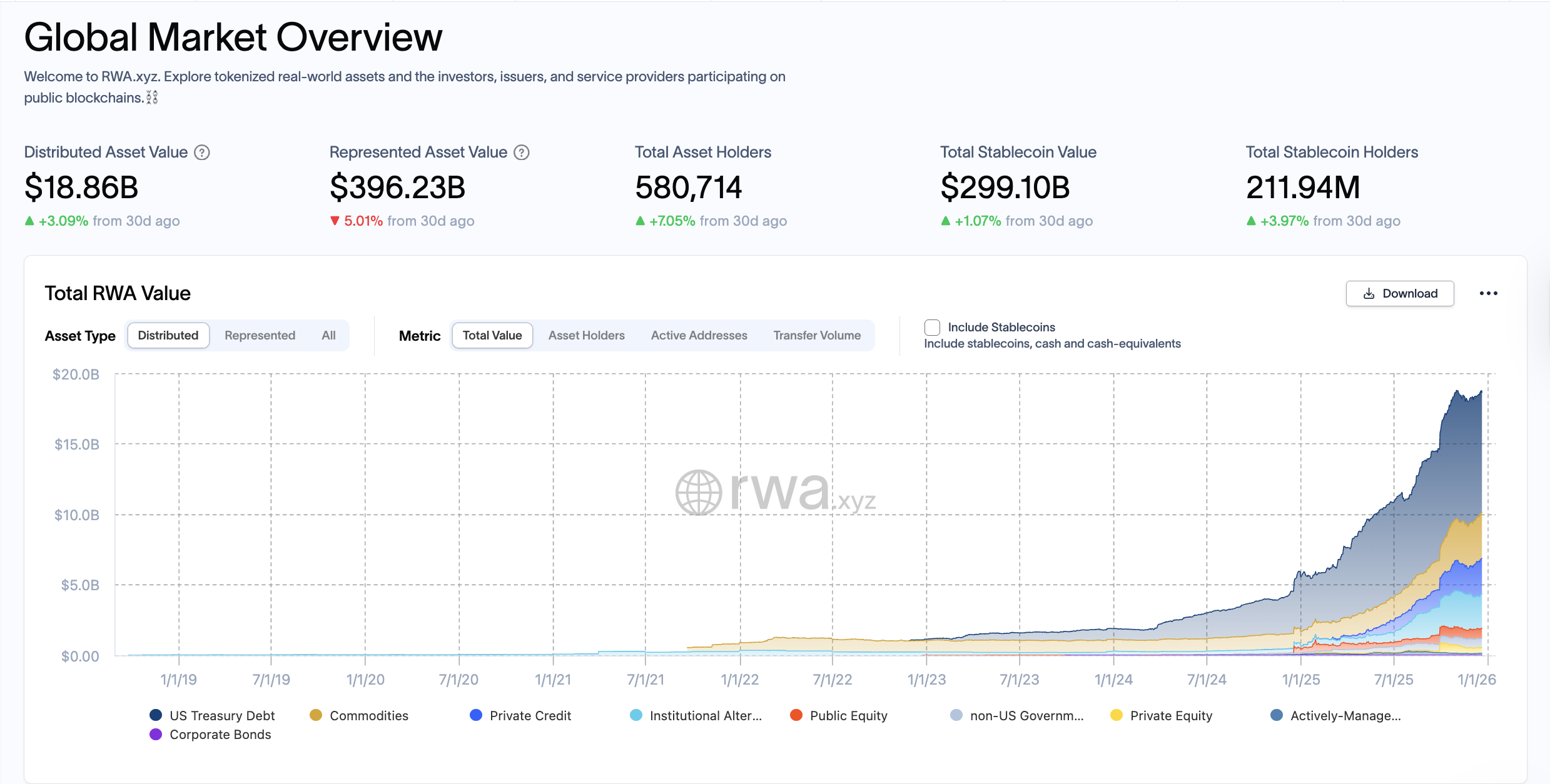
The market capitalization of the RWA sector, excluding stablecoins, is nearly $19 billion at the time of this writing. Source: RWA.XYZ

Financial incumbents like Citi, Bank of America, JPMorgan Chase and others will continue to exist in a different form, Grossman said, much like media companies continued to exist after the shift to digital distribution in the late 1990s and early 2000s, which disrupted business models that worked for decades.

Ultimately, the survivors and winners of the ongoing shift toward tokenized finance will be those companies that get ahead of the change and not those that attempt to stop the inevitable shift to a global financial system powered through blockchain rails, he said.

Related: Wall Street’s $4 quadrillion backbone to roll out tokenized US Treasurys

Why tokenized assets can change the game

Tokenizing real-world assets carries several benefits, including enabling 24/7 access to markets, making asset classes global in scale, cheaper transaction costs through disintermediation, and lowering settlement times to minutes, instead of days.

In September, the United States Securities and Exchange Commission (SEC) and the Commodity Futures Trading Commission (CFTC) issued a joint statement on creating a regulatory framework to enable 24/7 capital markets.
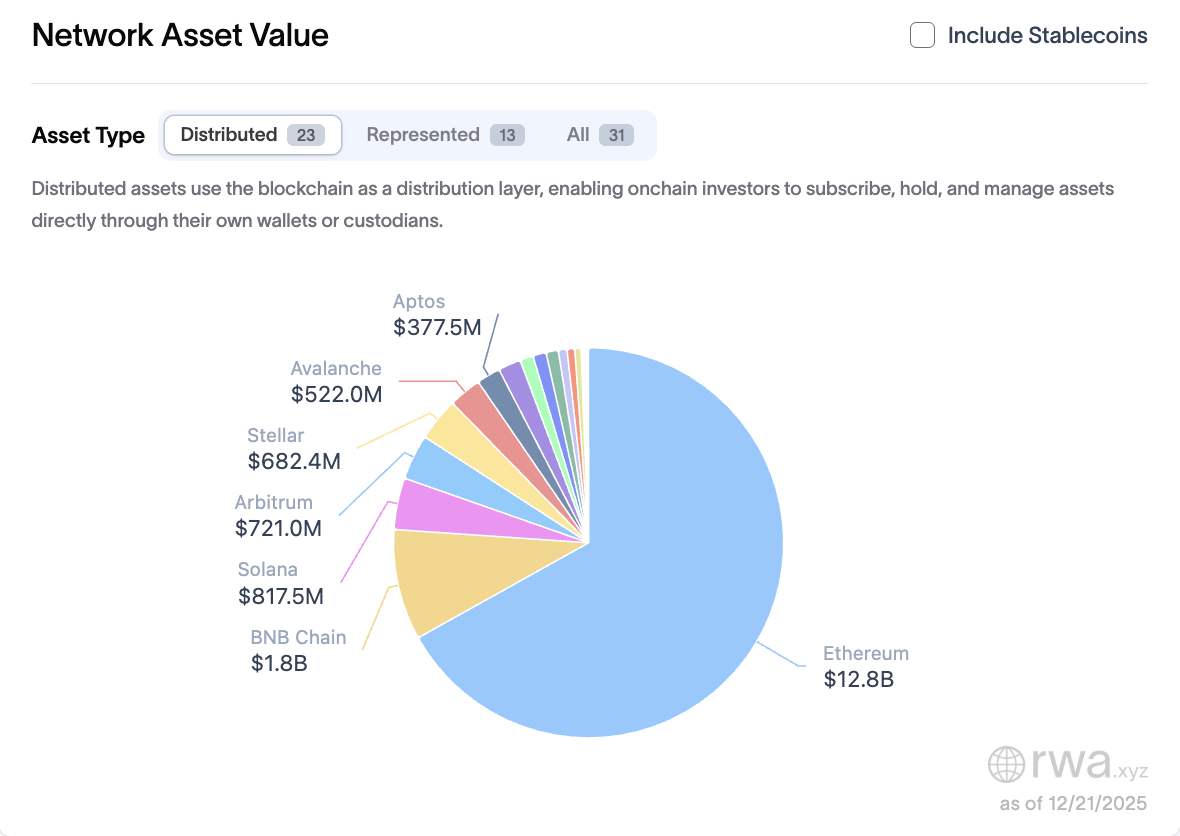
The overwhelming majority of tokenized RWA value has found its home on the Ethereum network. Source: RWA.XYZ

The financial system shifting to 24/7 trading represents a major departure from how traditional markets, which close on nights, weekends and holidays, currently operate.

In December, the Depository Trust and Clearing Corporation (DTCC), a settlement and clearing company that processed about $3.7 quadrillion in settlement volume in 2024, received approval from the SEC to start offering tokenized financial instruments.

The DTCC plans to roll out tokenized assets in the second half of 2026, starting with US Treasuries and stock indexes.

Magazine: Unstablecoins: Depegging, bank runs and other risks loom

Domande pertinenti

QAccording to Keith Grossman, how will tokenization impact the financial industry compared to digital technology's effect on media?

AKeith Grossman believes that tokenization will transform the financial industry faster than digital technology disrupted legacy media, such as print newspapers and physical music copies.

QWhat are some examples of major financial institutions already involved in tokenization, as mentioned in the article?

ABlackRock is offering tokenized funds, Franklin Templeton is running tokenized money market funds on public blockchains, and major global banks are piloting onchain settlement, tokenized deposits, and real-time asset movement.

QWhat key benefits does tokenizing real-world assets provide, according to the article?

ATokenizing real-world assets enables 24/7 access to markets, makes asset classes global, reduces transaction costs through disintermediation, and lowers settlement times to minutes instead of days.

QWhich organization, responsible for processing about $3.7 quadrillion in settlement volume in 2024, received SEC approval to offer tokenized financial instruments?

AThe Depository Trust and Clearing Corporation (DTCC) received approval from the SEC to start offering tokenized financial instruments.

QOn which blockchain network is the overwhelming majority of tokenized RWA value located, as per the article?

AThe overwhelming majority of tokenized RWA value is on the Ethereum network.

Letture associate

"Crypto Retirement Plan" Heavily Criticized by Democrats: Trump Is "Harvesting" American Workers' Pensions

Democratic senators Bernie Sanders (I-VT) and Elizabeth Warren (D-MA), along with Representative Bobby Scott (D-VA), are urging the Labor Department to repeal a proposed rule that would open U.S. retirement savings accounts, such as 401(k)s, to investments in cryptocurrencies like Bitcoin and other alternative assets. The rule, stemming from an August executive order by President Trump, would provide a legal safe harbor for plan fiduciaries offering these volatile assets if they follow a prescribed process. The lawmakers argue in a 14-page letter that the rule dangerously weakens long-standing "prudent man" standards under the Employee Retirement Income Security Act (ERISA), potentially exposing the $14.2 trillion in 401(k) savings to high-risk, minimally regulated investments. They cite warnings from FINRA about crypto's high volatility and from the FBI about massive cryptocurrency scam losses. The letter also alleges a conflict of interest, noting that President Trump's adult children manage the family's crypto business, which has reportedly raised billions from digital token sales. They contend the rule change could enrich the Trump family at the expense of workers' retirement security. In defense, the Trump administration frames the rule as expanding worker choice. Acting Labor Secretary Keith Sonderling stated it ends the department "picking winners and losers," requiring fiduciaries to follow a prudent process. Treasury Secretary Scott Bessent supported it as a step toward the president's "Golden Age."

marsbit3 min fa

"Crypto Retirement Plan" Heavily Criticized by Democrats: Trump Is "Harvesting" American Workers' Pensions

marsbit3 min fa

When Google Also 'Prints Stocks' to Build AI, Whose Narrative is Shattering the High Valuations of Neocloud?

Google has announced its first equity financing since 2005, a series of moves totaling $80 billion that signal a strategic challenge to Nvidia's GPU dominance in the AI compute market. This impacts "Neocloud" companies like CoreWeave, Nebius, and IREN, whose valuations are heavily tied to Nvidia's perceived uniqueness. Google's three-part strategy involves: launching new TPU chips (TPU 8t/8i) and selling them to third parties for the first time; forming a $25 billion compute-as-a-service joint venture with Blackstone; and raising ~$50 billion in new equity (part of an $80B package) to fund AI infrastructure, underscoring the massive capital demands even for tech giants. This marks a divergence from Microsoft's path. Microsoft, lacking a mature in-house AI chip, relies heavily on outsourcing to Neocloud providers using Nvidia GPUs. Google, with its proprietary TPU, is pursuing vertical integration—building its own data centers, selling chips, and competing directly with Neocloud services. While Neocloud firms have strong near-term revenue from locked-in Nvidia GPU contracts (e.g., CoreWeave's ~$100B backlog), Google's moves undermine their long-term valuation narrative based on Nvidia's sole supremacy and perpetual supply shortage. TPU performance claims and adoption by firms like Anthropic add credibility to Google's alternative. The AI compute market is transitioning from a uniform seller's market to a layered one: top AI labs are diversifying their hardware stacks; hyperscalers are pursuing different chip strategies; and financing costs will become a critical differentiator, favoring players like Google with lower capital costs. Key metrics to watch include the progress of the Google-Blackstone JV, expansion of the TPU customer base beyond Anthropic, and potential shifts in Microsoft's sourcing strategy. If Google succeeds on these fronts, the Neocloud investment thesis will require significant reassessment.

marsbit1 h fa

When Google Also 'Prints Stocks' to Build AI, Whose Narrative is Shattering the High Valuations of Neocloud?

marsbit1 h fa

Trading

Spot
Futures
活动图片