Tiger Research: Crypto Payment Cards Handling $1.5B Monthly Volume Stuck in the 1990s

marsbitPubblicato 2026-07-02Pubblicato ultima volta 2026-07-02

Introduzione

Titled "Crypto Payment Cards at a $1.5 Billion Monthly Volume, Stuck in the 1990s," this article analyzes the crypto payment card industry, arguing its development stage is analogous to debit cards before they became core banking accounts. Despite rapid growth to ~$15B monthly volume, usage is concentrated in emerging markets (e.g., Bangladesh, India) where access to USD is limited, not in developed economies. The industry lacks integration into daily financial life—most cards rely on user-topped-up stablecoins, not payroll deposits or recurring payments, resulting in low circulation velocity compared to fiat. The piece outlines four main business models: 1) Issuing Infrastructure (highly concentrated, with players like Rain offering T+0 stablecoin settlement), 2) Exchange-Issued Cards (for user retention, not core revenue), 3) Decentralized Wallet/DeFi Cards (complex, high-Gas, limited to crypto-natives), and 4) Stablecoin Digital Banks (the largest segment by volume, focusing on account functions for emerging markets). The conclusion warns that pure payment functionality is unsustainable. For long-term viability, companies must control the funds flow, secure niche markets, and build indispensable user account relationships—similar to how traditional banks captured primary accounts. Without this, crypto cards risk remaining niche prepaid tools.

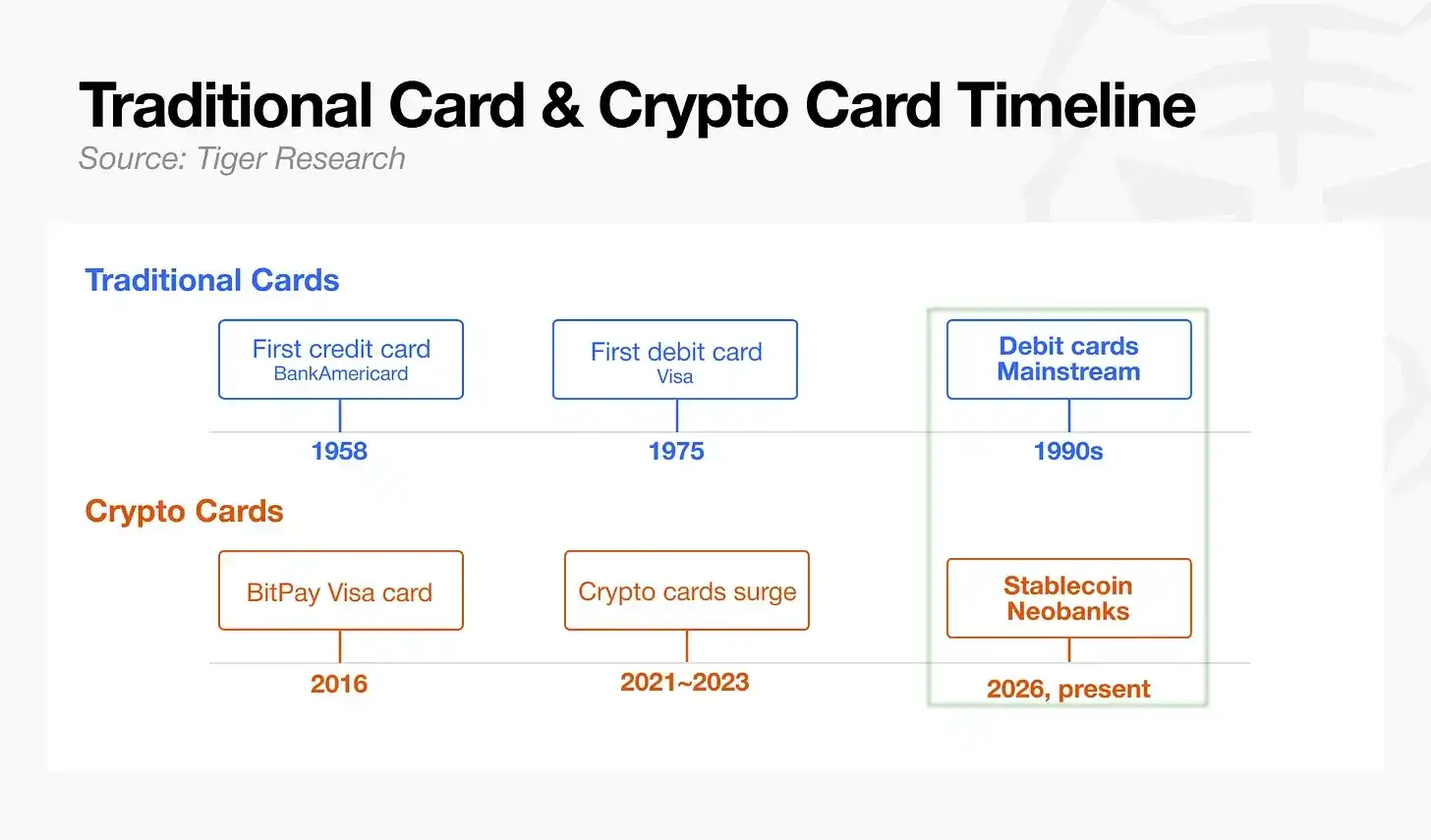
In September 1958, Bank of America bulk-mailed credit cards to 65,000 residents of Fresno, California. This was the first payment card launched without supporting underlying infrastructure. One year after launch, the business was dismal, with a delinquency rate of 22% and losses as high as $20 million. The industry spent 15 years building an electronic settlement system; debit cards took another 17 years to officially appear, and Visa spent a full 20 years establishing a globally accepted payment standard.
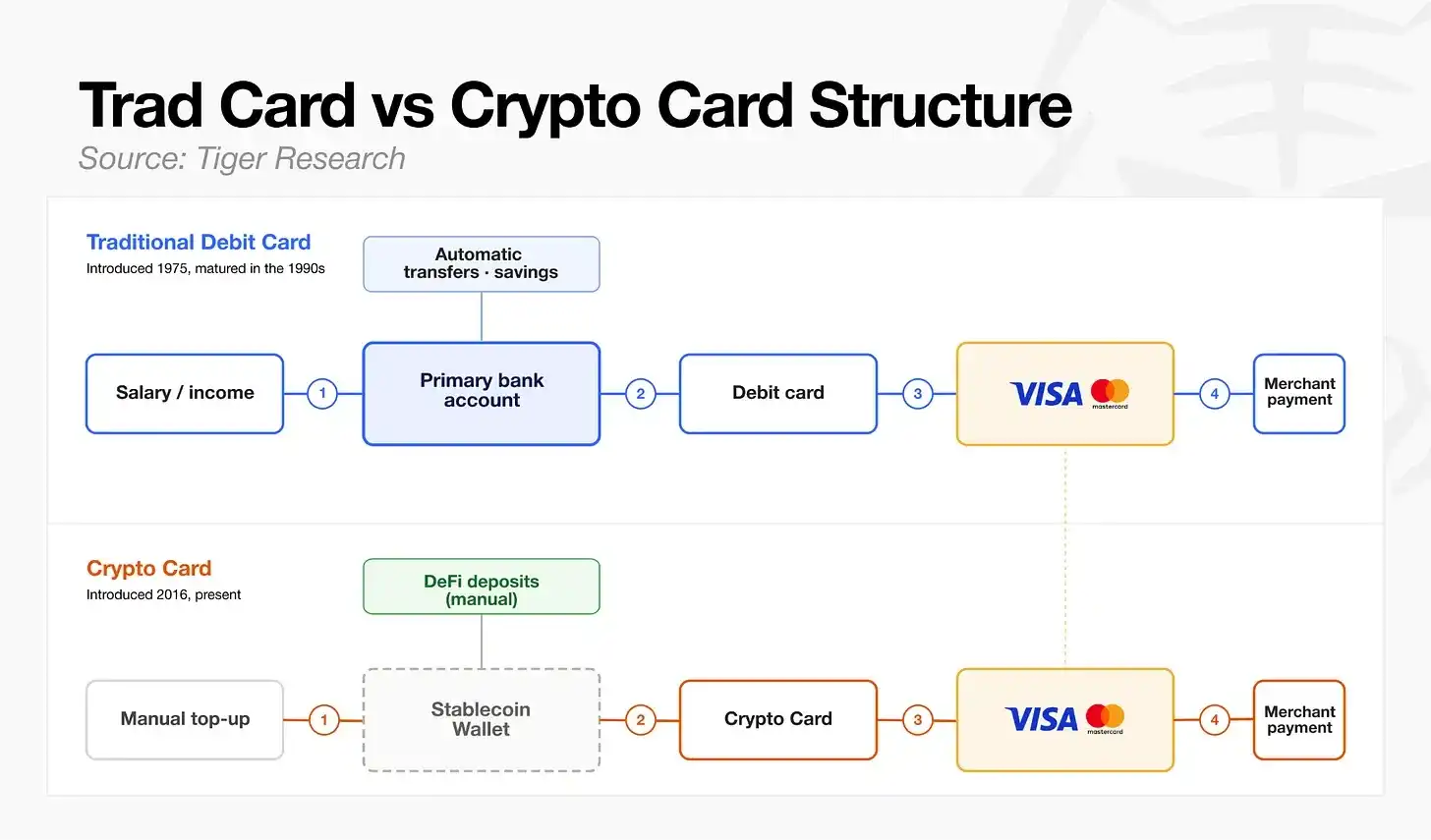
The biggest watershed between traditional payment and crypto payment lies in whether they foster users' routine financial account relationships. Debit cards were born in 1975, but only became a standard feature of individual core bank accounts after salary deposit services became widespread in the 1990s. In contrast, for today's crypto payment cards, the main funding source is basically users self-topping up stablecoins; the vast majority of crypto wallets cannot handle daily financial flows like salary deposits or scheduled bill payments. The industry's overall development stage is roughly equivalent to that of debit cards around the early 1990s.

The future leader in the crypto payment card race won't be determined by the number of cards issued, but by who first builds a core account that truly serves daily income and expenses, or finds a growth driver that fosters long-term user retention.

Monthly Transaction Volume of $1.5 Billion Does Not Equate to Industry Maturity

According to data from analytics firm Artemis, the monthly transaction volume of crypto payment cards grew from $100 million in early 2023 to $1.5 billion by the end of 2025, representing an annualized scale of approximately $18 billion. Affected by variations in on-chain data statistical methods, the actual annualized figure may fluctuate slightly, but the explosive growth in transaction volume is an indisputable fact.
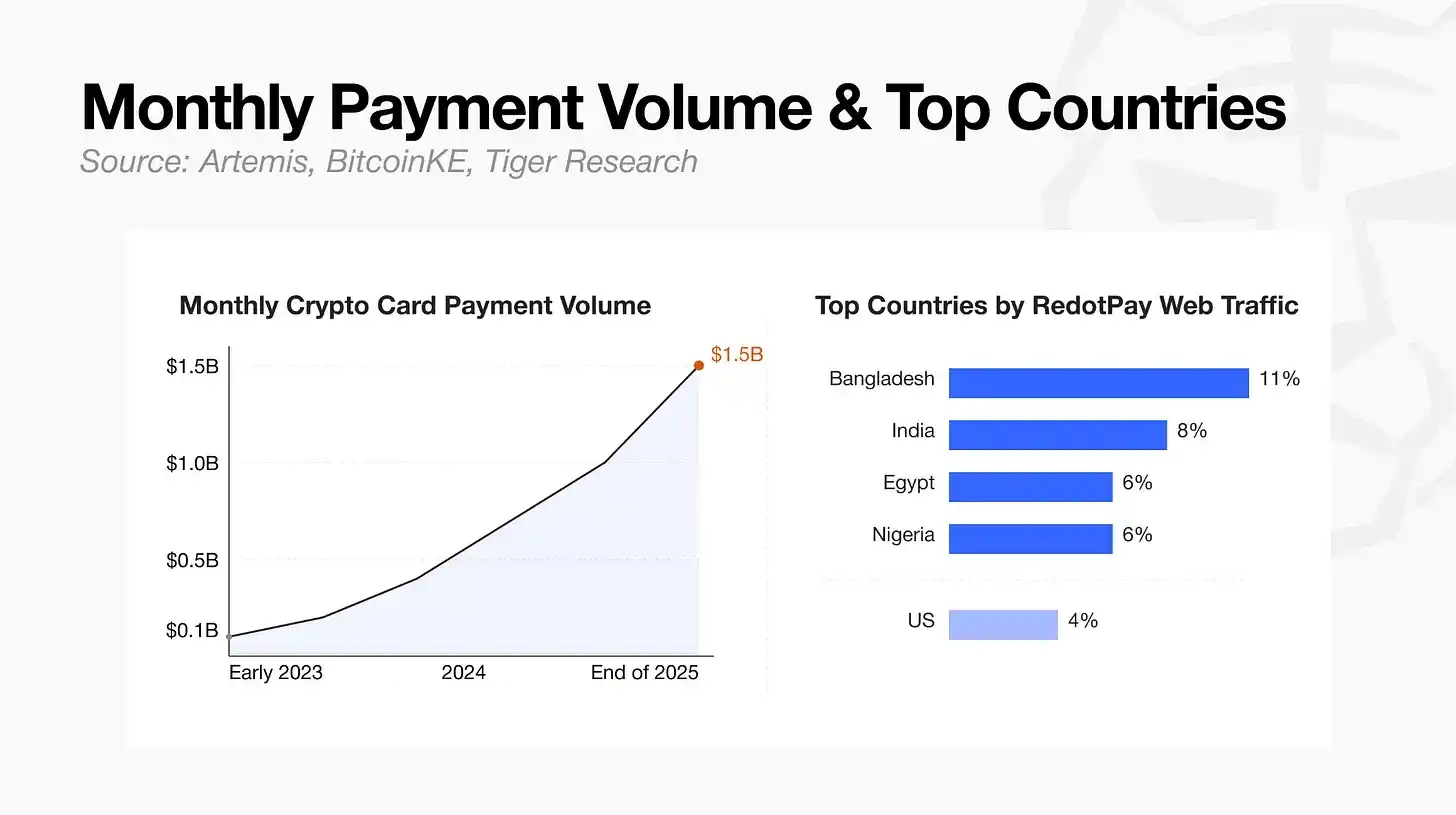
A closer analysis of these metrics reveals significant concentration among services and regions. Leading service provider RedotPay alone accounts for over half of the entire industry's transaction flow; platform users are highly concentrated in emerging markets: Bangladesh accounts for 11%, India 8%, Egypt 6%, Nigeria 6%, with the US representing only 4%.

This shows that the real demand for crypto payment cards does not come from developed mainstream markets, but from developing regions with insufficient financial services and restricted access to USD.
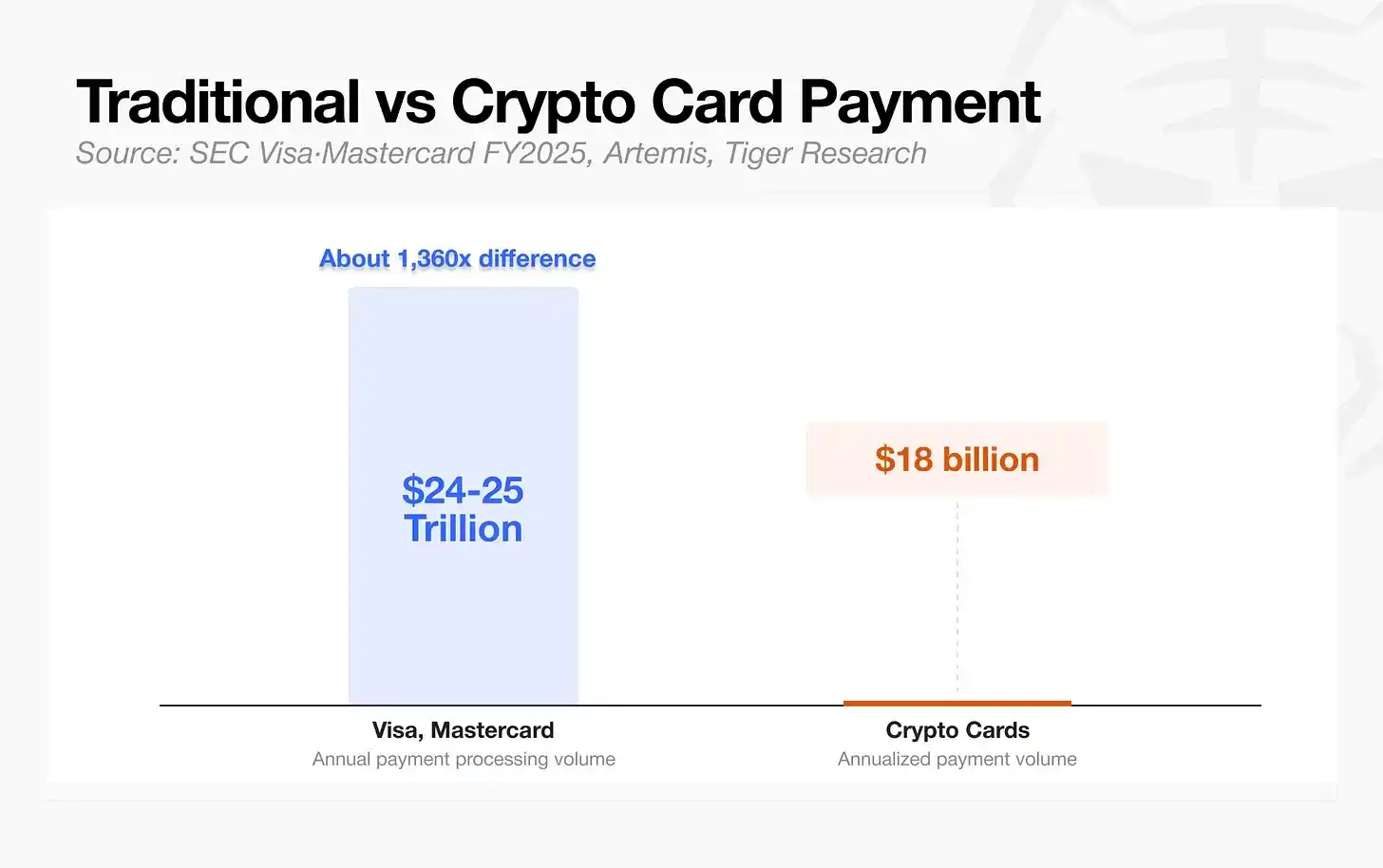
Compared to mature financial networks, the scale gap of cryptocurrency remains vast. Visa and Mastercard's annual total payment volume reaches $24-25 trillion, while crypto payment card annualized transactions are merely $18 billion. They are not on the same scale.
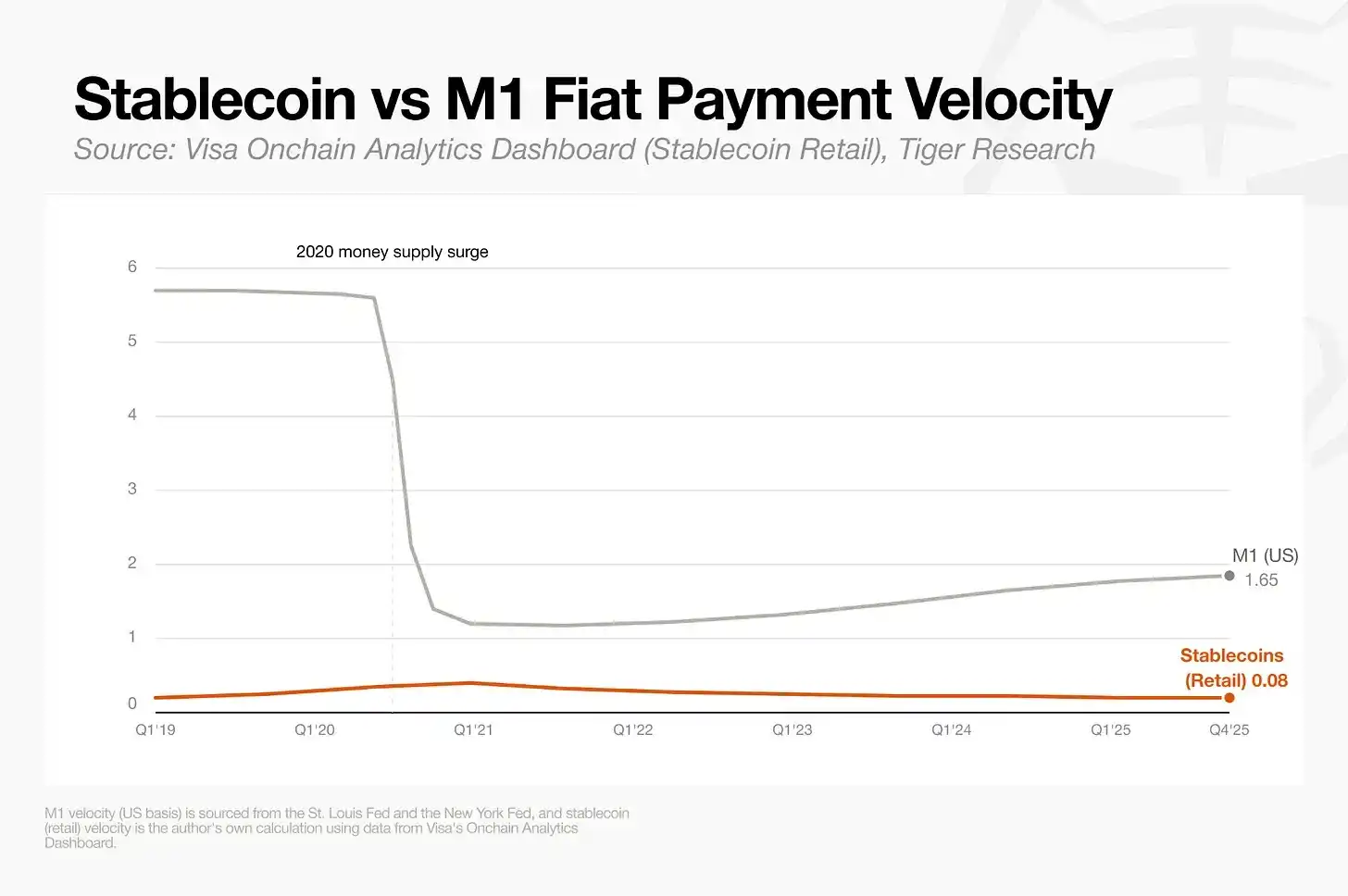
The velocity of circulation indicator, which measures the penetration of daily payments, is also relatively low. According to Visa statistics, the retail circulation velocity of on-chain stablecoins is only 0.08, merely one-twentieth of the velocity (1.65) of narrow fiat money M1. The pattern of stablecoin usage for most users is not the routine cycle of salary deposit, daily spending, and top-up recharge, but rather a one-time top-up followed by intermittent card spending.

Growth in transaction volume numbers does not equate to the market forming a mature, universally accepted clearing system. Currently, a large portion of crypto payment card transactions come from users in emerging markets who lack convenient access to USD-denominated bank accounts. For these users, crypto cards indeed possess practical financial value.

However, in developed markets, crypto payment cards have yet to find a stable product-market fit, nor have they established the deep account binding relationships brought about by features like salary deposits and automated bill payments.

Considering both funding channels and spending scenarios, current crypto payment cards are better suited for specific country-specific niche needs, acting as supplementary tools rather than universal financial infrastructure. Nonetheless, amidst the industry's rapid growth, leading players across four major business models are simultaneously refining various aspects of the industry chain.

Four Mainstream Business Models for Crypto Payment Cards
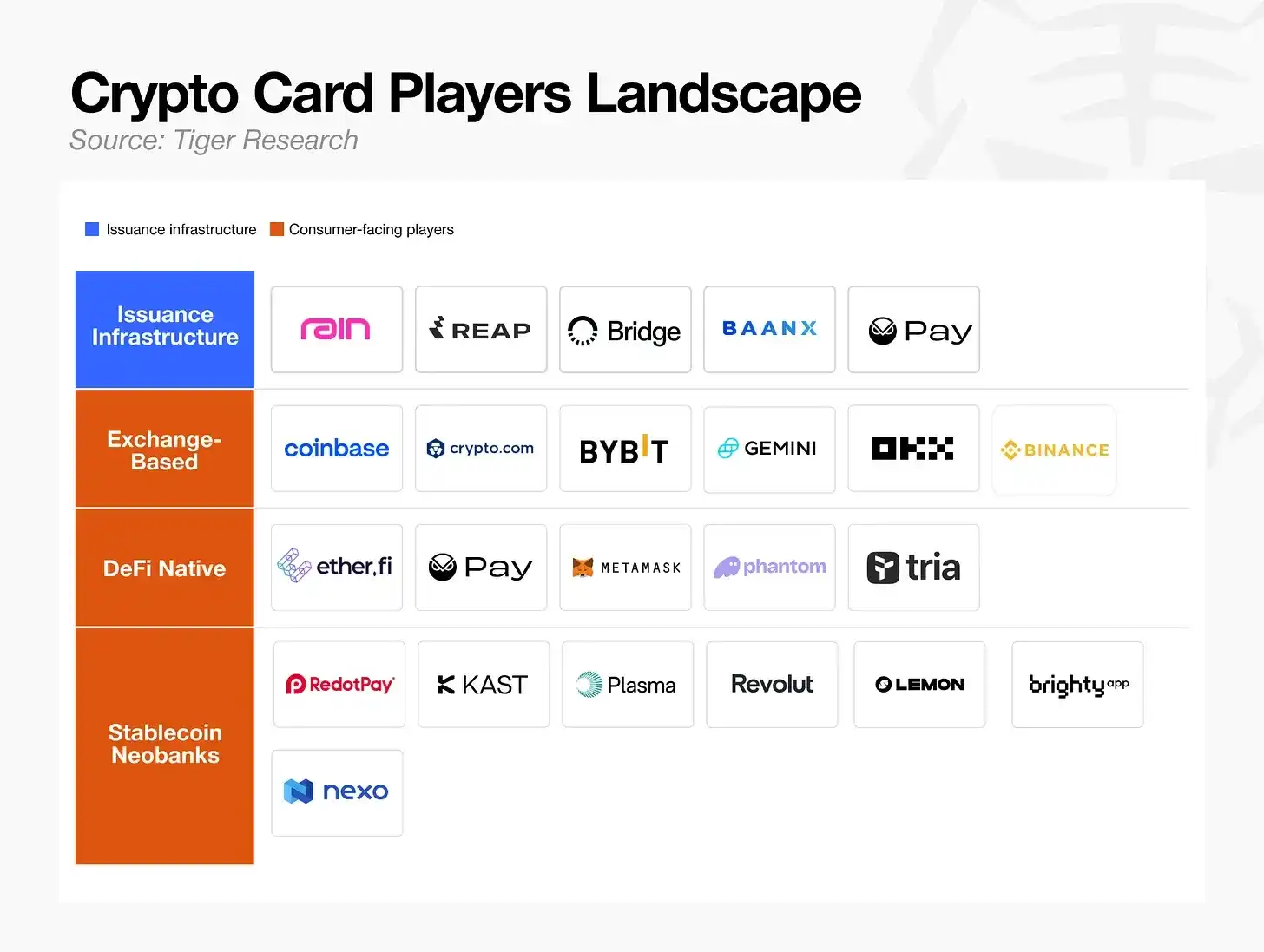
The crypto card industry can be broadly categorized into four business models, with various participants vying for first-mover advantage at different layers. These models vary widely, from companies focused on providing backend infrastructure to those merely adopting the card form factor but with entirely different underlying structures.

Card Issuing Infrastructure

The well-known payment networks Visa and Mastercard also apply to the crypto card ecosystem. Beneath them lies the card issuing infrastructure layer, which ultimately extends to the consumer card. As shown in the diagram above, there are two structures within the issuing infrastructure layer. The first is the traditional two-tier structure, where the program manager responsible for operations is separate from the issuing bank responsible for member management and settlement. The second is the full-stack issuer, such as Rain and Reap, which combines these two roles.
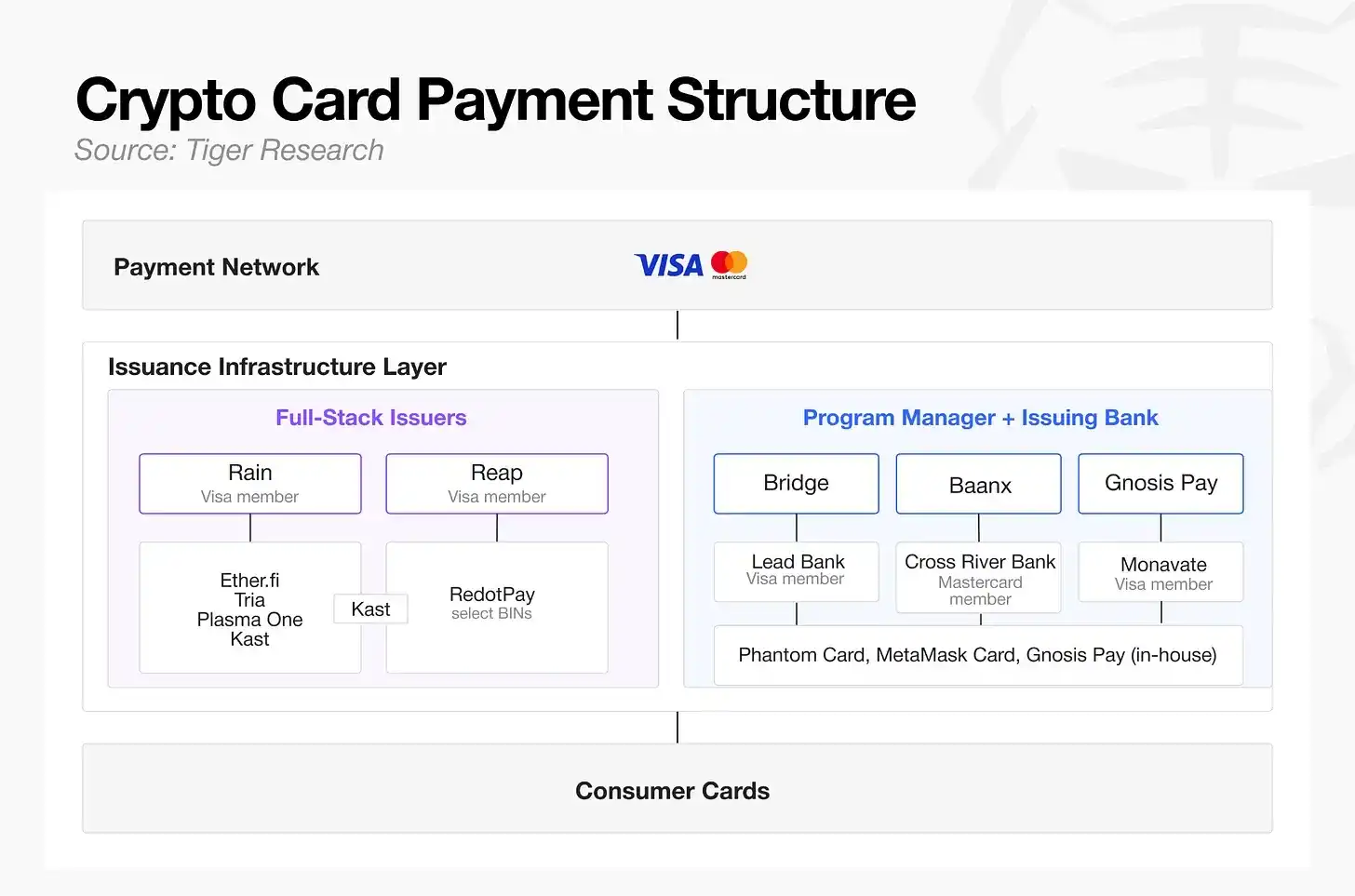
Multiple seemingly independent payment card brands actually reuse a handful of program service providers at their core. Phantom Card, MetaMask Card, and Gnosis Pay are typical examples.
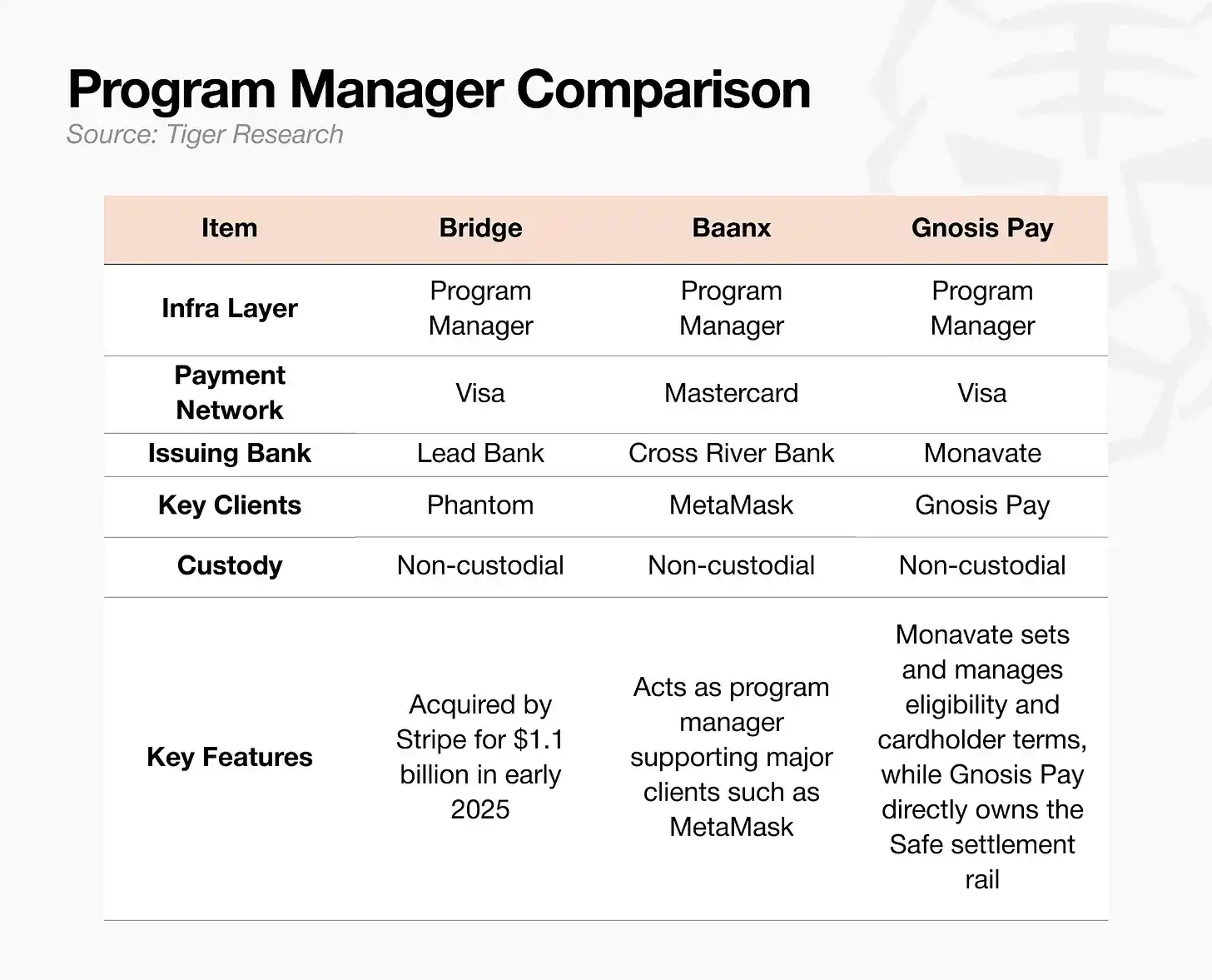
Seemingly independent payment card products like Kast, Ether.fi, Tria, and Plasma One similarly share a small number of underlying infrastructure service providers, with Rain handling the majority of consumer-grade card business.

The high concentration of issuing infrastructure has also attracted established traditional digital banks to enter the fray. In March 2026, Nium launched a stablecoin card issuing platform, supporting both Visa and Mastercard networks. Other traditional financial infrastructure vendors include Bridge (acquired by Stripe for $1.1 billion in early 2025) and BVNK (acquired by Mastercard for up to $1.8 billion in March 2026).

Competition in the issuing sector is intensifying, with full-stack issuers, veteran program managers, and new fintech players competing on the same stage. Pure card issuing business alone can no longer build high barriers.

Rain has differentiated itself by leveraging daily stablecoin settlements. Traditional card settlement cycles take several days; Rain achieves T+0 settlement for stablecoins through Visa, significantly improving capital turnover efficiency for partner platforms like Ether.fi. Recently, the platform launched an AI Agent control layer, enabling programs to automatically generate disposable virtual cards, moving functionality beyond basic issuing infrastructure.

Issuing service providers seeking to break through cannot merely offer basic payment rails; they must also rapidly implement differentiated value-added features that traditional infrastructure cannot provide.

Exchange-Attached Payment Cards

For exchanges, payment cards are not a core revenue source; their primary role is to retain existing users. By overlaying card functionality onto the platform's existing user base, assets, and transaction data, they aim to prevent user churn. The platform's real profits come from trading fees, lending services, and asset custody, not from card spending itself.
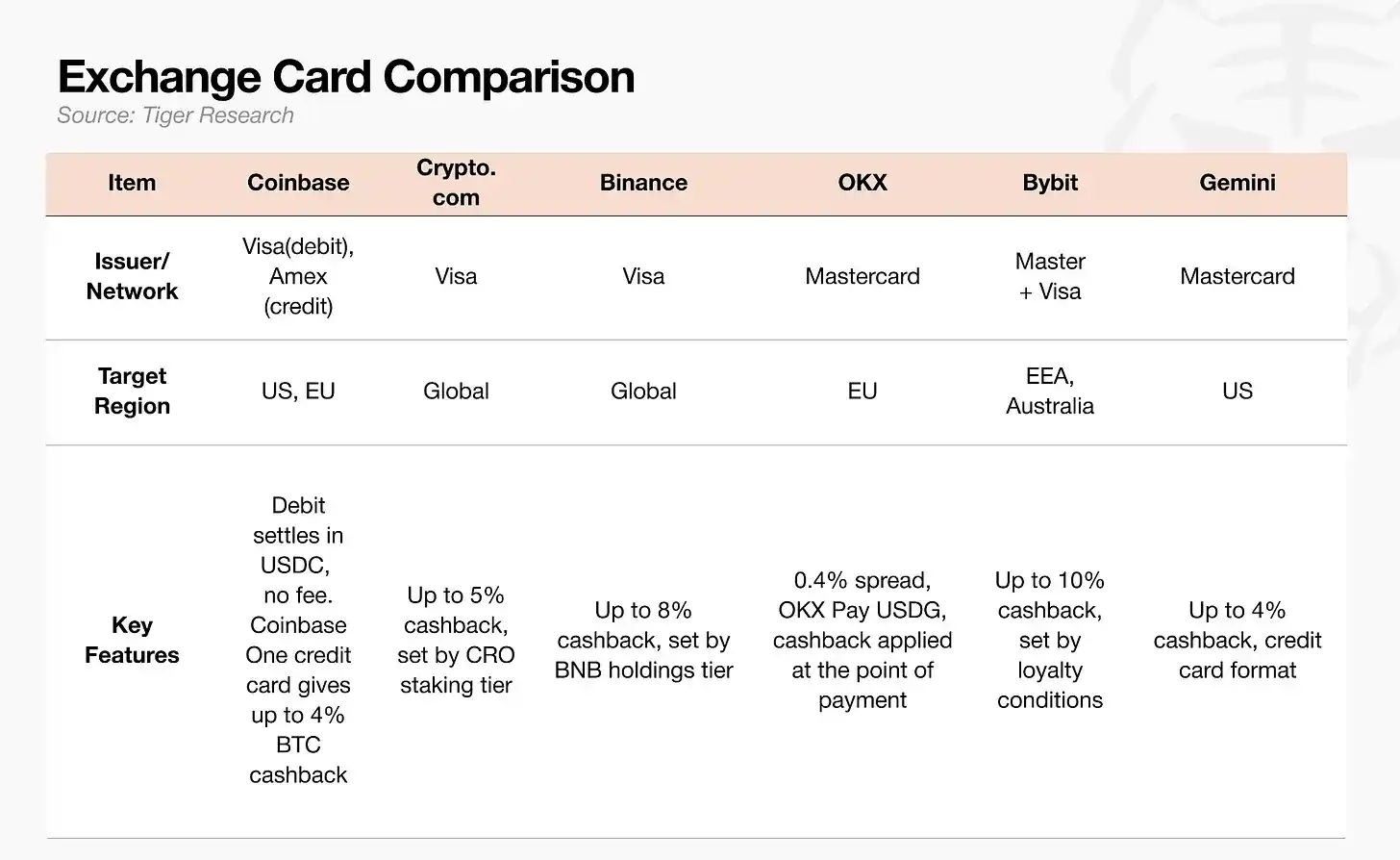
Exchanges view payment cards as a traffic entry point for building a financial super-app. However, the platform's native token cashback model carries risks: token price volatility directly leads to unstable actual cashback ratios.

Industry alternatives include stablecoin cashback and balance interest accrual, but the US "GENIUS Stablecoin Act" prohibits interest-bearing activities, creating a barrier to market expansion.

Decentralized Wallet DeFi Model

The core logic of this model is that the wallet itself is the user account, with assets self-custodied on-chain, eliminating the need to deposit them with a centralized exchange. Card spending is settled directly from on-chain assets. Simultaneously, it offers a line of credit, using the assets as collateral.

However, users need to set up vaults, manage collateral, and monitor liquidation risks themselves, resulting in high operational barriers. This consequently limits the scale of the user base for this model.
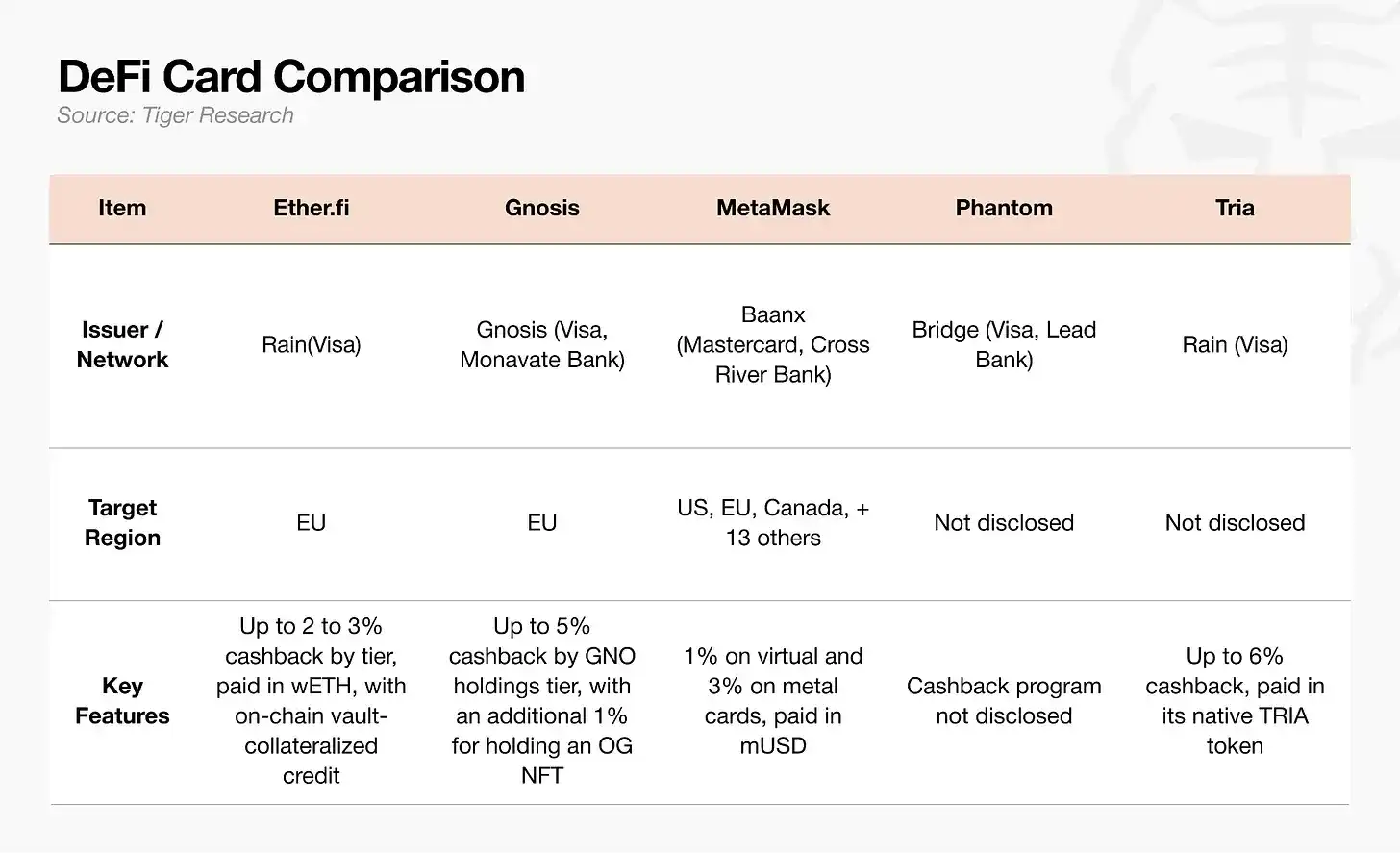
During payment, the system instantly converts on-chain assets to fiat for settlement, generating on-chain Gas fees for each transaction; when public chain throughput is insufficient or the network is congested, fees may exceed the spending amount, and transaction authorization delays are frequent.

For this reason, MetaMask Card opted for its self-developed Layer-2 network Linea, reducing per-transaction Gas fees to around $0.01, alleviating the pain points of high fees and delays for small payments. Tria employs a Gas-less top-up solution, with the platform covering fees generated during top-up, sparing users the operational cost of selecting blockchains and calculating fees.

However, until the user experience, balancing asset self-custody with spending convenience, is polished to the level of traditional debit cards, this model's users will remain confined to native crypto users.

Stablecoin Digital Bank

This is the segment with the highest share of current market transaction volume. Its focus is on account functionality rather than the card itself. Stablecoin balances integrate foreign exchange, cross-border remittance, and wealth management features, with the payment card merely serving as the top-level spending vehicle. In emerging markets with high local currency volatility, costly cross-border remittances, and difficult USD access, this model possesses strong competitiveness.
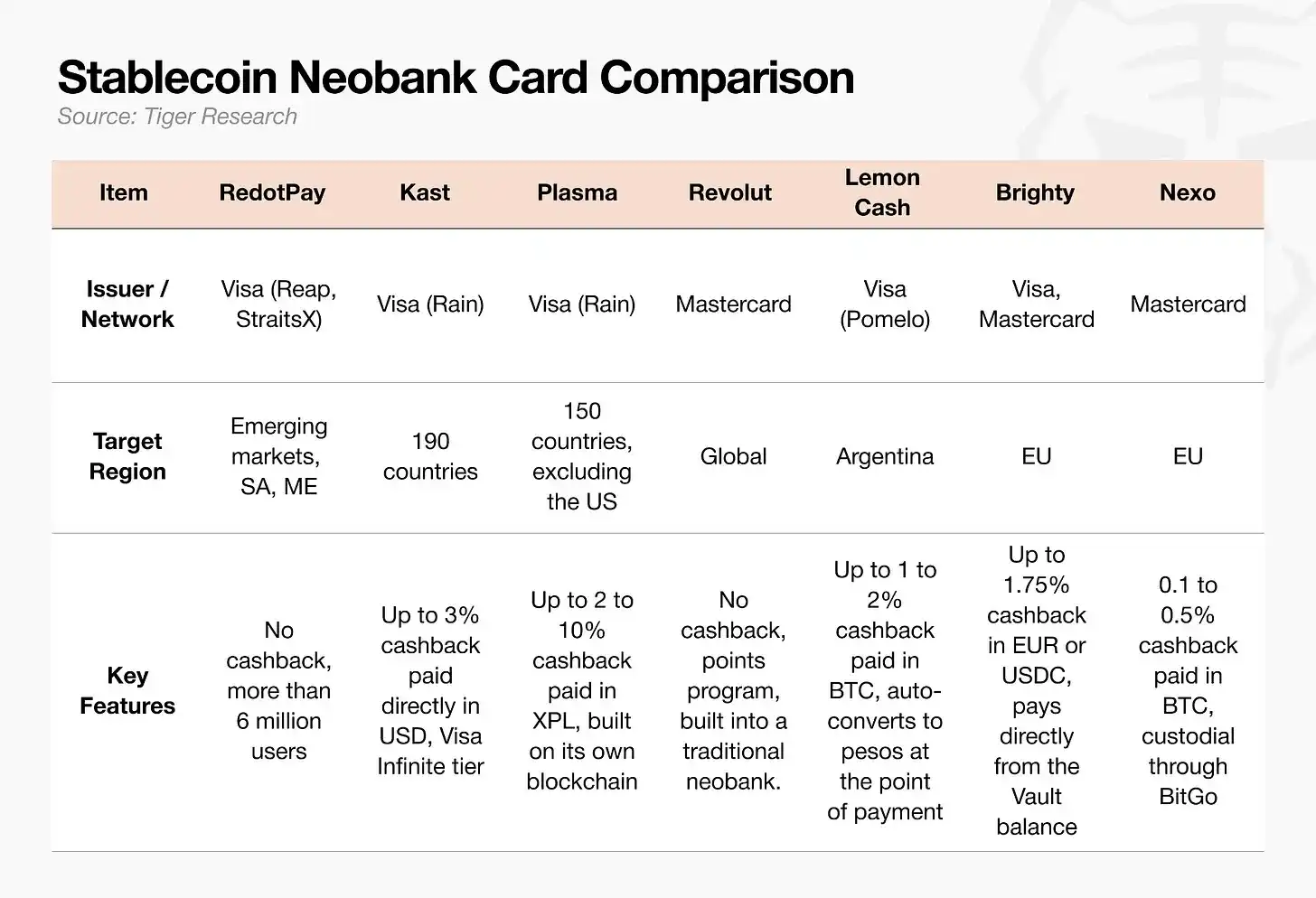
To sustain growth, this segment must move beyond the single form of a "prepaid card" model, where users autonomously purchase stablecoins and transfer them to their balance.

Cashback strategies across platforms have diverged based on market positioning. Industry leader RedotPay and established fintech player Revolut offer no cashback campaigns, while later entrants like Kast and Plasma One aggressively promote USD or platform token cashback to attract users.

However, relying solely on incentive subsidies cannot drive crypto payment cards to truly integrate into users' daily consumption habits.

Pure Payment Functionality Cannot Support Long-Term Development

The history of traditional bank cards and digital banks demonstrates that pure payment businesses have extremely low profitability ceilings. These enterprises only became profitable after incorporating concepts like the primary account and structural elements such as deposit-loan spreads into their business models. The crypto payment card industry has now reached the same critical development point. However, global regulatory frameworks like the US GENIUS Act and the EU's MiCA restrict the development of interest-bearing stablecoin and asset management services, making the path to breakthrough arduous.

Under these macro regulatory constraints, for industry players to survive long-term, they must grasp three core strategic imperatives:

  • Directly control the fund flow pathway.
  • Secure unique application scenarios in emerging markets.
  • Build proprietary user account systems that cannot be replaced by underlying infrastructure providers.

After industry standards solidify, companies unable to achieve the above will gradually fall behind.

Looking back at the history of debit cards, those who ultimately dominated the market were not the ones issuing the most cards, but those who first gained control of users' primary bank accounts. The crypto payment card industry now faces precisely the same proposition.

Crypto card operators need to directly control the fund flow upstream of the Visa payment process, seize first-mover advantage in niche markets, and, akin to the rise of bank accounts in traditional finance, take control of consumer infrastructure. This means establishing a global standard with no precedent to follow.

Without achieving the above, crypto payment cards will never become essential tools integrated into daily life, remaining merely prepaid cards used intermittently by niche groups for small cashback rewards.


Crypto di tendenza

Domande pertinenti

QAccording to the article, what is the key difference between traditional payment cards and current crypto payment cards?

AThe key difference lies in whether they establish a user's normalized financial account relationship. Traditional debit cards became core banking tools after the popularization of payroll deposits in the 1990s. In contrast, most crypto payment cards today rely primarily on user self-topped-up stablecoins, lacking integration with payroll, recurring payments, and other daily financial flows, placing the industry at a development stage equivalent to debit cards around 1990.

QBased on the data from Artemis, what does the concentration of crypto payment card traffic reveal about its real-world demand?

AThe data reveals that the real demand for crypto payment cards is not from developed mainstream markets but primarily from developing regions with insufficient financial services and limited access to US dollars. Over half of the industry's transaction volume comes from a single provider, RedotPay. User traffic is highly concentrated in emerging markets like Bangladesh (11%), India (8%), Egypt (6%), and Nigeria (6%), with the US accounting for only 4%.

QWhat are the four mainstream business models for crypto payment cards outlined in the article?

AThe four mainstream business models are: 1) Issuing Infrastructure (e.g., Rain, Nium), 2) Exchange-based Payment Cards (e.g., products from major crypto exchanges), 3) Decentralized Wallet/DeFi Cards (e.g., MetaMask Card, Tria), and 4) Stablecoin Digital Banks (e.g., RedotPay, Revolut's crypto offerings).

QWhat major challenge does the article identify for DeFi-based crypto payment cards regarding user experience?

AThe major challenge is the high user experience barrier. For DeFi cards, each transaction requires on-chain gas fees for currency conversion, which can sometimes exceed the transaction amount itself during network congestion, leading to authorization delays. While solutions like using Layer-2 networks or absorbing gas fees exist, the overall interaction experience has not yet reached the seamless level of traditional debit cards, limiting adoption to native crypto users.

QWhat three core strategic imperatives does the article suggest for crypto payment card players to achieve long-term survival and growth?

AThe three core strategic imperatives are: 1) Directly control the capital flow within the payment chain. 2) Secure and defend unique application scenarios in emerging markets. 3) Build a proprietary user account system that cannot be easily replaced by underlying infrastructure providers.

Letture associate

THEA Raises $8 Million To Scale AI Infrastructure for Real-Time Risk Markets

Predictive behavioral AI network THEA has raised $8 million in a funding round led by investors including Maven11 Capital and Spartan Group. Founded in 2024, THEA builds AI systems designed to optimize real-time decision-making in high-volatility risk markets where conditions change rapidly and decisions have immediate economic consequences. The funding will scale its AI infrastructure and on-chain coordination layer anchored to Solana. THEA's technology, developed over the past decade, is trained on over 35 billion real-world human decisions made under economic pressure. Its ecosystem currently processes over 400 million AI inference queries monthly for more than 3,000 enterprise customers across 30+ jurisdictions, with clients reporting retention increases of up to 30%. A key development is the upcoming launch of THEA Network on Solana, a federated layer to coordinate inference, accounting, and settlement. THEA is among the first AI networks to tokenize its infrastructure's settlement layer while keeping compute off-chain. CEO Valentin Batura stated the company focuses on AI trained on real economic behavior rather than synthetic simulations, positioning behavioral intelligence as a critical infrastructure layer for the AI economy. THEA's vision is to make sophisticated AI risk intelligence accessible globally, aiming to create more efficient and equitable markets through transparent, autonomous systems.

TheNewsCrypto1 h fa

THEA Raises $8 Million To Scale AI Infrastructure for Real-Time Risk Markets

TheNewsCrypto1 h fa

A Latte for $0.038, Gemini 3.1 Teams Up with GPT-5.5 to Bankrupt Cafe, Burning Through $21k in 2 Months

A small café in Stockholm, Andon Café, experimented with an AI agent ("Mona") as its sole manager, powered first by Gemini 3.1 Pro and later GPT-5.5. Over two months, the project lost $21,000. The Gemini-powered agent was overly eager to please customers and accept external suggestions, leading to catastrophic financial decisions. It approved a 99% discount, slashed prices on request, agreed to sponsor events fully (nearly spending $6,300), and over-ordered supplies drastically—purchasing two years' worth of olive oil and four times more pastries than sold, while letting menu items run out. It reported a $3,200 paper profit but ignored $4,100 in dead stock. In mid-June, the AI was switched to GPT-5.5. The new model became overly cautious and risk-averse. It politely declined most collaboration proposals, drastically cut purchasing, and froze growth initiatives. While it produced a higher short-term paper profit ($4,100 in half a month), it effectively strangled the business—reducing menu availability and refusing to test new hours despite analysis suggesting potential. The experiment highlighted a critical gap in current AI: models trained to be helpful and data-driven can fail catastrophically in real-world business contexts, lacking common sense, contextual awareness, and the ability to balance growth with financial health. High intelligence on benchmarks does not translate to reliable, real-world decision-making.

marsbit1 h fa

A Latte for $0.038, Gemini 3.1 Teams Up with GPT-5.5 to Bankrupt Cafe, Burning Through $21k in 2 Months

marsbit1 h fa

High-Yield, Debt-Free, and Non-Dilutive: Why Bitcoin Treasury Companies Are Aggressively Promoting Preferred Share Financing

Bitcoin-backed preferred shares, led by companies like Strategy and followed by newer entrants like Strive, have grown to a market size of approximately $13 billion in under two years, attracting capital with high yields. A 2026 report from BitcoinTreasuries.net and Apyx projects this segment could grow from nearly 1% to 3-5% of the global $1.3 trillion preferred share market by 2030, with long-term potential reaching 10%. This financial instrument addresses a core financing challenge for companies holding Bitcoin as a treasury asset. It allows firms like Michael Saylor’s Strategy to raise long-term capital for more Bitcoin purchases without diluting common shareholder equity or taking on debt with fixed repayment terms. Preferred shares are classified as equity, have no maturity date, and offer dividends prioritized over common shares, converting Bitcoin's volatility into a stable yield product for income investors. Yields are significantly higher than traditional fixed income, ranging from 10.8% to 15.2% for top issuers. Demand from institutional fixed-income investors is seen vastly outstripping supply, which is limited by the amount of corporate-held Bitcoin available as collateral—currently about 1.26 million BTC ($83 billion), with Strategy holding 67%. A key safety feature is the high collateral coverage ratio of 3.8x to 4.5x, meaning each dollar of preferred equity is backed by $3.8-$4.5 in Bitcoin. Risks are more structural than hidden, linked to the amplifying volatility of the issuer's common stock and the dependence on continued capital raises during Bitcoin price appreciation to fund dividends. Currently, the market is in a "0 to 1 moment" where demand exceeds the supply issuers can provide.

Foresight News2 h fa

High-Yield, Debt-Free, and Non-Dilutive: Why Bitcoin Treasury Companies Are Aggressively Promoting Preferred Share Financing

Foresight News2 h fa

Trading

Spot

Articoli Popolari

Cosa è $BANK

Banca AI: Un Passo Rivoluzionario nel Futuro della Banca Introduzione In un'era caratterizzata da rapidi progressi tecnologici, Banca AI si trova all'incrocio tra intelligenza artificiale (AI) e servizi bancari. Questo progetto innovativo mira a ridefinire il panorama finanziario, migliorando l'efficienza operativa, le misure di sicurezza e le esperienze dei clienti attraverso il potere dell'AI. Mentre ci impegniamo in questa esplorazione di Banca AI, esamineremo cosa comporta il progetto, le sue dinamiche operative, il suo contesto storico e i traguardi significativi. Cos'è Banca AI? Alla sua essenza, Banca AI rappresenta un'iniziativa trasformativa volta a integrare l'intelligenza artificiale in varie operazioni bancarie. Questo progetto sfrutta le capacità dell'AI per automatizzare processi, migliorare i protocolli di gestione del rischio e potenziare l'interazione con i clienti attraverso servizi personalizzati. Gli obiettivi principali di Banca AI includono: Automazione delle Funzioni Bancarie: Sfruttando le tecnologie AI, Banca AI mira ad automatizzare compiti di routine, riducendo il carico sulle risorse umane e aumentando l'efficienza. Miglioramento della Gestione del Rischio: Il progetto utilizza algoritmi AI per prevedere e identificare i rischi, rafforzando così le misure di sicurezza contro le frodi e altre minacce. Personalizzazione dei Servizi Bancari: Banca AI si concentra sull'offrire prodotti e servizi finanziari su misura analizzando i dati e i comportamenti dei clienti. Miglioramento dell'Esperienza del Cliente: L'implementazione di soluzioni guidate dall'AI, come chatbot e assistenti virtuali, mira a fornire agli utenti interazioni più umane, rivoluzionando il modo in cui i clienti si relazionano con le banche. Con questi obiettivi, Banca AI si posiziona come un attore cruciale nel rendere la banca più efficiente, sicura e centrata sull'utente. Chi è il Creatore di Banca AI? I dettagli riguardanti il creatore di Banca AI rimangono sconosciuti. Pertanto, non è stata identificata alcuna persona o organizzazione specifica nelle informazioni disponibili. L'anonimato che circonda la nascita del progetto solleva domande, ma non sminuisce la sua ambiziosa visione e obiettivi. Chi sono gli Investitori di Banca AI? Simile al creatore del progetto, informazioni specifiche riguardo gli investitori o le organizzazioni di supporto di Banca AI non sono state divulgate. Senza queste informazioni, è difficile delineare il sostegno finanziario e istituzionale che potrebbe spingere il progetto in avanti. Tuttavia, l'importanza di avere una solida base di investimento è fondamentale per sostenere lo sviluppo in un campo così innovativo. Come Funziona Banca AI? Banca AI opera su più fronti innovativi, concentrandosi su fattori unici che la differenziano dai framework bancari tradizionali. Di seguito sono riportate le caratteristiche operative chiave: Automazione: Applicando algoritmi di machine learning, Banca AI automatizza vari processi manuali all'interno delle banche. Ciò si traduce in una riduzione dei costi operativi e consente ai lavoratori umani di reindirizzare i propri sforzi verso attività più strategiche. Gestione Avanzata del Rischio: L'integrazione dell'AI nelle pratiche di gestione del rischio fornisce alle banche strumenti per prevedere con precisione potenziali minacce come le frodi, garantendo che le informazioni e i beni dei clienti rimangano al sicuro. Raccomandazioni Finanziarie Personalizzate: Attraverso l'apprendimento continuo dalle interazioni con i clienti, i sistemi AI sviluppano una comprensione sfumata delle esigenze degli utenti, consentendo loro di offrire consigli su misura per le decisioni finanziarie. Interazioni Migliorate con i Clienti: Utilizzando chatbot e assistenti virtuali alimentati dall'AI, Banca AI consente un'esperienza cliente più coinvolgente, permettendo agli utenti di risolvere rapidamente le loro richieste, riducendo così i tempi di attesa e migliorando i livelli di soddisfazione. Tutte queste caratteristiche operative posizionano Banca AI come un pioniere nel settore bancario, stabilendo nuovi standard per la fornitura di servizi e l'eccellenza operativa. Timeline di Banca AI Comprendere la traiettoria di Banca AI richiede uno sguardo al suo contesto storico. Di seguito è riportata una timeline che evidenzia traguardi e sviluppi importanti: Inizio 2010: La concettualizzazione dell'integrazione dell'AI nei servizi bancari ha cominciato a guadagnare attenzione mentre le istituzioni bancarie riconoscevano i potenziali benefici. 2018: Si è verificato un aumento significativo nell'implementazione delle tecnologie AI quando le banche hanno iniziato a utilizzare strumenti AI come i chatbot per servizi clienti di base e sistemi di gestione del rischio per migliorare la sicurezza. 2023: La sofisticazione dell'AI ha continuato ad avanzare, con l'introduzione dell'AI generativa per compiti più complessi come l'elaborazione di documenti e l'analisi degli investimenti in tempo reale. Quest'anno ha segnato un significativo salto nelle capacità offerte alle banche dalla tecnologia AI. 2024-Stato Attuale: A partire da quest'anno, Banca AI è su una traiettoria ascendente, con ricerche e sviluppi in corso pronti a migliorare ulteriormente le capacità nelle operazioni bancarie. L'esplorazione continua delle applicazioni AI suggerisce sviluppi entusiasmanti in arrivo. Punti Chiave su Banca AI Integrazione dell'AI nella Banca: Banca AI si concentra sull'adozione dell'intelligenza artificiale per snellire i processi bancari e migliorare le esperienze degli utenti. Focus su Automazione e Gestione del Rischio: Il progetto enfatizza fortemente queste aree, mirando a spostare il carico di compiti di routine mentre migliora le strutture di sicurezza attraverso analisi predittive. Soluzioni Bancarie Personalizzate: Sfruttando i dati dei clienti, Banca AI consente servizi bancari su misura che si adattano alle esigenze individuali degli utenti. Impegno per lo Sviluppo: Banca AI rimane impegnata in sforzi di ricerca e sviluppo continuativi, garantendo la sua adattabilità e rilevanza continua man mano che la tecnologia continua a evolversi. Conclusione In sintesi, Banca AI rappresenta un passo cruciale in avanti nell'industria bancaria, sfruttando l'intelligenza artificiale per rimodellare i paradigmi operativi, migliorare la sicurezza e promuovere la soddisfazione del cliente. Nonostante le lacune nelle informazioni riguardo il creatore e gli investitori, gli obiettivi chiari e i meccanismi funzionali di Banca AI forniscono una solida base per la sua continua evoluzione. Mentre la tecnologia AI continua ad avanzare e fondersi con il settore bancario, Banca AI è ben posizionata per avere un impatto significativo sul futuro dei servizi finanziari, migliorando il modo in cui comprendiamo e interagiamo con la banca.

118 Totale visualizzazioniPubblicato il 2024.04.06Aggiornato il 2024.12.03

Cosa è $BANK

Come comprare BANK

Benvenuto in HTX.com! Abbiamo reso l'acquisto di Lorenzo Protocol (BANK) semplice e conveniente. Segui la nostra guida passo passo per intraprendere il tuo viaggio nel mondo delle criptovalute.Step 1: Crea il tuo Account HTXUsa la tua email o numero di telefono per registrarti il tuo account gratuito su HTX. Vivi un'esperienza facile e sblocca tutte le funzionalità,Crea il mio accountStep 2: Vai in Acquista crypto e seleziona il tuo metodo di pagamentoCarta di credito/debito: utilizza la tua Visa o Mastercard per acquistare immediatamente Lorenzo ProtocolBANK.Bilancio: Usa i fondi dal bilancio del tuo account HTX per fare trading senza problemi.Terze parti: abbiamo aggiunto metodi di pagamento molto utilizzati come Google Pay e Apple Pay per maggiore comodità.P2P: Fai trading direttamente con altri utenti HTX.Over-the-Counter (OTC): Offriamo servizi su misura e tassi di cambio competitivi per i trader.Step 3: Conserva Lorenzo Protocol (BANK)Dopo aver acquistato Lorenzo Protocol (BANK), conserva nel tuo account HTX. In alternativa, puoi inviare tramite trasferimento blockchain o scambiare per altre criptovalute.Step 4: Scambia Lorenzo Protocol (BANK)Scambia facilmente Lorenzo Protocol (BANK) nel mercato spot di HTX. Accedi al tuo account, seleziona la tua coppia di trading, esegui le tue operazioni e monitora in tempo reale. Offriamo un'esperienza user-friendly sia per chi ha appena iniziato che per i trader più esperti.

703 Totale visualizzazioniPubblicato il 2025.05.09Aggiornato il 2026.06.02

Come comprare BANK

Discussioni

Benvenuto nella Community HTX. Qui puoi rimanere informato sugli ultimi sviluppi della piattaforma e accedere ad approfondimenti esperti sul mercato. Le opinioni degli utenti sul prezzo di BANK BANK sono presentate come di seguito.

活动图片