Three-Year High Smashes Rate-Cut Hopes, Who's Using CPI to Clean Out Whale Holdings?

Foresight NewsPubblicato 2026-06-11Pubblicato ultima volta 2026-06-11

Introduzione

U.S. CPI inflation accelerated to 4.2% year-over-year in May, reaching a three-year high and dampening market expectations for Federal Reserve rate cuts in 2026. The surge was primarily driven by a sharp 23.5% annual increase in energy prices, fueled by geopolitical conflicts. While core CPI rose 2.9% year-over-year, showing relative moderation, the hotter-than-expected headline data prompted a repricing in interest rate markets. Traders now overwhelmingly expect the Fed to hold rates steady, with some even pricing in potential rate hikes for late 2026 or 2027. The report triggered declines in major U.S. stock indices and pressured risk assets like Bitcoin, which remained volatile around $61,000-$62,000. Analysts note that while the energy-driven inflation spike is concerning, the controlled core figures provide the Fed room for patience. However, the "higher for longer" interest rate narrative has solidified. For crypto markets, this translates to continued outflows from Bitcoin ETFs, heightened volatility, and a market seemingly in a "capitulation" phase, with leverage reset but sustained demand yet to materialize.


By Ma He, Foresight News


On the evening of June 10th, Beijing time, the U.S. Bureau of Labor Statistics officially released the Consumer Price Index (CPI) data for May 2026. The report showed that driven by a significant surge in energy prices triggered by geopolitical conflicts, U.S. inflationary pressures rebounded noticeably, further dampening market expectations for the Federal Reserve's interest rate cut path within the year. According to data from the U.S. Bureau of Labor Statistics, the CPI rose 0.5% month-over-month (seasonally adjusted) in May, slightly slower than April's 0.6% increase, but rose 4.2% year-over-year (unadjusted), accelerating significantly from 4.2% in April and reaching the highest level since April 2023. Core CPI (excluding food and energy) rose 0.2% month-over-month, below market expectations of 0.3% and April's 0.4%; it rose 2.9% year-over-year, slightly up from the previous reading of 2.8%, in line with market expectations.


Energy prices were the core driver of this month's inflation rebound. The energy index rose 3.9% month-over-month and surged 23.5% year-over-year. Among them, gasoline prices rose 7.0% month-over-month, soaring 40.5% year-over-year; fuel oil rose 58.9% year-over-year. The U.S. Bureau of Labor Statistics explicitly stated that the energy index contributed to over 60% of the month-over-month increase in the overall CPI for May. Geopolitical conflicts involving Iran and related tensions have continued to push up international oil prices since February, with WTI crude once breaking above $100 per barrel, directly transmitting to U.S. domestic gasoline and energy service costs.


Following the data release, by the close on June 11th, the S&P 500 index fell approximately 1.62%, and the Nasdaq index declined 1.98%. The U.S. dollar index strengthened, and the U.S. Treasury yield curve shifted upward overall.
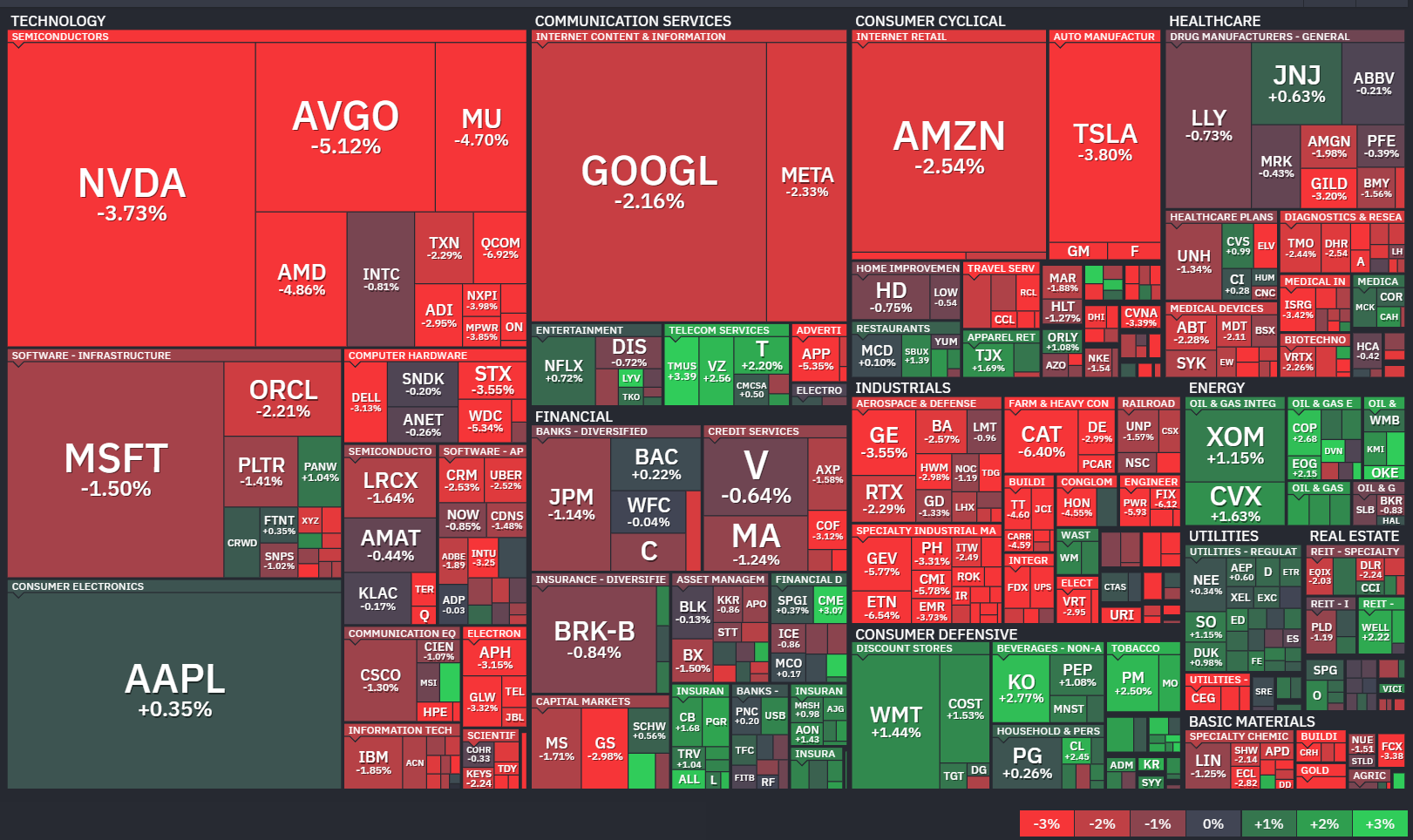


As a typical risk asset, the crypto market also faced clear pressure—Bitcoin price fluctuated between $61,000 and $62,000 around the data release, with market concerns that hot data could further squeeze liquidity expectations.


No Fed Rate Cuts This Year?


More crucial was the repricing in the interest rate derivatives market. According to the CME FedWatch Tool, the probability of the FOMC meeting on June 16-17 maintaining the federal funds rate unchanged in the current 3.50%-3.75% target range exceeds 96%. The probability of rate cuts for the entire year has significantly decreased, with some traders even starting to price in the possibility of the first rate hike at the end of 2026 or in 2027. The market had previously anticipated 1-2 rate cuts of 25 basis points in 2026, but this path has now been substantially delayed or canceled.


Most institutions believe that this CPI reinforces the expectation of 'higher-for-longer' interest rates, but there is still some distance from truly restarting a rate hike cycle.


Olu Sonola, Chief U.S. Economist at the international credit rating agency Fitch, said: "Headline inflation is indeed hot and heating up, but this isn't yet a story of panic-style rate hikes." He believes that core inflation remains relatively contained, providing the Fed with room to continue holding steady. What will truly determine the policy direction moving forward will be the upcoming months' core inflation and inflation expectation data.


Seema Shah, Chief Global Strategist at Principal Asset Management, stated that while headline inflation above 4% remains unsettling, energy is the primary driving force, and housing inflation is moderating, with no broad "second-round inflation effects" seen yet. Therefore, the Fed still has reason to remain patient.

She also pointed out that the market's current pricing for further rate hikes may be on the high side.


J.P. Morgan Asset Management believes this data may be close to a cyclical peak in this round of inflation. David Kelly, the firm's Chief Global Strategist, said that although inflation levels remain above the target range, "the most likely decision for the Fed at the upcoming policy meeting is to keep rates unchanged" and continue observing subsequent data changes.


The latest data from Kalshi shows the market's bet on the Fed holding rates steady this year has surged to 72%, while the probability of a single 25-basis-point cut has dropped to 18%.
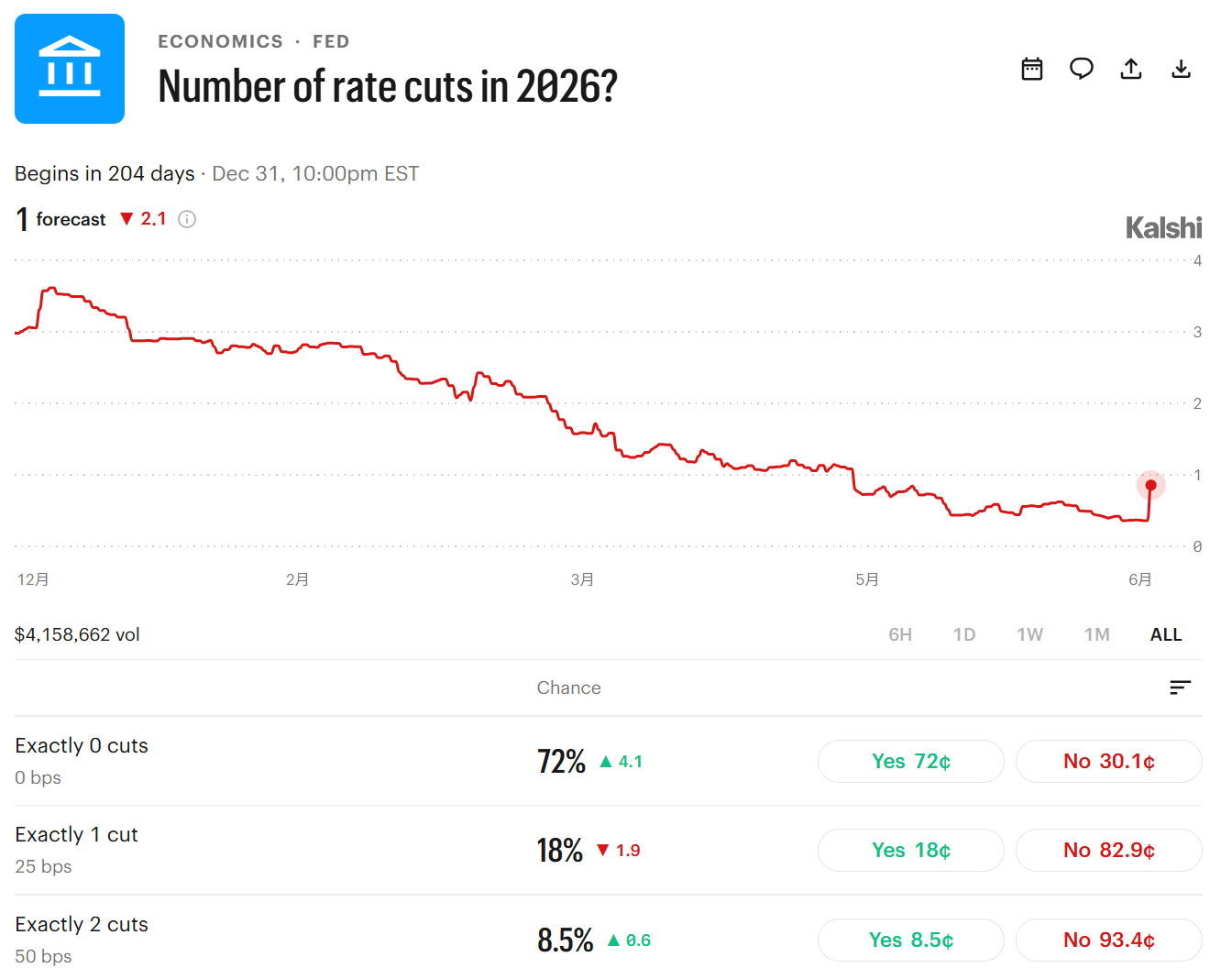


This stands in stark contrast to market expectations at the beginning of the year. In early 2026, the market generally believed the Fed would start a rate-cutting cycle against the backdrop of persistently declining inflation. April's CPI year-over-year had already risen to 3.8%, and the May data further confirmed the inflation rebound trend, making the high-interest-rate policy environment a mainstream narrative once again. While the external shock from energy prices has some temporary nature, if it transmits to core service prices, it will force the Fed to reassess the neutral interest rate level.


For the new Chair Wash, the June meeting is an important debut. Wash was formally sworn in as Fed Chair in late May 2026, succeeding Jerome Powell whose term ended. The June meeting will release a new Summary of Economic Projections and dot plot, and the market will closely watch officials' latest assessments of the inflation path, labor market, and policy rates.


Analyzing at a deeper level, the slowdown in core CPI month-over-month to 0.2% in May provided some relief signals, indicating underlying inflation pressures are not spiraling out of control broadly. However, the Fed historically places more emphasis on the "trend" of core indicators rather than single-month fluctuations, especially against a backdrop of volatile energy prices. The persistent stickiness of housing costs, potential second-round effects (energy costs pushing up other goods and services prices), and geopolitical uncertainties all add complexity to policy formulation.


Crypto and U.S. Stocks


The Fed's policy path is the core anchor for the global liquidity environment. A high-interest-rate or delayed-rate-cut environment is typically accompanied by a stronger dollar, rising U.S. Treasury yields, and pressure on valuations of risk assets. The correlation between crypto assets like Bitcoin and growth-oriented assets like Nasdaq has significantly increased over the past few years. Marginal changes in liquidity expectations are often first reflected in BTC prices and ETF fund flows.


Data from SoSoValue shows that since May this year, Bitcoin spot ETFs have seen significant and continuous net outflows, putting pressure on Bitcoin's price. BTC once fell below the $60,000 mark, later fluctuating around $62,000, with the risk of breaking down again at any time.
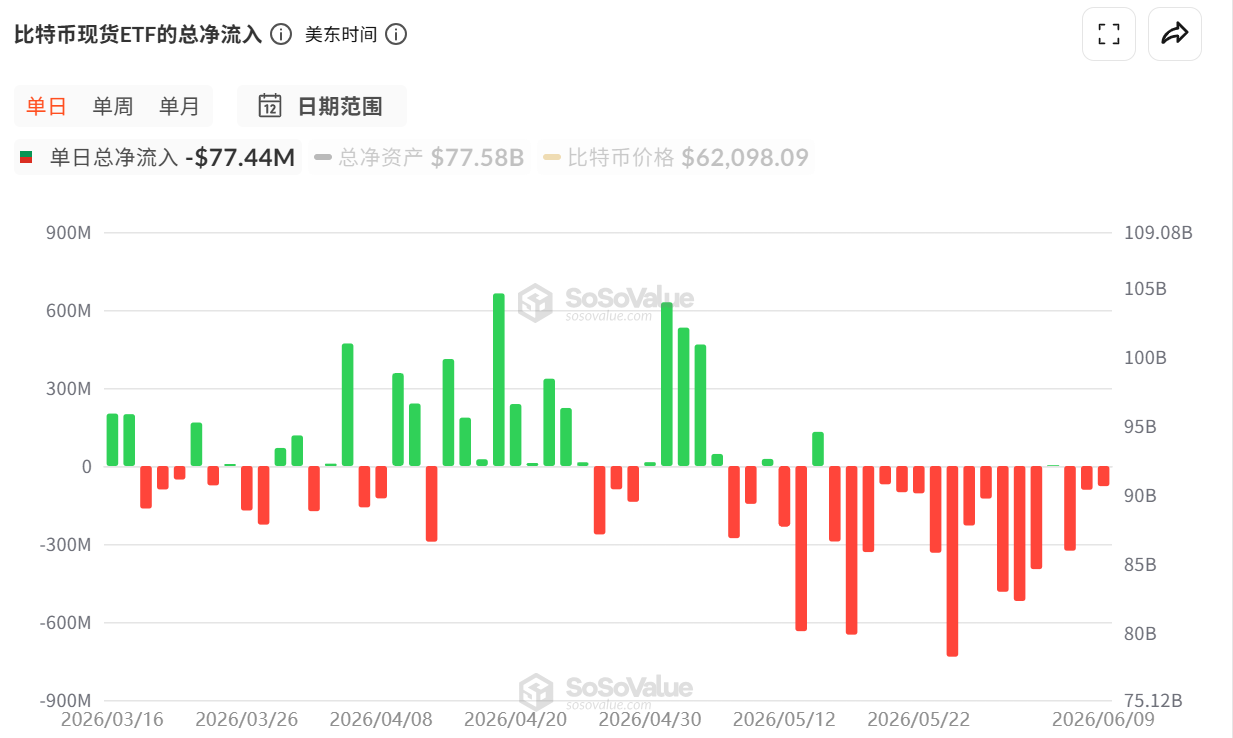


Although the current crypto ecosystem is much more mature than during the 2022-2023 bear market, in the short term, CPI data could still trigger a pullback in risk appetite, leverage unwinding, and amplification of short-term volatility.


The latest weekly report data from Glassnode shows that Bitcoin continues to exhibit characteristics of a later-stage correction, with recent buyers suffering significant losses, realized losses remaining high, and several major sources of demand substantially weakened. Bitcoin's price drop to around $60,000 triggered a significant deleveraging event, clearing a large number of speculative positions in the market. While this helps reset leverage levels, spot demand has not yet shown substantive recovery. The options market remains in a defensive posture, implied volatility stays elevated, demand for downside protection is strong, and dealer positioning is concentrated around current spot levels. Combined with declining institutional participation and slowing corporate treasury accumulation, these data points indicate that risk appetite remains low.
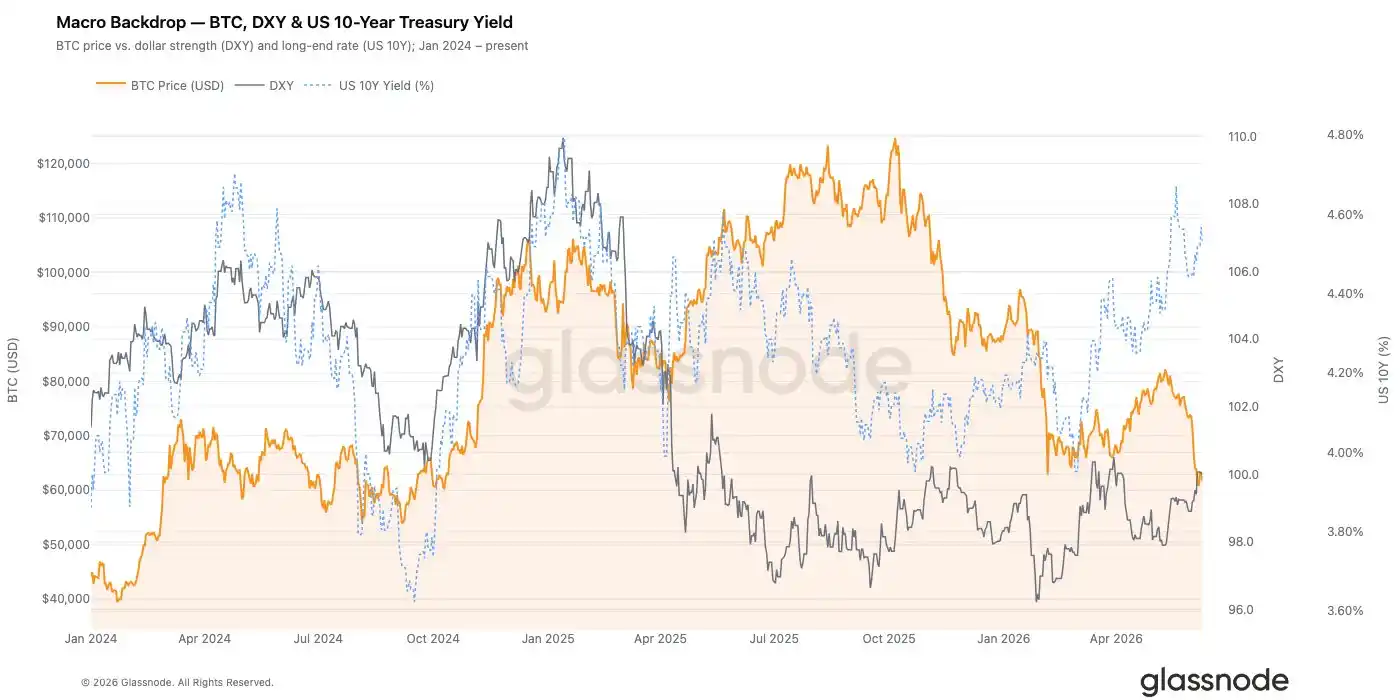


Overall, the market appears to be progressing further into a capitulation phase. Although leverage has largely been reset and valuation metrics have reached historically low levels, the demand response typically associated with long-term market lows has not yet materialized.


Historical experience shows that when inflation is mainly driven by supply-side factors like energy and core data remains relatively controlled, markets often gradually repair expectations for a "soft landing" after digesting the initial shock.


As for U.S. stocks, major investment banks maintain optimistic expectations. J.P. Morgan Asset Management believes this data may be close to a cyclical peak in this round of inflation. David Kelly, the firm's Chief Global Strategist, said that although inflation levels remain above the target range, "the most likely decision for the Fed at the upcoming policy meeting is to keep rates unchanged" and continue observing subsequent data changes.


J.P. Morgan indicates that "one-off shocks" like energy shocks may become the new normal. The AI investment cycle continues, but it also warns that inflation is higher than pre-pandemic, the correlation between stocks and bonds may structurally increase, and the 60/40 portfolio faces greater pressure.


Goldman Sachs recently raised its year-end target for the S&P 500 to 8,000 points (previously 7,600), expecting 24% EPS growth in 2026. It believes earnings growth remains the main driver of the stock market, though it noted in recent comments that the probability of Fed rate cuts this year has significantly decreased.


Domande pertinenti

QAccording to the article, what was the primary driver behind the unexpected rise in the US CPI for May 2026, and by how much did it contribute to the monthly increase?

AThe primary driver was energy prices, specifically due to geopolitical conflicts. The energy index contributed over 60% of the overall CPI's monthly increase.

QHow did the market's expectation for Federal Reserve monetary policy in 2026 change after the release of the May CPI data?

AMarket expectations shifted dramatically. The probability of the Fed holding rates steady for the entire year rose sharply to around 72%, while expectations for 1-2 rate cuts earlier in the year were largely abandoned. Some traders even began pricing in the possibility of a rate hike by late 2026 or 2027.

QWhat contrasting signals does the May CPI report present when comparing the 'Headline CPI' and the 'Core CPI'?

AThe report presents a contrast. The Headline CPI rose sharply by 4.2% year-over-year, a three-year high, driven by surging energy costs. However, the Core CPI (excluding food and energy) rose at a slower-than-expected pace of 0.2% month-over-month and 2.9% year-over-year, indicating that underlying, broader inflationary pressures were more contained.

QWhat impact did the CPI data have on Bitcoin and related crypto market indicators, according to on-chain data firm Glassnode?

AThe data contributed to a bearish environment. Bitcoin experienced significant deleveraging near $60,000, clearing out speculative positions. On-chain data showed severe losses for recent buyers, weakened demand, high implied volatility for downside protection, and a general lack of recovery in spot demand, indicating the market was in a 'capitulation phase'.

QDespite the hot inflation data, why do several cited economists and institutions believe the Fed is unlikely to panic and restart a hiking cycle immediately?

AThey point to the relatively controlled Core CPI figures as providing room for patience. They argue that the inflation surge is primarily driven by temporary energy shocks (supply-side) and has not yet translated into broad-based 'second-round effects' across other goods and services. Therefore, the most likely immediate action is for the Fed to hold rates steady and observe future data.

Letture associate

The World Cup is Here: The Battle for Entry into Prediction Markets Has Begun

The 2026 FIFA World Cup has begun, and alongside the on-field competition, a new off-field battleground is emerging: prediction markets. These blockchain-based platforms, which convert crowd wisdom into tradable probabilities, are gaining significant traction. However, their complexity—involving wallets, gas fees, and smart contracts—has historically limited participation to crypto-native users. Centralized exchanges (CEXs), like Gate, are tackling this adoption barrier. By integrating with leading prediction market protocol Polymarket, Gate simplifies the user experience. Users can participate directly with their exchange account and USDT, bypassing complex Web3 steps. Gate offers a streamlined "Prediction Mode" for casual users and a professional "Trading Mode" with advanced tools. Key features include two-way trading (allowing users to buy or sell positions before event resolution), support for diverse markets (sports, crypto, macroeconomics), and a suite of information tools like a "Smart Money" leaderboard, wallet tracking, and AI-powered insights. For the World Cup, Gate launched a dedicated hub aggregating schedules, standings, and relevant markets. This allows fans to seamlessly follow games and trade on outcomes, transforming passive viewing into active participation where they can monetize their predictions and trade on shifting consensus throughout a match. The article argues that prediction markets have proven their value in event forecasting. The next challenge is mass adoption. The competition is shifting from building effective protocols to creating accessible user entry points. By lowering technical barriers and building a complete ecosystem for information and trading, platforms like Gate aim to transition prediction markets from a niche crypto tool to a mainstream platform for expressing and trading on collective intelligence.

Odaily星球日报2 min fa

The World Cup is Here: The Battle for Entry into Prediction Markets Has Begun

Odaily星球日报2 min fa

Spain Held to a Draw by Cape Verde, Jucom Prediction Market Witnesses Historic Upset

In a major upset at the 2026 FIFA World Cup, tournament favorites Spain were held to a surprising 0-0 draw by debutants Cape Verde in their Group H opener on June 16, Beijing time. Despite dominating possession (74%) and recording 27 shots with an expected goals figure of 2.16, Spain failed to break down a resilient Cape Verde defense, with their 40-year-old goalkeeper Vozinha making 7 saves to earn Man of the Match. Pre-match predictions on the Jucom prediction market had heavily favored Spain, assigning them a 92% win probability. The actual result, a goalless draw, triggered significant volatility across related prediction markets. This outcome forces a market-wide reassessment of several key probabilities, including Spain's likelihood of winning the group and the tournament itself, while Cape Verde's previously near-zero chance of advancing is now being re-evaluated. The event highlights both the efficiency and the inherent limitations of prediction markets. While prices aggregate known information, football's low-scoring, high-variance nature means unquantifiable in-game factors can lead to unlikely results. The core value of such markets lies not in perfect foresight but in their ability to dynamically reflect how new information is incorporated into collective expectations. Platforms like Jucom, which track outcomes from single matches to the final champion, provide a real-time lens into how global consensus evolves with each game.

链捕手6 min fa

Spain Held to a Draw by Cape Verde, Jucom Prediction Market Witnesses Historic Upset

链捕手6 min fa

Standard Chartered Bank Places a 40x 'Bet', Calls for UNI to Rise to $100

Standard Chartered Bank’s digital asset research head, Geoff Kendrick, initiated coverage on Uniswap with a highly bullish long-term price target of $100 for its UNI token by 2030—a roughly 40-fold increase from its ~$2.60 trading price at the time of the report. The bank’s thesis hinges on the exponential growth of tokenized real-world assets (RWA), projected to surge from ~$340 billion to $4 trillion by 2028. It expects the share of these assets deployed in DeFi to rise from 3.5% to 30%, driving total DeFi TVL to around $2.7 trillion. As the leading decentralized exchange (DEX), Uniswap is positioned to capture a significant portion of this liquidity influx. A key catalyst is Uniswap’s “fee switch,” activated in late 2024, which directs a portion of protocol fees to UNI token buybacks and burns. This transforms UNI from a pure governance token into a yield-generating, deflationary asset, narrowing its valuation gap with centralized exchanges like Coinbase. The report draws an analogy: Coinbase operates like Netflix (centralized, high-cost), while Uniswap functions like YouTube (open, user-generated, network-effect driven). Despite its dominant market share and recent institutional adoption—such as BlackRock’s BUIDL fund and Fidelity’s stablecoin using Uniswap for liquidity—the path faces challenges. Competition from Solana-based DEXs and aggregators threatens user mindshare, while regulatory delays or setbacks in RWA adoption could slow the projected growth. Furthermore, UNI remains down over 92% from its 2021 peak, reflecting persistent market skepticism. Ultimately, Standard Chartered’s report signals a shift in traditional finance’s perception of DeFi, valuing network effects and cash flow potential. However, realizing the $100 target depends on Uniswap successfully navigating intense competition, regulatory hurdles, and the multi-year timeline for massive tokenized asset adoption.

marsbit30 min fa

Standard Chartered Bank Places a 40x 'Bet', Calls for UNI to Rise to $100

marsbit30 min fa

Trading

Spot
Futures
活动图片