Three Months of Raising $6 Billion in Funding: What Are the Leading Crypto VCs Betting On?

marsbitPubblicato 2026-05-08Pubblicato ultima volta 2026-05-08

Introduzione

While the crypto bear market persists, top-tier venture capital firms are making significant moves by raising massive new funds, signaling a strategic bet on the industry's future. Haun Ventures and a16z recently announced funds totaling $1 billion and $2.2 billion, respectively. This follows other major raises from firms like Dragonfly, Paradigm, ParaFi, and Blockchain Capital. In under three months, these six VCs have amassed over $6 billion in fresh capital, a clear example of counter-cyclical investing during a quiet market phase. The fundraising landscape highlights a sharp divergence between large and small VCs. Many mid-sized and smaller funds are struggling with poor returns, limited exit options, and difficulty raising new capital, leading some to scale back or exit. In contrast, leading firms are strengthening their dominance due to structural advantages: superior access to high-quality deals, the ability to invest across all stages, greater capacity for long-term bets and risk, and stronger negotiation power. These new funds are largely converging on key investment themes. The strongest consensus centers on next-generation on-chain financial infrastructure, including stablecoins, real-world asset (RWA) tokenization, prediction markets, and on-chain payments. VCs are focusing on projects with validated demand that can attract traditional finance flows. Another major focus is artificial intelligence (AI), particularly AI agents, as crypto seeks to position its open...

Author: Azuma, Odaily Planet Daily

The bear market in cryptocurrencies continues, yet some highly significant moves have emerged in the primary market.

On May 4th, Haun Ventures, the venture capital firm founded by former U.S. federal prosecutor Katie Haun, announced the completion of a funding round totaling $1 billion. The early-stage and later-stage funds will each be allocated $500 million, primarily to be invested over the next 2 to 3 years in startups within the cryptocurrency and blockchain sectors, while also expanding into intersecting areas such as AI agents, fintech, and alternative assets.

Just one day later, a16z followed up by announcing the close of its fifth cryptocurrency fund, Crypto Fund 5, securing $2.2 billion in committed capital. The fund will continue to deepen its focus on the cryptocurrency market, concentrating on the often-overlooked yet most value-creating parts during cyclical shifts, transforming next-generation infrastructure into products people use daily.

Looking back further in the timeline reveals that this is not a coincidence but more like a "collective consensus" among leading VCs.

In February of this year, Dragonfly's Fund IV completed a $650 million raise. At the end of February, multiple media outlets reported that Paradigm was seeking to raise up to $1.5 billion for its next fund. In March, ParaFi announced the completion of a $125 million raise. In late April, sources revealed that Blockchain Capital was raising $700 million for two funds... Within less than three months, just these six VCs alone have quietly amassed over $6 billion in funding.
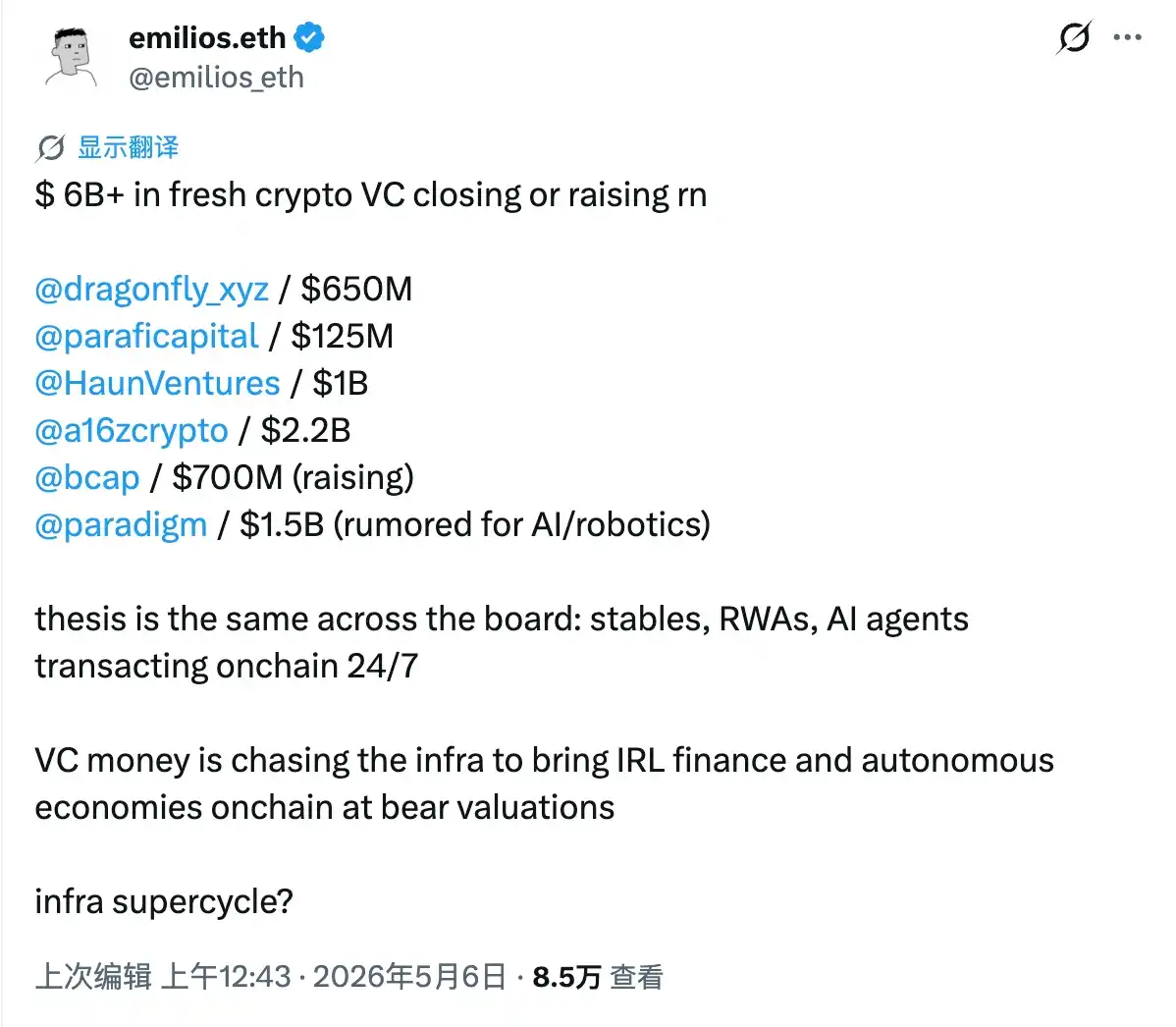
More crucially, this wave of fundraising did not occur at the market's peak but during the bearish phase characterized by depleted altcoin liquidity, declining primary market valuations, and persistently low industry sentiment. As a16z partner Chris Dixon stated, "We are in a relatively quiet stage." This is not a bullish follow-up but a typical counter-cyclical deployment.

The Primary Market is Diverging

Focusing solely on the $6 billion fundraising amount can easily create the illusion of "a primary market recovery," but the reality is far more complex. Surveying the current survival status of top-tier VCs versus mid-sized and smaller VCs reveals a clear trend of divergence in the primary market.

For most mid-sized and smaller VCs, this cycle is proving much tougher than anticipated. Due to the continued slump in altcoins (largely missing the entire bull run) coupled with tightening liquidity in the secondary market, exit channels for funds are severely obstructed. Paper profits often shrink or even turn negative over prolonged vesting periods. The disappointing investment returns have directly led to a decline in LP confidence, making fundraising for new funds increasingly difficult.

Consequently, we are witnessing the passive contraction of most mid-sized and smaller VCs during the bear market: some have chosen to downsize their funds and reduce deployment frequency; others have transitioned to pure secondary market funds; and some have exited the market entirely. Many mid-sized VCs that were highly visible during the last bull run have now vanished from the scene.

In stark contrast are the leading VCs still raising funds aggressively. Although their investment pace has also slowed with the market downturn, leveraging structural advantages, their dominance in the primary market is actually strengthening.

Regarding these structural advantages, firstly, top VCs typically possess stronger resource monopoly capabilities, enabling them to capture rare high-quality projects more effectively (prime examples include Kalshi backed by a16z and Paradigm, Polymarket backed by Dragonfly and ParaFi, Blockchain Capital which invested in Coinbase and Circle). Secondly, top VCs can cover the entire investment cycle, from early pre-seed and seed rounds to later Series A and B, offering more opportunities for late entry or amplified gains. Thirdly, top VCs have greater room for error, with larger AUM allowing them to withstand relatively higher failure rates and bet on longer-term narratives. Fourth, the brand power of top VCs translates to stronger bargaining power, often securing more favorable terms than mid-sized VCs even within the same funding round.

This structural disparity in advantages and disadvantages ultimately leads to market divergence, where the Matthew effect becomes increasingly pronounced. In a bull market, mid-sized VCs might still pull off a comeback with a few lottery-ticket wins, but during a bear cycle, this trend only intensifies.

What Are These $6 Billion Targeting?

Based on disclosures from these six VCs, the newly raised $6 billion is earmarked for the following sectors and directions.

  • Dragonfly: Bullish on crypto financialization trends, specifically mentioning stablecoins, prediction markets, agent payments, on-chain privacy, real-world asset tokenization.
  • Paradigm: Expanding beyond crypto into AI, robotics, and other frontier tech areas.
  • ParaFi: Stablecoins, asset tokenization, institutional-grade on-chain financial products.
  • Blockchain Capital: Focused on early-stage and growth-stage crypto startups.
  • Haun Ventures: Bullish on next-gen financial infrastructure, including stablecoins, asset tokenization, prediction markets, and also optimistic about the agent economy.
  • a16z: Mentions financial infrastructure like stablecoins, DeFi, prediction markets, asset tokenization. Also believes that in the era of the AI explosion, crypto networks' inherent properties can still address software transparency and verifiability issues.

Placing the public statements of these six VCs side by side, while differences in emphasis remain, overall they have converged significantly.

The core consensus undoubtedly centers on the new generation of on-chain financial infrastructure represented by stablecoins, asset tokenization (RWA), prediction markets, and on-chain payments. Whether it's Haun Ventures, a16z, Dragonfly, or ParaFi, these keywords are repeatedly mentioned in their new fund directions. To some extent, this signals a shift in the investment logic of the crypto industry. Compared to the more sentiment-driven bets of the last cycle, this time, leading VCs are placing greater emphasis on infrastructure-type projects that have preliminarily validated real demand and have the potential to capture traditional financial flows in the long term.

Additionally, leading VCs are significantly ramping up their AI-related investments. Paradigm has explicitly stated it will allocate part of its funds to AI and robotics, while Haun Ventures and Dragonfly have also mentioned agent-related directions. The reasons behind this trend are not complicated: on one hand, AI is currently the most certain major theme in the global tech industry, a space top VCs cannot afford to miss; on the other hand, the crypto industry is also trying to prove that it is not merely an old narrative marginalized by the AI hype but can become part of the underlying infrastructure for the AI era — especially as the agent economy gradually emerges, the inherent openness, composability, and permissionless nature of crypto networks are beginning to demonstrate renewed value.

Bear Market Fundraising is Essentially a Bet on the Next Cycle

For VCs, the bear market is often the stage that truly determines the future landscape.

While funds are easiest to raise during a bull market, project valuations and entry barriers are often also at their highest. It is only when market sentiment is low, liquidity dries up, and industry narratives falter that the opportunity for VCs to capture excess returns through judgment is truly amplified.

Looking back at past cycles, bear markets do not kill truly high-quality projects; instead, they accelerate market shakeouts, allowing the "gold to shine faster." This is why, even with current market sentiment remaining low, leading VCs are still raising funds counter-cyclically.

Because what they are truly betting on is never the "present," but rather who will become the next Circle, the next Hyperliquid, the next Polymarket once the next cycle begins.


Domande pertinenti

QWhat is the most significant consensus among the six top-tier crypto VCs regarding their new investment focus, as mentioned in the article?

AThe core consensus among these VCs is a focus on the next generation of on-chain financial infrastructure, including stablecoins, asset tokenization (RWA), prediction markets, and on-chain payments. They are prioritizing projects with validated real-world demand and the potential to capture long-term traditional financial flows.

QWhy are major crypto VCs raising large funds during a bear market, according to the article?

AThey are practicing counter-cyclical investment. The primary reason is that bear markets offer the best opportunity to capture outsized returns. Valuations and entry barriers are lower, and the market washout allows truly high-quality projects to emerge more clearly. They are essentially betting on who will become the leading projects in the next market cycle.

QHow is the venture capital landscape in the crypto market currently diverging, as described in the article?

AThe market is experiencing significant divergence. While top-tier VCs are actively raising large funds, most small to mid-sized VCs are facing severe challenges. The latter are struggling with poor returns, dwindling LP confidence, and difficulties in raising new funds, leading many to downsize, pivot to secondary markets, or exit entirely. This is widening the gap and strengthening the dominance of major players.

QWhat structural advantages do leading crypto VCs possess that allow them to thrive even in a bear market?

ALeading VCs possess four key structural advantages: 1) Stronger resource monopolization to capture scarce, high-quality deals. 2) The ability to cover the full investment lifecycle from pre-seed to late-stage. 3) Larger fund sizes providing more room for error and enabling longer-term bets. 4) Stronger brand power and bargaining power to secure better deal terms.

QBesides financial infrastructure, what other major trend are top crypto VCs increasingly investing in, and why?

AThey are significantly increasing their investments in AI-related fields. This is because AI is the most certain trend in global tech, making it an unavoidable area for top VCs. Furthermore, the crypto industry aims to position itself as part of AI's foundational infrastructure. The inherent properties of crypto networks—openness, composability, and permissionless access—are seen as valuable for emerging areas like the Agent economy.

Letture associate

A Nation Blocks Chips, a Giant Buys a Nuclear Power Plant: Why It's Time to Seriously Consider DeAI

**Title: Great Powers Blockade Chips, Giants Buy Nuclear Plants: Why It's Time to Seriously Consider DeAI** In May 2026, the US closed loopholes for Chinese firms to acquire advanced NVIDIA chips via overseas subsidiaries. That same month, Kenya halted a $1B geothermal data center project involving Microsoft, fearing its immense energy consumption. Meanwhile, Huawei announced mass production of its Ascend AI chip. These disparate events underscore a new reality: the competition for computing power ("compute") has escalated beyond the tech industry, becoming a geopolitical and infrastructural battleground. A new era of oligopoly is forming, with control over the AI stack—from GPU chips (NVIDIA) and cloud platforms (AWS, Azure, Google Cloud) to foundational models (OpenAI, Anthropic)—concentrating in a few Western "AI Octopus" corporations. This centralization creates systemic risks: pricing power and platform lock-in for users, infrastructure fragility, and a widening "compute divide" that threatens to marginalize nations without independent AI capacity. An "AI Iron Curtain" is deepening through export controls. In response, some nations like Saudi Arabia and the UAE are investing heavily to buy compute power, aiming to transition from oil to AI economies. The EU seeks to triple its compute capacity by 2030 to reduce dependency. However, the spending gap is vast, with four US tech giants alone planning ~$750B in AI capex for 2026. The race is increasingly constrained by energy, with AI tasks consuming up to 1000x more power than web searches, pushing firms to even acquire nuclear plants. This landscape is fueling interest in Decentralized AI (DeAI). It proposes a third way: using open protocols to coordinate a global network of idle GPUs, independent developers, and data centers, creating an AI infrastructure without a single controlling entity. Leveraging blockchain and cryptographic verification, DeAI aims to break market concentration, disperse energy demands, reduce geopolitical dependencies, and enhance transparency. While still nascent in performance and stability, DeAI's core promise is not immediate superiority but providing a crucial alternative architecture to resist monopoly, censorship, and centralized power. As specialized AI hardware costs fall and open-source models flourish, the window to build this foundation is open. The very existence of such competition serves as a vital check against the inevitable abuse of concentrated power.

marsbit30 min fa

A Nation Blocks Chips, a Giant Buys a Nuclear Power Plant: Why It's Time to Seriously Consider DeAI

marsbit30 min fa

Outpoll Review: A Prediction Market Platform Built for Active Traders

Outpoll Review: A Prediction Market Platform Built for Active Traders In recent years, prediction markets have grown from a niche sector to a mainstream arena, attracting billions in trading volume and institutional capital. However, the user experience and tools for traders have not kept pace. Outpoll, a new global prediction market platform, aims to fill this gap by providing enhanced trading infrastructure for active and professional traders. Built on standard prediction market principles, Outpoll allows users to trade on the outcome of specific events. It uses fully collateralized contracts with USDC settlement, charges a competitive 0.1% fee per trade, and provides clear settlement rules upfront to minimize disputes. A key focus for Outpoll is its professional-grade trading tools. The platform supports limit and market orders, as well as take-profit and stop-loss orders for open positions—features uncommon in prediction markets. For automated trading, Outpoll offers comprehensive REST and WebSocket APIs, enabling portfolio management, price arbitrage, and integration with existing tools. The platform also features a creator-led market model, where approved experts and community leaders can create and manage markets for niche topics under platform supervision. Its integrated interface combines news feeds directly with trading functions, allowing users to monitor events and manage positions seamlessly. Outpoll launched with a native Android app (available on Google Play) and plans an iOS version later this year. In summary, Outpoll distinguishes itself with trader-focused tools, practical APIs, transparent and collateralized markets, integrated news, and an expanding creator program. For active traders, its advanced order types and API access alone make it a platform worth watching. Outpoll is now globally accessible via outpoll.com and Google Play.

marsbit38 min fa

Outpoll Review: A Prediction Market Platform Built for Active Traders

marsbit38 min fa

Bitwise: Crypto Becomes a Contrarian Investment, Three Logics to Understand the Current Market

**Summary** Matt Hougan, Bitwise's CIO, analyzes the current crypto market through three key lenses, arguing it has shifted from a momentum-driven to a contrarian investment. **1) Crypto Becomes a Contrarian Play:** The market is weak, with major assets like Bitcoin and Ethereum down significantly. Capital has moved to hot sectors like AI, leaving crypto as an "unloved" asset class. This transforms crypto investing from trend-following to a test of patience and fundamental analysis. Investors now favor projects with solid fundamentals (e.g., Hyperliquid) over speculative ones. **2) Regulatory Overhang:** The uncertain fate of the U.S. CLARITY Act, a major crypto regulatory framework, is a key headwind. With its passage in 2024 seen as far from guaranteed (estimates range from 30-55%), institutional capital remains on the sidelines, choosing less risky alternatives like AI stocks. The market needs clarity—whether the bill passes or fails—more than any specific outcome to move decisively. **3) Capital Rotates to New Fundamentals:** This cycle differs from past bear markets where money fled to Bitcoin. Now, capital seeks smaller assets with strong use cases. While major cryptos fell in May 2024, tokens like Hyperliquid (+72%), Zcash (+50%), and XLM (+44%) rallied on their specific fundamentals. This rotation confirms the new contrarian, fundamentals-driven logic and signals the bear market may be in its later stages. **Conclusion:** Short-term pressure persists due to regulatory uncertainty and competition from AI narratives. Investing in crypto now requires a contrarian mindset—acting against the crowd and focusing on fundamental value. Patience and targeting high-quality projects based on their merits are essential for capturing long-term gains.

marsbit1 h fa

Bitwise: Crypto Becomes a Contrarian Investment, Three Logics to Understand the Current Market

marsbit1 h fa

ChatGPT Might Be Disappearing Soon

OpenAI announced at its "Intelligence at Work" event that its coding assistant, Codex, will be fully integrated into the ChatGPT app within weeks. This move marks a strategic shift from a conversational AI (Chat) towards a unified "agentic" platform capable of execution. Codex, originally launched to compete with Anthropic's Claude Code, has grown rapidly to 5 million weekly active users, with 20% being non-developers like analysts and designers. Its enterprise revenue now constitutes 40% of OpenAI's total. The integration is the first step in creating a super-app combining ChatGPT (interface), Codex (execution engine), and the Atlas browser (web access). OpenAI also unveiled new Codex features: specialized Agent plugins for six professional roles, an "Annotations" tool for direct document editing, and a "Sites" function to turn work into shareable web apps. Internally, this reflects a power shift; the Codex team now leads core product strategy. While the ChatGPT brand remains for its vast user base, the platform's future is focused on autonomous agents that perform tasks, not just chat. The article notes that competition with Claude Code pushed OpenAI's development, with Codex competing on cost-effectiveness and accessibility rather than raw coding quality. It concludes that the essence of "ChatGPT" is evolving from a chatbot into an AI agent platform, with the name potentially becoming a legacy symbol of its original function.

marsbit1 h fa

ChatGPT Might Be Disappearing Soon

marsbit1 h fa

Trading

Spot
Futures
活动图片




