Those Who Wanted to Buy Have Already Bought: SpaceX Retail Frenzy Subsides, Real Selling Pressure Arrives in August

marsbitPubblicato 2026-06-23Pubblicato ultima volta 2026-06-23

Introduzione

SpaceX (SPCX) debuted on June 12 at $150, soared to a record $225 by June 16 in a retail-fueled frenzy, then collapsed, losing over $600 billion in market cap in a single day this week and crashing back near its IPO price. Analysts note the initial surge was driven by record retail inflows exceeding those for major tech stocks, but momentum evaporated swiftly after the peak. The sell-off occurred with only 5% of shares freely tradable. The real pressure is yet to come: lock-up expirations starting in August could release up to 44% of insider shares by early September, potentially increasing the float ninefold. With retail buying exhausted and massive supply looming, analysts warn the path higher is now severely challenged, posing a broader risk to a market sustained by speculative momentum.

Original Author: Tyler Durden (ZeroHedge pseudonym)

Original Compilation: Source: ZeroHedge

Guide: SpaceX fell for three consecutive days, plummeting 16.4% on Monday alone, erasing $600 billion in market value, dropping back to the $150 opening price. This analysis bluntly argues that those who wanted to buy have already done so, and more critically, the selling pressure hasn't truly arrived yet. This pump-and-dump used only 5% of the float. Insiders could sell up to 44% of the shares by early September.

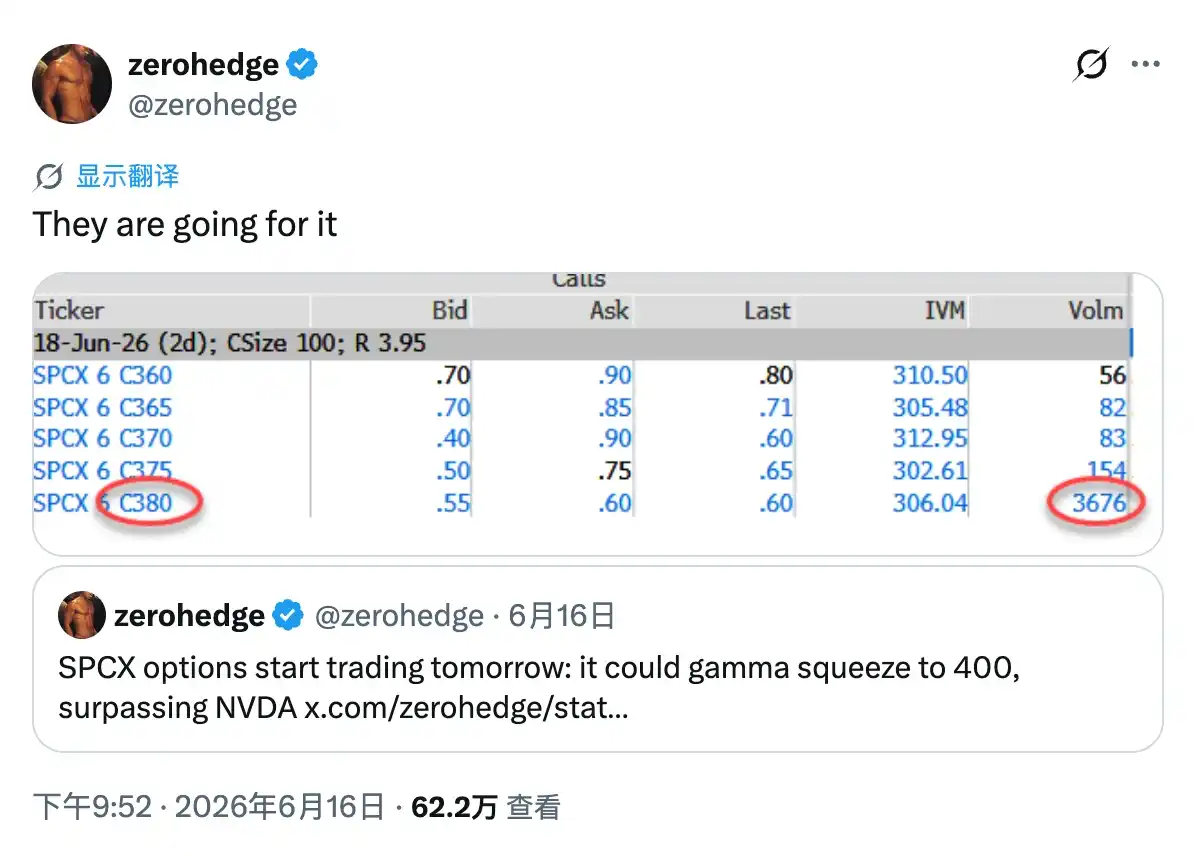
It began with a bang. SpaceX went public on June 12, opening at $150 per share, well above the $135 IPO price. Within two days, aggressive traders started furiously buying 380-strike call options expiring two days later, trying to launch the stock price into the stratosphere, creating a gamma squeeze.

@zerohedge tweet: They're really going to do it
In a report this morning, Canaccord described the "new wave of optimism" accompanying SpaceX's listing:

"The SPCX tape shows the market has entered a new phase of euphoria. Prior to this historic IPO, we felt AI optimism was already full, sometimes excessive, but buying was primarily from rational (albeit exuberant) institutions—large, well-funded public companies and PE investors. In our view, SPCX has turned a new page, with dramatically heightened retail participation, propelling the stock into the global top six by market cap and adding the equivalent of half of META's market value in its first week. Its market cap far surpasses that of its sister company TSLA, while revenue is only about one-fifth. Despite the company being named SpaceX, revenue is actually skewed towards connectivity—Starlink contributed $113.9B, launch services only $41B, and AI compute capacity was $32B in 2025."

Vanda Track put it even more starkly. In a review published earlier Monday, it wrote: "SpaceX's debut week set records. Retail investors net bought $405 million of SPCX in the first five trading days, the strongest retail participation in an IPO in recent years. Buying was extremely aggressive in the first few days, cooling somewhat towards the week's end. The flow characteristics increasingly resemble building a long-term position, not chasing a short-term meme stock."
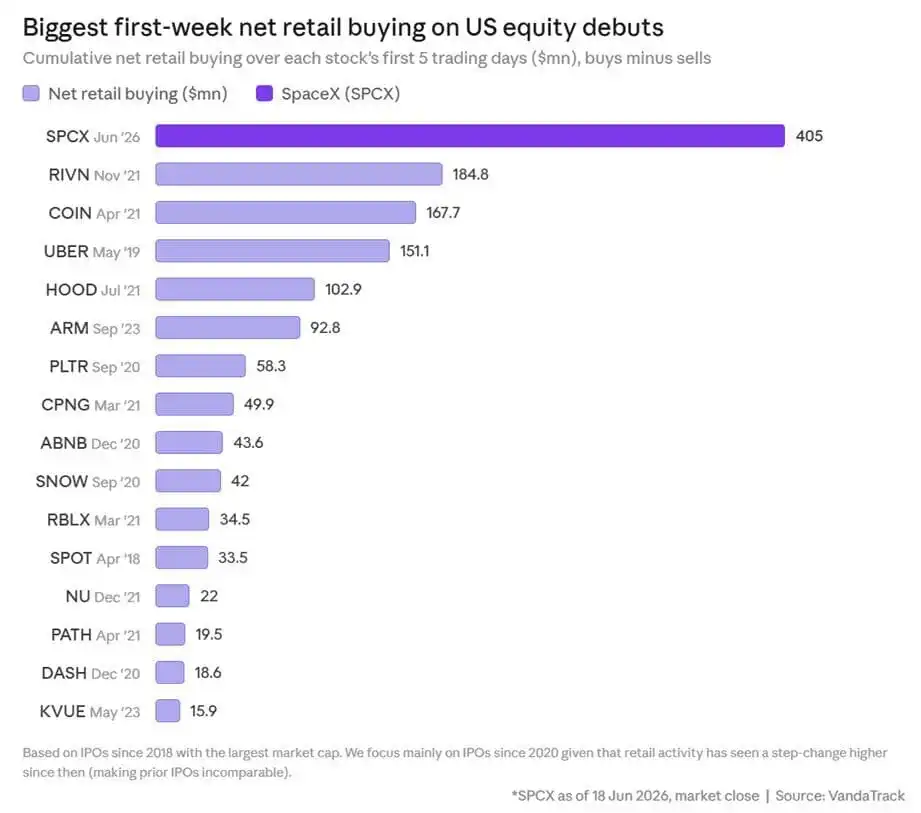
Caption: Retail flow for SPCX in its first five trading days

Source: Vanda Track

The scale of retail buying in SPCX becomes even more staggering in context. Last week's retail purchases of SPCX exceeded their combined buying of all other Mag 7 stocks—NVDA, MSFT, AMZN, META, GOOGL, and GOOG totaled only $278 million over those five days. Retail buying of SPCX also surpassed the combined retail flow into the SPY and QQQ ETFs ($352 million). A stock that began trading just last week is already competing with the market's largest individual stocks and ETFs for retail dollars.
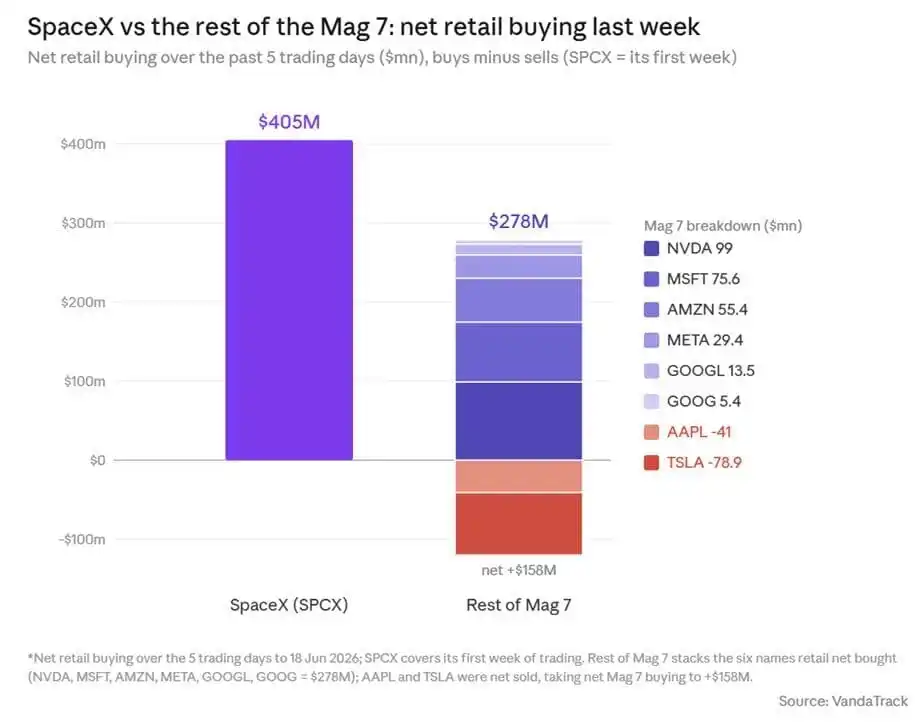
Caption: SPCX retail buying vs. Mag 7 stock retail buying

Source: Vanda Track

The old playbook unfolded again. Alongside the explosive buying of the stock, retail investors rapidly poured into various SpaceX leveraged products, with similarly strong demand. In the first few trading days, retail bought $65.8 million worth of the Leverage Shares 2x Long SPCX Daily ETF—a significant number, but still well below typical levels during speculative retail manias. Even so, it crushed recent thematic new issues: Roundhill's Memory ETF (DRAM) attracted only $5.6 million in its first four days. It took DRAM 22 trading days to surpass the cumulative retail buying that the SpaceX leveraged ETF had already absorbed.
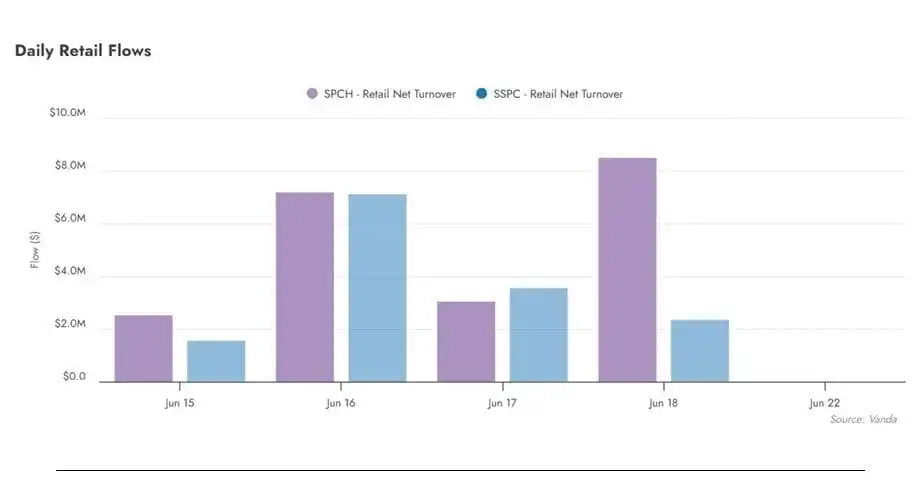
Caption: SPCX leveraged ETF retail flow vs. contemporaneous thematic ETF retail flow

Source: Vanda Track

Out of the gate, the momentum quickly stalled, and the fantasy of "riding a reusable rocket all the way into orbit via gamma squeeze" evaporated. June 16th was the peak, when SPCX hit a record high of $225, briefly surpassing Microsoft in market cap. Since then, daily retail flows have collapsed, with retail turnover almost vanishing.
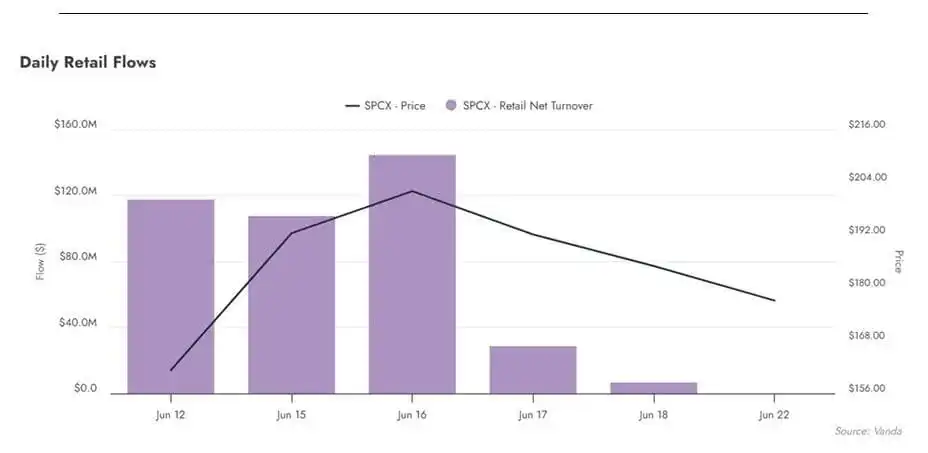
Caption: SPCX daily retail flow—cliff-like drop after peaking on June 16

Source: Vanda Track

This brings us back to Canaccord's statement. Based on SpaceX's early trading, the firm judged that "tech stocks likely have enough momentum to sustain them in the near term," but it also warned: "There's now an added layer of dangerous vacuum beneath these stocks."

Sure enough, once momentum dissipated, coupled with market awareness of trillions of shares about to unlock, the stock fell for three consecutive days, culminating in Monday's crash. On that day, as SpaceX sought to issue over $20 billion in investment-grade bonds for the first time—taking advantage of still-euphoric debt markets to replace a much higher-interest bridge loan before the window closed—SPCX plunged 16.4%, erasing a record $600 billion in market value in a single day. Including Wednesday's 5% drop and Thursday's 3.5% decline, the stock is now only slightly above its $150 opening price from two weeks ago.
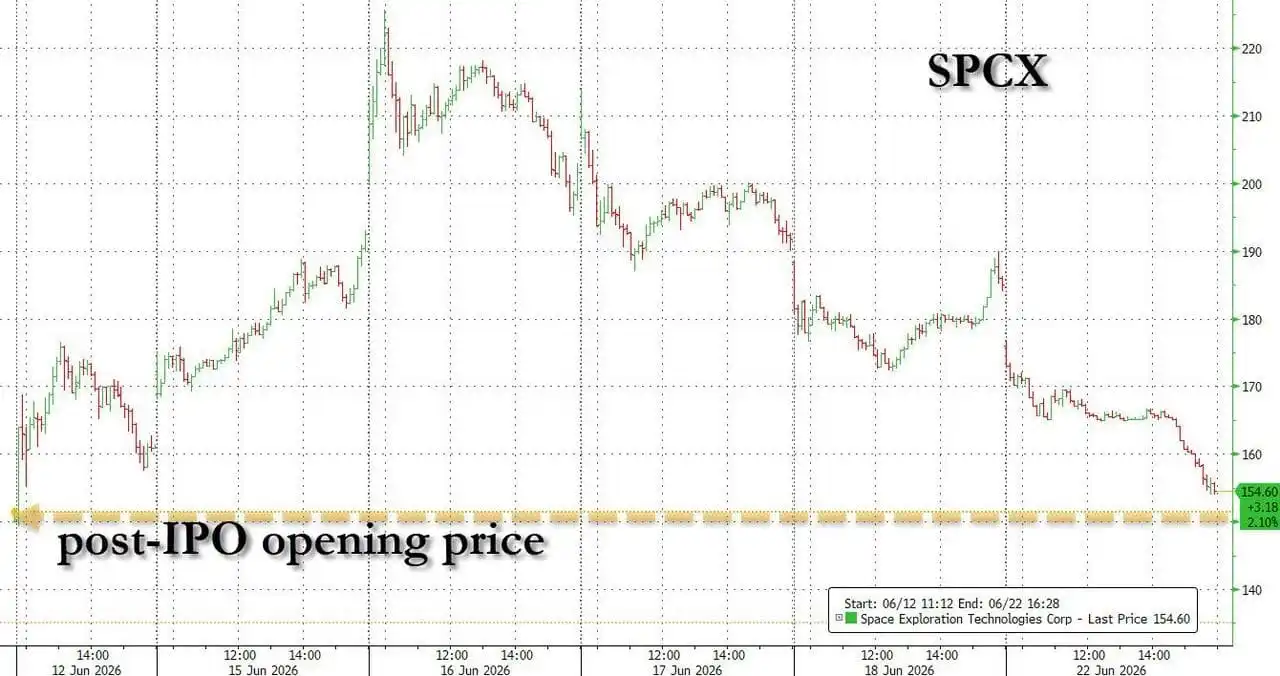
Caption: SPCX price action since IPO—retreat from $225 high to around $150

Source: ZeroHedge

Worse, after hours, SPCX briefly touched the $150 IPO opening price. If it opens below that level tomorrow, everyone who bought and held in the secondary market will be underwater.
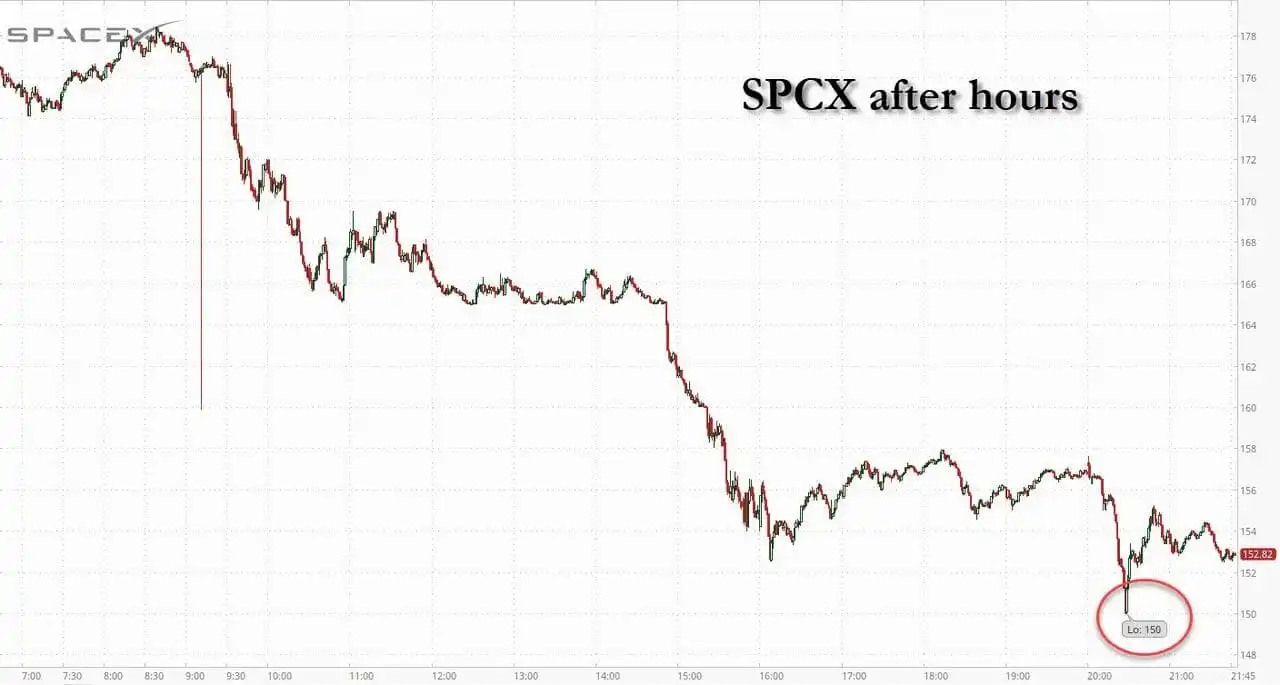
Caption: SPCX after-hours drop to near $150 IPO opening price

Source: ZeroHedge

Particularly noteworthy is that this pump-and-dump occurred with only 5% of the float available for trading—95% of shares are still locked up. But that will change soon.
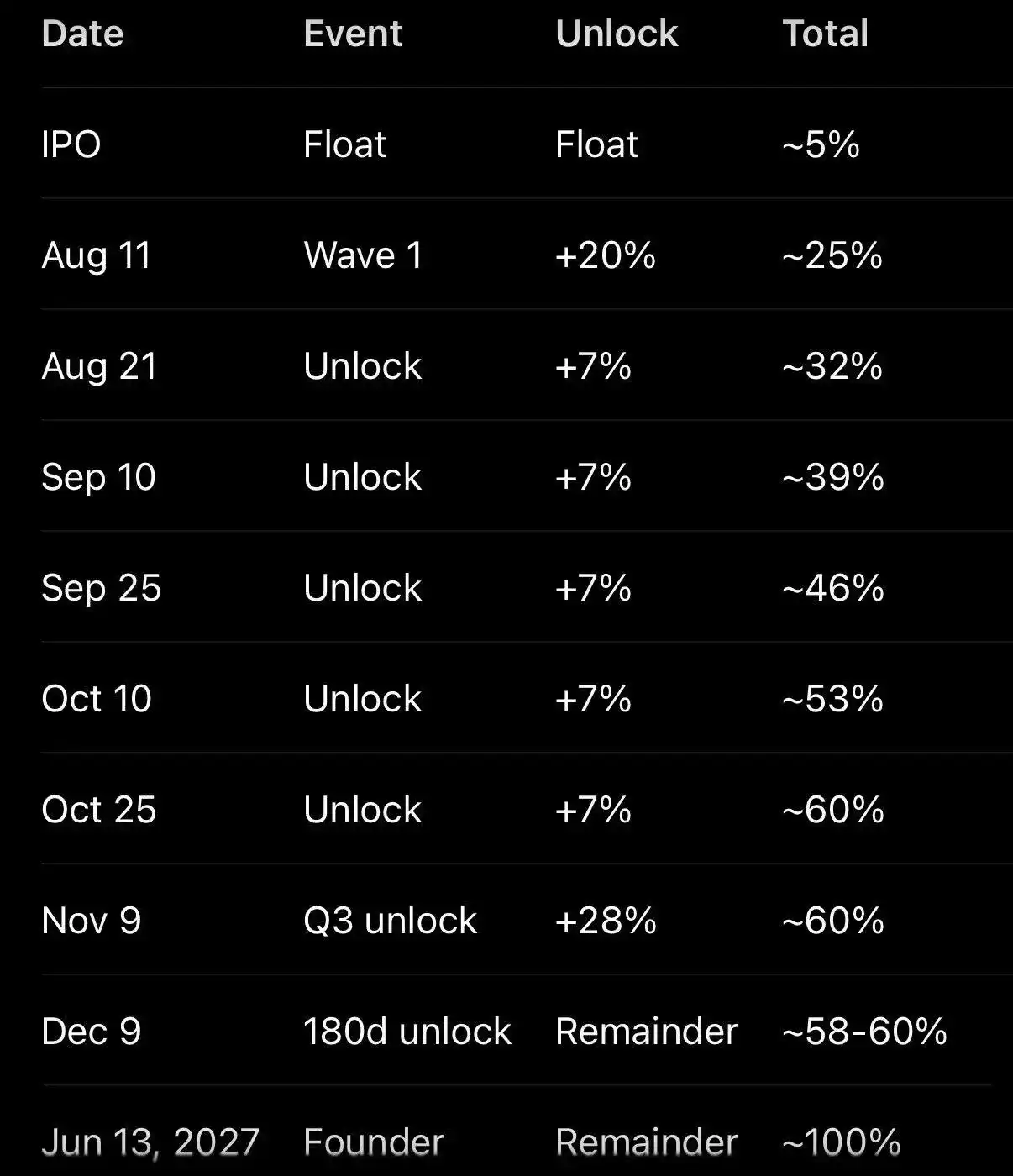
Caption: SPCX lock-up structure—currently only 5% float, 95% locked

Source: ZeroHedge

22V Research strategist Jeff Jacobson says that after SpaceX reports earnings in early to mid-August, a 20% block of insider shares will unlock. Additionally, if the stock price remains 30% above the IPO price, a further 10% will unlock. Another 7% unlocks around August 21st and September 10th.
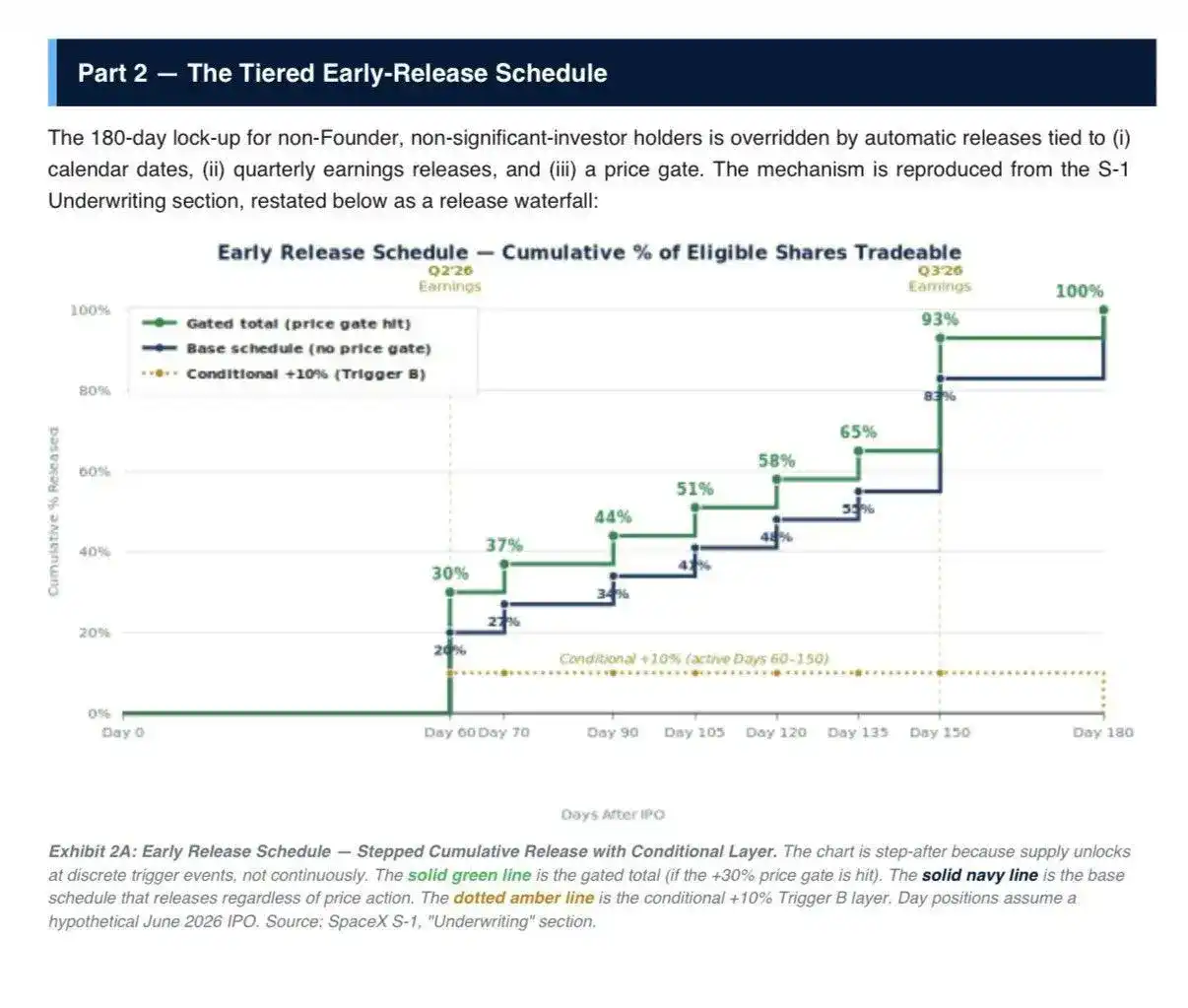
Caption: SPCX lock-up expiration schedule

Source: 22V Research

Jacobson says insiders could potentially sell up to 44% of SpaceX shares by early September, expanding the current float by approximately 900%.

In other words, lifting the stock price from here will only become increasingly difficult. Meanwhile, JonesTrading chief market strategist Michael O'Rourke says "the sellers have regained control," adding: "Everyone in the world who wanted to buy, has already bought."

Bloomberg, commenting on today's decline, wrote that SpaceX's slide today "dragged down most of the market."

Whether that's truly the case remains to be seen. But in this market—which has run almost entirely on retail euphoria and momentum-chasing since the March lows—once retail truly gets cold feet, starting with SpaceX, then the memory bubble, and finally the semiconductor stocks that have feasted on the AI trade...

@zerohedge tweet: The divergence between hyperscale cloud providers and semiconductors is unsustainable: massive capital expenditure is the key variable.
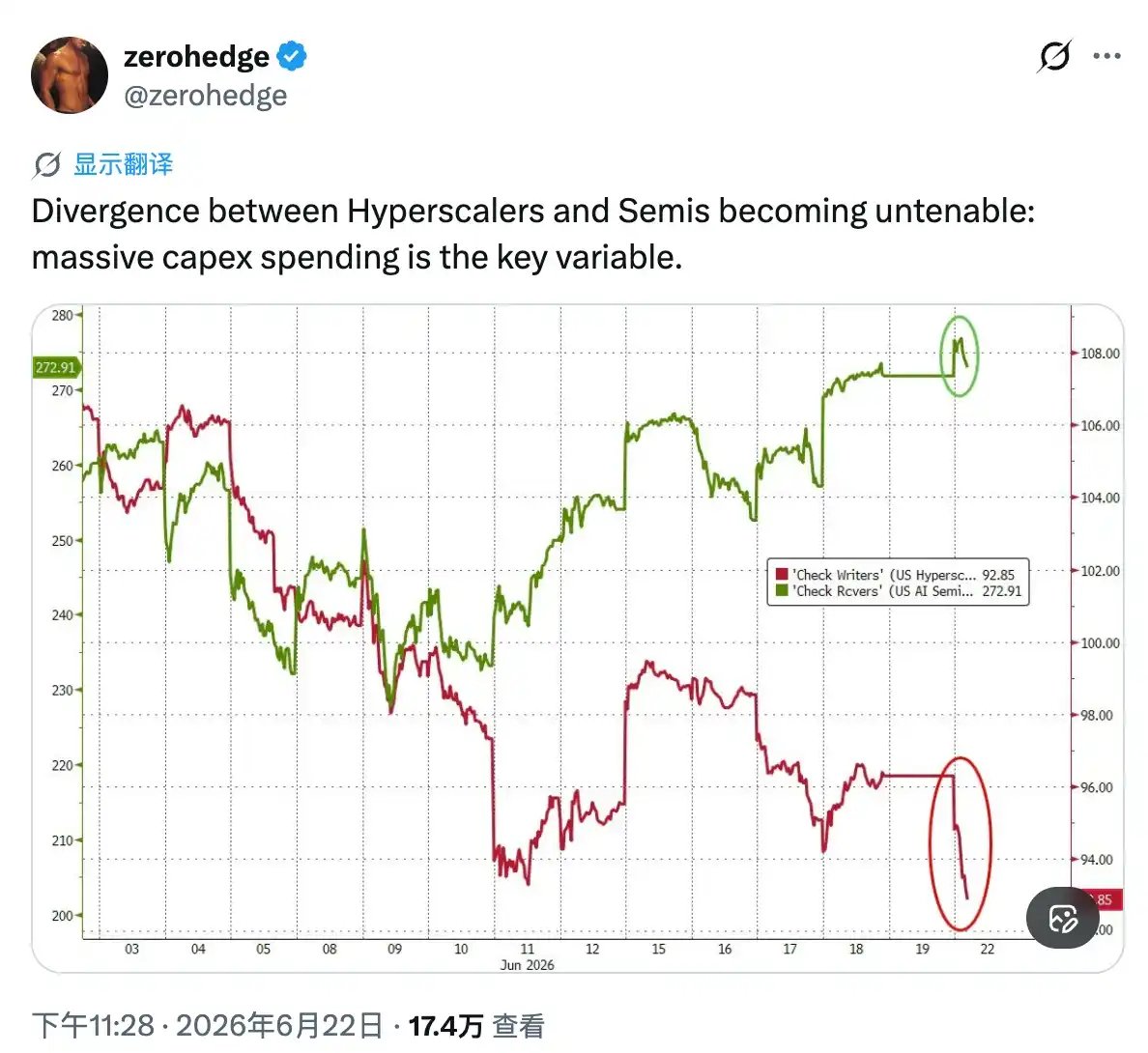
...then, it will be time to invert Eliot's line: The whimper of selling will become a bang.


Domande pertinenti

QWhat are the main reasons for the sharp decline in SpaceX's stock price after its initial spike?

AThe main reasons for the sharp decline are the rapid exhaustion of retail investor buying momentum, the company's announcement of a large bond offering, and the looming threat of significant share lock-up expirations (up to 44% of shares potentially becoming available for sale by early September).

QHow significant was retail investor participation in the first week of SpaceX's trading, according to Vanda Track?

AAccording to Vanda Track, retail investors were extremely significant, with a record net purchase of $405 million in SPCX shares in the first five trading days. This surpassed their combined purchases in all other Mag 7 stocks and even exceeded their combined flows into SPY and QQQ ETFs.

QWhat percentage of SpaceX shares are currently freely tradable, and what will happen to this figure by September?

ACurrently, only about 5% of SpaceX shares are freely tradable, with 95% locked up. However, according to 22V Research, insiders could potentially sell up to 44% of the company's shares by early September, which would increase the available float by approximately 900%.

QWhat was the 'gamma squeeze' strategy mentioned in the context of SpaceX's early trading, and what happened to it?

AThe 'gamma squeeze' strategy involved aggressive traders buying short-dated, extremely out-of-the-money call options (like $380 strike) shortly after the IPO. The goal was to force market makers to buy the underlying stock to hedge their positions, thereby driving the stock price up dramatically. This momentum-based strategy failed as buying interest faded and the stock price reversed.

QWhat broader market risk does the article suggest might follow if retail investor enthusiasm continues to fade?

AThe article suggests that a continued fade in retail investor enthusiasm could lead to a broader market sell-off. It speculates that the weakness could spread from SpaceX to other speculative areas like the memory bubble, and ultimately to the semiconductor stocks that have benefited most from the AI trade boom.

Letture associate

Treasury Secretary's Move to Suppress Treasury Yields Ignites 'Currency Debasement Trade'! Gold Hits Three-Month High, Bitcoin Surges Over 25% in a Single Week

US Treasury Secretary Besant's efforts to lower long-term Treasury yields by announcing expanded buybacks had only a brief market impact. However, this move fueled a "currency devaluation trade," weakening the US dollar while boosting both gold (to a three-month high) and Bitcoin (up over 25% for the week). Analysts attribute this reaction to deepening market concerns over the massive US fiscal deficit and structural pressures keeping long-term rates elevated, including fierce competition for capital from global government borrowing and massive AI sector financing. Despite the Treasury's actions, fundamental forces like growth, inflation, and capital demand are seen as limiting its ability to sustainably suppress yields. Bitcoin's strong positive correlation with gold has reinforced its narrative as a hedge against devaluation. While equity markets have shown resilience, some strategists warn that Treasury yields nearing 5% increase pressure on the dollar and high-leverage assets. Figures like Ray Dalio have advised reducing bond exposure in favor of gold and some Bitcoin, citing US debt risks. Market opinions are divided on the sustainability of the devaluation trade, with some noting the lack of a near-term catalyst for its next leg higher. The underlying tension between the Treasury's desire for lower borrowing costs and the Federal Reserve's focus on inflation and reducing market intervention remains a key theme. Upcoming events like Nvidia's earnings and the Jackson Hole symposium will test whether AI profits can continue supporting stocks and if the Fed aligns more with Washington's preference for easier financial conditions.

华尔街日报35 min fa

Treasury Secretary's Move to Suppress Treasury Yields Ignites 'Currency Debasement Trade'! Gold Hits Three-Month High, Bitcoin Surges Over 25% in a Single Week

华尔街日报35 min fa

Alexander Shokhin: Business Needs an Interest Rate Below 10% and the Dollar at 90-95 Rubles

Alexander Shokhin, head of the Russian Union of Industrialists and Entrepreneurs (RSPP), has advocated for potentially using "non-market" tools to keep the ruble within a target exchange rate corridor. This, he argues on August 21, would help avoid excessive volatility, though he called the topic a separate discussion. Shokhin had previously raised the idea of a currency corridor in late May, noting the ruble's current exchange rate is not fully market-driven due to a limited currency segment and reduced foreign currency demand. He stated that many business community colleagues propose fixing a corridor, even through non-market methods, to ensure predictability. The business community's key targets, as outlined by Shokhin in late December 2025, are a Central Bank key rate of 12%, inflation of 4–5%, and a US dollar exchange rate of 90–95 rubles by the end of 2026. A turning point for investment, he said, would be lowering the rate to 12% with 6% inflation, though truly comfortable business conditions would require a rate below 10%. He stressed the critical importance of currency predictability for corporate investment decisions. From a data analysis perspective, the idea of a ruble corridor is not new. A similar mechanism was used in Russia from 1995 to 1998, where the central bank held the dollar within fixed boundaries through regular interventions. This regime lasted three years before ending abruptly during the 1998 default, illustrating the fragility of rigid targets under external shocks. The macro-economic link is clear: stricter corridors require more reserves to defend against currency pressure. The key unresolved technical aspect is the specific sources and volume of such interventions given the current market's limited liquidity. Whether this discussion remains theoretical or leads to concrete corridor parameters will be seen in the coming months.

cryptonews.ru2 h fa

Alexander Shokhin: Business Needs an Interest Rate Below 10% and the Dollar at 90-95 Rubles

cryptonews.ru2 h fa

Trading

Spot
活动图片