This Investor Day, SanDisk's 'Stunning Numbers' Shook the Market

marsbitPubblicato 2026-08-14Pubblicato ultima volta 2026-08-14

Introduzione

SanDisk's Investor Day Shocks Market with "Explosive" Long-Term Targets SanDisk stunned the market at its 2026 Investor Day by unveiling an extremely aggressive long-term financial model. The company targets **mid-to-high double-digit revenue growth** for fiscal years 2028-2030. More impressively, it forecasts non-GAAP gross margins of approximately **80%** and operating margins around **75%** during that period, with an adjusted free cash flow margin of about 50%. A key strategic shift is SanDisk's focus on profitability over sheer output volume. The company clarified it will **flexibly adjust salable bit output based on profit optimization needs**, not simply chase bit shipment growth. This approach aims to avoid oversupply, especially during technology node transitions. SanDisk also committed to returning **100% of excess cash to shareholders** after funding business growth. Confidence in these targets is bolstered by new business model (NBM) agreements with eight major clients, covering roughly **50% of FY2027 and two-thirds of FY2028 bit shipments**, aiming to reduce cyclical volatility. The company sees massive tailwinds from AI, particularly the shift from training to inference, which is reshaping data center memory hierarchies. It estimates the enterprise flash TAM could reach **1.2 zettabytes by 2030**. SanDisk is advancing technologies like its CMOS Bonded Array (CBA) strategy and High Bandwidth Flash (HBF) for AI inference workloads. The announcement triggered...

Original Author: Li Dan

Original Source: Wall Street News

While AI inference demand continues to drive up storage needs, SanDisk has presented extremely aggressive long-term financial targets.

On Thursday, Eastern Time the 13th, SanDisk unveiled its long-term financial model at the 2026 Investor Day, outlining a series of financial goals to be achieved between fiscal years 2028 and 2030. This includes maintaining mid-to-high double-digit revenue growth during this period. SanDisk also clarified market doubts regarding bit growth, stating that the quantity of bits available for sale will be adjusted based on profitability optimization needs, while committing to return 100% of excess cash to shareholders after completing business investments.

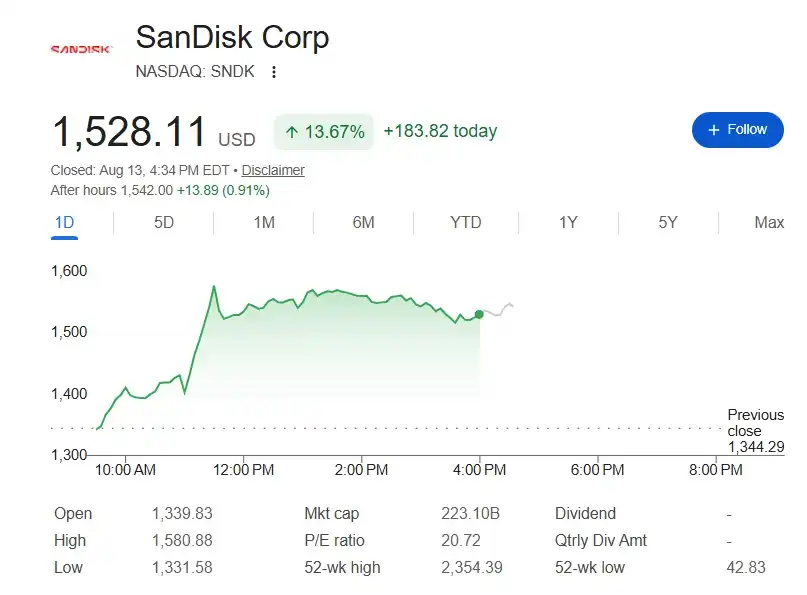
The market quickly voted with its share price following the announcement. SanDisk (SNDK) saw its intraday gain expand to 17.6% on Thursday; the storage sector also strengthened. By the close, SanDisk gained nearly 14%, SK Hynix and Western Digital rose over 7%, Seagate Technology increased nearly 5%, and Micron Technology gained over 4%.
FY2028-30 Goals: Gross Margin 80%, Operating Margin 75%

The long-term financial model presented by SanDisk was undoubtedly the most closely watched aspect of this Investor Day.

The company forecasts that between fiscal years 2028 and 2030, revenue will maintain mid-to-high double-digit growth, matching the pace of bit shipment growth. Simultaneously, on a non-GAAP basis, the gross margin is expected to remain around 80%, and the operating margin around 75%.

The concept of fiscal year timing here requires special attention. SanDisk's fiscal year does not align with the calendar year; its fiscal year ends on the Friday closest to June 30, typically spanning 52 weeks. Fiscal year 2026, the previous fiscal year, ended on July 3, 2026. Early July 2026 has already entered fiscal year 2027. Therefore, the announced period of fiscal years 2028 to 2030 refers not to calendar years 2028 to 2030, but to the future three-fiscal-year period starting around July 2027.

Under this financial model, SanDisk expects operating expenses to account for approximately 5% of revenue, with other income and expenses not having a significant impact. Even after accounting for taxes, capital expenditures, and the working capital required to support business growth, the company still anticipates an adjusted free cash flow margin of around 50%.

For the historically highly cyclical NAND storage industry, this set of targets is particularly aggressive. SanDisk is essentially sending a clear message to the market: AI-driven storage demand growth has the potential to keep the company's revenue growth and profitability at levels far above the traditional storage cycle average for years to come.

Not Blindly Chasing 'Bit Quantity': SanDisk to Flexibly Adjust Salable Production Based on Profitability

Another important signal released by SanDisk is that the company does not plan to simply pursue expanding bit shipments as a growth target, but will actively adjust the quantity of bits available for sale based on profitability.

The market had previously focused on SanDisk's bit growth guidance for FY2027: the company expects input bit growth to reach mid-to-high double digits, while the growth of output bits available for sale might be lower than this level. At the Investor Day, management further clarified that this does not mean the company lacks the capacity to expand output.

According to Lynx Equity Strategies analyst KC Rajkumar's interpretation of management's statements, SanDisk CEO David Goeckeler clearly stated that the long-term input bit growth target is mid-to-high double digits, but the quantity of bits available for sale will be flexibly adjusted based on the need to optimize profitability. In some periods, the actual output bit growth may even exceed mid-to-high double digits.

This signifies that SanDisk places more importance on 'how much money can be made per bit' rather than simply pursuing 'how many bits can be sold.'

Especially during NAND technology node transitions, the company will selectively cut wafer output to avoid an oversupply situation caused by too rapid an increase in bit density brought by new technologies.

Rajkumar points out that each NAND technology node transition at SanDisk brings an average of approximately 54% bit growth. Therefore, if the company were to fully release the new capacity brought by technological upgrades, it could easily recreate a situation of oversupply. By proactively reducing wafer output during node transitions, SanDisk can control the quantity of bits entering the market, thereby better maintaining prices, profit margins, and capital efficiency.

This approach also explains why SanDisk dares to set a long-term gross margin target of around 80%: the bit density increase brought by technological progress does not necessarily have to translate entirely into supply growth; the company can proactively 'hit the brakes,' converting part of the technological dividend into profitability.

Returning More 'Earned Money' to Shareholders: 100% of Excess Cash for Buybacks or Dividends

In addition to revenue and margin targets, SanDisk also gave a very clear capital return commitment.

SanDisk CFO Luis Visoso stated that after completing the investments needed to support business growth, the company expects to return 100% of excess cash to shareholders.

This means SanDisk's future capital allocation framework will revolve around three main lines: first, investing in business and technology to support growth; second, maintaining strong free cash flow generation capability; and finally, returning as much remaining cash as possible to shareholders.

An adjusted free cash flow margin of around 50% implies that if the long-term financial model is realized, SanDisk's future cash generation ability will be very strong, which is also a key reason the market is willing to assign it a higher valuation.

Long-Term Agreements with Eight Major Clients, Covering About Two-Thirds of FY2028 Bit Shipments

One of the key reasons for SanDisk's strong confidence in the above long-term financial model is that the company is changing the traditional NAND industry business model.

The company disclosed that it has currently signed New Business Model (NBM) agreements with 8 clients. These agreements include committed purchase volumes, binding contract frameworks, minimum financial guarantees, and structured pricing mechanisms. They can strengthen the alignment between customer demand and the company's capacity planning and reduce the impact of the traditional storage industry's cyclical volatility.

More importantly, the scale covered by these agreements is already substantial: the currently signed NBM agreements cover approximately 50% of FY2027 bit shipments and about two-thirds of FY2028 bit shipments.

SanDisk believes this model can lead to more predictable revenue, higher cash flow visibility, and more sustainable profit growth.

In other words, SanDisk is not only betting on the storage demand growth driven by AI but also attempting to partially transform the strong cyclical nature of traditional NAND business into more stable and predictable revenue and cash flow through long-term agreements.

AI Inference Spurs Larger Storage Market, Enterprise Flash TAM Expected to Reach 1.2 ZB by 2030

Another major support for SanDisk's high-growth outlook over the next three years is the new demands placed on storage infrastructure as AI expands from training to inference.

SanDisk estimates that the flash memory market could grow from a historical annual revenue base of $60 billion to over $300 billion in 2026 and approach $500 billion in 2027.
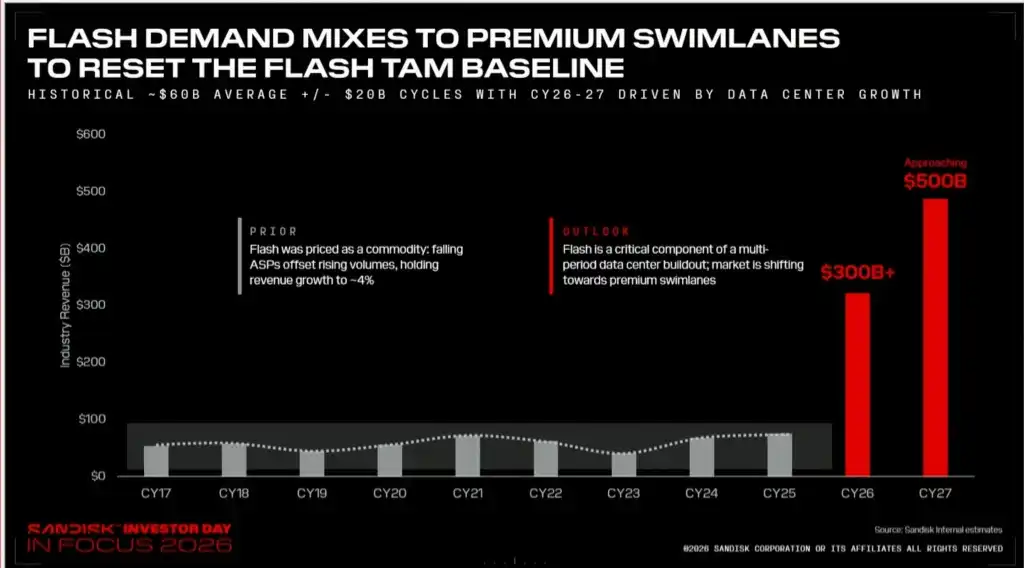
The company stated that AI inference workloads are driving rapid growth in Token usage, and KV Cache is reshaping the memory hierarchy in data centers. As AI inference scales, AI data centers will become increasingly dependent on storage. SanDisk expects that the Total Addressable Market (TAM) for flash memory in enterprise data centers will reach 1.2 Zettabytes (ZB) by 2030.

On the technical front, SanDisk is advancing a two-dimensional scaling strategy based on CMOS Direct Bond Array (CBA) to more flexibly develop customized products that meet the needs of different markets while improving capital efficiency.

The company's latest BiCS9 QLC technology is the first example of this strategy. This technology combines the BiCS8 array with a CMOS wafer based on BiCS10; meanwhile, the new BiCS10 QLC node achieves a 60% increase in bit density compared to BiCS8.

Betting on AI Inference with HBF, Storage Sector Rallies

SanDisk is also advancing a new High-Bandwidth Flash (HBF) technology for AI inference. The company stated that HBF is becoming a key technological solution to meet the storage demands of the AI inference era, and the related industry ecosystem is also forming.

From the market's perspective, this means SanDisk's AI storage logic is no longer limited to 'AI data centers need more SSDs' but has further extended to the demand for higher performance, lower power consumption, and higher storage density inherent to AI inference architecture itself.

This expectation also quickly spread across the entire storage sector. SanDisk's own rally was more pronounced: after announcing its long-term financial targets, its stock price once surged nearly 18% intraday. So far this year, SanDisk's stock price has accumulated a gain of over 530%.

However, SanDisk also emphasized that the aforementioned long-term financial targets are forward-looking indicators based on a series of estimates and assumptions. Actual results may still be affected by factors such as demand, average selling prices, competition, technological iteration, supply chains, and storage industry cycles.


Crypto di tendenza

Domande pertinenti

QWhat were the key long-term financial targets that SanDisk announced at its Investor Day, and for which fiscal years?

ASanDisk announced long-term financial targets for fiscal years 2028 to 2030, including revenue growth in the mid-to-high double digits, a non-GAAP gross margin of approximately 80%, and an operating margin of around 75%.

QAccording to the article, how does SanDisk plan to manage its bit output, and what is the strategic reason behind this approach?

ASanDisk plans to actively manage and adjust the number of sellable bits based on profitability optimization needs, rather than focusing solely on increasing bit shipment volume. This approach is to control market supply, maintain pricing and margins, and improve capital efficiency, especially during NAND technology node transitions.

QWhat capital return commitment did SanDisk make to its shareholders?

ASanDisk's CFO, Luis Visoso, stated that after making the necessary investments to support business growth, the company intends to return 100% of its excess cash to shareholders.

QWhat is the significance of SanDisk's new business model (NBM) agreements with customers, and what coverage do they have?

AThe New Business Model (NBM) agreements include commitments on purchase volumes, binding contractual frameworks, minimum financial guarantees, and structured pricing. They are significant as they help align customer demand with SanDisk's capacity planning and reduce the impact of traditional storage industry cyclicality. These agreements currently cover about 50% of bit shipments for FY2027 and approximately two-thirds for FY2028.

QWhat major market trend is SanDisk citing as a key driver for its future growth, and what is its related market size prediction?

ASanDisk cites the expansion of AI from training to inference as a major driver, which creates new demands for storage infrastructure like higher performance and density. The company estimates the enterprise datacenter flash Total Addressable Market (TAM) will reach 1.2 Zettabytes (ZB) by 2030.

Letture associate

Is RWA Still Meaningful Without DeFi?

The article "Would RWA Still Matter Without DeFi?" argues that tokenizing real-world assets (RWA) alone, like putting a barcode on a container, is not transformative. True value emerges when these tokenized assets are integrated into decentralized finance (DeFi) ecosystems, enabling valuation, financing, hedging, trading, and loss management in a programmable, automated manner. Tokenization provides digital representation, but DeFi provides utility through leverage, liquidity, and composability. The core challenge lies in aligning the different "time clocks" of blockchain (fast, 24/7), traditional markets (limited hours), and asset redemption (slow processes), which creates liquidation risks and gaps. Effective RWA integration requires more than a token; it needs a full stack: legally enforceable rights, reliable data oracles, clear transfer rules, executable secondary liquidity, appropriate collateral parameters, and credible loss resolution paths. Liquidity is defined not by total value locked (TVL) but by the ability to exit a position under stress within a required timeframe. Risk management for RWAs must be modeled as a dependency graph, monitoring interconnected nodes like issuers, custodians, oracles, and liquidity pools for early warning signs beyond just price data. While tokenized government bonds serve as an initial "ping test," the future lies in more complex assets like computing power and energy, which require bespoke risk models. Tokenized stocks paired with perpetual futures present a major test, combining global equity ownership with crypto-native leverage, necessitating robust architectural safeguards like isolation and dynamic collateral rules. The conclusion is that without DeFi, RWA tokenization offers limited value—improving distribution and transparency. The significant opportunity arises when tokenized assets become functional components within open, programmable capital markets, where they can be used as collateral and facilitate complex financial strategies. The token is merely the barcode; the market operating system is the real machine.

marsbit10 min fa

Is RWA Still Meaningful Without DeFi?

marsbit10 min fa

Government Intervention in the Bond Market: What Does It Mean?

On August 19, 2026, the U.S. Treasury unexpectedly announced it would at least double the size of its long-term Treasury buyback operations, starting September 9. The move triggered an immediate market reaction, with the 30-year yield falling 9 basis points. This intervention came against a backdrop of the 30-year yield hitting a 19-year high of 5.34% the previous day, driven by persistent inflation, high oil prices, deteriorating U.S. fiscal health with public debt surpassing $40 trillion, and a global "buyers' strike" for long-dated bonds. Treasury buybacks involve the government repurchasing older, less liquid bonds from the market via reverse auctions to improve market functioning, not to reduce overall debt. While the action provided tactical relief and signaled the Treasury's willingness to intervene, analysts caution it does not address core structural issues: massive fiscal deficits, high borrowing needs, and fading demand from traditional buyers like foreign central banks. For investors, the announcement offered short-term support for long-duration bond ETFs and boosted assets like gold, which rose 2.7%. However, it's unlikely to significantly lower mortgage rates or alter the challenging environment for long-term bonds. The key takeaway is the distinction between a tactical market operation and the unresolved structural pressures that continue to push yields higher, requiring close monitoring of upcoming economic data, Treasury auctions, and potential signals of more aggressive policy measures.

marsbit14 min fa

Government Intervention in the Bond Market: What Does It Mean?

marsbit14 min fa

After 'Bessent Put', How Far Is the U.S. from Restarting QE?

Following an unscheduled announcement from the U.S. Treasury Department on August 19th, investor discussions have intensified regarding the potential for future policy interventions in long-term bond markets. The Treasury increased the maximum size of its regular buyback operations for 10-to-30 year bonds from $2 billion to $4 billion, citing a desire to improve liquidity. This move came shortly after a surge in long-term yields, with the 30-year Treasury yield briefly touching 5.34%. Market analysts, rather than focusing on the modest operational size, have interpreted the timing—outside the normal quarterly communication window—as a significant signal. The move has been dubbed the "Bessent Put," implying the market's growing expectation that Treasury officials, led by Deputy Secretary Josh Bessent, may act to prevent a disorderly rise in long-term borrowing costs. This perception represents a potential shift in the market's view of the government's "policy reaction function." The underlying pressures on long-term bonds are multifaceted, including large fiscal deficits, increased Treasury supply, a rise in corporate debt issuance for AI infrastructure (creating a "crowding out" effect), and uncertainty around foreign holdings, particularly from Japan. Geopolitical risks in the Middle East further complicate the policy landscape, potentially creating conflicting pressures between fighting inflation and managing financing costs. However, the article clarifies that this Treasury buyback program is distinct from Quantitative Easing (QE). It is a debt management operation, not a Federal Reserve balance sheet expansion. While the announcement opens the door for market speculation about more forceful tools like Yield Curve Control (YCC) or a return to QE, analysts note that conditions would need to deteriorate significantly for such measures to be implemented. For now, the "Bessent Put" reflects a change in market expectations about possible policy boundaries, not an imminent launch of new monetary stimulus.

marsbit14 min fa

After 'Bessent Put', How Far Is the U.S. from Restarting QE?

marsbit14 min fa

Is Stablecoin Really Necessary for Cross-border Payments?

"Is Stablecoin Truly Necessary for Cross-Border Payments? While stablecoins are often praised as superior for cross-border transfers—especially if the recipient desires crypto—their advantage is less clear in traditional cross-currency scenarios (e.g., USD to Mexican Peso). The existing correspondent banking system is slow and costly (≈15% fees) due to multiple intermediaries. Modern fintech solutions like Wise have dramatically improved this by using a netting model: they hold local currency pools and settle payments domestically, avoiding actual cross-border fund movement. This offers near-instant transfers with low, transparent fees (averaging ~0.52%). The 'stablecoin sandwich' model (convert fiat to stablecoin, transfer on-chain, convert to local fiat) offers similar user experience but doesn't inherently provide major cost or speed advantages over fintech. Its on-chain transfer is cheap, but fiat conversion spreads remain. Stablecoin's real innovation is 'unbundling' the cross-border payment stack. Instead of requiring a proprietary global network like Wise, businesses only need reliable on- and off-ramps in specific corridors. This lowers market entry barriers, fosters competition among local providers, and can drive down costs, particularly for niche or underserved corridors (e.g., US to Africa). While vertical integration may reoccur, the open, permissionless nature of the underlying blockchain layer makes monopolistic pricing difficult. The long-term benefit is the potential redistribution of value—previously captured as intermediary rents—to consumers through lower costs."

marsbit18 min fa

Is Stablecoin Really Necessary for Cross-border Payments?

marsbit18 min fa

Ethereum Finally 'Bounces Back'! ETH Returns to the Golden Line, What's Different About This Rally?

Ethereum has surged above $2,300, a level not seen in over three months, marking a significant recovery and technical breakthrough by reclaiming key resistance levels, including the weekly EMA50 for the first time in the current bear market. The rally has been fueled by a combination of factors: improved market risk appetite, positive regulatory sentiment, and a major short squeeze where over 88% of recent ETH liquidations were short positions. The ETH/BTC ratio has also broken its long-term downtrend, indicating renewed strength for Ethereum relative to Bitcoin. Fundamentally, Ethereum spot ETFs have shown strong inflows, outperforming their Bitcoin counterparts in recent months. Wall Street institutions like Morgan Stanley and JPMorgan have notably increased their ETH exposure, while several banks have added or expanded positions in ETH ETFs. On-chain fundamentals remain robust, with the proportion of staked ETH reaching a new all-time high of nearly 33.7%. Data indicates long-term holding sentiment, as small wallet holdings increased while large outflows were often directed towards staking or contracts, not selling. However, potential headwinds include declining staking yields and community debate over proposals to adjust staking rewards at high participation levels. The upcoming Glamsterdam upgrade, featuring improvements to validator exit efficiency, could enhance liquidity and further attract institutional stakers. While the rebound is supported by sentiment, capital flows, and fundamentals, its sustainability hinges on continued positive developments.

marsbit18 min fa

Ethereum Finally 'Bounces Back'! ETH Returns to the Golden Line, What's Different About This Rally?

marsbit18 min fa

Trading

Spot

Articoli Popolari

Cosa è $S$

Comprendere SPERO: Una Panoramica Completa Introduzione a SPERO Mentre il panorama dell'innovazione continua a evolversi, l'emergere delle tecnologie web3 e dei progetti di criptovaluta gioca un ruolo fondamentale nel plasmare il futuro digitale. Un progetto che ha attirato l'attenzione in questo campo dinamico è SPERO, denotato come SPERO,$$s$. Questo articolo mira a raccogliere e presentare informazioni dettagliate su SPERO, per aiutare gli appassionati e gli investitori a comprendere le sue basi, obiettivi e innovazioni nei domini web3 e crypto. Che cos'è SPERO,$$s$? SPERO,$$s$ è un progetto unico all'interno dello spazio crypto che cerca di sfruttare i principi della decentralizzazione e della tecnologia blockchain per creare un ecosistema che promuove l'impegno, l'utilità e l'inclusione finanziaria. Il progetto è progettato per facilitare interazioni peer-to-peer in modi nuovi, fornendo agli utenti soluzioni e servizi finanziari innovativi. Al suo interno, SPERO,$$s$ mira a responsabilizzare gli individui fornendo strumenti e piattaforme che migliorano l'esperienza dell'utente nello spazio delle criptovalute. Questo include la possibilità di metodi di transazione più flessibili, la promozione di iniziative guidate dalla comunità e la creazione di percorsi per opportunità finanziarie attraverso applicazioni decentralizzate (dApps). La visione sottostante di SPERO,$$s$ ruota attorno all'inclusività, cercando di colmare le lacune all'interno della finanza tradizionale mentre sfrutta i vantaggi della tecnologia blockchain. Chi è il Creatore di SPERO,$$s$? L'identità del creatore di SPERO,$$s$ rimane piuttosto oscura, poiché ci sono risorse pubblicamente disponibili limitate che forniscono informazioni dettagliate sul suo fondatore o fondatori. Questa mancanza di trasparenza può derivare dall'impegno del progetto per la decentralizzazione—un ethos che molti progetti web3 condividono, dando priorità ai contributi collettivi rispetto al riconoscimento individuale. Centrando le discussioni attorno alla comunità e ai suoi obiettivi collettivi, SPERO,$$s$ incarna l'essenza dell'empowerment senza mettere in evidenza individui specifici. Pertanto, comprendere l'etica e la missione di SPERO rimane più importante che identificare un creatore singolo. Chi sono gli Investitori di SPERO,$$s$? SPERO,$$s$ è supportato da una varietà di investitori che vanno dai capitalisti di rischio agli investitori angelici dedicati a promuovere l'innovazione nel settore crypto. Il focus di questi investitori generalmente si allinea con la missione di SPERO—dando priorità a progetti che promettono avanzamenti tecnologici sociali, inclusività finanziaria e governance decentralizzata. Queste fondazioni di investitori sono tipicamente interessate a progetti che non solo offrono prodotti innovativi, ma contribuiscono anche positivamente alla comunità blockchain e ai suoi ecosistemi. Il supporto di questi investitori rafforza SPERO,$$s$ come un concorrente degno di nota nel dominio in rapida evoluzione dei progetti crypto. Come Funziona SPERO,$$s$? SPERO,$$s$ impiega un framework multifunzionale che lo distingue dai progetti di criptovaluta convenzionali. Ecco alcune delle caratteristiche chiave che sottolineano la sua unicità e innovazione: Governance Decentralizzata: SPERO,$$s$ integra modelli di governance decentralizzati, responsabilizzando gli utenti a partecipare attivamente ai processi decisionali riguardanti il futuro del progetto. Questo approccio favorisce un senso di proprietà e responsabilità tra i membri della comunità. Utilità del Token: SPERO,$$s$ utilizza il proprio token di criptovaluta, progettato per servire varie funzioni all'interno dell'ecosistema. Questi token abilitano transazioni, premi e la facilitazione dei servizi offerti sulla piattaforma, migliorando l'impegno e l'utilità complessivi. Architettura Stratificata: L'architettura tecnica di SPERO,$$s$ supporta la modularità e la scalabilità, consentendo un'integrazione fluida di funzionalità e applicazioni aggiuntive man mano che il progetto evolve. Questa adattabilità è fondamentale per mantenere la rilevanza nel panorama crypto in continua evoluzione. Coinvolgimento della Comunità: Il progetto enfatizza iniziative guidate dalla comunità, impiegando meccanismi che incentivano la collaborazione e il feedback. Nutrendo una comunità forte, SPERO,$$s$ può affrontare meglio le esigenze degli utenti e adattarsi alle tendenze di mercato. Focus sull'Inclusione: Offrendo basse commissioni di transazione e interfacce user-friendly, SPERO,$$s$ mira ad attrarre una base utenti diversificata, inclusi individui che potrebbero non aver precedentemente interagito nello spazio crypto. Questo impegno per l'inclusione si allinea con la sua missione generale di empowerment attraverso l'accessibilità. Cronologia di SPERO,$$s$ Comprendere la storia di un progetto fornisce preziose intuizioni sulla sua traiettoria di sviluppo e sui traguardi. Di seguito è riportata una cronologia suggerita che mappa eventi significativi nell'evoluzione di SPERO,$$s$: Fase di Concettualizzazione e Ideazione: Le idee iniziali che formano la base di SPERO,$$s$ sono state concepite, allineandosi strettamente con i principi di decentralizzazione e focus sulla comunità all'interno dell'industria blockchain. Lancio del Whitepaper del Progetto: Dopo la fase concettuale, è stato rilasciato un whitepaper completo che dettaglia la visione, gli obiettivi e l'infrastruttura tecnologica di SPERO,$$s$ per suscitare interesse e feedback dalla comunità. Costruzione della Comunità e Prime Interazioni: Sono stati effettuati sforzi attivi di outreach per costruire una comunità di early adopters e potenziali investitori, facilitando discussioni attorno agli obiettivi del progetto e ottenendo supporto. Evento di Generazione del Token: SPERO,$$s$ ha condotto un evento di generazione del token (TGE) per distribuire i propri token nativi ai primi sostenitori e stabilire una liquidità iniziale all'interno dell'ecosistema. Lancio della Prima dApp: La prima applicazione decentralizzata (dApp) associata a SPERO,$$s$ è stata attivata, consentendo agli utenti di interagire con le funzionalità principali della piattaforma. Sviluppo Continuo e Partnership: Aggiornamenti e miglioramenti continui alle offerte del progetto, inclusi partnership strategiche con altri attori nello spazio blockchain, hanno plasmato SPERO,$$s$ in un concorrente competitivo e in evoluzione nel mercato crypto. Conclusione SPERO,$$s$ rappresenta una testimonianza del potenziale del web3 e delle criptovalute di rivoluzionare i sistemi finanziari e responsabilizzare gli individui. Con un impegno per la governance decentralizzata, il coinvolgimento della comunità e funzionalità progettate in modo innovativo, apre la strada verso un panorama finanziario più inclusivo. Come per qualsiasi investimento nello spazio crypto in rapida evoluzione, si incoraggiano potenziali investitori e utenti a ricercare approfonditamente e a impegnarsi in modo riflessivo con gli sviluppi in corso all'interno di SPERO,$$s$. Il progetto mostra lo spirito innovativo dell'industria crypto, invitando a ulteriori esplorazioni delle sue innumerevoli possibilità. Mentre il percorso di SPERO,$$s$ è ancora in fase di sviluppo, i suoi principi fondamentali potrebbero effettivamente influenzare il futuro di come interagiamo con la tecnologia, la finanza e tra di noi in ecosistemi digitali interconnessi.

418 Totale visualizzazioniPubblicato il 2024.12.17Aggiornato il 2024.12.17

Cosa è $S$

Cosa è AGENT S

Agent S: Il Futuro dell'Interazione Autonoma in Web3 Introduzione Nel panorama in continua evoluzione di Web3 e criptovalute, le innovazioni stanno costantemente ridefinendo il modo in cui gli individui interagiscono con le piattaforme digitali. Uno di questi progetti pionieristici, Agent S, promette di rivoluzionare l'interazione uomo-computer attraverso il suo framework agentico aperto. Aprendo la strada a interazioni autonome, Agent S mira a semplificare compiti complessi, offrendo applicazioni trasformative nell'intelligenza artificiale (AI). Questa esplorazione dettagliata approfondirà le complessità del progetto, le sue caratteristiche uniche e le implicazioni per il dominio delle criptovalute. Cos'è Agent S? Agent S si presenta come un innovativo framework agentico aperto, progettato specificamente per affrontare tre sfide fondamentali nell'automazione dei compiti informatici: Acquisizione di Conoscenze Specifiche del Dominio: Il framework apprende in modo intelligente da varie fonti di conoscenza esterne ed esperienze interne. Questo approccio duale gli consente di costruire un ricco repository di conoscenze specifiche del dominio, migliorando le sue prestazioni nell'esecuzione dei compiti. Pianificazione su Lungo Orizzonte di Compiti: Agent S impiega una pianificazione gerarchica potenziata dall'esperienza, un approccio strategico che facilita la suddivisione e l'esecuzione efficiente di compiti complessi. Questa caratteristica migliora significativamente la sua capacità di gestire più sottocompiti in modo efficiente ed efficace. Gestione di Interfacce Dinamiche e Non Uniformi: Il progetto introduce l'Interfaccia Agente-Computer (ACI), una soluzione innovativa che migliora l'interazione tra agenti e utenti. Utilizzando Modelli Linguistici Multimodali di Grandi Dimensioni (MLLM), Agent S può navigare e manipolare senza sforzo diverse interfacce grafiche utente. Attraverso queste caratteristiche pionieristiche, Agent S fornisce un framework robusto che affronta le complessità coinvolte nell'automazione dell'interazione umana con le macchine, preparando il terreno per innumerevoli applicazioni nell'AI e oltre. Chi è il Creatore di Agent S? Sebbene il concetto di Agent S sia fondamentalmente innovativo, informazioni specifiche sul suo creatore rimangono elusive. Il creatore è attualmente sconosciuto, il che evidenzia sia la fase embrionale del progetto sia la scelta strategica di mantenere i membri fondatori sotto anonimato. Indipendentemente dall'anonimato, l'attenzione rimane sulle capacità e sul potenziale del framework. Chi sono gli Investitori di Agent S? Poiché Agent S è relativamente nuovo nell'ecosistema crittografico, informazioni dettagliate riguardanti i suoi investitori e sostenitori finanziari non sono documentate esplicitamente. La mancanza di approfondimenti pubblicamente disponibili sulle fondazioni di investimento o sulle organizzazioni che supportano il progetto solleva interrogativi sulla sua struttura di finanziamento e sulla roadmap di sviluppo. Comprendere il supporto è cruciale per valutare la sostenibilità del progetto e il suo potenziale impatto sul mercato. Come Funziona Agent S? Al centro di Agent S si trova una tecnologia all'avanguardia che gli consente di funzionare efficacemente in contesti diversi. Il suo modello operativo è costruito attorno a diverse caratteristiche chiave: Interazione Uomo-Computer Simile a Quella Umana: Il framework offre una pianificazione AI avanzata, cercando di rendere le interazioni con i computer più intuitive. Mimando il comportamento umano nell'esecuzione dei compiti, promette di elevare le esperienze degli utenti. Memoria Narrativa: Utilizzata per sfruttare esperienze di alto livello, Agent S utilizza la memoria narrativa per tenere traccia delle storie dei compiti, migliorando così i suoi processi decisionali. Memoria Episodica: Questa caratteristica fornisce agli utenti una guida passo-passo, consentendo al framework di offrire supporto contestuale mentre i compiti si sviluppano. Supporto per OpenACI: Con la capacità di funzionare localmente, Agent S consente agli utenti di mantenere il controllo sulle proprie interazioni e flussi di lavoro, allineandosi con l'etica decentralizzata di Web3. Facile Integrazione con API Esterne: La sua versatilità e compatibilità con varie piattaforme AI garantiscono che Agent S possa adattarsi senza problemi agli ecosistemi tecnologici esistenti, rendendolo una scelta attraente per sviluppatori e organizzazioni. Queste funzionalità contribuiscono collettivamente alla posizione unica di Agent S all'interno dello spazio crittografico, poiché automatizza compiti complessi e multi-fase con un intervento umano minimo. Man mano che il progetto evolve, le sue potenziali applicazioni in Web3 potrebbero ridefinire il modo in cui si svolgono le interazioni digitali. Cronologia di Agent S Lo sviluppo e le tappe di Agent S possono essere riassunti in una cronologia che evidenzia i suoi eventi significativi: 27 Settembre 2024: Il concetto di Agent S è stato lanciato in un documento di ricerca completo intitolato “Un Framework Agentico Aperto che Usa i Computer Come un Umano”, mostrando le basi per il progetto. 10 Ottobre 2024: Il documento di ricerca è stato reso pubblicamente disponibile su arXiv, offrendo un'esplorazione approfondita del framework e della sua valutazione delle prestazioni basata sul benchmark OSWorld. 12 Ottobre 2024: È stata rilasciata una presentazione video, fornendo un'idea visiva delle capacità e delle caratteristiche di Agent S, coinvolgendo ulteriormente potenziali utenti e investitori. Questi indicatori nella cronologia non solo illustrano i progressi di Agent S, ma indicano anche il suo impegno per la trasparenza e il coinvolgimento della comunità. Punti Chiave su Agent S Man mano che il framework Agent S continua a evolversi, diversi attributi chiave si distinguono, sottolineando la sua natura innovativa e il potenziale: Framework Innovativo: Progettato per fornire un uso intuitivo dei computer simile all'interazione umana, Agent S porta un approccio nuovo all'automazione dei compiti. Interazione Autonoma: La capacità di interagire autonomamente con i computer attraverso GUI segna un passo avanti verso soluzioni informatiche più intelligenti ed efficienti. Automazione di Compiti Complessi: Con la sua metodologia robusta, può automatizzare compiti complessi e multi-fase, rendendo i processi più veloci e meno soggetti a errori. Miglioramento Continuo: I meccanismi di apprendimento consentono ad Agent S di migliorare dalle esperienze passate, migliorando continuamente le sue prestazioni e la sua efficacia. Versatilità: La sua adattabilità attraverso diversi ambienti operativi come OSWorld e WindowsAgentArena garantisce che possa servire un'ampia gamma di applicazioni. Man mano che Agent S si posiziona nel panorama di Web3 e delle criptovalute, il suo potenziale per migliorare le capacità di interazione e automatizzare i processi segna un significativo avanzamento nelle tecnologie AI. Attraverso il suo framework innovativo, Agent S esemplifica il futuro delle interazioni digitali, promettendo un'esperienza più fluida ed efficiente per gli utenti in vari settori. Conclusione Agent S rappresenta un audace passo avanti nell'unione tra AI e Web3, con la capacità di ridefinire il modo in cui interagiamo con la tecnologia. Sebbene sia ancora nelle sue fasi iniziali, le possibilità per la sua applicazione sono vaste e coinvolgenti. Attraverso il suo framework completo che affronta sfide critiche, Agent S mira a portare le interazioni autonome al centro dell'esperienza digitale. Man mano che ci addentriamo nei regni delle criptovalute e della decentralizzazione, progetti come Agent S giocheranno senza dubbio un ruolo cruciale nel plasmare il futuro della tecnologia e della collaborazione uomo-computer.

843 Totale visualizzazioniPubblicato il 2025.01.14Aggiornato il 2025.01.14

Cosa è AGENT S

Come comprare S

Benvenuto in HTX.com! Abbiamo reso l'acquisto di Sonic (S) semplice e conveniente. Segui la nostra guida passo passo per intraprendere il tuo viaggio nel mondo delle criptovalute.Step 1: Crea il tuo Account HTXUsa la tua email o numero di telefono per registrarti il tuo account gratuito su HTX. Vivi un'esperienza facile e sblocca tutte le funzionalità,Crea il mio accountStep 2: Vai in Acquista crypto e seleziona il tuo metodo di pagamentoCarta di credito/debito: utilizza la tua Visa o Mastercard per acquistare immediatamente SonicS.Bilancio: Usa i fondi dal bilancio del tuo account HTX per fare trading senza problemi.Terze parti: abbiamo aggiunto metodi di pagamento molto utilizzati come Google Pay e Apple Pay per maggiore comodità.P2P: Fai trading direttamente con altri utenti HTX.Over-the-Counter (OTC): Offriamo servizi su misura e tassi di cambio competitivi per i trader.Step 3: Conserva Sonic (S)Dopo aver acquistato Sonic (S), conserva nel tuo account HTX. In alternativa, puoi inviare tramite trasferimento blockchain o scambiare per altre criptovalute.Step 4: Scambia Sonic (S)Scambia facilmente Sonic (S) nel mercato spot di HTX. Accedi al tuo account, seleziona la tua coppia di trading, esegui le tue operazioni e monitora in tempo reale. Offriamo un'esperienza user-friendly sia per chi ha appena iniziato che per i trader più esperti.

1.6k Totale visualizzazioniPubblicato il 2025.01.15Aggiornato il 2026.06.02

Come comprare S

Discussioni

Benvenuto nella Community HTX. Qui puoi rimanere informato sugli ultimi sviluppi della piattaforma e accedere ad approfondimenti esperti sul mercato. Le opinioni degli utenti sul prezzo di S S sono presentate come di seguito.

活动图片