
The Warsh Storm Approaches

marsbitPubblicato 2026-05-19Pubblicato ultima volta 2026-05-19

Introduzione

The article "The Warsh Storm Approaches" analyzes the potential market impact of Kevin Warsh becoming the new Federal Reserve Chairman, succeeding Jerome Powell. It argues that the current AI-driven stock market rally, concentrated in high-valuation tech giants, relies on a crucial premise: that long-term interest rates will eventually fall. This premise is now under threat as the 30-year Treasury yield remains persistently high, exceeding 5%, due to sticky inflation, worsening U.S. fiscal deficits, and deteriorating Treasury supply-demand dynamics. The core vulnerability is that high long-term rates pressure valuations by increasing the discount rate for future earnings. The article warns that Warsh's policy stance could intensify this pressure. Unlike Powell, Warsh is seen as more tolerant of market stress, more committed to quantitative tightening (QT/shrinking the Fed's balance sheet), and less inclined to provide implicit market support. His tenure at the Fed during the 2008 crisis shaped his skepticism about prolonged quantitative easing, believing it fuels asset bubbles without sufficiently boosting the real economy. While strong AI-driven earnings growth could theoretically offset higher rates, the narrative is currently concentrated in a few firms and hasn't yet translated into broad-based productivity gains for the wider economy. Therefore, the AI boom may not be enough to counter the valuation pressures from sustained high yields. Warsh's leadership could force t...

Produced by | Miaotou APP

Author | Ding Ping, Huxiao APP

Cover Image | Visual China

Warsh is not the storm itself, but he might make the market realize that when the storm comes, the Fed is no longer standing in the same position as before.

Over the past two years, tech giants like Nvidia, Microsoft, and Meta have continuously set new market cap records. AI has almost redefined the entire market's risk appetite, lifting the S&P 500 and Nasdaq indices.

But if we dissect this market rally, AI is merely the story on stage. The real factor propping up U.S. stock valuations is a more crucial premise: that long-term interest rates will ultimately come down.

Only if this premise holds true does the market dare to continue paying high premiums for future earnings, to discount the growth narratives of a few tech giants all the way to the present, and to chase stocks at 30x, 40x, or even higher P/E ratios.

But now, this premise is becoming shaky.

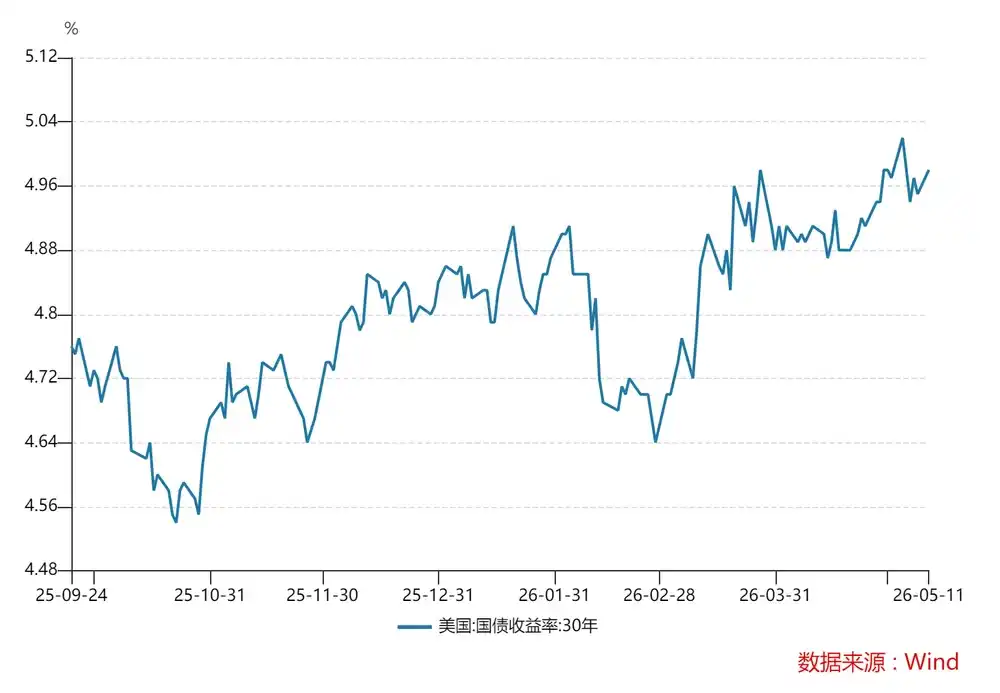
The yield on the 30-year U.S. Treasury note continues to climb, recently breaking through the high level of 5%. For a highly concentrated, expensive, and forward-earnings-narrative-dependent U.S. stock market, the longer long-term rates stay elevated, the more fragile the valuation system becomes.

What's more troublesome is that this pressure is likely to intensify.

On May 15th, Jerome Powell, after serving eight years as Fed Chair, formally stepped down. Kevin Warsh became the next Chairman. Compared to Powell, Warsh may be more tolerant of market pressure, more committed to balance sheet reduction, and less inclined to provide implicit Fed support for financial markets.

Once long-term yields move persistently higher and the Fed no longer soothes the market as quickly as before, the prosperous logic that has supported high U.S. stock valuations may begin to lose its foundation.

The Current Fragility of U.S. Stocks

It's that long-term rates refuse to come down.

For some time now, the market has focused excessively on whether the Fed will cut rates, overlooking a problem: long-term rates are no longer moving in sync with monetary policy.

In theory, central bank rate cuts directly lower short-term rates; if the market believes future rates will stay low, long-term rates should follow suit. But an anomaly has occurred. Even without the Fed hiking, the 30-year Treasury yield continues to rise, hitting a high of 5.13% on May 15th. This indicates the market does not believe long-term U.S. risks will diminish and therefore demands higher risk compensation.
This is precisely where U.S. stocks are most vulnerable right now.

The reason long-term rates are stuck at high levels has at least three layers.

First, inflation has not eased as smoothly as the market hoped.

The latest data shows U.S. April CPI rose 3.8% year-on-year, hitting a nearly three-year high. Core CPI accelerated to 2.8%. More troublingly, U.S.-Iran conflict risks haven't been truly resolved, with persistently high oil prices constantly reinforcing market concerns about imported inflation. As long as inflation expectations can't be firmly suppressed, long-term rates will struggle to fall smoothly.

Second, U.S. fiscal issues are also eroding market confidence in its long-term fiscal discipline.

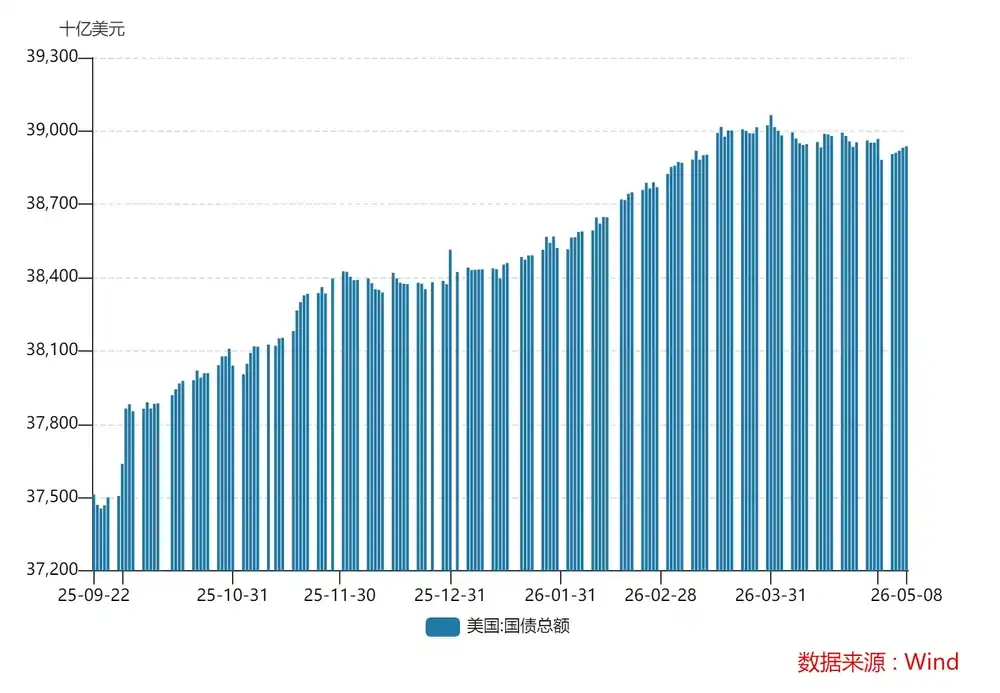
In October 2025, U.S. national debt stood at $38 trillion. Just five months later, that scale breached $39 trillion. Behind this is chronic fiscal deficits (high military and social welfare spending). The Treasury Department issues new bonds to repay maturing old debt, and these new bonds bring higher interest payments, pushing the U.S. into a "Ponzi-like" fiscal debt situation—needing ever-expanding debt to sustain the existing system's stability.
Third, the supply and demand structure for U.S. Treasuries is deteriorating.

On one side, the Treasury continues to increase issuance; on the other, overseas holdings are shrinking due to global de-dollarization. Foreign official sectors are reducing their accumulation, and the U.S. Treasury's share of global reserve assets is in decline, currently at 24%. Supply is increasing while the buying power is weakening, making it increasingly difficult to suppress long-term yields.

When these risks are not alleviated, U.S. Treasuries cease to be just safe assets, and investors naturally demand higher risk compensation.

This is especially dangerous for U.S. stocks.

Because the current U.S. stock market is not a broadly undervalued market relying on gradual earnings delivery. It is a highly concentrated market, supported by a handful of leaders, and extremely sensitive to discount rates.

Once long-term rates stay high, the discounting of future cash flows becomes significantly harsher, and the tolerance range for valuations narrows rapidly. At that point, the first to be hit may not be companies with the worst fundamentals, but precisely those with the best fundamentals but whose valuations are already stretched to the limit.

Bank of America's Hartnett also noted that once the 30-year Treasury yield stabilizes above 5%, rising financing costs and falling risk appetite would first impact high-valuation U.S. tech stocks.

October 2023 demonstrated this once.

At that time, the 30-year yield briefly rose above 5%, and the Nasdaq index corrected about 10% cumulatively over several months. Investors then still believed that once financial conditions worsened further, the Fed would ultimately send soothing signals. But if, after Warsh takes office, this expectation begins to waver, then the market's reaction to a similar long-term rate shock would be entirely different.

Many also like to compare today to 2007, but the truly relevant lesson isn't that rates were high then too. It's that the damage high rates inflict on a financial system never happens instantly. It's more like a chronic erosion: first pressuring financing, then valuations, then balance sheets, finally forcing out the weakest link in the system.

What truly burst in 2007 was real estate, subprime, and shadow banking. Today, what's more dangerous is high-deficit fiscal policy pushing long-term bond supply ever higher, making long-term yields hard to suppress. Banking unrealized losses, commercial real estate tail risks, and risk assets' dependence on liquidity would all be gradually exposed.

Therefore, once long-term rates fail to come down, the valuation foundation for this AI-driven bull market begins to loosen.

This problem will be more severe in the Warsh era.

Why Should Warsh Make the Market Wary?

Because Warsh's inclination towards balance sheet reduction would further push up 30-year Treasury yields, amplifying U.S. stock fragility.

How to understand this?

Fed balance sheet reduction (quantitative tightening, QT) means shrinking the size of the Fed's balance sheet. Previously, to stimulate the economy, the Fed bought many assets like Treasury bonds and mortgage-backed securities (MBS); buying these assets was equivalent to injecting a lot of money into the market. QT is about letting these assets decrease, gradually withdrawing liquidity from the market.

We can simply understand it as: the Fed stops buying newly issued or maturing Treasury bonds from the Treasury Department, and may even sell some of the bonds it holds.

As mentioned above, the U.S. Treasury is currently increasing issuance, and overseas buyers are reducing holdings. If the Fed also reduces its balance sheet, then new and maturing Treasuries can only flow to the market, with the market determining the interest rate level. The result is persistently rising Treasury yields. This also leads to an increasingly heavy interest burden for the government, which is very dangerous for a system relying on issuing new debt to replace old. Once interest costs become too high to support, a Treasury crisis emerges.

Former U.S. Treasury Secretary Paulson also warned that once U.S. Treasuries start losing market buyers, the entire financial system's "risk-free anchor" would be shaken.

If the consequences are so severe, why is Warsh inclined to reduce the balance sheet? This stems from his background.

Warsh served as a Federal Reserve Governor from 2006 to 2011, a period crucial for judging his policy leanings. He experienced the final credit expansion before the financial crisis, the 2008 global financial crisis, and the start of zero interest rates and QE (quantitative easing).

He is not someone who completely denies crisis intervention. On the contrary, during times of strongest systemic risk, he supported the Fed acting as lender of last resort and recognized the necessity of unconventional tools. But later he grew increasingly skeptical: should the prolonged QE post-crisis have persisted for so long?

From his perspective, the post-crisis U.S. economy did not recover in proportion to asset price gains. The real economy's recovery wasn't strong, productivity improvements were limited, but financial asset prices rebounded rapidly driven by liquidity, even surpassing pre-crisis levels.

This likely led Warsh to a very typical conclusion: QE might be good at boosting financial asset prices, but not necessarily equally good at repairing the real economy. Once markets begin to assume "the Fed will ultimately backstop asset prices," the financial system becomes increasingly dependent on liquidity, risk appetite is artificially suppressed long-term, and asset bubbles and misallocations worsen.

So in his logic, if the Fed maintains an oversized balance sheet and suppresses term premiums for too long, markets will ultimately become increasingly unable to function independently of central bank liquidity. In his view, QT is not just about withdrawing liquidity; it's also the Fed proactively withdrawing from its role as a "financial conditions stabilizer."

This is also why Warsh might be more inclined than Powell to advance QT.

Therefore, after Warsh takes office, the high-interest-rate environment will become even more severe, and the Fed may not soothe the market as quickly as before. Once such expectations form, the pressure on the already fragile high-valuation system of U.S. stocks will be further amplified.

The AI Narrative Can't Fully Offset High Rates

Of course, persistently high 30-year Treasury yields are not an absolute negative for U.S. stocks.

If the U.S. economy continues to outperform expectations, corporate earnings are revised upward, and especially if AI genuinely translates into broad productivity gains quickly, then even with elevated long-term rates, risk assets might still hold up. Ultimately, what determines whether the market can digest high rates is economic growth itself.

Over the past year, the reason U.S. stocks, especially tech stocks, continued to rise in a high-rate environment largely relied on this optimistic judgment: AI will significantly boost corporate profits, raise productivity, and open a new growth cycle for the U.S. economy.

But the problem is, the AI narrative currently concentrates more among a few leading companies and capital markets. It hasn't been sufficiently proven to quickly and broadly transform into fundamental improvements for the entire economy.

Take Nvidia as an example. It has indeed created astounding capital returns and market imagination. But such companies share these characteristics: high technological barriers, high profit concentration, limited employment absorption capacity (as of FY2026, Nvidia's global headcount was only about 42,000). Their spillover effects on the overall economy aren't as strong as market sentiment suggests.

In other words, AI can quickly lift valuations for companies like Nvidia and Microsoft in the short term, but it may not equally quickly support broader employment, investment, and expansion in the real economy.

More realistically, the U.S. itself faces problems of insufficient electricity, infrastructure, and industrial support. The faster the AI industry expands, the more it tends to suck capital, energy, and talent further into top tech sectors, making already uneven resource allocation even more concentrated towards leading tech.

This isn't to say AI won't succeed, just to emphasize it hasn't progressed fast enough to fully offset the valuation pressure from persistently high long-term rates.

In other words, the market thinks it's trading AI, but it's actually still trading another thing: low long-term rates and Fed backstops. As long as these two premises hold, high valuations can be justified. Once these premises begin to waver, no matter how strong AI is, it only delays, not cancels, the revaluation.

Warsh is not the source of the risk, but he might be the one who makes this trend harder to reverse.

In summary, while Warsh won't actively create a crisis, he might make the market truly accept for the first time that the high-valuation logic, supported by low long-term rates and Fed backstops, is no longer so stable.


Domande pertinenti

QAccording to the article, what is the key premise that has been supporting high valuations in the US stock market, and why is it becoming unstable?

AThe key premise is that long-term interest rates will ultimately fall. This is becoming unstable because the 30-year U.S. Treasury yield remains persistently high (above 5%), which undermines the market's willingness to pay high premiums for future earnings and increases the fragility of the valuation system for stocks, especially highly valued tech stocks.

QWho is Kevin Warsh, and how might his approach as Fed Chair differ from Jerome Powell's, potentially impacting market expectations?

AKevin Warsh is the next Fed Chair following Jerome Powell. The article suggests he may be more tolerant of market stress, more persistent in quantitative tightening (QT / balance sheet reduction), and less likely to provide implicit support to financial markets compared to Powell. This could weaken the market's expectation of a 'Fed put' or rapid intervention to stabilize markets.

QWhat are the three main reasons cited in the article for the persistent high level of long-term U.S. Treasury yields?

A1. Inflation has not declined as smoothly as expected, with CPI data remaining high and oil price risks from conflicts like U.S.-Iran tensions reinforcing inflation concerns. 2. The U.S. fiscal situation undermines confidence in long-term fiscal discipline, with rapid debt growth leading to a 'Ponzi-like' structure requiring more borrowing to service existing debt. 3. Deteriorating supply-demand dynamics for U.S. Treasuries, as the Treasury increases issuance while foreign buyers (due to de-dollarization) are reducing their holdings.

QHow could a high 30-year Treasury yield and Kevin Warsh's potential policies combine to create specific risks for the U.S. stock market?

AA persistently high 30-year yield increases the discount rate for future corporate earnings, putting pressure on the high valuations of growth stocks, particularly in the tech sector. If Chairman Warsh is less inclined to intervene and supports continued quantitative tightening, it could remove a key market support (the 'Fed put'), leading to a re-rating of valuations as the old logic of low long-term rates and Fed support weakens.

QThe article argues that the AI narrative cannot fully offset the pressure from high interest rates. What is the primary limitation of the AI boom mentioned in this context?

AThe primary limitation is that the benefits of the AI boom are currently concentrated in a few leading companies and in capital markets, but it has not yet been proven to translate quickly and broadly into widespread improvements in economic fundamentals like productivity, employment, and investment across the broader economy. Therefore, it cannot sufficiently cover the valuation pressure caused by sustained high long-term interest rates.

Letture associate

Why Haven't Forex Stablecoins Taken Off?

Why FX Stablecoins Never Took Off: A Path Forward via Synthetic FX Despite the explosive growth of stablecoin-powered digital banking, which has seen ~$6B in VC investment and a 24x surge in crypto card spending in under a year, a major limitation persists: these banks are essentially dollar-only accounts. This leaves 95-99% of global accounts, which are denominated in non-USD currencies, underserved. Attempts to create native foreign currency (FX) stablecoins (like EURC) have largely failed, with total FX stablecoin TVL at ~$600M compared to $400B for USD stablecoins—a 700x gap. These FX tokens face critical challenges: fragile pegs due to low liquidity, limited exchange/FinTech acceptance, poor on/off-ramps, complex regional compliance, and a chicken-and-egg adoption problem. The article argues that the solution lies not in competing with entrenched USD stablecoin networks (USDT/USDC), but in adopting a synthetic FX model inspired by traditional finance. Specifically, it advocates for Mark-to-Market Non-Deliverable Forwards (NDFs)—cash-settled FX derivatives that allow users to maintain underlying USD stablecoin holdings while having their account balance and P&L denominated in a foreign currency. This approach offers key advantages: strong oracle-based pegs, retention of deep USD stablecoin liquidity and yield, superior on/off-ramps, scalability to any currency with a reliable feed, and capital efficiency. It mirrors how modern institutional FX markets operate. Primary use cases for on-chain NDFs include: 1. **Digital Banks/Wallets:** Enabling multi-currency accounts for international users without leaving the USD stablecoin ecosystem, boosting deposits and retention. 2. **FX Carry Trade Vaults:** Offering access to sovereign interest rate differentials (e.g., earning yield on BRL) in a more stable and scalable format than crypto-native products like Ethena. 3. **Global Enterprise Payments:** Allowing merchants to receive payments in local currency equivalents while settling in USD stablecoins, similar to services offered by Stripe for fiat. The conclusion is that synthetic FX, not native FX stablecoins, is the viable path to integrating foreign exchange into the growing stablecoin digital banking landscape, potentially unlocking the next phase of institutional DeFi and multi-trillion-dollar global adoption.

链捕手32 min fa

Why Haven't Forex Stablecoins Taken Off?

链捕手32 min fa

IOSG Founder: Web3 Is 'Losing Blood,' How Can Practitioners Survive Better?

IOSG Founder: Web3 Is "Bleeding Out" – How Can Practitioners Survive Better? In a candid reflection, the founder of IOSG Ventures voices deep concerns about the current state of Web3, describing an ecosystem experiencing severe "blood loss." Despite the recent MuShanghai event showcasing a successful pivot towards a more diverse, global community, a somber reality persists: many crypto-native attendees were there exploring exits or new labels in biotech, AI, and robotics. The core issue is identified as a breakdown in the ecosystem's positive feedback loop. Alarmingly, underestimated "low-probability bad events" are occurring simultaneously: a significant brain drain of Chinese developers to AI, a lack of breakout applications despite massive funding, and a widening credibility gap for practitioners globally, often stigmatized as scam artists. This has created a dire接班人 (successor) problem, with the next generation seeing little professional prestige or financial upside in crypto compared to fields like AI. A significant portion of the critique focuses on Ethereum and Vitalik Buterin. While not pessimistic about Ethereum's technology, the founder worries that critical development windows were missed by focusing on niche technical narratives like ZK and L2 instead of mass-market applications. A more urgent concern is that Vitalik may be isolated in an "information bubble," shielded from the grassroots community's hardships by layers of intermediaries, preventing crucial feedback from reaching him. The call is for Vitalik to return to a founder's mindset, re-engage directly with the community, and rally efforts for the next decade. The divergence between U.S. and Chinese OG (Original Gangster) ecosystems is stark. While many U.S. builders reinvest their wealth into the ecosystem, the Chinese scene suffers from a severe lack of "造血能力" (blood-making ability), with most market-driven funds struggling and many early success stories cashing out entirely. This threatens the entire Asian Web3 ecosystem's survival. For individual practitioners, survival advice is pragmatic: find your core "why," maintain life balance beyond token prices, continuously learn new skills (like AI), form small, trusted alliances for mutual support, and practice self-compassion. The industry's greatest need is not money or tech, but lighthouses—individuals at all levels who offer mentorship, grants, referrals, and honest reflection to guide others. The piece concludes with a direct appeal: OGs must pay forward the opportunities the industry gave them; founders must not struggle alone; and builders must continue their work, ensuring it remains a viable profession. The survival of Web3's "cathedral" depends not on any single leader but on the collective responsibility of everyone who remains.

marsbit1 h fa

IOSG Founder: Web3 Is 'Losing Blood,' How Can Practitioners Survive Better?

marsbit1 h fa

Deficits, Inflation, and the New Fed: The Deep Logic Behind US Bond Yields Breaking 5% and the Market Reset

In the week of May 15-19, 2026, U.S. long-term Treasury yields surged to multi-year highs, with the 30-year yield hitting 5.2%, a level unseen since 2007, and the 10-year yield climbing to 4.687%. Equity markets declined in response. Four primary factors are driving the rise in yields. First, stubborn inflation persists, with April wholesale prices rising 6% year-over-year, fueling expectations of potential future Fed rate hikes instead of cuts. Second, newly confirmed Fed Chair Kevin Warsh inherits a complex inflation battle, with markets closely awaiting his first FOMC meeting. Third, deteriorating U.S. fiscal health, marked by large deficits and rising debt servicing costs, is eroding the traditional "safe-haven" premium for Treasuries. Fourth, the "One Big Beautiful Bill" tax cuts are projected to add trillions to the national debt, contributing to Moody's recent credit rating downgrade. Rising yields pressure stocks through several channels: a higher discount rate reduces the present value of future earnings (especially for growth stocks); rising risk-free rates compress equity risk premiums, making bonds relatively more attractive; higher borrowing costs impact consumers and corporations; and a stronger dollar affects multinational earnings. For investors, the environment favors value and financial stocks over long-duration growth stocks. Bond investors find attractive yields in short to intermediate maturities, while income investors see the best fixed-income opportunities in over a decade. Key developments to watch include Chair Warsh's first FOMC meeting, upcoming inflation data, Treasury auction demand, and whether the 30-year yield approaches 6%, a level that could trigger a more sustained equity valuation reset. The bond market's message is clear: the era of cheap government borrowing is over, posing a central challenge for markets in late 2026.

marsbit1 h fa

Deficits, Inflation, and the New Fed: The Deep Logic Behind US Bond Yields Breaking 5% and the Market Reset

marsbit1 h fa

Is MicroStrategy Selling Bitcoin Not a Bearish Signal? Deconstructing the 5 Financial Logics Behind Corporate Bitcoin Divestment

The article "Is Strategy Selling Bitcoin Not a Bearish Signal? Decoding 5 Financial Logics Behind Corporate Bitcoin Divestment" analyzes why companies might sell their bitcoin holdings, arguing it's not necessarily negative. It begins by noting the market's surprise at Strategy's potential sale, contrasting its previous "never sell" stance. The core argument is that corporate decisions prioritize shareholder value, and selling bitcoin can be a rational strategic choice. The article outlines five key financial reasons for such sales: 1. **Increase Bitcoin Holdings Per Share:** Companies can use proceeds from bitcoin sales to repurchase shares when the stock price is undervalued relative to its bitcoin assets. This reduces the outstanding share count, potentially increasing the bitcoin amount backing each remaining share. 2. **Optimize Capital Structure & Reduce Financing Costs:** Building cash reserves through bitcoin sales can improve credit ratings (as favored by agencies like S&P), leading to lower future borrowing costs. Repaying debt with sale proceeds also reduces financial leverage. 3. **Legitimate Tax Planning:** In the absence of wash-sale rules for bitcoin in the US, companies can sell to realize capital losses, then repurchase, lowering the tax basis of their holdings and creating tax offsets. 4. **Counter Negative Market Narratives:** A controlled, non-disruptive sale could demonstrate market resilience and disprove fears that corporate selling would crash the market, thereby normalizing bitcoin as a corporate treasury asset. 5. **Repurchase Preferred Stock at a Discount:** If a company's preferred stock trades significantly below its face value, using bitcoin sale proceeds to repurchase it can retire expensive liabilities at a profit, saving on future dividend payments. The conclusion emphasizes that bitcoin's monetary properties offer flexibility. Strategic sales can protect corporate and shareholder interests, making asset utilization more important than rigid "hold" mandates.

marsbit1 h fa

Is MicroStrategy Selling Bitcoin Not a Bearish Signal? Deconstructing the 5 Financial Logics Behind Corporate Bitcoin Divestment

marsbit1 h fa

Trading

Spot
Futures

Articoli Popolari

Come comprare PING

Benvenuto in HTX.com! Abbiamo reso l'acquisto di Ping (PING) semplice e conveniente. Segui la nostra guida passo passo per intraprendere il tuo viaggio nel mondo delle criptovalute.Step 1: Crea il tuo Account HTXUsa la tua email o numero di telefono per registrarti il tuo account gratuito su HTX. Vivi un'esperienza facile e sblocca tutte le funzionalità,Crea il mio accountStep 2: Vai in Acquista crypto e seleziona il tuo metodo di pagamentoCarta di credito/debito: utilizza la tua Visa o Mastercard per acquistare immediatamente PingPING.Bilancio: Usa i fondi dal bilancio del tuo account HTX per fare trading senza problemi.Terze parti: abbiamo aggiunto metodi di pagamento molto utilizzati come Google Pay e Apple Pay per maggiore comodità.P2P: Fai trading direttamente con altri utenti HTX.Over-the-Counter (OTC): Offriamo servizi su misura e tassi di cambio competitivi per i trader.Step 3: Conserva Ping (PING)Dopo aver acquistato Ping (PING), conserva nel tuo account HTX. In alternativa, puoi inviare tramite trasferimento blockchain o scambiare per altre criptovalute.Step 4: Scambia Ping (PING)Scambia facilmente Ping (PING) nel mercato spot di HTX. Accedi al tuo account, seleziona la tua coppia di trading, esegui le tue operazioni e monitora in tempo reale. Offriamo un'esperienza user-friendly sia per chi ha appena iniziato che per i trader più esperti.

345 Totale visualizzazioniPubblicato il 2025.10.27Aggiornato il 2025.10.27

Come comprare PING

Discussioni

Benvenuto nella Community HTX. Qui puoi rimanere informato sugli ultimi sviluppi della piattaforma e accedere ad approfondimenti esperti sul mercato. Le opinioni degli utenti sul prezzo di PING PING sono presentate come di seguito.

活动图片












