In the 1980s, Latin America's total external debt accounted for nearly 50% of its GDP. This metric was once a scale used by Washington to measure loyalty and control over this backyard.
Today, that number has dropped to 20%.
However, this 22-percentage-point difference does not mean that the people of Latin America are becoming wealthier day by day. To no longer be subject to others' currencies and rules, they are still struggling within the old order and paying a heavy price for it.
This is a contest about "control" versus "loss of control." The United States has attempted to grasp the economic lifeline of this continent through debt, currency, and sanctions. Yet, when this control is pushed to its limit, the system inevitably ignites an endogenous force of resistance.
Three Weapons of U.S. Financial Control Over Latin America
For over half a century, the financial empire of the United States has ruled Latin America primarily with three highly effective weapons.
The first weapon is debt. This is the empire's oldest colonial tool and its most effective instrument of financial governance.
On August 12, 1982, a plea for help from Mexico's Finance Minister was the trigger for the Latin American debt crisis. As Mexico declared its inability to repay $80 billion in external debt, the first domino fell. Brazil, Argentina, and Venezuela subsequently tumbled into the quagmire of default.
Then, a "creditors' alliance" composed of the U.S. Treasury, the Federal Reserve, and the IMF stepped in. The救命钱 they offered was exorbitantly expensive; each aid package came with extremely苛刻的附加条件 attached.
This was the later infamous Washington Consensus, which forced these countries to slash government spending, sell off state-owned assets, and completely open their domestic markets and capital controls.
It was an era when the U.S. could decide a nation's destiny for the next decade with a single check. Debt became a rope tightened around the necks of Latin American countries, with the other end always held by the Americans. Behind every aid package, the price of power was already clearly marked.
The second weapon is dollarization.
When debt control wasn't彻底 enough, a more extreme solution was pushed forward: simply abolish your national currency and directly use the U.S. dollar.
First, the U.S., through prior debt harvesting, induced foreign exchange depletion and hyperinflation in these countries, creating a physiological fear of the local currency among the populace. Then, Washington's think tanks began a large-scale舆论 campaign promoting "monetary stability," packaging the dollar as the only safe haven from turmoil.
And when providing emergency loans, the U.S. would often暗示 or even明示 that only by adopting the dollar could they obtain long-term financial credit endorsement. In 2000, on the brink of social unrest, Ecuador was forced to abandon its currency; shortly after, El Salvador, Panama, and others followed suit.
This is a very霸道 logic: if a country doesn't even have its own currency, its economic sovereignty is essentially in a state of trusteeship. Abandoning the national currency is equivalent to handing over the keys to your house. From then on, your inflation rate, your interest rates, can only be decided by others.
The third weapon is sanctions. This is the final, and most destructive, heavy weapon,专门 used against those who attempt to脱离轨道 and challenge the existing order.
Taking Venezuela as an example, the U.S. has imposed over 900 sanctions against it, involving 209 key individuals,几乎封死了 this country's every生存空间.
Venezuela is actually incredibly rich, literally "rolling in oil." Its oil reserves are as high as 303 billion barrels, even more than Saudi Arabia's. But the problem is, much of this oil is extra-heavy, like asphalt, with extremely high extraction difficulty. It requires external capital, technology, and diluents to turn it into money.
U.S. sanctions精准地切断 these lifelines, leaving Venezuela sitting on the "world's largest oil vault" unable to monetize it. The result is that Venezuela's oil production plummeted from 3 million barrels per day to a low of less than 500,000 barrels within just seven years.
It wasn't until early 2026, when U.S. forces, citing "narcoterrorism" and related criminal charges, conducted a military operation in Venezuela to take away Maduro, and Trump announced that major oil companies would take over and invest tens of billions of dollars to repair infrastructure, that the sanctions blade finally completed its closed loop.
First, use sanctions to completely paralyze a country's liquidity, then, under the banner of "management and repair," enter the ruins with tens of billions of dollars in hand, completing the re-harvesting of the global energy landscape.
Debt, dollarization, and sanctions—these three shackles constituted the U.S.'s half-century-long financial blockade of Latin America. This net was once impermeable, stretching from Mexico City to Buenos Aires.
Three Variables
Now, a series of variables are eroding the foundation of imperial hegemony. The three once-infallible weapons are failing amidst the changing logic of global博弈.
The loosening of the debt shackle began in the first decade of the 21st century. The biggest variable behind it is China.
In 2001, China joined the WTO, initiating a decade-long supercycle for commodities. Latin America, as a major global supplier of raw materials, became the biggest beneficiary of this feast.
Brazil's iron ore, Chile's copper, Argentina's soybeans—all flowed continuously to the East, exchanged for unprecedented foreign exchange accumulation. This accumulation gave Latin American countries breathing room and the底气 to break free from the IMF's束缚.
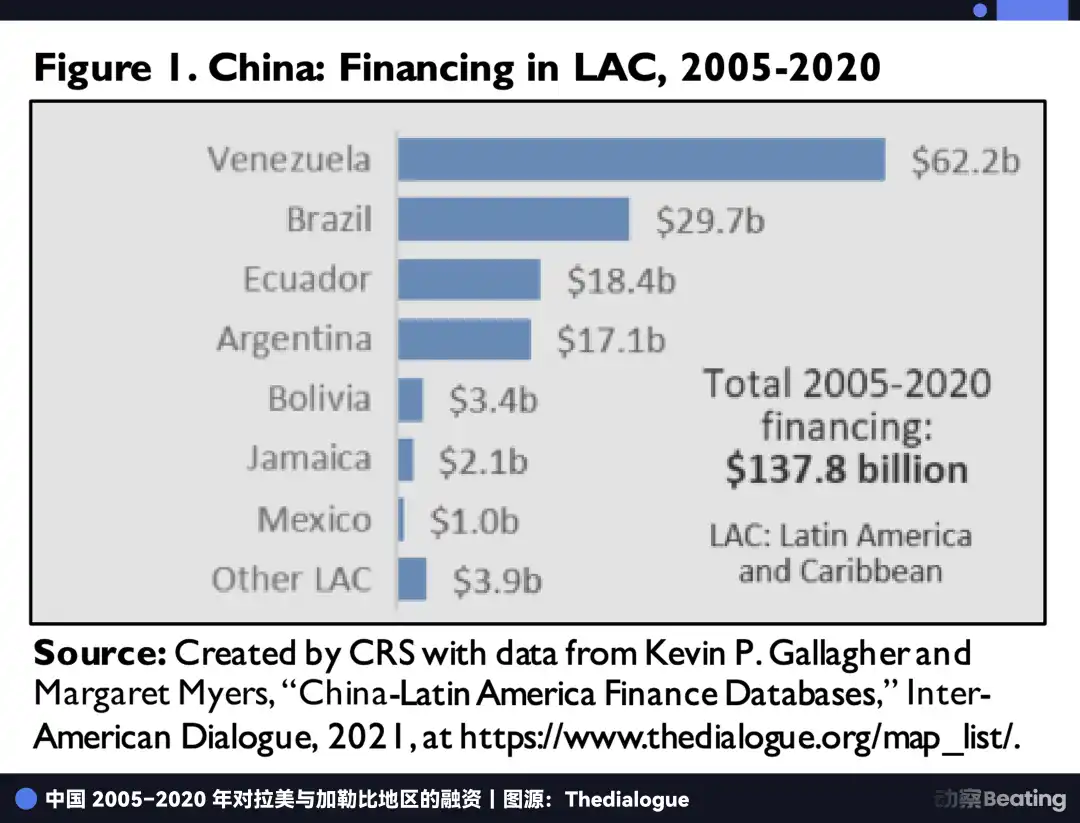
In 2005, Brazil and Argentina successively announced the early repayment of all debts owed to the IMF. From 2005 to 2020, China provided Latin America with over $137 billion in loans without political conditions attached.
Venezuela received $62 billion of this, with other major recipients including Brazil, Ecuador, and Argentina. These "oil-for-loans" agreements helped build much-needed infrastructure and gave these countries more bargaining chips when negotiating with Western creditors.
At the same time, Washington soon discovered it could not control these countries' economic policies through dollarization. The Latin American people hold U.S. dollars en masse to hedge against the collapse of their national currencies, not out of admiration for the "American Dream." In the streets and alleys of Latin America, the dollar is彻底剥离 of its political color, reduced to a purely financial tool—a reliable hard currency that won't turn into worthless paper tomorrow.
This is the so-called "de-Americanized dollarization."
People need the stability of the dollar but reject Washington's rules. The dollar is becoming a global, neutral measure of value, much like gold. It belongs to the world, no longer solely to the U.S. government.
When large volumes of dollar transactions spontaneously operate outside the official monitoring system, Washington finds that while it can still print money, it is increasingly difficult to manipulate the economic lifelines of other countries through monetary leverage.
As both debt and dollarization gradually lost their effectiveness, the U.S. opted for more激进 sanctions.
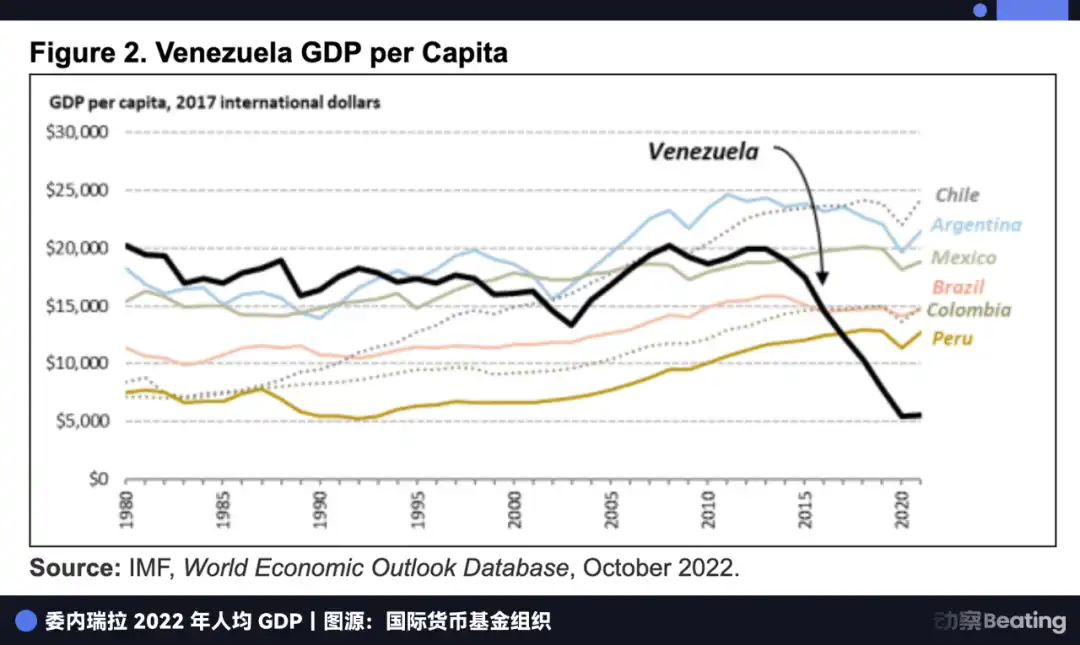
On one hand, internal governance failures and corruption in Venezuela led to the collapse of its economic pillar, with the national currency becoming worthless due to hyperinflation. On the other hand, external sanctions directly caused its GDP to shrink by about 75%. It was precisely this sense of suffocation from internal and external troubles that催生 a parallel financial ecosystem完全独立于 the dollar闭环之外.
Meanwhile, to avoid the risk of sky-high U.S. fines, global major banks initiated a so-called "de-risking" movement,主动切断 business dealings with Latin America. According to a report by the Atlantic Council, over 21 banks in the Caribbean lost correspondent banking relationships, with some countries even losing the ability to handle basic dollar trade and remittances from emigrants.
This defensive financial exclusion did not reinforce the existing hegemony; instead, it pushed more innocent individuals and businesses into the emerging parallel financial ecosystem.
The Parallel Financial Ecosystem Outside the Iron Curtain
In this博弈 over financial sovereignty and survival instinct, Latin America's parallel financial ecosystem is being woven from four forces—stablecoins, local Fintech, non-U.S. trade channels, and the underground economy—into a network不受 Washington's will左右.
In Latin America, stablecoins are no longer just investment or speculation chips.
Taking Venezuela as an example, to evade sanctions, the official government established a shadow financial network. By December 2025, about 80% of this country's oil revenue was collected in the form of the stablecoin USDT.
Furthermore, according to intelligence, through a channel spanning Turkey and the UAE for gold refining and over-the-counter transactions, Venezuela may have secretly amassed Bitcoin reserves worth up to $60 billion, a holding size comparable to MicroStrategy's.
However, this channel bypassing the SWIFT system, crossing Turkey and the UAE for gold and cryptocurrency, while technically evading sanctions, also became a key point of entry for Washington's accusations of involvement in illegal fund flows and support for drug trafficking due to its极高的隐蔽性.
For ordinary Latin Americans, when traditional bank accounts were frozen due to sanctions, they stopped paying attention to the繁冗 and politically charged instructions of the settlement systems, instead directly moving funds across borders via blockchain.
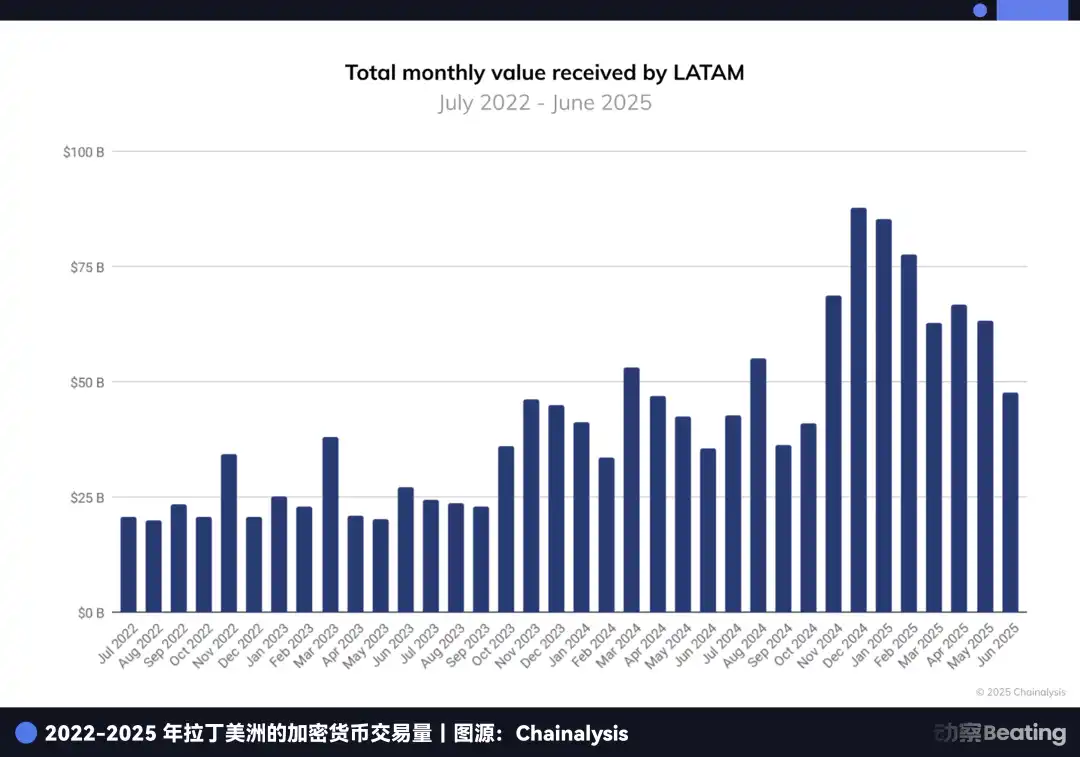
According to Chainalysis data, between 2022 and 2025, cryptocurrency transaction volume in Latin America approached $1.5 trillion. In Brazil, over 90% of transactions were related to stablecoins.
Compared to Manhattan bankers accustomed to俯瞰 from on high, local Fintech companies care more about the soil under their feet and具体的生计. In Brazil, for instance, even though only 60 million people have credit cards, the user base of the central bank-led Pix payment system surged to 170 million.
In 2024, Pix's total transaction volume reached $3.8 trillion, 1.7 times Brazil's GDP. Behind this data lies资金周转效率 pushed to the extreme.
Meanwhile, digital banking giant Nubank grew its user base from 1.3 million to 114 million in just eight years, capturing over 60% of Brazil's adult population, and recorded nearly $2 billion in net profit in 2024.
Payment giant Mercado Pago swept across Latin America with $142 billion in payment volume, while remittance market newcomer Bitso硬生生 tore a 4% share of the U.S.-Mexico remittance market from traditional giants like Western Union.
Additionally, non-dollar channels and the underground economy have converged. The $5 billion currency swap between Argentina and China, and the ongoing推进 of local currency settlement between China and Brazil, are becoming a symmetrical choice against the backdrop of great power博弈. This脱钩 from the top down is granting Latin American trade a form of breathing room independent of the dollar.
On the streets of Argentina, a black market exchange rate known as the "Dólar Blue" has become the全民的经济晴雨表. Its huge gap with the official rate赤裸裸地揭示了 the bankruptcy of official credit and has催生 countless street currency exchange vendors called "arbolitos" (little trees) and "cuevas cripto" (crypto caves)专门 trading USDT.
The穿透力 of stablecoins, the渗透率 of local Fintech, the strategic choices of non-U.S. channels, and the野蛮生长 of the underground economy共同编织 this financial network that摆脱 centralized control.
Who is Handing Over the Knife?
Any species' breakthrough requires not only an internal will to survive but also often a剧烈催化 from the external environment. The driving force behind the rise of Latin America's parallel financial system恰恰 comes from the U.S., which is trying to defend the old order.
A series of operations by Washington not only failed to stifle the sprouts of the new order but instead provided the most ample nourishment for its expansion.
The first push came from politicians'强行征用 of financial channels.
The Trump administration once proposed a 1% tax on remittances sent from the U.S. This might seem like a minor抽成, but against the backdrop of Latin America's annual remittances exceeding $150 billion, it was enough to shake the lifelines of tens of millions of low-income families.
Remember, in traditional financial channels, sending $200 to Latin America would incur fees of $6~8 just from giants like Western Union.
This additional 1% tax became the last straw that broke the camel's back. This tax slip sent an extremely dangerous signal to every laborer: traditional remittance channels are not only expensive but can also become pawns in political games at any time.
Trump might have thought he was building a financial wall, but客观上 he驱赶 tens of millions of users to flee the old system and collectively rush into the embrace of stablecoins and local Fintech. When the cost of survival is pushed to the limit by politics, users will migrate at an unprecedented speed.
The second push stems from a severe撕裂 among Wall Street elites regarding利益分配.
As mentioned earlier, to comply with increasingly strict anti-money laundering regulations, Wall Street giants initiated a "de-risking" movement,主动切断 business ties with "high-risk areas" like Latin America. JPMorgan Chase, as early as 2014, closed tens of thousands of Latin American client accounts citing "excessive risk."
By the end of 2025, JPMorgan Chase, on one hand, froze the bank accounts of two stablecoin companies operating in Venezuela, BlindPay and Kontigo, playing the role of the dollar system's most loyal "gatekeeper." On the other hand, it was疯狂囤积 physical precious metals to hedge against dollar risk.
Public data shows that JPMorgan Chase has become the world's largest holder of physical silver. More intriguingly, JPMorgan moved large amounts of silver from a deliverable state to a non-deliverable state.
This means this silver, while sitting in warehouses, is no longer allowed to be used to fulfill futures contract deliveries. In other words, JPMorgan is taking these "chips" off the gambling table and locking them away in its own rarely seen backyard.
While the dollar hegemony is still effective, these Wall Street elites use the rules to maximize their financial control; but at the same time, they are also preparing for the eventual collapse of this system. JPMorgan is both the number one maintainer of the existing dollar system and its biggest "internal short."
Thus, the more the U.S. tries to tighten the dollar's reins, the more the dollar leaps over the wall in a wild manner, seeking safer pastures. When core players within a system start preparing escape routes for the post-dollar era, this control inevitably moves towards its opposite.
The Curse of Hegemony
This dilemma of "control" versus "loss of control" is not unique to this era. If we look back to the foggy 19th century, in the long river of financial history, we can hear a distant and similar echo—the decline of the British pound.
In that long century, the pound sterling was the undisputed world currency. But when a currency truly belongs to the whole world, it no longer完全 belongs to its home country.
To output pounds to the world, Britain was forced to maintain a chronic trade deficit. This cost directly led to the hollowing out of its manufacturing industry and the慢性衰落 of its national power. In 1931, after experiencing three severe runs on the pound, Britain was forced to abandon the gold standard, and pound hegemony fell from grace.
The British Empire learned a lesson with a century of tuition: the more you try to use currency status to harvest the world, the more you accelerate the透支 of its vitality.
Today, the U.S. dollar is stepping into the same dilemma.
The more Washington tries to use the dollar as a weapon, employing sanctions, taxes, and harsh regulations to encircle and suppress, the more likely the dollar is to加速离家出走. You are明修栈道 (feigning movement in one direction), while the populace is暗渡陈仓 (advancing secretly another way).
Stablecoins, local Fintech, non-U.S. trade channels, the野蛮生长 underground economy... all these various choices are essentially隐秘路径 for the dollar to escape Washington's control.
From the近乎执念囤积 of physical gold by central banks in recent years to the关门落锁 of top financial capital on physical assets, this collective choice is shifting the global financial center of gravity back towards the era of hard assets.
This transformation is not happening amidst the total collapse of the old empire, but is being spontaneously deconstructed by hundreds of millions of tiny individuals and enterprises in the apparent prosperity of the present-day U.S.
The echo of history is already circling over Washington, its sound clearly audible.