The United States Will Not Reject Stablecoins

marsbitPubblicato 2026-01-19Pubblicato ultima volta 2026-01-19

Introduzione

The article argues that the U.S. has no fundamental reason to reject stablecoins, despite regulatory friction. The debate centers on the "passive yield" mechanism, with traditional banks fearing massive deposit outflows—potentially up to $6 trillion—from community banks into yield-bearing stablecoins like USDC, which could raise lending costs. Coinbase counters that yield is a tool for user benefit and efficiency, helping users escape near-zero bank interest rates. Stablecoin issuers like Tether and Circle have become significant buyers of U.S. Treasury bonds, holding $1700 billion in Treasuries and accounting for a small but growing share of the money supply. With foreign demand for U.S. debt declining, stablecoins help sustain Treasury markets. The piece traces the rapid evolution of on-chain yield mechanisms, from Ethena’s USDe—which surged then contracted after deleveraging events—to more mature vault-based models like those on Morpho. While on-chain yield products have advanced, real-world adoption in payments remains limited. The solution proposed is integrating yield into payment systems, making yield a default feature during transactions—not just when holding or idling—thus benefiting users, merchants, and platforms. Examples like Airwallex’s yield products and travel platform partnerships show the potential. The conclusion is that stablecoins must expand utility and user base to succeed, with the next challenge being the governance of yield vaults to prevent syste...

Author: Zuo Ye

Coinbase's last-minute defection has led to a stall in the subsequent Clarity Act of the Genius Act in Congress, with the "passive yield" mechanism of stablecoins becoming a focal point.

The banking industry believes that up to $6 trillion in deposits could flow into stablecoins, especially with Coinbase sharing 50% of the profits from USDC, which would siphon deposits from small local banks and community banks, further complicating financing for small businesses and ordinary people.

Coinbase counters that yield generation is merely an operational and incentive mechanism. With sufficient asset reserves for stablecoins, it will not cause a systemic crisis but will instead free more people from the "exploitation" of the banking industry's 0.01% demand deposit interest rate.

The yield mechanism, after three rounds of on-chain yield-bearing stablecoins, remains a hot topic that the traditional financial industry has yet to catch up with. We live in a world of vast disparities: the crypto space moves fast, while TradFi has scale.

Yield Capitalism

The reduction in U.S. Treasury purchases and the increase in gold acquisitions are happening simultaneously. U.S. Treasuries need new buyers, and Tether and Circle are stepping up to the task.

Facing Coinbase's USDC offering an annualized yield of up to 3.35%, the banking industry has two main arguments for defense. First, the deposit scale of the U.S. banking industry is as high as $18 trillion. If demand deposit interest rates are too high, banks will further increase loan rates, ultimately raising financing costs for businesses and personal credit costs.
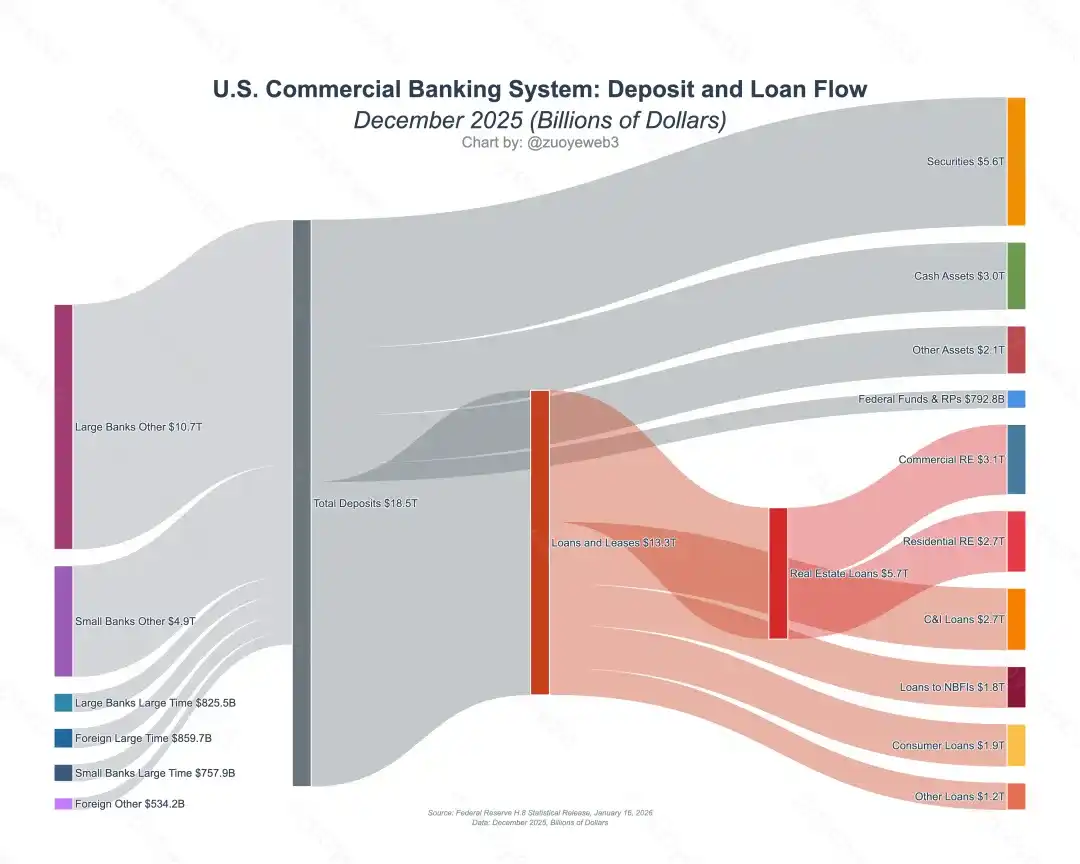
Image description: Flow of deposits and loans in U.S. commercial banks, Image source: @NewYorkFed

Second, yield-bearing stablecoin issuers are increasingly favoring the purchase of U.S. Treasuries, which undermines the banking industry's role in dollar circulation. Additionally, on-chain stablecoins participating in DeFi could potentially cause a systemic financial crisis.
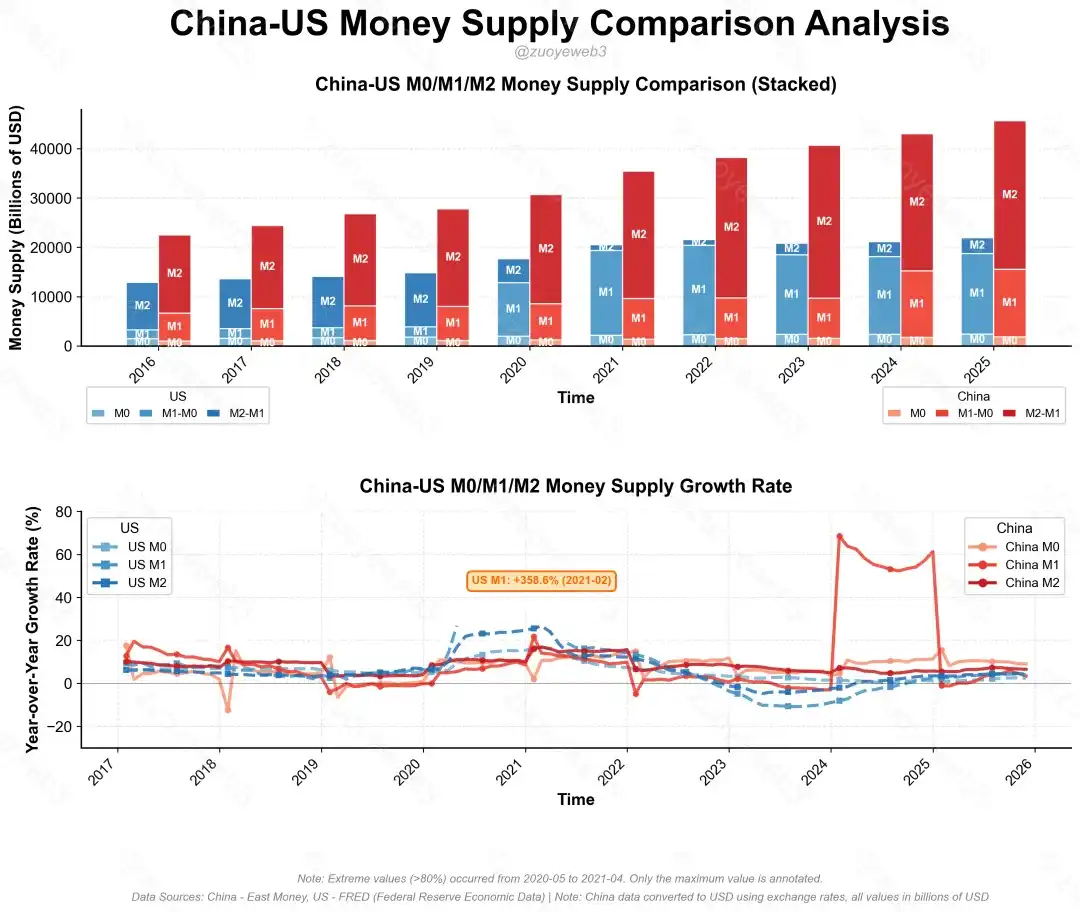
Image description: Comparison of China and U.S. M0/M1/M2, Image source: @zuoyeweb3

Addressing these two issues specifically, the current USDC issuance is $75 billion, with $40 billion invested in U.S. Treasuries. Tether's issuance is $180 billion, with $130 billion invested in U.S. Treasuries. Calculating only stablecoins issued based on U.S. Treasuries amounts to $170 billion, accounting for 3%/0.8%/0.7% of the U.S. M0/M1/M2.

However, according to Ark Invest's statistics, the share of the three largest foreign buyers of U.S. Treasuries has dropped from 23% in 2011 to 6% in 2024. With the tariff war spreading to Europe, U.S. Treasuries need more external buyers to maintain their global status. Fundamentally, the U.S. has no reason to reject stablecoins.

Although the Genius Act prohibits offering interest to attract customers, GUSD issued by Paxos in partnership with Kraken and PYUSD issued with Paypal can still bypass this restriction. Either Paxos and other third parties act as the operational entity, or custodial institutions like Anchorage offer interest to institutional clients.

In fact, crypto peers, including Ripple and a16z, hope to pass the bill as soon as possible, rejecting passive yield but also exploring active yield. Only Coinbase is putting up a stubborn resistance.

The core issue lies in scale expansion. The total issuance of various stablecoins is currently $300 billion, with strictly defined on-chain yield-bearing stablecoins at $30 billion. Compared to the two major real-world obstacles, the practical impact feared by the banking industry is still far in the future.

Within the crypto space, since the collapse of UST in 2022, the only highlight has been USDe and sUSDe issued by Ethena, forming the main model of on-chain yield-bearing stablecoins. However, after sparking a frenzy in 2025, it quickly went through three phases:

  • 2025.7.29: Starting with the carry trade arbitrage initiated by USDe in collaboration with Aave, the scale rapidly dropped from $10 billion to $6.5 billion after the 10·11 major liquidation. It abandoned building its own blockchain and essentially transformed into a white-label platform.
  • 11·03 xUSD depegging incident: This led to a FUD crisis for many vault managers on Morpho/Euler. The issuance and scale of on-chain stablecoins plateaued, no longer maintaining the growth trend since July.
  • The Plasma deposit activity, which wasn't remembered until December: Including Tempo supported by Paradigm and Stripe, Stable supported by Tether, and Plasma and other stablecoin blockchains, all lacked staying power and failed to make breakthroughs in P2P payments and off-chain enterprise adoption.

Outside the crypto space, as mentioned earlier, the banking industry's strict blockade against stablecoin yield generation is evident. The stablecoinization of the payment industry is an unstoppable trend but remains strangely disconnected from DeFi. Firstly, the three crises did not affect the payment industry's enthusiasm for stablecoins. Secondly, the yield mechanism can indeed improve overall economic efficiency.

Payment Embraces On-Chain Vaults

It is not capital that creates interest, but interest that creates capital.

Ethena is gradually bowing out, but it at least leaves behind an opportunity for stablecoins to be reborn, truly a case of "a whale falls, and all things flourish":

  • Yield mechanism generalization: It has spread from stablecoins to all assets, such as Perp DEX and Binance's RWUSD product lines.
  • Vaults are basically mature: For example, white-label platforms for generic yield stablecoins based on the earnings of Morpho vault managers like Stakehouse.

If we observe the current operation process of stablecoins, it has significantly diverged from traditional USDT, especially with the embedded existence of yield-bearing products.
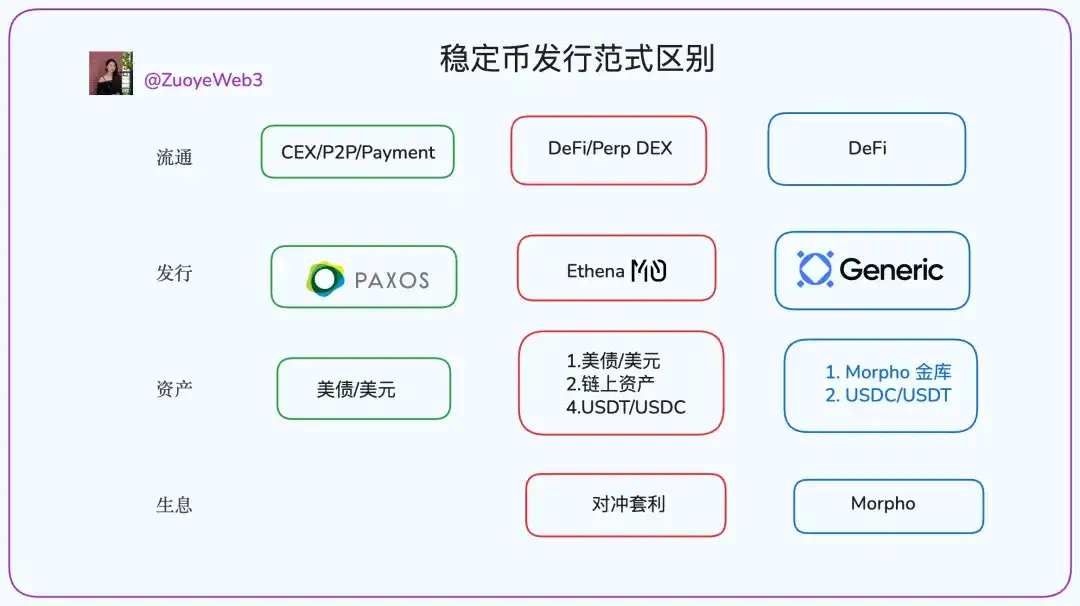
Image description: Stablecoin issuance paradigm, Image source: @zuoyeweb3

USDC/USDT based on U.S. Treasuries are not only the foundation for issuing stablecoins like Ethena's but also the pools of USDC in lending can further衍生 as the underlying source for yield mechanisms. This is the true current state of on-chain stablecoin adoption.

Except for TRC-20 USDT on Tron, the destination for most stablecoins is DeFi. This not only disproves the banking industry's fear that yield-bearing stablecoins will harm the financial system but also disproves the sanctity of "passive yield" that Coinbase staunchly defends. The Morpho yield vaults that Coinbase connects to are also products operated by Stakehouse.

Coinbase plays a dual role in skimming profits: it takes profits from USDC issuance and also takes profits from Morpho's operations. It's more Meituan than Meituan, more Didi than Didi.

Beyond Coinbase, on-chain stablecoins can already avoid excessive skimming by issuers and channel providers. However, the cracks between yield generation, stablecoins, and payments still require innovative mechanisms to erase.

In other words, if yield-bearing stablecoins can only divert funds from the banking industry to DeFi Vaults, becoming non-productive speculative bubbles and ultimately a self-fulfilling prophecy, $6 trillion in stablecoins would be enough to trigger a systemic crisis.

To promote the growth of stablecoin scale, increase their real-world utility, and still retain the yield mechanism, the only way is to make yield generation a universal standard in the payment industry.

Taking Airwallex's Yield product as an example, it not only offers a higher annualized yield than Coinbase's USDC deposits but also supports merchants with multi-currency yield products, underpinned by money market funds.
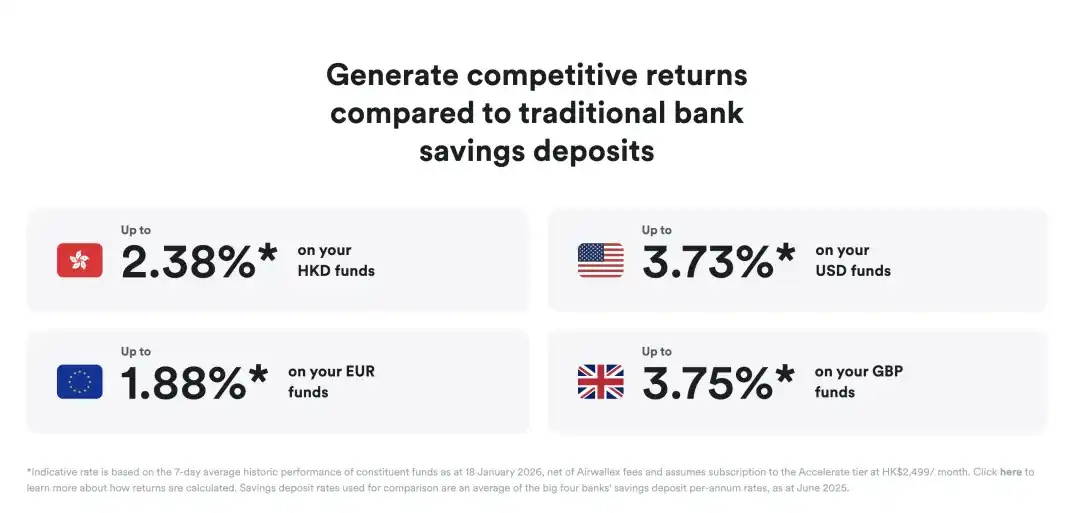
Image description: Airwallex Yield Product, Image source: @airwallex

Comparing this to Stakehouse's on-chain vaults, the only difference is the real business scenarios that Airwallex and others possess, allowing for efficient use of corporate idle funds. However, if combined by on-chain vaults, not only would the yield be higher, but the yield-bearing stablecoins could also be used normally.

Different from USDC's holding-to-earn-yield and Airwallex's idle-funds-yield, yield-bearing stablecoins "earn yield while usable," embedding the yield mechanism into the entire process before, during, and after use. Even after consumption, a Points mechanism can be added.

Compared to the difficult customer acquisition for U Cards on the C-end, payment channels need the financial innovation of stablecoins more. Trip.com's overseas version supports U deposits, backed by the Singapore-licensed gateway Triple-A. For Trip.com, it's just integrating a new third-party payment. For Triple-A, choosing which stablecoin to use is a matter of code selection.

After the disputes involving Morpho/Aave/Sonic, no one believes that "Code is Law" anymore; the concept of decentralization has been severely damaged. But "Money is Code" is increasingly clear. Even from a legal perspective, quite a few yield-bearing stablecoins are more compliant than USDT.

This way, users, merchants, and channel providers can all get what they want: users get interest, merchants get customer traffic, and channels get benefits. This is also the most embedded and feasible path for commercial scenarios currently.

Conclusion

The deposit-ization of funds, the yield-ization of deposits.

The crypto industry is at a turning point. Selling its own assets to outsiders is gradually becoming unworkable; altcoins and Meme coins are inadequate. The path for stablecoins to break out of the circle is too far from retail investors because retail cannot profit from the real adoption of stablecoins.

Half a year ago, stablecoins were an asset issuance method. Now, stablecoins need to have hidden appreciation potential.

After the flameout of leverage-based USDe and xUSD, expanding the use cases and holder base of stablecoins, thereby having retail act as LPs to provide liquidity for on-chain vaults, is currently more feasible.

Problems stack upon problems. This will create new issues of vault misconduct, which previously only affected the crypto space and were relatively controllable. Once it spills over to real businesses and users, the entire stablecoin ecosystem will be rejected. How to control the vaults? We need new methods. This is the theme of the next article: Everyone is a Vault Manager,透视透视透视透视透视透视透视透视透视透视透视透视透视透视透视透视透视透视透视透视透视透视透视透视透视透视透视透视透视透视透视透视透视透视透视透视透视透视透视透视透视透视透视透视透视透视透视透视透视透视透视透视透视透视透视透视透视透视透视透视透视透视透视透视透视透视透视透视透视透视透视透视透视透视透视透视透视透视透视透视透视透视透视透视透视透视透视 Vaults.

Domande pertinenti

QWhat is the main controversy surrounding the 'passive yield' mechanism of stablecoins as discussed in the article?

AThe main controversy is that the banking industry fears up to $6 trillion in deposits could flow into stablecoins, particularly USDC with its 50% profit-sharing model from Coinbase. This could drain deposits from small local and community banks, making financing more difficult for small businesses and ordinary individuals. They argue that high demand deposit interest rates would force banks to raise lending rates, increasing corporate financing and personal credit costs.

QHow do stablecoin issuers like Tether and Circle contribute to the U.S. Treasury market, and why is this significant?

AStablecoin issuers like Tether (USDT) and Circle (USDC) are significant buyers of U.S. Treasury bonds. Specifically, USDC has purchased $40 billion in Treasuries and USDT has purchased $130 billion. Together, they account for $170 billion in Treasury purchases, providing a new source of demand as the share of traditional foreign buyers has declined from 23% in 2011 to 6% in 2024, helping to maintain the global status of U.S. debt.

QWhat are the three phases of rapid development that on-chain yield-bearing stablecoins went through after the 2025 hype, according to the article?

AThe three phases are: 1) The cycle loan arbitrage initiated by USDe with Aave starting July 29, 2025, which crashed after the October 11th event, causing its scale to drop from $10 billion to $6.5 billion and leading it to abandon building its own blockchain. 2) The November 3rd xUSD de-pegging incident, which caused FUD among vault managers on Morpho/Euler and halted the growth trend of on-chain stablecoins. 3) The insufficient momentum of stablecoin blockchains like those supported by Paradigm, Stripe's Tempo, and Tether's Stable and Plasma, which failed to achieve breakthroughs in P2P payments and off-chain enterprise adoption.

QHow does the article propose to resolve the conflict between the yield-bearing nature of stablecoins and their need for real-world utility?

AThe article proposes embedding the yield mechanism directly into the entire payment process—before, during, and after use—making stablecoins 'yield while usable.' This approach, combined with points mechanisms post-consumption, would allow users to earn interest, merchants to gain customer traffic, and payment channels to benefit, thereby integrating yield-bearing stablecoins into real commercial scenarios without being purely speculative.

QWhat role does Coinbase play in the on-chain yield ecosystem for stablecoins, and what criticism does it face?

ACoinbase plays a dual role: it profits from issuing USDC and also from operating yield vaults on platforms like Morpho. This double fee extraction leads to criticism that it acts like a super-extractive platform (compared to Meituan or Didi). The article notes that Coinbase is stubbornly resisting regulations that would prohibit passive yield, unlike other crypto firms like Ripple and a16z that support the Clarity Act to ban such yields.

Letture associate

An Open-Source AI Tool That No One Saw Predicted Kelp DAO's $292 Million Vulnerability 12 Days Ago

An open-source AI security tool flagged critical risks in Kelp DAO’s cross-chain architecture 12 days before a $292 million exploit on April 18, 2026—the largest DeFi incident of the year. The vulnerability was not in the smart contracts but in the configuration of LayerZero’s cross-chain bridge: a 1-of-1 Decentralized Verifier Network (DVN) setup allowed an attacker to forge cross-chain messages with a single compromised node. The tool, which performs AI-assisted architectural risk assessments using public data, identified several unremediated risks, including opaque DVN configuration, single-point-of-failure across 16 chains, unverified cross-chain governance controls, and similarities to historical bridge attacks like Ronin and Harmony. It also noted the absence of an insurance pool, which amplified losses as Aave and other protocols absorbed nearly $300M in bad debt. The attack unfolded over 46 minutes: the attacker minted 116,500 rsETH on Ethereum via a fraudulent message, used it as collateral to borrow WETH on lending platforms, and laundered funds through Tornado Cash. While an emergency pause prevented two subsequent attacks worth ~$200M, the damage was severe. The tool’s report, committed to GitHub on April 6, scored Kelp DAO a medium-risk 72/100—later acknowledged as too lenient. It failed to query on-chain DVN configurations or initiate private disclosure, highlighting gaps in current DeFi security approaches that focus on code audits but miss config-level and governance risks. The incident underscores the need for independent, AI-powered risk assessment tools that evaluate protocol architecture, not just code.

marsbit2 h fa

An Open-Source AI Tool That No One Saw Predicted Kelp DAO's $292 Million Vulnerability 12 Days Ago

marsbit2 h fa

Trading

Spot
Futures

Articoli Popolari

Cosa è $S$

Comprendere SPERO: Una Panoramica Completa Introduzione a SPERO Mentre il panorama dell'innovazione continua a evolversi, l'emergere delle tecnologie web3 e dei progetti di criptovaluta gioca un ruolo fondamentale nel plasmare il futuro digitale. Un progetto che ha attirato l'attenzione in questo campo dinamico è SPERO, denotato come SPERO,$$s$. Questo articolo mira a raccogliere e presentare informazioni dettagliate su SPERO, per aiutare gli appassionati e gli investitori a comprendere le sue basi, obiettivi e innovazioni nei domini web3 e crypto. Che cos'è SPERO,$$s$? SPERO,$$s$ è un progetto unico all'interno dello spazio crypto che cerca di sfruttare i principi della decentralizzazione e della tecnologia blockchain per creare un ecosistema che promuove l'impegno, l'utilità e l'inclusione finanziaria. Il progetto è progettato per facilitare interazioni peer-to-peer in modi nuovi, fornendo agli utenti soluzioni e servizi finanziari innovativi. Al suo interno, SPERO,$$s$ mira a responsabilizzare gli individui fornendo strumenti e piattaforme che migliorano l'esperienza dell'utente nello spazio delle criptovalute. Questo include la possibilità di metodi di transazione più flessibili, la promozione di iniziative guidate dalla comunità e la creazione di percorsi per opportunità finanziarie attraverso applicazioni decentralizzate (dApps). La visione sottostante di SPERO,$$s$ ruota attorno all'inclusività, cercando di colmare le lacune all'interno della finanza tradizionale mentre sfrutta i vantaggi della tecnologia blockchain. Chi è il Creatore di SPERO,$$s$? L'identità del creatore di SPERO,$$s$ rimane piuttosto oscura, poiché ci sono risorse pubblicamente disponibili limitate che forniscono informazioni dettagliate sul suo fondatore o fondatori. Questa mancanza di trasparenza può derivare dall'impegno del progetto per la decentralizzazione—un ethos che molti progetti web3 condividono, dando priorità ai contributi collettivi rispetto al riconoscimento individuale. Centrando le discussioni attorno alla comunità e ai suoi obiettivi collettivi, SPERO,$$s$ incarna l'essenza dell'empowerment senza mettere in evidenza individui specifici. Pertanto, comprendere l'etica e la missione di SPERO rimane più importante che identificare un creatore singolo. Chi sono gli Investitori di SPERO,$$s$? SPERO,$$s$ è supportato da una varietà di investitori che vanno dai capitalisti di rischio agli investitori angelici dedicati a promuovere l'innovazione nel settore crypto. Il focus di questi investitori generalmente si allinea con la missione di SPERO—dando priorità a progetti che promettono avanzamenti tecnologici sociali, inclusività finanziaria e governance decentralizzata. Queste fondazioni di investitori sono tipicamente interessate a progetti che non solo offrono prodotti innovativi, ma contribuiscono anche positivamente alla comunità blockchain e ai suoi ecosistemi. Il supporto di questi investitori rafforza SPERO,$$s$ come un concorrente degno di nota nel dominio in rapida evoluzione dei progetti crypto. Come Funziona SPERO,$$s$? SPERO,$$s$ impiega un framework multifunzionale che lo distingue dai progetti di criptovaluta convenzionali. Ecco alcune delle caratteristiche chiave che sottolineano la sua unicità e innovazione: Governance Decentralizzata: SPERO,$$s$ integra modelli di governance decentralizzati, responsabilizzando gli utenti a partecipare attivamente ai processi decisionali riguardanti il futuro del progetto. Questo approccio favorisce un senso di proprietà e responsabilità tra i membri della comunità. Utilità del Token: SPERO,$$s$ utilizza il proprio token di criptovaluta, progettato per servire varie funzioni all'interno dell'ecosistema. Questi token abilitano transazioni, premi e la facilitazione dei servizi offerti sulla piattaforma, migliorando l'impegno e l'utilità complessivi. Architettura Stratificata: L'architettura tecnica di SPERO,$$s$ supporta la modularità e la scalabilità, consentendo un'integrazione fluida di funzionalità e applicazioni aggiuntive man mano che il progetto evolve. Questa adattabilità è fondamentale per mantenere la rilevanza nel panorama crypto in continua evoluzione. Coinvolgimento della Comunità: Il progetto enfatizza iniziative guidate dalla comunità, impiegando meccanismi che incentivano la collaborazione e il feedback. Nutrendo una comunità forte, SPERO,$$s$ può affrontare meglio le esigenze degli utenti e adattarsi alle tendenze di mercato. Focus sull'Inclusione: Offrendo basse commissioni di transazione e interfacce user-friendly, SPERO,$$s$ mira ad attrarre una base utenti diversificata, inclusi individui che potrebbero non aver precedentemente interagito nello spazio crypto. Questo impegno per l'inclusione si allinea con la sua missione generale di empowerment attraverso l'accessibilità. Cronologia di SPERO,$$s$ Comprendere la storia di un progetto fornisce preziose intuizioni sulla sua traiettoria di sviluppo e sui traguardi. Di seguito è riportata una cronologia suggerita che mappa eventi significativi nell'evoluzione di SPERO,$$s$: Fase di Concettualizzazione e Ideazione: Le idee iniziali che formano la base di SPERO,$$s$ sono state concepite, allineandosi strettamente con i principi di decentralizzazione e focus sulla comunità all'interno dell'industria blockchain. Lancio del Whitepaper del Progetto: Dopo la fase concettuale, è stato rilasciato un whitepaper completo che dettaglia la visione, gli obiettivi e l'infrastruttura tecnologica di SPERO,$$s$ per suscitare interesse e feedback dalla comunità. Costruzione della Comunità e Prime Interazioni: Sono stati effettuati sforzi attivi di outreach per costruire una comunità di early adopters e potenziali investitori, facilitando discussioni attorno agli obiettivi del progetto e ottenendo supporto. Evento di Generazione del Token: SPERO,$$s$ ha condotto un evento di generazione del token (TGE) per distribuire i propri token nativi ai primi sostenitori e stabilire una liquidità iniziale all'interno dell'ecosistema. Lancio della Prima dApp: La prima applicazione decentralizzata (dApp) associata a SPERO,$$s$ è stata attivata, consentendo agli utenti di interagire con le funzionalità principali della piattaforma. Sviluppo Continuo e Partnership: Aggiornamenti e miglioramenti continui alle offerte del progetto, inclusi partnership strategiche con altri attori nello spazio blockchain, hanno plasmato SPERO,$$s$ in un concorrente competitivo e in evoluzione nel mercato crypto. Conclusione SPERO,$$s$ rappresenta una testimonianza del potenziale del web3 e delle criptovalute di rivoluzionare i sistemi finanziari e responsabilizzare gli individui. Con un impegno per la governance decentralizzata, il coinvolgimento della comunità e funzionalità progettate in modo innovativo, apre la strada verso un panorama finanziario più inclusivo. Come per qualsiasi investimento nello spazio crypto in rapida evoluzione, si incoraggiano potenziali investitori e utenti a ricercare approfonditamente e a impegnarsi in modo riflessivo con gli sviluppi in corso all'interno di SPERO,$$s$. Il progetto mostra lo spirito innovativo dell'industria crypto, invitando a ulteriori esplorazioni delle sue innumerevoli possibilità. Mentre il percorso di SPERO,$$s$ è ancora in fase di sviluppo, i suoi principi fondamentali potrebbero effettivamente influenzare il futuro di come interagiamo con la tecnologia, la finanza e tra di noi in ecosistemi digitali interconnessi.

75 Totale visualizzazioniPubblicato il 2024.12.17Aggiornato il 2024.12.17

Cosa è $S$

Cosa è AGENT S

Agent S: Il Futuro dell'Interazione Autonoma in Web3 Introduzione Nel panorama in continua evoluzione di Web3 e criptovalute, le innovazioni stanno costantemente ridefinendo il modo in cui gli individui interagiscono con le piattaforme digitali. Uno di questi progetti pionieristici, Agent S, promette di rivoluzionare l'interazione uomo-computer attraverso il suo framework agentico aperto. Aprendo la strada a interazioni autonome, Agent S mira a semplificare compiti complessi, offrendo applicazioni trasformative nell'intelligenza artificiale (AI). Questa esplorazione dettagliata approfondirà le complessità del progetto, le sue caratteristiche uniche e le implicazioni per il dominio delle criptovalute. Cos'è Agent S? Agent S si presenta come un innovativo framework agentico aperto, progettato specificamente per affrontare tre sfide fondamentali nell'automazione dei compiti informatici: Acquisizione di Conoscenze Specifiche del Dominio: Il framework apprende in modo intelligente da varie fonti di conoscenza esterne ed esperienze interne. Questo approccio duale gli consente di costruire un ricco repository di conoscenze specifiche del dominio, migliorando le sue prestazioni nell'esecuzione dei compiti. Pianificazione su Lungo Orizzonte di Compiti: Agent S impiega una pianificazione gerarchica potenziata dall'esperienza, un approccio strategico che facilita la suddivisione e l'esecuzione efficiente di compiti complessi. Questa caratteristica migliora significativamente la sua capacità di gestire più sottocompiti in modo efficiente ed efficace. Gestione di Interfacce Dinamiche e Non Uniformi: Il progetto introduce l'Interfaccia Agente-Computer (ACI), una soluzione innovativa che migliora l'interazione tra agenti e utenti. Utilizzando Modelli Linguistici Multimodali di Grandi Dimensioni (MLLM), Agent S può navigare e manipolare senza sforzo diverse interfacce grafiche utente. Attraverso queste caratteristiche pionieristiche, Agent S fornisce un framework robusto che affronta le complessità coinvolte nell'automazione dell'interazione umana con le macchine, preparando il terreno per innumerevoli applicazioni nell'AI e oltre. Chi è il Creatore di Agent S? Sebbene il concetto di Agent S sia fondamentalmente innovativo, informazioni specifiche sul suo creatore rimangono elusive. Il creatore è attualmente sconosciuto, il che evidenzia sia la fase embrionale del progetto sia la scelta strategica di mantenere i membri fondatori sotto anonimato. Indipendentemente dall'anonimato, l'attenzione rimane sulle capacità e sul potenziale del framework. Chi sono gli Investitori di Agent S? Poiché Agent S è relativamente nuovo nell'ecosistema crittografico, informazioni dettagliate riguardanti i suoi investitori e sostenitori finanziari non sono documentate esplicitamente. La mancanza di approfondimenti pubblicamente disponibili sulle fondazioni di investimento o sulle organizzazioni che supportano il progetto solleva interrogativi sulla sua struttura di finanziamento e sulla roadmap di sviluppo. Comprendere il supporto è cruciale per valutare la sostenibilità del progetto e il suo potenziale impatto sul mercato. Come Funziona Agent S? Al centro di Agent S si trova una tecnologia all'avanguardia che gli consente di funzionare efficacemente in contesti diversi. Il suo modello operativo è costruito attorno a diverse caratteristiche chiave: Interazione Uomo-Computer Simile a Quella Umana: Il framework offre una pianificazione AI avanzata, cercando di rendere le interazioni con i computer più intuitive. Mimando il comportamento umano nell'esecuzione dei compiti, promette di elevare le esperienze degli utenti. Memoria Narrativa: Utilizzata per sfruttare esperienze di alto livello, Agent S utilizza la memoria narrativa per tenere traccia delle storie dei compiti, migliorando così i suoi processi decisionali. Memoria Episodica: Questa caratteristica fornisce agli utenti una guida passo-passo, consentendo al framework di offrire supporto contestuale mentre i compiti si sviluppano. Supporto per OpenACI: Con la capacità di funzionare localmente, Agent S consente agli utenti di mantenere il controllo sulle proprie interazioni e flussi di lavoro, allineandosi con l'etica decentralizzata di Web3. Facile Integrazione con API Esterne: La sua versatilità e compatibilità con varie piattaforme AI garantiscono che Agent S possa adattarsi senza problemi agli ecosistemi tecnologici esistenti, rendendolo una scelta attraente per sviluppatori e organizzazioni. Queste funzionalità contribuiscono collettivamente alla posizione unica di Agent S all'interno dello spazio crittografico, poiché automatizza compiti complessi e multi-fase con un intervento umano minimo. Man mano che il progetto evolve, le sue potenziali applicazioni in Web3 potrebbero ridefinire il modo in cui si svolgono le interazioni digitali. Cronologia di Agent S Lo sviluppo e le tappe di Agent S possono essere riassunti in una cronologia che evidenzia i suoi eventi significativi: 27 Settembre 2024: Il concetto di Agent S è stato lanciato in un documento di ricerca completo intitolato “Un Framework Agentico Aperto che Usa i Computer Come un Umano”, mostrando le basi per il progetto. 10 Ottobre 2024: Il documento di ricerca è stato reso pubblicamente disponibile su arXiv, offrendo un'esplorazione approfondita del framework e della sua valutazione delle prestazioni basata sul benchmark OSWorld. 12 Ottobre 2024: È stata rilasciata una presentazione video, fornendo un'idea visiva delle capacità e delle caratteristiche di Agent S, coinvolgendo ulteriormente potenziali utenti e investitori. Questi indicatori nella cronologia non solo illustrano i progressi di Agent S, ma indicano anche il suo impegno per la trasparenza e il coinvolgimento della comunità. Punti Chiave su Agent S Man mano che il framework Agent S continua a evolversi, diversi attributi chiave si distinguono, sottolineando la sua natura innovativa e il potenziale: Framework Innovativo: Progettato per fornire un uso intuitivo dei computer simile all'interazione umana, Agent S porta un approccio nuovo all'automazione dei compiti. Interazione Autonoma: La capacità di interagire autonomamente con i computer attraverso GUI segna un passo avanti verso soluzioni informatiche più intelligenti ed efficienti. Automazione di Compiti Complessi: Con la sua metodologia robusta, può automatizzare compiti complessi e multi-fase, rendendo i processi più veloci e meno soggetti a errori. Miglioramento Continuo: I meccanismi di apprendimento consentono ad Agent S di migliorare dalle esperienze passate, migliorando continuamente le sue prestazioni e la sua efficacia. Versatilità: La sua adattabilità attraverso diversi ambienti operativi come OSWorld e WindowsAgentArena garantisce che possa servire un'ampia gamma di applicazioni. Man mano che Agent S si posiziona nel panorama di Web3 e delle criptovalute, il suo potenziale per migliorare le capacità di interazione e automatizzare i processi segna un significativo avanzamento nelle tecnologie AI. Attraverso il suo framework innovativo, Agent S esemplifica il futuro delle interazioni digitali, promettendo un'esperienza più fluida ed efficiente per gli utenti in vari settori. Conclusione Agent S rappresenta un audace passo avanti nell'unione tra AI e Web3, con la capacità di ridefinire il modo in cui interagiamo con la tecnologia. Sebbene sia ancora nelle sue fasi iniziali, le possibilità per la sua applicazione sono vaste e coinvolgenti. Attraverso il suo framework completo che affronta sfide critiche, Agent S mira a portare le interazioni autonome al centro dell'esperienza digitale. Man mano che ci addentriamo nei regni delle criptovalute e della decentralizzazione, progetti come Agent S giocheranno senza dubbio un ruolo cruciale nel plasmare il futuro della tecnologia e della collaborazione uomo-computer.

395 Totale visualizzazioniPubblicato il 2025.01.14Aggiornato il 2025.01.14

Cosa è AGENT S

Come comprare S

Benvenuto in HTX.com! Abbiamo reso l'acquisto di Sonic (S) semplice e conveniente. Segui la nostra guida passo passo per intraprendere il tuo viaggio nel mondo delle criptovalute.Step 1: Crea il tuo Account HTXUsa la tua email o numero di telefono per registrarti il tuo account gratuito su HTX. Vivi un'esperienza facile e sblocca tutte le funzionalità,Crea il mio accountStep 2: Vai in Acquista crypto e seleziona il tuo metodo di pagamentoCarta di credito/debito: utilizza la tua Visa o Mastercard per acquistare immediatamente SonicS.Bilancio: Usa i fondi dal bilancio del tuo account HTX per fare trading senza problemi.Terze parti: abbiamo aggiunto metodi di pagamento molto utilizzati come Google Pay e Apple Pay per maggiore comodità.P2P: Fai trading direttamente con altri utenti HTX.Over-the-Counter (OTC): Offriamo servizi su misura e tassi di cambio competitivi per i trader.Step 3: Conserva Sonic (S)Dopo aver acquistato Sonic (S), conserva nel tuo account HTX. In alternativa, puoi inviare tramite trasferimento blockchain o scambiare per altre criptovalute.Step 4: Scambia Sonic (S)Scambia facilmente Sonic (S) nel mercato spot di HTX. Accedi al tuo account, seleziona la tua coppia di trading, esegui le tue operazioni e monitora in tempo reale. Offriamo un'esperienza user-friendly sia per chi ha appena iniziato che per i trader più esperti.

780 Totale visualizzazioniPubblicato il 2025.01.15Aggiornato il 2025.03.21

Come comprare S

Discussioni

Benvenuto nella Community HTX. Qui puoi rimanere informato sugli ultimi sviluppi della piattaforma e accedere ad approfondimenti esperti sul mercato. Le opinioni degli utenti sul prezzo di S S sono presentate come di seguito.

活动图片