The Unbundling of the Stock Market

marsbitPubblicato 2026-04-06Pubblicato ultima volta 2026-04-06

Introduzione

The article "The Unbundling of Stock Markets" by Prathik Desai argues that traditional financial markets, built on outdated structures like fixed trading hours and centralized exchanges, are being disrupted. Recent developments, such as S&P licensing its 500 index to a new crypto exchange (Hyperliquid), Nasdaq's SEC-approved tokenized stock trading, and Cboe's proposal for near 24/5 US equity trading, signal a shift towards unbundled, efficient, and accessible markets. Capital seeks the fastest path to price information, and new platforms like Hyperliquid's HIP-3, which offers 24/7 trading of traditional assets (e.g., commodities, indices) via perpetual contracts, are gaining traction due to their liquidity, lower friction, and ability to react to global events in real-time. The author concludes that market participants will adopt any structure that reduces the delay between events and price discovery, regardless of whether it originates from traditional institutions or permissionless blockchain platforms.

Author: Prathik Desai

Compiled by: Block unicorn

Preface

Clocks are not a good way to cover up delays. For decades, financial markets have been built around the speed of information transmission. They introduced closing bells, batch settlements, and regional exchanges, which made sense in an era of slow information flow. But all that has changed. Capital does not wait. Just as water always finds a crack, so does capital. Financial gravity pulls it towards the fastest path to obtain price information. This is the law of the market. Market participants will not tolerate inefficiency forever.

This is what I have observed from a macro perspective over the past few weeks as financial markets have evolved.

In today's article, I will help you understand what has broken the old bundled structure of financial markets, transforming it into a more efficient, unbundled structure that spans different venues, wrappers, and times.

Changing of the Guard

I have been studying finance for over a decade. In the early stages of my learning, I always viewed traditional stock exchanges as synonymous with the market. For most of their development, stock exchanges were the place where everyone and everything converged: buyers, sellers, regulators, and the technology that drives the market. It had indices tracking its components, and it had clocks indicating trading hours, telling everyone when they could trade and when they could not.

But this has changed in the past few years. In fact, just in the past few weeks, we have seen several developments that confirm this shift.

On March 18, S&P Dow Jones Indices licensed the S&P 500 index to Trade[XYZ], allowing HIP-3 market deployers to launch the first and only S&P 500 perpetual derivatives contract on the Hyperliquid exchange. The S&P 500 is the world's most followed large-cap U.S. equity index, tracking 500 leading U.S. companies, covering about 80% of the total U.S. market capitalization, with a total market cap of over $61 trillion. The index covers at least half of the global equity market's capitalization.

This is an index with nearly 70 years of history, listed on a market that is only 6 months old.

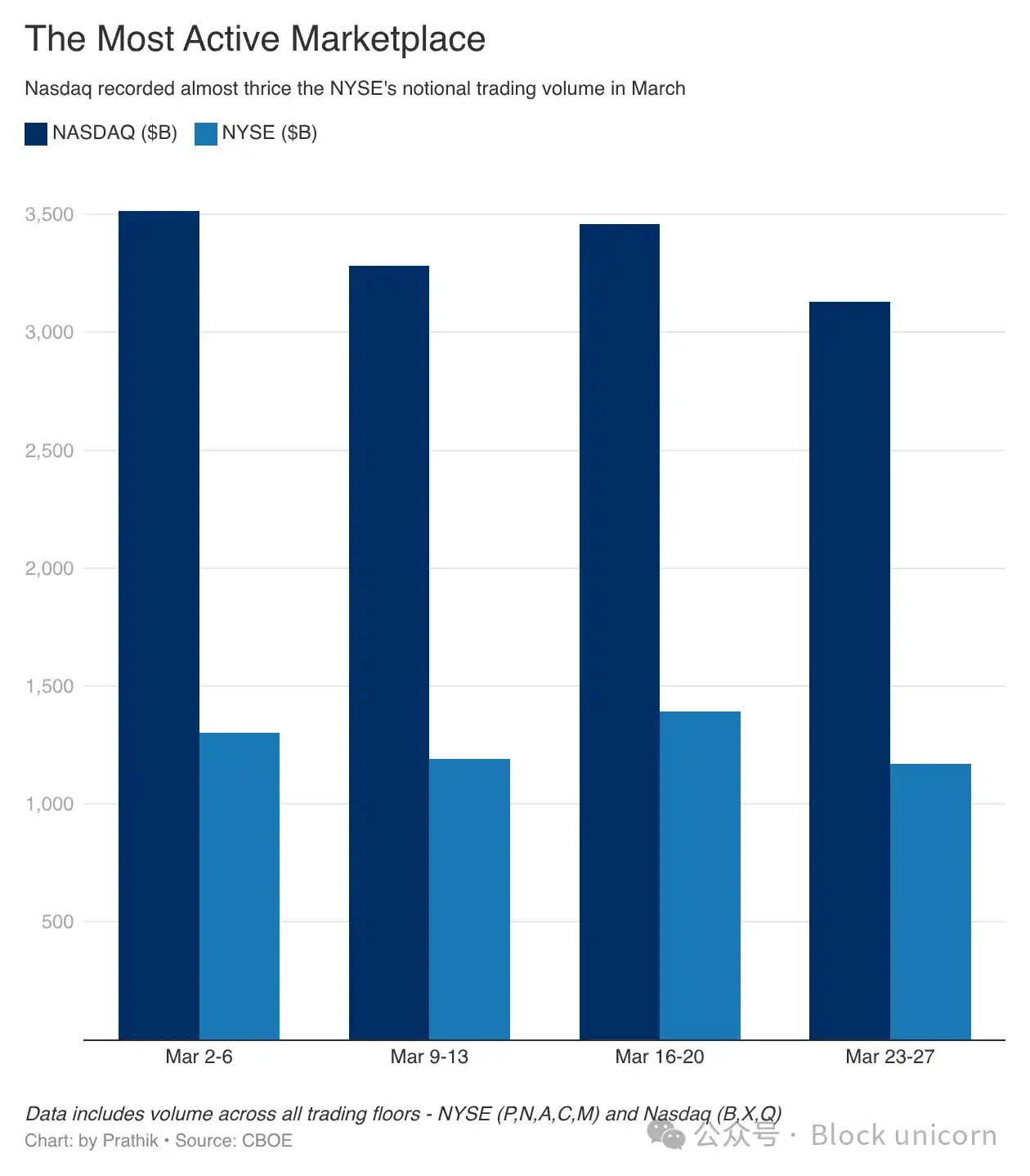
The day after S&P's announcement, the U.S. Securities and Exchange Commission (SEC) approved Nasdaq's application to trade and settle some stocks in tokenized form. Nasdaq is one of the world's most active trading venues, often exceeding the nominal trading volume of the New York Stock Exchange (NYSE), the world's largest exchange by market capitalization.
On March 16, Cboe Global Markets (Cboe Global Markets) filed a proposal with the U.S. Securities and Exchange Commission (SEC) to launch "near 24x5 U.S. equity trading." The largest operating body behind this U.S. financial exchange stated that it is ready to provide 24/5 equity trading services as early as December 2026.

But why? There is growing demand for extended U.S. equity trading hours.

These three initiatives collectively target the outdated bundled trading structure. Hyperliquid's launch of an S&P 500 futures trading market challenges the decades-old convention where investors could only trade traditional indices through traditional markets. It also enables 24/7 global trading of one of the most tracked large-cap indices.

Nasdaq's tokenized stock trading initiative targets infrastructure. It introduces a new form of wrapping, allowing the same stock to be traded in different ways. Previous attempts at tokenizing stocks have been criticized by the industry.

Investors questioned whether these tokens享有 the same rights as the original shares.

But, if I provide the same equity exposure through a token on the blockchain, without losing the voting rights and legal protections attached to the original dematerialized shares, wouldn't you accept it?

Why would you do this? What's in it for you?

Well, if you are an investor outside the U.S. who wants easier access to the stock market of the world's largest economy? What if this tokenized stock makes it easier for you to integrate it with collateral and lending systems?

When you consider 24/7 trading, these advantages multiply.

This is what Cboe is attacking. Its near 24x5 (24 hours a day, 5 days a week) trading proposal aims to acknowledge that capital does not wait for office hours. Traders always want to express their views immediately after receiving information. If Cboe does not provide them with a market to express their views, then traders will flock to other platforms that do.

Nothing I'm talking about is hypothetical, nor is it something that "might happen in the near future." They are happening, right now, as we speak.

An Unbundled Future

The adoption of financial product unbundling is most evident in Hyperliquid's HIP-3 market, which only officially launched in late October 2025.

In the past month alone, the cumulative trading volume on the HIP-3 market increased by $72 billion. The cumulative volume for the previous four months was $78 billion.
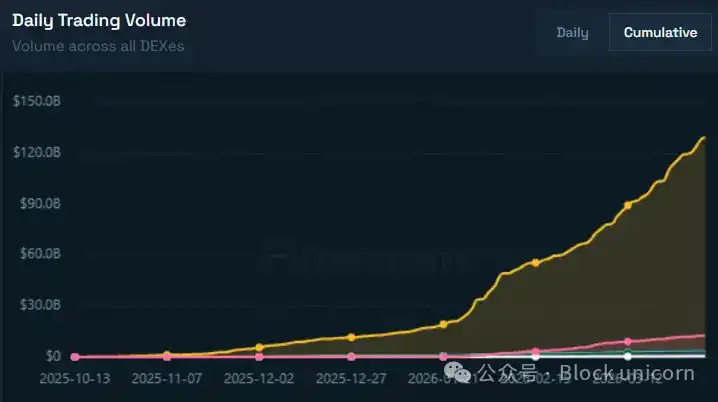
In March, Trade[XYZ] perpetual markets on traditional financial commodities and equities continued to account for 90% of HIP-3's daily trading volume. But this is not the most interesting aspect.

More than half of Trade[XYZ]'s trading volume comes from perpetual contract markets for silver, crude oil, Brent crude, and gold.

Hyperliquid provides a unified trading platform for spot cryptocurrencies as well as perpetual contracts for both cryptocurrencies and traditional assets. This not only simplifies the trading process on a unified platform but also brings higher liquidity, a unified user interface, and tighter bid-ask spreads.

Traders still want to trade some of the largest, hottest assets, spanning commodities, publicly listed companies, large private companies, and indices. You might want to trade silver, gold, crude oil, Tesla, Apple, Amazon, Google, an index tracking the top 100 U.S. non-financial companies, and the S&P 500 index—all of which can be done on the Hyperliquid platform.

HIP-3 unbundles the function of investing in these assets from the existing exchange infrastructure, while still tracking the underlying assets of their original benchmarks. So when you go long on a silver futures contract on HIP-3, the underlying asset it tracks is still pegged to the value of one ounce of silver in the Pyth data feed.

Traders have switched from previous platforms to trading silver on HIP-3 because HIP-3 does not distinguish between U.S. and non-U.S. traders, nor does it follow any specific time. Whenever an event occurs that traders want to express a view on through asset pricing, HIP-3 provides them with a market, regardless of the trader's geographic location or time zone.

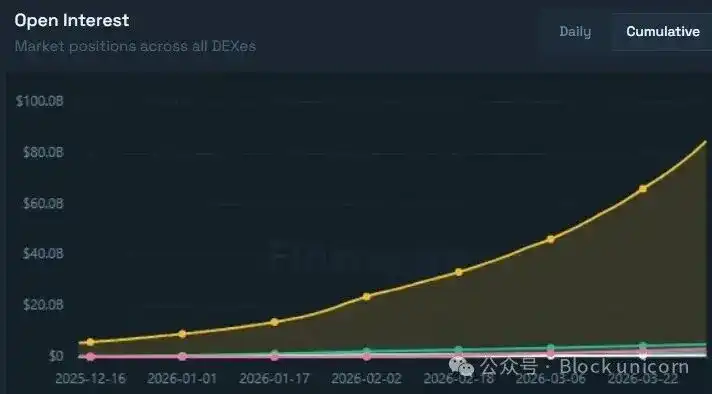
The significant growth in open interest (OI) on the Hyperliquid platform over the past few weeks fully demonstrates the above results. OI measures the total value of outstanding derivative positions. Unlike volume, which reflects trading activity, OI reflects trading commitment.
极

Open interest was $1.13 billion on March 1 and doubled to $2.2 billion on April 1. This shows that traders are confident in Hyperliquid's perpetual contracts and are locking in funds.

These metrics indicate that when market access is easier and there is less friction, traders will not be loyal to a particular platform or asset class. They will choose any platform that offers volatility, convenience, and liquidity.

This is why traditional institutions like S&P, Nasdaq, and Cboe are taking steps to acknowledge this behavior.

At least two recent events have demonstrated the importance of 24/7 trading and market volatility to traders.

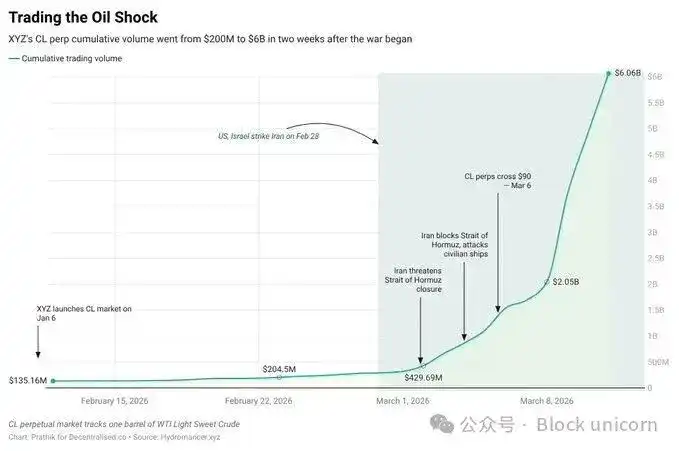
Saurabh wrote in a tweet on Decentralised.Co: "On February 28, the U.S. and Israel attacked Iran during traditional market hours. Within hours, the price of oil-linked perpetual contracts on the Hyperliquid platform surged 5% as traders digested the shock in real time."

Just two weeks after the outbreak of war, the trading volume of oil-linked perpetual contracts surged from $200 million to a cumulative $6 billion.
A major隐患 of emerging platforms is liquidity. If liquidity is insufficient, bid-ask spreads may widen, causing traders to face a pricing disadvantage worse than on other platforms.

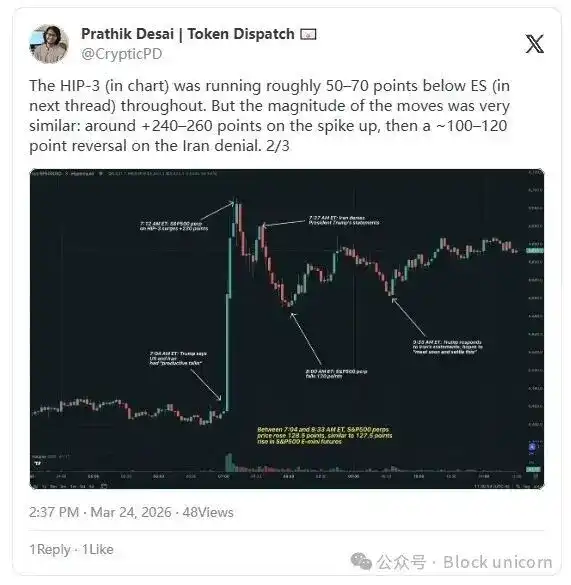
Last week, as U.S. President Trump consulted with Iranian officials on holding "productive talks," the Hyperliquid platform demonstrated its strong liquidity. The newly launched S&P 500 index futures based on the HIP-3 platform were able to accurately track the movement of the CME E-mini S&P 500 futures, down to the minute.

Although the on-chain perpetual contract was about 50–70 points lower than the ES, the magnitude of the price movement was similar.
What This Means

For decades, traditional markets have been bundled and controlled venues (exchanges), time (trading sessions), and products (indices/contracts).

They chose to maintain the status quo because they failed to establish mechanisms to address inefficiencies such as time delays, trading hour restrictions, and regulatory constraints on non-U.S. investors. Instead, they掩盖了 these inefficiencies and packaged them into procedural systems designed to build trusted institutions to attract investors.

People still trade and invest. This is not because they are stupid, or because they believe the rhetoric peddled by traditional financial markets. They do it because they have no choice. This began to change with the advent of blockchain, which provided the world with on-chain markets, making trading and investing easier than ever before.

People saw this choice and seized it.

They didn't care in the past, and they won't care in the future about changes in market structure. They also don't care whether the new structure is bundled or unbundled. As long as traders and investors can more easily express their opinions through financial instruments, they will embrace the new market structure, whether existing institutions like it or not. It doesn't matter if this structure comes from traditional giants like Nasdaq, Cboe, or S&P 500, or from a permissionless platform running on a blockchain.

The financial industry continues to evolve as it always has, and will adopt any structure that narrows the gap between the occurrence of an event and the expression of price opinion.

Important events are happening all over the world, every hour of the day. So why should prices have to wait until a clock starts ticking on a Monday morning in a glass-walled building in New York before they are determined?


Domande pertinenti

QWhat is the main argument presented in the article about the traditional structure of financial markets?

AThe article argues that the traditional, bundled structure of financial markets—which includes fixed trading hours, centralized exchanges, and specific product offerings—is becoming obsolete. It posits that capital seeks the fastest path to price information and that market participants will not tolerate inefficiencies, leading to an unbundled future with 24/7 trading across various venues and asset wrappers.

QWhat recent developments does the author cite as evidence of the shift towards an unbundled market structure?

AThe author cites three key developments: 1) S&P Dow Jones Indices licensing the S&P 500 to Trade[XYZ] for a perpetual derivatives contract on the Hyperliquid exchange. 2) The SEC approving Nasdaq's application to trade and settle some stocks in a tokenized form. 3) Cboe Global Markets submitting a proposal to the SEC for near 24x5 trading of U.S. stocks.

QHow does the article use the performance of Hyperliquid's HIP-3 market to support its thesis?

AThe article points to the massive growth of Hyperliquid's HIP-3 market, which saw a cumulative trading volume increase of $72 billion in just one month. It highlights that a majority of this volume is in perpetual contracts for traditional assets like silver, oil, and stock indices, demonstrating that traders are rapidly adopting new, unbundled platforms that offer 24/7 access, lower friction, and unified trading for both crypto and traditional assets.

QAccording to the article, what is a major historical reason traditional markets maintained their bundled structure?

AThe article suggests that traditional markets maintained their bundled structure not because it was the most efficient, but because they failed to build mechanisms to solve inherent inefficiencies like time delays, trading hour restrictions, and regulatory limits for non-U.S. investors. Instead, they masked these inefficiencies by packaging them as procedural rituals designed to create an aura of trust and institutional reliability.

QWhat fundamental force does the author identify as the driver behind the move to unbundle markets?

AThe author identifies 'financial gravity' as the fundamental force. This is the idea that capital, like water, will always find the path of least resistance and fastest access to price information. Market participants will naturally migrate to any structure that minimizes the gap between when an event occurs and when a price opinion can be expressed, regardless of whether it comes from a legacy institution or a new, permissionless platform.

Letture associate

Must-Watch Events Next Week|CLARITY Act Could Face Senate Vote; SpaceX, Circle to Report Earnings (8.3-8.9)

**Summary: Key Events and Developments to Watch (August 3-9)** The upcoming week is marked by significant financial disclosures, key legislative deadlines, and notable product updates. **Major Financial Events:** Several companies are scheduled to release their Q2 2026 earnings. American Bitcoin (ABTC) will report on August 3, followed by SpaceX and Hut 8 Mining Corp. on August 4, and Circle on August 5. Notably, a significant portion of SpaceX shares (up to 12% of total shares) will be unlocked on August 6 following their earnings release. **Key Legislative Deadline:** The U.S. Senate faces an August 7 deadline to secure 60 votes for the CLARITY Act, a bipartisan bill aiming to establish a federal regulatory framework for cryptocurrencies. The Senate may hold a full vote on the bill during the week. **Economic Data:** The U.S. July Non-Farm Payrolls report will be released on August 7, providing crucial labor market data. **Technology & Product Updates:** * **Shutdowns:** DeFi portfolio tracker Zapper and wallet app Ctrl Wallet will cease operations on August 3. * **Upgrades:** LayerZero will deprecate its v1 relayers on August 3. XRP Ledger's new version 3.3.0, featuring five new functions, is expected next week. * **AI:** Elon Musk announced that the advanced Grok 4.6 AI model is set for release around August 7. * **Bitcoin:** The BIP-110 forced signaling for a potential Bitcoin network change is scheduled to begin around August 8. **Other Notable Events:** Chinese robotics firm Unitree Tech has set its preliminary price inquiry for its IPO for August 5. South Korean exchange Upbit will delist AQT and AERGO tokens on August 3.

marsbit10 min fa

Must-Watch Events Next Week|CLARITY Act Could Face Senate Vote; SpaceX, Circle to Report Earnings (8.3-8.9)

marsbit10 min fa

Stocks Are Plummeting More Sharply Than Cryptocurrencies. Where Has the Money Gone?

Stock Markets Plunge Deeper Than Cryptocurrencies: Where Did the Money Go? In late July, Seoul's Kospi index triggered circuit breakers for two consecutive days, plummeting over 40% from its June high. The collapse was led by heavyweight stocks like SK Hynix, whose record profits still disappointed investors, and devastating leveraged ETFs, with one major product losing over 83% of its value. This signaled a global, forced deleveraging targeting the most crowded trades. Interestingly, while stocks exhibited extreme volatility akin to crypto markets, Bitcoin rose nearly 15% in July after a prior steep drop. Analysis shows the money fleeing equities did not flow into Bitcoin. Instead, Bitcoin had already absorbed its sell-off in May-June, when U.S. spot Bitcoin ETFs saw historic outflows. The true safe-haven beneficiary was gold, whose price rose over 20% year-on-year, highlighting a decoupling between Bitcoin and gold as "digital gold." The sell-off was a targeted unwinding of leveraged positions in tech and semiconductors, accelerated by broker-dealer risk management and shifts in the AI narrative, including new competition from Chinese memory chipmakers. The retreat path was clear: from high-valuation tech stocks to cash and U.S. Treasuries, then to gold. For Bitcoin to attract sustained institutional inflows, conditions like eased global liquidity pressure, a "soft-landing" Fed rate cut, and U.S. regulatory clarity via legislation like the stalled CLARITY Act are needed. Currently, Bitcoin is not a safe haven but an already-cleared asset. Its low correlation with tech stocks, however, makes it a potential diversification play for institutional portfolios once the storm passes. The money isn't here yet, but the positioning is underway.

marsbit10 min fa

Stocks Are Plummeting More Sharply Than Cryptocurrencies. Where Has the Money Gone?

marsbit10 min fa

In Conversation with Ray Dalio: We Are Currently in an AI Bubble, with 1% of My Portfolio in Bitcoin

Ray Dalio, founder of Bridgewater Associates, warns in an interview that the current AI boom shows classic bubble characteristics, which could lead to significant economic downturns as seen in past cycles like 1929 or 2000. He explains that speculative enthusiasm, fueled by debt and overvaluation, often precedes a crash when rising rates or taxation force asset sales, causing widespread losses and recession. Dalio also outlines his "Big Cycle" theory, describing an approximate 80-year pattern where widening wealth gaps, massive government deficits, and shifting geopolitical power (like China's rise) create internal conflict and global instability. He emphasizes that we are in a late-cycle, transitional phase where traditional powers like the US and UK face decline. For personal wealth protection, Dalio advises diversification beyond cash into assets like stocks, bonds, real estate, and particularly gold, which he prefers over Bitcoin. While he holds about 1% of his portfolio in Bitcoin as a non-printable hard asset, he views gold as more secure from technological or governmental threats. Regarding AI's impact, Dalio believes it will disproportionately benefit capital owners, worsening inequality by replacing both physical and cognitive labor. He suggests that human intuition and emotional intelligence, combined with AI, will be key for future workers. On taxation, Dalio argues that wealth taxes are impractical and risk triggering asset sell-offs, reducing productive investment. He points to the UK as a cautionary example of debt, low productivity, and political strife. Geopolitically, Dalio foresees a more regionalized world, with the US showing weakness in prolonged conflicts like with Iran, akin to past imperial declines. The ideal outcome, he suggests, is coexisting powerful blocs (e.g., Americas, China-Asia Pacific) without major war.

marsbit4 h fa

In Conversation with Ray Dalio: We Are Currently in an AI Bubble, with 1% of My Portfolio in Bitcoin

marsbit4 h fa

Daily 7.2 Trillion KRW: Foreign Capital's Record Net Buying on Friday! Wall Street Says Headwinds for Korean Stock Fund Flows Have Subsided

South Korean stock market sees a dramatic shift in fund flows. On July 31, foreign investors made a record net purchase of approximately KRW 7.2 trillion in KOSPI stocks, marking a fundamental reversal from the persistent large-scale net outflows seen in previous months. This contributed to a significant narrowing of foreign net selling in July to KRW 9.8 trillion, down sharply from KRW 48.4 trillion in June and KRW 44.5 trillion in May. Simultaneously, domestic institutional pressure eased. South Korean pension funds and asset managers turned to a net buying position in July, purchasing KRW 1.0 trillion worth of KOSPI shares, contrasting with net sales in May and June. Market volatility is expected to be dampened by new financial regulations. Effective July 31, the Financial Services Commission tightened access for retail investors to single-stock leveraged ETFs by raising the minimum cash deposit requirement. Trading volumes for these products subsequently dropped to about 50% of their monthly average. Citigroup Research maintains its year-end KOSPI target of 10,000 points. The firm cites several supportive factors: the substantial easing of headwinds from capital outflows, a robust fundamental outlook for the semiconductor sector, historically low market valuations, strong economic fundamentals, and the potential for policy support from financial authorities if needed.

marsbit4 h fa

Daily 7.2 Trillion KRW: Foreign Capital's Record Net Buying on Friday! Wall Street Says Headwinds for Korean Stock Fund Flows Have Subsided

marsbit4 h fa

Trading

Spot
活动图片




