Author: Francesco Andreoli, Head of Developer Relations, Consensys
Translation: Chopper, Foresight News
Everyone is focused on round after round of funding, but no one notices the closures. So, I decided to document both.
Six months ago, I started counting neobanks. I realized no one could definitively say how many were still operational. Not analysts selling reports for $4,000, not the VCs funding them, not even the competing founders could give an accurate answer.
As of July 2026, after verification, there are 368 neobanks in active operation. I continue to track each institution based on public data from neobankbeat.
But the number that truly reshaped my understanding of the industry wasn't 368. It was the names I had to remove while compiling the list.
368 Active Neobanks
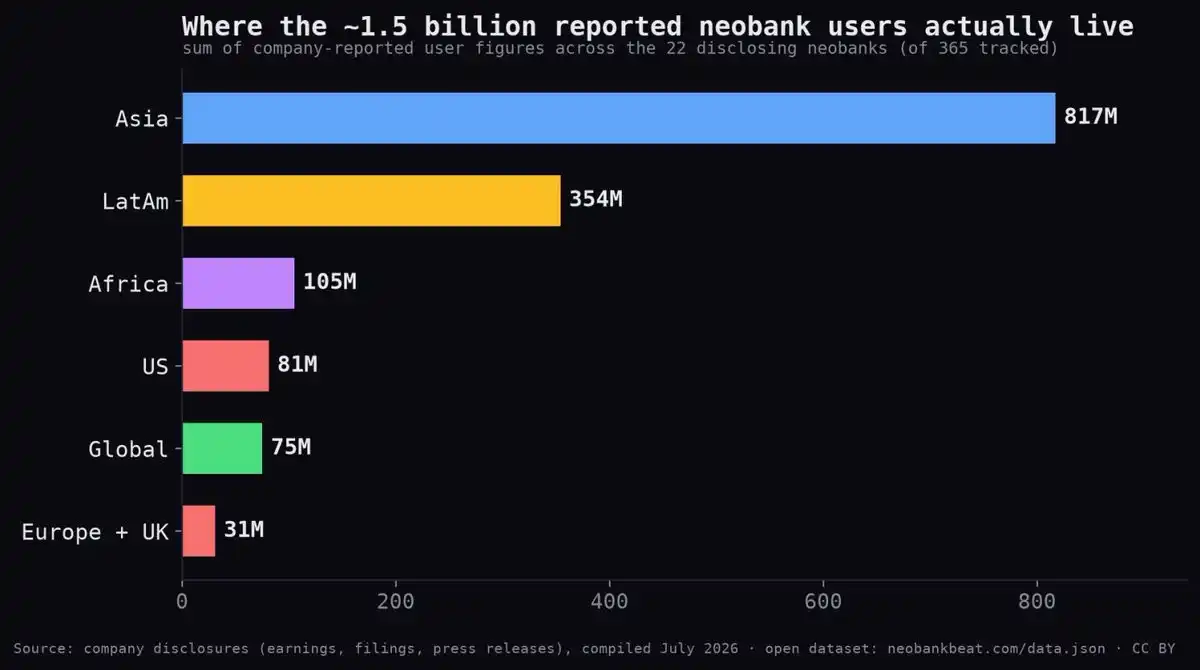
First, let's acknowledge the undeniable rise of the industry. Aggregating the self-reported data from each company in the database, the neobanks we track collectively serve approximately 1.46 billion users. This is not a forecast or a market size projection, but the real customer base reported by each.
The geographical distribution of users will shatter the assumptions of Western fintech media readers: 817 million users are located in Asia. WeBank alone serves over 400 million users, more than the total user base of all US and European neobanks combined. Nubank has 131 million more customers than all US neobanks put together. Revolut, the European benchmark with over 50 million users, is impressive, but it's only a small fraction compared to the Asian market.
The center of innovation has also shifted. Among neobanks founded after 2020 and surviving to this day, 30% are native Web3 self-custody applications where the platform does not hold user funds. Among those founded in the 2010s, this proportion is only 4%. Regardless of how you view cryptocurrency, builders have already voted with their feet.
So, the rise of neobanks is real. These 368 institutions can be divided into three distinct waves: 254 traditional challenger banks, 58 fiat-crypto hybrid platforms, and 56 native Web3 platforms; supported by 106 infrastructure providers and backed by 219 investment firms. The complete ecosystem map is clear.
Next, here's the truth you won't find in any funding pitch deck.
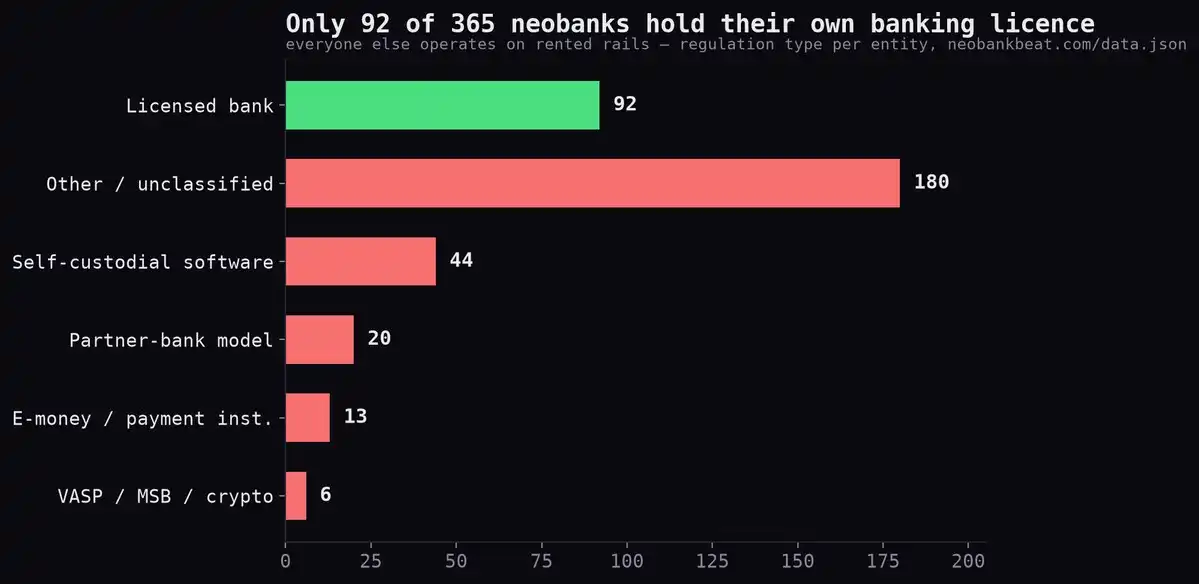
Out of the 368 institutions, only 127 hold full banking licenses.
Yes, two-thirds of the platforms called "banks" in the app stores do not have banking licenses. They operate through partnerships with licensed banks, electronic money licenses, or little-known card issuers. The vast majority of customers can't tell the difference.
This is not an insignificant technical detail; it is the core structural risk of the entire industry and has already led to multiple incidents:
- 2018 WaveCrest: Visa terminated the partnership, leading to overnight shutdowns of dozens of crypto card projects;
- 2020 Wirecard: A €1.9 billion funding gap caused the freezing of many European neobank services built on its platform;
- 2024 Synapse: The collapse of this Banking-as-a-Service (BaaS) provider made ordinary US users realize that "FDIC insurance" wasn't what they imagined, because the underlying system recording fund ownership had failed;
- 2026 Ready: History repeats, but with a new cast of characters.
When a traditional bank fails, deposit insurance pays out customer funds. When the infrastructure a neobank relies on collapses, customers can only wait in line during the bankruptcy liquidation process.
The demise in this industry is always silent, which is precisely what is most alarming.
When I first started compiling this database, I didn't anticipate that the removal of names from the list would never stop.
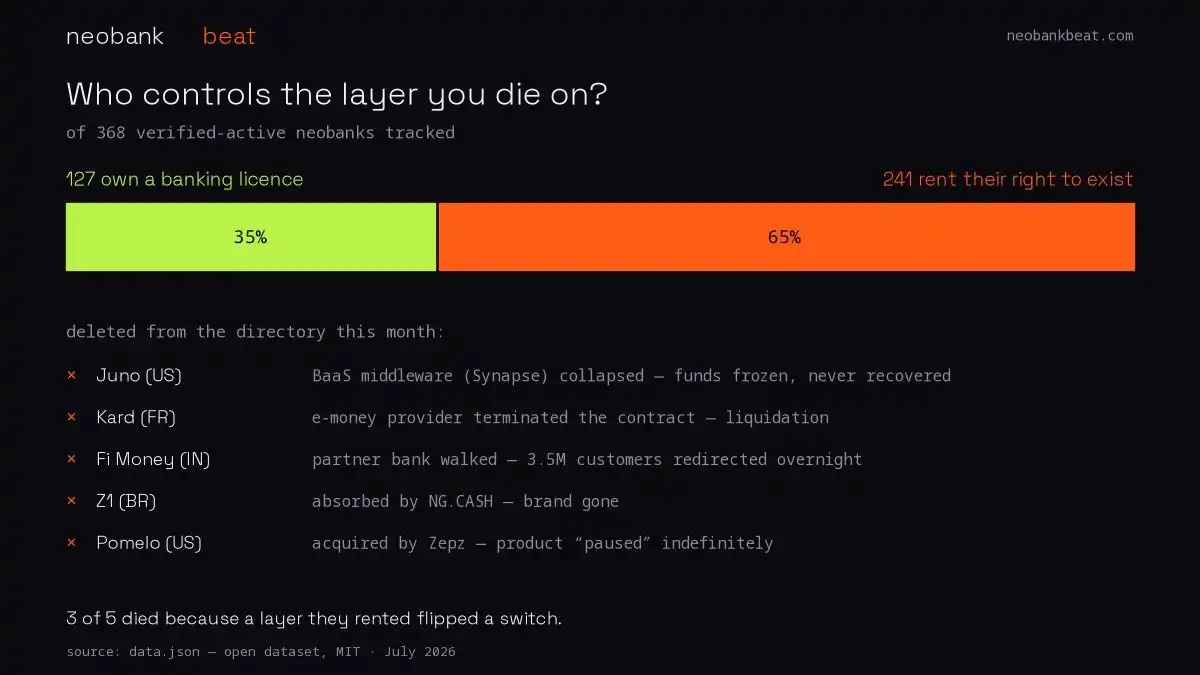
Just this month, five institutions were removed from the list: liquidated, acquired/merged, or quietly pivoted. No press releases, no post-mortems. Neobanks don't collapse dramatically like FTX. The apps simply stop updating, customer service stops responding; one day, the website domain redirects to a partner's page, and hundreds of thousands of customers either move their funds or lose them altogether.
No media writes obituaries for failed neobanks. Fintech media love covering new launches and funding rounds, with ad revenue and industry resources concentrated there. Failed businesses are forever hidden from view. So, a new generation of founders keeps stepping into the same traps, thinking they are the first to spot the problem.
This is precisely why we give equal importance to the birth of new institutions and the exit of old ones. Data on failures is far more valuable than funding news. Press releases don't teach lessons.
"AI Can Solve the Profitability Problem"? Really?
Now, almost every neobank funding pitch deck mentions artificial intelligence. We cross-checked all 368 platforms against regulatory filings, official records, and actual launched products, not just marketing copy.
Only 67 platforms have implemented AI at scale, accounting for 18%. The remaining 300+ are either still piloting, "exploring R&D," or simply claiming proprietary tech by using a partner's model.
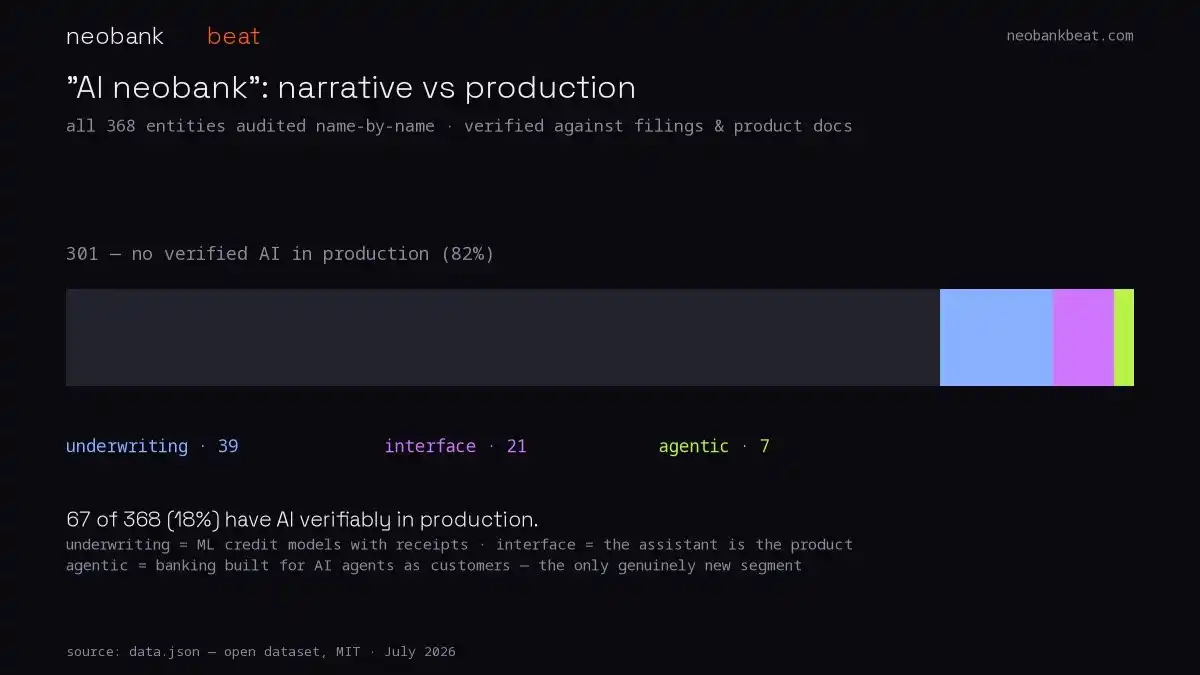
Who are the true pioneers of AI-powered neobanking? The answer is surprising. The early adopters of AI applications in the industry are mostly not well-known giants, but credit institutions in emerging markets like Nigeria, the Philippines, Mexico, and Bangladesh. In regions with underdeveloped credit systems, relying on models to grant credit to people with little history isn't just a product feature; it's the foundation for survival. While Western markets talk about AI banking, markets in the Global South have already implemented it at scale—innovation driven by the necessity to survive.
The Truth Revealed by the Ecosystem Map
Looking across the infrastructure ecosystem, 106 service providers support 368 consumer-facing brands. At this layer, a handful of partner banks, BaaS platforms, and card processors simultaneously host dozens of upper-layer brands. This high degree of concentration, invisible to consumers, is the source of potential risk for the next Synapse-like crisis.
This is the true state of the industry in 2026. The industry has experienced transformative growth, with 1.5 billion people accessing banking services via their phones, many for the first time; but the entire system is built on underlying service providers that the public knows almost nothing about. Two-thirds of the platforms would struggle to survive if their upstream partners faced a crisis.
Finally, I offer three predictions, while accepting they may be proven wrong:
- The license gap will close from both ends. Well-funded unlicensed platforms will acquire or apply for banking licenses; weaker platforms will exit the market in 2027. Players in the middle ground will disappear.
- The first AI credit model failure will occur within the next credit cycle. The majority of the 67 scaled models have not yet experienced a full economic downturn. Some teams are about to encounter risk scenarios not covered in their AI training data.
- The next generation of financial services customers will not be natural persons. Financial infrastructure channels for AI agents, agent-managed wallets, agent-issued cards, and machine-to-machine payments—only 7 companies are currently working on this. The current landscape resembles the Web3 sector in 2021: few participants, niche models, but with long-term structural opportunities.