The Trillion-Dollar Stablecoin War: Binance Decides to Re-enter the Fray

marsbitPubblicato 2025-12-24Pubblicato ultima volta 2025-12-24

Introduzione

The stablecoin market, with $27.6 trillion in on-chain transfers in 2024, has surpassed the combined volume of Visa and Mastercard. This marks a shift from a niche crypto product to a critical piece of global financial infrastructure. The article outlines the evolution of stablecoins. The 1.0 era was defined by first-mover advantage and passive monopolies. Tether's USDT dominates with a 60% market share, while Circle's USDC, despite its compliance focus, faced a crisis during the 2023 Silicon Valley Bank collapse, proving that network effect is the ultimate moat. Binance's journey reflects this competitive landscape. Its first stablecoin, the regulated BUSD, was shut down by U.S. regulators in 2023. It then pivoted to supporting FDUSD and has now taken a strategic stake in a new model with the launch of $U. Unlike traditional stablecoins, $U is a "stablecoin ETF" or "套娃" (nesting doll), backed by a basket of existing stablecoins: USDT, USDC, and the politically-connected USD1 from the Trump family. USD1's rapid growth, including a $2 billion investment into Binance from an Abu Dhabi fund, highlights a new dimension: stablecoins. The article argues that stablecoins are no longer just financial tools but vehicles for political capital and a new front in the battle for monetary influence, as evidenced by the U.S. passing the GENIUS Act to establish a federal regulatory framework. The "nesting doll" structure of $U aims to mitigate single-point risks (e.g., USDT's opacity, US...

In 2024, the total on-chain transfer volume of stablecoins reached $27.6 trillion, surpassing the combined total of Visa and Mastercard for the first time.

This figure was $300 billion five years ago and close to zero a decade ago.

On December 18, a project named United Stables launched a new stablecoin, $U, in Dubai. Its reserves are not U.S. dollar cash or treasury bonds but a combination of three stablecoins: USDC, USDT, and USD1. Using stablecoins to collateralize stablecoins is known in the industry as "nesting."

Binance Wallet integrated immediately, with official endorsement from BNB Chain, and full support from PancakeSwap and Four.Meme.

This configuration sends a clear message in the crypto circle: Binance is personally entering the fray.

$U itself may be insignificant. But the trend it represents is clear: stablecoins are moving from wild growth to a state of rival regimes, and a new battle is beginning.

Stablecoin 1.0 Era: The Monopoly of First Movers

The essence of stablecoins is "on-chain dollars." Users deposit $1 with the issuer and receive 1 token, which can circulate on any blockchain globally, 24/7, with second-level settlement and fees of just a few cents.

Compared to Alipay or bank transfers, the core advantage of stablecoins is that they require no real-name verification, no bank account, and no regulatory approval. A wallet address is the only barrier to entry.

When Tether issued USDT in 2014, the entire crypto market's capitalization was less than $50 billion. So Tether seized the opportunity window: traditional banks generally refused to provide services to cryptocurrency companies. The only way to cash out profits after trading cryptocurrencies was to exchange crypto assets for USDT, locking in dollar-denominated gains.

USDT's rise was not just due to a superior product but also because users had no other choice. This "passive monopoly" has continued to this day. As of December 2025, USDT's market capitalization is approximately $199 billion, accounting for 60% of the stablecoin market.

In 2018, Circle, in partnership with Coinbase, launched USDC, emphasizing compliance: monthly reserve audit reports, funds custodied with regulated financial institutions, and adherence to the U.S. securities regulatory framework. The subtext was that Tether's black-box model would eventually cause problems.

By 2022, USDC's market cap once approached 70% of USDT's. Wall Street bet that the compliant faction would ultimately prevail.

In March 2023, Silicon Valley Bank collapsed. Circle had $3.3 billion in reserves deposited there. USDC briefly depegged to $0.87—an asset promised to always equal $1 had lost 13% of its value.

The lesson the market drew was: compliance is a plus, but not a moat. Banks can fail, regulators can change course; the real barrier is network effects—when your user base and liquidity are large enough, you become the de facto standard.

The survival rule of the Stablecoin 1.0 era was simple: first-mover advantage trumps everything.

Binance's Three Pivots

Exchanges are the traffic hubs of the crypto world, and stablecoins are the unit of account for trading. Whoever controls the mainstream stablecoin holds pricing power. Binance cannot afford to give up this position.

In 2019, Binance partnered with Paxos, a New York-licensed trust company, to issue BUSD. This was a compliant stablecoin regulated by the New York Department of Financial Services, with a peak market cap of $16 billion, second only to USDT and USDC.

BUSD once accounted for 40% of Binance's trading volume. It was a core tool for Binance to establish its autonomous "monetary sovereignty."

In February 2023, the SEC issued a Wells Notice to Paxos, alleging that BUSD was an unregistered security. On the same day, the New York Department of Financial Services ordered Paxos to stop minting new BUSD. Nine months later, Binance founder CZ pleaded guilty in the U.S., and Binance paid a $4.3 billion fine.

$16 billion in stablecoin assets was reduced to zero under regulatory pressure.

Binance reacted quickly. Shortly after BUSD was halted, the Hong Kong company First Digital launched FDUSD,恰好 coinciding with the launch window of Hong Kong's virtual asset licensing system. FDUSD quickly became one of the main stablecoins on the Binance platform, although the two parties never publicly confirmed a partnership.

The move from BUSD to FDUSD was passive survival; the move from FDUSD to $U is active positioning.

The design logic of $U is fundamentally different from the previous two: it does not directly compete with USDT, USDC, or USD1 but incorporates them all into its reserve pool. In a sense, $U is a "stablecoin of stablecoins" or a "stablecoin ETF."
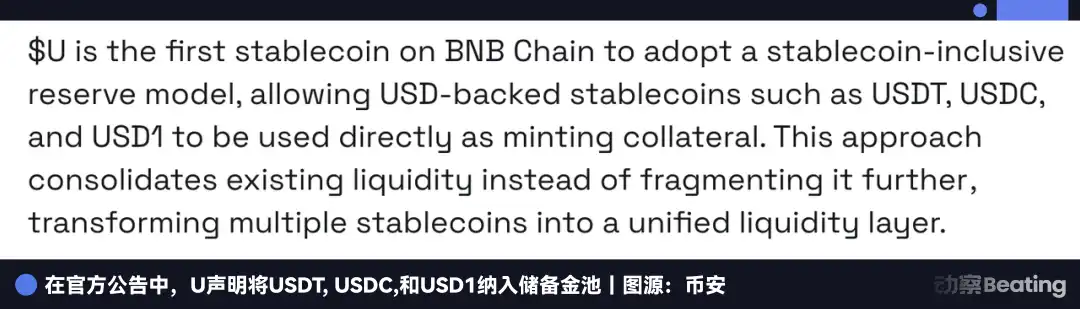
Binance's lesson is: stablecoins reliant on a single regulatory framework always have their lifelines held by others.

The Presidential Family Enters the Fray

The most noteworthy component in $U's reserves is USD1.

In March 2025, the Trump family issued the USD1 stablecoin through World Liberty Financial. According to public disclosures, Trump family-related entities hold 60% of the parent company's equity and receive 75% of the net income share. Trump himself serves as the "Chief Cryptocurrency Advocate," while his sons Eric and Donald Jr. serve as "Web3 Ambassadors."

By December 2025, the Trump family had already profited over $1 billion from the project.

Two months after its issuance, USD1 received its first major order: the Abu Dhabi sovereign wealth fund MGX invested $2 billion in Binance, using USD1 as the payment tool.

This was the largest cryptocurrency payment in history, instantly providing the nascent stablecoin with $2 billion in "practical endorsement."

As of December, USD1's market cap is approximately $2.7 billion, ranking seventh among stablecoins and becoming one of the fastest-growing.

Now, USD1 has been included in $U's reserves. This implies a hidden chain of interests: part of Binance's ecosystem trading volume is converted into usage scenarios for USD1; part of USD1's usage scenarios is converted into income for the Trump family.

The deeper game lies in the monetization of political capital. After Trump returned to the White House, the SEC suspended investigations into several crypto projects, including cases involving Sun Yuchen, a major investor in World Liberty Financial. Treasury Secretary Besant stated clearly at the White House Crypto Summit: "We will use stablecoins to maintain the dollar's status as the world's reserve currency."

Stablecoins are no longer just financial tools; they are becoming carriers of political resources.

The Logic of Nesting

Using stablecoins to collateralize stablecoins might seem redundant. But this design is based on three considerations.

Risk Diversification. USDT's hidden danger lies in its opaque reserves; USDC's隐患在于 its over-reliance on the U.S. banking system, as the Silicon Valley Bank incident warned; USD1's隐患在于 its deep binding with Trump's political fate. Holding any one alone means bearing its specific risk. Combining the three theoretically allows for risk hedging.

Liquidity Aggregation. The pain point of the stablecoin market is fragmented liquidity. USDT has its liquidity pools, USDC has its own, and funds are scattered across dozens of public chains and hundreds of DeFi protocols. $U attempts to connect these isolated pools, providing users with a unified liquidity entry point.

Narrative Upgrade. The competitive dimension of Stablecoin 1.0 was "who is more transparent" and "who is more compliant"—a rhetoric repeated for a decade. $U attempts to provide a new narrative framework: "settlement currency designed for the AI era," "supporting gasless signature transfers."

Of course, gasless transfers are part of the EIP-3009 standard, which existed in 2020, and USDC already supports it. So "AI-native" is more of a universal label; any on-chain stablecoin can be called by smart contracts and enable automatic machine-to-machine payments. $U's real differentiation lies not in technology but in its ecosystem and aggregated architecture.

Naturally, the nested structure also implies risk transmission: if one layer has a problem, the effects ripple through.

If USDT were to collapse one day, $U would not go to zero completely but would certainly承受 the impact: reserves shrinking, redemption pressure surging, depegging risk rising.

所谓 "Risk diversification" is more accurately "diversifying the intensity of impact from a single point of failure," ensuring that holders don't lose everything if any underlying asset fails. It's a bottom-protection mindset, not a risk-free design.

From Gray Zone to Great Power Game

2025 is the first year of stablecoin regulation.

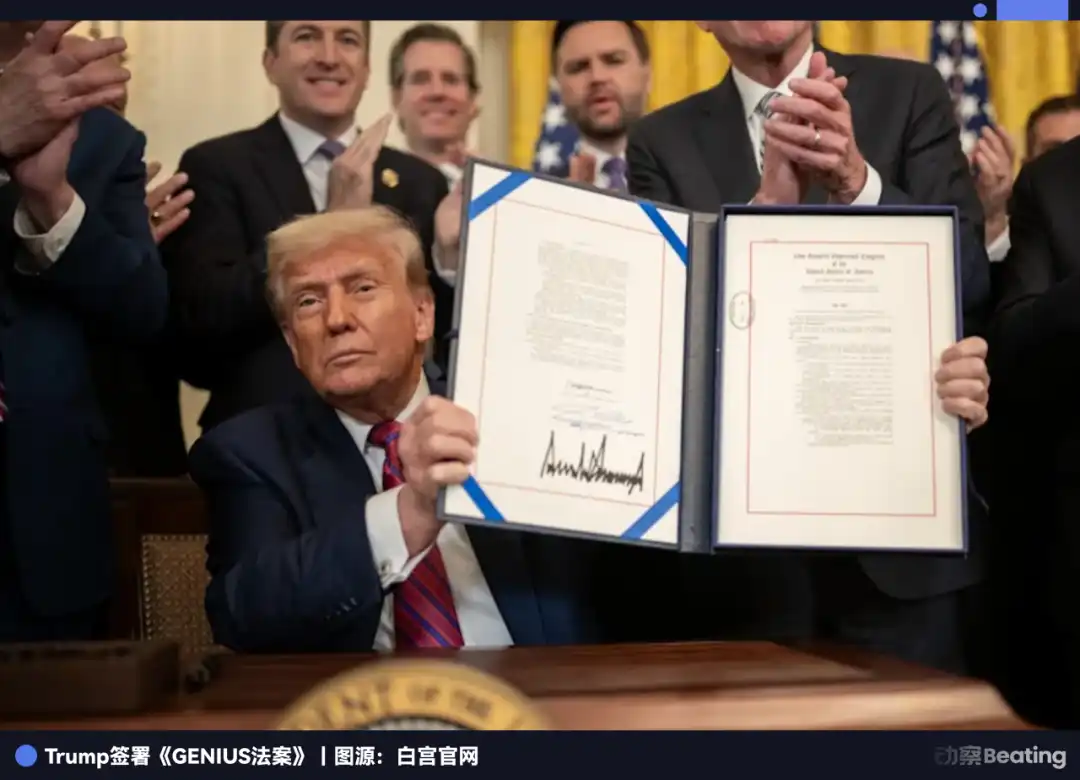
In June, Circle listed on the NYSE, with an IPO price of $31, closing at $69 on the first day, its market cap approaching $20 billion, becoming the "first stablecoin stock." In the same month, the U.S. Senate passed the GENIUS Act with 68 votes in favor, establishing a federal regulatory framework for stablecoins for the first time. The EU's MiCA regulations came into full effect, and Hong Kong, Japan, and Singapore相继 introduced licensing systems.

Over the past decade, stablecoins existed in a gray area, with regulators lacking grounds for intervention. Now, with an annual transfer volume exceeding the world's largest payment network, no government can continue to pretend not to see it.
Data shows: 34% of adults in Turkey hold USDT to hedge against the lira's depreciation; nearly 30% of remittances in Nigeria are completed via stablecoins; tech workers in Argentina普遍 use USDC to receive salaries, bypassing local currency inflation. In these countries, stablecoins are already the de facto "shadow dollar."

The foundation of dollar hegemony is not the Fed's money-printing ability but the inertia of global trade being denominated and settled in dollars. If stablecoins become the next-generation cross-border payment infrastructure, controlling stablecoins means controlling dollar hegemony in the digital age.

This is the underlying logic behind the Trump family's entry and the reason why the GENIUS Act passed with rare bipartisan consensus: in Washington, stablecoins are no longer a小众 issue for the crypto circle but a strategic resource concerning national interests.

The Imminent Battle

Whether $U will succeed is still uncertain. Its current circulating market cap is negligible compared to USDT's nearly $200 billion and USDC's nearly $80 billion.

But it represents a new paradigm in stablecoin competition.

Competition in the 1.0 era was about going it alone: Tether established a monopoly with first-mover advantage, Circle tried to leverage compliance to撬动 the market, and Binance fought for pricing power through BUSD. The core question was "who can survive."

Competition in the 2.0 era is about forming alliances. PayPal issued PYUSD, Ripple launched RLUSD, Robinhood teamed up with Galaxy Digital and Kraken to form the USDG alliance. Traditional financial giants, crypto-native players, sovereign capital, and political forces have all entered the arena.

The new core question becomes "who can tie more players together."

$U's strategy is to achieve aggregation through "nesting": not making enemies with any party, but turning everyone into its "underlying asset." Binance's intention is to build a "decentralized centralization": using an aggregated architecture to分散 regulatory risk while maintaining control over the core ecosystem.

This hundred-army battle has no final outcome. The regulatory balance is still swaying, technological boundaries are still expanding, and political variables are still accumulating.

The only certainty is: stablecoins have moved from being supporting actors in cryptocurrency to key infrastructure in the global financial system. An annual trading volume of $27 trillion is enough to make anyone who underestimates it pay the price.


Domande pertinenti

QWhat is the total on-chain transfer volume of stablecoins in 2024, and how does it compare to Visa and Mastercard?

AIn 2024, the total on-chain transfer volume of stablecoins reached $27.6 trillion, surpassing the combined total of Visa and Mastercard for the first time.

QWhat is the unique feature of the new stablecoin $U launched by United Stables, and what is this structure called in the industry?

AThe unique feature of $U is that its reserves are not US dollars or treasury bonds but a combination of three other stablecoins: USDC, USDT, and USD1. This structure is referred to as a 'nested doll' or '套娃' in the industry.

QWhat was the major event in March 2023 that caused USDC to depeg, and what was the market's lesson from this incident?

AIn March 2023, the collapse of Silicon Valley Bank caused USDC to depeg, briefly dropping to $0.87. Circle had $3.3 billion in reserves held at the bank. The market learned that compliance is an advantage but not a moat; the real barrier is network effect—when a stablecoin has enough users and liquidity, it becomes the de facto standard.

QHow did the Trump family get involved in the stablecoin market, and which major transaction significantly boosted the credibility of their stablecoin USD1?

AThe Trump family entered the stablecoin market in March 2025 by issuing USD1 through World Liberty Financial. A major transaction that significantly boosted its credibility was the Abu Dhabi sovereign fund MGX's $2 billion investment in Binance, which was paid using USD1.

QWhat are the three main considerations behind the design of the 'nested doll' stablecoin $U, as mentioned in the article?

AThe three main considerations behind the design of $U are: 1) Risk diversification by combining multiple stablecoins to hedge against specific risks; 2) Liquidity aggregation to connect fragmented liquidity pools across different blockchains and DeFi protocols; 3) Narrative upgrade, positioning it as a settlement currency for the AI era and promoting features like gasless transfers.

Letture associate

Trading

Spot
Futures

Articoli Popolari

Cosa è BNB WHALES

Comprendere le Balene BNB: Un Approfondimento nel Paesaggio delle Cryptovalute Introduzione alle Balene BNB Nel vibrante mondo delle criptovalute, emergono regolarmente nuovi progetti, spesso promettendo soluzioni innovative ed esperienze uniche. Uno di questi progetti è Balene BNB, lanciato nel 2023 e costruito sulla BNB Smart Chain (BEP20). Balene BNB si propone di stabilire una presenza distintiva all'interno dell'ecosistema delle criptovalute, concentrandosi sulla creazione di una piattaforma coinvolgente che unisce i benefici della tecnologia blockchain con interazioni sociali e di gioco. Questo articolo mira a esplorare più a fondo Balene BNB, analizzando i suoi componenti principali, meccaniche e traiettoria di sviluppo. Cosa sono le Balene BNB? Le Balene BNB sono un'iniziativa criptovalutaria che cerca di fornire una gamma diversificata di funzionalità e opportunità per i propri utenti nel crescente ambiente del Web3. Utilizzando lo standard BEP20, il progetto opera con un'offerta totale di token di 100 trilioni (100.000.000.000.000.000). Nonostante questa cifra significativa, è interessante notare che attualmente non ci sono token in circolazione, indicando che il progetto potrebbe essere ancora nelle sue fasi iniziali di sviluppo. Il principale obiettivo delle Balene BNB è creare una piattaforma in cui gli utenti possano partecipare a varie attività interattive beneficiando della sicurezza e della trasparenza offerte dalla tecnologia blockchain. Promuovendo un ambiente unico e coinvolgente, Balene BNB punta a costruire una comunità forte di utenti che sono coinvolti nel progetto e nel suo sviluppo. Chi è il Creatore delle Balene BNB? L'identità del creatore delle Balene BNB rimane non divulgata al momento, presentando una sfida per coloro che cercano di capire i principi fondanti e le intuizioni visionarie del progetto. Questa assenza di informazioni disponibili pubblicamente riguardo alla leadership del progetto può sollevare domande tra i potenziali investitori e utenti sulla sua governance e struttura di responsabilità. Chi sono gli Investitori delle Balene BNB? Con l'evoluzione delle Balene BNB, le informazioni riguardanti investitori specifici o supporto da fondazioni di investimento non sono attualmente disponibili. La documentazione ufficiale del progetto, incluso il suo whitepaper, non divulga né sostenitori finanziari individuali né istituzionali. La mancanza di trasparenza in questo senso può talvolta sollevare interrogativi sulla legittimità e sostenibilità dei nuovi progetti all'interno dell'ecosistema delle criptovalute. Come Funzionano le Balene BNB? Le Balene BNB operano sulla BNB Smart Chain utilizzando lo standard BEP20, noto per la sua efficienza e basse commissioni di transazione, attirando una varietà di sviluppatori e progetti. L'aspetto unico delle Balene BNB risiede nella sua attenzione alla creazione di una piattaforma guidata dalla comunità. Sebbene i dettagli operativi precisi siano scarsi, il progetto enfatizza l'interazione e il coinvolgimento, potenzialmente incorporando elementi gamificati nelle sue offerte. L'enfasi sulla comunità è fondamentale, poiché si allinea con le tendenze prevalenti nel campo delle criptovalute, dove il contributo e la partecipazione degli utenti spesso determinano il successo di un progetto. Ulteriori innovazioni potrebbero essere previste, ma attualmente, i meccanismi specifici e le funzionalità che differenziano Balene BNB da altre iniziative crittografiche devono ancora essere completamente chiariti. Senza informazioni dettagliate riguardo alla sua funzionalità, è difficile valutare in modo completo i differenziali del progetto. Timeline delle Balene BNB Lo sviluppo delle Balene BNB si è svolto attraverso tappe chiave, segnando il suo percorso nel panorama delle criptovalute. Di seguito è riportata una cronologia di eventi significativi riguardanti il progetto: 2023: Lancio delle Balene BNB, segnando l'ingresso del progetto nel mercato. 2023: Pubblicazione del whitepaper del progetto, che delinea gli obiettivi generali e il framework operativo. In Corso: Le Balene BNB continuano a sviluppare le proprie funzionalità, puntando a costruire una base utenti solida e ad espandere le proprie offerte. Punti Chiave sulle Balene BNB Piattaforma: BNB Smart Chain (BEP20) Offerta Totale: 100 trilioni di token (100.000.000.000.000.000) Offerta Circolante: 0 token (indicando una fase nascente) Obiettivo del Progetto: Favorire una piattaforma di criptovalute coinvolgente per l'interazione e la costruzione di comunità. Creatore: Sconosciuto Investitori: Non divulgati Stato Operativo: Attivo con sviluppo e espansione in corso Conclusione Nel mentre le Balene BNB navigano nel competitivo panorama delle criptovalute, offrono uno sguardo sul potenziale dei progetti guidati dalla comunità costruiti sulle fondamenta della tecnologia blockchain. Concentrandosi sul coinvolgimento e sull'interazione, l'iniziativa si pone all'avanguardia dell'innovazione nel campo del Web3. Tuttavia, il successo del progetto dipenderà alla fine dalla chiarezza delle sue meccaniche operative, dalla divulgazione della sua governance e dalla creazione di una solida comunità di utenti. Per potenziali utenti e investitori, le Balene BNB rappresentano un caso studio nella natura in evoluzione dei progetti di criptovalute—una che illustra sia le emozionanti possibilità che le complessità associate a nuove iniziative. Con il paesaggio che continua a evolversi, sarà essenziale monitorare i progressi delle Balene BNB e il loro impatto sull'ecosistema più ampio delle criptovalute.

335 Totale visualizzazioniPubblicato il 2024.04.05Aggiornato il 2024.12.03

Cosa è BNB WHALES

Come comprare BNB

Benvenuto in HTX.com! Abbiamo reso l'acquisto di Binance Coin (BNB) semplice e conveniente. Segui la nostra guida passo passo per intraprendere il tuo viaggio nel mondo delle criptovalute.Step 1: Crea il tuo Account HTXUsa la tua email o numero di telefono per registrarti il tuo account gratuito su HTX. Vivi un'esperienza facile e sblocca tutte le funzionalità,Crea il mio accountStep 2: Vai in Acquista crypto e seleziona il tuo metodo di pagamentoCarta di credito/debito: utilizza la tua Visa o Mastercard per acquistare immediatamente Binance CoinBNB.Bilancio: Usa i fondi dal bilancio del tuo account HTX per fare trading senza problemi.Terze parti: abbiamo aggiunto metodi di pagamento molto utilizzati come Google Pay e Apple Pay per maggiore comodità.P2P: Fai trading direttamente con altri utenti HTX.Over-the-Counter (OTC): Offriamo servizi su misura e tassi di cambio competitivi per i trader.Step 3: Conserva Binance Coin (BNB)Dopo aver acquistato Binance Coin (BNB), conserva nel tuo account HTX. In alternativa, puoi inviare tramite trasferimento blockchain o scambiare per altre criptovalute.Step 4: Scambia Binance Coin (BNB)Scambia facilmente Binance Coin (BNB) nel mercato spot di HTX. Accedi al tuo account, seleziona la tua coppia di trading, esegui le tue operazioni e monitora in tempo reale. Offriamo un'esperienza user-friendly sia per chi ha appena iniziato che per i trader più esperti.

908 Totale visualizzazioniPubblicato il 2024.12.12Aggiornato il 2025.03.21

Come comprare BNB

Cosa è BNB CARD

Comprendere BNB Card: Rivoluzionare l'Identità Digitale in Web3 Nel panorama in rapida evoluzione della tecnologia blockchain e delle criptovalute, la BNB Card o $BNBCARD si distingue come un progetto notevole. Questo token meme utilitario guidato dalla comunità sfrutta la BNB Smart Chain (BSC), mirando a integrare la cultura meme con soluzioni innovative per l'identità digitale. Man mano che sempre più utenti si immergono nei regni della decentralizzazione, è fondamentale analizzare cosa offre BNB Card, le sue sfumature operative e il suo potenziale impatto sul mercato. Cos'è BNB Card ($BNBCARD)? Alla sua essenza, BNB Card rappresenta un token meme con una sostanziale utilità. È progettato per dare potere agli utenti consentendo la creazione di carte d'identità digitali personalizzate che sono sia espressive che funzionali. Il progetto racchiude diverse caratteristiche chiave: Carte d'Identità Personalizzabili: Gli utenti hanno la possibilità di progettare carte d'identità digitali a tema Binance, fornendo loro una piattaforma per l'auto-espressione e un'interazione comunitaria migliorata. Struttura Decentralizzata: Sviluppata sulla BSC, BNB Card enfatizza attributi chiave come sicurezza, trasparenza e sovranità degli utenti. La natura decentralizzata della struttura consente transazioni che sono sia efficienti che sicure. Modello Centrato sulla Comunità: L'enfasi sulla partecipazione di base piuttosto che su modelli finanziari guidati da laboratori crea un ambiente coinvolgente per i suoi utenti. Sfruttando la viralità intrinseca della cultura meme, BNB Card promuove un robusto movimento comunitario. L'obiettivo primario di BNB Card è democratizzare gli strumenti di identità digitale in Web3, offrendo soluzioni accessibili che avvantaggiano gli utenti senza i vincoli tipicamente associati ai sistemi di gestione dell'identità tradizionali. Creatore e Investitori Quando si esplora l'identità dietro BNB Card, è importante notare che nessun singolo creatore è esplicitamente accreditato. Invece, il progetto sembra essere guidato dalla comunità, suggerendo uno sforzo collettivo ispirato al concetto della “Early Builder Card” di Binance. Questo approccio allo sviluppo organico è comune tra i progetti all'interno dello spettro dei token meme, dove lo sviluppo è spesso influenzato dalla passione della comunità piuttosto che da un'autorità centrale. In termini di investimento, l'assenza di sostenitori istituzionali pubblicamente dichiarati evidenzia ulteriormente la base comunitaria del progetto. Esso prospera grazie al supporto organico della comunità, riflettendo una caratteristica abituale dei progetti guidati dai meme che spesso coinvolgono il loro pubblico attraverso canali social piuttosto che percorsi di investimento formali. Come Funziona BNB Card impiega diversi meccanismi che delineano il suo funzionamento e spirito innovativo: Utilità del Token: Il token BNBCARD consente agli utenti di accedere a un insieme di strumenti per la creazione di ID, fornendo anche una piattaforma per la governance comunitaria. Il token funge da elemento centrale che abilita queste funzionalità. Integrazione Blockchain: Utilizzando la BSC, BNB Card garantisce compatibilità con applicazioni basate su Ethereum Virtual Machine (EVM). Questa integrazione offre agli utenti i vantaggi di basse commissioni di transazione migliorando l'accessibilità. Ecosistema Fai-da-te (DIY): Centrale nell'appeal di BNB Card è il suo approccio fai-da-te (DIY) alla generazione di carte d'identità digitali. Questo elemento partecipativo incoraggia gli utenti a impegnarsi nell'espressione creativa, promuovendo una cultura inclusiva che prospera sulla contribuzione e collaborazione. Cronologia La cronologia è fondamentale per comprendere la traiettoria di BNB Card. I traguardi importanti nella storia del progetto includono: 18 marzo 2025: BNB Card è stata quotata su LBank, segnando un passo significativo nel suo percorso di scambio e aprendo porte per liquidità e accessibilità per gli utenti. 19 marzo 2025: Un momento cruciale si è verificato quando il token ha registrato un aumento astronomico del 26.000% in 24 ore, attirando l'attenzione per il suo potenziale e l'entusiasmo della comunità. Sviluppi in Corso: Il progetto sta continuamente espandendo le sue partnership con scambi decentralizzati (DEX) come PancakeSwap, migliorando ulteriormente la liquidità e il coinvolgimento degli utenti. Innovazione e Differenziazione Comprendere cosa distingue BNB Card richiede un'esplorazione più profonda del suo framework innovativo: Ibrido Meme-Utilità: BNB Card fonde con successo il fascino giocoso della cultura meme con applicazioni pratiche nella gestione dell'identità digitale. Questo approccio di nicchia si rivolge efficacemente a un ampio pubblico, attirando sia utenti esperti di tecnologia che quelli nuovi nel mondo delle criptovalute. Governance Decentralizzata: Operare senza controllo centralizzato consente al progetto di sfruttare direttamente il contributo della comunità. Il processo decisionale collettivo sostenuto dal coinvolgimento della comunità dà potere agli utenti, assicurando che le loro voci contribuiscano allo sviluppo e alla direzione del progetto. Scalabilità: BNB Card può beneficiare enormemente dagli aggiornamenti della roadmap 2025 per la BNB Chain, che includono miglioramenti come l'aumento della velocità delle transazioni e l'integrazione di strumenti di intelligenza artificiale. Questi miglioramenti posizionano il progetto in modo vantaggioso all'interno di un ambiente altamente competitivo. Conclusione BNB Card è emblematica di una nuova ondata di soluzioni per l'identità digitale all'interno dell'ecosistema Web3. Fondendo divertimento, coinvolgimento della comunità e utilità pratica, invita gli utenti a partecipare attivamente nella definizione delle loro persone digitali. Mentre il progetto naviga nel dinamico panorama delle criptovalute, il suo successo dipenderà probabilmente dal mantenimento di un forte supporto della comunità mentre si adatta ai progressi tecnologici e alle esigenze degli utenti. L'integrazione della decentralizzazione con la cultura meme non serve solo come mezzo per il coinvolgimento guidato dagli utenti, ma anche come base per la narrazione in evoluzione riguardante l'identità digitale nell'era della blockchain. In sintesi, BNB Card non solo esemplifica la convergenza di creatività e utilità all'interno dello spazio crypto, ma sottolinea anche l'importanza della comunità nel guidare il futuro delle tecnologie decentralizzate.

298 Totale visualizzazioniPubblicato il 2025.03.26Aggiornato il 2025.03.26

Cosa è BNB CARD

Discussioni

Benvenuto nella Community HTX. Qui puoi rimanere informato sugli ultimi sviluppi della piattaforma e accedere ad approfondimenti esperti sul mercato. Le opinioni degli utenti sul prezzo di BNB BNB sono presentate come di seguito.

活动图片