The 'Trading Prodigy' Who Made $15 Million, Now Laments Contemplating Self-End

Foresight NewsPubblicato 2026-06-22Pubblicato ultima volta 2026-06-22

Introduzione

The title "The 'Trading Genius' Who Made $15 Million Laments Wanting to End It All" introduces an article about a crypto trader known as Spider. A screenshot of his personal journal, expressing suicidal thoughts after massive consecutive losses, recently spread online, sparking widespread discussion on crypto speculation, risk management, and mental health. Reactions were mixed, with some criticizing his public sharing of despair and others offering support. Spider, active in DeFi and meme coin trading since 2020, gained a following by sharing aggressive, high-leverage strategies. His publicly shared wallet address once peaked at around $12 million, fueled largely by gains from tokens like TRUMP, but its value drastically declined afterwards. He has openly reflected that past success bred overconfidence, leading to significant losses and even a major tax debt in 2022, which he later repaid. Community observers note his pattern of rapid wealth accumulation in bull markets followed by complete loss in downturns, highlighting the thin line between strategic trading and gambling addiction. The article concludes that the current crypto environment is far more challenging than previous cycles, emphasizing the importance for traders to secure profits, diversify, and build an identity beyond trading to survive long-term.


Author: Ma He, Foresight News


Recently, a screenshot of Spider's journal spread rapidly on the X platform. In the log, this trader long active in the DeFi and meme coin fields described in detail the suicidal thoughts arising from consecutive heavy losses, attributing them to a gambling mentality, following wrong chat rooms, and blindly copying trades, while expressing fear over the idea that "death is a release."


The incident quickly gained traction, sparking intense community discussion on crypto speculative culture, risk management, and mental health.
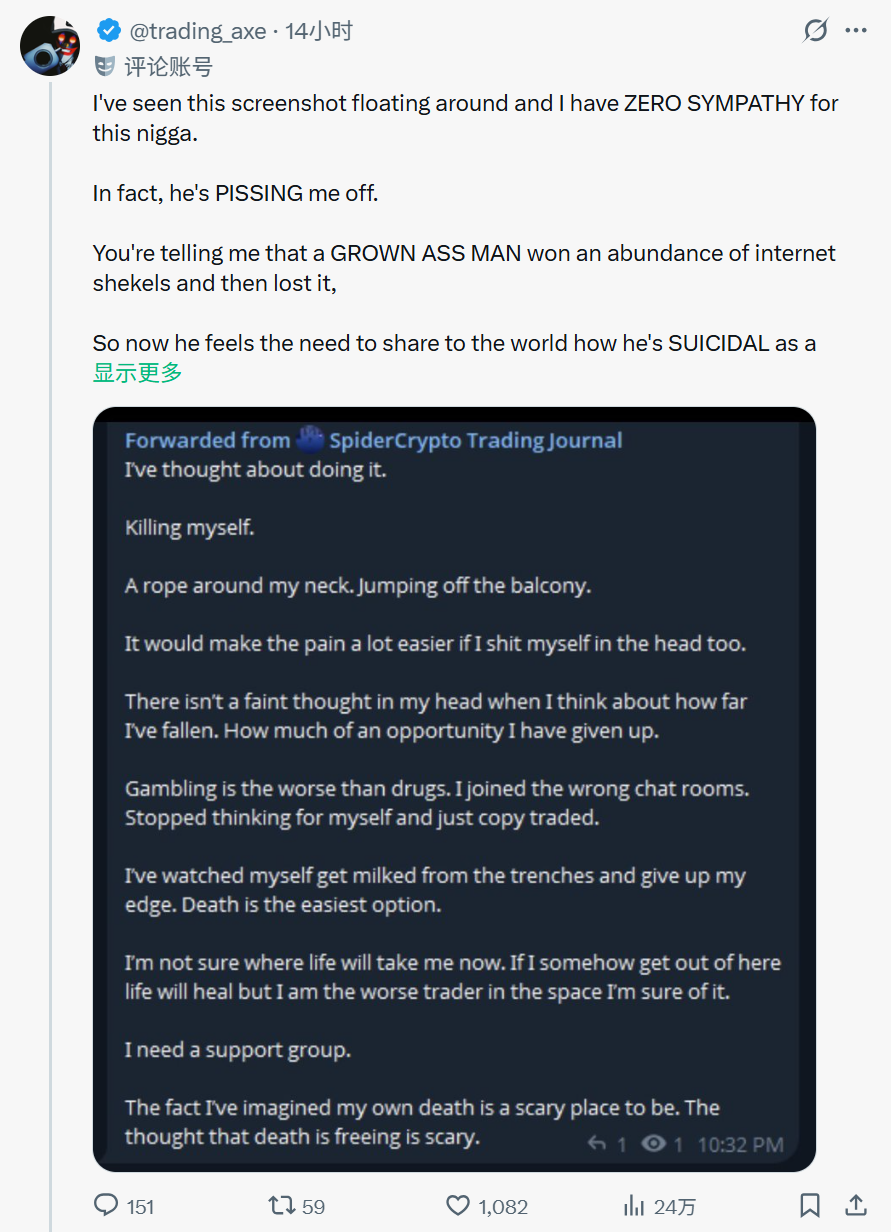


The Twitter account Trading axe expressed no sympathy whatsoever for the individual, even angrily commenting, "You're telling me a grown man made a fortune from virtual money on the internet, then lost it all, and now feels the need to share 'I want to kill myself' with the whole world? Alexander Wice lost $1 billion in 2021 due to over-leverage, didn't complain, didn't make excuses, and just moved forward."


However, some community members offered comfort, saying, "SBF also suffered major setbacks and was even sentenced to 25 years, but he's still alive, so it shouldn't come to this."


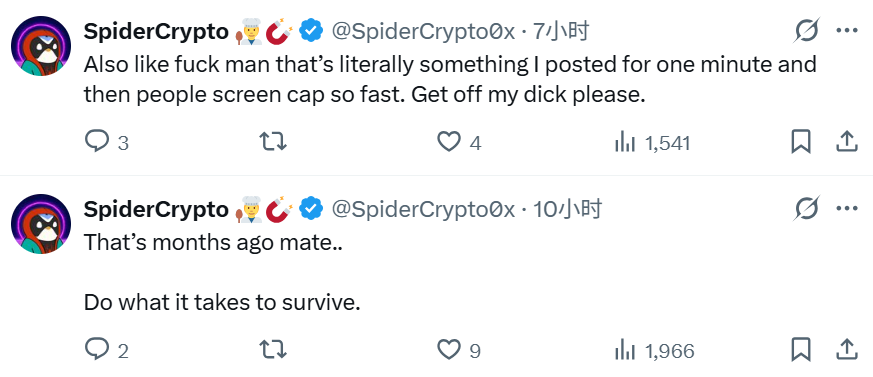
The protagonist, Spider, soon responded in the comments section of his tweet, stating, "It was literally something I posted for one minute before someone screenshotted it. Furthermore, it added that this text was actually posted several months ago." He also offered himself words of encouragement.


So who exactly is Spider? What happened in the past?


Single Address Peaked at $15 Million


Spider's X account is @SpiderCrypto0x. He operates the Telegram channel SpiderCrypto Trading Journal (with approximately 33,000 subscribers). His content primarily shares insights on DeFi, NFT, and meme coin trading, with a style emphasizing on-chain data verification. His bio often mentions collaborations with platforms like Rainbet. His X account joined around August 2020, initially being active in the DeFi space.



Spider was already active in trench trading during the DeFi Summer of 2020. Long-term observers like Twitter user CryptoCaligh recalled in a post dated June 22, 2026: "I was one of those in the trenches with Spider, frantically buying DeFi coins. I've been watching his play since 2020, it's been almost 7 years now." His style is characterized as aggressive and high-leverage, often capable of rapidly scaling positions in bull markets. During the same period, he gradually built influence by sharing trading views through TG logs and X posts.


During the 2021 bull market, Spider achieved significant profits (users mention gains in the $6-7 million range within short periods). In the 2022 bear market, he nearly lost his entire net worth (community estimates close to $10 million). More seriously was the tax issue—due to publicly flaunting gains, he attracted attention from tax authorities, resulting in a debt of about $4 million.


According to CryptoCaligh's recollection, he later negotiated a payment plan with the government and received help from old friends, gradually paying off the debt through further trading. This phase exposed the fragility of his high-risk strategy in bear markets and became a starting point for his reflection on "false confidence."


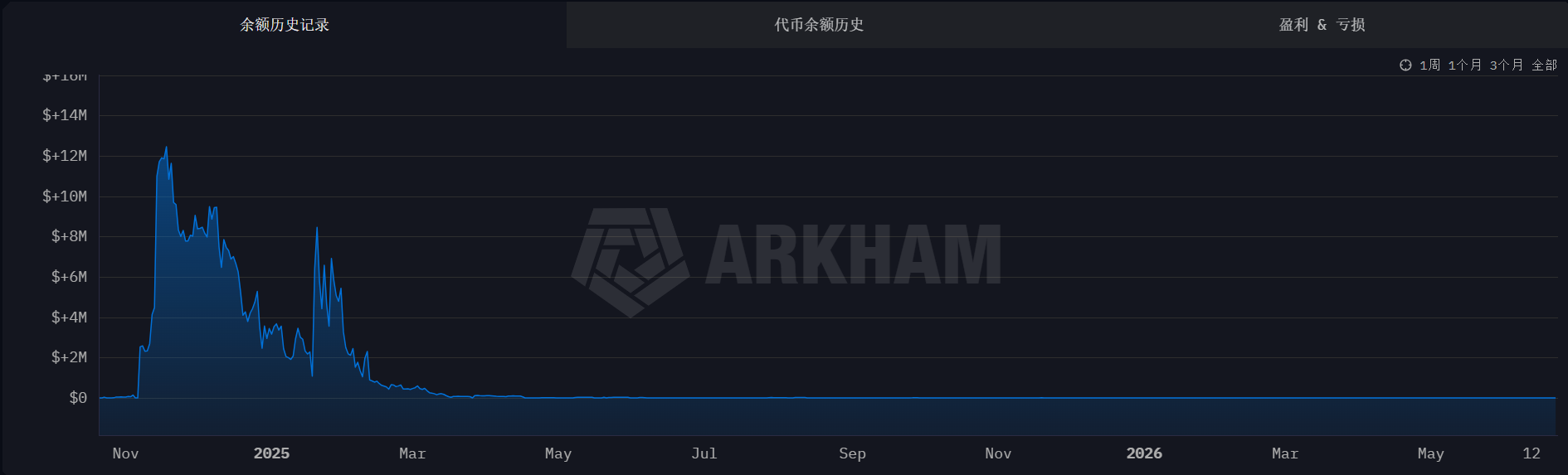
Spider himself has publicly shared his main TRUMP holding wallet address (J9HqxT4U39B45YcXxL4B1GZzdhSrXFr2N2Lam4bXrQeB) in an X post. According to Arkham data, the disclosed address peaked at around $12 million in December 2024 before declining. On January 20, 2025, due to the TRUMP coin, the account balance surged from around $1.5 million to $8.5 million. The funds remained at high levels for a few months before beginning a steady decline. After March of that year, the balance was nearly depleted.


He reflected: "Past success gives you false confidence, making you believe you can do it again. That was one of the reasons for my disastrous loss."


Arkham data shows this wallet address made transfers to over 36 addresses on Pump.fun alone. It is speculated that he likely ended up suffering heavy losses in PvP (player vs. player) trading.
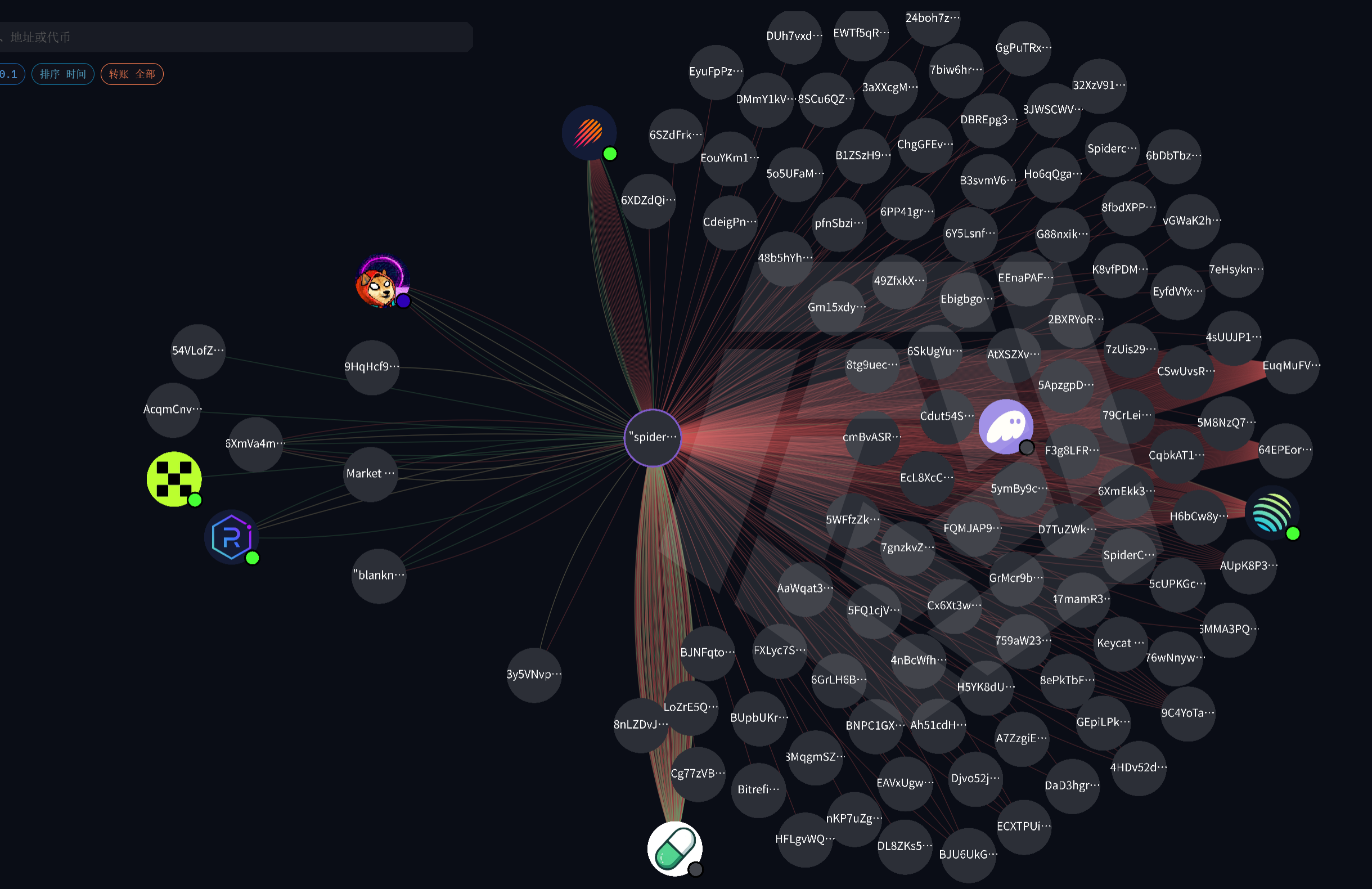


Currently, his Twitter homepage continues to post trading-related content on X, indicating he remains active in the market.


From Big Gains to Big Losses, Gambling and Trading Are Often Separated by a Thin Line


It's often easier to see clearly from the outside. User CryptoCaligh pinpointed his real issue.


"He once threw $40,000 into a coin at its peak, and it could turn into $500,000 in a day. This kind of operation indeed works in crazy bull markets, but when the tide recedes, you lose all the money you made just as quickly. There's only a thin line between gambling and trading, and many people get deeply entangled. Once addicted, it will ruin you."


Furthermore, he added, "What's the point of making millions and losing it all? That's just a dream. You need to think clearly: Are you here to invest and try to make millions, or are you already an addicted gambler?"


In crypto cycles, similar cases of "sudden wealth - back to zero - psychological breakdown" recur repeatedly. During the 2021 bull cycle, massive liquidity inflow made earning relatively easy. However, the crypto space of 2025-2026 is no longer an era of easy money. Many concepts have been debunked, VC coins have been abandoned by communities, and meme coins have grown tiresome in endless PvP, with market trading difficulty increasing exponentially.


Those who survive long-term typically preserve profits during bull markets, establish diversified allocations, and cultivate a non-trading identity.


Domande pertinenti

QWhat triggered the widespread discussion about Spider's situation on social media?

AA log screenshot from Spider was rapidly disseminated on the X platform. In the log, this active DeFi and meme coin trader detailed his suicidal thoughts following consecutive massive losses, blaming a gambling mentality, misleading chat rooms, and blind copy-trading, while expressing fear over the idea that 'death is a release.'

QAccording to the article, what is the main difference between Spider's success during the bull market and his subsequent failure?

ADuring the bull market, Spider's aggressive, high-leverage style allowed him to rapidly amplify his positions and achieve significant profits (e.g., turning $40k into $500k in a day). However, when the bull market receded, this same strategy led to equally rapid losses, exposing the fragility of his high-risk approach in a bear market. He reflected that past success gave him false confidence, leading him to believe he could repeat it, which contributed to his惨败.

QWhat significant financial and legal challenge did Spider face after the 2022 bear market, according to the article?

AAfter the 2022 bear market, Spider lost nearly his entire net worth (estimated by the community to be close to $10 million). Additionally, he faced a significant tax problem. Due to publicly炫耀 his earnings, he attracted attention from tax authorities and incurred a debt of approximately $4 million.

QWhat point does the user CryptoCaligh make about the nature of Spider's activities in the crypto market?

ACryptoCaligh指出 that there is a very thin line between gambling and trading, and many people become deeply addicted to it. He questions whether one is in the market to invest and make millions or is already an addicted gambter. He emphasizes that making and then losing millions is meaningless—it's just a dream—and that such addiction can destroy a person.

QBased on the article, what are some characteristics of traders who can survive long-term in the volatile crypto market?

AAccording to the article, those who can survive long-term in the crypto market typically manage to secure profits during bull markets, establish diversified asset allocations, and cultivate a non-trading identity or sense of self outside of their trading activities.

Letture associate

Bittensor Moves Towards Ultimate Decentralization: The Critical 18 Months for the TAO Ecosystem is Here?

Bittensor, a decentralized AI protocol, is accelerating its transition to full decentralization over the next 18 months, as outlined in a recent post by co-founder Const. The project currently operates in a "semi-decentralized" state: ownership and network participation are open and permissionless, with TAO distribution based on competitive contribution. However, protocol upgrades and governance have remained under core team control to enable rapid iteration in the fast-evolving AI sector. This strategic shift comes as the ecosystem matures, boasting 128 subnets and a large community. Const argues that continued centralization now poses risks, including single points of failure and regulatory scrutiny. The upcoming decentralization roadmap includes optimizing validator competition, opening liquidity pools, introducing governance rights for Alpha holders, and refining economic models. The move could fundamentally reshape TAO's value proposition, adding governance premiums to its existing valuation based on AI narrative and scarcity. It also signals a potential maturation of the AI crypto sector, where competition may shift from hype to sustainable protocol design and real economic activity. Bittensor positions itself not just as another AI token, but as foundational infrastructure aiming to decentralize intelligence production—analogous to Bitcoin's role in decentralizing money—with the goal of creating a resilient "Millennium Intelligence Federation."

marsbit2 min fa

Bittensor Moves Towards Ultimate Decentralization: The Critical 18 Months for the TAO Ecosystem is Here?

marsbit2 min fa

Japan's AI Dark Horse Emerges: How a 7B Small Model Challenges Fable and Mythos?

In June 2026, Sakana AI's new model Fugu caused a stir in the AI community. Its Fugu Ultra variant achieved scores of 73.7 on SWE-Bench Pro and 82.1 on TerminalBench 2.1, surpassing GPT-5.5 and Claude Opus 4.8, and was claimed to be comparable to export-restricted models like Fable 5 and Mythos Preview. Remarkably, the core of this high-performance system is not a massive model, but a small 7B-parameter RL Conductor model. Fugu operates as a multi-agent orchestrator: the 7B model acts as a "foreman," dynamically analyzing user tasks and delegating subtasks to a pool of top-tier global models (e.g., GPT-5, Gemini 3.1 Pro). It then synthesizes and verifies their outputs. This architecture represents a paradigm shift from monolithic models to an expert-team approach. It enhances performance in complex, multi-step engineering tasks like code review and security testing by enabling cross-validation from specialized models, improving long-session stability and token efficiency. However, Fugu's strengths come with trade-offs: it faces inherent latency due to multiple API calls, relies heavily on underlying US model APIs (creating dependency risks), and its benchmark comparisons with Fable/Mythos are based on reported scores, not head-to-head testing. For Japan's AI ecosystem, which lacks the massive compute and data resources of the US or China, Fugu exemplifies an "asymmetric breakthrough" strategy. Instead of competing directly in parameter scale, it focuses on intelligent orchestration of existing global models, offering a degree of AI sovereignty and resilience. While a significant system-level innovation, its ultimate capability is still bounded by the underlying models it coordinates.

marsbit2 min fa

Japan's AI Dark Horse Emerges: How a 7B Small Model Challenges Fable and Mythos?

marsbit2 min fa

Trading

Spot
Futures
活动图片