The 'Stock Call King' Serenity: 3840% Annual Return, Beating Institutions to the Punch

Odaily星球日报Pubblicato 2026-05-26Pubblicato ultima volta 2026-05-26

Introduzione

This article profiles the mysterious stock trader and analyst known as Serenity, who has gained significant influence on social media platform X as a "stock call king." Serenity claims extraordinary annual returns of 3840% for the current year and 2256% over the past two years, primarily by focusing on overlooked companies within the AI and semiconductor supply chains. Operating anonymously, Serenity describes himself as a former Reddit WallStreetBets trader, an AI/semiconductor supply chain analyst, and a former AI research scientist. His core investment strategy, termed the "Chokepoint" theory, involves identifying small, critical bottleneck companies in the AI infrastructure ecosystem—such as those in photonics, substrates, and materials—that are essential yet undervalued. He argues these "invisible champions" become crucial as demand for AI hardware surges, creating significant investment opportunities before large institutions take notice. A frequently cited example is stock AXTI, which he has recommended for over two years and claims has yielded over 10,000% returns. The article notes that while Serenity's free, public posts on X have garnered a large following, his identity and exact portfolio size remain unverified, leading to some skepticism. Critics question if his reported returns are fabricated or if he might be manipulating prices of low-market-cap stocks. Serenity counters that he shares research freely to democratize information, allowing retail investors to ...

Original | Odaily Planet Daily (@OdailyChina)

Author | Golem (@web3_golem)
As an investor focused on US stocks in AI and semiconductors, if you haven't heard of Serenity, chances are you're still on the sidelines when it comes to investment research.

Why is that? Because he is currently the hottest "stock call king" on the entire internet. From retail investors to Wall Street, almost everyone is reading his reports and copying his trades. Some people even package his publicly available, free insights into courses to sell within communities.

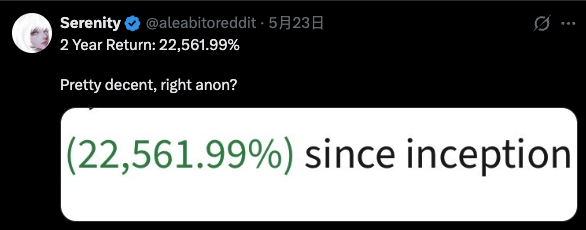
On May 24th, Serenity announced his investment performance for this year on platform X: a year-to-date return of 3840.39%. Just the day before, he had also shared his investment return over the past two years, which was a staggering 2256.99%.
Serenity, "Far Ahead of the Pack"

Serenity only joined X in July 2025, and by May this year, his follower count had grown to 358k, with over 32k subscriptions—just under 15k less than Elon Musk's subscription count. Yet, to this day, no one knows Serenity's true identity. People's understanding of his background comes solely from his self-written bio:

  • Former famous Reddit WSB trader who switched to X(Odaily Note: WallStreetBets is the largest US retail trading community. Serenity was banned for recommending a stock with the ticker AXTI in 2022. This stock has risen over 700% year-to-date);
  • AI & semiconductor supply chain analyst, former RISC-V Foundation member, former AI research scientist;
  • Now primarily trades "those overlooked bottlenecks."

As can be seen from the bio, Serenity's persona is that of an AI expert. He has also claimed to have turned down an offer from Nvidia's AI team back in 2018. In a post, Serenity stated that his investments are also based on a thorough understanding and research of the AI and semiconductor industries. His typical investment research process is: first conduct initial paper research, then translate these ideas into actual plans and trades, followed by subsequent due diligence on the Alpha, and finally, celebrate when the stocks rise.

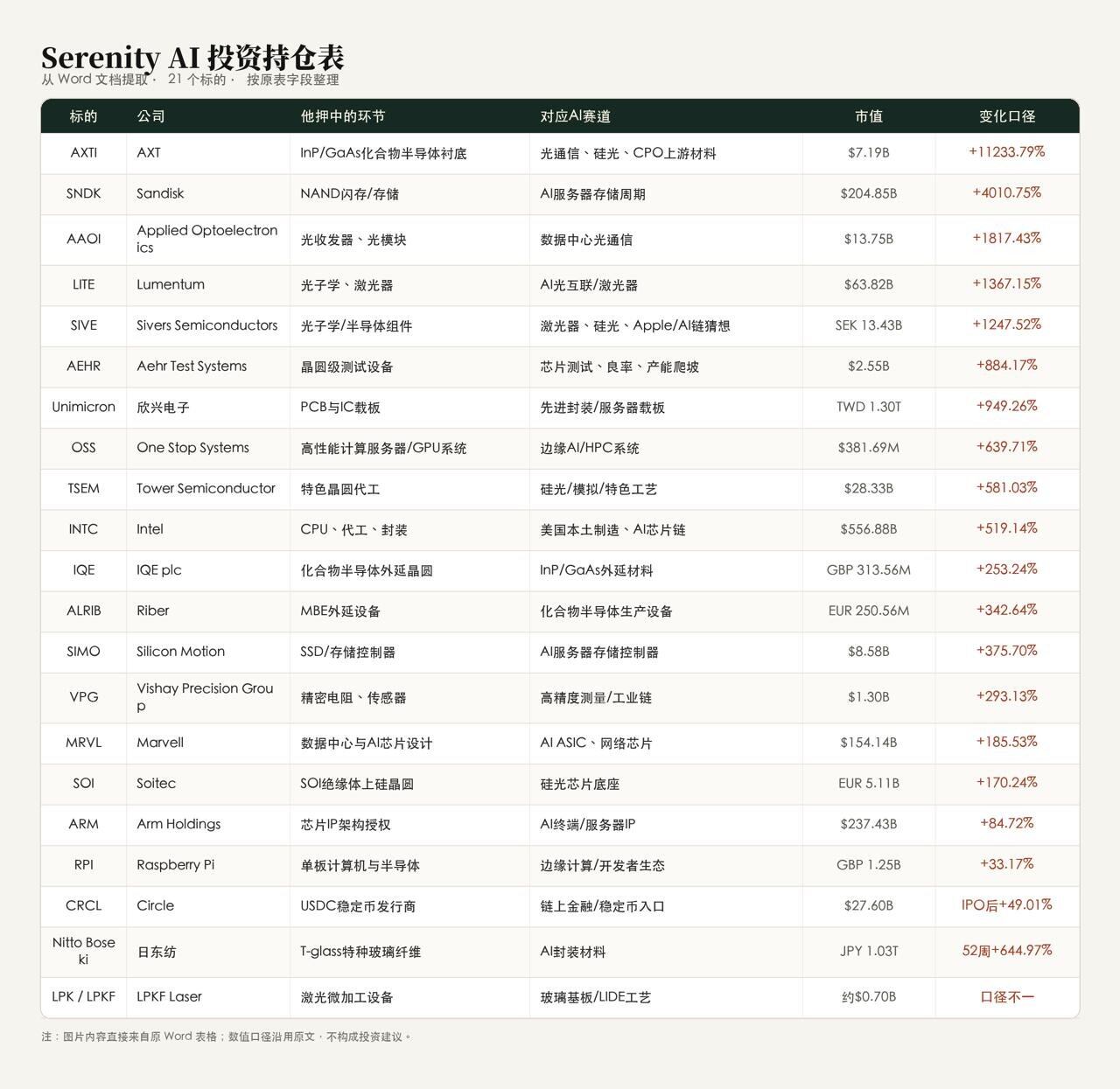
As shown in the image below, this is a list of Serenity's main stock holdings compiled by community user @kaikaibtc, primarily focused on sectors within the AI industry chain such as optical modules, silicon photonics, storage, CPO (Co-Packaged Optics), and substrates. None of these 21 stocks has a profit lower than 100%. Among them, AXTI, a stock Serenity has mentioned most frequently and "called" for over two years, has even yielded profits exceeding 10,000%. He has publicly stated that AXTI is his most legendary trade.
However, what's perhaps even more remarkable than these astonishing profits is that Serenity identified these targets before not only retail investors took notice, but even before institutions entered the market.

When Serenity posted about recommending a particular stock in the past, he was mostly met with skepticism. Only months or even a year later, when investors saw the exaggerated performance of the stock, would they belatedly realize he was right. Stocks like RPI, AXTI, SIVE, and others are vivid examples. When such cases repeatedly occurred, the Serenity account naturally became a must-read for retail investors, Wall Street, and even Silicon Valley investors.

Why is Serenity always ahead of the market and able to unearth those undervalued stocks? The secret lies in his self-constructed investment theory: the Supply Chain Bottleneck (Chokepoint) theory.

The Bottleneck (Chokepoint) Investment Method

Chokepoint is the highest-frequency word appearing in Serenity's posts and is also his core investment logic.

AI is undoubtedly the world's dominant narrative today, but the AI industry suffers from a clear supply-demand imbalance. On one hand, internet giants are spending lavishly on an "arms race" for AI infrastructure; on the other, the supply side is clearly insufficient, with even Nvidia's orders entering a "rationing system." Therefore, capital has also realized that the current stage of AI development has little to do with downstream applications but everything to do with the upstream supply chain. Whoever occupies a critical position in the AI supply chain, whoever is irreplaceable, deserves to be repriced.

Thus, over the past few months, the market's hype around the AI industry has deconstructed the supply chain step by step, starting from the initial GPU computing power. The second layer includes storage, data centers, and optical modules, further down to power, materials, networking equipment, etc. This layered deconstruction of the AI supply chain to find the key "chokepoint" companies in each segment is essentially Serenity's bottleneck investment method, except he acted far ahead of most retail investors and institutions.

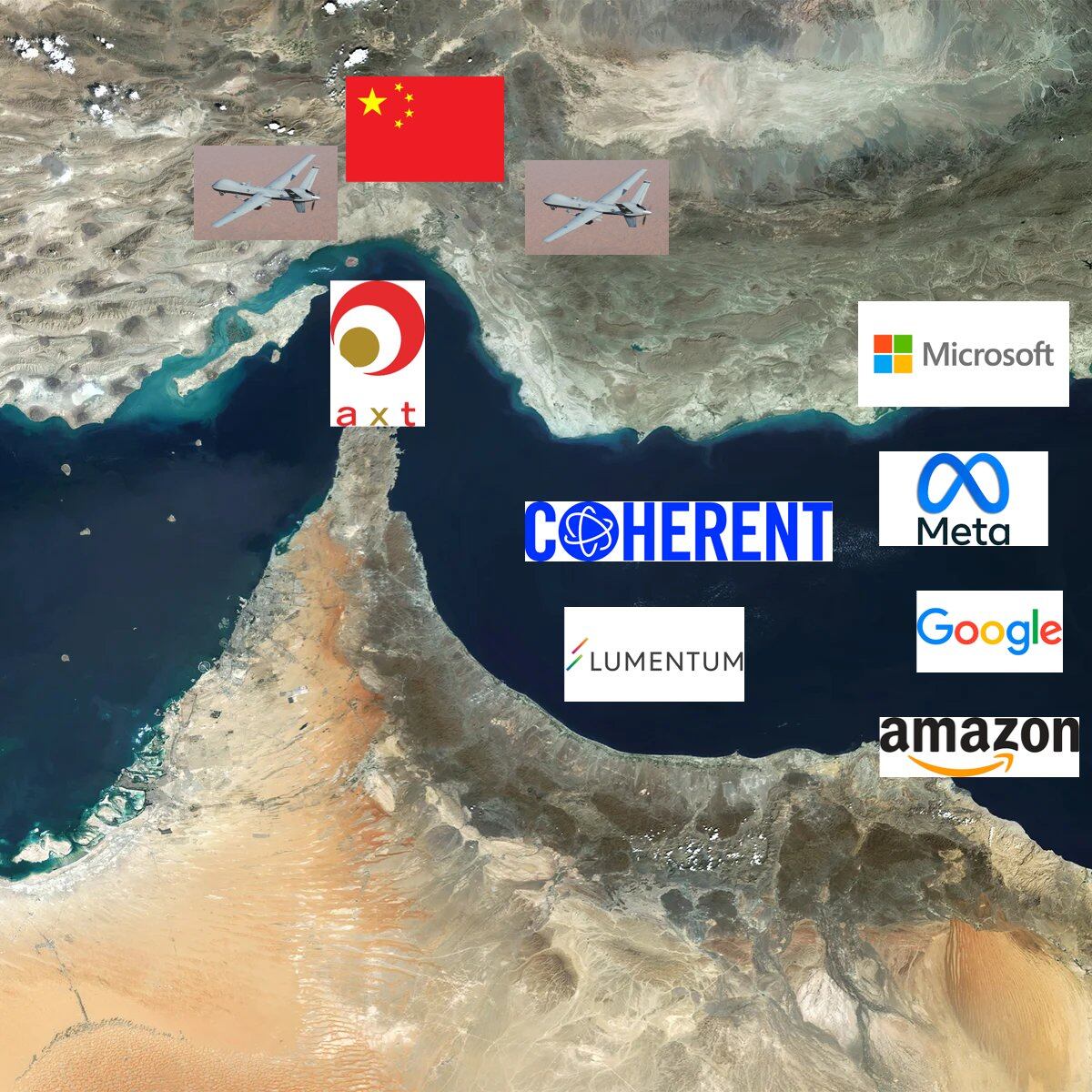
On March 31st, Serenity used an analogy while calling AXTI to vividly explain what a bottleneck point is. He used the Strait of Hormuz as a comparison. Over 20% of the world's crude oil supply passes through the Strait of Hormuz, making it a critical chokepoint in global energy trade. AXTI's relationship to AI optical module companies is similar to the Strait of Hormuz's relationship to global energy trade.
The essence of Serenity's ability to achieve excess returns still comes from market information asymmetry, using sharp thinking and foresight to seek out the "hidden champions" on the AI industry chain that are not fully priced. These companies are not as glamorous as giants like Nvidia, Micron, or SK Hynix, but they are small-scale monopolies whose shortage or shutdown could cause earthquakes in the trillion-dollar downstream AI industry.

For example, when Serenity called IQE in February-March this year, he repeatedly stated that both IQE and Landmark are major photonic chip epitaxial wafer foundries, but IQE's total capacity is much larger than Landmark's. At that time, Landmark's market cap was about $3.8 billion, while IQE's was only $135 million.

It's worth mentioning that Serenity is not superhuman either, knowing every aspect of the AI industry chain in detail. He often mentions using AI to assist in AI supply chain research, including deconstructing industry chains, digging up suppliers, and debating viewpoints with AI.

True Legend or "Photoshop Master"?

In the investment field, deifying any individual is extremely dangerous. Serenity's success rate is not 100%. Stocks he recommended earlier this year, such as CPSH and INFQ, also experienced significant pullbacks in February and March. Rather than copying his portfolio outright, retail investors and traders should learn his research framework and mindset, thereby forming their own system and ultimately finding their own Alpha.

Serenity is also a highly idealistic and mysterious figure. None of his publicly available personal information has third-party verification, and no one even knows if he is male or female. The only private information he has revealed is that he lives an international digital nomad life, currently in Japan learning Japanese. He also lived in Mainland China for a short period in the past, so he knows some Chinese, and frequently travels to countries like South Korea, the UK, Singapore, and Canada, claiming to have visited at least 28 countries.

Because Serenity only shares return rates and not actual portfolio positions, some have questioned whether his profits might be fabricated. Serenity's response to this is: "The reason for not disclosing specific amounts is that the amount is not important." He just wants to prove that users can also find purely valuable information from free posts, and that market return rates expressed as percentages are most suitable for validating a thesis. He also stated that he deeply despises traditional KOLs who flaunt money, luxury watches, cars, and private jets.

Opposing paywalls or paid communities is also a distinct characteristic of Serenity. Serenity publishes most of his core market research entirely on X, accessible for free by anyone, with no barriers, no paid communities. His account subscription costs only $1/month, and the content is merely an Excel spreadsheet. Even without subscribing, it does not affect understanding his core viewpoints in the slightest.

In this world where "all hustle and bustle is for profit," Serenity's behavior—which appears not to seek fame or fortune, generously sharing his market views—seems unnaturally altruistic. Therefore, some speculate that Serenity is merely using his influence to manipulate the prices of these low-market-cap stocks, building positions at low levels, pumping them up, and then selling high, leaving only a tiny "ant-sized" position in his account to fool followers, especially since he only ever reveals return rates, not real profits.

This has a flavor of "measuring the gentleman's heart with a小人's (villain's) mind." Of course, Serenity has his own gentlemanly explanation.

He believes the stock market is a positive-sum game. His goal is to share critical information before institutions "buy in," allowing retail investors to also get on the right path and reap profits. Especially when he sees they don't have to pay over $2000 to join any paid community to see the "wealth code," he feels proud, claiming he is changing the old model. For instance, he said if he didn't tell the IQE story, an institution like AVGO would simply quietly acquire IQE outright, and retail investors wouldn't get any profit at all.

Which version is the truth? Is Serenity someone who truly sees through the AI supply chain, or a top-tier player harvesting traders under the guise of the "bottleneck narrative"? We currently do not know. Whether Serenity will ultimately become a legend or a bubble, we can only leave that for time to answer.

Domande pertinenti

QWhat is Serenity's reported annual investment return for the current year, according to the article?

AAccording to the article, Serenity's reported investment return for the year is 3840.39%.

QWhat is Serenity's primary investment strategy or theory, as described in the article?

ASerenity's primary investment strategy is the 'Chokepoint' or 'Supply Chain Bottleneck' investment theory. It involves identifying critical, undervalued companies in the AI supply chain that hold monopolistic or bottleneck positions, similar to strategic points like the Strait of Hormuz for oil trade.

QWhich stock is mentioned as Serenity's most legendary trade, with a profit exceeding 10,000%?

AThe stock mentioned as Serenity's most legendary trade, with a profit exceeding 10,000%, is AXTI.

QWhat are the main points of skepticism or criticism mentioned about Serenity's claims in the article?

AThe main points of skepticism are: 1) Serenity only shows percentage returns and not actual portfolio values or real-time trades, leading some to question if the returns are fabricated. 2) There is speculation that he might be using his influence to manipulate the price of low-market-cap stocks by buying low, promoting them, and selling high, leaving only a small 'ant position' for show.

QHow does the article describe Serenity's approach to sharing his investment research with the public?

AThe article describes Serenity's approach as highly transparent and anti-paywall. He shares his core research and ideas for free on platform X (formerly Twitter). His paid subscription is only $1 per month and provides just an Excel spreadsheet, with the free content being sufficient to understand his key investment theses. He opposes traditional paid communities and aims to give retail investors information before large institutions act.

Letture associate

AI PC Battle: Bet on the Toll Booth, Not the Camp

**Title:** The AI PC Battle: Don't Bet on Sides, Bet on the Tollbooth **Summary:** The AI PC competition is moving beyond simple "x86 vs. Arm" narratives. The core investment thesis should focus on identifying which players can sustain margins, cash flow, and pricing power throughout the upgrade cycle, rather than backing a particular architecture. The opportunity is analyzed in three layers: 1. **The Advanced Foundry Tollbooth:** TSMC is positioned to collect "tolls" regardless of which chip designer wins, due to its dominant ~70% share in advanced semiconductor manufacturing, which is essential for high-end AI PC chips. 2. **Compute & Platform Spillover:** AMD represents an offensive in the x86 CPU+GPU space, while NVIDIA leverages its GPU and CUDA software stack dominance. Both benefit from the demand for increased local AI compute. 3. **Architecture Diffusion & Turnaround Plays:** ARM and Intel offer potential for significant upside (elasticity), but investments here require stricter discipline due to higher execution risks and competitive challenges. The industry is transitioning from concept to shipment validation. While short-term forecasts for AI PC adoption have been revised down slightly due to tariffs and procurement delays, the long-term trend towards AI becoming a standard PC feature remains intact. The key driver for upgrade cycles will be whether compelling enterprise applications (e.g., privacy-sensitive computing, low-latency inference) emerge beyond consumer-focused features like meeting summarization. Investment strategy should prioritize companies with platform-level advantages and recurring revenue streams. TSMC offers high certainty as the foundational tollbooth. AMD presents a strong offensive play within the established ecosystem. ARM and Intel are higher-risk, higher-potential-reward turnaround bets. The report cautions against chasing short-term hype and emphasizes a disciplined, long-term approach focused on buying ecosystem strength and cash-flow certainty after market enthusiasm subsides. **Key Risks:** Underwhelming AI PC applications slowing upgrade cycles; slow improvement in Windows on Arm compatibility; macro/tariff impacts on PC demand; potential advanced node supply-demand mismatches affecting TSMC; high overall AI sector valuations making stocks vulnerable to a risk-off shift in markets.

marsbit15 min fa

AI PC Battle: Bet on the Toll Booth, Not the Camp

marsbit15 min fa

Ten-Thousand-Word Analysis: From $10 to $290, MRVL Wins the Entire AI Era by 'Not Making GPUs'

Marvell Technology's stock price surged from under $10 in 2016 to a record $290 in June 2026, fueled not by making GPUs, but by dominating AI infrastructure connectivity. This analysis argues the market misvalues MRVL as merely a smaller Broadcom in custom AI chips, overlooking its true, unique position. Marvell's core strength lies in enabling high-speed data flow for AI clusters through three interconnected businesses. First, it holds a commanding ~70% market share in high-speed optical DSPs (essential for data center light modules), a deep-moat business with accelerating growth. Second, its custom AI chip design business serves hyperscalers like AWS, Microsoft, and Google, with a significant revenue pipeline despite lower margins. Third, stable cash flows come from Ethernet switch chips and enterprise storage controllers. Together, they form a full-stack "AI data movement" platform. CEO Matt Murphy's transformative leadership since 2016, involving strategic divestments, key acquisitions (like Inphi for optical DSPs), and securing long-term agreements with major cloud providers, repositioned the company. A pivotal $2 billion strategic investment from NVIDIA in 2026 underscored Marvell's critical role in the AI ecosystem, particularly through collaborations like NVLink Fusion. While Marvell faces risks—including client concentration (losing the Amazon Trainium3 design), lower-margin business mix, competitive threats, insider selling, and complex supply chains—its fundamentals remain strong. The optical interconnect moat is widening with the acquisition of Celestial AI (photonics fabric), and financial metrics show accelerating revenue growth and operating leverage. With a PEG ratio suggesting undervaluation relative to its growth, the thesis is that the market undervalues Marvell's monopolistic position in AI "plumbing" while overemphasizing its competitive custom chip segment. The story transcends investing, symbolizing how in any complex system—from the internet to AI—the value of "connection" ultimately surpasses that of individual "nodes."

marsbit44 min fa

Ten-Thousand-Word Analysis: From $10 to $290, MRVL Wins the Entire AI Era by 'Not Making GPUs'

marsbit44 min fa

AI Relay Stations Spark Heated Debate on Zhihu: Behind Cheap Tokens, What Are Users Really Worried About?

A discussion on Zhihu about "AI relay stations" shifted the niche developer topic of "cheap tokens" into broader user awareness. Users moved beyond simply questioning the legitimacy of these services to focus on practical concerns: Where do cheap tokens truly come from? Is the model being accessed the real one? Can relay stations see prompts, code, and API keys? For occasional users, are the risks worth it? The core debate centered less on price and more on trust. A primary worry is model authenticity—the risk of "model swapping," where users paying for a premium model might be routed to a cheaper one, creating an information asymmetry. Others argued that cost comparisons matter; while cheaper than official pay-as-you-go APIs, relay stations may not be the lowest-cost option versus subscriptions, domestic models, or free tiers, making user needs assessment crucial. Speculation about token sources ranged from legitimate bulk discounts to gray-area methods like account sharing or exploiting regional pricing. This opacity makes risk assessment difficult for users. Data security emerged as a critical concern, especially for enterprise use. When processing sensitive information like code, contracts, or client data, the inability to verify a relay station's data handling, retention, or access policies poses significant compliance and confidentiality risks. The evolving consensus suggests relay stations can be used cautiously for low-sensitivity, disposable tasks (e.g., summarizing public info, simple translation). However, they should not be the default for sensitive, professional, or production workflows involving proprietary data, Agents, or automated systems. Recommendations include avoiding large prepayments, not relying on a single service, using test prompts to monitor quality, anonymizing data where possible, and keeping official channels as backups. Ultimately, the discussion framed tokens not just as a billing unit but as a measure of real cost encompassing price, model integrity, data security, and service stability. The popularity of relay stations highlights user demand for affordable access, but the debate underscores a key trade-off: the savings from cheap tokens may come at the price of trust, transparency, and control over one's data and AI experience.

marsbit1 h fa

AI Relay Stations Spark Heated Debate on Zhihu: Behind Cheap Tokens, What Are Users Really Worried About?

marsbit1 h fa

In-Depth Research Report on TradFi: The Convergence Wave of Crypto and Traditional Finance

In 2026, the crypto industry is undergoing a profound infrastructure-level transformation—TradFi assets are migrating on-chain at an unprecedented pace. According to CoinGecko's Q1 2026 report, the total value locked (TVL) of tokenized real-world assets (RWA) has surpassed $31 billion, a nearly 4x increase from $7.8 billion at the beginning of 2025, with the sector’s aggregate market capitalization reaching $19.3 billion. Among these, the market cap of tokenized stocks surged from $2 million to $486 million, with Q1 spot trading volume reaching $15.1 billion—a single quarter already surpassing the entire second half of 2025. RWA perpetual contract Q1 trading volume reached a staggering $524.8 billion, far exceeding the $313 billion for all of 2025. Meanwhile, BlackRock's BUIDL fund has reached $2.3 billion in scale and has filed for two new tokenized funds, signaling that the world's largest asset manager's tokenization strategy is evolving from pilot to product suite expansion. HTX, as a core participant in the crypto exchange sector, officially launched TradFi perpetual futures products including NVDA, AAPL, MSFT, META, and SPY in 2026, enabling crypto users to gain 24/7 trading access to core U.S. equities. Boston Consulting Group predicts that global tokenized asset scale could reach $16 trillion by 2030, while McKinsey offers a conservative estimate of approximately $2 trillion. The on-chain migration of TradFi assets is no longer a "future narrative" but a structural transformation unfolding in real time, as crypto exchanges evolve from single crypto asset trading platforms toward "multi-asset-class trading infrastructure."

HTX Learn1 h fa

In-Depth Research Report on TradFi: The Convergence Wave of Crypto and Traditional Finance

HTX Learn1 h fa

Trading

Spot
Futures
活动图片