The Scythe of Bitcoin's Leading Figure: A Record of a Nasdaq Robbery

marsbitPubblicato 2026-02-18Pubblicato ultima volta 2026-02-18

Introduzione

This investigation details a sophisticated financial scheme orchestrated by David Bailey, CEO of Nakamoto Holdings ($NAKA). Through a reverse merger with a shell company, NAKA's stock skyrocketed from $2 to over $30, luring retail investors while early PIPE investors entered at just $1.12 per share. The stock then collapsed by 99% to $0.29. Amid the crash, Bailey engaged in desperate debt refinancing, accruing massive losses. He then used the crippled public company to acquire his own private firms, BTC Inc and UTXO Management, at a fixed share price of $1.12—nearly four times the market rate. This acquisition, approved by shareholders during the stock's peak without their full understanding, resulted in massive dilution for existing investors. The entire operation, while technically compliant, transferred wealth from retail investors to insiders. Bailey, who compared himself to historical financial dynasties, ultimately used the wreckage of the public company to enrich himself and his private empire, showcasing a brutal intersection of influencer culture and public markets.

Editor's Note: This article provides an in-depth analysis of the astonishing capital operations behind David Bailey and the Nakamoto Holdings ($NAKA) he controls. From the frenzied surge during the backdoor listing to the 99% crash after retail investors entered the market, and then using the devastated listed company to acquire his private assets at a high premium, it is a meticulously designed wealth transfer leveraging information asymmetry and regulatory loopholes.

This is a brutal investigation into greed, compliance games, and influencer capitalism. It serves as a warning that when belief is packaged as a financial product, and when the slogan of decentralization meets centralized greed, retail investors are often the last exit liquidity. Understanding this story might give you more clarity and less blind following the next time a big name promotes an investment.

Below is the full content:

This morning, David Bailey used a listed company whose market value has evaporated by 99% to acquire two private companies he founded at a premium four times the current stock price—all without requiring a shareholder vote.

What's most shocking? This asset transfer drama was locked in long before retail investors bought their first share.

To understand how this was done, we must start from the beginning.

In May 2025, a zombie company named KindlyMD announced a merger with Nakamoto Holdings, a Bitcoin reserve tool founded by David Bailey.

The stock price soared from $2 to over $30 within days, attracting a flood of retail investors. Bitcoin influencers celebrated, and Bailey even compared himself to the Morgans, the Medicis, and the Rothschilds.
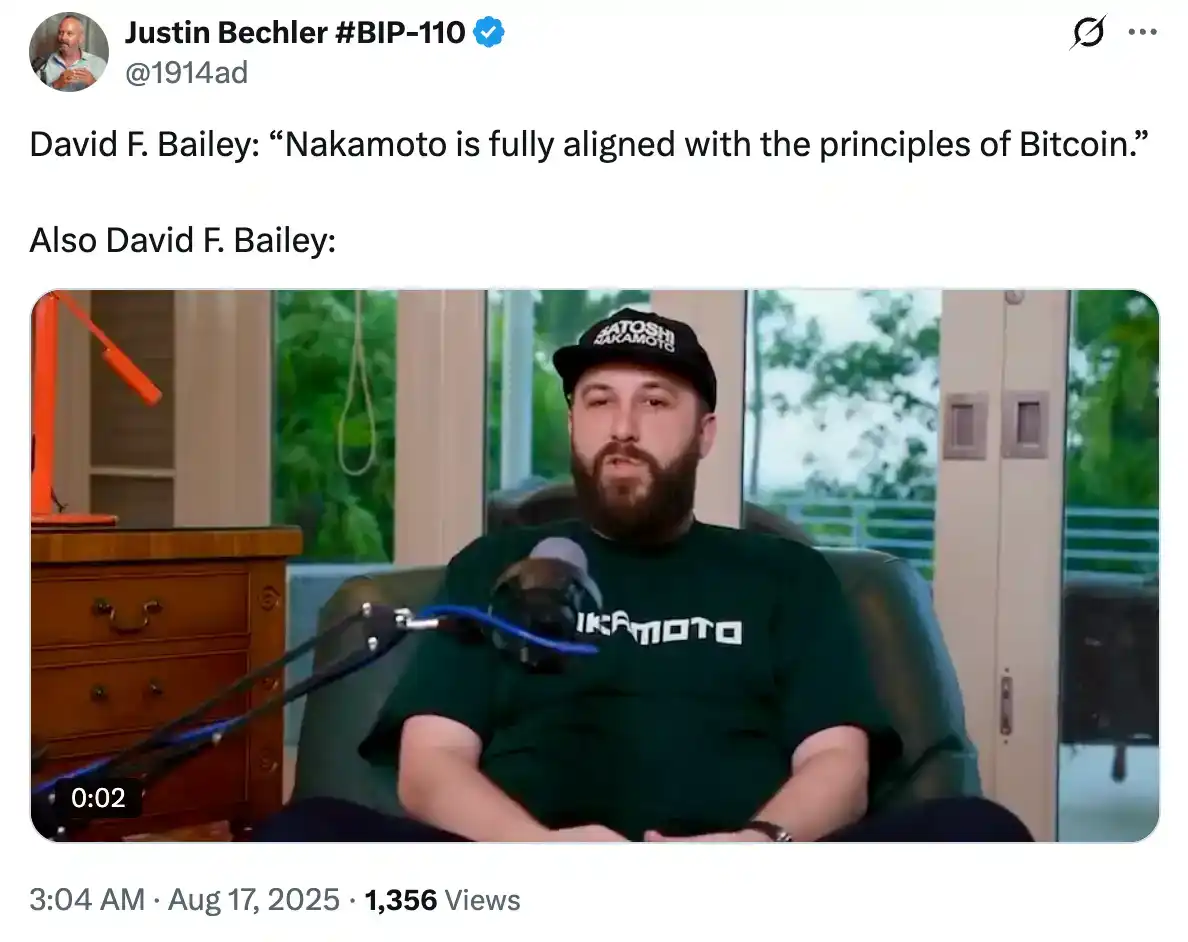
Nine months later, the stock price fell to 29 cents, and Bailey just used this stock to buy his own companies.

The Pump

The mechanism was quite ingeniously designed.

KindlyMD was originally an unnoticed micro-cap stock on Nasdaq. Nakamoto Holdings went public through a reverse merger, backed by $510 million in PIPE (Private Investment in Public Equity) financing and $200 million in convertible bonds.

On paper, it seemed like the birth of a Bitcoin reserve giant, with a new generation of Bitcoin influencers rushing to tell you why to buy $NAKA (of course, the reason was to own more Bitcoin).

Within days, NAKA's price-to-NAV ratio reached an astonishing 23x, meaning speculators paid $23 for every $1 of Bitcoin held by the company.

Michael Saylor's MicroStrategy never reached such a premium. The difference is that MicroStrategy has years of operational history, a software business generating actual revenue, and a CEO who didn't manipulate the transaction structure to enrich himself on the backend.

Insiders knew secrets that retail investors didn't. The PIPE investors—including the notorious BIP-110 opponents Udi Wertheimer, Jameson Lopp, and Adam Back—got in at $1.12 per share. Retail investors bought at $28, $30, $31, and even higher.

This information asymmetry was built into the structure from day one.

In June, Bailey completed another $51.5 million PIPE financing at $5.00 per share. Although the second batch of investors got in at a much lower cost than retail, it was still far above the $1.12 floor price, and they were ultimately harvested too.

Bailey celebrated the financing, saying it took less than 72 hours and investor demand was extremely strong.

Let's take a closer look at this strategy.

The Dump

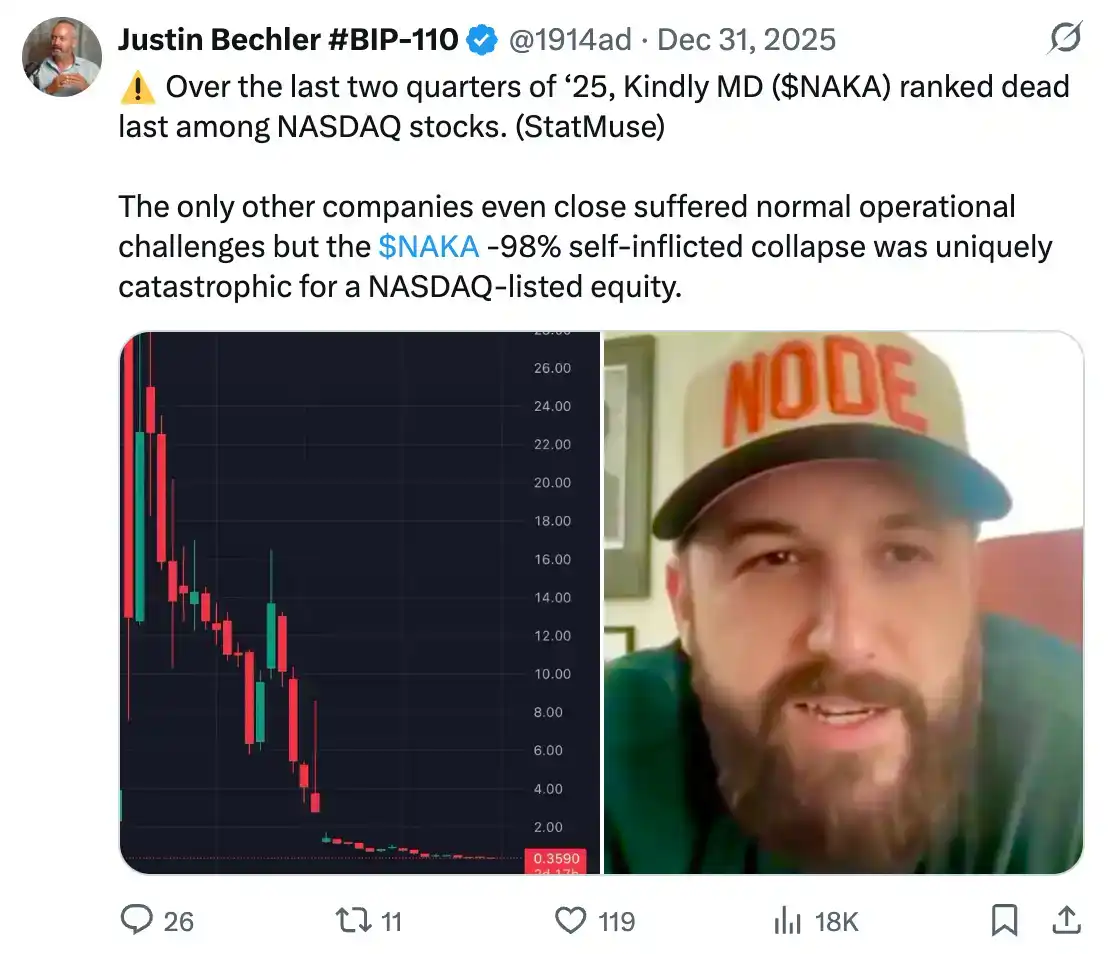
By September, NAKA had plummeted by 96%.

The early PIPE investors who obtained shares at $1.12 could finally cash out after the merger was completed in August, and they did so.

Bailey's response was quite bizarre for a public company CEO; he told shareholders who were just there for a quick trade to leave.

So they left.

The stock price continued to fall. Below $1. Below 50 cents. Below 30 cents. A company holding about 5,765 Bitcoins (worth over $500 million) now had a market cap of less than $300 million.

The market valued Nakamoto even lower than the Bitcoin on its balance sheet, which says a lot about how investors view the management team and corporate structure wrapped around these Bitcoins.
Debt Spiral

As the stock price crashed, Bailey changed lenders frequently, like a gambler borrowing money on the casino floor.

The initial capital structure included $200 million in convertible bonds from Yorkville Advisors, with a conversion price of $2.80. As NAKA's stock price fell below this level, the convertible bonds became debt that could devour equity. So, on October 3, Nakamoto took out a $203 million term loan from Two Prime Lending to redeem Yorkville's notes and interest.

Four days later, on October 7, they borrowed $206 million in USDT from Antalpha at 7% interest to repay Two Prime. Antalpha's loan had a term of only 30 days (with an option to extend for another 30 days). They replaced the term loan with a 30-day bridge loan within a week.

The plan was to convert this bridge loan into a $250 million 5-year secured convertible bond from Antalpha. Use the new convertible to repay the bridge loan, the bridge loan to repay the term loan, and the term loan to repay the old convertible.

But that $250 million convertible never materialized on Antalpha's terms.

On December 16, Nakamoto borrowed $210 million in USDT from Kraken at 8% interest, over-collateralized by 150% with Bitcoin from its treasury.
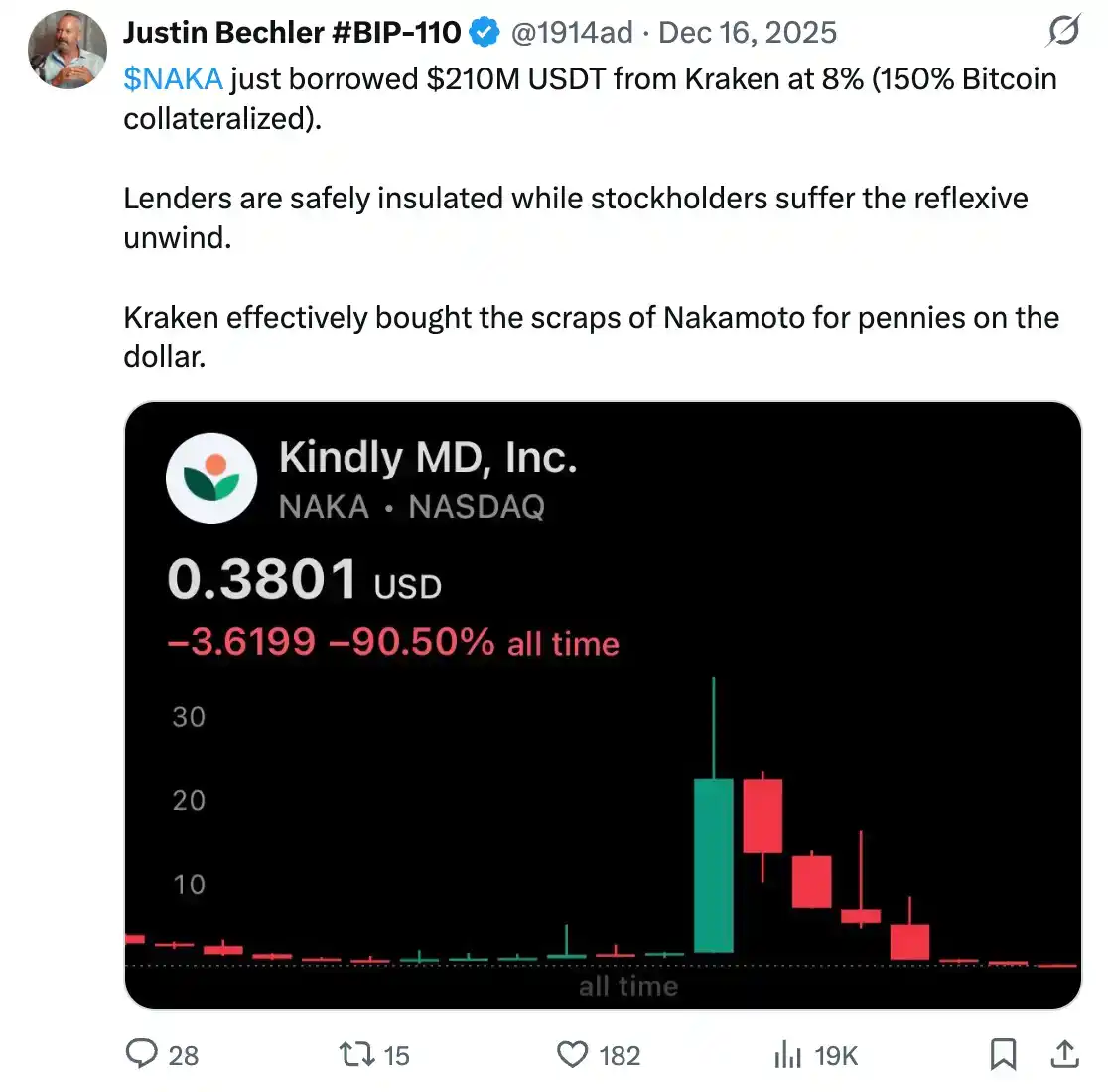
Do the math: The lender has $315 million worth of Bitcoin as collateral for a $210 million loan. If NAKA's stock goes to zero, Kraken takes the collateral. If Bitcoin drops 33%, Kraken remains unscathed. At every stage of this drama, the lenders were tightly protected, while common shareholders bore the full brunt of the reflexive crash.

Each new loan tightened the noose.

Countdown

On December 10, Nasdaq notified Nakamoto that it faced delisting risk because its stock price had been below $1 for 30 consecutive business days. The company must regain compliance by June 8, 2026, meaning the closing price must be above $1 for 10 consecutive trading days.

The current stock price is 29 cents.
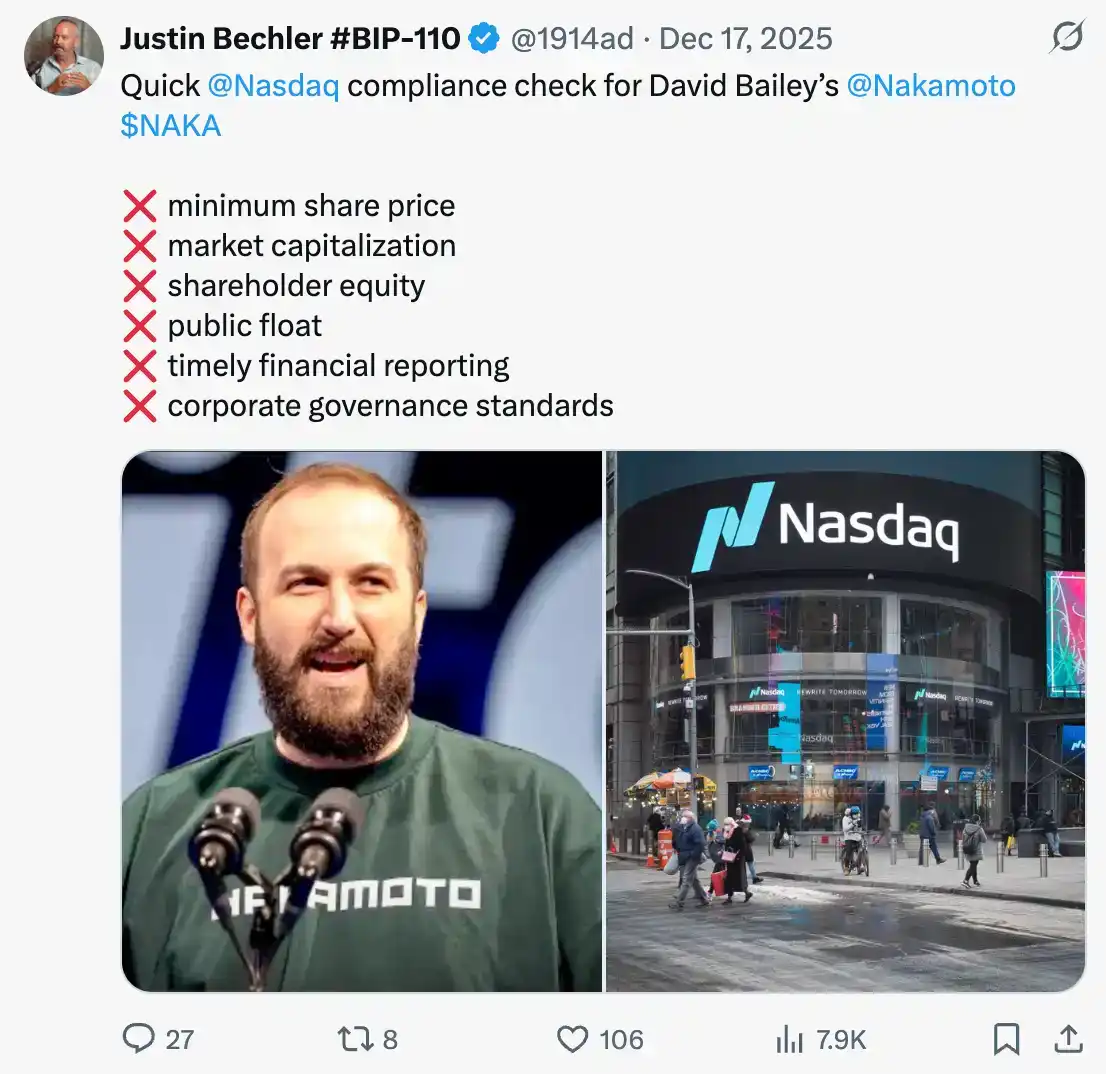
If delisted, Nakamoto would be unable to conduct ATM (at-the-Market) offerings, issue convertible bonds, or use stock as acquisition currency. Everything Bailey assembled in this shell relies on a Nasdaq listing that currently cannot be maintained.

Accounting Disaster

In November, Nakamoto filed a Form 12b-25 with the SEC, admitting it could not submit its quarterly financial report on time due to accounting complexities from the merger. Preliminary data revealed the truth:

The Nakamoto acquisition resulted in a $59.75 million loss (payment price higher than net asset value)

$22.07 million unrealized loss on digital assets

$1.41 million realized loss from selling Bitcoin

$14.45 million loss on debt extinguishment from refinancing rotations

A quarterly loss of approximately $97 million, partially offset by a $21.8 million accounting gain from contingent liabilities. This company, which was supposed to be the perfect Bitcoin reserve tool, couldn't even submit its books on time.

The Heist

This brings us back to this morning.

Nakamoto announced signing a definitive merger agreement to acquire BTC Inc and UTXO Management. BTC Inc owns Bitcoin Magazine and operates the Bitcoin Conference. UTXO manages a Bitcoin-focused hedge fund.

Bailey is the Chairman and CEO of the buyer, Nakamoto.

He is also the founder of the sellers, BTC Inc and UTXO.

He is the buyer, the seller, and the CEO approving the terms.

But weeks before the acquisition, he quietly handed the CEO title to Brandon Greene, creating a paper-thin separation between himself and the entities he was about to buy with shareholder equity.

This morning's deal was entirely financed with Nakamoto stock, priced at $1.12 per share based on a call option embedded in the original marketing services agreement. And $NAKA is still struggling to climb back to $0.29.

Bailey's companies received a stock valuation nearly four times the current market price. Security holders of BTC Inc and UTXO will receive 363.6 million shares, valuing the deal at $107.3 million at market prices.

But these shares were issued at $1.12, meaning the deal was structured when NAKA's stock was flying high, and the terms were never adjusted when the stock crashed.

Forget the fictional pricing on the contract. What really matters is that 363.6 million new shares just entered the float. Regardless of whether the documents say $1.12 or $0.29, existing shareholders were diluted by this quantity. The $1.12 label is a courtesy to the seller, but the dilution is real.

No additional shareholder approval was needed because the call option was already embedded in the original merger documents, and shareholders voted to approve them when NAKA's stock was still at $20, $30.

The retail investors who approved these terms had no idea they were authorizing the future acquisition of Bailey's private business at a locked-in high premium while their own shares were turning to dust.

Architecture of Self-Dealing

Stepping back, the entire architecture is breathtakingly elegant.
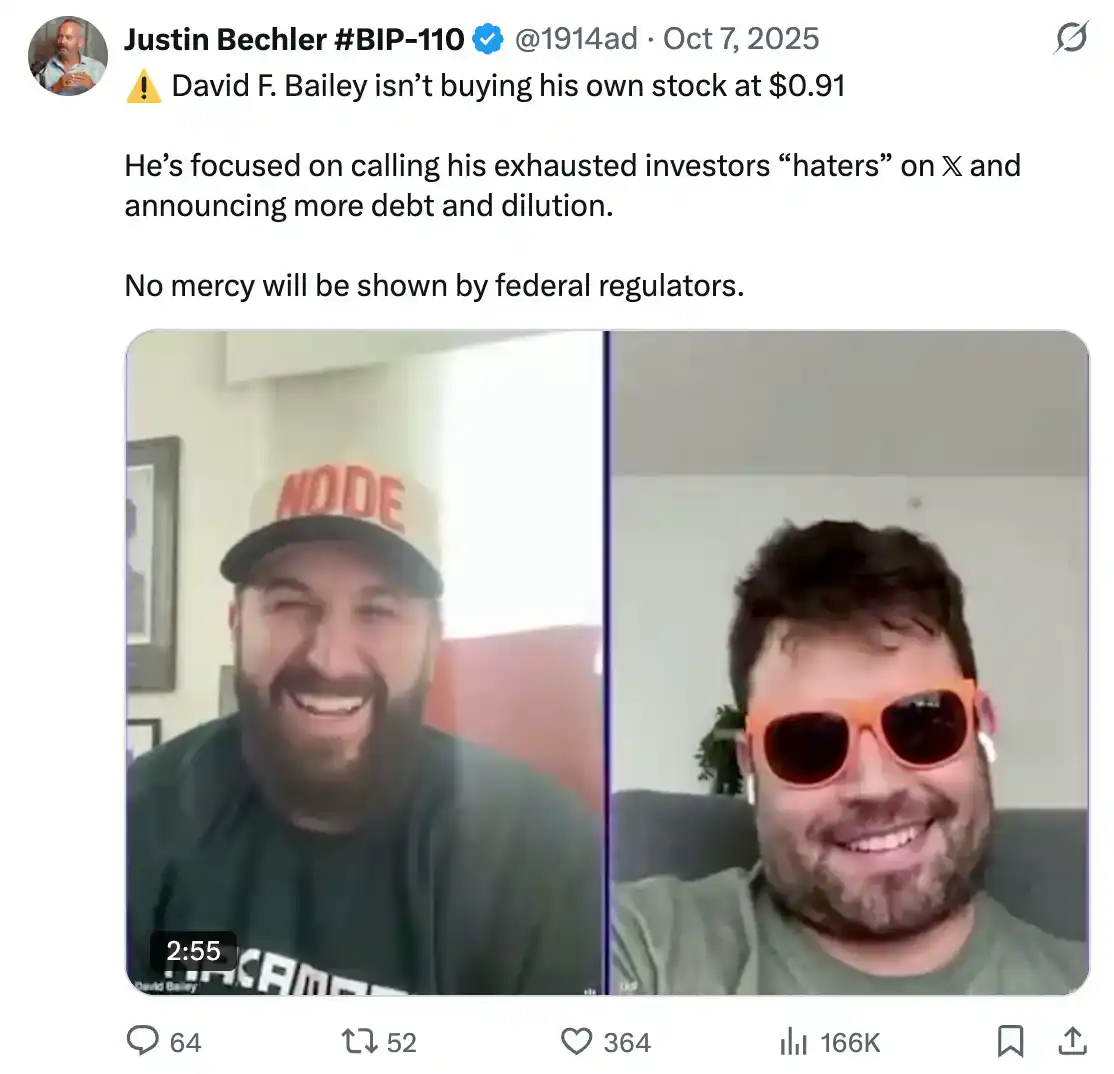
Bailey created Nakamoto Holdings. Merged it into a public shell company via KindlyMD, raising $710 million in the process. Driven by retail enthusiasm, the stock was pumped to 23x NAV. PIPE investors got in at $1.12, while the public paid 20 to 30 times that. The stock then crashed 99%.

During this time, the company changed lenders three times in a week, trying to manage $200 million in debt that was structured to convert to equity when the stock price was much higher.

Now, with the shattered stock price below 30 cents, Bailey is using this hollowed-out tool to swallow his private empire at terms agreed upon when the stock was a hundred times higher. The initial KindlyMD merger was the Trojan horse, and the acquisition of BTC Inc was the real payload.

Bailey told us from the start. In the initial press release, he said Nakamoto would acquire BTC Inc, subject to audit and call option exercise. The MSA was publicly filed, and the option terms were disclosed. Everything was legally compliant and fully transparent—just like all complex financial engineering, the truth was buried in piles of documents no one would read.

The person who operates Bitcoin Magazine, organizes the world's largest Bitcoin conference, and positions himself as a leader of the Bitcoin movement, built a public company, destroyed 99% of shareholder value, and is now using it to acquire his own businesses at a premium.

He once compared himself to the Medicis. At least the Medicis created value for Florence before taking their cut.

Nakamoto is the freak show that happens when influencer culture meets the public stock market.

Exit Liquidity

David Bailey raised $710 million from over 200 investors across six continents. He promised them a future like the Morgans, Medicis, and Rothschilds, a financial dynasty built on Bitcoin. He told them Nakamoto would bring Bitcoin to the center of global capital markets. He said their names would echo through history.

But he delivered a 99% loss.

He priced the PIPE at $1.12 while retail bought at $28. He embedded call options to acquire his own companies into the filings without shareholders understanding what they were authorizing. He rotated three lenders in a week to prevent $200 million in debt from crushing equity, accumulating $14 million in debt extinguishment losses along the way. He sold Bitcoin at a loss from the treasury that was supposed to only accumulate, not sell. He couldn't even submit quarterly financial reports on time. And when the stock price finally fell to 29 cents...

When the rubble was cleared and the retail investors who trusted him were wiped out, he exercised that call option, using the wreckage of their investment to buy his private empire at four times the market price.

Bailey holds 11 million shares at a cost of $1.12. Adam Back holds nearly 9 million shares. Balaji, Lopp, Yusko, Salinas, Jihan Wu—they all got in at a price that teachers, truck drivers, or first-time investors could never access. These are the people who shape the Bitcoin narrative. They run conferences, publish magazines, manage funds, post tweets. They are the supply chain of belief, turning skeptics into believers and believers into bag holders.

Now, Bailey owns Bitcoin Magazine, the Bitcoin Conference, and a hedge fund, all packed into a public company with a market cap only a fraction of its Bitcoin holdings, all acquired with stock priced four times the market value, all approved before a single cent from retail entered.

And he's not done.

Nakamoto has already filed with the SEC for a $5 billion ATM (At-the-Market) stock offering. Bailey now controls the media division, the conference division, the hedge fund, and a shelf registration that allows him to keep issuing stock collateralized by the Bitcoin treasury until the last bit of value is squeezed out.

When exactly did the Bitcoin community hand the keys to conference promoters and influencer capitalists? And why is anyone surprised when they drive away with the car?


Domande pertinenti

QWhat was the key mechanism David Bailey used to acquire his private companies at a premium using the struggling Nakamoto Holdings stock?

AHe utilized a call option embedded in the original marketing services agreement, which was approved by shareholders when the stock price was high, allowing the acquisition at $1.12 per share despite the market price collapsing to $0.29.

QHow did the PIPE investors benefit from the retail investors in the Nakamoto Holdings deal?

APIPE investors, including prominent Bitcoin figures, acquired shares at $1.12, while retail investors bought in at prices 20 to 30 times higher, around $28 to $31, creating a massive information asymmetry from the start.

QWhat was the consequences of Nakamoto's stock price falling below $1 for an extended period?

AThe company received a delisting notice from Nasdaq, threatening its ability to conduct ATM offerings, issue convertible notes, or use its stock as acquisition currency, which was crucial for Bailey's plans.

QWhat financial maneuvers did Nakamoto employ to manage its $200 million debt as the stock price collapsed?

AThe company rapidly cycled through lenders, first replacing a convertible note with a term loan, then a 30-day bridge loan, and finally a loan from Kraken secured by 150% over-collateralization of its Bitcoin treasury, accruing significant losses in the process.

QHow did David Bailey structure the acquisition to avoid additional shareholder approval for buying his own companies?

AThe call option for the acquisition was pre-approved by shareholders in the initial merger documents when the stock was highly valued, so no further vote was required when the deal was executed after the price crash.

Letture associate

Trading

Spot
Futures

Articoli Popolari

Cosa è BITCOIN

Comprendere HarryPotterObamaSonic10Inu (ERC-20) e la sua posizione nel mondo delle criptovalute Negli ultimi anni, il mercato delle criptovalute ha assistito a un aumento della popolarità delle meme coin, catturando l'interesse non solo dei trader, ma anche di coloro che cercano coinvolgimento comunitario e valore di intrattenimento. Tra questi token unici c'è HarryPotterObamaSonic10Inu (ERC-20), un progetto intrigante che mescola riferimenti culturali nel tessuto delle criptovalute. Questo articolo esplora gli aspetti chiave di HarryPotterObamaSonic10Inu, analizzando i suoi meccanismi, l'etica guidata dalla comunità e il suo coinvolgimento con il panorama crittografico più ampio. Che cos'è HarryPotterObamaSonic10Inu (ERC-20)? Come suggerisce il suo nome, HarryPotterObamaSonic10Inu è una meme coin costruita sulla blockchain di Ethereum, classificata secondo lo standard ERC-20. A differenza delle criptovalute tradizionali che possono enfatizzare l'utilità pratica o il potenziale investimento, questo token prospera grazie al valore di intrattenimento e alla forza della sua comunità. Il progetto mira a creare un ambiente in cui gli utenti coinvolti possono riunirsi, condividere idee e partecipare ad attività ispirate a diversi fenomeni culturali. Una caratteristica notevole di HarryPotterObamaSonic10Inu è la zero tassa sulle transazioni. Questo elemento allettante tende a incoraggiare il trading e il coinvolgimento della comunità, privo di costi aggiuntivi che possono scoraggiare i trader di piccole dimensioni. L'offerta totale della moneta è fissata a un miliardo di token, un numero che segna la sua intenzione di mantenere una circolazione sostanziale all'interno della comunità. Creatore di HarryPotterObamaSonic10Inu (ERC-20) Le origini di HarryPotterObamaSonic10Inu sono avvolte in un certo mistero; i dettagli sul creatore rimangono sconosciuti. Lo sviluppo di questo token non presenta un team identificabile o un piano esplicito, cosa non rara nel settore delle meme coin. Invece, il progetto è emerso organicamente, con il suo progresso fortemente dipendente dall'entusiasmo e dalla partecipazione della sua comunità. Investitori di HarryPotterObamaSonic10Inu (ERC-20) Per quanto riguarda investimenti esterni e finanziamenti, HarryPotterObamaSonic10Inu rimane ambiguo. Il token non elenca alcuna fondazione di investimento conosciuta o un sostegno organizzativo significativo. Invece, la linfa vitale del progetto è la sua comunità di base, che informa la sua crescita e sostenibilità attraverso azioni collettive e coinvolgimento nello spazio crittografico. Come funziona HarryPotterObamaSonic10Inu (ERC-20)? In quanto meme coin, HarryPotterObamaSonic10Inu opera principalmente al di fuori delle strutture tradizionali che governano spesso il valore degli asset. Ci sono diversi aspetti distintivi che definiscono il funzionamento del progetto: Transazioni senza tasse: Senza costi fiscali sulle transazioni, gli utenti possono comprare e vendere liberamente il token senza preoccuparsi di costi nascosti. Coinvolgimento della comunità: Il progetto prospera sull'interazione della comunità, sfruttando le piattaforme social per creare entusiasmo e facilitare il coinvolgimento. Discussioni, condivisione di contenuti e coinvolgimento sono elementi cruciali che aiutano ad espandere la sua portata e a favorire la lealtà tra i sostenitori. Nessuna utilità pratica: Va notato che HarryPotterObamaSonic10Inu non offre un'utilità concreta all'interno dell'ecosistema finanziario. Piuttosto, è classificato come un token principalmente per attività di intrattenimento e comunitarie. Riferimento culturale: Il token incorpora astutamente elementi della cultura pop per attirare interesse, collegandosi a appassionati di meme e seguaci delle criptovalute. HarryPotterObamaSonic10Inu esemplifica come le meme coin operino in modo diverso rispetto ai progetti di criptovalute più tradizionali, entrando nel mercato come costrutti sociali innovativi piuttosto che come asset utilitari. Cronologia di HarryPotterObamaSonic10Inu (ERC-20) La storia di HarryPotterObamaSonic10Inu è segnata da diversi traguardi notevoli: Creazione: Il token è emerso da un meme virale, catturando l'immaginazione di molti appassionati di criptovalute. Le date di creazione specifiche non sono disponibili, sottolineando la sua crescita organica. Inserimento negli scambi: HarryPotterObamaSonic10Inu ha fatto il suo ingresso in vari scambi, consentendo un accesso e un trading più facili da parte della comunità. Iniziative di coinvolgimento della comunità: Attività in corso volte a migliorare l'interazione della comunità, comprese gare, campagne sui social media e generazione di contenuti da parte di fan e sostenitori. Piani di espansione futura: La tabella di marcia del progetto include il lancio di una collezione NFT, merchandising e un sito di eCommerce relativo ai suoi temi culturali, coinvolgendo ulteriormente la comunità e cercando di aggiungere più dimensioni al suo ecosistema. Punti chiave su HarryPotterObamaSonic10Inu (ERC-20) Natura guidata dalla comunità: Il progetto dà priorità al contributo collettivo e alla creatività, garantendo che il coinvolgimento degli utenti sia al centro del suo sviluppo. Classificazione come meme coin: Rappresenta l'epitome delle criptovalute basate sull'intrattenimento, distinguendosi dai veicoli d'investimento tradizionali. Nessuna affiliazione diretta con Bitcoin: Nonostante la somiglianza nel nome del ticker, HarryPotterObamaSonic10Inu è distintivo e non ha alcuna relazione con Bitcoin o altre criptovalute consolidate. Focus sulla collaborazione: HarryPotterObamaSonic10Inu è progettato per creare uno spazio per la collaborazione e la condivisione di storie tra i suoi detentori, fornendo un canale per la creatività e il legame comunitario. Prospettive future: L'ambizione di espandersi oltre il suo presupposto iniziale verso NFT e merchandising delinea un percorso per il progetto per potenzialmente entrare in strade più mainstream all'interno della cultura digitale. Poiché le meme coin continuano a catturare l'immaginazione della comunità crittografica, HarryPotterObamaSonic10Inu (ERC-20) si distingue per i suoi legami culturali e il suo approccio centrato sulla comunità. Anche se potrebbe non adattarsi al modello tipico di un token orientato all'utilità, la sua essenza risiede nella gioia e nella camaraderia coltivate tra i suoi sostenitori, evidenziando la natura in evoluzione delle criptovalute in un'epoca sempre più digitale. Con la continuazione dello sviluppo del progetto, sarà importante osservare come le dinamiche della comunità influenzano la sua traiettoria nel panorama in continuo cambiamento della tecnologia blockchain.

1.3k Totale visualizzazioniPubblicato il 2024.04.01Aggiornato il 2024.12.03

Cosa è BITCOIN

Come comprare BTC

Benvenuto in HTX.com! Abbiamo reso l'acquisto di Bitcoin (BTC) semplice e conveniente. Segui la nostra guida passo passo per intraprendere il tuo viaggio nel mondo delle criptovalute.Step 1: Crea il tuo Account HTXUsa la tua email o numero di telefono per registrarti il tuo account gratuito su HTX. Vivi un'esperienza facile e sblocca tutte le funzionalità,Crea il mio accountStep 2: Vai in Acquista crypto e seleziona il tuo metodo di pagamentoCarta di credito/debito: utilizza la tua Visa o Mastercard per acquistare immediatamente BitcoinBTC.Bilancio: Usa i fondi dal bilancio del tuo account HTX per fare trading senza problemi.Terze parti: abbiamo aggiunto metodi di pagamento molto utilizzati come Google Pay e Apple Pay per maggiore comodità.P2P: Fai trading direttamente con altri utenti HTX.Over-the-Counter (OTC): Offriamo servizi su misura e tassi di cambio competitivi per i trader.Step 3: Conserva Bitcoin (BTC)Dopo aver acquistato Bitcoin (BTC), conserva nel tuo account HTX. In alternativa, puoi inviare tramite trasferimento blockchain o scambiare per altre criptovalute.Step 4: Scambia Bitcoin (BTC)Scambia facilmente Bitcoin (BTC) nel mercato spot di HTX. Accedi al tuo account, seleziona la tua coppia di trading, esegui le tue operazioni e monitora in tempo reale. Offriamo un'esperienza user-friendly sia per chi ha appena iniziato che per i trader più esperti.

3.6k Totale visualizzazioniPubblicato il 2024.12.12Aggiornato il 2025.03.21

Come comprare BTC

Cosa è $BITCOIN

ORO DIGITALE ($BITCOIN): Un'Analisi Completa Introduzione all'ORO DIGITALE ($BITCOIN) L'ORO DIGITALE ($BITCOIN) è un progetto basato su blockchain che opera sulla rete Solana, con l'obiettivo di combinare le caratteristiche dei metalli preziosi tradizionali con l'innovazione delle tecnologie decentralizzate. Sebbene condivida un nome con Bitcoin, spesso definito “oro digitale” a causa della sua percezione come riserva di valore, l'ORO DIGITALE è un token separato progettato per creare un ecosistema unico all'interno del panorama Web3. Il suo obiettivo è posizionarsi come un asset digitale alternativo valido, anche se i dettagli riguardanti le sue applicazioni e funzionalità sono ancora in fase di sviluppo. Cos'è l'ORO DIGITALE ($BITCOIN)? L'ORO DIGITALE ($BITCOIN) è un token di criptovaluta esplicitamente progettato per l'uso sulla blockchain di Solana. A differenza di Bitcoin, che fornisce un ruolo di stoccaggio di valore ampiamente riconosciuto, questo token sembra concentrarsi su applicazioni e caratteristiche più ampie. Aspetti notevoli includono: Infrastruttura Blockchain: Il token è costruito sulla blockchain di Solana, nota per la sua capacità di gestire transazioni ad alta velocità e a basso costo. Dinamiche di Offerta: L'ORO DIGITALE ha un'offerta massima fissata a 100 quadrilioni di token (100P $BITCOIN), sebbene i dettagli riguardanti la sua offerta circolante siano attualmente non divulgati. Utilità: Sebbene le funzionalità precise non siano esplicitamente delineate, ci sono indicazioni che il token potrebbe essere utilizzato per varie applicazioni, potenzialmente coinvolgendo applicazioni decentralizzate (dApp) o strategie di tokenizzazione degli asset. Chi è il Creatore dell'ORO DIGITALE ($BITCOIN)? Attualmente, l'identità dei creatori e del team di sviluppo dietro l'ORO DIGITALE ($BITCOIN) rimane sconosciuta. Questa situazione è tipica tra molti progetti innovativi nel settore blockchain, in particolare quelli allineati con la finanza decentralizzata e i fenomeni delle meme coin. Sebbene tale anonimato possa favorire una cultura guidata dalla comunità, intensifica le preoccupazioni riguardo alla governance e alla responsabilità. Chi sono gli Investitori dell'ORO DIGITALE ($BITCOIN)? Le informazioni disponibili indicano che l'ORO DIGITALE ($BITCOIN) non ha alcun sostenitore istituzionale noto o investimenti di venture capital prominenti. Il progetto sembra operare su un modello peer-to-peer incentrato sul supporto e sull'adozione della comunità piuttosto che su percorsi di finanziamento tradizionali. La sua attività e liquidità si trovano principalmente su exchange decentralizzati (DEX), come PumpSwap, piuttosto che su piattaforme di trading centralizzate consolidate, evidenziando ulteriormente il suo approccio di base. Come Funziona l'ORO DIGITALE ($BITCOIN) Le meccaniche operative dell'ORO DIGITALE ($BITCOIN) possono essere elaborate in base al suo design blockchain e alle caratteristiche della rete: Meccanismo di Consenso: Sfruttando il proof-of-history (PoH) unico di Solana combinato con un modello di proof-of-stake (PoS), il progetto garantisce una validazione efficiente delle transazioni contribuendo all'alta performance della rete. Tokenomics: Sebbene meccanismi deflazionistici specifici non siano stati dettagliati ampiamente, l'ampia offerta massima di token implica che potrebbe soddisfare microtransazioni o casi d'uso di nicchia che devono ancora essere definiti. Interoperabilità: Esiste il potenziale per l'integrazione con l'ecosistema più ampio di Solana, inclusi vari piattaforme di finanza decentralizzata (DeFi). Tuttavia, i dettagli riguardanti integrazioni specifiche rimangono non specificati. Cronologia degli Eventi Chiave Ecco una cronologia che evidenzia traguardi significativi riguardanti l'ORO DIGITALE ($BITCOIN): 2023: Il dispiegamento iniziale del token avviene sulla blockchain di Solana, contrassegnato dal suo indirizzo di contratto. 2024: L'ORO DIGITALE guadagna visibilità poiché diventa disponibile per il trading su exchange decentralizzati come PumpSwap, consentendo agli utenti di scambiarlo contro SOL. 2025: Il progetto assiste a un'attività di trading sporadica e a un potenziale interesse per impegni guidati dalla comunità, sebbene non siano state documentate partnership significative o avanzamenti tecnici fino ad ora. Analisi Critica Punti di Forza Scalabilità: L'infrastruttura sottostante di Solana supporta alti volumi di transazioni, il che potrebbe migliorare l'utilità di $BITCOIN in vari scenari di transazione. Accessibilità: Il potenziale basso prezzo di trading per token potrebbe attrarre investitori al dettaglio, facilitando una partecipazione più ampia grazie a opportunità di proprietà frazionata. Rischi Mancanza di Trasparenza: L'assenza di sostenitori, sviluppatori o di un processo di audit pubblicamente noti potrebbe generare scetticismo riguardo alla sostenibilità e all'affidabilità del progetto. Volatilità del Mercato: L'attività di trading è fortemente dipendente dal comportamento speculativo, il che può comportare una significativa volatilità dei prezzi e incertezze per gli investitori. Conclusione L'ORO DIGITALE ($BITCOIN) emerge come un progetto intrigante ma ambiguo all'interno dell'evolvente ecosistema di Solana. Sebbene tenti di sfruttare la narrativa dell'“oro digitale”, la sua partenza dal ruolo consolidato di Bitcoin come riserva di valore sottolinea la necessità di una chiara differenziazione della sua utilità e struttura di governance. L'accettazione e l'adozione future dipenderanno probabilmente dall'affrontare l'attuale opacità e dalla definizione più esplicita delle sue strategie operative ed economiche. Nota: Questo rapporto comprende informazioni sintetizzate disponibili a ottobre 2023, e potrebbero essersi verificati sviluppi oltre il periodo di ricerca.

99 Totale visualizzazioniPubblicato il 2025.05.13Aggiornato il 2025.05.13

Cosa è $BITCOIN

Discussioni

Benvenuto nella Community HTX. Qui puoi rimanere informato sugli ultimi sviluppi della piattaforma e accedere ad approfondimenti esperti sul mercato. Le opinioni degli utenti sul prezzo di BTC BTC sono presentate come di seguito.

活动图片