The Scriptures Chanted by OpenAI and Anthropic Might Be Crooked

marsbitPubblicato 2026-05-28Pubblicato ultima volta 2026-05-28

Introduzione

In the current AI landscape, "Harness-style" Multi-Agent Systems (MAS)—where multiple AI agents with temporary roles collaborate under a central workflow for task efficiency—dominates the conversation, championed by players like OpenAI and Anthropic. However, the author argues this approach, focused on orchestration and software engineering, may be misguided. A more transformative, yet less discussed, alternative is the "Protocol-Native Agent System." Here, the core unit shifts from task-specific agents to persistent "Personal Agents" or "unmanned companies" that represent individuals. These agents possess sovereignty, long-term memory, identity, resources, and relationships. This paradigm change transforms MAS from a distributed software system into a digital society. Collaboration can no longer rely on shared prompts or context, but must be built on protocols governing identity, trust, incentives, reputation, and value exchange—essentially, "Protocol as Organization." The future's true challenge lies not in improving single-agent capabilities, but in enabling long-term coordination among autonomous entities with differing goals, world models, and values. The author suggests that future organizations might themselves be dynamic alliances of such sovereign agents, leading to an "intelligence-native civilization."

Over the past year, "Multi-Agent System (MAS)" has become one of the hottest directions in the AI world.

A large number of frameworks and products have emerged simultaneously. The most famous among them are obviously Claude Code and Codex. This step indeed makes money, but this path might not be the right one!

The early internet was about portals, but that wasn't the final form!

At the very least, we should know there is another path entirely parallel to this.

Today, we are talking about what other routes exist besides: "How multiple AI Agents collaborate to complete complex tasks."

Let's first summarize this popular and familiar route.

We can touch on this topic a bit in a live stream, but I don't want to focus entirely on it. There aren't many people watching anyway, and I'm worried it might get the stream taken down...

The First Route: Harness-style MAS

This is the current mainstream direction for MAS. Its essence is: "Multiple AI roles collaborate to complete tasks." For example:

  • One Agent writes code
  • One Agent does testing
  • One Agent does planning
  • One Agent does searching
  • One Agent does review

They cooperate with each other, forming an automated workflow. The core characteristics of such systems are:

  • Shared context
  • Shared goal
  • Centralized scheduling
  • Temporary roles
  • No long-term identity
  • No sustained interests
  • No true ownership

Essentially, it's more like: A Workflow Engine. Adding Ontology merely makes the workflow flexible and complex; it doesn't change this essence.

It is not a Society. So, most of today's MAS is essentially LLM Orchestration, where one large model schedules multiple sub-roles to complete complex reasoning.

The Agent here is more like:

  • A callable function
  • A tool with personality
  • A task node

Their existence is to improve the efficiency of completing individual tasks. Therefore, keywords associated with Harness MAS are (each has been hot, and might even cycle back):

  • Prompt Engineering
  • Context Management
  • Task Routing
  • Tool Calling
  • Planning
  • Memory
  • Workflow

Essentially, I think this still falls under software engineering problems. So, the experienced "old masters" good at programming have been reborn. To control these things well, without solid programming skills and good abstraction ability, it's actually very difficult to manage.

If you can't manage it, the large model will be like the Monkey King, occasionally popping out and hitting you with a stick.

The word "Harness" is used in reverse here.

Springtime for the old masters.

The Second Route: Protocol-Native Agent System

But there is another route, one almost nobody mentions. I've written a bit about it in my upcoming new book, but this line of thinking actually presupposes the concept of an "unmanned company." Without deeply understanding the unmanned company, it's easy to misunderstand.

The core of this route is no longer about multiple Agents completing tasks. Instead, it's "each person owns their own Personal Agent" or "each person owns their own dedicated unmanned company."

This is an extremely huge change. Because when an Agent truly belongs to an "individual," the nature of the Agent undergoes a fundamental transformation.

It is no longer task-scoped, but becomes identity-scoped. These are two terms the model helped me coin; I struggled for a long time to come up with the English words.

The core idea here is actually decision-making sovereignty. The biggest difference between a Personal Agent/an unmanned company and a general system is that they need to have a certain kind of sovereignty. Otherwise, the essence discussed later doesn't hold. The difference between an unmanned company and an unmanned system also lies in the sovereignty over cash flow.

In other words, the future Personal Agent or unmanned company needs to possess the following characteristics:

  • Has long-term memory
  • Has a persistent identity
  • Has preferences
  • Has resources
  • Has permissions
  • Has history
  • Has a relationship network
  • Has interests/boundaries
  • Has representation (represents "you")

It is no longer a one-time AI Tool. It is a continuously existing proxy personality with a certain kind of sovereignty.

Dual-native architecture, the key to not misusing AI.

From "Software Module" to "Digital Society"

Once entering the world of Personal Agents and true unmanned companies, the entire system philosophy changes completely. Because Agents are no longer:

  • Belonging to the same model
  • Belonging to the same company
  • Sharing the same context
  • Sharing the same goal

Therefore, collaboration between systems can no longer rely on (this current hot keyword list can be extended further):

  • Prompt
  • Workflow
  • Shared Context

It can only rely on protocols (Protocol). This means: the core of the AI world will shift from Prompt Engineering to Protocol Engineering. It also means the various current hot keywords become largely meaningless.

Why will protocol become the core? Because when massive Agents exist independently, they must solve among themselves:

  • Identity confirmation
  • Permission boundaries
  • Trust mechanisms
  • Delegation relationships
  • Negotiation mechanisms
  • Incentive mechanisms
  • Reputation systems
  • Value exchange
  • Capability declaration
  • Long-term contracts

These needs are different from the needs of current task-oriented multi-agents. At this point, interactions between Agents are no longer like API Calls, but more like Institutional Interaction. With sovereignty comes a complex intertwined system of rights and responsibilities. For humans, this is contracts, laws, etc. What about for intelligent agents?

This is why it was said earlier that this would build a completely different kind of Multi-Agent System. Here, the essence of MAS changes from a distributed software system to a digital social system.

Philosophical Notes (7)

"Protocol as Organization"

In the traditional internet, the role of protocols is data communication, where the sender and receiver agree on the format for talking to each other. For example:

  • TCP/IP
  • HTTP
  • SMTP

They define how data is transmitted. In the blockchain world, protocols have further evolved into: Protocol as State Computation. For example: The essence of Ethereum is not merely message passing, but the entire network jointly executing state transition rules. Thus all nodes: Same input → Same execution → Same state. For the first time, protocol becomes a shared state machine.

But entering the stage of Agent Society, protocols will continue to evolve. Future protocols will not only define:

  • Communication
  • Computation
  • But also define:
  • Coordination
  • Permissions
  • Incentives
  • Identity
  • Organizational relationships

This is clearly a brand-new system of rights and responsibilities, so protocols will begin to assume the function of "organization." Ultimately evolving into: Protocol as Organization.

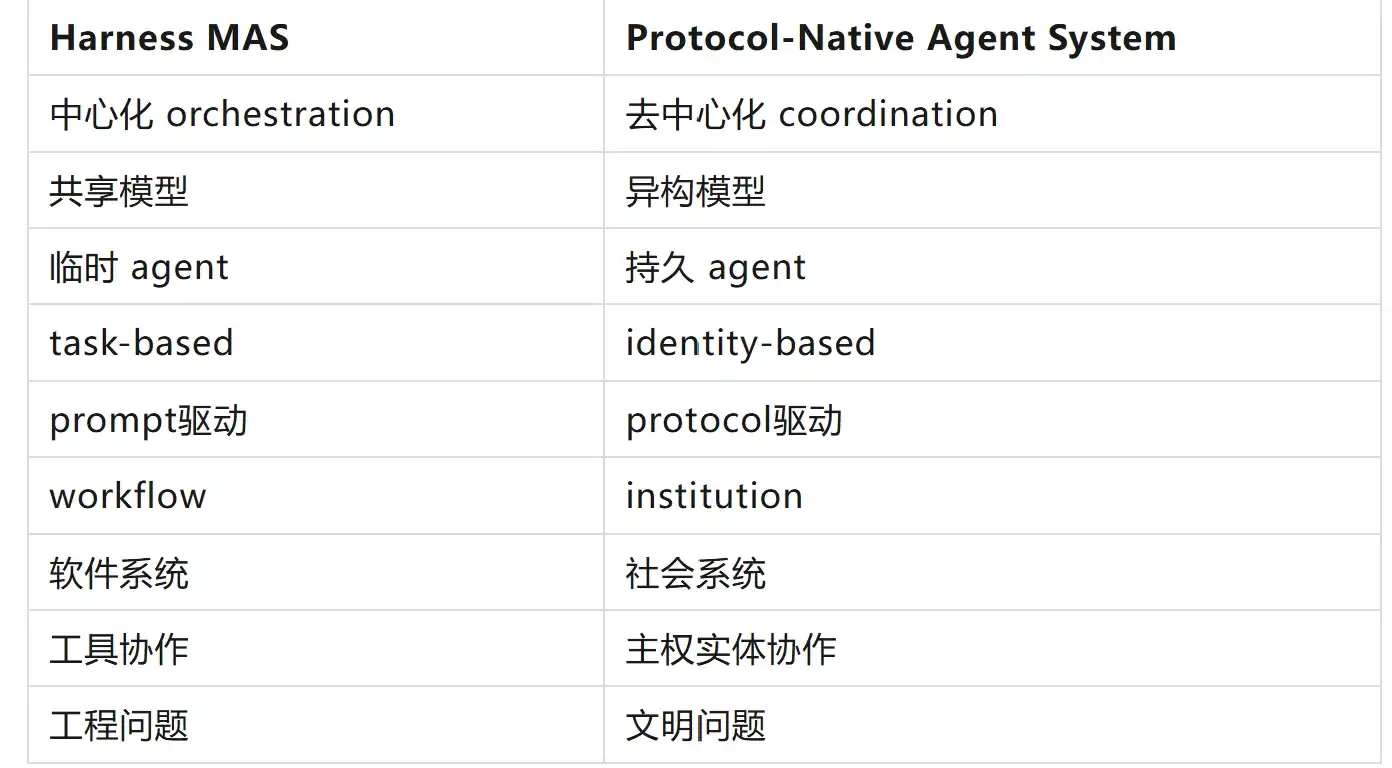
Let's make a table to compare the fundamental differences between the two MAS approaches mentioned earlier:
After "Intelligence"

Many people today believe the biggest problems with AI are:

  • Reasoning ability
  • Model capability
  • Long context
  • Multimodality
  • Agent execution

These indeed pose current challenges, but I truly believe all these will be solved soon. However, upon truly entering Agent Society, the most difficult problem might become: how autonomous entities achieve long-term collaboration.

Kepler was revered as the "lawgiver of the heavens" because of his three laws. But what are the laws for Agents here? When sovereignty is partially separated, this is an unavoidable question.

Because in the future:

  • Agents will have different goals
  • Agents will have different world models
  • Agents will have different interests
  • Agents will have different memories
  • Agents will have different value systems

Therefore, the truly difficult thing in the future is not "making Agents talk," but "enabling Agents to form a coherently interpretable world model."

This means: Ontology, Semantic Protocol, these fields once neglected by the internet, will become core again. There are already some signs; Ontology, such an obscure term, is now almost becoming a mainstream engineering vocabulary. It's truly an astonishing thing.

The Secret of Palantir

Companies Might Just Be "Agent Associations"

Pushing this further, future "companies" might not even be human organizations. (Students who often read my articles, does this sound familiar? The high-end game of unmanned companies has appeared.) They could be protocol alliances of numerous Personal Agents.

For example:

  • Your Agent
  • My Agent
  • AI CFO
  • AI Lawyer
  • AI Sales
  • AI Factory

Dynamically forming organizations through protocols. Organizations are no longer fixed structures, but Agent associations that can be reorganized in real-time.

Therefore, many future systems may no longer be software running, but may be transforming into: organizations computing. And this might be the true: Intelligence-Native Civilization.

Finally, I'll use an AI-generated image to summarize the entire article:
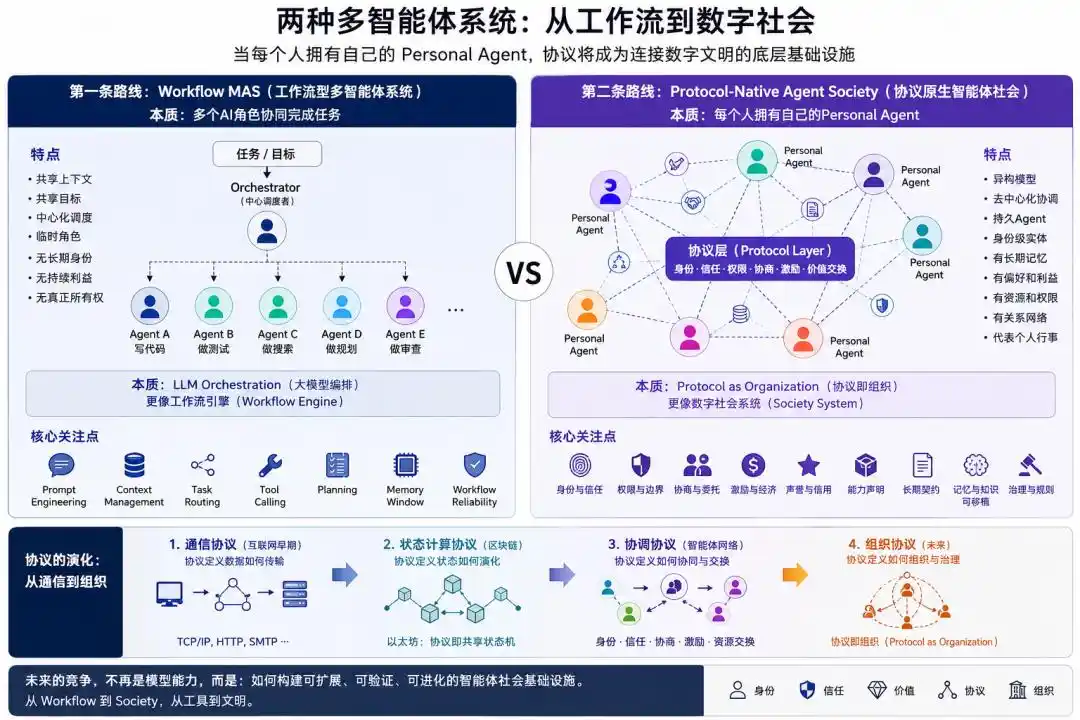
(The summary is indeed better than banana)

I have established a "universe" of AI ontology.

Galloping with the wind, spring grows old; The world is fickle, the traveler's steps are slow.

This article is from the WeChat public account "琢磨事," author: Li Zhiyong

Crypto di tendenza

Domande pertinenti

QWhat are the two main AI Multi-Agent System (MAS) development paths discussed in the article, and how do they fundamentally differ?

AThe article discusses two main MAS paths. The first is 'Harness-style MAS,' which is currently mainstream. It involves multiple AI agents (like coders, testers) orchestrated by a central system to complete complex tasks. It's essentially a sophisticated workflow or orchestration system. The second path is 'Protocol-Native Agent System.' Here, the focus shifts to personal or sovereign agents (like a Personal Agent or an 'unmanned company') that represent individuals with long-term memory, identity, and resources. The fundamental difference is in their nature: the first is a task-oriented, centrally controlled software system, while the second envisions a society-like system of autonomous entities that must coordinate through protocols.

QAccording to the article, why will 'protocols' become the core challenge in a future populated by autonomous Personal Agents?

AIn a future with many independent, sovereign Personal Agents (each with its own goals, memory, and value systems), central coordination methods like shared context or workflows become impossible. Therefore, protocols will become the core mechanism for enabling coordination. These protocols will need to solve complex social and institutional problems like identity verification, trust establishment, permission boundaries, incentive mechanisms, reputation systems, and long-term contracts between autonomous entities. The core challenge thus shifts from 'prompt engineering' to 'protocol engineering' to manage interactions in this digital society.

QWhat key characteristics define a true 'Personal Agent' or 'unmanned company' as opposed to a task-specific agent in the first MAS path?

AA true Personal Agent or unmanned company is defined by sovereignty and persistent identity, unlike temporary task agents. Its key characteristics include: long-term memory, a continuous identity, personal preferences, owned resources, specific permissions, a personal history, a relationship network, defined interest boundaries, and the ability to represent its owner ('you'). It is an identity-scoped entity, not a task-scoped tool. This sovereignty is what necessitates the complex protocol-based interactions described in the article.

QThe article suggests the concept of 'Protocol as Organization.' What does this mean in the context of Agent Society?

A'Protocol as Organization' means that in an Agent Society, the protocols governing agent interactions will take on the functions traditionally associated with human organizations. Beyond just defining data communication (like HTTP) or shared state computation (like blockchain), these advanced protocols will define coordination rules, permission structures, incentive models, identity management, and the very organizational relationships between agents. In this way, a 'company' or collective entity could be formed dynamically not by legal documents and fixed structures, but by a set of protocols that allow a coalition of Personal Agents and specialized AI agents to collaborate and operate together.

QWhat does the author believe will be the most difficult challenge after basic AI 'intelligence' problems (like reasoning, context) are solved?

AThe author believes the most difficult challenge will be enabling long-term collaboration between autonomous entities (agents). Once agents have different goals, world models, interests, memories, and value systems, the core problem shifts from making agents intelligent to making their interpretations of the world align enough for cooperation. This will make fields like Ontology (defining shared conceptual frameworks) and Semantic Protocols (protocols with shared meaning) critically important, moving the focus from technical execution to social and philosophical coordination within a digital civilization.

Letture associate

Senior Trader's Confession: How to Trade Market's False Expectations?

Veteran trader's case study: trading the market's "wrong expectations". This trade centered on a textbook "expectation error" after a weak CPI report. While the market initially priced in broad monetary easing (sending Nasdaq to 30,060), the crucial 30-year real yield hit a 20-year high. This signaled a fractured transmission mechanism: short-term rates eased, but long-term funding costs (vital for tech valuations) refused to fall. The trader executed five short positions on the Nasdaq (NQ) as it fell from 30,060 to 28,768. The core methodology: don't just trade the data, but analyze the market's implied causal chain and identify where it breaks. In this case, the chain was: Weak CPI → Policy Easing → Lower Long-Term Funding Costs → NQ Valuation Expansion. The break occurred between policy easing and long-term rates. The "veto variable" – long-term real yields – refused to confirm the bullish narrative. Trades were structured around "fast variables" (price) temporarily repairing while "slow variables" (funding conditions) remained broken. The article outlines a repeatable framework: 1) Map the market's implied causal chain. 2) Identify the veto variable. 3) Observe if it rejects the narrative. 4) Enter when price still follows the old script. 5) Choose the cleanest asset expression (e.g., short NQ, not broad S&P). 6) Define both invalidation and fulfillment exit conditions. The key insight: Alpha often comes not from an information edge, but from a "reaction function edge" – recognizing when the market is applying an outdated causal logic to new data. The critical question: What causal chain is the market's first reaction relying on, and is that chain still valid today?

marsbit22 min fa

Senior Trader's Confession: How to Trade Market's False Expectations?

marsbit22 min fa

Opinion: The Hedging Relationship Between U.S. Treasuries and Stocks Has Broken Down, and BTC, as a Risk Asset, Is Under Dual Pressure

For the past 20 years, U.S. investors relied on a free insurance policy: when stocks fell, bonds rose, cushioning portfolio losses. This reliable inverse correlation underpinned entire financial strategies. However, this mechanism broke down around 2020 and has not recovered. Currently, the two-month rolling correlation between the S&P 500 and 10-year Treasury yields is at -0.69, its lowest level since 1996, indicating stocks and bonds are moving in sync to an unprecedented degree, eliminating the traditional portfolio shock absorber. The失效 of this hedge is not simply due to lost confidence in U.S. debt. The key driver is the shift from growth-dominated to inflation-dominated market narratives. When growth fears prevail, stocks and bonds move inversely. Since 2022, persistent inflation volatility has been the dominant factor, causing both asset classes to suffer simultaneously from higher inflation expectations. Investors now seek safety without duration risk, favoring cash, dollars, and short-term Treasuries while selling long-duration bonds. Record U.S. deficits, rising net interest payments, and waning foreign demand (e.g., from Japan) are pressuring long-term yields, with the 30-year yield surpassing 5%. This environment places Bitcoin, as a risk asset on the far end of the risk curve, under dual pressure. Higher risk-free rates increase the opportunity cost of holding non-yielding assets like Bitcoin, while falling equities reduce overall risk appetite. Bitcoin's performance has become highly sensitive to macro conditions such as real yields, dollar strength, and financial conditions. While its long-term thesis as a fixed-supply asset outside the sovereign credit system is strengthened by these fiscal trends, the same conditions hurt it in the short term. The return of bonds as a effective hedge requires inflation volatility to subside, growth risks to retake dominance, and the Fed to have room to ease policy. Until then, Bitcoin trades in a market where the deepest asset class no longer absorbs shocks, removing the safety floor for all risk assets, especially those that pay nothing to wait.

marsbit22 min fa

Opinion: The Hedging Relationship Between U.S. Treasuries and Stocks Has Broken Down, and BTC, as a Risk Asset, Is Under Dual Pressure

marsbit22 min fa

Funding Weekly | Crypto.com Secures $400M Investment, CeFi and Stablecoin Sectors Continue to Attract Capital

Crypto Weekly Investment Recap: Funds Converge on CeFi, Stablecoins, and AI Last week's crypto and AI investment landscape saw significant capital concentration, with a few large deals dominating. **Crypto/Web3 Highlights (July 13-19):** Total investment exceeded **$812 million** across 17 deals. Key trends: * **Centralized Finance (CeFi) & Stablecoins** remained a major magnet, led by **Crypto.com**'s massive **$400 million** raise from Citadel Securities, valuing the exchange at $20B. * **Infrastructure & Tools** saw 7 deals, including **Cyclops** ($20M for stablecoin payments) and **ADI Chain** ($50M for stablecoin settlement infrastructure). * **DeFi** had 2 deals, such as AI-native DEX **Quote Trade** ($4M). * Other notable raises: API broker **Alpaca** ($135M), cross-border platform **Flex** ($70M), treasury firm **ORANGE JUICE** ($40M), and prediction market **Pascal** ($9M). * **Acquisitions:** Keyrock bought BlockFills' trading unit, SBI Holdings acquired Singapore exchange Coinhako, and MoonPay bought startup Glide. **AI & Robotics Highlights:** Investment momentum in AI remained very strong. * Nvidia-backed AI cloud service **Fireworks** raised a massive **$1.5 billion** at a $17.5B valuation. * In robotics, **Walden Robotics** (spun out from Toyota) secured **$300 million**, and Chinese humanoid firm ****逐际动力** **(Climax Dynamics) raised nearly **$200 million** in a Pre-IPO round. * Other significant AI raises included Indian programming platform **Emergent** ($130M) and drone company **Brinc** ($125M), backed by Sam Altman. Overall, the trend shows capital flowing heavily into established crypto financial services, stablecoin infrastructure, and large-scale AI/robotics commercialization.

marsbit1 h fa

Funding Weekly | Crypto.com Secures $400M Investment, CeFi and Stablecoin Sectors Continue to Attract Capital

marsbit1 h fa

The Gentlest Bear Market? BTC Bears Exit, ARK and Bitwise Collectively Bullish

**Title: The Mildest Bear Market? BTC Shorts Exit, ARK and Bitwise Collectively Bullish** Bitcoin continues to consolidate around $75,000 while Ethereum struggles near $1,900. Market data shows $116 million in liquidations over 24 hours, with $62.7 million from short positions, and the Fear & Greed Index remains at 35 (Fear). According to Polymarket, there's a 33% probability BTC falls below $50,000 this year. ARK Invest's Q2 2026 Bitcoin report notes technical weakness but identifies potential bottoming signals, including a record high in long-term holder supply, suggesting selling exhaustion. Bitwise's Juan Leon calls this the "structurally mildest bear market" on record, with a ~50% drawdown from highs, less severe than past cycles. He highlights institutional accumulation and a shift in investor dialogue from survival to entry points. Technical analysis from Bit suggests a potential C-wave low may have formed, with an ideal bottoming range between $50,000-$55,000. However, glassnode's CryptoVizArt warns that failure to break $66,000 could signal a local top, as new buyer accumulation is concentrated there. Analyst Darkfost identifies a critical support band between $59,000-$70,000, where 50% of BTC's circulating supply has changed hands. Notably, trader Doctor Profit announced closing all crypto short positions—including BTC shorts from $115k-$125k and over 100 altcoin shorts—for significant profit. He has begun a phased accumulation of Bitcoin spot starting at $64,000, reversing his previous $40k-$50k target, citing structural positives like regulatory clarity and institutional adoption. He argues the anticipated September/October bottom may arrive earlier than the herd expects.

Foresight News2 h fa

The Gentlest Bear Market? BTC Bears Exit, ARK and Bitwise Collectively Bullish

Foresight News2 h fa

Trading

Spot

Articoli Popolari

Come comprare ONE

Benvenuto in HTX.com! Abbiamo reso l'acquisto di Harmony (ONE) semplice e conveniente. Segui la nostra guida passo passo per intraprendere il tuo viaggio nel mondo delle criptovalute.Step 1: Crea il tuo Account HTXUsa la tua email o numero di telefono per registrarti il tuo account gratuito su HTX. Vivi un'esperienza facile e sblocca tutte le funzionalità,Crea il mio accountStep 2: Vai in Acquista crypto e seleziona il tuo metodo di pagamentoCarta di credito/debito: utilizza la tua Visa o Mastercard per acquistare immediatamente HarmonyONE.Bilancio: Usa i fondi dal bilancio del tuo account HTX per fare trading senza problemi.Terze parti: abbiamo aggiunto metodi di pagamento molto utilizzati come Google Pay e Apple Pay per maggiore comodità.P2P: Fai trading direttamente con altri utenti HTX.Over-the-Counter (OTC): Offriamo servizi su misura e tassi di cambio competitivi per i trader.Step 3: Conserva Harmony (ONE)Dopo aver acquistato Harmony (ONE), conserva nel tuo account HTX. In alternativa, puoi inviare tramite trasferimento blockchain o scambiare per altre criptovalute.Step 4: Scambia Harmony (ONE)Scambia facilmente Harmony (ONE) nel mercato spot di HTX. Accedi al tuo account, seleziona la tua coppia di trading, esegui le tue operazioni e monitora in tempo reale. Offriamo un'esperienza user-friendly sia per chi ha appena iniziato che per i trader più esperti.

353 Totale visualizzazioniPubblicato il 2024.12.12Aggiornato il 2026.06.02

Come comprare ONE

Discussioni

Benvenuto nella Community HTX. Qui puoi rimanere informato sugli ultimi sviluppi della piattaforma e accedere ad approfondimenti esperti sul mercato. Le opinioni degli utenti sul prezzo di ONE ONE sono presentate come di seguito.

活动图片