The Return of the Rimland: A Renewed Game Around Sea Power, Energy, and the Dollar

marsbitPubblicato 2026-04-13Pubblicato ultima volta 2026-04-13

Introduzione

Retitled "The Return of the Rimland: A Re-Game Surrounding Sea Power, Energy, and the Dollar," this analysis argues that the conflict centered on Iran is no longer a localized military issue but a systemic global struggle over who controls the flows of energy and trade. The U.S. is employing a "Rimland" strategy, using naval blockades, threats of 50% tariffs on nations aiding Iran, and the redirection of energy routes (like reactivating the Trans-Arabian Pipeline) to draw China into the conflict and bypass strategic chokepoints like the Strait of Hormuz. This has turned a regional confrontation into a structural shock impacting global energy markets, supply chains, and the financial system. Key market risks are not yet fully priced in. While oil prices have spiked, the second-order effects—such as tightened liquidity, pressure on tech investments (like AI from helium supply risks), reduced consumer spending, and agricultural supply shocks from high fertilizer costs—are only beginning to manifest. The Federal Reserve faces a dilemma on whether to tighten policy against this energy-driven inflation. The conflict's escalation is inevitable; the central questions are the pathways of its diffusion and when markets will price in these broader, systemic risks.

Editor's Note: Ceasefire, blockade, and tariff threats—the conflict surrounding Iran has not subsided but continues to spill over. From the Strait of Hormuz to the Red Sea, from energy corridors to trade秩序, the core of the situation is no longer a local military confrontation but a systemic博弈 around "who controls the flow."

Using the "Rimland" strategy as a线索, this article points out that the United States is attempting to turn the conflict from a regional issue into a global one by海上封锁 and restructuring energy routes, drawing China into it. As sanctions and interception measures escalate, the confrontation originally centered on the Middle East is transforming into a structural冲击 affecting global energy, supply chains, and the financial system.

More critically, the market has not fully digested this "chain reaction." The immediate fluctuations in oil prices are only the first step; their transmission to liquidity, tech investments, consumer spending, and even agricultural supply is just beginning to show. After the revaluation of energy prices, the real test is how the global economy will withstand the second-round冲击 triggered by this.

This means that the current issue is no longer whether the conflict will escalate, but along which paths its impact will扩散, and when the market will start to pay for these尚未定价 risks.

Below is the original text:

Alright, the situation is now clear.

The tensions we highlighted last Wednesday have proven to be irreconcilable.

Iran wants nuclear weapons and control over the strait; and Trump cannot accept either of these. How far apart are these two "target circles"? So much so that even Israel's war with Lebanon hasn't been included in the discussion agenda.

I won't claim my judgment was precise, but we may indeed have entered the "mid-game." This is not a conflict that can be called off in an afternoon. The core issue is very simple: Who will control the world's most important水道? And, is Iran willing to threaten its neighbors to gain bargaining chips for nuclear negotiations?

That is the key.

What is now becoming clear is a整套策略路径. Readers who have followed along, from "Fighting for the Dollar" to "Don't Take the Bait," to "Awakening the Hegemon" and "Fragile Peace," should already see the pattern.

Trump is executing a "Rimland" strategy.

Intercept shipping. Threaten to impose 50% tariffs on all countries providing weapons to Iran. Instead of attacking the内陆(heartland), control the maritime channels of energy transport to draw China into this博弈. For every mine Iran lays, for every oil tanker it attacks, retaliate tenfold—seize their vessels, control oil tankers, directly sell their crude oil.

Settle in U.S. dollars.
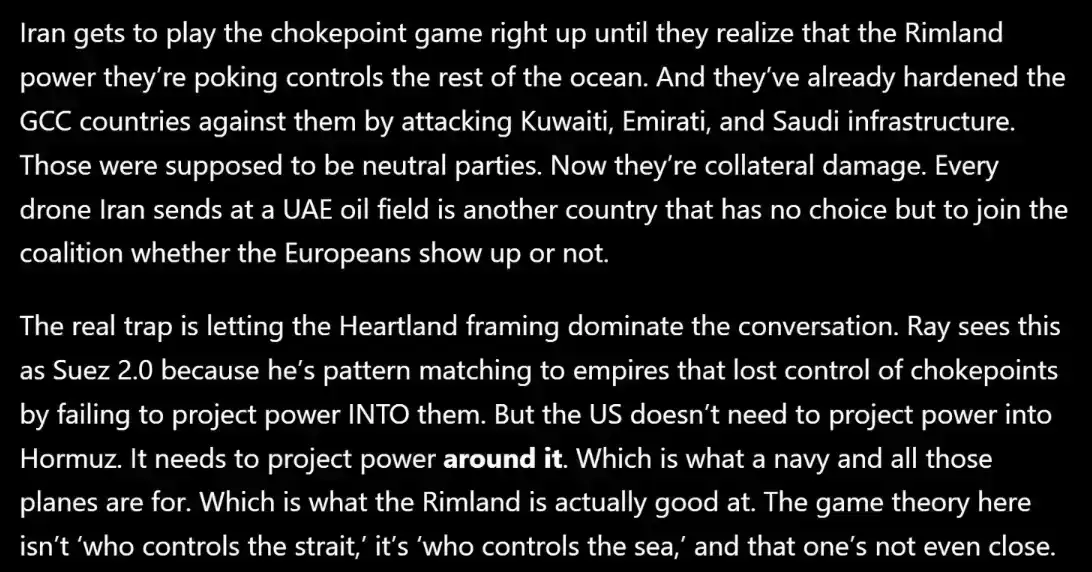
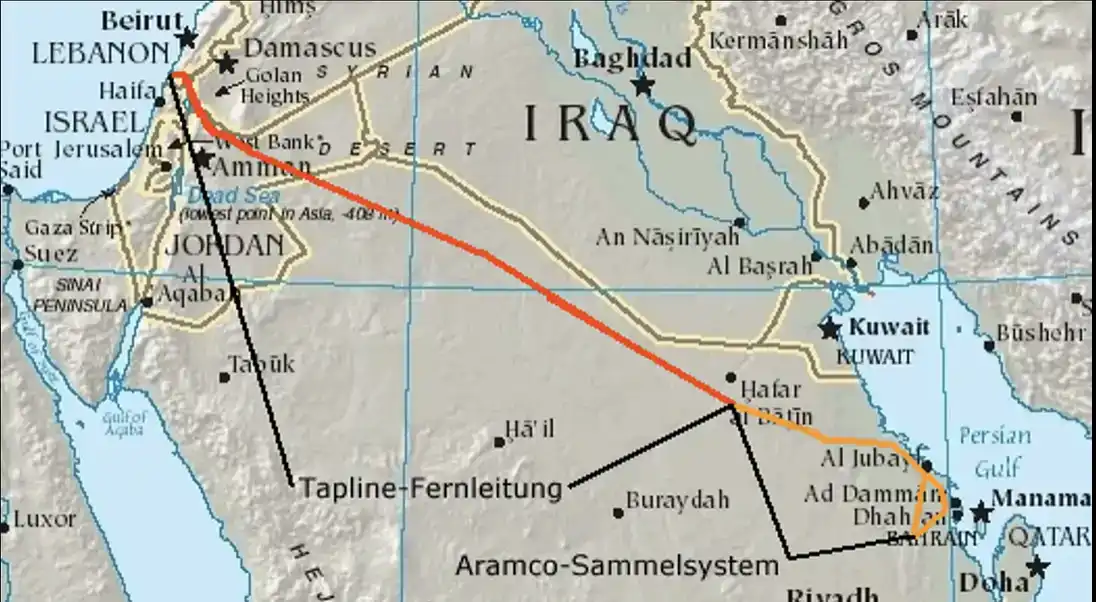
Then there's the "Abraham Accords." Saudi oil is transported via Jordan to the port of Haifa; the Trans-Arabian Pipeline (Tapline) is being reactivated. A corridor of physical infrastructure is connecting coastal countries into an energy network, completely bypassing the "heartland." This is a "Rimland alliance" built with pipelines and steel.

In my view, we have reached this point largely due to this process itself—Iran (and China) ignited Israel through Hamas' actions on October 7, thereby interrupting this normalization process; had this process advanced, it could have formed an alternative trade route bypassing the Strait of Hormuz and even the "Belt and Road."
This also explains the divergence between Washington and Brussels. The U.S. feels the weight of responsibility; Europe似乎 believes it can secure energy access through private negotiations while letting the "older brother" bear the cost of conflict. France, on one hand, blocked relevant UN Security Council resolution, while on the other, negotiated bilateral transit arrangements through the strait with various parties and called for the formation of an "alliance of independent nations." This is a typical "heartland" mindset: making deals with inland powers, avoiding direct conflict, as if maritime routes will maintain themselves.

Trump has just堵上了 this漏洞—and thus turned America's problem into the world's problem.

As of writing, crude oil prices have risen over 6%, stocks have fallen about 1%, and last week's gains due to the ceasefire look highly likely to be quickly erased. I bought some VIX call options over the weekend, so you could say I have a bit of a立场.

How the situation develops next depends on a series of more fundamental questions:

· Can the ceasefire hold for another week, or will it collapse in "reverse deduction"?·

Trump has stated he will intercept ships that have paid "tolls" to Iran—does this include Chinese ships? What will happen when they try to load crude from Kharg Island?

· He has also reiterated the threat of imposing 50% tariffs on any country providing weapons to Iran—does this mean a trade war is back on the agenda?

Then there's Iran's countermeasures: it could activate the Houthis, who still have the capability to make the Bab el-Mandeb strait difficult to pass. Notably, most oil tankers transporting crude via Saudi Arabia's "East-West Pipeline" are VLCCs (Very Large Crude Carriers) that cannot pass through the Suez Canal. If the Houthis escalate, it would affect not only Red Sea shipping but force these giant tankers carrying the most critical crude to take much longer routes.

The main thread is: this conflict continues to expand in scale and spillover scope.

By escalating actions to全面拦截 all ships paying "tolls" to Iran and reiterating tariff threats, Trump has explicitly drawn China into this博弈. Beijing has been hoarding crude for years precisely for scenarios like this. But against the backdrop of an economy dragged down by real estate, how long can the Chinese market remain "calm"? How likely is it to escalate confrontation to ensure energy supply?

From Venezuela to Iran, the sequence of these actions looks increasingly like a deliberately designed strategy.

The "Rimland" is returning.

Next, are the chain reaction questions at the market level:

· How bad will Monday's open be? The first round of selling came mainly from short-term funds and retail buying of put options. When will long-term funds start to see volatility as uncontrollable, forcing them to sell or hit risk limits?

· Last week, hedge funds quickly covered their "long AI hardware, short software" positions. But with oil prices, falling bonds, tightening liquidity,再加上 Gulf helium supply chain risks (a key input for chip manufacturing), is it enough to reprice expectations for the AI acceleration cycle?

· Before the conflict, the U.S. Q1 economy grew almost zero. As energy prices surge, household disposable income is eaten up by gasoline, heating, and jet fuel—will families cut spending or lever up further?

· Fed meeting minutes show policymakers are already discussing tightening policy to counter energy-driven inflationary pressures. A new round of debate on "how to handle negative supply shocks" is unfolding. Faced with an energy shock of this magnitude, can the Fed still "choose to look away"?

Ultimately, these questions point to a larger "chain reaction."

The "Rimland" strategy addresses energy and the dollar, but it does not solve the entire system supported by energy. The market is currently only pricing the "first node," it hasn't transmitted to the "second node" yet. Oil prices can revalue quickly on news, but agricultural production cycles don't. Urea prices are still at $700, and the USDA's projected wheat planting area will be the lowest since 1919—this won't reverse just because two diplomats shake hands. Farmers who couldn't afford fertilizer in March can't "replant" in April.

Domande pertinenti

QWhat is the core strategic concept discussed in the article regarding the US approach to the Iran conflict?

AThe article identifies the US strategy as a revival of the 'Rimland' strategy, which involves controlling key maritime energy transport routes and applying economic pressure (like tariffs and shipping interdictions) to draw global powers like China into the conflict, rather than engaging in direct inland ('heartland') military confrontation.

QAccording to the article, how is the conflict impacting global markets beyond the immediate oil price spike?

AThe article states that the initial oil price volatility is just the first step. The conflict's effects are beginning to transmit to broader areas, including liquidity, technology investment (potentially repricing AI cycle expectations due to helium supply risks), consumer spending (as energy costs erode disposable income), and agricultural supply chains (due to high fertilizer costs and reduced planting areas that cannot be quickly reversed).

QWhat specific action did the US take to counter European attempts to secure energy access independently?

AThe article states that the US, under Trump, 'plugged the loophole' by moving to intercept all ships that had paid 'transit fees' to Iran. This action countered European efforts (like France's bilateral passage negotiations and calls for an 'independent coalition') to privately secure energy transit deals while avoiding direct conflict, thereby making the US problem a global one.

QWhat is one major potential Iranian countermeasure discussed, and what would be its secondary effect on oil transport?

AA major potential Iranian countermeasure is activating the Houthis to disrupt the Bab el-Mandeb Strait. A secondary effect is that this would not only impact Red Sea shipping but also force Very Large Crude Carriers (VLCCs) carrying Saudi oil via the East-West pipeline to take much longer routes, as these massive ships cannot transit the Suez Canal.

QHow does the article connect the 'Rimland' strategy to the broader global economic system and the Federal Reserve's potential response?

AThe article argues that the 'Rimland' strategy addresses issues of energy and dollar control but does not solve the problems for the entire system that energy supports. It suggests the Federal Reserve may be forced to abandon its practice of 'looking through' energy-driven inflation and instead tighten monetary policy to confront a major negative supply shock, which would have widespread economic consequences.

Letture associate

Has Hook Summer Truly Arrived? sato, Lo0p, FLOOD Ignite the New Uniswap v4 Narrative

With the broader market showing signs of recovery, a new wave of interest has emerged around Ethereum-based meme coins. Following ASTEROID, tokens like sato, sat1, Lo0p, and FLOOD, built upon the Uniswap v4 Hook protocol, are capturing market attention. Their market capitalizations range from millions to tens of millions of dollars, injecting much-needed focused liquidity into a market lacking narratives. This article explores whether this trend signifies an incoming "Hook Summer" and its potential impact on UNI's price. Hooks are essentially plug-in smart contracts for Uniswap v4 liquidity pools, allowing developers to inject custom logic at key points in a pool's lifecycle (like initialization, adding/removing liquidity, swaps). This transforms the AMM into programmable building blocks. Key highlighted projects include: * **sato**: Peaked over $38M market cap. It utilizes a v4 curve for minting/burning; buying locks ETH as reserve to mint new tokens, while selling redeems ETH from the reserve and burns tokens. * **sat1**: Market cap briefly exceeded $10M, promoted as an "optimized sato," but later declined significantly. * **Lo0p**: Reached nearly $6.6M. It's a lending AMM protocol where buying LO0P tokens locks them as collateral, allowing users to borrow ETH from the pool reserve at 40% LTV, aiming to improve capital efficiency for idle ETH in LPs. * **FLOOD**: Peaked near $6M. Its mechanism directs asset reserves from buys into Aave v3 to generate yield, with fees and interest retained in the pool to potentially influence the token's price long-term. In the long term, the development of the Hook ecosystem can attract users and liquidity to Uniswap v4, benefiting UNI's fundamentals—especially combined with the recent activation of the protocol fee switch, where a portion of fees is used to burn UNI. However, in the short term, these Hook-based tokens are unlikely to directly drive significant UNI price appreciation. Their impact is moderated by factors like token sustainability, price volatility, and broader market and regulatory conditions. Currently, Uniswap v4's TVL ($595M) still trails behind v2 and v3, indicating adoption and growth will take time. The article concludes that while the Hook ecosystem provides long-term "nourishment" for UNI, its short-term role is more of a "catalyst" than a "booster." Readers are cautioned that these are early-stage experimental tokens and may carry unknown risks.

Odaily星球日报3 min fa

Has Hook Summer Truly Arrived? sato, Lo0p, FLOOD Ignite the New Uniswap v4 Narrative

Odaily星球日报3 min fa

Interview with Michael Saylor: I Did Say I Would Sell Bitcoin, But Never a Net Sale

Interview with Michael Saylor: I Said We'd Sell Bitcoin, But Never Be a Net Seller In a recent podcast, MicroStrategy Executive Chairman Michael Saylor clarified the company's stance on potentially selling Bitcoin. Following MicroStrategy's earnings call statement about being prepared to sell BTC to fund dividends for its STRC (Strategic) credit product, Saylor emphasized the distinction between selling and being a "net seller." Saylor explained the core business model: MicroStrategy sells credit instruments like STRC and uses the proceeds to buy Bitcoin, which is viewed as "digital capital" expected to appreciate around 30-40% annually. A portion of these capital gains can then be used to pay the dividends on the credit products. He stressed that even if the company sells some Bitcoin for dividends, it simultaneously buys much more with new credit issuance. For example, after raising $3.2 billion from STRC sales in April, the dividend obligation was only $80-90 million, making the company a net buyer. The clarification aims to counter market narratives questioning the value of Bitcoin on MicroStrategy's balance sheet if it were never sold, and to dismiss claims of a "Ponzi scheme." Saylor reiterated his personal philosophy for investors: "Don't be a net seller of bitcoin" and ensure your Bitcoin holdings increase each year. Saylor also discussed Bitcoin's role as the foundation for "digital credit," noting that STRC has become the largest and most liquid preferred stock issue in the U.S., offering high risk-adjusted returns (Sharpe ratio). He highlighted Bitcoin's deep liquidity, stating that even large purchases by MicroStrategy do not move the market significantly, which is driven by macro factors, geopolitical tensions, and capital flows from ETFs and credit products. Finally, Saylor reflected on his early inspiration from sci-fi books, which motivated his path to MIT, and maintained his fundamental thesis on Bitcoin remains unchanged: it is superior digital capital enabling superior digital credit.

链捕手7 min fa

Interview with Michael Saylor: I Did Say I Would Sell Bitcoin, But Never a Net Sale

链捕手7 min fa

Beaten SK Hynix Employees in China: Year-end Bonus Less Than 5% of Korean Staff's

"SK Hynix Chinese Staff Hit Hard: Bonuses Less Than 5% of Korean Counterparts" Driven by the AI boom, South Korea's SK Hynix is experiencing record performance, with media reports predicting massive year-end bonuses for its employees, making them highly desirable in the matchmaking market. However, this prosperity starkly contrasts with the situation for the company's Chinese employees. According to reports, SK Hynix operates under a rule allocating 10% of operating profit for employee bonuses. While projections suggest Korean employees could receive bonuses reaching millions of RMB, a Chinese employee with over a decade of technical experience revealed the disparity: "If they get 3 million, Chinese staff get less than 5% of that." After adjustments based on KPI ratings, this employee's highest bonus was slightly over 100,000 RMB. Bonuses are paid annually in Korea but semi-annually in China. During the industry downturn in 2023-2024, Chinese employees received no bonus at all. The gap extends beyond bonuses. Recruitment posts for SK Hynix's Chinese factories (in Wuxi, Dalian, Chongqing) show engineer monthly salaries ranging from 10,000 to 35,000 RMB, with a 13th-month salary promised. Chinese employees also receive standard benefits like annual leave but lack stock incentives, which are reportedly unavailable to them. Furthermore, management positions in China are predominantly held by Korean personnel, though industry observers note a gradual increase in local middle managers over time. SK Hynix has confirmed the 10% bonus rule but cautioned that specific future bonus amounts remain unpredictable. The company forecasts strong demand for HBM and other high-value enterprise products for the next 2-3 years, driven by AI infrastructure investment. This focus on business-to-business markets may continue to constrain supply for consumer products, potentially prolonging price increases for components like memory.

链捕手21 min fa

Beaten SK Hynix Employees in China: Year-end Bonus Less Than 5% of Korean Staff's

链捕手21 min fa

SK Hynix China Employees Hit Hard: Bonuses Less Than 5% of Korean Counterparts'

"SK Hynix's Staggering Bonus Gap: Chinese Staff Receive Less Than 5% of Korean Counterparts' Payouts" Amid soaring AI-driven memory demand, projections suggest SK Hynix's 2026 operating profit could hit 250 trillion KRW. Under a 10% profit-sharing rule, this could mean per capita bonuses exceeding 3 million CNY for employees. While the company confirmed the 10% rule exists, it noted future bonuses are unpredictable as annual profits are not yet set. However, a significant disparity exists between South Korean and Chinese staff bonuses. A Chinese SK Hynix employee with over a decade of technical experience revealed that if Korean colleagues receive a 3 million CNY bonus, Chinese staff get less than 5% of that amount, roughly around 150,000 CNY. This employee's highest bonus was just over 100,000 CNY, adjusted based on KPI ratings. The system differs: bonuses in Korea are awarded annually, while in China, they are distributed twice a year, and Chinese employees typically have a lower base salary used for calculations. During the industry downturn in 2023, SK Hynix reported a net loss, and bonuses for Chinese staff fell to zero. Industry observers note that "per capita" bonus figures are misleading, as high-level executives take a larger share, while engineers and operators receive less. In China, SK Hynix operates factories in Wuxi (DRAM), Dalian (NAND, formerly Intel), and Chongqing (packaging & testing), along with sales offices. Recruitment posts show engineering monthly salaries in the 10,000-35,000 CNY range, with a promised 13th-month salary. Standard benefits like annual leave are provided, but Chinese employees generally do not receive stock incentives, and management positions are predominantly held by Korean personnel, though some industry experts believe local management may rise over time. Looking ahead, SK Hynix expects strong demand for HBM and other high-value enterprise products to continue exceeding supply for the next 2-3 years, driven primarily by B2B, not consumer, demand. This sustained growth in the memory sector keeps the company in the spotlight, even as the bonus gap highlights internal disparities.

marsbit41 min fa

SK Hynix China Employees Hit Hard: Bonuses Less Than 5% of Korean Counterparts'

marsbit41 min fa

Trading

Spot
Futures
活动图片