The Recursive AI Anthropic Warned About: Tian Yuandong's New Company Has Just Taken the "First Step"

marsbitPubblicato 2026-06-12Pubblicato ultima volta 2026-06-12

Introduzione

Anthropic recently highlighted the rapid progress toward "recursive self-improvement," where AI systems autonomously design and train their successors. In response, Recursive Superintelligence, a new company co-founded by former Meta researcher Tian Yuan Dong, has publicly demonstrated its first step toward automating AI research. The company released a system designed to autonomously execute the full AI research cycle: generating ideas, implementing code, running experiments, and learning from results. It validated this approach by achieving state-of-the-art results on three diverse benchmarks: 1. **NanoChat Autoresearch:** Optimizing a small language model's validation loss under a fixed 5-minute GPU budget, improving upon the community's best result. 2. **NanoGPT Speedrun:** Reducing the time to train a GPT model to a specific loss on 8 H100 GPUs from 79.7 seconds to 77.5 seconds, beating a highly optimized, human-driven community effort. 3. **SOL-ExecBench:** Improving the overall score on NVIDIA's suite of 235 GPU kernel optimization tasks by 18%, closing the gap to the hardware limit. The system discovered novel optimizations in this highly specialized domain without direct human expertise. Recursive's system operates as a general framework, capable of parallel exploration and cross-task knowledge transfer while incorporating safeguards against reward hacking. The company, backed by $650M in funding and a star-studded team including Richard Socher and Alexey Dosov...

Recently, Anthropic published an article titled "When AI Builds Itself," which quickly sparked widespread discussion. The article revealed a striking set of internal data: as of May 2026, over 80% of the code in Anthropic's codebase had been written by Claude, with engineers merging eight times more code per day than in 2024. In an internal test, Claude improved the runtime of a piece of training code by approximately 52x over a baseline, whereas an experienced human researcher typically takes 4 to 8 hours to achieve a 4x speedup.

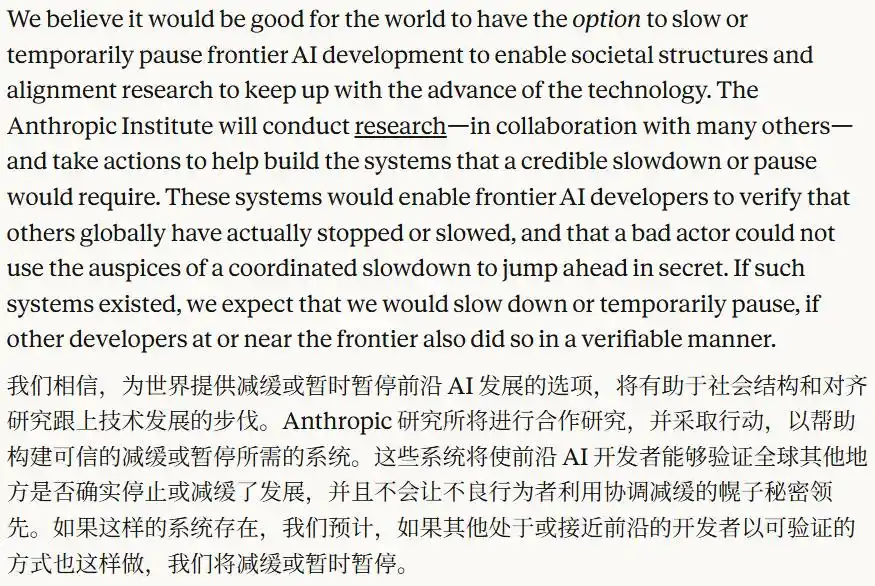
Anthropic points this trajectory towards a deeper destination: "Recursive Self-Improvement"—AI systems autonomously designing, building, and training their own successive versions, with humans no longer driving every step. Notably, the company also called for industry coordination to have the option to pause or even temporarily halt frontier AI development when the moment of recursive self-improvement arrives. And Anthropic is already doing this: restricting its latest Claude Fable 5 from being used for frontier AI research.

Now, Recursive Superintelligence has announced it has taken the first step toward automated AI research.

This new company co-founded by Tian Yuandong has been out of stealth mode for just one month, and has now released its first public technical achievement. They have built an open-ended automated knowledge discovery system and achieved state-of-the-art (SOTA) results on three benchmarks. Simply put, they have succeeded in making AI run experiments for you.
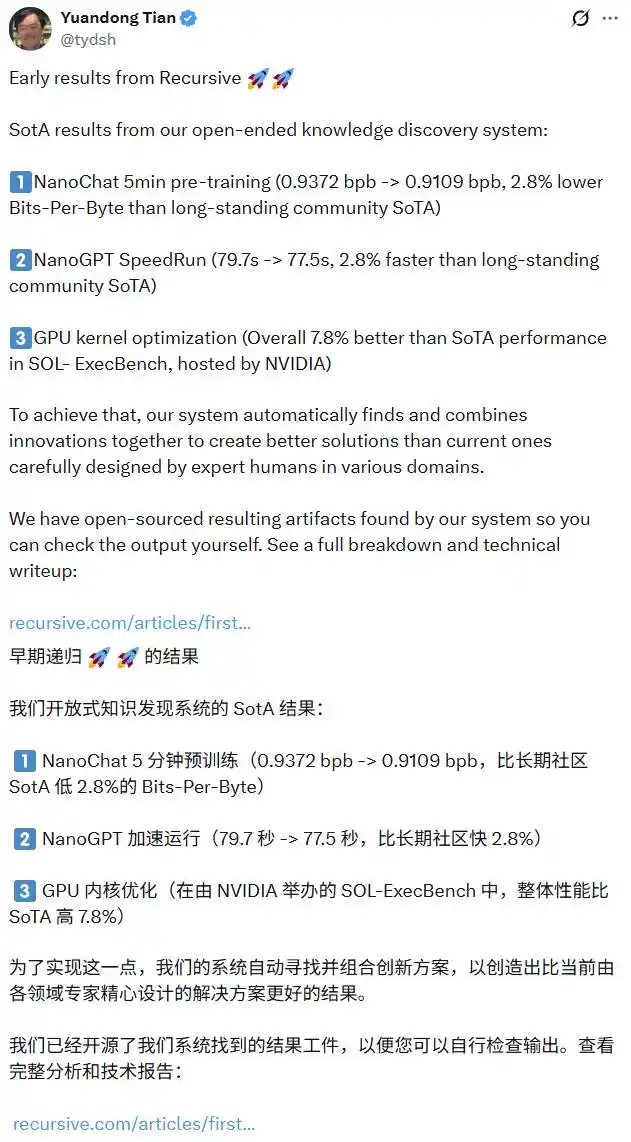
https://x.com/tydsh/status/2065062838255649082

The First Result: Let AI Run Experiments for You

Recursive's first public technical achievement is called "First Steps Toward Automated AI Research."
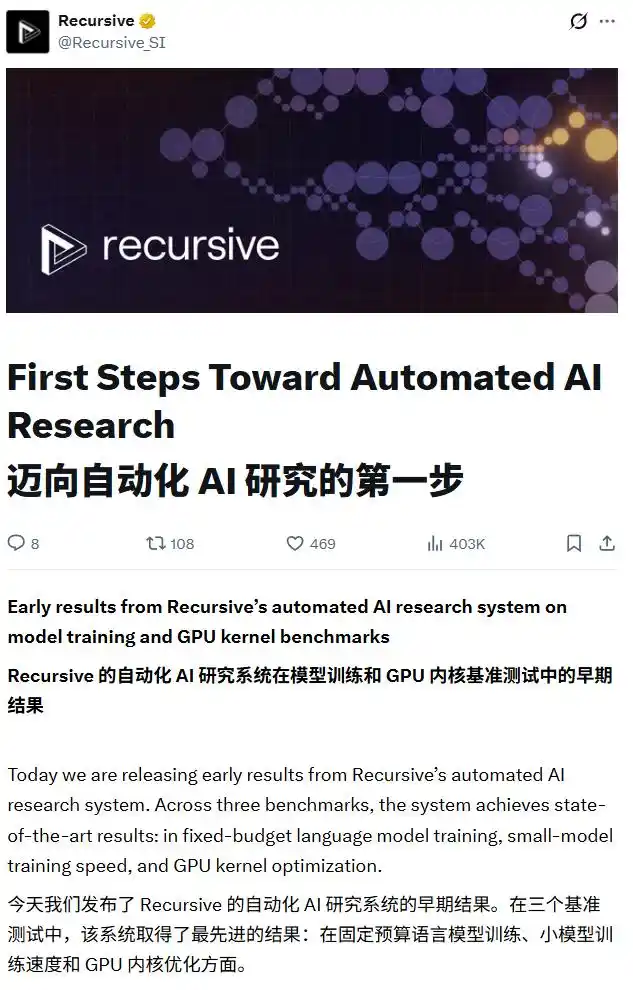
Tweet: https://x.com/Recursive_SI/status/2064980090702962699

Repo: https://github.com/recursive-org/first-steps-toward-automated-ai-research

Blog: https://www.recursive.com/articles/first-steps-toward-automated-ai-research

To summarize in one sentence, the core of this work is: building a system capable of autonomously advancing the AI research cycle and setting new records on three benchmark tests.

Before dissecting the results, it's necessary to understand the design logic of this system.

The traditional AI research process is a highly human-dependent closed loop of "propose idea—write code—run experiment—analyze results—propose new idea." Its efficiency bottleneck lies not in computing power, but in people. The number of researchers worldwide who can design frontier training pipelines is exceedingly small, and each round of experimental iteration requires their intensive involvement.

Recursive's system attempts to automate this closed loop.

Its working method is: for a clearly defined optimization objective, the system automatically proposes experimental ideas, implements code, runs validation, learns from it, and then decides how to search next. Multiple research lines can be advanced in parallel, effective discoveries can be reused across tasks, and mechanisms for detecting reward hacking are embedded within the entire loop to prevent the system from "taking shortcuts" to inflate evaluation metrics without genuinely improving anything.

This is not a specialized tool fine-tuned for a single problem, but rather a general-purpose research automation framework spanning different domains. Recursive demonstrates this using three significantly different test scenarios.

Three Battlefields, Three New Records
Scenario One: Small Model Training Under Fixed Compute Budget (NanoChat Autoresearch)

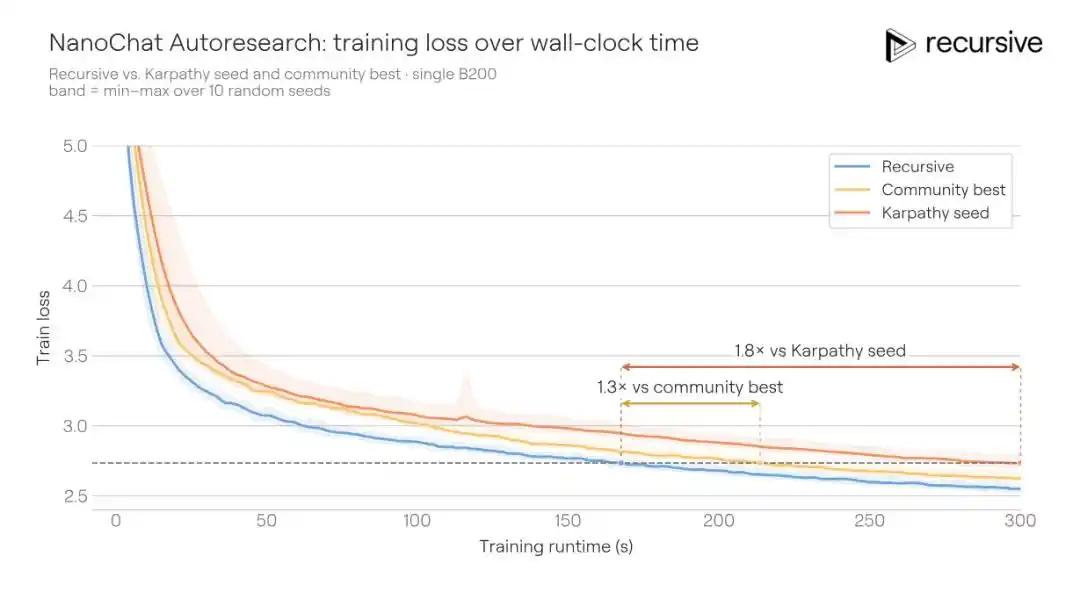
The rules for this benchmark come from the autoresearch project initiated by Andrej Karpathy (author of GPT-2, former OpenAI co-founder): on a single GPU, given a fixed training budget of five minutes, train a small language model to achieve the lowest possible validation loss (measured in BPB, lower is better).

This scenario is naturally suited for automated research: short experimental cycles, low metric variance, relatively easy detection of cheating behavior. Precisely because of this, a community project called "autoresearch@home" has been running on this benchmark for a long time—dozens of human researchers collaborating with hundreds of AI agents continuously pushing the metric down.

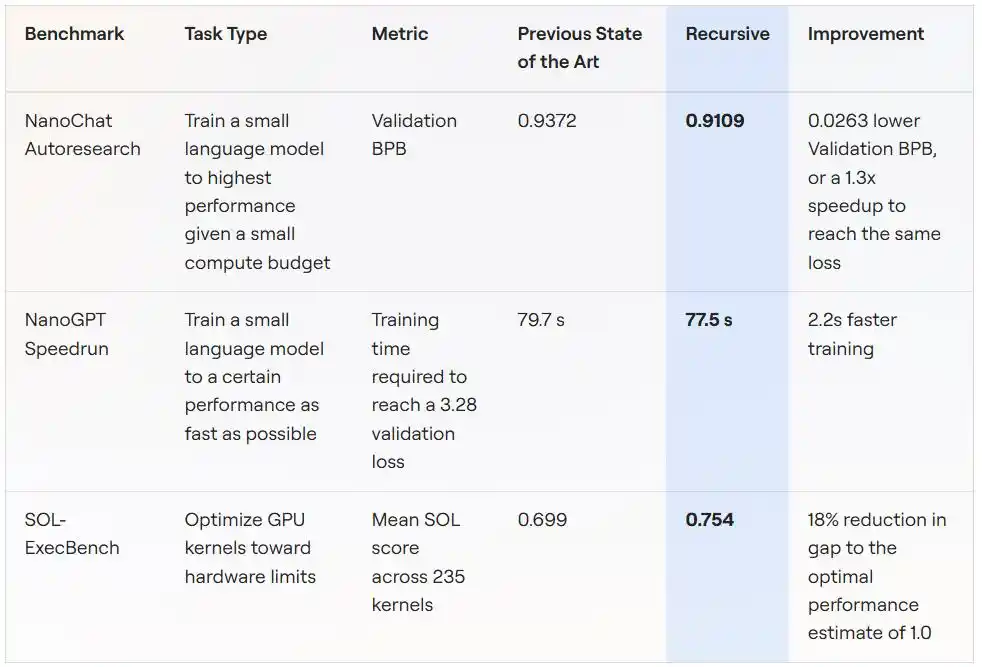
Recursive's system started from the same initial code and ultimately improved the validation BPB from the community's best of 0.9372 to 0.9109, an improvement of 0.0263 BPB. Put another way: to achieve the same training quality, Recursive's solution requires 1.3 times less training time than the competitor's.
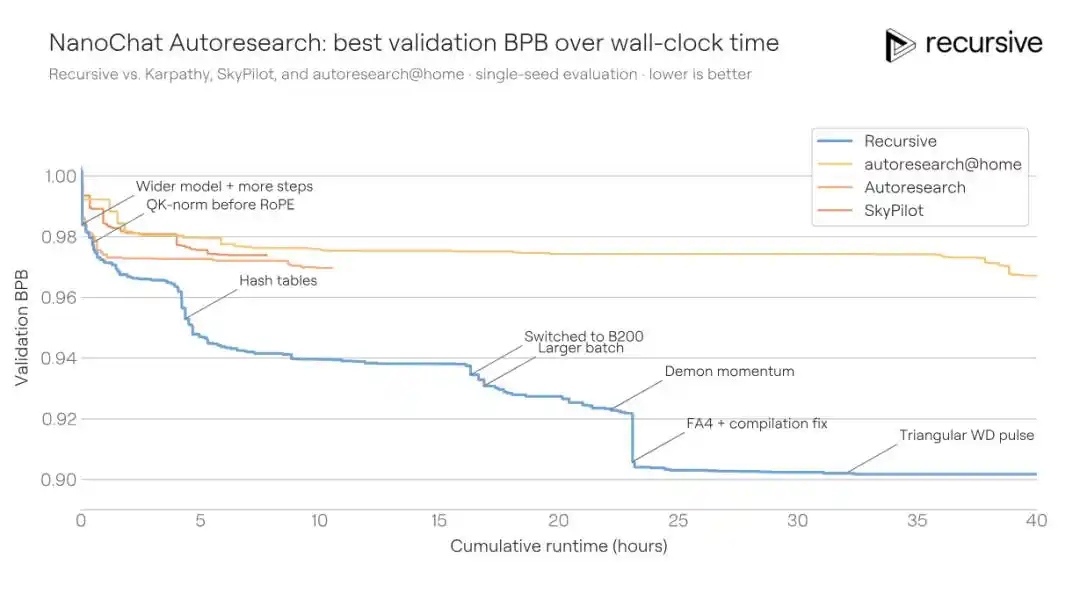
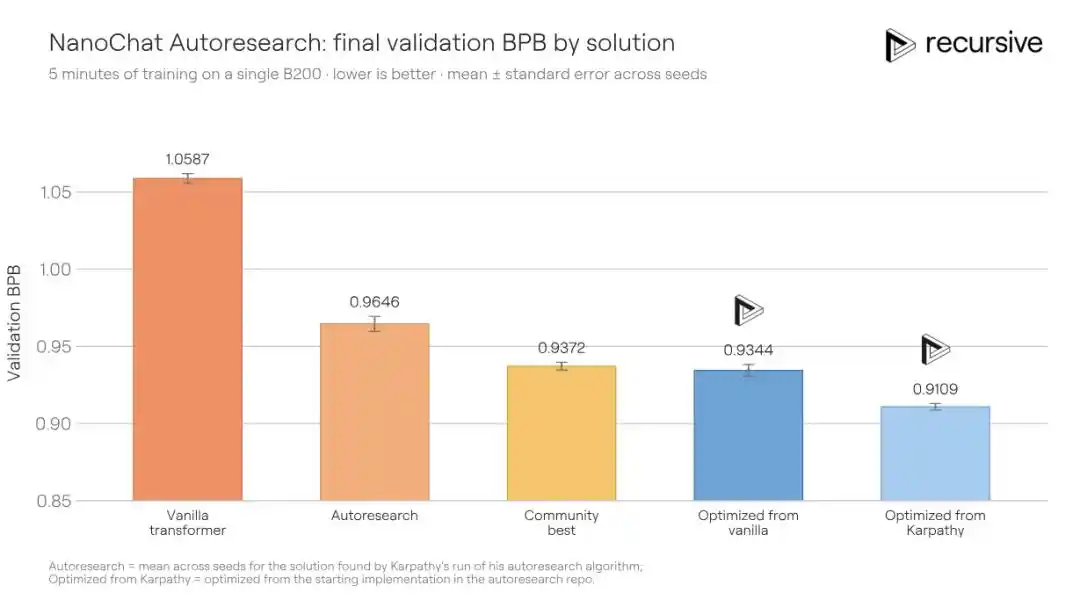
The improvements discovered by the system were not a single silver bullet. It combined architecture adjustments, auxiliary losses, attention mechanism modifications, optimizer behavior, weight decay scheduling, compiler settings, and more. One of the key discoveries was a richer short-context memory mechanism: within the attention's value path, embedding both bigram (adjacent word pairs) and trigram (triplet) information via hash tables, with weighted mixing via learnable gating. Different Transformer layers use different hash functions, reducing the probability of cross-layer collision.

This trick is conceptually related to works like DeepSeek Engram, but the system deployed it in a specific variant not yet seen in published literature for the fixed-budget scenario.

Scenario Two: Training Speed Limit Race (NanoGPT Speedrun)

If the previous scenario was about "going one step further" on an active community's results, this scenario is much harder.

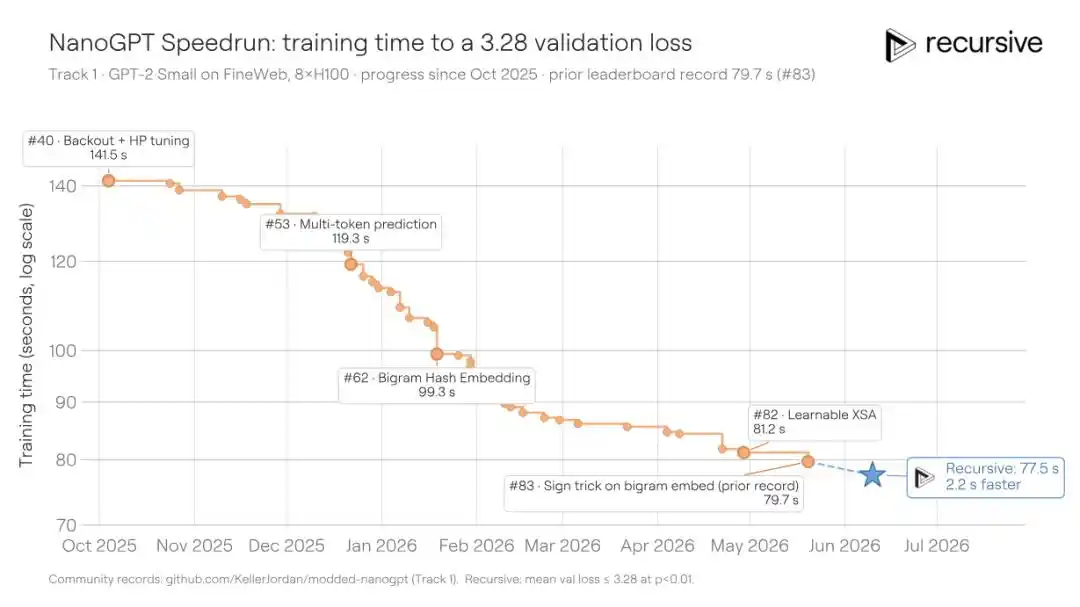
NanoGPT Speedrun is another benchmark initiated by Karpathy and continuously optimized by the community for over two years: the shortest time required to train a GPT model to a validation loss of 3.28 on 8 H100 GPUs. Since mid-2024, the community has compressed the time from about 45 minutes to 79.7 seconds through 83 documented contributions. Each new solution must squeeze out more time from an already extremely optimized codebase, making the difficulty self-evident.

Recursive's system started from the existing optimal solution and further compressed the training time to 77.5 seconds, saving 2.2 seconds. This improvement is comparable to, or even better than, what recent human contributors have achieved.
The core tricks found by the system this time include:

FP8 Precision Attention Computation. The community solution used FP8 (8-bit floating point) computation only in the model's final layer (language model head). The system extended FP8 into the matrix operations of the attention layers, using FP8 for forward propagation to achieve twice the Tensor Core throughput, while retaining BF16 for backward propagation to maintain stability.

Annealing Exploration Noise in the Optimizer. The system injected zero-mean Gaussian noise into the update steps of the NorMuon optimizer, with the noise amplitude linearly annealing to zero as training progressed. This is somewhat like giving the optimizer a behavior pattern of "explore boldly first, then converge robustly," helping the final solution settle in a flatter loss basin.

More Streamlined Fused MLP Kernel. The system rewrote a Triton GPU kernel so that forward propagation only stores activation values after ReLU squaring, and during backward propagation, the unsquared intermediate results are recomputed internally within the kernel, saving one full round-trip read/write of the activation tensor in high-bandwidth GPU memory—a direct hardware-level speedup.

Three improvements, belonging to three different specialized areas: precision strategy, optimizer design, and GPU kernel programming. The fact that the system found room for improvement on a result optimized by the community for two years speaks for itself.

Scenario Three: GPU Kernel Optimization (SOL-ExecBench)

The first two scenarios operated at the model training level. The third scenario delves deeper: optimizing GPU compute kernels.

SOL-ExecBench is a benchmark introduced by NVIDIA, containing 235 kernel writing tasks covering various real-world workloads like matrix multiplication, reduction, normalization layers, attention components, quantization routines, fused blocks, etc. The scoring metric is the SOL score: 0.5 corresponds to a baseline PyTorch implementation, and 1.0 corresponds to the hardware's theoretical limit. The previous best public score was 0.699.
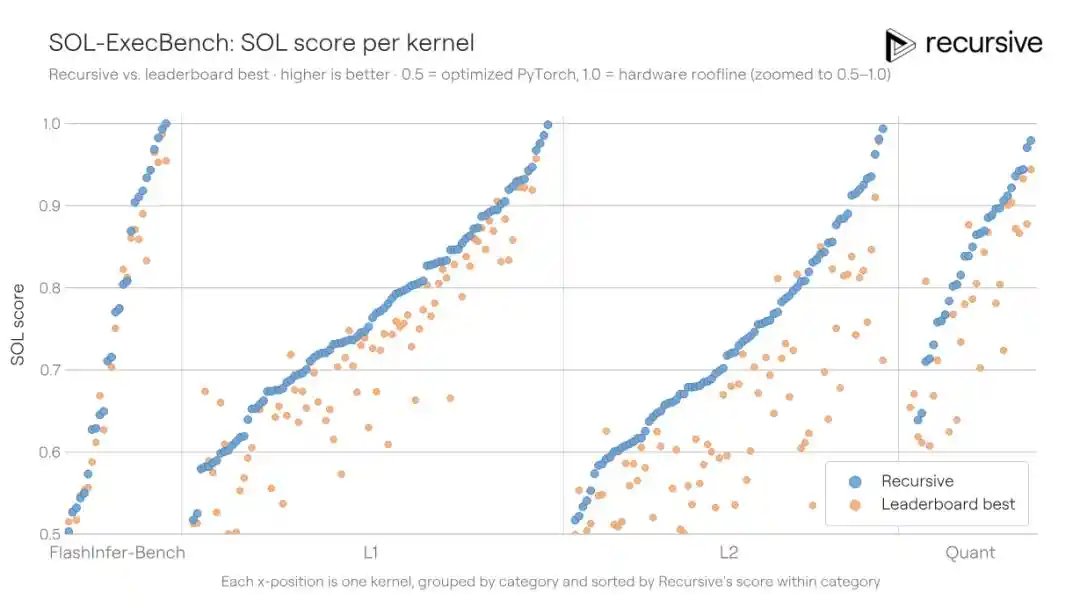
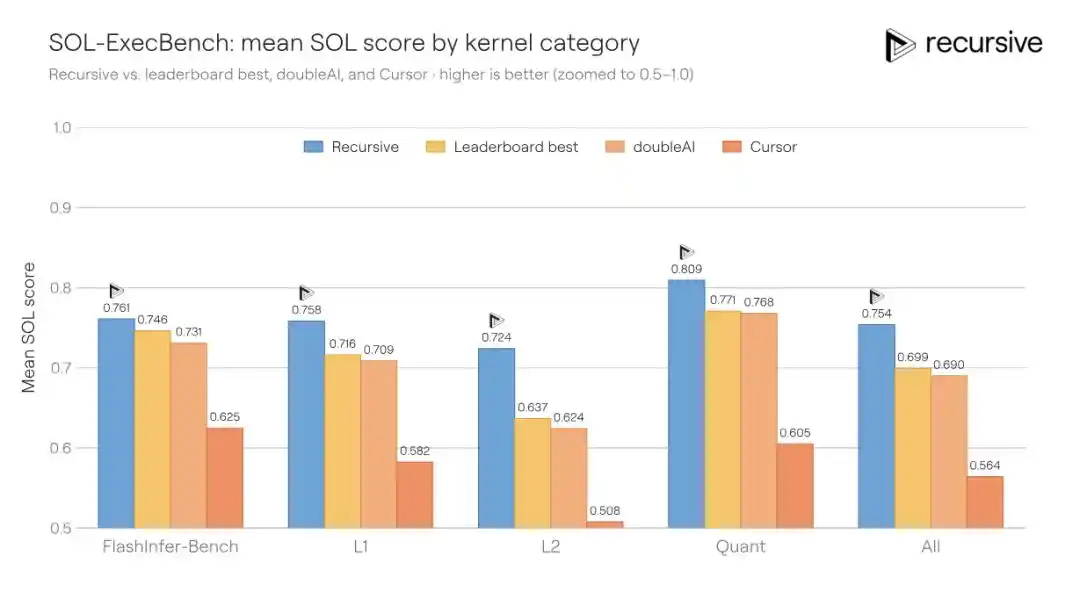
Recursive's system ran on all 235 kernels, allowing discovered optimization patterns (e.g., memory access strategies, tiling methods, reduction techniques) to be reused across tasks. The final score improved to 0.754, reducing the gap to the hardware limit by 18%.

This scenario is particularly significant because kernel engineering is an extremely specialized field—engineers who can write efficient Triton/CUDA kernels are rare globally. The Recursive team candidly admits in their blog, "We ourselves are not experts in kernel engineering. These ideas came from the system itself, not from our specialized background."

Recursive: Using AI to Research and Recursively Improve AI

The company releasing this achievement, Recursive Superintelligence, was founded between late 2025 and early 2026 and only came out of stealth last month. In addition to Tian Yuandong, former Research Scientist Director at Meta FAIR, the founding team includes:
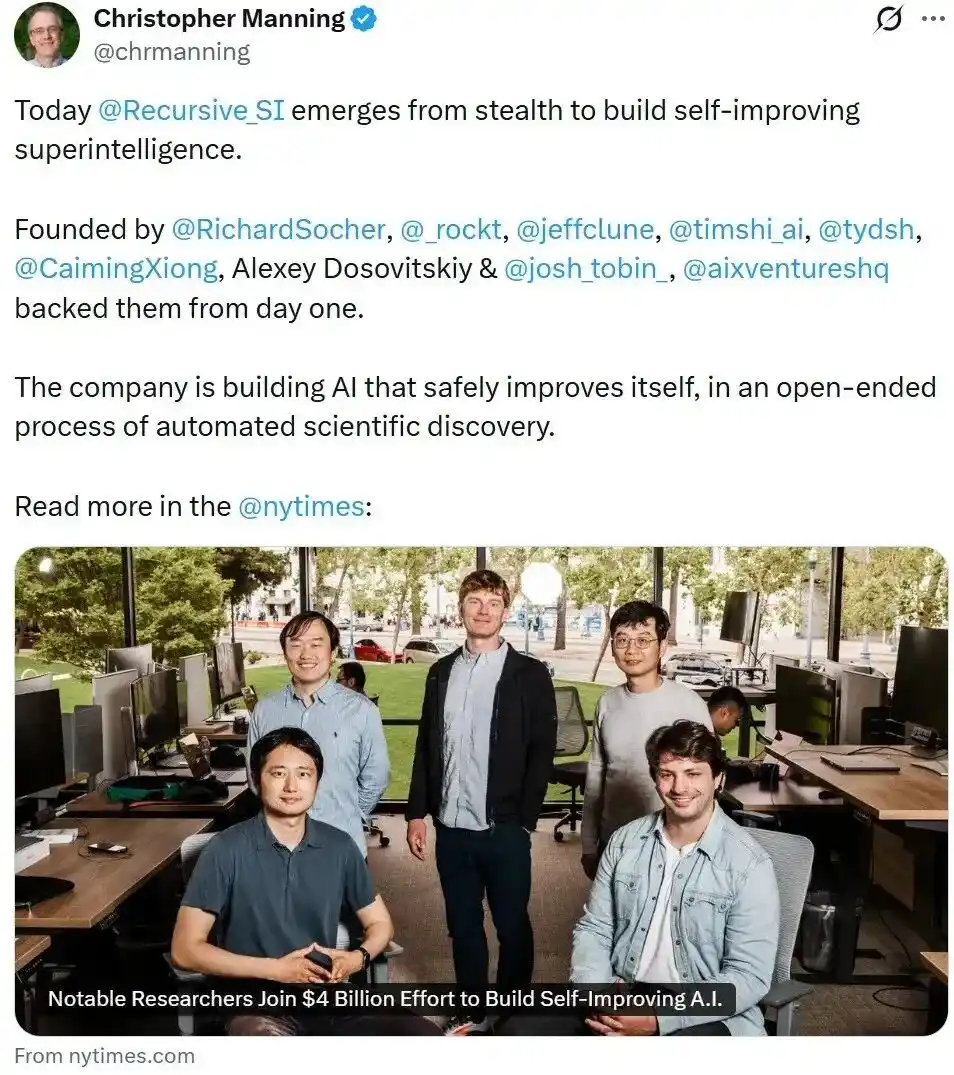
Richard Socher, Recursive CEO, former Chief Scientist at Salesforce.

Alexey Dosovitskiy, former Google DeepMind Research Scientist and first author of Vision Transformer, with over 160,000 Google Scholar citations.

Tim Rocktäschel, former DeepMind Principal Scientist and UCL AI Professor.

Peter Norvig, former Google Director of Research, co-author with Stuart Russell of the famous AI textbook "Artificial Intelligence: A Modern Approach."

Caiming Xiong, former VP of AI at Salesforce.

Tim Shi, former OpenAI researcher, co-founder and CTO of enterprise AI company Cresta.

Josh Tobin, Recursive CTO, former Research Lead at OpenAI and Uber ATG.

Jeff Clune, former VP of Research at Google DeepMind, Professor of Computer Science at the University of British Columbia, Canada.

Remarkably, this startup, without even having a public product yet, has already secured $650 million in funding with a valuation of $4.65 billion, led by GV (Google Ventures) and Greycroft, with follow-on investment from NVIDIA and AMD Ventures.

The company's core proposition directly corresponds to its name: building AI systems that can recursively enhance their own research capabilities, allowing AI to participate in and accelerate the R&D process of AI itself, ultimately forming a self-reinforcing closed loop.

For more details, refer to the report "After Leaving Meta, Tian Yuandong Just Announced His Startup."

Of course, Recursive is not alone in this arena. Yann LeCun's AMI Labs raised $1 billion in March this year, and David Silver's Ineffable Intelligence secured a $1.1 billion seed round in April, both pointing in a similar direction: enabling AI systems to autonomously generate knowledge and reduce human intervention in the research process. However, in terms of the pace of public achievements, Recursive's "First Steps" is likely one of the most concrete and reproducible technical demonstrations among similar companies to date.

The Dawn of the Recursive Paradigm

Placed within the broader industry context, Recursive's released achievement represents the preliminary realization of a new type of AI R&D paradigm: making the AI system itself the primary agent of research.

The core logic of this "recursive AI" is not complicated: AI enhances AI research capabilities, and the improved AI can then more effectively enhance itself, in a virtuous cycle. It does not rely on a single breakthrough, but on a system that continuously generates breakthroughs.

This approach has significant implications for the economics of AI research itself. The training pipelines for frontier models still heavily depend on a small number of researchers with specific skills, numbering no more than a few thousand globally. If automated research systems can take over even a portion of this work, both the speed and cost curve of AI progress will change.

This assessment also echoes other recent voices from the industry. For instance, Anthropic's "When AI Builds Itself" mentioned at the beginning of this article has a serious tone—it calls for industry coordination to have options to pause or temporarily halt frontier AI development when the moment of recursive self-improvement arrives, to allow time for societal structures and alignment research to catch up. For more details, see "AI Self-Evolution Too Fast, Anthropic Calls for Global Halt on R&D."
https://www.anthropic.com/institute/recursive-self-improvement

These two events happening simultaneously are thought-provoking. On one side, Anthropic is documenting and warning about the direction of this trajectory; on the other side, teams like Recursive are making step-by-step progress to turn this trajectory into reality.

Of course, Recursive itself acknowledges this is still the "first step": the current system works best in scenarios with clear metrics, rapid feedback, and detectable cheating. There is still considerable distance from autonomously advancing open scientific questions. Preventing reward hacking will be a core challenge on the path to scaling.

But a closed loop has begun to turn. The question now is simply how fast it will spin.

This article is from the WeChat public account "Machine Heart" (ID: almosthuman2014), author: Machine Heart in Recursive Evolution, editor: Panda


Domande pertinenti

QWhat is recursive self-improvement in AI, and why is it significant according to the article?

ARecursive self-improvement refers to AI systems autonomously designing, building, and training their own successor versions, reducing human intervention at every step. According to the article, this is significant because it points towards a future where AI progress could accelerate dramatically. As highlighted by Anthropic's data, AI (like Claude) is already writing most of their code and optimizing processes far beyond human efficiency, potentially leading to a self-reinforcing cycle of improvement that changes the economics and speed of AI development.

QWhat specific achievement did Recursive Superintelligence announce, and how does it work?

ARecursive Superintelligence announced its first public technical achievement: an open-ended automated knowledge discovery system for AI research. The system automates the traditional AI research loop of 'idea generation - coding - experimentation - analysis.' It works by autonomously proposing experimental ideas, implementing code, running validations, learning from results, and deciding the next search direction for a given optimization goal. It demonstrated this by achieving state-of-the-art results on three different benchmark tests.

QWhat are the three benchmark tests where Recursive's system achieved new records, and what were the key improvements?

A1. NanoChat Autoresearch: The system improved validation loss (BPB) by 0.0263 on a small model training task with a fixed 5-minute compute budget. A key improvement was a richer short-context memory mechanism using hashed bigram/trigram information in attention layers. 2. NanoGPT Speedrun: It reduced the training time to reach a target validation loss from 79.7 seconds to 77.5 seconds. Key improvements included FP8 precision in attention calculations, annealed exploration noise in the optimizer, and a more efficient fused MLP GPU kernel. 3. SOL-ExecBench: The system improved the overall score for GPU kernel optimization tasks from 0.699 to 0.754 (closing 18% of the gap to the hardware limit) by discovering and reusing optimization patterns across 235 different kernel tasks.

QWhy is the development of automated AI research systems like Recursive's considered a potential concern, as hinted by the article?

AThe development of automated AI research systems is a potential concern because it could lead to rapid, uncontrolled recursive self-improvement. As noted with Anthropic's warning, if AI systems become proficient at autonomously improving themselves, the pace of AI advancement could outstrip society's ability to develop safety measures, governance, and alignment research. This creates a risk scenario where highly capable AI emerges before adequate safeguards are in place, prompting calls for coordinated pauses in frontier AI development.

QWho are some of the notable founders and backers of Recursive Superintelligence mentioned in the article?

AThe notable founders include Tianyuan Dong (former Meta FAIR), Richard Socher (CEO, former Salesforce), Alexey Dosovitskiy (Vision Transformer co-author), Tim Rocktäschel (former DeepMind), Peter Norvig (co-author of 'Artificial Intelligence: A Modern Approach'), Caiming Xiong (former Salesforce AI VP), Tim Shi (former OpenAI), Josh Tobin (CTO, former OpenAI), and Jeff Clune (former Google DeepMind). The company raised $650 million in funding at a $4.65 billion valuation, led by GV (Google Ventures) and Greycroft, with participation from NVIDIA and AMD Ventures.

Letture associate

The Revelation from the Raydium Theft Incident: New DeFi Vulnerabilities Lurking in Forgotten Old Contracts

**Raydium Exploit Reveals DeFi's Hidden Risk: Forgotten "Zombie" Contracts** A recent attack on Raydium's deprecated V3 AMM pools resulted in a loss of approximately $1.34 million. The hacker exploited pools that were no longer supported by Raydium's current UI or SDK but remained fully functional and accessible on-chain. This incident highlights a critical, often overlooked category of risk in DeFi: inactive or legacy smart contracts that projects fail to properly decommission. Since March 2025, there have been at least 8 publicly reported attacks targeting such abandoned contracts, with total losses around $10.8 million. Including older pools and deprecated features, the count rises to 10 incidents with roughly $22.5 million in losses. These "zombie contracts" represent a lifecycle management failure rather than a code vulnerability, yet they are typically misclassified under general "code bug" categories in security reports, masking the true scale of the problem. The root cause is that projects often merely document a contract as "deprecated" without taking essential technical steps to secure it: withdrawing remaining assets, disabling external call functions, and implementing ongoing monitoring. These forgotten, under-monitored components become prime targets for attackers. To address this, the industry needs to recognize "zombie contracts" as a distinct risk category and establish standardized decommissioning protocols. Essential steps should include: 1) a formal retirement announcement, 2) removal of all front-end integrations, 3) withdrawal of locked assets, 4) disabling key contract functions, 5) ongoing security monitoring, 6) clear user communication, and 7) a post-mortem analysis. The value of a DeFi project lies not only in its current TVL but also in the security of its historical codebase, which has now become a new attack surface.

Foresight News1 h fa

The Revelation from the Raydium Theft Incident: New DeFi Vulnerabilities Lurking in Forgotten Old Contracts

Foresight News1 h fa

Robots Begin to 'Consume Data': The Hidden Production Chain from Indian Data Factories to Billion-Dollar Humanoid Robots

Robots have started to 'consume data,' driving the formation of a new industrial supply chain focused on producing training data for embodied AI. Unlike large language models, which are trained on vast internet text corpora, embodied AI models face a 'data desert' in the physical world. This has created a massive demand for first-person perspective video data (Ego Data), captured by workers wearing cameras in places like Indian garment factories. Companies like Neocambrian AI are establishing 'data factories' where workers perform standardized tasks (e.g., sorting clothes, kitchen organization) to generate thousands of hours of video. Research, such as NVIDIA's EgoScale, demonstrates that scaling this human demonstration data predictably improves robot performance, particularly for dexterous manipulation. This has validated a training path combining large-scale human data for pre-training with smaller amounts of robot-specific data for fine-tuning. The value of different data types varies significantly, forming a 'data pyramid.' The base consists of low-cost, large-scale internet and Ego Data. Higher layers include more expensive motion-capture data (e.g., from data gloves), simulation/synthetic data, and the most costly and scarce layer: real robot teleoperation data. This demand has spawned a layered ecosystem of data suppliers: low-cost data factories, motion capture and alignment specialists, robot-native teleoperation service providers, simulation data companies, and platforms aiming for data standardization. Robot companies themselves are adopting a 'layered procurement' strategy: outsourcing generic Ego Data while building in-house capabilities for robot-specific adaptation data and the critical deployment/failure data generated in real-world applications. The industry is shifting focus from hardware and basic mobility to the data pipelines required for general-purpose capability. While parallels exist to data labeling companies like Scale AI in the LLM boom, the physical complexity of robot data—involving action success ambiguity and sim-to-real gaps—requires more integrated solutions for data collection, annotation, and a continuous feedback loop. The race is on to build the data engines that will teach robots to operate reliably in the unstructured real world.

marsbit4 h fa

Robots Begin to 'Consume Data': The Hidden Production Chain from Indian Data Factories to Billion-Dollar Humanoid Robots

marsbit4 h fa

Spicy Commentary | Michael Saylor's 'Player Talk'; 60-Year-Old Aunt Liquidated After 'Scamming a Young Man'

**"Spicy Commentary": Three Tales of Crypto's Wild Week** This week's "Spicy Commentary" column highlights three dramatic stories from the cryptocurrency world. First, **MicroStrategy's Michael Saylor** addressed the controversy over his company potentially selling Bitcoin. At the BTC Prague event, he clarified, "I never said the company can't sell Bitcoin. I told *you* never to sell *your* Bitcoin." This "do as I say, not as I do" stance was criticized by netizens as peak linguistic gymnastics, noting a history of him previously stating the company would "never" sell. Second, a **bizarre fraud case** emerged from Beijing. A 60-year-old woman, obsessed with getting rich from crypto but unwilling to risk her own savings, posed online as the 20-something "god-daughter" of a high-ranking official. She catfished a young man, convincing him to give her over 200,000 yuan for fabricated emergencies. She then invested all the stolen money into cryptocurrency with 10x leverage, only to lose everything in a market crash. The woman was sentenced to four years in prison for fraud. Finally, a **sobering trader's tale** surfaced on Reddit. A user posted "Tale of a crypto trader," confessing their net worth had plummeted from a peak of $45 million to roughly $17,200, primarily due to holding meme coins too long. The post, described as a crypto "book of confessions," sparked reactions ranging from sympathy to critique about greed, poor risk management, and the perils of treating meme coins as long-term investments instead of taking profits. The column concludes that this week featured masterful rhetoric, elaborate scams, and extreme financial volatility, stitching together another chapter in crypto's unpredictable theater.

Foresight News4 h fa

Spicy Commentary | Michael Saylor's 'Player Talk'; 60-Year-Old Aunt Liquidated After 'Scamming a Young Man'

Foresight News4 h fa

Tremble Humans, AI Continues Its Accelerated Sprint

Trembling, Humans: AI Continues Its Accelerated Sprint Yes, AI is still rapidly accelerating. While deep learning seemed to stall quickly in its early years, large models after years of development show no sign of hitting their ceiling. At the Zhiyuan Conference 2026, the focus is on enabling AI to move from the digital world into the physical world. Scaling Law remains effective, continuing to drive advancements in both large language models and multimodal models. The industry is now entering a phase of pursuing World Models, though unresolved technical paths and data issues mean this exploration may take 3-5 more years. Concurrently, breakthroughs in Agents are accelerating AI's real-world application in fields like healthcare and meetings. Making Agents truly useful requires key hardware-software co-design, evident from the strong presence of chip vendors at the conference. We stand at a new historical threshold where AI is becoming a foundational force reshaping the world. The first day of the conference highlighted AI's evolution from "knowing how to chat" to "knowing how to work." Scaling Law persists, World Models are the next key battleground, and Agents are transitioning from usable to好用 (user-friendly). Scaling Law is not ending but diversifying. New models like Anthropic's Fable 5 demonstrate scaling through parameter size, synthetic data, and reinforcement learning. Advancements in AI Coding and Agent deployment are enabling a trend of AI self-evolution, potentially allowing AI to take over digital world iterations. World Models represent the next frontier for large models extending into the physical realm, but no current model is truly impressive at solving real-world problems. Technical consensus is lacking, with debates on data sources (video, simulation, real-world). Different approaches are emerging: language-centric, pixel-centric, 3D-structure-centric, and visual-representation-centric models. Zhiyuan Institute is exploring a fifth path: unified latent space modeling fusing language and visual representations, and introduced its own under-development World Model, Physis-v0.1. On the product side, Agents are key to bringing AI into daily life. Since 2025, the "Year of the Agent," products have become more proactive and capable of complex tasks. Zhiyuan showcased four vertical Agents for cardiac diagnosis, autonomous research, meeting summarization, and protein risk discovery. However, technical challenges remain, particularly in context engineering like memory and orchestration. "Harness" – the engineering framework around an Agent – is crucial for maximizing its capabilities by clarifying intent, designing workflows, and incorporating validation and feedback. In summary, AI's breakneck pace continues on multiple fronts: foundational model scaling, the ambitious pursuit of World Models for physical understanding, and the ongoing refinement of practical Agents. The journey from capable to truly reliable and useful AI systems is well underway.

marsbit4 h fa

Tremble Humans, AI Continues Its Accelerated Sprint

marsbit4 h fa

Trading

Spot
Futures

Articoli Popolari

Cosa è GROK AI

Grok AI: Rivoluzionare la Tecnologia Conversazionale nell'Era Web3 Introduzione Nel panorama in rapida evoluzione dell'intelligenza artificiale, Grok AI si distingue come un progetto notevole che collega i domini della tecnologia avanzata e dell'interazione con l'utente. Sviluppato da xAI, un'azienda guidata dal rinomato imprenditore Elon Musk, Grok AI cerca di ridefinire il modo in cui interagiamo con l'intelligenza artificiale. Mentre il movimento Web3 continua a prosperare, Grok AI mira a sfruttare il potere dell'IA conversazionale per rispondere a query complesse, offrendo agli utenti un'esperienza che è non solo informativa ma anche divertente. Cos'è Grok AI? Grok AI è un sofisticato chatbot di intelligenza artificiale conversazionale progettato per interagire dinamicamente con gli utenti. A differenza di molti sistemi di intelligenza artificiale tradizionali, Grok AI abbraccia un'ampia gamma di domande, comprese quelle tipicamente considerate inappropriate o al di fuori delle risposte standard. Gli obiettivi principali del progetto includono: Ragionamento Affidabile: Grok AI enfatizza il ragionamento di buon senso per fornire risposte logiche basate sulla comprensione contestuale. Supervisione Scalabile: L'integrazione dell'assistenza degli strumenti garantisce che le interazioni degli utenti siano sia monitorate che ottimizzate per la qualità. Verifica Formale: La sicurezza è fondamentale; Grok AI incorpora metodi di verifica formale per migliorare l'affidabilità delle sue uscite. Comprensione del Lungo Contesto: Il modello di IA eccelle nel trattenere e richiamare una vasta storia di conversazione, facilitando discussioni significative e consapevoli del contesto. Robustezza Adversariale: Concentrandosi sul miglioramento delle sue difese contro input manipolati o malevoli, Grok AI mira a mantenere l'integrità delle interazioni degli utenti. In sostanza, Grok AI non è solo un dispositivo di recupero informazioni; è un partner conversazionale immersivo che incoraggia un dialogo dinamico. Creatore di Grok AI Il cervello dietro Grok AI non è altri che Elon Musk, un individuo sinonimo di innovazione in vari campi, tra cui automotive, viaggi spaziali e tecnologia. Sotto l'egida di xAI, un'azienda focalizzata sull'avanzamento della tecnologia AI in modi benefici, la visione di Musk mira a rimodellare la comprensione delle interazioni con l'IA. La leadership e l'etica fondamentale sono profondamente influenzate dall'impegno di Musk nel superare i confini tecnologici. Investitori di Grok AI Sebbene i dettagli specifici riguardanti gli investitori che sostengono Grok AI rimangano limitati, è pubblicamente riconosciuto che xAI, l'incubatore del progetto, è fondato e supportato principalmente dallo stesso Elon Musk. Le precedenti imprese e partecipazioni di Musk forniscono un robusto sostegno, rafforzando ulteriormente la credibilità e il potenziale di crescita di Grok AI. Tuttavia, al momento, le informazioni riguardanti ulteriori fondazioni di investimento o organizzazioni che supportano Grok AI non sono facilmente accessibili, segnando un'area per potenziali esplorazioni future. Come Funziona Grok AI? Le meccaniche operative di Grok AI sono innovative quanto il suo framework concettuale. Il progetto integra diverse tecnologie all'avanguardia che facilitano le sue funzionalità uniche: Infrastruttura Robusta: Grok AI è costruito utilizzando Kubernetes per l'orchestrazione dei container, Rust per prestazioni e sicurezza, e JAX per il calcolo numerico ad alte prestazioni. Questo trio garantisce che il chatbot operi in modo efficiente, si scaldi efficacemente e serva gli utenti prontamente. Accesso alla Conoscenza in Tempo Reale: Una delle caratteristiche distintive di Grok AI è la sua capacità di attingere a dati in tempo reale attraverso la piattaforma X—precedentemente nota come Twitter. Questa capacità consente all'IA di accedere alle informazioni più recenti, permettendole di fornire risposte e raccomandazioni tempestive che altri modelli di IA potrebbero perdere. Due Modalità di Interazione: Grok AI offre agli utenti la scelta tra “Modalità Divertente” e “Modalità Normale”. La Modalità Divertente consente uno stile di interazione più giocoso e umoristico, mentre la Modalità Normale si concentra sulla fornitura di risposte precise e accurate. Questa versatilità garantisce un'esperienza su misura che soddisfa varie preferenze degli utenti. In sostanza, Grok AI sposa prestazioni con coinvolgimento, creando un'esperienza che è sia arricchente che divertente. Cronologia di Grok AI Il viaggio di Grok AI è segnato da traguardi fondamentali che riflettono le sue fasi di sviluppo e distribuzione: Sviluppo Iniziale: La fase fondamentale di Grok AI si è svolta in circa due mesi, durante i quali sono stati condotti l'addestramento iniziale e il perfezionamento del modello. Rilascio Beta di Grok-2: In un significativo avanzamento, è stata annunciata la beta di Grok-2. Questo rilascio ha introdotto due versioni del chatbot—Grok-2 e Grok-2 mini—ognuna dotata delle capacità per chattare, programmare e ragionare. Accesso Pubblico: Dopo lo sviluppo beta, Grok AI è diventato disponibile per gli utenti della piattaforma X. Coloro che hanno account verificati tramite un numero di telefono e attivi per almeno sette giorni possono accedere a una versione limitata, rendendo la tecnologia disponibile a un pubblico più ampio. Questa cronologia racchiude la crescita sistematica di Grok AI dall'inizio all'impegno pubblico, enfatizzando il suo impegno per il miglioramento continuo e l'interazione con gli utenti. Caratteristiche Chiave di Grok AI Grok AI comprende diverse caratteristiche chiave che contribuiscono alla sua identità innovativa: Integrazione della Conoscenza in Tempo Reale: L'accesso a informazioni attuali e rilevanti differenzia Grok AI da molti modelli statici, consentendo un'esperienza utente coinvolgente e accurata. Stili di Interazione Versatili: Offrendo modalità di interazione distinte, Grok AI soddisfa varie preferenze degli utenti, invitando alla creatività e alla personalizzazione nella conversazione con l'IA. Avanzata Struttura Tecnologica: L'utilizzo di Kubernetes, Rust e JAX fornisce al progetto un solido framework per garantire affidabilità e prestazioni ottimali. Considerazione del Discorso Etico: L'inclusione di una funzione di generazione di immagini mette in mostra lo spirito innovativo del progetto. Tuttavia, solleva anche considerazioni etiche riguardanti il copyright e la rappresentazione rispettosa di figure riconoscibili—una discussione in corso all'interno della comunità AI. Conclusione Come entità pionieristica nel campo dell'IA conversazionale, Grok AI incarna il potenziale per esperienze utente trasformative nell'era digitale. Sviluppato da xAI e guidato dall'approccio visionario di Elon Musk, Grok AI integra conoscenze in tempo reale con capacità di interazione avanzate. Si sforza di spingere i confini di ciò che l'intelligenza artificiale può realizzare, mantenendo un focus su considerazioni etiche e sicurezza degli utenti. Grok AI non solo incarna il progresso tecnologico, ma rappresenta anche un nuovo paradigma conversazionale nel panorama Web3, promettendo di coinvolgere gli utenti con sia conoscenze esperte che interazioni giocose. Man mano che il progetto continua a evolversi, si erge come testimonianza di ciò che l'incrocio tra tecnologia, creatività e interazione simile a quella umana può realizzare.

492 Totale visualizzazioniPubblicato il 2024.12.26Aggiornato il 2024.12.26

Cosa è GROK AI

Cosa è ERC AI

Euruka Tech: Una Panoramica di $erc ai e delle sue Ambizioni in Web3 Introduzione Nel panorama in rapida evoluzione della tecnologia blockchain e delle applicazioni decentralizzate, nuovi progetti emergono frequentemente, ciascuno con obiettivi e metodologie uniche. Uno di questi progetti è Euruka Tech, che opera nel vasto dominio delle criptovalute e del Web3. L'obiettivo principale di Euruka Tech, in particolare del suo token $erc ai, è presentare soluzioni innovative progettate per sfruttare le crescenti capacità della tecnologia decentralizzata. Questo articolo si propone di fornire una panoramica completa di Euruka Tech, un'esplorazione dei suoi obiettivi, della funzionalità, dell'identità del suo creatore, dei potenziali investitori e della sua importanza nel contesto più ampio del Web3. Cos'è Euruka Tech, $erc ai? Euruka Tech è caratterizzato come un progetto che sfrutta gli strumenti e le funzionalità offerte dall'ambiente Web3, concentrandosi sull'integrazione dell'intelligenza artificiale nelle sue operazioni. Sebbene i dettagli specifici sul framework del progetto siano piuttosto sfuggenti, è progettato per migliorare l'engagement degli utenti e automatizzare i processi nello spazio crypto. Il progetto mira a creare un ecosistema decentralizzato che non solo faciliti le transazioni, ma incorpori anche funzionalità predittive attraverso l'intelligenza artificiale, da cui il nome del suo token, $erc ai. L'obiettivo è fornire una piattaforma intuitiva che faciliti interazioni più intelligenti e un'elaborazione delle transazioni più efficiente all'interno della crescente sfera del Web3. Chi è il Creatore di Euruka Tech, $erc ai? Attualmente, le informazioni riguardanti il creatore o il team fondatore di Euruka Tech rimangono non specificate e piuttosto opache. Questa assenza di dati solleva preoccupazioni, poiché la conoscenza del background del team è spesso essenziale per stabilire credibilità nel settore blockchain. Pertanto, abbiamo classificato queste informazioni come sconosciute fino a quando dettagli concreti non saranno resi disponibili nel dominio pubblico. Chi sono gli Investitori di Euruka Tech, $erc ai? Allo stesso modo, l'identificazione degli investitori o delle organizzazioni di supporto per il progetto Euruka Tech non è prontamente fornita attraverso la ricerca disponibile. Un aspetto cruciale per i potenziali stakeholder o utenti che considerano di impegnarsi con Euruka Tech è la garanzia che deriva da partnership finanziarie consolidate o dal supporto di società di investimento rispettabili. Senza divulgazioni sulle affiliazioni di investimento, è difficile trarre conclusioni complete sulla sicurezza finanziaria o sulla longevità del progetto. In linea con le informazioni trovate, anche questa sezione rimane allo stato di sconosciuto. Come funziona Euruka Tech, $erc ai? Nonostante la mancanza di specifiche tecniche dettagliate per Euruka Tech, è essenziale considerare le sue ambizioni innovative. Il progetto cerca di sfruttare la potenza computazionale dell'intelligenza artificiale per automatizzare e migliorare l'esperienza dell'utente all'interno dell'ambiente delle criptovalute. Integrando l'IA con la tecnologia blockchain, Euruka Tech mira a fornire funzionalità come operazioni automatizzate, valutazioni del rischio e interfacce utente personalizzate. L'essenza innovativa di Euruka Tech risiede nel suo obiettivo di creare una connessione fluida tra gli utenti e le vaste possibilità presentate dalle reti decentralizzate. Attraverso l'utilizzo di algoritmi di apprendimento automatico e IA, mira a ridurre le sfide degli utenti alle prime armi e semplificare le esperienze transazionali all'interno del framework Web3. Questa simbiosi tra IA e blockchain sottolinea l'importanza del token $erc ai, fungendo da ponte tra le interfacce utente tradizionali e le avanzate capacità delle tecnologie decentralizzate. Cronologia di Euruka Tech, $erc ai Sfortunatamente, a causa delle limitate informazioni disponibili riguardo a Euruka Tech, non siamo in grado di presentare una cronologia dettagliata dei principali sviluppi o traguardi nel percorso del progetto. Questa cronologia, tipicamente preziosa per tracciare l'evoluzione di un progetto e comprendere la sua traiettoria di crescita, non è attualmente disponibile. Man mano che le informazioni su eventi notevoli, partnership o aggiunte funzionali diventano evidenti, gli aggiornamenti miglioreranno sicuramente la visibilità di Euruka Tech nella sfera crypto. Chiarimento su Altri Progetti “Eureka” È importante sottolineare che più progetti e aziende condividono una nomenclatura simile con “Eureka.” La ricerca ha identificato iniziative come un agente IA della NVIDIA Research, che si concentra sull'insegnamento ai robot di compiti complessi utilizzando metodi generativi, così come Eureka Labs ed Eureka AI, che migliorano l'esperienza utente nell'istruzione e nell'analisi del servizio clienti, rispettivamente. Tuttavia, questi progetti sono distinti da Euruka Tech e non dovrebbero essere confusi con i suoi obiettivi o funzionalità. Conclusione Euruka Tech, insieme al suo token $erc ai, rappresenta un attore promettente ma attualmente oscuro nel panorama del Web3. Sebbene i dettagli sul suo creatore e sugli investitori rimangano non divulgati, l'ambizione centrale di combinare intelligenza artificiale e tecnologia blockchain si erge come un punto focale di interesse. Gli approcci unici del progetto nel promuovere l'engagement degli utenti attraverso l'automazione avanzata potrebbero distinguerlo mentre l'ecosistema Web3 progredisce. Con l'evoluzione continua del mercato crypto, gli stakeholder dovrebbero tenere d'occhio gli sviluppi riguardanti Euruka Tech, poiché lo sviluppo di innovazioni documentate, partnership o una roadmap definita potrebbe presentare opportunità significative nel prossimo futuro. Così com'è, attendiamo ulteriori approfondimenti sostanziali che potrebbero svelare il potenziale di Euruka Tech e la sua posizione nel competitivo panorama crypto.

513 Totale visualizzazioniPubblicato il 2025.01.02Aggiornato il 2025.01.02

Cosa è ERC AI

Cosa è DUOLINGO AI

DUOLINGO AI: Integrare l'apprendimento delle lingue con Web3 e innovazione AI In un'era in cui la tecnologia rimodella l'istruzione, l'integrazione dell'intelligenza artificiale (AI) e delle reti blockchain annuncia una nuova frontiera per l'apprendimento delle lingue. Entra in scena DUOLINGO AI e la sua criptovaluta associata, $DUOLINGO AI. Questo progetto aspira a fondere la potenza educativa delle principali piattaforme di apprendimento delle lingue con i benefici della tecnologia decentralizzata Web3. Questo articolo esplora gli aspetti chiave di DUOLINGO AI, esaminando i suoi obiettivi, il framework tecnologico, lo sviluppo storico e il potenziale futuro, mantenendo chiarezza tra la risorsa educativa originale e questa iniziativa indipendente di criptovaluta. Panoramica di DUOLINGO AI Alla sua base, DUOLINGO AI cerca di stabilire un ambiente decentralizzato in cui gli studenti possono guadagnare ricompense crittografiche per il raggiungimento di traguardi educativi nella competenza linguistica. Applicando smart contracts, il progetto mira ad automatizzare i processi di verifica delle competenze e le allocazioni di token, aderendo ai principi di Web3 che enfatizzano la trasparenza e la proprietà da parte degli utenti. Il modello si discosta dagli approcci tradizionali all'acquisizione linguistica, facendo forte affidamento su una struttura di governance guidata dalla comunità, che consente ai detentori di token di suggerire miglioramenti ai contenuti dei corsi e alle distribuzioni delle ricompense. Alcuni degli obiettivi notevoli di DUOLINGO AI includono: Apprendimento Gamificato: Il progetto integra traguardi blockchain e token non fungibili (NFT) per rappresentare i livelli di competenza linguistica, promuovendo la motivazione attraverso ricompense digitali coinvolgenti. Creazione di Contenuti Decentralizzati: Apre opportunità per educatori e appassionati di lingue di contribuire con i propri corsi, facilitando un modello di condivisione dei ricavi che beneficia tutti i collaboratori. Personalizzazione Guidata dall'AI: Utilizzando modelli avanzati di machine learning, DUOLINGO AI personalizza le lezioni per adattarsi ai progressi individuali, simile alle funzionalità adattive presenti nelle piattaforme consolidate. Creatori del Progetto e Governance A partire da aprile 2025, il team dietro $DUOLINGO AI rimane pseudonimo, una pratica comune nel panorama decentralizzato delle criptovalute. Questa anonimato è inteso a promuovere la crescita collettiva e il coinvolgimento degli stakeholder piuttosto che concentrarsi su sviluppatori individuali. Lo smart contract distribuito sulla blockchain di Solana annota l'indirizzo del wallet dello sviluppatore, che segna l'impegno verso la trasparenza riguardo alle transazioni, nonostante l'identità dei creatori sia sconosciuta. Secondo la sua roadmap, DUOLINGO AI mira a evolversi in un'Organizzazione Autonoma Decentralizzata (DAO). Questa struttura di governance consente ai detentori di token di votare su questioni critiche come l'implementazione di funzionalità e le allocazioni del tesoro. Questo modello si allinea con l'etica dell'empowerment della comunità presente in varie applicazioni decentralizzate, enfatizzando l'importanza del processo decisionale collettivo. Investitori e Partnership Strategiche Attualmente, non ci sono investitori istituzionali o capitalisti di rischio identificabili pubblicamente legati a $DUOLINGO AI. Invece, la liquidità del progetto proviene principalmente da scambi decentralizzati (DEX), segnando un netto contrasto con le strategie di finanziamento delle aziende tradizionali di tecnologia educativa. Questo modello di base indica un approccio guidato dalla comunità, riflettendo l'impegno del progetto verso la decentralizzazione. Nel suo whitepaper, DUOLINGO AI menziona la formazione di collaborazioni con “piattaforme educative blockchain” non specificate, mirate ad arricchire la sua offerta di corsi. Sebbene partnership specifiche non siano ancora state divulgate, questi sforzi collaborativi suggeriscono una strategia per mescolare innovazione blockchain con iniziative educative, ampliando l'accesso e il coinvolgimento degli utenti attraverso diverse vie di apprendimento. Architettura Tecnologica Integrazione AI DUOLINGO AI incorpora due componenti principali guidate dall'AI per migliorare la sua offerta educativa: Motore di Apprendimento Adattivo: Questo sofisticato motore apprende dalle interazioni degli utenti, simile ai modelli proprietari delle principali piattaforme educative. Regola dinamicamente la difficoltà delle lezioni per affrontare le sfide specifiche degli studenti, rinforzando le aree deboli attraverso esercizi mirati. Agenti Conversazionali: Utilizzando chatbot alimentati da GPT-4, DUOLINGO AI offre una piattaforma per gli utenti per impegnarsi in conversazioni simulate, promuovendo un'esperienza di apprendimento linguistico più interattiva e pratica. Infrastruttura Blockchain Costruito sulla blockchain di Solana, $DUOLINGO AI utilizza un framework tecnologico completo che include: Smart Contracts per la Verifica delle Competenze: Questa funzionalità assegna automaticamente token agli utenti che superano con successo i test di competenza, rinforzando la struttura di incentivi per risultati di apprendimento genuini. Badge NFT: Questi token digitali significano vari traguardi che gli studenti raggiungono, come completare una sezione del loro corso o padroneggiare competenze specifiche, consentendo loro di scambiare o mostrare digitalmente i loro successi. Governance DAO: I membri della comunità dotati di token possono partecipare alla governance votando su proposte chiave, facilitando una cultura partecipativa che incoraggia l'innovazione nell'offerta di corsi e nelle funzionalità della piattaforma. Cronologia Storica 2022–2023: Concettualizzazione I lavori per DUOLINGO AI iniziano con la creazione di un whitepaper, evidenziando la sinergia tra i progressi dell'AI nell'apprendimento delle lingue e il potenziale decentralizzato della tecnologia blockchain. 2024: Lancio Beta Un lancio beta limitato introduce offerte in lingue popolari, premiando i primi utenti con incentivi in token come parte della strategia di coinvolgimento della comunità del progetto. 2025: Transizione DAO Ad aprile, avviene un lancio completo della mainnet con la circolazione di token, stimolando discussioni nella comunità riguardo a possibili espansioni nelle lingue asiatiche e ad altri sviluppi dei corsi. Sfide e Direzioni Future Ostacoli Tecnici Nonostante i suoi obiettivi ambiziosi, DUOLINGO AI affronta sfide significative. La scalabilità rimane una preoccupazione costante, in particolare nel bilanciare i costi associati all'elaborazione dell'AI e nel mantenere una rete decentralizzata reattiva. Inoltre, garantire la creazione e la moderazione di contenuti di qualità in un'offerta decentralizzata presenta complessità nel mantenere standard educativi. Opportunità Strategiche Guardando al futuro, DUOLINGO AI ha il potenziale per sfruttare partnership di micro-credentialing con istituzioni accademiche, fornendo validazioni verificate dalla blockchain delle competenze linguistiche. Inoltre, l'espansione cross-chain potrebbe consentire al progetto di attingere a basi utenti più ampie e a ulteriori ecosistemi blockchain, migliorando la sua interoperabilità e portata. Conclusione DUOLINGO AI rappresenta una fusione innovativa di intelligenza artificiale e tecnologia blockchain, presentando un'alternativa focalizzata sulla comunità ai sistemi tradizionali di apprendimento delle lingue. Sebbene il suo sviluppo pseudonimo e il modello economico emergente comportino alcuni rischi, l'impegno del progetto verso l'apprendimento gamificato, l'istruzione personalizzata e la governance decentralizzata illumina un percorso per la tecnologia educativa nel regno di Web3. Man mano che l'AI continua a progredire e l'ecosistema blockchain evolve, iniziative come DUOLINGO AI potrebbero ridefinire il modo in cui gli utenti interagiscono con l'istruzione linguistica, potenziando le comunità e premiando il coinvolgimento attraverso meccanismi di apprendimento innovativi.

466 Totale visualizzazioniPubblicato il 2025.04.11Aggiornato il 2025.04.11

Cosa è DUOLINGO AI

Discussioni

Benvenuto nella Community HTX. Qui puoi rimanere informato sugli ultimi sviluppi della piattaforma e accedere ad approfondimenti esperti sul mercato. Le opinioni degli utenti sul prezzo di AI AI sono presentate come di seguito.

活动图片